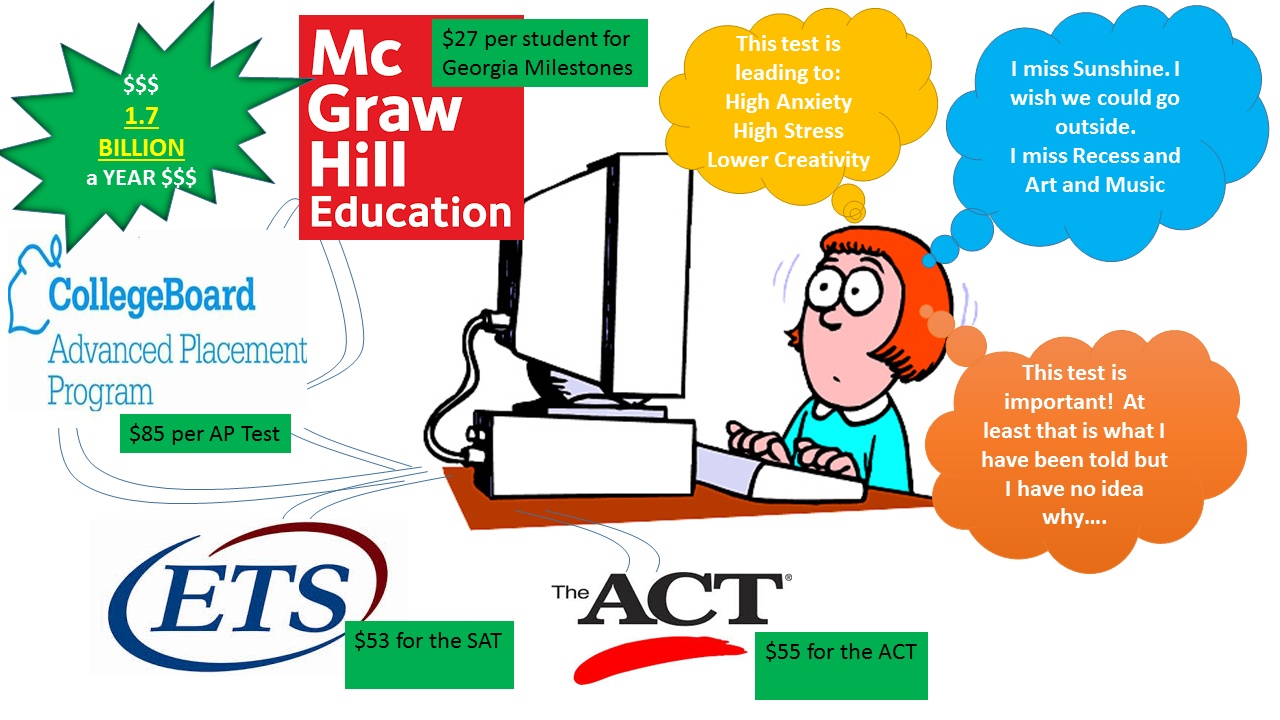
Latest News and Comment from Education

Sunday, October 30, 2016

Teachers union head says Donald Trump would decimate public education - Florida Politics

Teachers union head says Donald Trump would decimate public education - Florida Politics:

Teachers union head says Donald Trump would decimate public education


The 2016 presidential race has been devoid of substantive public policy on a lot of issues, more more so than regarding public education. That’s not the fault of Hillary Clinton, insists one of her top surrogates, Randi Weingarten, the head of the American Federation of Teachers.
“I think Hillary has tried to raise the issue of education several times in the last debate,” Weingarten told FloridaPolitics.com early Sunday morning. “She talked about the Trump effect during the second debate. I think that the questions haven’t been asked in the debates, and the three or four speeches she’s given on it haven’t been covered.”
During the second debate, Clinton did talk about the effect that some of Donald Trump’s rhetoric on kids, saying,”Children listen to what is being said. And there’s a lot of fear. In fact, teachers and parents are calling it the Trump effect. Bullying is up. A lot of people are feeling uneasy. A lot of kids are expressing their concerns.”
“We’ve seen situations where kids come from school and say, ‘I’m really scared they’re going to deport my mother or my father, or kids on a playground saying, ‘Build a wall, or,’you’re going back to Mexico,'” Weingarten says. “It is just shocking the way in which his hate, his spewing of hate and insults have now unleashed it in children.”
Weingarten was in the Tampa Bay area for three separate events on Sunday to campaign for Clinton. Her American Federation of Teachers was the first national labor union to make a presidential endorsement in the 2016 cycle this past summer.
Weingarten has been critical of Trump’s $20 billion voucher proposal, which would use federal funds to create state-run block grants allowing students to enroll in private and charter schools. Weingarten says it will take away federal funds for low-income students, in particular, and she says it will eviscerate the public school system in America.
“It’s simpy a transfer of money that goes to poor kids that are taught in a public system to unregulated, unaccountable private schools, and so call it what it is,” she dramatically . “The decimation of public education.”
Weingarten is a New York City native who began working for the United Federation of Teachers thirty years ago. She questions Trump’s sincerity when it comes to wanting to improve public education.
“Donald Trump  has never shown any connection to public schools that I have seen,” she says. “I worked in New York City for many years. I was the president of the teachers union for 12 years, I worked for the UFT for about 20 years, I never ever ever saw Donald Trump at any civic activity connected to children, and I was at many events, and so there’s no care about kids, and you can see that from both the exploitation at Trump University and the fighting off of the fraud cases now, and just the total morally bankrupt proposal to take $20 billion that goes to poor kids and special needs kids.”Teachers union head says Donald Trump would decimate public education - Florida Politics:


Issues Matter – With a week to go, a last request for financial support - Wait What?

Issues Matter – With a week to go, a last request for financial support - Wait What?:

Issues Matter – With a week to go, a last request for financial support


As the Norwich Bulletin wrote yesterday,
Pelto – advocates for a more progressive tax code that borrows heavily from Sen. Bernie Sanders’ plan, which would raise taxes on the rich and close many corporate loopholes. A longtime education advocate, Pelto also opposes what he views as oppressive federal oversight in public education. – Norwich Bulletin October 29, 2016
As the Green Party candidate for Congress in the 2nd Congressional District, I set out to ensure that this campaign engaged voters on a variety of vital issues including the need to adopt a fair system of taxation and putting an end to the dangerous and devastating impact of privatizing public education in this country.
At a variety of candidate debates and political events, I’ve worked to speak out about the very real problems and challenges that face our communities, our state and the nation.  I’m proud to report that these efforts have had a positive impact, especially when it comes to our historic effort to protect our students, parents, teachers and public schools from those who seek to turn public education into nothing more than profit centers for the charter school industry and their allies in the corporate education reform industry.
All of the candidates running in the 2nd Congressional District, including the incumbent, Congressman Joe Courtney, have pledged to blunt those who favor testing over teaching and are pushing the regressive elements of the corporate education reform agenda.
In addition to the debates, Pelto 2016 campaign mailings and other voter outreach activities are providing additional opportunity to educate, persuade and mobilize people to step up and speak out on the serious problems that are undermining the wellbeing of our society.
With Election Day only a week away, we continue to implement a voter contact program designed to promote a major turnout on Election Day.
Your financial support would be extremely helpful as we strive to pay the remaining bills.  Please consider making a donation to Pelto 2016.  It is quick and easy and the funds you provide will have a big impact on our ability to successfully implement our campaign strategy.
You can donate to Pelto 2016 on line by clicking on Pelto for Congress 2016 orhttps://pelto2016-ectgreens.nationbuilder.com/donate
Alternatively, print off and send the following form with your check to Pelto 2016, PO Box 400, Storrs, CT. 06268
Thank you so much,


Pelto For Congress | Connecticut 2nd District – Green Party - http://wp.me/P7H2vZ-2


Exam stress among the young: When grades define worth, Singapore News & Top Stories - The Straits Times

Exam stress among the young: When grades define worth, Singapore News & Top Stories - The Straits Times:

Exam stress among the young: When grades define worth

The obsession with grades and exams can take its toll on children. Amelia Teng speaks to experts and shines the light on the pressures children face and what parents can do to ease their burden.

Image result for Exam stress among the young: When grades define worth


One counsellor recalled how a 13-year-old girl scored 83 marks in mathematics but was scolded by her mother for being careless on one of the questions.
"Her mother told her that she could have scored above 85 had she been more careful," said Ms Lena Teo, deputy director of therapy and mental wellness services at the Children-At-Risk Empowerment Association Singapore. The girl was referred to her because of anxiety, depression and self-harm.
Then, there was a mother who made her son retake the Primary School Leaving Examinations (PSLE), even though he had passed the first time. "I was shocked," said Dr Carol Balhetchet, senior director for youth services at the Singapore Children's Society.
"I couldn't understand why a parent would put her child through another year of primary school for better grades."
The obsession among some parents for grades and exams is putting undue stress on young children here - an issue that has come under the spotlight after a Primary 5 pupil fell to his death. According to a coroner's inquiry last week, the boy had seemed afraid of showing his mid-term exam grades, having failed Higher Chinese and mathematics, to his parents.
Parents here have described the episode as a wake-up call, with many admitting it has forced them to rethink how much pressure they put on their young children to do well academically - sometimes without even realising it.
BEYOND GRADES
It's not just about academics, but they just want to see their parents happy for who and what they are... There is more understanding across schools that children have to be measured more holistically, but some old structures like grading and assessment haven't changed.
DR CAROL BALHETCHET, senior director for youth services at the Singapore Children's Society.
More than As and Bs on a report card, it is the expression on their parents' faces when they read it that often matters most to children, added experts.
A parent's show of approval, disappointment or anger are signs of affirmation and acceptance, or otherwise, for young children. "Children just want to see their parents happy for who and what they are," said Dr Balhetchet.
Latest figures show that last year, there were 27 suicides among 10- to 19-year-olds - a 15-year high. This was double the 2014 figure, despite a drop in the overall number of suicides.
Young suicides have also been on the rise elsewhere - in Britain, 201 young people in the same age group of 10 to 19 had killed themselves in 2014, up from 179 in 2013.
A recent investigation by the University of Manchester of 130 teen suicides also showed that more than a quarter of them had experienced exam stress or other academic pressures.
The worry, counsellors here said, is that parents sometimes do not realise that by harping on grades, young children's sense of self-worth ends up being defined by how well they do in school. Even the "reminder" that if the child does not do well in school, he could end up with a poor job in the future can add pressure.
Families today also have fewer children, counsellors pointed out. And that means that children not only have fewer siblings to confide in, they also end up having greater expectations placed on them.
Said Madam Madelin Tay from Family Central, a service by Fei Yue Community Services: "With fewer kids, parents can afford better resources and surely want the best for their kids. So it may be intentional or unintentional that they want to see results after investing their time and money."
And not just when they enter primary school.
Housewife Nadia Ng, 28, who has a four-year-old boy and 2½-year-old girl, said: "Even in pre-school, other parents ask me if I send my son for enrichment classes, but I don't see a need because he's so young."
The Ministry of Education has, in recent years, taken steps to reduce the overemphasis on academic marks, by not naming the top scorers of national examinations and investing more in programmes to nurture students' strengths in other areas, such as sports or music.
The PSLE T-score - often criticised for causing excessive stress - will also be done away with in 2021, and pupils will no longer be graded relative to their peers.
Mr Bimal Rai, an educational psychologist from Reach Therapy Services, said he sees more efforts to help academically weaker students through schools like Crest Secondary. "The good thing is that there are multiple pathways in the education system today."
But parents do not buy into this as well - that learning is a lifelong journey.
"There is more understanding across schools that children have to be measured more holistically, but some old structures like grading and assessment haven't changed," said Dr Balhetchet.
Mr Brian Poh, a clinical psychologist from the Institute of Mental Health's department of child and adolescent psychiatry, said that children also have other pressures to deal with. These include friendship issues, bullying, sibling rivalry and difficulties with school authorities, he added.
While some children can cope, counsellors said that others may struggle and later develop socio-emotional problems such as anxiety, extreme mood swings or even withdrawal from social circles.
The Primary 5 boy's death has seen some parents relook their own behaviour.
Housewife Karen Chen, a 34-year-old mother of three, said: "Education seems like a rat race, and it does seem that kids are under more pressures today. The recent tragedy is a wake-up call for all parents to evaluate ourselves and how we help our kids manage stress."
Madam Christine Lim, 39, a part-time recruiter who has a son in Primary 2 and daughter in Primary 6, said: "As long as they try their best, I can accept any grade.
"Sometimes I scold them for making careless mistakes or I may threaten to not take them on holidays, but I've never hit them for bad results."
Mrs Tan Kee Leng said she was more careful with her words during the lead-up to her son's Primary PSLE this year.
"He started to get more stressed and couldn't sleep very well," said the 42-year-old who works in a pharmaceutical company.
"Instead of asking him what's the highest mark or how his friends did... we told him we would accept his results and we would move on no matter what."Exam stress among the young: When grades define worth, Singapore News & Top Stories - The Straits Times:
A version of this article appeared in the print edition of The Sunday Times on October 30, 2016, with the headline 'When grades define worth'. Print Edition | SubscribeExam stress among the young: When grades define worth, Singapore News & Top Stories - The Straits Times:

New York Times Endorses Zephyr Teachout | Diane Ravitch's blog

New York Times Endorses Zephyr Teachout | Diane Ravitch's blog:

New York Times Endorses Zephyr Teachout


Good news for Zephyr Teachout!
She received the endorsement of the News York Times!
From the New York Times’ endorsement of Zephyr Teachout:
“In the sprawling 19th District, in the Hudson Valley and Catskills, Zephyr Teachout, a Democrat, is running against John Faso, a Republican who was the Assembly minority leader. Ms. Teachout, a Fordham law professor and author, is an expert on political corruption and the corrosive influence of money in politics. She gained national attention as a political novice for her surprisingly potent bid to unseat Gov. Andrew Cuomo in the 2014 Democratic primary. Her campaign is focused on fighting corporate monopolies and dirty money, protecting the environment and cutting red tape for small businesses and farms. Senator Bernie Sanders of Vermont, a kindred spirit, has endorsed her.
“Mr. Faso, well known and respected in this district, has a lifetime ‘A’ rating from the National Rifle Association. He wants to support the local economy by speeding up environmental reviews of big projects and cutting corporate taxes. Mr. Faso says he disagrees with Mr. Trump on several issues but refuses to say whether or not he will vote for him. Ms. Teachout is the better candidate for this era of gridlock and disillusionment. She promises to be the strong voice for change in Washington that so many angry voters are demanding.”New York Times Endorses Zephyr Teachout | Diane Ravitch's blog:
Zephyr Teachout for Congress | - http://www.zephyrteachoutforcongress.com/

Image result for Zephyr Teachout!


Zephyr Teachout for Congress | - http://www.zephyrteachoutforcongress.com/

CURMUDGUCATION: ICYMI: Catching Up with Reading (10/30)

CURMUDGUCATION: ICYMI: Catching Up with Reading (10/30):

ICYMI: Catching Up with Reading (10/30)


I've been home for about a week and I am just about back up to speed. There's a lot to read this time around. As always, I encourage you to share wildly whatever you like here. 

What Are the Main Reasons Teachers Call It Quits

NPR takes a look at why some folks are getting out of the teaching biz. No surprises here, but nice to see NPR catching on

LA Unified Takes a Hard Look at Charter Schools

Charters have taken it on the chin in LA, and there's a definite shift in attitude there.

A Public Education

Friend of this blog Phyllis Bush ran an op-ed this week that gets to the heart of what does and does not make a public education.

State-Run Kids: Suleika's Story

Here's a moving story of what the charter mess in New Jersey looks like to the families and children of the city.

Black Children Deserve the Stability That Neighborhood Schools Offer

Andre Perry absolutely nails it in discussing one of the worst effects of charter schools-- the loss of a stabilizing institutions for a community

What I Miss

Friend of this blog Mary Holden (it's nice to have all these friends) has been writing an honest and personal account of her departure from the classroom. Here's her look back at what she misses.

King of the Castle

Jennifer Berkshire (Edushyster) takes a look at the infamous Massachusetts charter that makes its teachers pay to leave.

Wall Street Firms Make Money from Pension Funds, Spend It On Charters

Actual reporter (you know-- the old fashioned type who actually goes out and finds thing out) David Sirota reports the maddening but predictable news that public teacher pension funds are helping fund the attack on public education.

The Vivisection of Literature

Another examination of how the study of literature has been beaten up in the rush to High Standards

The Absurd Defense of Standards Post-Common Core

Jane Robbins takes a quick look at how some folks are in a Kentucky spitting match over the Core

NAACP President: Why We Should Pause the Expansion of Charter Schools

Since they made the charteristas all sad, the NAACP has had lots of folks trying to tell them what happened, why it happened, and what they should really do. Here's the president of NAACP to explain what they did and why they did it. 


PA: State Rep Compares School Boards to Hitler
Brad Roae is running for re-election for the PA House of Representatives for District 6. First elected in 2006, Roae has had some interesting things to say about education in Pennsylvania. Hitler blamed the Jews for everything that 


Big Education Ape: Catch up with CURMUDGUCATION: How (Not) To Grade Schools + GA: Ed Consultant Slams Takeover Amendment - http://bigeducationape.blogspot.com/2016/10/catch-up-with-curmudgucation-how-not-to.html


The Attack on Teachers Goes to College | Seattle Education

The Attack on Teachers Goes to College | Seattle Education:

The Attack on Teachers Goes to College

liu2
The Attack on Teachers Goes to College
The dramatic lockout of faculty at Long Island University in Brooklyn this fall brought home the reality that what is happening in higher education is closely related to the attack on education in our K-12 public schools.
On August 31, 2016 the contract between the faculty on the Brooklyn campus and Long Island University (LIU) was due to expire. The negotiating team was told on that day if they did not accept the contract, faculty would be locked out.
The faculty members turned down the contract offer but did not vote to strike. In response, LIU cut off professors’ email accounts and health insurance. The professors were locked out of their classrooms and told they would be replaced. If faculty members went into the university buildings where their offices and classrooms were, they were told they could be criminally charged for trespassing.
Some of those faculty members had been teaching at LIU for twenty or thirty years.
As I listened to some of them express their shock at being treated so poorly to Amy Goodman on Democracy Now!, I was reminded of what I have heard K-12 teachers in schools across the country say about endless budget cuts, union-busting, and the threat of being replaced by less-skilled (and cheaper) employees.
One of the issues of concern in the LIU contract was a two-tier wage system that would The Attack on Teachers Goes to College | Seattle Education:


Russ on Reading: Independent Reading: One Key to Balanced Literacy Instruction

Russ on Reading: Independent Reading: One Key to Balanced Literacy Instruction:

Independent Reading: One Key to Balanced Literacy Instruction


 Two weeks ago I posted a research-based response to literacy commentator Tim Shanahan's continuing dismissal of Independent Reading. The post prompted a twitter exchange with Dr. Shanahan in which he questioned the research and I reiterated the broad based support for Independent Reading that I found among literacy experts. The exchange ended with this tweet.


Ignoring for a moment that "fair and balanced" is the slogan of Fox News, I would like to address how Independent Reading is, indeed, a part of a balanced approach to literacy instruction. You can judge who is being fair to kids.

Since its introduction in 1983, Pearson and Gallagher's gradual release of responsibility model has been the gold standard for teaching complex reading strategies. The gradual release model calls for instruction to be organized around four experiences to ensure student learning: explicit description of the strategy, teacher modeling of the strategy, teacher and student collaboration and guided practice in using the strategy, and independent use of the strategy. This model informs much of the current 
Russ on Reading: Independent Reading: One Key to Balanced Literacy Instruction:

Florida Teacher Faces Dismissal Over Computerized Music Testing | deutsch29

Florida Teacher Faces Dismissal Over Computerized Music Testing | deutsch29:

Florida Teacher Faces Dismissal Over Computerized Music Testing

Image result for big education ape well rounded

In Florida, music teachers must administer computerized tests to assess themselves.
It is a setup.
If students have difficulty with signing onto the computer, or with submitting a response, the teacher assisting these students could be accused of cheating.
It’s called “zero tolerance.”
On October 28, 2016, the Tampa Bay Times published a story about a music teacher who was accused of cheating on the computerized test designed to test her.
Never mind that the outcome of the test was terrible. Zero tolerance.
Never mind that using computerized tests to determine fine arts outcomes is imbecilic on its face. The State of Florida wants to test all teachers in their subject areas, and the narrow, unrealistic practice of using computerized standardized tests to determine teacher worth might as well be extended to its illogical extreme.
Instruments down, kids. Time to grade the music teacher. Have a seat at the computer.
From the Tampa Bay Times story on Hillsborough County music teacher, Vanessa Lewis:
Lewis, who was used to a format in which she played music and read questions, now had to administer the test via computer. She is not good at technology. And she missed a training session, relying on the school’s art teacher to fill her in on the instructions.
Her kids, who had in some cases sat through weeks of testing already, were exhausted.
“They were done,” she said.
Still, her job depended on their scores.
Children told their teachers that Lewis fed them some of the answers.
“My own students said it took forever because they had to sit with their hands raised until she came to them and checked their answers,” third-grade teacher 
Florida Teacher Faces Dismissal Over Computerized Music Testing | deutsch29:

The problem with that equity vs. equality graphic you’re using | Cultural Organizing

The problem with that equity vs. equality graphic you’re using | Cultural Organizing:

The problem with that equity vs. equality graphic you’re using


iisc_equalityequity


I was doing some work for a colleague at the Family Leadership Design Collaborative, and she gave me a challenge: redesign the “equity vs. equality” graphic that’s been circulating on the web. You’ve probably come across a version of this graphic yourself. There are a bunch of iterations, but basically it shows three people trying to watch a baseball game over the top of a fence. The people are different heights, so the shorter ones have a harder time seeing. I’ve included the best-looking version above, but the one below is the most common.
Equity vs. Equality infographic with three people standing on crates looking over a fence at a baseball game
In the first of two images, all three people have one crate to stand on. In other words, there is “equality,” because everyone has the same number of crates. While this is helpful for the middle-height person, it is not enough for the shortest and superfluous for the tallest. In contrast, in the second image there is “equity” — each person has the number of crates they need to fully enjoy the game.
The distinction between equity and equality is an important one. For example, if we’re talking about school funding, advocating for equality would mean ensuring that all schools had the same amount of resources per pupil (an improvement in most cases, to be sure). On the other hand, advocating for equity would mean recognizing that some schools — like those serving students in low-income Communities of Color — will actually need more resources (funding, experienced teachers, relevant curriculum, etc.) if we are going to make a dent in the educational disparities that have come to be known as the “achievement gap.”
The problem with the graphic has to do with where the initial inequity is located. In the graphic, some people need more support to see over the fence because they are shorter,an issue inherent to the people themselves. That’s fine if we’re talking about height, but if this is supposed to be a metaphor for other inequities, it becomes problematic. For instance, if we return to the school funding example, this image implies that students in low-income Communities of Color and other marginalized communities need more The problem with that equity vs. equality graphic you’re using | Cultural Organizing:


Reshuffling the Deck: Why Growth-Based Accountability School Metrics Are Fair to Schools, Teachers and the Public | Ed In The Apple

Reshuffling the Deck: Why Growth-Based Accountability School Metrics Are Fair to Schools, Teachers and the Public | Ed In The Apple:

Reshuffling the Deck: Why Growth-Based Accountability School Metrics Are Fair to Schools, Teachers and the Public

Image result for big education ape  Poverty.

If you overlaid poverty by zip code with school accountability metrics, no surprise, high poverty geographic areas closely match low performance on standardized tests, as well as rates of chronic absenteeism, numbers of suspensions, number of students in foster care or living in shelters, etc.,
If you overlaid education levels of parents with school accountability metrics, no surprise, levels of parent education closely align with student achievement.
Schools Watch, part of the Center for New York City Affairs at the New School published an enlightening study, A Better Picture of Poverty.
‘New York City’s ‘truly disadvantaged’ public schools. urban schools serve students and their families who face the heaviest misery and hardship imposed by poverty and family dysfunction, and these are typically in neighborhoods most bereft of the reserves of community “social capital” that can offset poverty’s worst effects.
The study  devised a new metric that the Center called “risk load factors.”
“…18 school and community “risk load factors” that closely align with scores on Common Core tests … From teacher turnover to the number of students who are homeless, our analysis shows that the connection between chronic absenteeism and the characteristics of deep poverty are clear.”
“A 2013 study in Philadelphia concluded that homelessness, child maltreatment and a mother’s level of education were the strongest predictors of a child’s school achievement.”
In spite of the undisputed links of poverty to test results New York State uses a proficiency metric – a cut score, a proficiency grade, set by the state psychometrician, solely based on test scores.
High income, high tax, high parent education districts are overwhelmingly proficient while low income, low tax, low parent education level districts are overwhelmingly below proficient, or, to use the state term, are “approaching proficiency.”
As I described on a recent blog New York State, as part of the new ESSA law is crafting a new accountability metric, with wide discretion.
A core question emerged: should the state continue utilizing proficiency metrics or move to a growth metric. A growth metric utilizes growth regardless of proficiency.
Mike Petrilli is the President of the Fordham Institute, a right-of-center education think tank; however, you can’t place Petrilli in the “(de)reformer” camp; he is an independent thinker.
In his Flypaper blog  “Why states should use student growth, and not proficiency rates, when gauging school effectiveness,” Petrilli and his co-author, Aaron Churchill write,
Our goal with this post is to convince you that continuing to use status measures like proficiency rates to grade schools is misleading and irresponsible—so much so that the results from growth measures ought to count much more—three, Reshuffling the Deck: Why Growth-Based Accountability School Metrics Are Fair to Schools, Teachers and the Public | Ed In The Apple:


This Week in My Career - Badass Teachers Association

Badass Teachers Association:

This Week in My Career

By:  Patte Carter-Hevia


A couple of days ago, I was talking to a union official about my teaching assignment, Life Skills, with a decision to emphasize leadership. I teach in a leadership academy that for years has not taught a leadership class. When presented with the opportunity to teach Life Skills again, I jumped at it. The focus of leadership has been in my brain for years.
This person asked me about my curriculum. I told him there wasn’t one as far as I knew.. He said it was problematic. He talked about instructional council. Getting something approved could take over a year. There was an approval process that involved reviewing the curriculum and the teaching materials to make sure that no copyright laws were being violated, a budget, a pre- and post-test for teacher-evaluation purposes.
I get it.
Sort of.
I’m the teacher who for years has used toothpaste to teach my kids that their words matter so choose them carefully. I’m the teacher who was moved to Track 3 (minimally effective), accused of stealing instructional time from students last year, and placed on an improvement plan for teaching that lesson in these days of high-stakes testing. I had to scratch and crawl to be rated effective at the end of the school year.
I have been teaching Life Skills on and off for years. I have never been given curriculum. I have never been given teaching materials. I have never been given a budget. To be honest, I never asked. I don’t want to be scripted or pigeon-holed by someone else’s definition of Life Skills and Leadership.. As long as I have been teaching I have considered lesson planning (what materials to use, how to use them, what to say, how to evaluate student learning) to be part of my job. Standardized sucks the life out of authentic teaching and authentic learning.
I scavenge. I find. I develop. I buy. People who know I spend my own money and who believe in what I do help me when they can.
I teach.
Students learn.
I am a work in progress, even after over thirty years working in education, twenty-five of them as a certified teacher. So are my students.
How do you measure self-esteem? Self-confidence? Responsibility? Decency? Respect? Communication? Listening? Stepping outside one’s comfort zone and possibly making a difference? Integrity? Motivation? Common sense?
Pre- and post-test be damned. Are we so far gone in education that if we can’t measure it on Badass Teachers Association:


Rapacious Testing Vendors Have No Place Assessing Potential Teachers

Rapacious Testing Vendors Have No Place Assessing Potential Teachers:

RAPACIOUS TESTING VENDORS HAVE NO PLACE ASSESSING POTENTIAL TEACHERS

Image result for TESTING VENDORS  ASSESSING  TEACHERS

Teaching talent can be better assessed in classroom settings rather than via ethically suspect outside businesses.


A vendor is “a person who sells things, especially on the street or a business that sells a particular type of product," according to the dictionary definition. A vendor is a noble professional. I would go to a vendor to purchase a hat. I would not go to a vendor to purchase a test. Yet, that is exactly what occurs when an institute or an organization buys an assessment program.
In and of itself, purchasing a testing or assessment program is not destructive. Involving an outside source to get an objective look at achievement can be useful. The detrimental effect of hiring an outside agency comes when it is done large-scale, involving huge amounts of cash, as was the case in Texas. "The London-based Pearson Education company has held a $468 million, five-year contract for state exams through 2015. Lawmakers, the former Senate Education Committee chairman, and Lt. Gov. Dan Patrick had gone into battle with the company in 2013 while criticizing its excessive influence on education policy. Overall, leaders called for more intensive scrutiny of any future testing contracts. It was decided by the state auditor that the state education agency had not overseen the contract with Pearson in an adequate manner.
American children deserve the most knowledgeable teachers standing in front of the classroom. No one would dispute this expectation. However, there is major disagreement on how to identify the most talented teachers. Certainly, a rigorous interview process that includes the candidate actually teaching can assist school districts in hiring potential teachers. Certainly, quality teacher training programs that include a full year of student teaching, not the standard one semester, can develop future teachers’ content knowledge and teaching skills. However, many states and professional licensing organizations also mandate Praxis tests as part of the certification process. Why is this mandate suspect?
Remember the definition of vendor? The Educational Testing Service (ETS), creators of the Praxis tests, continually refer to themselves as “vendor” in Guidelines for Producing RFIs and RFPs Related to Teacher Licensure Assessment ProgramAs a vendor, ETS is a business selling a product. The bottom line to any business is profit. Even though ETS defines itself as “nonprofit,” ETS recently announced an increase in certification application fees.
  • Program Specialist: From $125 to $200
  • Resource Specialist: From $125 to $200     
  •  Instructional Add-On: From $125 to $200   
  •  Level II: From $125 to $200                         
Lipscomb University leading the nation in teacher prepClassroom training is the most effective way to assess potential teachers, not standardized tests, educator Maryanne J. Kane writes.LIPSCOMB UNIVERSITY
To prepare for the Praxis exams, ETS conveniently has an online store selling Rapacious Testing Vendors Have No Place Assessing Potential Teachers:

Bill Gates Won't Leave His Fortune To His Children & Here's Why That's A Beautiful Thing | Romper

Bill Gates Won't Leave His Fortune To His Children & Here's Why That's A Beautiful Thing | Romper:

Bill Gates Won't Leave His Fortune To His Children & Here's Why That's A Beautiful Thing

Ever wonder what it would be like to be the children of the second richest couple in the world? One would think it would be all private jets, sun-kissed holidays, and amazing cars that cost more than mid-size homes. It sounds amazing, but for the children of Bill and Melinda Gates, it's not exactly reality. The billionaire philanthropist wants to teach his children to follow their own path. To that end, Bill Gates is not leaving his fortune to his children. Because Bill Gates and his wife Melinda know a little something about parenting; self-reliance and independence are two of the greatest gifts you can give your children. Even if it seems like billions and billions of dollars would also be an acceptable gift.
The founder of Microsoft announced on the British television show This Morning on Wednesday that he would be leaving his billion dollar fortune to charity instead of his children (daughters Jennifer, 20, Rory, 17, and Phoebe, 14).
"It's not a favor to kids to have them have huge sums of wealth," he said. "It distorts anything they might do, creating their own path."
He and wife Melinda will naturally make sure their children aren't left destitute, and plan to pay for their college. But beyond that, he wants his children to learn to take care of themselves.
"Our kids will receive a great education and some money so they are never going to be poorly off but they'll go out and have their own career."
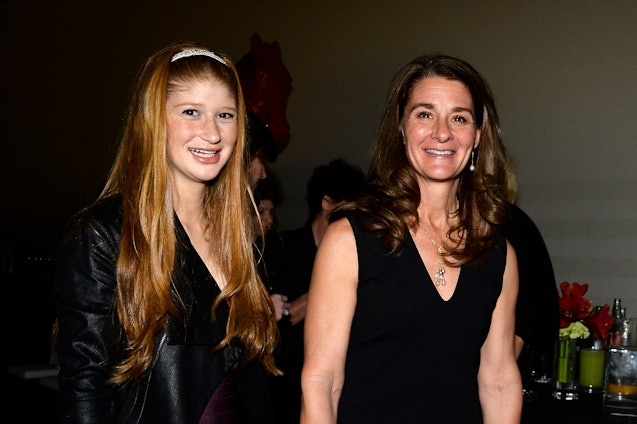
Pascal Le Segretain/Getty Images Entertainment/Getty Images
PARIS, FRANCE - DECEMBER 07: (L-R) Jennifer Gates and Melinda Gates pose after the Style & Competition for Amade at the Gucci Paris Masters 2013 on December 7, 2013 in Paris, France. (Photo by Pascal Le Segretain/Getty Images)
The Bill and Melinda Gates Foundation is the largest transparently run grant foundation in the world. The foundation is worth over 80 billion dollars, and has made great strides all over the world to carry out their mission to better the next generation with access to health care and education. The Gates' family, instead of simply living off the proceeds of their Microsoft fortune, has made philanthropy a top priority and the Gates' children are no exception.Gates said in a rare interview on This Morning:
“This money is dedicated to helping the poorest. They know that, they are proud of that, they go on trips with us to see the work that's being done."
The Gates' children could have looked forward to lives without obstacles. They Bill Gates Won't Leave His Fortune To His Children & Here's Why That's A Beautiful Thing | Romper: