Latest News and Comment from Education

Thursday, October 20, 2016

2,000 Seattle teachers wear ‘Black Lives Matter’ shirts to class | The Seattle Times

2,000 Seattle teachers wear ‘Black Lives Matter’ shirts to class | The Seattle Times:

2,000 Seattle teachers wear ‘Black Lives Matter’ shirts to class
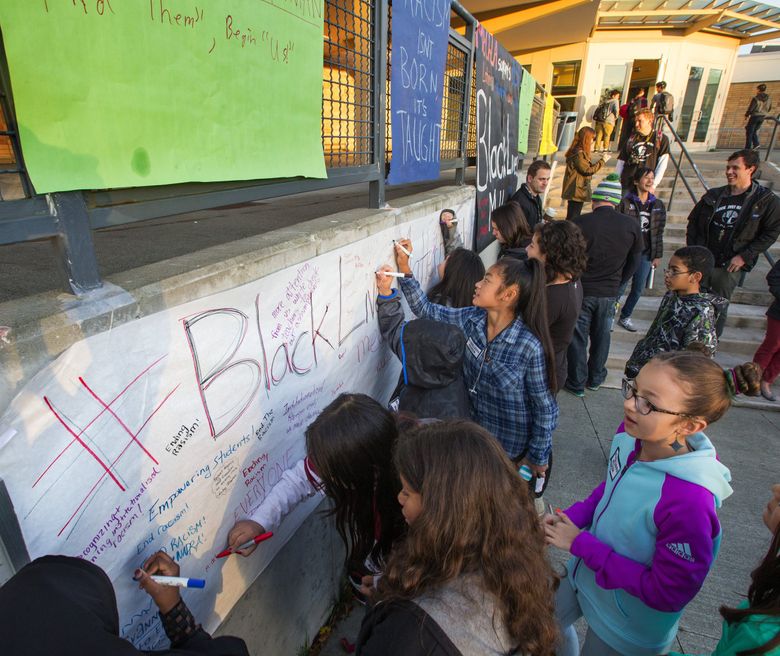
Chief Sealth International High School and Denny Middle School teachers and students hold a rally Wednesday morning to show their commitment to closing opportunity gaps and continuing the conversation on racial equity in their school. (Mike Siegel/The Seattle Times)
The “Black Lives Matter at School” rallies attracted hundreds of students, parents and teachers on Wednesday.


About 2,000 Seattle educators wore Black Lives Matter shirts at their schools Wednesday to call for racial equity in education.

Schools across the district held “Black Lives Matter at School” rallies before classes began for the day. Students, parents and teachers also wore stickers and buttons emblazoned with the “Black Lives Matter” slogan.

The purpose of the day was to affirm that “black lives matter in the public schools,” according to organizers, who are members of Social Equality Educators, a group of educators within the Seattle teachers union. Teachers also wanted to show their support for John Muir Elementary, which had its “Black Men Uniting to Change the Narrative” event canceled last month after receiving a threat over teachers’ plans to wear Black Lives Matter shirts.

Before school started Wednesday at Chief Sealth International High School, dozens of educators and students gathered outside the building and held up banners and signs.

 About 60 Chief Sealth educators had ordered the shirts beforehand. Some of the shirts said “Black Lives Matter” and “#say­hername,” a reference to Sandra Bland, a black woman who died in police custody in Texas. Those shirts had an image of a fist. Others wore shirts that said “Black Lives Matter” and “We Stand Together” with an image of a tree.


Teacher Diana Romero said she decided to wear a shirt “to support our black brothers and sisters in support for justice.” As a Latina, she said she has seen firsthand the unfair treatment of people of color by police officers.


A sixth-grade class from nearby Denny International Middle School, whose teacher brought them to the Sealth rally, wore Black Lives Matter stickers. Teacher Ben Evans said he wanted them to see how their voices can be heard. Many of his students are aware of racial inequities already, he added.


“Black Lives Matter At School” wasn’t sponsored by the school district, but it coincides with Seattle Public Schools’ “day of unity,” aimed at bringing more attention to racial equity in education. The district said in a statement that it has asked students, family, staff and community members to “engage and join the conversation in our united efforts to eliminate opportunity gaps.” As a public institution, the district doesn’t take official positions on social or political movements, district spokesman Luke Duecy said in a statement earlier this week.

Because Wednesday’s rally at Sealth was not an official district event, teachers were told to leave before students started arriving for school. But members of the Black Student Union (BSU) remained until the start of classes.

For BSU President Precious Manning, 17, the rally and shirts represented the international school coming together in solidarity. Black Lives Matter means making sure everyone is included, she said.

“Black Lives Matter means ‘don’t leave us out,’ ” she said.

Each school planned its own events for “Black Lives Matter at School” day. At Leschi Elementary, for example, participants taped notes on a banner that asked “What does Black Lives Matter mean at Leschi?” Lowell Elementary’s front sign read “Black Lives Matter at Lowell.”

In addition to Seattle schools, staff at Highline’s White Center Heights Elementary wore shirts.

Another “Black Lives Matter At School” rally is planned for Wednesday evening at Washington Hall, where activists and artists, including Grammy-award winning singer-songwriter Kimya Dawson, will perform and speak about racial equity. Seattle Seahawks defensive lineman Michael Bennett is also expected to attend.

The event is from 6-8 p.m. at Washington Hall, 154 14th Ave., in Seattle’s Central District.2,000 Seattle teachers wear ‘Black Lives Matter’ shirts to class | The Seattle Times:

Image result for 2,000 Seattle teachers wear ‘Black Lives Matter’ shirts to class

What New Challenges To The Charter School Industry Reveal

10/20/2016 – What New Challenges To The Charter School Industry Reveal:

What New Challenges To The Charter School Industry Reveal


THIS WEEK: What’s Wrong With Reed Hastings … Schools Pursuing Integration … No Credit For Graduation Rates … Ignoring Student Debt … Stupid Teacher Prep Rules

TOP STORY

What New Challenges To The Charter School Industry Reveal

By Jeff Bryant

“As school year 2016-17 rolls out, the charter industry finds it faces formidable new challenges from many unexpected corners … What happened? A new omnibus report helps answer that question by explaining what made charter schools an instant public relations hit, how they were able to fly under the radar of public scrutiny for so long, and why challenges to the sector are arising now.”
Read more …

NEWS AND VIEWS

The Battle Of Hastings: What’s Behind The Netflix CEO’s Fight To Charterize Public Schools?

Capital & Main

“Reed Hastings, CEO of Netflix … helped launch the powerful EdVoice pro-charter lobbying group and … has donated more than $3.7 million to the California Charter Schools Association … Hastings and other school reform-minded tech billionaires want to inject the start-up mentality into the country’s schools, using high-tech solutions to replace human labor and disrupting longtime management and oversight approaches in the name of efficiency. But … roughly half of all start-ups fail. What happens to the children who get caught in those failures?”
Read more …

These Are The 100 U.S. School Districts That Are Actively Pursuing Socioeconomic Integration

The Washington Post

“The number of districts and charter schools that use socioeconomic status as a factor in student assignment has grown quickly from two in 1996 to 39 in 2007 to 100 today … there are 4.4 million students enrolled in these districts, nearly 9 percent of all students nationwide … The communities currently pursuing socioeconomic integration are in red states and blue, and in many parts of the country.”
Read more …

Graduation Rate Hits Record High of 83.2%: Should Obama Take Credit?

Education Week

“President Barack Obama appears to be using this graduation rate announcement to take an education victory lap … But it’s also possible that any one of a number of other factors could be the driving force, including decreases in violent crime, drug abuse, and teen pregnancy … What’s more, it’s not clear if higher graduation rates necessarily mean that more students are leaving high school prepared for college … The Obama administration’s tenure also saw the first drop in 4th and 8th reading and math scores on the National Assessment of Educational Progress, or the nation’s report card, in more than two decades.”
Read more …

STUDY: Evening Cable News Spent Less Than Two And A Half Hours Discussing College Affordability In An Entire Year

Media Matters For America

“Fox News, MSNBC, and CNN … devoted limited time to discussing [college affordability] and … the majority of guests participating in the discussions were white, male, and middle-aged or older … The most represented profession, by far, among evening cable news guests discussing college affordability was journalists … Over the year studied, a total of eight current students (6% of guests) made guest appearances … 41% (52 guests) discussed [Bernie] Sanders’ record or policy stances on college affordability topics. About a quarter of the guests discussed Clinton’s record or policy stances on these issues.
Read more …

Fed’s Stupid Teacher Prep Program Rules

Education Week

Pennsylvania school teacher and blogger Peter Greene writes, “The feds have released their rules governing teacher preparation programs, and they are just as stupid as they have promised to be all along …The genius portion is the part that links college teacher program ratings to student results on the Big Standardized Test … There are a couple of obvious outcomes of a policy like this, the most obvious and damning being that if [a] program wants to survive, it has to avoid sending its graduates to low-performing (aka poor and under-resourced) schools. And since teachers most commonly teach somewhere near their community of origin, that means [the program] will definitely consider not accepting students from poor and under-resourced communities … Of course, we could also use test results to evaluate the work of officials who set education policy, and if test results fail to go up annually, we could simply fire all those officials … But that would just be crazy talk. Almost as crazy as doing an actual evaluation of tests themselves.”
Read more …
 10/20/2016 – What New Challenges To The Charter School Industry Reveal:

The Politics of Citizen Teachers - Bridging Differences - Education Week

The Politics of Citizen Teachers - Bridging Differences - Education Week:

The Politics of Citizen Teachers


Image result for Citizen Teachers

Deborah Meier continues her conversation with Harry Boyte. To read their full exchange, please visit here.
Dear Harry and friends,
We've allowed politics to have such a bad name that we forget that practicing smart politics is one of the arts and crafts of a working democracy. None of us can play full roles as citizens, or citizen-teachers, if we insist on being ignorant about these skills. They require empathy as well as knowledge of ones field, they require understanding the history of the institutions we work in as well as the communities they serve, and we need to have colleagues whom we trust sufficiently to talk out together our ideas, our strategies, our short and long-term plans, our doubts and our certainties. 
Schools of education—whether progressive or conservative—are too often in the business of trying to get us to agree with what they believe and to move into the field smoothly and successfully. A tough task, but both insufficient and often dangerous.
Teaching requires more immediate acts of human judgment of the most complex sort more often than probably any other field. Our judgment is affected by so many unseen indirect past experiences, as well as ideas and theories we hold often unknown even to us that make our judgments far too fallible. We need feedback from people we trust to have our and the children's best interest at heart.  We need ways to evaluate our judgments in settings where we are not paralyzed by defensiveness. We need to be tough enough to take critique at least as honest as the critique we offer our students. We need preparation for this kind of setting as well as constant opportunities for "refreshing" these skills.
We also needed help in maneuvering life in the school we found ourselves.To play the role of citizens of our school we needed to understand it and the pressures on it from outside as well as inside.  We needed to bring our political skills to bear upon the "politics" of schooling.
It was in a Center created by professor Lillian Weber at City College of New York that I confronted for the first time what such an education might be like—one that taught pedagogy and subject matter in combination with real-life skills in the politics of school for student teachers and practicing teachers together. Weber reminded me of old union organizers (no coincidence it turned out) who urged us not to mourn "but to organize." When we came to the Center for help she insisted that we pose our requests as problems not complaints. No whining. Let's look at what we might do, not wish away the real world. For several years I worked for the Center, helping teachers in schools whose principals agreed to our presence. Teachers who wanted our form of help were placed together on a corridor where they could easily share their ideas and their work, and at times even their children. Advisors came once a week to help them share and to make suggestions. The advisor worked for the corridor, not the principal, and our first difficult task was to create the necessary trust between us to carry out the project. If we've said this will stay in this room, we need to prove that our promise was not broken, for example.  
Every Friday advisors (about ten of us) got together at the Center to discuss our work, hear each other's critiques, suggestions, and make plans for the following week. We worked each with four schools and in this way we also contributed to the work of forty or more schools. We shared books, curriculums, films, and mostly our experiences. We were influenced by the work of Pat Carini and sought to present our work as nonjudgmentally and concretely as we could. We took no orders but we committed ourselves to take each other's suggestions seriously.   


Isaias' Story: The Struggles and Dilemmas Facing Children of Immigrants

Isaias' Story: The Struggles and Dilemmas Facing Children of Immigrants:

Isaias’ Story: The Struggles and Dilemmas Facing Children of Immigrants

Book of Isaias
Isaias Ramos (second from left) walks with his friends in Memphis, TN. (Photo courtesy of Daniel Connolly)
In the midst of all the rancor surrounding the debate over immigration – reaching new heights of vitriol and divisiveness in the 2016 presidential campaign season – it may be easy to forget that communities across the country, especially in their public schools, are working with many undocumented families to try to forge some path of success for their children.
Educators at Kingsbury High School in Memphis, TN., never saw Isaias Ramos as a “problem” or a “statistic”  – he’s just one of the best students they ever taught. Isaias‘ family came to this country in 2003 from Hidalgo, Mexico and settled in Memphis, where his parents would set up a small house-painting business. Isaias excelled at school, and in 2012, as he prepared for his senior year, he met Daniel Connolly, a reporter with the Memphis Commercial Appeal. Connolly, who had been covering immigration from Mexico to the American south for a decade, wanted to take a closer look at the lives of immigrant children. With the blessing of Isaias and his family and school administrators, Connolly spent the 2012-13 school year embedded in Kingsbury, tracking Isaias and some of his classmates as they navigated their way through the difficult senior year, and the educators who intervened to help them make the right choices about their future.
What began as an award-winning multimedia project for the Commercial Appealevolved into “The Book of Isaias: A Child of Hispanic Immigrants Seeks His Own America,”  published in October by St. Martins Press. Connolly recently spoke with NEA Today about how the story of one teenager and his classmates illustrates how Isaias' Story: The Struggles and Dilemmas Facing Children of Immigrants:

Turning School Discipline Over to the Police Does Not Work -Education Law Prof Blog

Education Law Prof Blog:

Turning School Discipline Over to the Police Does Not Work


The ACLU of California has released a new report titled The Right To Remain a Student: How California School Policies Fail to Protect and Serve.  The report begins:
Over the past two decades, police officers in the United States have increasingly displaced school administrators as disciplinarians, responding to minor offenses and conduct violations that pose no direct threat to personal safety. This increase in student-police interactions has funneled thousands of students into the school-to-prison pipeline and created adverse legal consequences for school districts. The Right to Remain a Student: How California School Policies Fail to Protect and Serve details these consequences and describes the current state of school district policies in California that pertain to police on campus. Additionally, it shares model policies that both promote school safety and protect student rights. These model policies are designed to ensure that school staff will manage police encounters safely and equitably for all students—no matter their race, class, disability status, gender, or where they go to school.
It finds:
  • Many districts have conflicting, vague, or absent law enforcement policies that provide little to no meaningful guidance to school staff on when to call police to campus or how to interact with police.
  • Most school districts give staff complete discretion to call police to address student misbehaviors that should be handled by school staff such as administrators or counselors, including: a. General school rule violations (62% of districts give staff discretion), b. Bullying and harassment (60.7% of districts give staff discretion), c. School disruption (57.4% of districts give staff discretion), and d. Vandalism (66.7% of districts give staff discretion or even require reporting to police).
  • Very few schools (4% or less in each category) have policies limiting police contact for rule-breaking or minor offenses.
  • California school districts provide inadequate guidance to school staff on what they should do when police officers question students on campus. a. Of school districts statewide, 70.9% allow police officers to interview students immediately upon demand, stating that staff “shall not hinder or delay” interrogations. b. Less than 1% provide that an adult (not a police officer) must be present to make sure the student’s civil rights are observed during police questioning. c. Only 1.3% of districts have a police ensuring that staff or police advise students of their constitutional right to remain silent.
  • California school districts similarly do not protect students who are arrested or removed from campus by police. a. Of California school districts, 30% have no barriers to police removing a student from campus and 8% provide no guidance whatsoever about police officers removing students from campus. b. Only 18.3% of California school districts require a school administrator to ascertain the reason the officer must remove the student from school. c. Only 5.6% of school districts maintain any procedures governing the enforcement of arrest warrants on campus.
A key thesis of the report is the need to distinguish between every day misbehavior of students and other behavior that may actually justify police involvement.  As I emphasize in the book Ending Zero Tolerance, many schools do Education Law Prof Blog:

Come July 2017, UCLA Will No Longer Oversee Smarter Balanced | deutsch29

Come July 2017, UCLA Will No Longer Oversee Smarter Balanced | deutsch29:

Come July 2017, UCLA Will No Longer Oversee Smarter Balanced


In February 2016, the Partnership for Assessment of Readiness for College and Career (PARCC) posted a Request for Information (RFI) in which it formally solicited advice on how it should proceed as a Common Core testing consortium.
The result of that PARCC RFI was 128-page response by a number of organizations, which I wrote about here.
One of the suggestions for PARCC’s future concerns its being overseen by the other Common Core consortium, Smarter Balanced. Interestingly, Smarter Balanced, which included its own advice in response to PARCC’s RFI, did not itself offer to oversee PARCC.
What Smarter Balanced offered in its advice for PARCC were details on how Smarter Balanced successfully operated as a consortium.
That is why it is surprising that  EdWeek’s Sean Cavanagh reports that Smarter Balanced will be seeking a new fiscal agent. Smarter Balanced has a contract with the University of California system, and UCLA has been serving as the Smarter Balanced fiscal agent. UCLA’s 3-year contract for this role expires on June 30, 2017.
On September 28, 2016, UCLA notified Smarter Balanced to inform the consortium that UCLA was not interested in continuing to oversee Smarter Balanced. Cavanagh reports that Smarter Balanced is in negotiations to seek another university in the University of California system to oversee Smarter Balanced.
UCLA notes that it will continue to “focus on scholarly work and new research in coordination” with Smarter Balanced, but UCLA will not run the consortium.
Of course, the very fact that Smarter Balanced will be transitioning to a new fiscal agent means that its future stability is in question.
So, America, we have two Common Core testing consortia, both of which face questionable stability– which also points to questionable sustainability.
Of course, PARCC and Smarter Balanced both need states as consortium members in order to survive.
It remains to be seen how states will respond to the fact that both PARCC and Smarter Balanced are experiencing their own internal struggles.Come July 2017, UCLA Will No Longer Oversee Smarter Balanced | deutsch29:


A Moral Issue « Dad Gone Wild

A Moral Issue « Dad Gone Wild:

A Moral Issue

img_0496


 As I sit down to write this piece, I feel like I need to make a couple of statements before diving into the main topic at hand. First, in a recent post I raised the question of why parents might choose charter schools, but please don’t mistake my deeper understanding of this issue as a softening of my position on charter school growth (as some may have tried to insinuate). I am as opposed to the concept of charter schools as I’ve ever been; I’m just more opposed to hypocrisy, and at present, Nashville seems to be suffering more from the latter than the general issue of charter schools.

I will also add that I don’t understand how people can support a moratorium on charter schools and not devote an equal amount of time to ensuring that our current schools have all the resources needed. How do you look a parent in the eye and tell them you have stopped charter school growth, but as a result, their child will be going to a school with 23 portables, which should get warm after the first hour or so, but they will need a coat as the bathrooms are in the main building?
Secondly, Diane Ravitch was kind enough to pick up my last piece on the situation with Metro Nashville Public Schools’ new director. She used stronger language at the time than I probably would have used, but upon reflection, it was the right language. You see, what her critics missed was that she didn’t call for Dr. Joseph’s immediate dismissal, but rather “If the elected board can’t straighten out this mess and revise Dr. Joseph’s contract to assure that he works for the board – the board does not work for him – then it’s time to cut their losses and terminate his contract.” That’s a little different than the hyperbole shared over at Education Post. I guess that Common Core close reading strategy hasn’t extended to adults yet.
Diane took a lot of heat in the comments section of that piece on her blog, and at one point gave this response: “I know and trust A Moral Issue « Dad Gone Wild:

CURMUDGUCATION: PA: About the Professor Strike

CURMUDGUCATION: PA: About the Professor Strike:

PA: About the Professor Strike

Image result for Strike animated gif


As just about everyone has heard today, the professors at fourteen of Pennsylvania's state colleges and universities are on strike (due to a quirk in our system, Pitt, Penn State and Temple are in a different state university system). This is the first such strike in ever.


It is hard to know exactly what's going on in the first days of a strike. I was president of my own local union over a decade ago when we went on strike, and I still remember well how information management is a huge issue all by itself, struggling both with the issue of hundreds of people shooting off their mouths regardless of knowledge, and both sides trying hard to control the narrative. 

Bottom line-- be a cautious information consumer these days.

But as some with friends, family and former students all over this dispute, I can note a couple of things.

The state's point man is Chancellor Frank Brogan. Brogan started out as an elementary classroom teacher in Florida and got out pretty quickly to enter administration. He eventually became Florida's youngest-ever Education Commissioner. He was going to run for that job again when he was tagged to be Jeb! Bush's Lt. Governor. He was Jeb's point man on education and was elected to second Lt. Gov. term, but left in 2003 to become president of Florida Atlantic University. Upon being appointed to second term at that job, he left that job to become chancellor of Florida's university system in 2009. In 2013, Pennsylvania hired him away, while PA was being run by a governor who wanted to roll the university system back. And he carried all that baggage into contract negotiations that have been dragging on since 2015. 

The contract struggle has been a fine example of all the bad things happening in higher education. The state has proposed to hire more adjuncts, force them to teach more classes for the same money (or, more likely, take a pay cut for the same work), push more cyber classes, and just generally 
CURMUDGUCATION: PA: About the Professor Strike:

WTF: Franklin High Students Asked to Sign "Convenant" - Seattle Schools Community Forum

Seattle Schools Community Forum: Franklin High Students Asked to Sign "Convenant":

Franklin High Students Asked to Sign "Convenant"


This apparently happened yesterday and the reactions are quite interesting.  The document is below this text.

From the Soup for Teachers Facebook page:

 - backpedaling - Meg Richman I teach at Franklin. This was clumsy. It is a part of an initiative to focus on the achievement gap that hurts African American students the hardest. There was an assembly to get buy-in from the kids for an extra push on everyone's part. Lack of foresight about how it would be received, but it came from an honest and caring place.  
Teachers BTW were not consulted.

Really? The district and schools don't know this is a sensitive issue and aren't clearly thinking these things out?

- reaction at Facebook

KT Jones But that's the inherent problem, right? Good intentions are great but the actions are damaging. This letter sends the message that black parents don't know how to prepare their students for college. It is beyond insulting and it is a crying shame that the teachers were not involved in the decision. There could have been outreach from the teachers to the community to ask the parents if they needed support and what they needed support with. Instead they were left with insinuations and degradation. 

Odetta Owen Exactly. I can't grasp the mindset that says this is helpful or respectful. On the eve of a BLM event where families and PTSA's were not invited to collaborate with the District and SEA this is bad timing and shows lack of insight. While I believe the words that intentions were well placed I am worried about the lack of understanding possessed by the decision makers. Equally disturbing is the consistent pattern of attempting solutions without inviting parents/families to the table.

Ms. Owen is right... for so many issues, not just the opportunity gap.  This district has a real habit of believing they know best and it seems to backfire a lot.


From 100 Black Parents:

So there is a letter/agreement given to African American Students at Franklin HS that is being shared tonight. After talking to some folks and getting MORE BACKGROUND and CONTEXT here is what it is: 1) The letter that is being shared is being taken out of context. 2) It is not from the PRINCIPLE (sic) but rather a part of an overall program: Keeping It 100: GET SMART that is seeking success for STUDENTS OVER THE COURSE OF THE YEAR and 3) It is just one of MANY Community Partners in the building (see List) 4) If you are a PARENT IN THE BUILDING have not seen this paperwork, then you need to be more involved in the building or at least call the school to see what's going on. The program CLEARLY seeks to involve BLACK PARENTS by asking them to check their child's grades in the Source. Once again we prove that we are the BEST at being #REACTIVE but have a ways to go in being #PROACTIVE

This is all fine and well but again, the principals and the district should be working together and if there are outside partnerships, everything should be vetted thru the district. 

  
KING 5 story 


One parent, Timika Anderson, said her 17-year-old daughter brought the form home two weeks ago. Anderson said her daughter was upset that the form was passed out only to black Seattle Schools Community Forum: Franklin High Students Asked to Sign "Convenant":


Why top US education official wants to lift cap on charter schools - CSMonitor.com

Why top US education official wants to lift cap on charter schools - CSMonitor.com:

Why top US education official wants to lift cap on charter schools
US Education Secretary John King called for lifting the 'arbitrary cap' on charter school growth, taking a pro-charter stance on an issue that has recently become more partisan and divisive.


Education Secretary John King jumped into the charter school debate Wednesday to praise the schools and call for a lift of the “arbitrary caps” on the institutions.
The publicly-funded, privately-operated schools have become an increasingly contentious and partisan issue. Supporters argue that they provide families, especially those in urban areas, with increased choices when traditional public schools fail. Opponents cite cases of mismanagement and claim that the schools drain funds from the non-charter public school system. On Nov. 8, voters in Massachusetts will confront the issue first hand with a ballot question regarding the expansion of charter schools in their state. It's the only state with a charter school ballot initiative this year.
Dr. King said the United States is “fortunate, I think, as a country, to have some high-performing charters that are doing a great job providing great opportunities to students — charters that are helping students not only perform at higher levels academically, but go on to college at much higher rates” than students at some neighborhood public schools.
“That’s good,” he added. “We should have more schools like that, and I think any arbitrary cap on that growth of high-performing charters is a mistake.”
Those views put King at odds with Democrats and the NAACP, who have called for stronger oversight and criticized schools for expelling some of the more difficult students.
While charter schools once received bipartisan support, new revelations about the privately managed institutions have caused Democrats and Republicans to split over the issue. Donald Trump proposed a $20 billion school choice program in September that would focus largely on a voucher-based system. Conversely, Hillary Clinton’s support of charters has waned.
In Massachusetts, voters have become increasingly divided over a ballot question that, if passed, would allow the state to create 12 new charter schools each year. Currently, the measure stands to fail by around 11 points, according to a poll, with 64 percent of Democrats opposing it.
“Many charters schools are producing extraordinary results for our students and we should celebrate the hard work of those teachers and spread what’s working to other schools,’’ Sen. Elizabeth Warren (D) of Massachusetts, said in a statement. “I am very concerned about what this specific proposal means for hundreds of thousands of children across our Commonwealth, especially those living in districts with tight budgets where every dime matters. Education is about creating opportunity for all our children, not about leaving many behind.”
Some 6,800 charter schools currently have around six percent of students enrolled nationwide and are poised to educate some 40 percent of US students if charter school growth continues.
But research shows, much like neighborhood public schools, some Why top US education official wants to lift cap on charter schools - CSMonitor.com:

Tester, Juneau, education officials: ESSA can't be 'No Child Left Behind 2.0' | Local | missoulian.com

Tester, Juneau, education officials: ESSA can't be 'No Child Left Behind 2.0' | Local | missoulian.com:

Tester, Juneau, education officials: ESSA can't be 'No Child Left Behind 2.0'

Jon Tester
Jon Tester
Superintendents and teachers from across western Montana are cautiously optimistic about the Every Student Succeeds Act, a new law that tosses out the controversial No Child Left Behind and is supposed to return more control to states and local school districts.
U.S. Sen. Jon Tester, D-Mont., hosted a roundtable discussion Tuesday afternoon at Missoula County Public Schools' business building. Superintendent of Public Instruction Denise Juneau and senior adviser to the U.S. Education Secretary Ruthanne Buck joined him, as did superintendents from Montana school districts.
The goal, Buck said, is to hear comments and concerns of educators nationwide as the U.S. Department of Education continues to write regulations and guidance surrounding Every Student Succeed's implementation.
ESSA went into effect in December, replacing No Child Left Behind, which was enacted in 2002.
Tester and Republican U.S. Rep. Ryan Zinke voted for ESSA. Republican U.S. Sen. Steve Daines voted no, saying the law "fails to provide states with needed flexibility and control over federal education funds to best address the needs of local students." 
In March, Juneau appointed two work groups of 33 teachers, parents and school board members to help develop the state's plan. Montana will move from No Child Left Behind to ESSA next school year.
"Local control is critical," Tester said.
***
That all sounds nice, superintendents said, but will it be reality?
The argument against No Child Left Behind was that the federal government had too much control over education, holding funding hostage if states didn't meet certain benchmarks tied to annual standardized testing. ESSA is reported to relax that control, and let states and local districts decide accountability for themselves.
"Is there really going to be local control or is that just words on a page?" said Great Falls Public Schools superintendent Tammy Lacey.
Lacey said she has "more questions than answers" about ESSA and agreed with Juneau that she doesn't want ESSA to turn into "No Child Left Behind 2.0."
"For the record, neither do we," Buck said.
"Will we learn that accountability drives what's taught in our classrooms?" Lacey said. "We know and saw that happen when we tested math and reading, what happened in schools, where the focus went."
She's referring to a common criticism that NCLB encouraged "teaching to the test," specifically to the requirement for annual Tester, Juneau, education officials: ESSA can't be 'No Child Left Behind 2.0' | Local | missoulian.com


SANDRA STOTSKY: Test-based accountability: The best we can do? | NewBostonPost

Test-based accountability: The best we can do? | NewBostonPost:

Test-based accountability: The best we can do?


Who doesn’t want accountability in education? That was the selling point for No Child Left Behind (NCLB). It was the selling point for the Massachusetts Education Reform Act (MERA) of 1993. It was even a selling point for Finnish reforms in teacher education in 1970.
But how did Congress and most of our education researchers and policy makers get frozen into thinking that test-based accountability is the only kind of accountability?
There are other forms of accountability—and maybe, just maybe, another form of accountability, or even hybrids of existing forms, might lead to gains in U.S. student achievement, if indeed that is a goal of accountability (i.e., to ensure that federal taxpayers are getting something worthwhile for their money).
Improved student achievement was the goal of MERA in 1993. Schools and school districts were held accountable. (The “grand bargain” was money for more effective schools.) Over the next decade, many changes took place in public education, including increased funding, “revised learning standards,” “revised student assessments based on clear curriculum frameworks,” and “revised teacher licensing.”
These reforms eventually did lead to increased levels of achievement for all groups of kids, even though average differences in achievement between groups were not closed after 10 to 15 years. (Closing achievement gaps was not a goal of MERA; improving academic achievement for all students was.)
Gains in student achievement were a goal of Finnish reforms in 1970. Professional accountability is how Helen Ladd describes the Finnish version of accountability. Schooling was restructured (enrollment in a free upper secondary school—vocational or academic—was encouraged, even though students could legally leave school after grade 9); teachers’ academic quality and teacher education were academically upgraded; and teachers in grades 1 to 9 were in charge of their school’s curriculum, with minimum guidance from a central ministry of education and no state-mandated testing in grades 1 to 9. See this review for details.
And gains it did lead to, for large numbers of children—not for all, and not without some problem Test-based accountability: The best we can do? | NewBostonPost:


Huntington Park leaders vote to ban new charter schools for a year - LA Times

Huntington Park leaders vote to ban new charter schools for a year - LA Times:

Huntington Park leaders vote to ban new charter schools for a year

Image result for charter moratorium
Huntington Park City Council members voted Tuesday to ban new charter schools in the city until next fall.
The 4-1 vote extended a 45-day moratorium passed last month after city officials complained about the number of requests for new schools and said they were concerned about increased traffic.
Charter schools are publicly funded but often are privately run. Unlike most traditional public schools, they can accept students from anywhere, not just from the neighborhoods around them.
There are about 30 schools — including 10 charters — within the city’s three square miles, though some share campuses.
In a September report to the council, City Manager Edgar Cisneros itemized what he saw as the problems new charter schools create. “Communities within the vicinity of charter schools have experienced impacts to vehicle circulation, parking, and noise,” he wrote.
The report suggested that a “high number of inquiries and requests” from charters had prompted the call for a moratorium. The moratorium also  applies to existing charter schools that want to move and expand in new locations, Cisneros said.
But, although many charter schools have made inquiries, city records show only three in the last year actually said they planned to submit applications, said Huntington Park’s economic development manager, Manuel Acosta. He could not give a count of the inquiries. 
It’s unclear whether the city has legal authority to enact the ban. Only school districts, counties and the state can authorize or reject charter schools. Cities, however, do control zoning and can decide whether or not to grant permits.
The California Charter Schools Assn. has said it may sue the city over the moratorium.
The city is attractive to charters because its zoning policies are looser than those of other nearby cities, Acosta said. The moratorium, he said, will allow the city to spend Huntington Park leaders vote to ban new charter schools for a year - LA Times:

New Jersey student jumps out window to escape standardized test | PhillyVoice

New Jersey student jumps out window to escape standardized test | PhillyVoice:

New Jersey student jumps out window to escape standardized test


A 15-year-old New Jersey girl broke her ankle Wednesday morning after jumping two stories from her Asbury Park high school in a last ditch effort to avoid taking a standardized test. 
According to an official with the Asbury Park School District, the student leaped from a bathroom window at Asbury Park High School at approximately 8:44 a.m. as her class was conducting the PSAT, a prep for the standard college entrance examination. The test was being administered to freshmen, sophomores and juniors, with a delayed opening for seniors. 
The student, a sophomore, reported to homeroom at the start of the school day before heading up to the women's room and climbing out the window. When she fell, she yelled out for help and was treated  at the scene by a team of nurses from Asbury Park High School and Monmouth County Vocational School District. 
Eventually, the student was transported with a broken ankle to Jersey Shore University Medical Center, where she underwent further treatment and an evaluation by medical staff. 
“It’s unfortunate that one of our students took extreme measures to exit the building, which resulted in her being injured,” said Superintendent Dr. Lamont Repollet. “Our priority is to have a safe learning environment where we take the safety and security of all of our students very seriously.”
Counselors will be made available to staff and students who may have been affected by the incident. New Jersey student jumps out window to escape standardized test | PhillyVoice: