Latest News and Comment from Education

Thursday, September 29, 2016

Special Nite Cap: Catch Up on Today's Post 9/29/16

Special Nite Cap: Catch Up on Today's Post 9/29/16


Featured Post

Bill Schuette issues major ruling on Detroit schools, doesn't mention the thousands he's accepted from pro-charter DeVos family ​ | Detroit Metro Times


Letter to the editor on EdTech | Parents Across America
Letter to the editor on EdTech | Parents Across America : Letter to the editor on EdTech PAA urges parents and others to take a moment whenever you see a mention of digital learning in your local newspaper to write a letter to the editor to help educate the public about some of the many concerns raised by EdTech. Here’s an example, written by PAA interim executive director Julie Woestehoff and pu
Saving School Districts - LA Progressive
Saving School Districts - LA Progressive : Saving School Districts How a Ballot Measure Brought America’s Largest Public School System Back From the Brink F our years ago California voters overwhelmingly passed Proposition 30, the emergency ballot measure that Governor Jerry Brown and state education leaders had argued was needed to rescue public schools and community colleges from the fiscal fre
Schools Matter: Understanding KIPP Model Charter Schools, Part 10
Schools Matter: Understanding KIPP Model Charter Schools, Part 10 : Understanding KIPP Model Charter Schools, Part 10 In the Part 9 from Work Hard, Be Hard: Journeys through "No Excuses" Teachin g, Barbara Veltri provided some details on the role that Teach for America plays in sustaining the paternalistic "no excuses" corporate reform schools. Part 10 picks up where that chapter left off. For pr
Toward A More Equitable Future: The Trends and Challenges Facing America's Latino Children
Toward A More Equitable Future: The Trends and Challenges Facing America's Latino Children : TOWARD A MORE EQUITABLE FUTURE: THE TRENDS AND CHALLENGES FACING AMERICA'S LATINO CHILDREN This text is taken from the foreword of the NCLR report " Toward a More Equitable Future: The Trends and Challenges Facing America’s Latino Children ." Latino children have been central to the work of NCLR and our A
CURMUDGUCATION: NC: Charters Get Their More-Than-Fair Share
CURMUDGUCATION: NC: Charters Get Their More-Than-Fair Share : NC: Charters Get Their More-Than-Fair Share The North Carolina Justice Center has just released a study of charter school funding, and if anyone was worried that poor NC charters were not getting sufficient support, they can relax. " Fair Funding for Charter Schools: Mission Accomplished " comes from Kris Nordstrom . Nordstrom is a NC
The Ticking Clock of Teacher Burnout - The Atlantic
Negative Effects of American Teachers' Time With Students - The Atlantic : The Ticking Clock of Teacher Burnout On average, American educators spend more hours with students than their international counterparts—and that may not be a good thing. Would if I only taught part-time? That was my favorite daydream question as an elementary-school teacher in Massachusetts. Just to be clear, I wasn’t exa
Impact of Poverty on Student Achievement: All in the Mind?
Impact of Poverty on Student Achievement: All in the Mind? : Impact of Poverty on Students: All in Their Minds? Students from low-income families who believe that they can develop skills and do better in school if they work hard and practice—a “growth mindset,” in other words—may be buffered from the effects of poverty on student achievement, a Stanford University study has found. But students wh
Unequal discipline: Sacramento City’s black students get kicked out of class way more than their counterparts
Sacramento News & Review - Unequal discipline: Sacramento City’s black students get kicked out of class way more than their counterparts - News - Local Stories - September 29, 2016 : Unequal discipline: Sacramento City’s black students get kicked out of class way more than their counterparts Attempts at ‘restorative justice’ have become flashpoint in districtwide labor negotiations In June, the U
Buffalo teachers rally over stalled contract - The Buffalo News
Buffalo teachers rally over stalled contract - City & Region - The Buffalo News : Buffalo teachers rally over stalled contract Union president calls offer an insult Union supporters attend a rally Wednesday outside City Hall, where the Board of Education was meeting. Robert Kirkham/Buffalo News The latest go-round in the 12-year saga over a new contract for Buffalo teachers hit yet another snag t
CPAG 2016 Public Meeting Notices, Agendas, Minutes - California Practitioners Advisory Group (CA Dept of Education)
CPAG 2016 Public Meeting Notices, Agendas, Minutes - California Practitioners Advisory Group (CA Dept of Education) : California Practitioners Advisory Group An advisory body to the California State Board of Education 2016 Public Meeting Notices, Agendas, and Minutes Public Meeting Notice and Agenda, September 29, 2016 (Posted 09-Sep-2016) Joint Meeting of the California Practitioners Advisory Gr
School Choice Fans Should Pump the Brakes on Trump's Plan, Advocate Says - Politics K-12 - Education Week
School Choice Fans Should Pump the Brakes on Trump's Plan, Advocate Says - Politics K-12 - Education Week : School Choice Fans Should Pump the Brakes on Trump's Plan, Advocate Says When Donald Trump released his plan to dramatically expand school choice earlier this month, those who support vouchers, education savings accounts, and various forms of choice were generally pleased with, at the very
JEB! Comes to Harvard | janresseger
JEB! Comes to Harvard | janresseger : JEB! Comes to Harvard It seems JEB! is back, sort of. He has taken on a new gig as a lecturer about education policy this fall at Harvard University. His position will be to present on education issues at the Program on Education Policy and Governance, which is part of the Kennedy School’s Taubman Center for State and Local Government . Valerie Strauss report
NYC Educator: Tons of Coverage, Hundreds of Millions of Dollars for Charters--We're on Our Own
NYC Educator: Tons of Coverage, Hundreds of Millions of Dollars for Charters--We're on Our Own : Tons of Coverage, Hundreds of Millions of Dollars for Charters--We're on Our Own I cannot believe the crap that passes for news nowadays. Families for Excellent Schools says any damn thing it likes on behalf of Eva Moskowitz, who terrorizes young people into peeing their pants over tests. She's celebr
The Measure of Citizenship isn’t an Exit Exam – It’s Participating in Our Democracy | gadflyonthewallblog
The Measure of Citizenship isn’t an Exit Exam – It’s Participating in Our Democracy | gadflyonthewallblog : The Measure of Citizenship isn’t an Exit Exam – It’s Participating in Our Democracy Pennsylvania legislators just flunked civics – big time. Once again, instead of offering real solutions to eradicate the ignorance of the coming generation , they clothed themselves in their own. A bi-partis
Connecticut taxpayers robbed by their elected officials and the Lockheed Martin Corporation - Wait What?
Connecticut taxpayers robbed by their elected officials and the Lockheed Martin Corporation - Wait What? : Connecticut taxpayers robbed by their elected officials and the Lockheed Martin Corporation The politicians and industry officials were beaming. The media was singing their praises. The Connecticut General Assembly had just voted to give Lockheed Martin $220 million in public funds. The ques
Elizabeth Warren Clarifies The Charter Schools Debate
9/29/2016 – Elizabeth Warren Clarifies The Charter Schools Debate : Elizabeth Warren Clarifies The Charter Schools Debate September 29, 2016, 2016 Subscribe THIS WEEK: Structural Racism In Pre-K … No To School Cops … Kaepernick Effect … Important Governors Races … School Board Elections TOP STORY Elizabeth Warren Clarifies The Charter Schools Debate By Jeff Bryant “This week, Massachusetts news o
Reform Selling Reform: Chiefs for Change Promoting Relay Graduate School of Education | deutsch29
Reform Selling Reform: Chiefs for Change Promoting Relay Graduate School of Education | deutsch29 : Reform Selling Reform: Chiefs for Change Promoting Relay Graduate School of Education Chiefs for Change (C4C) is a corporate-reform-promoting organization that began under the direction of Jeb Bush; as of March 2015, C4C is its own nonprofit. Under Bush, C4C’s membership of state ed superintendents
Gülen's charter schools in US - Nagehan Alçı - Daily Sabah
Gülen's charter schools in US - Nagehan AlƧı - Daily Sabah : Gülen's charter schools in US During President Recep Tayyip Erdoğan's U.N. Summit meetings with top U.S. officials in New York, the primary subject matter was the threat posed by the Gülenist Terror Group (FETƖ) and the extradition of its leader, Fethullah Gülen. Washington still issues tepid remarks and no tangible indication of Gülen'
Five Virtual Charter Schools, Five Different Ways to Track Attendance | Oklahoma Watch
Five Virtual Charter Schools, Five Different Ways to Track Attendance | Oklahoma Watch : Five Virtual Charter Schools, Five Different Ways to Track Attendance A Charter School Taking Attendance Two virtual charter schools, including the state’s largest, reported 100 percent attendance last year — an accomplishment rarely, if ever, achieved in a brick-and-mortar school. With no seats to fill and n
California Department of Education receives Seal of Biliteracy honor in Washington, D.C.
California Department of Education receives Seal of Biliteracy honor in Washington, D.C. : California Department of Education receives Seal of Biliteracy honor in Washington, D.C. WASHINGTON D.C. >> The California Department of Education (CDE) received an award in Washington, D.C., Friday recognizing the state as the national leader in the Seal of Biliteracy awarded to high school graduates who d
Bill Schuette issues major ruling on Detroit schools, doesn't mention the thousands he's accepted from pro-charter DeVos family ​ | Blogs | Detroit Metro Times
Bill Schuette issues major ruling on Detroit schools, doesn't mention the thousands he's accepted from pro-charter DeVos family ​ | Blogs | Detroit Metro Times : Bill Schuette issues major ruling on Detroit schools, doesn't mention the thousands he's accepted from pro-charter DeVos family ​ Michigan Attorney General Bill Schuette weighed in Wednesday on what has become an increasingly contentious
Everything Is Interesting | The Nation
Everything Is Interesting | The Nation : Everything Is Interesting Nicholson Baker goes back to school. Nicholson Baker has always been an outlier in American letters. Born in 1957, he is more or less contemporary with the celebrated literary generation of David Foster Wallace, Jonathan Franzen, Mary Karr, Colson Whitehead, George Saunders, and Helen DeWitt. Like them, he marries a postmodernist

YESTERDAY

Special Nite Cap: Catch Up on Today's Post 9/28/16
Special Nite Cap: Catch Up on Today's Post 9/28/16 Featured Post New Empirical Evidence: Students’ “Persistent Economic Disadvantage” More Likely to Bias Value-Added Estimates | VAMboozled! CA 2016 National Blue Ribbon Public 

Big Education Ape Todays News


Letter to the editor on EdTech | Parents Across America

Letter to the editor on EdTech | Parents Across America:
Image result for parents across america
Letter to the editor on EdTech 


PAA urges parents and others to take a moment whenever you see a mention of digital learning in your local newspaper to write a letter to the editor to help educate the public about some of the many concerns raised by EdTech.
Here’s an example, written by PAA interim executive director Julie Woestehoff and published earlier this week in theWyoming Tribune Eagle. Feel free to “borrow” any of it!

As the heavy push for so-called “personalized learning” moves through Wyoming and across the nation, parents should be asking for an accounting of what digital devices and programs their children are using in school, how much time they are in front of screens, how much money is being spent and how effective these programs really are.
The national parent advocacy organization Parents Across America, which I head, recently published a major review of the many concerns surrounding digital learning. They show that there is actually very little research addressing its impact or information about how it is being used in our schools. What we do know is that online learning has an overall poor academic track record, and that children already need less screen time, not more.
We explained how digital learning products help the test publishers and others profiting from public education continue to control the curriculum and access vast amounts of student data. Meanwhile, students are spending increasing hours glued to computer screens and other digital devices, leaving less time for interacting with other children, adults or their own imaginations, all of which are necessary for success in school and in life.
While not against the appropriate use of technology in schools, we are concerned about technology use that reduces schooling to a data-mining computer game. Children need to master technology, and parents must work harder to monitor their children’s time on devices at home. But it is important, too, for schools, school districts and states to be cautious, diligent, transparent and accountable about their technology decisions in order to be sure that our children are safe and getting the best education possible.
Letter to the editor on EdTech | Parents Across America:


Saving School Districts - LA Progressive

Saving School Districts - LA Progressive:

Saving School Districts


How a Ballot Measure Brought America’s Largest Public School System Back From the Brink

Four years ago California voters overwhelmingly passed Proposition 30, the emergency ballot measure that Governor Jerry Brown and state education leaders had argued was needed to rescue public schools and community colleges from the fiscal free-fall of the 2008 Great Recession.
The good news, according to the California school teachers and officials, parents, college professors, health-care advocates and economic researchers interviewed by Capital & Main for this series, is that the initiative not only performed as advertised, but it may be the most spectacularly successful ballot initiative in the state’s notoriously uneven history of direct democracy.

By raising income taxes on the wealthy and the sales tax on everyone, Prop. 30 dramatically stabilized school funding in the wake of the recession, averting thousands of new teacher layoffs while beginning the work of restoring the jobs and programs lost during the first years of the crisis.

By raising income taxes on the wealthy and the sales tax on everyone, Prop. 30 dramatically stabilized school funding in the wake of the recession, averting thousands of new teacher layoffs while beginning the work of restoring the jobs and programs lost during the first years of the crisis. It was also instrumental in allowing the state legislature to balance its budget for the first time in years without slashing social programs.
Together with a recovering economy, the temporary tax measure has to date reinvested more than $31.2 billion in preschool, K-12, and community colleges. By boosting per-pupil funding by more than 14 percent, Prop. 30 bumped the state’s Great Recession-battered national ranking from dead last in 2010-11 to 40th among all states at $10,493 per student in 2016-17. It’s still a far cry from California’s long-ago position as a top funder of public education, and a 2016 report estimates that merely moving California to the average funding level of the top 10 states would require roughly a doubling of current state funding under Prop. 30.
But the measure is scheduled to expire at the end of 2018. And that, say Great Recession survivors, will again place California’s still-wobbly public schools on the edge of the same fiscal precipice that made the system so vulnerable in 2008.
“There was a cluster of bad things happening simultaneously as districts struggled to balance their budgets,” Tom Torlakson, the State Superintendent of Public Instruction, recalled in a phone call to Capital & Main. “We saw a suspension of money for curricular materials, so teachers had to do with somewhat outdated text books. Parents who wanted to see their children in a small class of 25 or 30 students were seeing classes with 38 and 40 students.”
Those memories are still fresh for Torlakson, who took office in January 2011, when the shock waves of the global financial crisis had opened up a two-year, $18 billion budgetary abyss — at a cost of nearly $3,000 per student — beneath the state’s already badly strapped public schools. Barely three days into his new job, he declared a state of financial emergency.
It was the most significant economic crisis for California public education since the Great Depression. But because California schools were in a very different place than they were in the 1930s, in many ways, it was the most devastating financial blow ever to hit the system. What had begun in 2008 as a “$28 billion hole,” according to numbers provided by California’s Department of Finance, by the 2011-12 budget, ballooned to a $98.3 billion cumulative deficit. Balancing the budget meant all services in the state felt the impact of cuts — cuts so deep that they quickly spilled over into the constitutionally protected funding for K-12 education and community colleges.
California public schools arguably had already been among the leanest in the nation. Considered a “low-spending” education state even before the crisis, the system had ranked among the lowest in Saving School Districts - LA Progressive:
Image result for Proposition 55.

Schools Matter: Understanding KIPP Model Charter Schools, Part 10

Schools Matter: Understanding KIPP Model Charter Schools, Part 10:

Understanding KIPP Model Charter Schools, Part 10

Get 20% Off w/code: RLEGEN16

In the Part 9 from Work Hard, Be Hard: Journeys through "No Excuses" Teaching, Barbara Veltri provided some details on the role that Teach for America plays in sustaining the paternalistic "no excuses" corporate reform schools. Part 10 picks up where that chapter left off.  

For previous posts in this series, google "Understanding KIPP Model Charter Schools."


Chapter 10
“KIPP is grad school for TFA gluttons for punishment”
If you were in TFA and it wasn’t punishing enough for you, then KIPP is right up your alley.(KIPP teacher, 1166)

You cannot teach someone to be a great teacher in twenty days.  (KIPP teacher and TFA trainer, 1178)
         Teach for America and KIPP Model schools maintain a mutually-supportive ideological bond and business relationship. Without the 30-40 percent of KIPP teachers who are presently or formerly TFA corps members, KIPP and its total compliance charter emulators would be hard-pressed to find enough teachers to maintain their operations.  At the same time, TFA alums with aspirations for leadership benefit greatly from schools No Excuses charters.  For without KIPP and the other No Excuses charter chains, TFA alumni, with their two years of teaching experience, would have few opportunities to move into school leader positions and without the requisite administrative and leadership training that is typically required of public school administrators. 
Some KIPP Model schools prefer teachers who have matriculated from TFA, while others like to recruit first-year TFA teachers so that they “they don’t have to unlearn ‘bad’ teaching habits.”  Another KIPP teacher noted that TFA alumni do particularly well at KIPP because they are naĆÆve and have “the mindset of a missionary” who “believes that kids need to be broken before we can build them up.”
         Seven of the former No Excuses interviewed were former TFA corps members, and all of them had received repeated solicitous emails about KIPP through their TFA email accounts.  One teacher formed Schools Matter: Understanding KIPP Model Charter Schools, Part 10:


Toward A More Equitable Future: The Trends and Challenges Facing America's Latino Children

Toward A More Equitable Future: The Trends and Challenges Facing America's Latino Children:

TOWARD A MORE EQUITABLE FUTURE:

THE TRENDS AND CHALLENGES FACING AMERICA'S LATINO CHILDREN


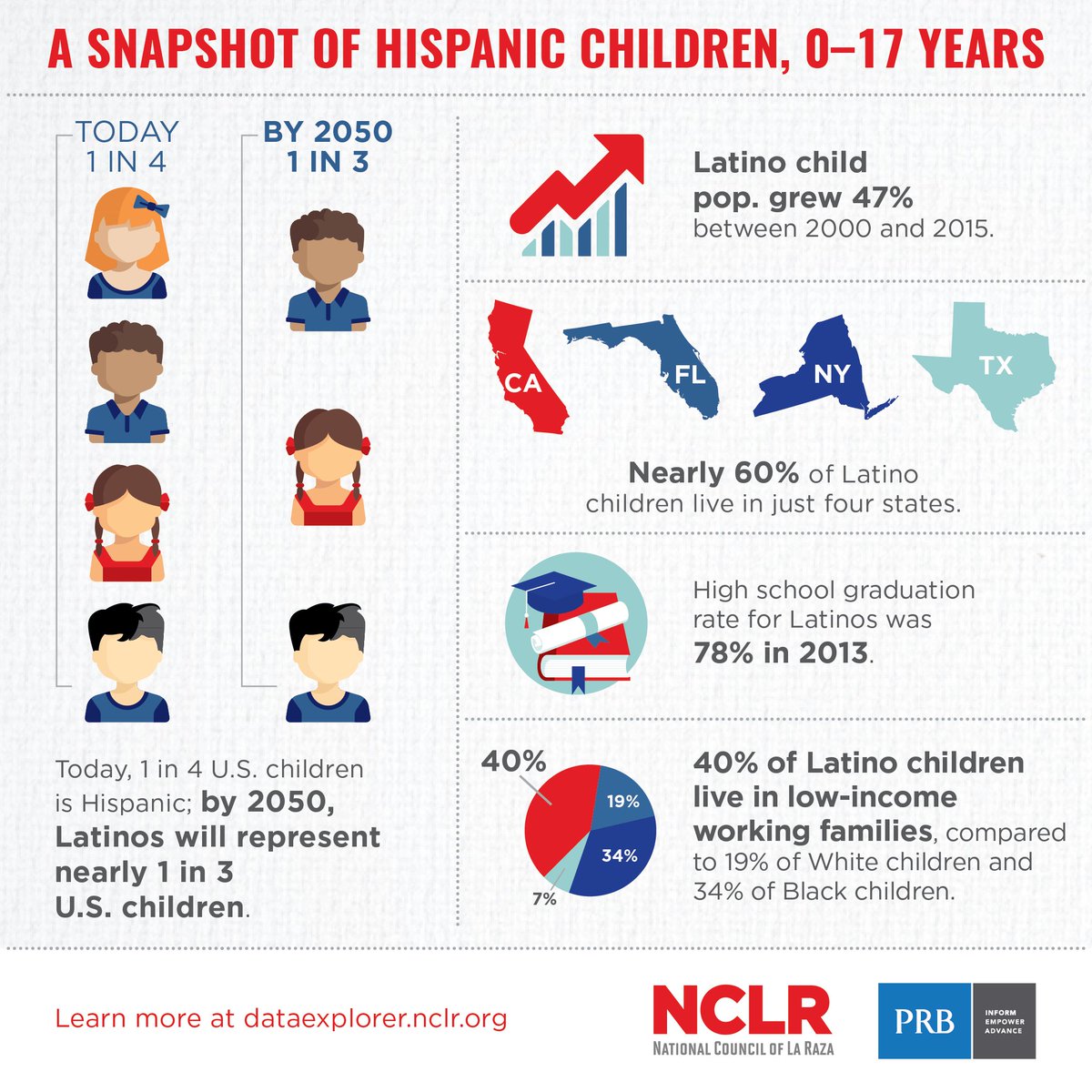
Latino children have been central to the work of NCLR and our Affiliates for the past half century. We were early pioneers of programs in Migrant Head Start, insistent that schools be held accountable for ensuring quality education for all students, fierce advocates for children’s health coverage, and supporters of deferred action for undocumented childhood arrivals. Through all of this, NCLR has been at the forefront of national and state-level efforts to protect children and ensure that Hispanic youth have the same chance at a successful future as all other children.
Now, more than ever, our nation must maintain and enhance its investments in Latino children. As this report shows, the growth of the Hispanic child population in the United States over the past 15 years has been unprecedented, contributing significantly to increasing diversity in schools, across neighborhoods, within institutions, and, in the longer term, at the polls. In just one generation, nearly one in three children in the United States will be Latino. The report shows that inequities can be reduced with the right policies and programs, and that we are headed in the right direction in a number of instances. Indeed, the positive trends reported here occurred as a result of targeted policies that have aimed to advance the well-being of children—whether that be improved health coverage, better schools and more accountability in our education system, or dismantling the school-to-prison pipeline. The report also shows that we have a long way to go to reduce remaining gaps and negative trends. Problems such as generational poverty, discrimination, bigotry and demonization, and other factors impede the positive development of young children of color and can potentially have a detrimental impact on the overall integration of Latino communities. We can and must do better.
The data in the report help us see where we have been and where we are going. NCLR knows what a tremendous asset Latino kids are for America, how resilient they are and what strengths they and their families have when given the chance. From the Hispanic toddler who learned important developmental and language skills through Head Start to the DACA recipient who was able to fulfill her dream of going to college and find a great job—we know that given the right support, our nation’s Hispanic children can be central players in our nation’s future workforce and society. We urge our readers to use the information provided here to join us in building a more equitable future for all American children.Toward A More Equitable Future: The Trends and Challenges Facing America's Latino Children:

RELATED


CURMUDGUCATION: NC: Charters Get Their More-Than-Fair Share

CURMUDGUCATION: NC: Charters Get Their More-Than-Fair Share:

NC: Charters Get Their More-Than-Fair Share

Image result for pigging out animated gif

The North Carolina Justice Center has just released a study of charter school funding, and if anyone was worried that poor NC charters were not getting sufficient support, they can relax.

"Fair Funding for Charter Schools: Mission Accomplished" comes from Kris Nordstrom. Nordstrom is a NC economist who has worked in government before joining NCJC. He's no anti-charter zealot; witness this quote from a piece about the report:

Charter schools are public schools, and North Carolina’s students deserve equal funding whether they attend a public charter school or a "traditional" public school operated by a local school district. Luckily, "fair funding" already exists.

As regular readers know, I'm in complete disagreement with him on this point-- charters are private schools run with public tax dollars. But I mention this so that it's clear I'm not simply cherry-picking from the work of someone who already agrees with me.


Nordstrom's report has some simple but important findings, but first, he makes this observation about "fairness."

It is worth noting that under both current law and HB 539, the sharing of local funds only flows in one direction: from the school district, to the charter school. Under neither scenario is the charter school required to share local funding – which includes grant funding and private donations – with the traditional public school system.

Yeah, you know, it is worth noting. In fact, that's one more way in which charter schools really 
CURMUDGUCATION: NC: Charters Get Their More-Than-Fair Share:


The Ticking Clock of Teacher Burnout - The Atlantic

Negative Effects of American Teachers' Time With Students - The Atlantic:

The Ticking Clock of Teacher Burnout

On average, American educators spend more hours with students than their international counterparts—and that may not be a good thing.

Image result for The Ticking Clock of Burnout animated gif


Would if I only taught part-time?


That was my favorite daydream question as an elementary-school teacher in Massachusetts. Just to be clear, I wasn’t exactly looking to work less than a standard 8- or 9-hour workday. More than anything else, I craved a different schedule, in which I’d teach less on a daily basis and have more time to study my craft, plan better lessons, assess student work, and collaborate with my colleagues. With an average school day of about seven hours, about 5.5 of which I’d spend with my students, I always felt squeezed for time as an educator in the Bay State.


But my teaching environment changed when I moved to Finland. (Long story short: I married a Finn, we purchased one-way tickets to Helsinki in 2013, and I found a classroom teaching job at a Finnish public school, where I taught for two years.)


Just a few days before I started teaching in Helsinki, I met with my principal in her office, where she printed out my new teaching schedule. As I grasped that piece of paper, I struggled to believe what I was hearing for the first time: My full-time workload, reflecting a typical arrangement for other elementary teachers in Finland, would require only 18 hours of weekly classroom instruction. Not only that, but I’d have several 15-minute breaks sprinkled throughout each school day, which I could typically use flexibly (while my students played outside, supervised by a rotating team of teachers). This Helsinki timetable was a significant departure from my previous teaching schedule, but in Finland, where teachers have relatively fewer instructional hours compared to their international peers, it wasn’t exceptional. At my American school, I would usually spend an additional 10 hours instructing my students each week, and, every day, I’d usually possess just one block for planning.


Initially, I believed that Finland was an outlier with the amount of time it offers teachers to plan, assess, and collaborate on a daily basis. But, later, I’d discover that this kind of arrangement is fairly typical among countries that excel on international standardized assessments, such as the PISA. Take Singapore, for example.


In that high-performing Asian nation, lower-secondary (grades seven to nine) teachers work an average of 47.6 hours each week, only 17.1 hours of which are Negative Effects of American Teachers' Time With Students - The Atlantic:

Impact of Poverty on Student Achievement: All in the Mind?

Impact of Poverty on Student Achievement: All in the Mind?:

Impact of Poverty on Students: All in Their Minds?

growth mindset in students


Students from low-income families who believe that they can develop skills and do better in school if they work hard and practice—a “growth mindset,” in other words—may be buffered from the effects of poverty on student achievement, a Stanford University study has found.
But students who live in poverty are less likely to have growth mindsets. Instead, they have what researchers call a “fixed mindset,” or the idea that intelligence and skills are more like foot size or eye color: an unchangeable trait.
The topic of growth vs fixed mindsets, and their effects on student achievement, has been a popular—and controversial—one since Stanford’s Carol Dweck published her book, Mindset: The New Psychology of Success in 2006. But the recent Stanford study, which involved 168,000 10th-grade students across all of Chile, is the most expansive, and goes the furthest to explore how family income interacts with mindset.
Typically, students from low-income families score worse on standardized tests than their wealthier peers. But the researchers found that poor students with growth mindsets performed just as well as wealthy students with fixed mindsets.
“Strikingly, students from low-income families (the lowest 10 percent) who had a growth mindset showed comparable test scores with fixed mindset students whose families earned 13 times more (80th percentile),” said the study, which was published in the Proceedings of the National Academy of Sciences, and co-authored by Dweck, Susana Claro, and David Paunesko, all of Stanford.
The problem is students from low-income families are much less likely to have growth mindsets. “At the extremes, students from the lowest-income families were twice as likely to endorse a fixed mindset as students from the top-income families and schools,” according to the study.

Growth Mindset in Students – Deficit Ideology?

But is a focus on “growth mindset” just another way of blaming individual students for problems that are institutionalized and overwhelming? Is it another way of Impact of Poverty on Student Achievement: All in the Mind?:


Unequal discipline: Sacramento City’s black students get kicked out of class way more than their counterparts

Sacramento News & Review - Unequal discipline: Sacramento City’s black students get kicked out of class way more than their counterparts - News - Local Stories - September 29, 2016:

Unequal discipline: Sacramento City’s black students get kicked out of class way more than their counterparts
Attempts at ‘restorative justice’ have become flashpoint in districtwide labor negotiations

Image result for kicked out of class

 In June, the U.S. Department of Education released data showing black students were nearly four times more likely to receive at least one out-of-school suspension than white students.The disparity might actually be worse in the Sacramento City Unified School District, whose black students are particularly likely to be suspended for what’s termed “willful defiance.”

“In Sacramento, we noticed it’s really, really bad,” Black Parallel School Board member Carl Pinkston said during a public forum held last week at Fruit Ridge Elementary School.
The Sacramento City Teachers Association held the September 20 forum ahead of contract talks with the district, set to open October 11. Amid a potentially stacked agenda for negotiations, glaring racial inequities represent one of the more urgent—and contentious—challenges facing teachers and district administrators, who recently killed a disciplinary reform program the union didn’t want.

Meanwhile, Sacramento City’s black students are getting kicked out of class at much higher rates than their peers, the data shows.

According to statistics culled from Ed-Data, a government-associated website covering California’s K-12 educational system, black students received 49.9 percent of out-of-school suspensions even though they accounted for roughly one-sixth of the district’s 46,868 students.

Black students also remain far more likely to receive tougher punishments. For instance, Sacramento City schools are increasingly giving in-school rather than out-of-school suspensions for “willful defiance,” a catch-all offense that essentially allows a student to be suspended for having a bad attitude.
In recent years, the district has shifted its disciplinary model to keep more kids in school through in-school suspensions, with Latinos, whites and Asians now more likely to receive in-school suspensions for defiance.

But black students are still more likely to be kicked out of the classroom and at much higher rates. Black students received one out-of-school defiance suspension for every 16.17 black students during the 2014-15 school year.
Black students in Sacramento are about five times as likely to receive an out-of-school suspension for defiance as Latino students, nearly seven times as likely as whites and roughly 30 times as likely as Asians.

The long-term ripples are profound. Pinkston, whose community organization advises the district on issues facing black students, said suspended students are three times more likely to drop out of school and six Sacramento News & Review - Unequal discipline: Sacramento City’s black students get kicked out of class way more than their counterparts - News - Local Stories - September 29, 2016:

Buffalo teachers rally over stalled contract - The Buffalo News

Buffalo teachers rally over stalled contract - City & Region - The Buffalo News:

Buffalo teachers rally over stalled contract
Union president calls offer an insult

Union supporters attend a rally Wednesday outside City Hall, where the Board of Education was meeting.
Union supporters attend a rally Wednesday outside City Hall, where the Board of Education was meeting. Robert Kirkham/Buffalo News

The latest go-round in the 12-year saga over a new contract for Buffalo teachers hit yet another snag this week when the union walked away from the bargaining table and sent swarms of teachers to rally Wednesday outside City Hall.
Bargaining had been moving forward and the two sides met as recently as Tuesday in efforts to reach a new contract, to replace one that expired 12 years ago.
But talks broke down, representatives for the Buffalo Teacher Federation walked out and no future meetings have been scheduled.
The two sides still seem far apart and the rancor spilled over into the Board of Education meeting Wednesday at City Hall.
“Twelve years is too long,” said Philip Rumore, union president. “What is on the table is an insult.”
“We appreciate his fervor,” responded Superintendent Kriner Cash, “but we respectfully disagree that we have proposed anything that would ever be insulting to teachers.”
A few of the main bargaining issues:
• Health insurance: The district is proposing teachers pay 10 percent of their premium.
The union is agreeable to having teachers pay some dollar amount toward their health insurance, but not a percentage and not the 10 percent proposed.
• Wages: At the crux of why negotiations broke down.
The district is offering a 10 percent pay hike upon ratification of the contract, followed by a 3 percent increase the next year. The contract also would include a onetime bonus ranging from $2,000 to $7,000.
In addition, the district has proposed bumping up starting teacher salaries to attract teachers to the district, said Nathaniel Kuzma, the district’s deputy general counsel.
Kuzma called the compensation package proposed by the district “fair and competitive.”
The union, however, is interested in beefing up the middle and upper end of salaries, which Rumore says lag behind other districts.
As for the 10 percent raise, the union argues that teachers have been without a contract for 12 years, which would make for a raise of less than 1 percent a year.
Also, the district’s proposal doesn’t include any retroactive pay, a sore point for the union.
• Attendance incentive: The district’s latest offer proposes bonuses based on teacher attendance to address concerns about teacher absenteeism.
One of the problems with that, Rumore said, is it discriminates against female teachers having children or teachers using personal days for religious holidays.
• Changes in work rules: Among the changes, the district wants to bump up the number of Buffalo teachers rally over stalled contract - City & Region - The Buffalo News:


CPAG 2016 Public Meeting Notices, Agendas, Minutes - California Practitioners Advisory Group (CA Dept of Education)

CPAG 2016 Public Meeting Notices, Agendas, Minutes - California Practitioners Advisory Group (CA Dept of Education):


California Practitioners Advisory Group

An advisory body to the California State Board of Education

2016 Public Meeting Notices, Agendas, and Minutes

Public Meeting Notice and Agenda, September 29, 2016 (Posted 09-Sep-2016)
Joint Meeting of the California Practitioners Advisory Group and State Board of Education
Public Meeting Notice and Agenda, June 22, 2016 (Posted 08-Jun-2016)
Joint Meeting of the California Practitioners Advisory Group and State Board of Education
Public Meeting Notice and Agenda, April 13–14, 2016
California Practitioners Advisory Group Meeting
Last Reviewed: Thursday, September 29, 2016


CPAG 2016 Public Meeting Notices, Agendas, Minutes - California Practitioners Advisory Group (CA Dept of Education):


California Department of Education Receives
Seal of Biliteracy Honor in Washington, D.C.

WASHINGTON D.C.—The California Department of Education received an award in Washington, D.C., today recognizing the state as the national leader in the Seal of Biliteracy awarded to high school graduates who demonstrate proficiency in more than one language.
U.S. Secretary of Education John King presented the award to CDE officials during a national symposium about multiliteracy and dual-language learning. California representatives also attended a ceremony Thursday evening at the White House. California was the first state to create an official Seal of Biliteracy in 2012.
More than 40,000 California students received the Seal of Biliteracy last school year—the most of any state and four times the number of graduates since the program started. Since 2012, more than 20 other states have adopted the seal.
The Seal of Biliteracy is a gold seal on the transcript or diploma of a graduating senior and is a statement of accomplishment for future employers and for college admissions.
"Fluency in more than one language has always been an admirable skill, but it's increasingly becoming one that's highly sought after by employers," said State Superintendent of Public Instruction Tom Torlakson. "In California, we encourage and recognize this accomplishment because it enriches students’ lives, allows them to understand other cultures more deeply, and gives them a tool that helps them succeed in 21st century careers and college."
Representing CDE at the Washington, D.C., events were Dr. Tom Adams, Deputy Superintendent of the Instruction and Learning Support Branch, and Dr. Veronica Aguila, Director of the English Learner Support Division.
Details about the Seal of Biliteracy are available at the CDE State Seal of Biliteracy Web page.
# # # #
Tom Torlakson — State Superintendent of Public Instruction
Communications Division, Room 5206, 916-319-0818, Fax 916-319-0100

School Choice Fans Should Pump the Brakes on Trump's Plan, Advocate Says - Politics K-12 - Education Week

School Choice Fans Should Pump the Brakes on Trump's Plan, Advocate Says - Politics K-12 - Education Week:

School Choice Fans Should Pump the Brakes on Trump's Plan, Advocate Says


When Donald Trump released his plan to dramatically expand school choice earlier this month, those who support vouchers, education savings accounts, and various forms of choice weregenerally pleased with, at the very least, the turn in the spotlight for their issue. But some of the subsequent reaction, while it retains that general satisfaction that the Republican presidential nominee has addressed choice, is not quite as enthusiastic. 
Take Chad Miller, the director of education policy at the American Action Forum, a nonprofit organization in Washington that supports free markets and limited government. Miller has also worked for the U.S. House education committee and the National Alliance for Public Charter Schools. In a recent piece for the AAF's website, he went so far as to say that Trump's proposal should actually "discourage" friends of school choice
Why? Miller ticks off several reasons why Trump's plans lacks details, or worse. Among his concerns:
  • Supply might fail to meet demand, he says, noting that there are concerns about "barriers-to-entry" at many private schools that students might wish to attend.
  • The focus on students in big urban districts leaves out many in rural areas.
  • Trump's plan could distort or put a strain on school budgets because of inadequate funding for students' tuition.
  • Individual schools' autonomy could be diminished.
And then there's the issue of federal influence. Miller says it's ironic that Trump has railed against the Common Core State Standards, which some conservatives believe the federal government pushed too hard on states in exchange for additional aid. 
"So how exactly is prioritizing funding for states that adopt Trump's policies any different? It's not, and therein lies another problem of offering half-baked policy proposals," Miller wrote.
electionslug_2016_126x126.jpgIn an interview, Miller said he's hopeful that whatever happens to Trump's presidential aspirations, school choice fans will be able to leverage Trump's public discussion of the issue into broader support for choice over the long term. But that's not enough to counterbalance what school choice fans should be worried about with a big, Washington-backed program. (Rep. Luke Messer, R-Ind., who has favored allowing federal Title I dollars for disadvantaged students to be used at the public or private school of their choice, has also worried about creating, essentially, a federal department of educational choice—one of Messer's staffers, Rob Goad, is now Trump's education adviser.)
"What comes along with that are the regulations that either undercut or hamstring the state and/or the schools that are willing to participate," Miller said.

Helpful Theatrics?

Miller's viewpoint is not universal, of course. For example, in a piece for the conservative news website Town Hall, Robert Holland, a senior fellow at the Heartland Institute wrote on Sept. 28 that, "If nothing else, Trump's theatrics cast the spotlight on parental choice as a serious election issue more than any recent presidential campaign has done." And Miller himself calls the plan "commendable."
However, "theatrics" aside, Miller told me one other reason he's skeptical about Trump's long-term commitment to this issue if he's elected: his track record—or lack thereof. (Trump has written in favor of school choice in at least one of his books, "The America We Deserve.") 
"Trump has never come up as someone out there supporting these issues for us," Miller said.
Photo: Republican presidential candidate Donald Trump speaks at Saint Anselm College Monday, June 13, 2016, in Manchester, N.H. (AP Photo/Jim Cole)

Don't miss another Politics K-12 post. Sign up here to get news alerts in your email inbox.

JEB! Comes to Harvard | janresseger

JEB! Comes to Harvard | janresseger:

JEB! Comes to Harvard

Image result for big education ape JEB

It seems JEB! is back, sort of.  He has taken on a new gig as a lecturer about education policy this fall at Harvard University. His position will be to present on education issues at theProgram on Education Policy and Governance, which is part of the Kennedy School’s Taubman Center for State and Local Government.  Valerie Strauss reports that he will be lecturing in a course titled, “The Political Economy of the School.”
Let’s review Jeb Bush’s contributions to education policy in Florida, where he was a governor who prioritized education “reform.” Later, after his term as governor of Florida ended, he founded a national education advocacy organization, the Foundation for Excellence in Education.  This blog has covered Bush’s ideas and so-called school reform “accomplishments”here and here in posts that highlighted a report by Lindsey Layton for the Washington Postand an in-depth profile by Alec MacGillis in the New Yorker.
Here is a brief summary. Jeb worked very hard to bring school vouchers to Florida. His first attempt back in 1998, the centerpiece of his gubernatorial campaign, was later found to violate the state’s constitution, but eventually he got the Florida Tax Credit Scholarship Program operating. He rapidly expanded charter schools during his term, and he encouraged the non-profit schools to hire the big for-profit management chains to operate the schools. Bush introduced the A-F letter grades for schools and school districts that this blog has shown to promote segregation by income across metropolitan areas in states that have tried it. Under Governor Bush, Florida launched the (much-copied) Third Grade Guarantee, that denies promotion to fourth grade for any third-grader who cannot pass the state’s reading test—even though research demonstrates that retention-in-grade at any time in a student’s academic life increases the risk of dropping out when the student becomes an adolescent. After his term as governor ended, Bush formed an education advocacy foundation to promote privatization and his other pet education theories. This Foundation for Excellence in Education created Chiefs for Change, a network of far-right state secretaries of education who were shown to be willing to be paired with corporations in the education sector and who fanned out across other states JEB! Comes to Harvard | janresseger:
Image result for big education ape JEB