Latest News and Comment from Education

Tuesday, August 23, 2016

What I Learned from Watching a Week's Worth of Olympic Charter School Ads

What I Learned from Watching a Week's Worth of Olympic Ads:

What I Learned from Watching a Week's Worth of Olympic Charter School Ads


 It is my opinion that, if a television network is going to bring us something like the Olympics, which take place over 17 days, the network must be compelled to change the damn commercials halfway through. I love Allison Janney, but I can only see her interacting with tiny CGI squirrels so often. And while I admit that Dylan's licensing "All I Really Want To Do" for use by a chicken farm is one of the most Bob things ever, I tired even of that. Give us some relief. The airwaves belong to the people, man!

However, the constant repetition did give me a chance to study at length a couple of interesting political ads. For example, Kelly Ayotte, the Metternich of Manchester, the Talleyrand of Tuftenboro, had one in regular rotation. The following words do not appear in this ad in any combination.
"Donald Trump" and "Republican."
For all you can glean from her commercials, Kelly Ayotte might as well be running on the American Party ticket downballot from Millard Fillmore.
The other one was a commercial in favor of the referendum here in the Commonwealth (God save it!) that would lift the cap on the number of charter schools here. This, of course, was pitched by a nice suburban mom who thinks every child in Massachusetts should go to the best school they can choose. This ad was in heavier rotation than Ayotte's was, and it was sponsored partly by a little somethin'-somethin' called Education Reform Now, which is one of those nom de scams that sets off alarm bells in anyone who actually pays attention to how politics works in this era of institutionalized influence peddling.
Sure enough, thanks to the invaluable Diane Ravitch, we are directed to the research of Professor Maurice Cunningham of the University of Massachusetts at Boston. Cunningham has dropped his bathysphere deep into the depths of the dark money behind the push to life the charter cap.
Via WGBH:
SGP also helped to introduce Leadership for Educational Equity into Massachusetts in 2014. LEE is a spinoff of Teach for America and according to Education Week assists TFA alumni in seeking leadership roles in their communities, including to elective office. LEE teaches advocacy, community organizing, and assists TFA alums with their campaigns. It also provides network access to people who give to privatization candidates. American Prospect got access to a LEE site that asserted that by 2015 it aimed to have 250 members in elected office, 300 in policy or advocacy leadership roles and 1000 in active community roles. LEE is a 501(c)(4) but its form 990 tax returns are not available through the IRS website. Both of the newly funded 501(c)(4) organizations, FES and LEE, have a political focus. Educators for Excellence and OneGoal are 501(c)(3)s and should not be involved in politics, but their roles in Massachusetts bear watching as well. The contribution to Education Reform Now isn't that big, but ERN is the funder of Democrats for Education Reform, which has spent millions in dark money in Massachusetts politics.
Yes, the push for corporate education "reform" is sadly a bipartisan one. Cunningham also traces within Massachusetts a dynamic common to corporate education "reform" everywhere—namely, What I Learned from Watching a Week's Worth of Olympic Ads:

Charter Schools Increase Fraud, Corruption, Chaos, and Anarchy | Dissident Voice

Charter Schools Increase Fraud, Corruption, Chaos, and Anarchy | Dissident Voice:

Charter Schools Increase Fraud, Corruption, Chaos, and Anarchy

Every day, more than a few news items, journal articles, books, and blogs expose a range of scandals, crimes, fraud, and corruption associated with charter schools—schools that barely make up seven percent of the nation’s schools. There are arrests, fugitives, government investigations, embezzlement, lawsuits, lies, mismanagement, Enron-style accounting, shell games, nefarious links between millionaires, legal loopholes of all kinds, little accountability, and rampant arrogance, anticonsciousness, and impunity, making a reckless “Wild West” atmosphere seem civilized, stable, and virtuous in comparison.
The charter school sector has taken all the antisocial, antipublic, and antipeople practices of medieval autocrats and opportunists to new extremes. To be sure, such crimes and corruption are widespread in other sectors and institutions in society. After all, the society and its outdated economic system are decaying rapidly and dragging everything down with it. But the charter school phenomenon has introduced a new level, a new range, a new quality of criminality, secrecy, recklessness, and impunity. It has brought a new vigor to the drive to violate all civilized norms of conduct. It is breathtaking in its scope, and there appears to be no end in sight to the wrecking activity, making one wonder how much more chaotic, anarchic, and violent things will get in the charter school sector in the months and years ahead.
One only has to read Doug Martin’s Hoosier School Heist (2014) to feel irreversible internal nausea about the corruption and fraud unfolding in the education privatization movement energetically organized by major owners of capital. The many works of Kenneth Saltman, Christopher Lubienski, Alex Molnar, Danny Weil, Bruce Baker, Susan Ohanian, Diane Ravitch, Jeff Bryant, and so many others have also exposed and opposed the widespread corruption plaguing this deregulated, non-unionized, and non-transparent sector.
It is important to appreciate that this neoliberal perfidy is taking place in the context of a continually failing economy, the constant lowering of living and working standards for millions, and no sign that the ruling elite have any solutions to the worsening problems. Today, insecurity prevails broadly. The natural and social environment are being destroyed rapidly. Unemployment and under-employment remain high. The labor force participation rate is at an all-time low. Student debt is out of control. More young adults are living at home with their parents. Violence is widespread. Depression and opiate addiction are pervasive. Surveillance is increasing. Poverty and segregation are growing. Income and wealth inequality are intensifying. More wars are being planned. The entire polity is more marginalized than ever by a discredited political setup. The 2016 elections are scandalous and offensive in every respect. National chauvinism is alive and well. And chaos, anarchy, and violence are everywhere, including in new television shows and movies that take the spectacle of cruelty and anti-consciousness to new levels, desensitizing and dehumanizing more people in the process. One cannot even wake up in the morning without being traumatized by some “breaking news” about another tragedy of some sort.
It is not possible to feel normal, well-adjusted, and healthy under such Charter Schools Increase Fraud, Corruption, Chaos, and Anarchy | Dissident Voice:
 

Monday, August 22, 2016

Help is Available for Schools Damaged by Wildfires - Year 2016 (CA Dept of Education)

Help is Available for Schools Damaged by Wildfires - Year 2016 (CA Dept of Education):

State Schools Superintendent Tom Torlakson Announces Help is Available for Schools Damaged by Wildfires


SACRAMENTO – State Superintendent of Public Instruction Tom Torlakson today announced that school districts, charter schools, and county offices of education will continue to receive state funding despite a possible loss of student attendance revenues because of wildfires.
"First let me share my deepest sympathies for the families, firefighters, first responders, communities, students, and school districts that have been affected by the wildfires," said Torlakson.
"California’s schools provide a great education, and many students also rely on their school for breakfast, lunch, and before and after school programs. The California Department of Education is available to help districts continue to receive funding for all of these crucial programs.”
School districts are funded based on the average number of students they serve each day. In an emergency, a district can request a waiver to receive funding for students displaced by fires even if the student temporarily enrolls in another district. Districts should consult the CDE Management Advisory 90-01 Web page.
Also, districts with portable classrooms that can be loaned to fire-damaged schools can notify the CDE School Facilities and Transportation Services Division. Division staff can help connect schools with spare portables and school sites that need temporary classrooms.
# # # #
Tom Torlakson — State Superintendent of Public Instruction
Communications Division, Room 5206, 916-319-0818, Fax 916-319-0100
Last Reviewed: Monday, August 22, 2016
Help is Available for Schools Damaged by Wildfires - Year 2016 (CA Dept of Education):

John Oliver hysterically savages charter schools — and charter supporters aren’t happy - The Washington Post

John Oliver hysterically savages charter schools — and charter supporters aren’t happy - The Washington Post:

John Oliver hysterically savages charter schools — and charter supporters aren’t happy


In September 2015,  John Oliver did a hilarious segment on his HBO show “Last Week Tonight,” skewering the country’s obsession with standardized testing. He’s done it again, this time with a back-to-school segment blasting some charter schools (see transcript below).
In his new segment broadcast Aug. 21, Oliver says that he is not going to address whether or not charters are a good idea, but takes a serious yet sadly funny look at charters that are terribly — and sometimes criminally — operated.
The overall message is that the charter school movement — backed by Democrats and Republicans alike, President Obama and former president George W. Bush — has been allowed to flourish over the last 25 years without anywhere near enough oversight and that ultimately, kids are getting hurt.
Oliver lets charter supporters talk for themselves in video clips interspersed throughout, such as when Ohio Gov. John Kasich talks about how he wants to run public schools like pizza shops. And then Oliver savages the notion that public education would improve if it were operated like a business in an unprecedented way on a popular television show.
Kasich said:
We will improve the public schools if there’s a sense of competition. Just like a pizza shop in the town, if there’s only one and there’s not much pepperoni on it, you can call ‘til you’re blue in the face. But the best way to get more pepperoni on that pizza is to open up a second pizza shop, and that’s what’s going to improve our public schools.
Oliver commented:
Okay, okay, that doesn’t work on any level. First, no one has ever called it a pizza shop. Second, it’s a little hard to hear the man who just defunded Planned Parenthood talk about the importance of choice. Third, there’s such a thing as paying for extra pepperoni like a normal person. And finally the notion that the more pizza shops there are the better pizza becomes is effectively undercut by the two words: Papa John’s. But Ohio’s charters have had huge problems with lack of oversight. A review of one year’s state audits found charters misspent public money nearly four times more often than any other form of taxpayer-funded agency …
The problem with letting the free market decide when it comes to kids is that kids change faster than the market. And by the time it’s obvious the school is failing, futures may have been ruined.
Naturally, charter supporters were shaken by the segment — and some actually issued statements about it. The National Alliance for Public Charter Schools issued a release Monday that tried to minimize the impact of Oliver’s message. It said:
“The August 21 episode of Last Week Tonight with John Oliver examined the critical importance of strong charter school authorizers and laws. The program began by spotlighting one of the thousands of high-performing charter schools that are opening doors of opportunity for students – especially those living in low-income communities. High-quality charter schools like these are the norm, giving families access to local, public, and effective educational options in communities where traditional district schools aren’t meeting the needs of students.
“Most of the program focused on charter schools in three states that were engaged in practices that were either questionable or unethical. These practices are unacceptable, but are not representative of charter schools nationwide. Furthermore, many of the examples featured are years-to-decades old, and fail to reflect the significant progress that the charter school movement has made in the areas of oversight and accountability.
“To be clear, anyone who is not in education for the betterment of students has no right to be in education. But these select examples should not tarnish the good work being done by dedicated charter school educators across 43 states and Washington, DC. At the National Alliance for Public Charter Schools, we are strong advocates for policies and laws that both hold charter schools accountable and allow great charter schools to open and flourish. We take seriously the issues raised by Last Week Tonight, and we will continue our work to strengthen charter school oversight in areas that are falling short.”
Here’s the transcript of nearly all of the segment. I have italicized the words that come from John Oliver hysterically savages charter schools — and charter supporters aren’t happy - The Washington Post:

Mike Pence Has Pushed Hard for School Privatization With Lousy Results - BillMoyers.com

Mike Pence Has Pushed Hard for School Privatization With Lousy Results - BillMoyers.com:

Mike Pence Has Pushed Hard for School Privatization With Lousy Results

Donors love Trump's VP's conservative, ALEC-aligned rhetoric, but ignore the effects of his policies.


Public school students that received vouchers to attend private schools subsequently scored lower on reading and math tests compared to similar students that remained in public schools. The magnitudes of the negative impacts were large.

— BROOKINGS INSTITUTION REPORT ON VOUCHERS IN INDIANA AND LOUISIANA


Mike Pence is a hardcore right-winger playing the long game, especially when it comes to privatizing public schools.
It’s not just that the Republican vice-presidential nominee and Indiana governor last weekend told a roomful of deregulation-obsessed executives and lobbyists in Indianapolis, “You are the model for Washington, DC, after this election. You really are.”


The nation is “at a fork in the road,” Pence said at the American Legislative Exchange Council’s annual meeting, referring not only to who would be president for the next four years but who would control the Supreme Court for the “next 40 years.”
The choice is “whether we will have justices appointed to the Supreme Court, as my partner in this endeavor is committed to doing, that reflect the brilliance and the greatness and the principles of the late justice Antonin Scalia,” he said. “So I would say to all of you, for the sake of the rule of law, for the sake of the sanctity of life, for the sake of our Second Amendment and all of our God-given liberties, we must ensure that the next president making appointments to the Supreme Court of the United States of America is President Donald Trump.”
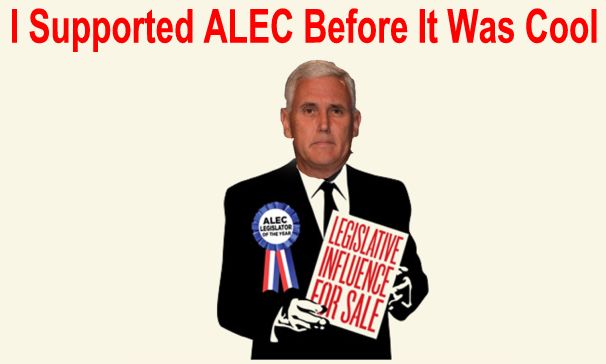
Pence was no stranger to the stage of ALEC, a corporate-funded behemoth that drafts bills and finds right-wing lawmakers to carry them. He’s been an ALEC fixture for years, touting deregulation, privatization and extreme social conservatism. But he’s best-known for a personal focus on supplanting traditional public education, notably embracing taxpayer-funded vouchers so parents can send kids to K-12 private schools and aggressively expanding privately run charter public schools.
As is typical at ALEC, Pence praised enterprise and deregulation, and said a Trump administration would result in “empowering states with resources and flexibility.” But a closer look at his Indiana record of privatizing education, where the ALEC model has been in play, has shown it to be a brazen and failed experiment.
Charter School and Voucher Problems
A recent National Public Radio profile of Pence’s education record noted that he has been one of the leading governors pushing K-12 privatization. “Under Gov. Pence, the growth in the number of charter schools and the use of private school vouchers have exploded,” it said. “After the voucher program survived a state Supreme Court challenge in 2013, it’s grown into one of the largest in the country. Pence helped to do that by advocating to expand the program to include middle-income, not just low-income families, and also by removing the cap on how many students qualify.”
Yet this May, when WTHR, Indianapolis’ NBC-TV affiliate, looked at the charter school experiment, it  found that “nearly half of the state’s 76 charter schools are doing poorly or failing.” The scores were based on the state’s new accountability standards.
In one example, reporters quoted sources from Indiana Science Academy West who said, “Nothing is taught… nothing is learned,” and cited “unlicensed teachers,” high staff turnover Mike Pence Has Pushed Hard for School Privatization With Lousy Results - BillMoyers.com:


Hoosier School Heist TV is Doug Martin's channel featuring videos of his book tour across Indiana speaking on the corporate takeover of public education. Order Hoosier School Heist at http://hoosierschoolheist.com/.
Follow Hoosier School Heist on Facebook: https://www.facebook.com/HoosierSchoolHeist
Tweet with Doug Martin at: https://twitter.com/DougMartinED

CURMUDGUCATION: How Do Unions Really Affect Schools?

CURMUDGUCATION: How Do Unions Really Affect Schools?:

How Do Unions Really Affect Schools?


Back in February, Eunice Han at Wellesley College put out a paper entitled "The Myth of Unions' Overprotection of Teachers: Evidence from the District-Teacher Matched Panel Data on Teacher Turnover." Han reaches some really interesting and, perhaps for some folks, counter-intuitive findings, and they're worth a look.

But full disclosure right up front-- I can't really make sense out of her methodology. Han takes sixteen pages just to explain how she did what she did, and it includes all sorts of economist equationing and data mumbo-jumbo that is just plain beyond me. Things like this:


Han has a Ph.D. from Harvard and she has, no kidding, an impressive bucket list. And I can follow the reasoning behind her data crunching, but not the crunching itself. And if her findings seem vaguely familiar, it's because they have been covered elsewhere (check out this interview with Han from Edushyster). But there are some pieces of research that are worth re-blogging about. You say "redundant;" I say "amplifying the message."

So here are the conclusions Han reached with her data crunching.

Union Strength Affects Teacher Pay-- But So Do Other Factors

Much to nobody's surprise, districts with stronger collective bargaining units end up with higher-paid teachers. Generally that "wage premium" is paid for teachers with the most experience.

However, there are other factors that figure in. Districts with a high percentage of minority students pay their teachers more. But teachers who work in districts with a large student population, and teachers who work in districts with a large free/reduced lunch enrollment are paid 
CURMUDGUCATION: How Do Unions Really Affect Schools?:


AFT’s Weingarten on Calif. Supreme Court’s decision to decline to hear Vergara | American Federation of Teachers

AFT’s Weingarten on Calif. Supreme Court’s decision to decline to hear Vergara | American Federation of Teachers:

AFT’s Weingarten on Calif. Supreme Court’s decision to decline to hear Vergara  


WASHINGTON—American Federation of Teachers President Randi Weingarten on the California Supreme Court's decision to reject the plaintiffs' petition for review in Vergara v. California.
"I am relieved by the court's decision declining an appeal of the unanimous California Court of Appeal ruling upholding California educators’ due process rights. The billionaire-funded attack, from its inception, tried to pit our children against their teachers—people who make a difference in our children's lives every day—rather than understand and solve the real problems ailing public education. Now that this chapter is closed, we must embrace our shared responsibility to help disadvantaged kids by supporting them so they can reach their full potential. While that starts with teachers, it also means providing programs and services that engage students and address their well-being.
"I hope this decision closes the book on the flawed and divisive argument that links educators’ workplace protections with student disadvantage. Instead, as the expert evidence clearly showed—and the Court of Appeal carefully reasoned—it was the discretionary decisions of some administrators, rather than the statutes themselves, that contributed to the problems cited by the plaintiffs.
"It is now well past time that we move beyond damaging lawsuits like Vergara that demonize educators and begin to work with teachers to address the real issues caused by the massive underinvestment in public education in this country. The state of California, like many others, remains in the throes of a serious teacher shortage. We need to hire, support and retain the best teachers, not pit parents against educators in a pointless blame game that does nothing to help disadvantaged students pursue their dreams."

# # # #
The AFT represents 1.6 million pre-K through 12th-grade teachers; paraprofessionals and other school-related personnel; higher education faculty and professional staff; federal, state and local government employees; nurses and healthcare workers; and early childhood educators.
- See more at: http://www.aft.org/press-release/afts-weingarten-calif-supreme-courts-decision-decline-hear-vergara#sthash.ZruIIJjh.FBzny4n6.dpuf


Contact:

Andrew Crook
202-393-8637
acrook@aft.org

Without local school boards, parents in poor communities lose their vote

Without local school boards, parents in poor communities lose their vote:

Without local school boards, parents in poor communities lose their vote

ing Wars,” an investigation of voting rights and election participation, is the 2016 project of the Carnegie-Knight News21 program, a national multimedia, investigative reporting project produced by the nation’s top journalism students and graduates. Each year, students selected into the program report in-depth on a topic of national importance. This story was reprinted with permission.
In at least 20 states, lawmakers have stripped locally elected school board members of their power in impoverished, mostly minority communities, leaving parents without a voice – or a vote – in their children’s education, according to a News21 state-by-state analysis of school takeovers.
More than 5.6 million people live in places where state officials took over entire districts or individual schools in the past six years, according to News21 data collected from state government agencies. About 43 percent are African-American and around 20 percent are Hispanic. On average 29.2 percent of people in those areas are living below the poverty level. The U.S. average is 15.5 percent.
In Highland Park, Michigan, where grass grows knee-high around decaying, long-abandoned schools, the state turned the troubled suburban district over to a private company and shut down the city’s only high school.
“As a voter, what do you do when they stole your vote?” said Danielle Floyd, a mother in Highland Park. “I can’t say that we can go out and vote. Because we’ve done that. And it didn’t work.”
In the Delta town of Drew, Mississippi, education advocates say there aren’t enough books to go around four years after state legislators consolidated the small school system into a countywide district.
In Little Rock, Arkansas – a historic symbol of school desegregation – black parents worry that the city’s schools once again are becoming segregated. They say their concerns have fallen on the deaf ears of the state, which removed the city’s school board more than a year ago.
And in New Orleans, the majority of the public schools are under the jurisdiction of the state, but charter companies make most of the educational decisions, a trend that was further accelerated after Hurricane Katrina in 2005. Charter schools are tuition-free, independently operated public schools.
Typically in a school takeover – sometimes referred to as “intervention” – a state will assume broad authority over a district, dramatically reducing and sometimes eliminating the power of a local school board, elected by community constituents.
“It feels like we don’t have much control over our kids education and how they’re being educated,” said Lashanda Mayberry, another Without local school boards, parents in poor communities lose their vote:


Big Education Ape: New Orleans tries to mix charter schools with democracy: Is this the district of the future? - The Washington Post -http://bigeducationape.blogspot.com/2016/05/new-orleans-tries-to-mix-charter.html

BREAKING: CA Supreme Court Will NOT Review Vergara Ruling | deutsch29

BREAKING: CA Supreme Court Will NOT Review Vergara Ruling | deutsch29:

BREAKING: CA Supreme Court Will NOT Review Vergara Ruling


The case of Beatriz Vergara et al. vs. the State of California et al. has been working its way though the courts for over four years now, since May 14, 2012.
The journey is over. Petition denied:
The petition for review is denied. Chin, Liu and Cuéllar, JJ., are of the opinion the petition should be granted. STATEMENT by Cantil-Sakauye, C. J. The court, recently having resumed issuing, from time to time, statements by one or more justices dissenting from the denial of a petition for review, has adopted a policy that such statements, when they pertain to an appellate court opinion that has been published in the Official Reports, will also be published, appended to the original appellate court opinion in the Official Reports. With these policies now in place, separate statements will afford members of the court an opportunity to express their views regarding the denial of a petition for review, but of course any separate statement represents the views solely of the authoring justice or any justice signing the statement. In addition, it remains the case that an order denying review does not reflect the views of the justices voting to deny review concerning the merits of the decision below. Rather, an order denying review represents only a determination that, for whatever reason, a grant of review is not appropriate at the time of the order. (See People v. Davis (1905) 147 Cal. 346, 349-350; see also, e.g., People v. Triggs (1973) 8 Cal.3d 884, 890-891.) Similarly, that a justice has not prepared, responded to, or joined a separate statement should not be read as reflecting the views of that justice concerning any separate statement that has been filed by any other justice. Werdegar, Chin, Corrigan, Liu, Cuéllar and Kruger, JJ., concur.
DISSENTING STATEMENT by Liu, J. This case concerns the constitutionality of California’s statutes on teacher tenure, retention, and dismissal. The plaintiffs are nine schoolchildren – Beatriz Vergara, Elizabeth Vergara, Clara Grace Campbell, Brandon Debose, Jr., Kate Elliott, Herschel Liss, Julia Macias, Daniella Martinez, and Raylene Monterroza – who attend California public schools. They allege that these statutes lead to the hiring and retention of what they call “grossly ineffective teachers” (i.e., teachers in the bottom 5 percent of competence) and that being assigned to a grossly ineffective teacher causes significant educational harm. Plaintiffs further allege that they have suffered or are at risk of suffering these harms and that the harms fall disproportionately on minority and low-income students. After hearing eight weeks of evidence, the trial court ruled that the challenged statutes violate the equal protection clause of the California Constitution (Cal. Const., art. I, § 7, subd. (a)), noting that the evidence of detrimental effects that grossly ineffective teachers have on their students “is compelling” and “shocks the conscience.” The Court of Appeal reversed, holding that plaintiffs failed to establish a viable equal protection claim. (Vergara v. State of California (2016) 246 Cal.App.4th 619 (Vergara).) Plaintiffs now seek this court’s review. One of our criteria for review is whether we are being asked “to settle an important question of law.” (Cal. Rules of Court, rule 8.500(b)(1).) Under any ordinary understanding of that criterion, our review is warranted in this case. As the trial court observed: “All sides to this litigation agree that competent teachers are a critical, if not the most important, component of success of a child’s in-school educational experience. All sides also agree 
BREAKING: CA Supreme Court Will NOT Review Vergara Ruling | deutsch29:
 Image result for big education ape Vergara


State Supreme Court declines to take up Vergara case, which targeted teacher job protections | 89.3 KPCC - http://www.scpr.org/news/2016/08/22/63829/state-supreme-court-declines-to-take-up-vergara-ca/


Julian Vasquez Heilig Debates Howard Fuller about School Choice | Diane Ravitch's blog

Julian Vasquez Heilig Debates Howard Fuller about School Choice | Diane Ravitch's blog:

Julian Vasquez Heilig Debates Howard Fuller about School Choice


Julian Vasquez Heilig, professor at Sacramento State, researcher, and prominent blogger, debates Howard Fuller, leader of BAEO (Black Advocates for Educational Opportunity). BAEO is funded by the Walton Family Foundation, the Bradley Foundation, and other rightwing foundations.
The debate focuses on the recent decision by the NAACP annual conference and by Black Lives Matter to call for a moratorium on new charters, because of the harm done to black communities.
Julian, a leader of the NAACP education division in California, is highly critical of charter schools because of their lack of accountability and their private management; Fuller supports school choice as the best way to help all black children.