Latest News and Comment from Education

Friday, July 15, 2016

After Being Ordered To Consolidate, District Argues It Would Create White Flight | ThinkProgress

After Being Ordered To Consolidate, District Argues It Would Create White Flight | ThinkProgress:

After Being Ordered To Consolidate, District Argues It Would Create White Flight


five-decade fight to desegregate the schools in a small Mississippi town continues, as the school district is appealing a federal court order for the district to combine its two high schools and two middle schools.
Two of the school district’s schools, a middle school and a high school, are overwhelmingly black. As of May of last year, in fact, every single child enrolled at the Cleveland school district’s high school was black. The federal judge presiding over the case concluded that consolidating schools would allow the “greatest degree of desegregation possible” in the county.
The school district is appealing this decision, however. The school board’s three white board members voted to appeal while its two black board members voted against it, according to the Washington Post. The school board’s lawyer, Jamie Jacks, told the Post that “the district has the most integrated classrooms of any school district in the area,” and that school consolidation would result in white flight from the schools.
Although these two schools continue to be racially isolated, the school district has been ordered to desegregate through various reforms. A 1969 court order instructed the school district to divide into attendance zones to ensure diversity in schools. But in the 1980s, the U.S. Department of Justice filed a complaint claiming some of the school district's policies were still standing in the way of integration.
The Cleveland school district certainly isn't alone. There are a lot of school desegregation cases that remain open decades after they first began. ProPublica took a close look at these desegregation orders in 2014 and found that, although many court orders have been lifted over the past 15 years, some still remain open. The highest number of these cases, both voluntary and court-ordered desegregation cases, were concentrated in Alabama, Georgia, and Mississippi.
For instance, there has been a lawsuit against the Avoyelles Parish School Board in Louisiana for almost 50 years by now. Last year, a desegregation order from the U.S. Department of Justice laid out the various policies and expectations the Avoyelles Parish school system must meet. Critics of Louisiana's school voucher program say that the program is increasing school segregation.
There were still fairly high numbers of open cases in New York, California, and Connecticut, however. Looking at the national picture, a high percentage of students of color attend segregated schools. A study released in 2012 from the University of California, Los Angeles, found that 43 percent of Latino students and 38 percent of black students in the U.S. attend schools where fewer than 10 percent of their classmates are white. More than one in seven black and Latino students attend "apartheid" schools or schools where less than 1 percent of their classmates are white.
Recent U.S. Supreme Court cases haven’t aided efforts to desegregate. The court ruled public school assignment plans would not “take account of students’ race” in a 2007 case affecting students in Louisville, Kentucky and Seattle, effectively hamstringing many school districts' efforts to make their schools more diverse.After Being Ordered To Consolidate, District Argues It Would Create White Flight | ThinkProgress:


Rally for Education Justice—Are We Winning? | The Progressive

Rally for Education Justice—Are We Winning? | The Progressive:

Rally for Education Justice—Are We Winning?


 With the sound of jet engines booming overhead, a crowd of about 800 people gathered at the Lincoln Memorial last week to advocate for “the people’s education.”  The People’s March for Public Education and Social Justice took place in the middle of a political “no-fly” zone in Washington, DC. Democrats and Republicans alike have largely avoided the issues raised by the People’s March. But at the grassroots level, the backlash against bipartisan, corporate education reform has grown too big to ignore.  High-stakes testing, crackdowns on teachers unions, and the massive growth of privately controlled charter schools that undermine local neighborhood schools—especially in low-income, non-white communities—drove hundreds of activists to come out and protest.

Speakers including education historian Diane Ravitch and best-selling author and education justice advocate Jonathan Kozol denounced the assault on teachers and students taking place in schools, calling out a culture of "test and punish" that strips teachers of their professionalism and robs children of the joys of learning.
North Carolina's Reverend William Barber, of the Moral Monday Movement, and Keron Blair, who directs the Alliance to Reclaim Our Schools also spoke, placing the fight to save public schools firmly in the intersection of civil rights and social justice movements represented by Black Lives Matter, Fight for $15, and other popular progressive causes.
All agreed that current education policies—often referred to as “reforms”—impose a mandate from policy elites and wealthy foundations that are blind to the impacts  of their ideas on school communities, and deaf to the voices of those who oppose them. The group called for equitable funding across all public schools, an end to high-stakes testing, strong local leadership, and support for professional, qualified, and committed teachers.
Since the early days of the Obama administration, the pushback against prevailing education policies coming from the Beltway has been an inconvenient noise in the Democratic Party. Once it became apparent that the Obama Administration would maintain a “Washington consensus” on the education policies it inherited from George W. Bush, Rally for Education Justice—Are We Winning? | The Progressive:

Amid Changing Mandates, Colorado Schools Work to Get Parents Involved

Amid Changing Mandates, Colorado Schools Work to Get Parents Involved:

Amid Changing Mandates, Colorado Schools Work to Get Parents Involved


 Numerous studies have shown that low-income parents tend to participate less in their children’s educational experience than parents with higher incomes. For more than 50 years, the U.S. government has been trying to change that by offering funding to increase parent involvement in low-income schools. In Colorado, one school district began implementing programs to address the issue after learning it was not in compliance with federal requirements – programs that continue today even as federal legislation evolves.

Since 1965, with the passage of the Elementary and Secondary Act (ESEA), Congress has tied parent involvement to federal education funding. This trend continued with the No Child Left Behind Act of 2002 and then the Every Student Succeeds Act of 2015. While states and counties grapple with changing federal requirements, outreach coordinators in Thompson School District in Loveland, Colo., are primarily focused on building strong, personal relationships with parents and giving them input and leadership opportunities in their local parent-engagement programs.
Low-income parents face demographic and psychological barriers to participating in their child’s education, as well as language and cultural barriers, according to the American Counseling Association.
However, these barriers are not insurmountable. A 2013 literature review by the research institute MDRC.orgconcludes: “Parents from diverse backgrounds, when given direction, can become more engaged with their children.” This review looked at learning activities at home, family involvement in schools, school outreach to engage families and supportive parenting activities.
In the Thompson School District, two schools in particular have used federal funding to engage parents in creative ways. At Truscott Elementary, Spanish-speaking parents started a “Café Con Leche” group to socialize and plan ways to help at school. At Winona Elementary, in the same district, “Padres en Acción” formed to provide training for parents, enabling them to tutor children at home and to serve as tutors inside the school.
Federal parent-involvement funds help to increase parent engagement. One direct way is by outreach staff that help parents support their children’s learning. In 2002, when Congress passed the No Child Left Behind (NCLB) bill, each school district receiving NCLB funds was required to use up to 1 percent of its federal funds for activities, materials and resources that improved parent involvement.
Under the “Every Student Succeeds Act” (ESSA), accountability for those dollars will change from federal hands to state and local hands. Opinions differ on the merits of this change, but the most important thing, according to Michelle Myers, the family outreach liaison at Truscott and Winona Elementary schools in Loveland, is that outreach must be positive and personal to strengthen parent partnerships.
Getting into Compliance
In the first years of NCLB, federal reviewers found that Colorado and other states’ schools were not complying with parent notification and participation requirements. The Colorado Department of Education (CDE) provided support and guidance to help local districts to comply. The first use of parent involvement funds in the early years of NCLB at Thompson School District was for part-time wages to family outreach liaisons who served as Spanish language interpreters at all the district’s Title I schools.
Many schools in the district offered a “menu” of ways for parents to help their children at home and at school. Still, principals found it difficult to recruit diverse and disadvantaged parents to serve on committees or to volunteer in school.
Myers helped the principals of Truscott and Winona Elementary schools to manage parent participation in school planning and decision-making as well as the use of federal parent-involvement funds.
Her teammates, Gloria Major and Claudeth Castellanos, did similar work in other schools within Thompson School District. Their Spanish language fluency and positive relations with parents help them make personal invitations to school events. When they can, they accompany Spanish-speaking parents and call to get feedback, Myers said.
“I spend time with every parent to discuss the school’s responsibility to involve them in the education of their children,” Myers said. “Special education staff and the English language acquisition teachers also look for Amid Changing Mandates, Colorado Schools Work to Get Parents Involved:

San Ysidro School District teachers ripped off? | San Diego Reader

San Ysidro School District teachers ripped off? | San Diego Reader:

San Ysidro School District teachers ripped off?
County education board superintendent suspected of malfeasance


 In 2014, the board of the San Ysidro School District told the teachers it was nearly broke and asked them to swallow a pay cut of 8 percent. The teachers went on strike, then settled for 1 percent, but now they are demanding money back.

In a claim filed July 1, they say that the board hid deep in a books and supplies account some $4 million that would have covered a decent pay hike. Moreover, the county office of education, overseer then of the district's chaotic finances, failed to take notice. In fact, the teachers allege, two top county education officials "purposely hid" the money to make the district financial picture look "more dire than it was."
Such "misleading and deceitful actions," according to the claim filed with the county board of education, forced the strike "when there were funds available to prevent" it.
Randolph E. Ward
As they press for their losses to be restored, members of the teachers' bargaining unit, the San Ysidro Education Association, are calling for the resignations of county school superintendent Randolph E. Ward and a top aide, Lora Duzyk, whom allegedly was directly involved in overseeing district finances. The teachers' association president, Guillermina Sandez, told the school board the two county officials' actions amounted to "institutionalized racism" against poor Latino youth.
Meanwhile, a call for the resignations of Ward and Duzyk came July 7 from another quarter, the California Taxpayers Action Network. As reported in La Prensa, the network filed a lawsuit alleging that superintendent Ward set things up so that he and Duzyk could receive pay raises without performance reviews.
The complaint alleges that the superintendent tied his salary hikes to those of county office of education teachers and, since he negotiated the teachers' contracts, had an inherent conflict of interest. Duzyk, the court filings note, was paid by the San Ysidro district as its overseer from 2013 to 2015 and saw her salary jump 6 percent while she advocated cuts for the San Ysidro teachers.
And a report issued May 24 by the San Diego County Grand Jury calls for an "independent forensic audit" of the San Ysidro School District, noting that hundreds of millions in long-term debt had been amassed "with little to show for it." The grand jury report said the district has ignored citizens' requests made as far back as 1998 to form a bond-oversight panel. Voters in 1997 had approved a $250 million bond issue, and it would not be until three years later before a state law took effect requiring citizen oversight.
Among other irregularities noted by the grand jury:San Ysidro School District teachers ripped off? | San Diego Reader:

Do charter schools have advantages that accelerate brain drain?

Do charter schools have advantages that accelerate brain drain?:

Do charter schools have advantages that accelerate brain drain?


Do more charter schools have certain built-in advantages that lead to socio-economic segregation in public education, thus making the job of traditional public schools that much harder?
Some local school administrators certainly think so, but charter supporters are calling foul.
As families with the economic means and the motivation to enroll and send their child to a charter school that may be located outside the region do so, local superintendents say, it can leave districts with a higher proportion of less-advantaged and poorer children who aren’t able to do the same.
Indeed, the main reason many families who left the Gill-Montague Regional School District for School Choice or charter schools gave for doing so, were concerns about the peer-to-peer interaction between their children and other students, wrote Superintendent Michael Sullivan in a letter to state Senate President Stanley Rosenberg last year urging him to oppose raising the current 120-school limit on new or expanded charter schools in Massachusetts.
Sullivan said that scenario can become cyclical: “My concern is that this dynamic could lead to a negative cycle ... resulting in higher concentrations of underserved students in the districts they leave,” Sullivan said. “This in turn could lead to even greater interest in leaving for schools where parents perceive there will be a higher percentage of students who come from more advantaged circumstances.”
He said that trend could leave his district with a disproportionate number of students who have a harder time doing well in school.
Tamara Grogan, a Greenfield High School French teacher and member of the board at Greenfield’s Four Rivers Charter Public School, doesn’t deny some of those concerns may have validity, especially when it comes to parental motivation and transportation.
Savvy parents

“The place where the playing field is not level is in applications. That’s a valid criticism. If you’re a parent who’s willing to fill out a piece of paper, you’re different from a parent who is not willing to do so,” she said. “(District schools) have to bus everyone in, and (Four Rivers) doesn’t have to. The experience I’ve had though is most parents who are living out of the area are doing things to get there… carpooling… they’re finding ways.”
But Grogan said most local district schools can take advantage of state and federal grant programs to build or repair facilities, and that’s less common in charter schools. Four Rivers had to foot the entire $5.8 million cost of purchasing the campus and constructing its main instructional building, Peter Garbus, the principal, said. The state school building assistance bureau contributes about three quarters of school construction costs.
“Does Four Rivers have a gym? Does it have an auditorium? No,” Grogan said. “Does it have an art studio or a big music room? No. It has a rusty barn with a concrete floor, and that’s where they do all the gym stuff when it’s raining outside.”
Cherry picking?

Beyond just economic stratification, many critics of charters schools also accuse them of being able to artificially “cherry-pick” the students who attend their schools, either reducing the number of special needs students they accept by failing to offer adequate programming for them or by encouraging students with low academic performance to transfer back to their home district through strict discipline policies.
Four Rivers’ wait list currently has 74 students on it.
But according to state education data, that doesn’t appear to be the case in Franklin County, at least.
Garbus said the student demographics at his school largely mirror those of the county at large.
By race, data from DESE for 2015 shows that Four Rivers’ 217-student population included about half as many African American students as the county overall, according to federal census data, but nearly twice the number of both Asian and Hispanic students. Eighty-five and a half percent of the school’s students are white compared to 94.1 percent of the county’s total population.
By educational subgroup, the state’s Charter Analysis and Review Tool shows that Four Rivers, in Do charter schools have advantages that accelerate brain drain?:


Thursday, July 14, 2016

Mike Klonsky's SmallTalk Blog: Ed activists enter the lion's den, win some important concessions

Mike Klonsky's SmallTalk Blog: Ed activists enter the lion's den, win some important concessions:

Ed activists enter the lion's den, win some important concessions

In an unexpected move, Democrats have revised the K-12 education section of their party’s 2016 platform in important ways, backing the right of parents to opt their children out of high-stakes standardized tests, qualifying support for charter schools, and opposing using test scores for high-stakes purposes to evaluate teachers and students. -- Washington Post
Party platforms mean little and are usually forgotten the day after the election. This year's platform fight within the Democratic Party is more significant than usual because it reflects the struggles of real movements on the ground -- the Fight For 15 Movement, for example -- and because of the realignment of forces within both major political parties.


Dem platform now supports Opt-Out
Throughout the primary campaign, Sanders continually tried to drag Clinton leftward on policy. Leading up to the national convention, Sanders insisted that the party adopt “the most progressive platform ever passed.” That may be a low bar, but it did.

For the first time, after intense internal debate between the Clinton and Sanders factions, the DNC's platform committee backed the unqualified inclusion of the $15 minimum wage as the official policy of the party. They also dropped their statement of support for TPP.

With education activists like Chicago's Troy LaRaviere leading the way, the Sanders forces wrung concessions from Clinton loyalists and came away with an education plank that broke from the current administration's outright support for privately-run charters and high-stakes testing. The party is now on record in its support for the opt-out movement of parents and Mike Klonsky's SmallTalk Blog: Ed activists enter the lion's den, win some important concessions:


California Floats Multiple Measures for Grading Schools - Living in Dialogue

California Floats Multiple Measures for Grading Schools - Living in Dialogue:

California Floats Multiple Measures for Grading Schools

By Anthony Cody.
This week leaders in the California Department of Education released a new system for “grading schools”that proposes to assign schools a set of colored indicators based on a variety of measurements. This system is intended to replace the old system of performance indicators which gave schools a single numeric score, (the Academic Performance Index, or API) based only on test scores. While this new system brings us elements of that long sought goal of “multiple measures,” I fear that we have yet to escape the box of the “measure to manage” paradigm.
Over the past eight years the state of California has resisted some of the worst aspects of Federal reform. The state resisted federal pressure to tie teacher evaluations to student test scores, and Jerry Brown was a vocal critic of Arne Duncan’s Race to the Top, as indicated by his statement in 2009. In more recent years, Brown has restructured school funding, to direct resources to school districts based on student needs, as influenced by factors such as poverty and the proportion of language learners enrolled.
But the state – and our state teacher union, the California Teachers Association, have also embraced the Common Core (renamed “California Standards” last year.) With cooperation from the state university system, the California Teachers Association and funding from the Gates Foundation, teachers have been treated to days devoted to celebrating the Common Core. This year teachers will get yet another day-long Gates-funded Common Core festival, though once again they are the national standards that dare not speak their name.
California teachers and students have been told that a new and much improved accountability system is in the works, and now the draft has finally arrived. The mandate for this system is in regulations created by the federal Department of Education, which asks states to create a system to show “Measures of School Quality,” described this way:
Increased state flexibility to take a more holistic view of school performance based 
California Floats Multiple Measures for Grading Schools - Living in Dialogue:

The bigot Mike Pence and his neighbor Bruce Rauner. | Fred Klonsky

The bigot Mike Pence and his neighbor Bruce Rauner. | Fred Klonsky:

The bigot Mike Pence and his neighbor Bruce Rauner.

pence2

-By John Dillon. John blogs at Pension Vocabulary.
This post from March of 2015 is a reminder of the bizarre political philosophies that drive dangerous characters like soon-to-be-named VP candidate Governor Pence of Indiana and their fellows in other states – like Illinois. 
Governor Rauner’s “role model.”, according to Crain’s editorial board, is Mitch Daniels.   He told them so in March of 2014. In addition, the private equity manager/governor of Illinois has hired the chief legal counsel from Indiana (Jason Barclay) in order to have the same man who whispered in Mitch Daniels’ ear murmuring in his.
Wisely, Rauner is circumspect in emulating his idol Daniels, now the president of Purdue University, where the past governor has been battled for his attempts to remove Howard Zinn’s works from the curriculum…and now, for too swiftly moving the university’s professorial staff into a standardized corporate style testing of students’ growth per year – one linked to performance measurements for them and teachers.
In the last week, Indiana passed into law a religious objections bill, one that has come with some rather unexpected opposition from corporations and The bigot Mike Pence and his neighbor Bruce Rauner. | Fred Klonsky:


My disappointment with the amended Democratic platform - NYC Public School Parents:

NYC Public School Parents: My disappointment with the amended Democratic platform: "group mentoring" instead of class size reduction?:

My disappointment with the amended Democratic platform: "group mentoring" instead of class size reduction?


There has been much discussion of the recent amendments made to the Democratic platform.  See the video below of delegates including Pennsylvania attorney Chuck Pascal , Troy LaRaviere, head of the Chicago Principals and Administrators Association, Randi Weingarten, President of the AFT, and others proposing and approving changes to the original, highly flawed document

Clearly there have been substantial improvements, pointing out the destructive impact of high-stakes testing, particularly on students of color and the schools they attend, proposing that parents have the right to opt out testing, and describing  the destabilizing influence from the unchecked rapid expansion of charters.  See Valerie Strauss on the amendments, as well as a transcript of the discussion that occurred here.  

Some of the language seems to have been influenced by the petition to the Democratic Party posted by the Network for Public Education Action.  (Full disclosure:  I'm on the board of NPE.)  Corporate reformers including  Peter Cunningham, former press secretary to Arne Duncan,  and Shavar Jeffries of Democrats for Education Reform expressed predictable outrage.

At the same time, public school teachers and bloggers like Peter Greene pointed out that the platform only opposes for-profit charters, even as the distinction between for-profit and non-profit charters is often hazy, as non-profits can contract with for-profit operations to run their schools.  See also this excellent Pro Publica report for more on this issue.

And although the amended platform specifically calls for charter schools to be obligated to "reflect their communities, and thus must accept and retain proportionate numbers of students of color, students with disabilities and English Language Learners in relation to their neighborhood public schools" this has been the law in New York since 2010 -- without any real attempt to enforce it. 


Democrats on Charters and Testing from Schoolhouse Live on Vimeo.


There are other  aspects of the platform that I find disappointing still. It contains a proposal to fund group mentoring, which is described as a NYC Public School Parents: My disappointment with the amended Democratic platform: "group mentoring" instead of class size reduction?:


antiracismdsa: We Won ! Chicano History Will be in the California Textbooks in 2017

antiracismdsa: We Won ! Chicano History Will be in the California Textbooks in 2017:

We Won ! Chicano History Will be in the California Textbooks in 2017

By Duane Campbell
History and social science textbooks in public schools in California and most of the nation are racist, class-biased, and ignore LGBT history. This condition will change in California in 2017 when new textbooks are adopted.

It is over. We won !

 At 2:45 PM today the California State Board of Education unanimously endorsed a new History /Social Science Framework for California’s public schools that includes a substantial addition of Chicano/Latino history, improved history of LGBT people, and improvements in several other histories.
This completes a 6 year effort against substantial opposition to revise the Framework.  As a result textbooks in California in 2017 will be the most inclusive ever required, and all students will be taught an inclusive history. This has been the major campaign of this blog and the Mexican American Digital History project since 2009. 

Under this decision California students will finally be encouraged to know the history of Latino civil rights leaders like Cesar Chavez and Dolores Huerta and Filipino labor leaders like Larry Itliong, as well as an accurate and inclusive history of LGBT activists  as a part of the history of California and the nation. These topics are currently substantially absent from public school textbooks and curricula in California.
The Quality Instructional Materials Committee of the  California State Board of Education decided to include these long- ignored histories in their re-writing of the History/Social Science Framework for the state.  The Framework  document sets the parameters and the minimums required of textbooks used  in the schools.  Because of California’s large size and market, what goes into California textbooks  frequently also gets written into textbooks around the nation.

In the current books, when the 51%  of students who are Latino, the 11.5% who are Asian, and the estimated 11% of students who are LGBT, do not see themselves as part of history, for many their sense of self is  marginalized.  As I argued in a prior book, marginalization negatively impacts their connections with school and their success at school. This has resulted in a nearly 50% dropout rate for Latinos and some Asian groups  and LGBT students.. School marginalization also contributes directly to low-level civic engagement.  An accurate history would provide some of these  students with a  a sense of self, of direction, of purpose. History and social science classes  should help young people acquire and learn to use the skills, knowledge, and attitudes that will prepare them to be competent and responsible citizens throughout their lives.  

 As a consequence of the current  outdated history texts for California public schools, most schools, most teachers,  fail to teach an accurate, complete, complex  history of the Chicano- Latino people, of Asian Americans and of LGBT youth, among others.   This essentially means that the writers are choosing not to recognize reality. – not to tell the full story. 
And, while California and the nation have a general problem with low civic antiracismdsa: We Won ! Chicano History Will be in the California Textbooks in 2017:


SBE News Release for July 13, 2016 - State Board of Education (CA Dept of Education)

SBE News Release for July 13, 2016 - State Board of Education (CA Dept of Education):

Board Sets Balance of State and Local Measures to Hold Schools Accountable

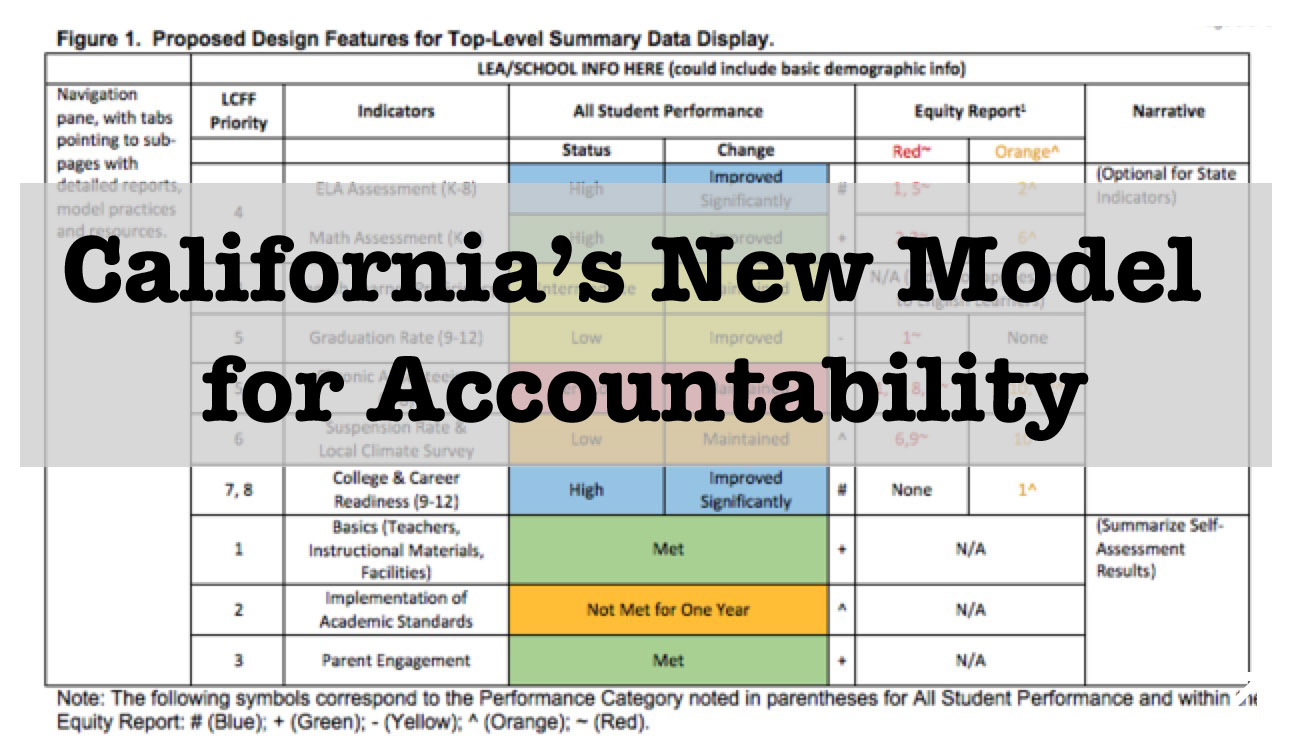
The state's proposed school report card, as of Wednesday, July 13.
The California State Board of Education today affirmed state and local measures of progress for California’s new school accountability system. In addition to scores on standardized tests in English and math, schools will be held accountable for students’ college and career readiness, proficiency for English learners, graduation rates, chronic absenteeism, suspension rates and school climate, basic conditions at a school, implementation of academic standards, and parent engagement.
The board intends to adopt evaluation rubrics supporting the new accountability system in September 2016 so educators, parents and stakeholders have a clearer picture about how local schools are serving students. A lack of progress for subgroups of students within educational agencies will be highlighted in an equity report and signal the need for support and intervention from county offices of education and the state superintendent of public instruction.
"Improving school accountability is a priority set by the Governor and Legislature under the new school funding formula. In this first year, we have a limited set of options for measuring performance across all of California’s 10,000 school sites. Overall much greater access to information about school performance will be available beginning in 2016-17, although we anticipate improvements to this system over time," explained California State Board of Education president Michael Kirst.
In California's new school funding and accountability system, more students, parents, educators and stakeholders are involved in educational decision-making than ever before. An initial online top level summary display (DOC) presented by the staff highlights the state’s educational priorities, and once finalized it will be available for each school. More detailed reports and resources for improving outcomes for local students also will be available online. In addition, an equity report is included in the display that will purposely highlight any significant lack of progress for specific student subgroups to promote equity.
Today's board discussion focused the state’s requirements. The federal government now is working to finalize regulations for its Every Student Succeeds Act, the new federal accountability law. Board members cautioned against recreating "No Child Left Behind tripwires" and spoke in favor of preserving local flexibility.
"California is at the forefront nationally in establishing one coherent school accountability system that supports local, state and federal requirements. Our goal is to establish one system that holds schools accountable for progress, maximizes data to those closest to students and classrooms, and makes access as user-friendly as possible," Kirst said.
The 2016-17 State Budget includes $24 million for the California Collaborative for Educational Excellence (CCEE) to provide training for educators and stakeholders to support the effective use of the evaluation rubrics and local accountability plans. The CCEE will work to facilitate the broad use of data to empower local decision-making processes and ensure that resources are efficiently allocated to improve student outcomes. The law requires that the training will begin after the California State Board of Education adopts the evaluation rubrics and no later than October 16, 2016.
###
The board unanimously approved the following motion.
Staff recommend that the SBE take the following action related to the design of the LCFF evaluation rubrics:
  1. Approve a measure of college and career readiness, as specified in Attachment 1, including:
    1. Adopting the College and Career Indicator (CCI), which combines Grade 11 test scores on English Language Arts (ELA) and Math and other measures of college and career readiness, as a state indicator (formerly called “key indicators”)[1];
    2. Using the CCI to establish standards for Priority 7 (Access to Broad Course of Study) and Priority 8 (Outcomes in a Broad Course of Study) based on the approved methodology of calculating performance for state indicators;
    3. Modifying the state indicator for student test scores on ELA and Math (Priority 4 – Pupil Achievement), approved at the May 2016 Board meeting, to remove the Grade 11 scores, in order to avoid double-counting those test scores in two state indicators; and
    4. Directing staff to prepare a recommendation for the September 2016 Board meeting on the final technical specifications for the CCI.
  2. Approve a methodology for establishing standards, as specified in Attachment 2 for:
    1. Priority 1 (Appropriately Assigned Teachers, Access to Curriculum-Aligned Instructional Materials, and Safe, Clean and Functional School Facilities),
    2. Priority 2 (Implementation of State Academic Standards),
    3. Priority 3 (Parent Engagement),
    4. County Office of Education (COE) Priority 9 (Coordination of Services for Expelled Students), and
    5. COE Priority 10 (Coordination of Services for Foster Youth).
  3. Approve inclusion of a standard for the use of local climate surveys to support a broader assessment of performance on Priority 6 (School Climate), as specified in Attachment 2.
  4. Approve inclusion of an Equity Report, which identifies instances where any student subgroup is in the two lowest performance categories (currently Red or Orange) on a state indicator, within the top-level summary data display, as specified in Attachment 4.
  5. Direct staff to develop, in advance of the September 2016 meeting, a proposed timeline through the end of the 2017 calendar year that addresses the further developmental work after approval of the initial phase of the evaluation rubrics, including, but not limited to:
    1. the state and local indicators,
    2. standards for the state indicators and/or LCFF priorities,
    3. the statements of model practices, and
    4. the alignment of elements included in the ESSA state plan with the LCFF evaluation rubrics.
Big Education Ape: 'Get to green:' California wants to grade school performance with colors instead of a single number - LA Times - http://bigeducationape.blogspot.com/2016/07/get-to-green-california-wants-to-grade.html

Why the movement to privatize public education is a very bad idea - The Washington Post

Why the movement to privatize public education is a very bad idea - The Washington Post:

Why the movement to privatize public education is a very bad idea


Samuel E. Abrams is the director of the National Center for the Study of Privatization in Education at Teachers College, Columbia University. He has a written a new book, “Education and the Commercial Mindset,” that details how and why market forces have come to rise in public education and become important in corporate school reform.
Renowned progressive educator Deborah Meier wrote an interesting review of the book on her blog. She wrote in part:
This is a book that you should rush out and buy/read. The author, Samuel E. Abrams,  is currently the director of the National Center for the Study of Privatization in Education, Teachers College, Columbia. When I first saw the title and the source, I did not think it would be a book I would be enthusiastic about.
However, I discovered immediately that the author taught for a number of years at NYC’s Beacon High School, which I know and respect. So I decided maybe my biases were unfair. Indeed I was wrong to be wary. Chapter One should be a must for all those who want (or should want) to understand the period we are in and the issues confronting us. If you can’t imagine reading the whole book — start there. Then decide.
Actually every chapter that follows is important including one on charters with a focus on KIPP — which Abrams is more sympathetic to than I am. But like the rest of the book he presents the issues with lots of documentation and data, and he presents KIPP fairly. He covers considerable territory with some historical background on every topic he deals with for those who love it. His final chapters on schooling in other distant lands focuses on the Nordic nations with a lot, of course, on Finland.
You can see the rest of her review here, and below is the Q & A I did with Abrams about his book and the privatization movement:Why the movement to privatize public education is a very bad idea - The Washington Post: