Latest News and Comment from Education

Monday, June 20, 2016

Draining The Semantic Swamp of “Personalized Learning”–A View from Silicon Valley (Part 1) | Larry Cuban

Draining The Semantic Swamp of “Personalized Learning”–A View from Silicon Valley (Part 1) | Larry Cuban on School Reform and Classroom Practice:

Draining The Semantic Swamp of “Personalized Learning”–A View from Silicon Valley (Part 1)


No surprise that a catch-phrase like “personalized learning,” using technology to upend traditional whole group  lessons, has birthed a gaggle of different meanings. Is it  updated “competency-based learning?” Or “differentiated learning” in new clothes or “individualized learning” redecorated?  (see here,here and here). Such proliferation of school reforms into slogans is as familiar as photos of sunsets. “Blended learning,” “project-based teaching,” and “21st Century skills” are a few recent bumper stickers–how about “flipped classrooms?”– that have generated many meanings as they get converted by policymakers, marketeers, researchers, wannabe reformers, and, yes, teachers into daily lessons.
For decades, I have seen such phrases become semantic swamps where educational progressives and conservatives argue for their version of the “true” meaning of the words. As a researcher trained in history, since the early 1980s, I have tracked policies as they get put into practice in schools and classrooms.  After all, the first step in science is to observe systematically the phenomenon or as Yogi Berra put it: “You can observe a lot by watching.” The second step is to describe and tell others what was seen and explain it.
Over the past few months, I have visited eight schools and 17 teachers in “Silicon Valley,” that near-mythical stretch of the Bay area in Northern California encompassing San Jose, San Francisco, and Oakland and their environs. I went into schools and classrooms that administrators, policymakers, researchers, and others identified for me as “best cases,” or exemplars of integrating use of technology into daily lessons. Many, but not all, told me that they had integrated technology into their lessons to “personalize learning.”
The questions I asked myself while observing a class was simply: What are teachers and students doing when computer use is integrated into a lesson? Toward what ends is such use aimed?
Teachers and principals invited me to observe.  There were no tours or group visits. I went to each school and talked with principals, various teachers, and read online documents describing the school. I sat in 90-minute lessons, listened to students in and out of class–even shadowing a student at one school for a Draining The Semantic Swamp of “Personalized Learning”–A View from Silicon Valley (Part 1) | Larry Cuban on School Reform and Classroom Practice:


Key problems with Education Department’s plans to implement new K-12 law - The Washington Post

Key problems with Education Department’s plans to implement new K-12 law - The Washington Post:

Key problems with Education Department’s plans to implement new K-12 law


Here is a critique of the rules that the Department of Education has proposed to implement regarding the “accountability” provisions of the new Every Student Succeeds Act,  the K-12 education law that Congress passed last December to replace the 2001 No Child Left Behind law.
One of the reasons that Congress passed the ESSA — eight years later than scheduled — was because many in the education world had come to think that the Obama administration had become too prescriptive and heavy-handed in education policy, which traditionally has been left to local and state agencies. The proposed rules include provisions that critics fear will allow some of the biggest problems of NCLB to continue and allow the department to dictate to states what they must do on issues such as standardized testing for “accountability” purposes.
This post looking at the draft rules was written by Monty Neill, executive director of theNational Center for Fair and Open Testing, known as FairTest, a nonprofit organization that works to end the misuses of standardized testing and to ensure that evaluation of students, educators and schools is fair, open, valid and educationally sound.

By Monty Neill
While the accountability provisions in the Every Student Succeeds Act (ESSA) are superior to those of No Child Left Behind, the Department of Education’s draft regulations intensify ESSA’s worst aspects and will have the effect of perpetuating some of NCLB’s most damaging practices.
The draft regulations over-emphasize testing, mandate punishments not required in law, and continue federal micro-management. When the department makes decisions that should be set at the state and local level in partnership with local educators, parents, and students, it takes away local voices that ESSA restores. All of this will make it harder for states, districts and schools to recover from the educational damage caused by NLCB – the very damage that led Congress to fundamentally overhaul NCLB’s accountability structure and return authority to the states.
The Education Department must scrap five specific requirements in its draft regulations, as explained below. If it does not, Congress must ensure the administration follows the letter and spirit of the new K-12 education law.
Most egregiously, the department would require states to lower the ranking of any school that does not test 95 percent of its students or to identify it as needing “targeted support.”  No such mandate exists in ESSA. In fact, this provision violates explicit statutory language that ESSA does not override “a State or local law regarding the decision of a parent to not have the Key problems with Education Department’s plans to implement new K-12 law - The Washington Post:


The Importance of Parent Voice | Dad Gone Wild

The Importance of Parent Voice | Dad Gone Wild:

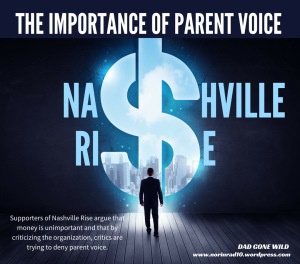
THE IMPORTANCE OF PARENT VOICE

FullSizeRender (1)

The thing I admire most about the education reform movement is their brilliant co-opting of language. They use language to frame their manifesto in a manner that is extremely difficult to counter-argue. Take, for example, their heavy reliance on phrases like “Quality schools for all kids” and “We think all kids can learn.” How are you going to counter that? With “Some kids can’t learn” or “Sub-par schools for all”? I don’t think so. And so the reformers play into America’s irrational fear of teacher’s unions by attacking them while glorifying the people who make up the teaching profession. I know, I never said it made sense; just that it was well crafted.
Their biggest coup, though, may be in getting people to refer to them as reformers when they’ve shown little ability to reform anything. Look at their main vehicles. As the research continues to come in, a picture is beginning to emerge of charter schools being about as successful as traditional public schools, but a whole lot more disruptive. Cyber charters are performing so badly that even the National Alliance for Public Charter schools is attacking them. Teach For America, the organization that was intended to get a “high quality” teacher in front of every child, is morphing into a social organization and relying on cheap PR stunts since recruitment is down 35%. Achievement School Districts that were going to bring the bottom 5% of schools up to the top 25% percent are now being shown to be ineffective, and schools are being returned to local school district control. In fact, the only things you could say they have truly reformed are school board races. Used to be 10k and some knowledge about education could you elected. Those days are long gone and themoney has become astronomical. All in all not exactly a great body of work for reformers, I’d say.
You’d think with this kind of success rate, you might want to look into another arena to lend your expertise. Unfortunately, there is just a little too much money involved in education these days. So it’s impossible for the reform movement to just admit they were wrong and walk away. They’ve got to double down. Of course, when they do, they rely on the same tricks as they used in the past. They create language that makes it virtually impossible to have an honest discussion.
So let me walk you through their typical game plan. Step one: you create an organization with a name that makes the general public trust you. You know, like A+ SchoolsGreat Public Schools Now, or Project Renaissance. If you need a little help with the brand name, you can always call Proof Branding. They’ve got experience at this kind of thing.
Once you’ve got your organization created, you need to adopt a platform. It helps here to be tired about all that arguing over charter schools vs. traditional schools. After all, you are above this kind of thing because you just care about kids. Your The Importance of Parent Voice | Dad Gone Wild:


Time Sensitive Action Required by 6.21.16: Big Brotherland the New American Homeland? – Missouri Education Watchdog

Time Sensitive Action Required by 6.21.16: Big Brotherland the New American Homeland? – Missouri Education Watchdog:

Time Sensitive Action Required by 6.21.16: Big Brotherland the New American Homeland?

With Rule 41, Little-Known Committee Proposes to Grant New Hacking Powers to the Government

rule 41
The Electronic Frontier Foundation (EFF) has filed legal action against Google trying to protect your child’s data mined from school and now it’s time to support EFF in its effort to stop the updates to Rule 41.  From eff.com:
The government hacking into phones and seizing computers remotely? It’s not the plot of a dystopian blockbuster summer movie. It’s a proposal from an obscure committee that proposes changes to court procedures—and if we do nothing, it will go into effect in December.
The proposal comes from the advisory committee on criminal rules for the Judicial Conference of the United States. The amendment [PDF] would update Rule 41 of the Federal Rules of Criminal Procedure, creating a sweeping expansion of law enforcement’s ability to engage in hacking and surveillance. The Supreme Court just passed the proposal to Congress, which has until December 1 to disavow the change or it becomes the rule governing every federal court across the country.  This is part of a statutory process through which federal courts may create new procedural rules, after giving public notice and allowing time for comment, under a “rules enabling act.”1
The Federal Rules of Criminal Procedure set the ground rules for federal criminal prosecutions. The rules cover everything from correcting clerical errors in a judgment to which holidays a court will be closed on—all the day-to-day procedural details that come with running a judicial system.
The key word here is “procedural.”  By law, the rules and proposals are supposed to be procedural and must not change substantive rights.
But the amendment to Rule 41 isn’t procedural at all. It creates new avenues for government hacking that were never approved by Congress.
The proposal would grant a judge the ability to issue a warrant to remotely access, search, seize, or copy data when “the district where the media or information is located has been concealed through technological means” or when the media are on protected computers that have been “damaged without authorization and are located in five or more districts.” It would grant this authority to any judge in any district where Time Sensitive Action Required by 6.21.16: Big Brotherland the New American Homeland? – Missouri Education Watchdog:


By Opening the Door to Cell Phones, Are Schools Also Feeding an Addiction?

By Opening the Door to Cell Phones, Are Schools Also Feeding an Addiction?:

By Opening the Door to Cell Phones, Are Schools Also Feeding an Addiction?

cell phones in the classroom
When the Glendale Unified School District loosened cell phone use restrictions a few years ago, Chris Davis welcomed the change for two reasons. First, as a history and journalism teacher at Clark Magnet School, he looked forward to not spending an inordinate amount of his time chasing down wayward students with their ever-present smartphones.
“If the school tried to impose a ban, that’s how I would spend my day. What a waste of time and energy,” Davis says.
But Davis recognizes mobile devices as more than what some consider the “new chewing gum”—a nuisance more than an offense and one very difficult to enforce. He believes that as long as each of his students has access to a cell phone, and the parameters around their use are clearly defined, the classroom rewards outweigh the risks of a more open policy.
Sure, some students in other schools spend class time staring at their devices, texting, sharing, communicating through sites like Snapchat—generally presenting an ongoing classroom management provocation. But these are not major issues with Davis’ students. Accommodating cell phones in the classroom, he believes, doesn’t amount to a deal with the devil.
Clark Magnet has a science and technology focus, which makes it ideally suited for a wider use of smartphone applications. But even in Davis’ history and journalism class, he encourages students to use the devices for oral histories. When using Google Docs/Drive, Davis finds that some students find typing and editing on a smartphone easier than the relatively bulky Chromebooks they also have access to in class.
“All the teachers are aware of the classroom management challenges, but it’s just a more realistic approach. When used carefully and with limitations, it is a very useful learning tool.”
Before New York City lifted its ban on cell phones in schools, many students had to pay a dollar to check their devices at a van before school. (AP Photo/Richard Drew)
Realistic. This is how many teachers describe their acceptance, if not embrace, of how the hyper-connected, media-saturated world of their students has gained a foothold in their classrooms. George Summerhill, a middle school teacher in Reno, Nev., calls it the “new reality,” one that he concedes he is ambivalent about. But Summerhill also doesn’t want to be trapped in what he views as myopic thinking about the looming dangers of classroom technology. Now in his 12th year of teaching at Cold Springs Middle School, Summerhill made adjustments, started small, and so far likes what he sees. He may sound a little resigned, but “cell phones aren’t going away so why not use them?” he By Opening the Door to Cell Phones, Are Schools Also Feeding an Addiction?:


Op-ed: Why do teachers leave? Teachers know why | The Salt Lake Tribune

Op-ed: Why do teachers leave? Teachers know why | The Salt Lake Tribune:

 Why do teachers leave? Teachers know why

The legislative Interim Committee wonders why the teacher attrition rate is high. As a retired teacher, perhaps I can shed some light.
A few years ago I spent a summer teaching in Kenya. Before going, I had a cerebral understanding of poverty and life in a third world country based on what I'd read/seen on CNN or 60 Minutes. But before actually experiencing it first hand, I couldn't possibly comprehend destitution. Just a couple of months of the sights, sounds and smells taught me that knowing about poverty and understanding poverty are not the same.
Similarly, college grads become teachers thinking they know what to expect, but the demands are overwhelming, supports limited. Legislators and administrators whose experiences in teaching are non-existent or long ago may not fathom modern classrooms.
Many educators are chagrined by testing requirements and paperwork. Some struggle with limited technology or reel as they fight inadequate copy machines, heating and cooling issues, and other structural challenges. The pay is not great, respect levels are wanting.
Yes, there's much to worry about in public education.
Just look at basic finances. When I started teaching in 1983, I was allotted $12 per student to purchase all teaching materials except copy paper. That had to cover every pencil and crayon, bulletin board cut out, file folder, etc., for the entire year. In 2015, my per-student allotment remained $12 per student. An additional few hundred dollars of legislative funds were appropriated, but the truth is, teachers, especially in elementary schools, and most particularly in Title I schools, must spend a lot of their own money to provide the education students deserve.
Another critical issue is teacher autonomy. Previously, elementary teachers designed schedules and learning goals and solved problems based on professional judgments. Nowadays, schedules are dictated down to the minute, with little or no flexibility. Many learning goals come from administrators and legislators, and every child is expected to meet them, regardless of where they started, or what challenges they may have. And play time or the arts? Not a priority!
Additionally, a student can miss 20, 40 or more days in the year, and teachers are still expected to prove that projected learning growth has occurred. Whether due to illness, vacation, suspension or indolence, children come back after missing a day, week or month, and teachers are expected to pick up the slack. The responsibility for these students can be weighty on the hearts and minds of caring educators.
Thinking optimistically, it's not that legislators or administrators don't care or don't want to help. Honestly, funds are limited, there's a lot to do, and people who are several steps removed from teaching make the decisions. They don't know, in a real sense, what it's like to deal with a class of 32 little kids, some who haven't had breakfast, others whose parents are in the middle of a messy divorce, others who are struggling with English, others with disabilities … the list goes on.
Every field has challenges. In my case, the thing that got to me in the end was the feeling that I had absolutely no voice to improve the system. As a lowly teacher, one who loved my classroom, my students, and my community, I'd become tired of being patted on the head and told to just deal with the status quo. Sadly, the joys of the work were ultimately undermined by the frustrations of the system for me, and, I suspect, for others, as well.
Why are teachers leaving education in droves? The real question is, why do some keep hanging around?
Judy Mahoskey retired as an elementary school teacher this spring after 33 years in a Title I school. She is nationally board certified, holds a master's degree, reading endorsement, math endorsement and ESL endorsement.Op-ed: Why do teachers leave? Teachers know why | The Salt Lake Tribune:

Should Children With Special Needs Be Exempted to Take the Common Core Test? : News : Parent Herald

Should Children With Special Needs Be Exempted to Take the Common Core Test? : News : Parent Herald:

Should Children With Special Needs Be Exempted to Take the Common Core Test?

Daily Life At A Secondary School
Student all throughout the United States are subjected to take the Common Core test, even the children who are under the special needs class. It is still an ongoing debate as most children with special needs understand things differently compared to their peers. One question is still left unanswered, Should children with special needs take the Common Core test?
As of the latest update, schools from 27 states and the District of Columbia have already opted to use the alternate test design for children with special needs. The alternative test is patterned and aligned to the Common Core State standards.
EdWeek cited that the alternate assessment was developed by the Dynamic Learning Maps or National Center and State Collaborative. Both are being federally funded consortia. Aside from these states, the state of Alaska is also trying to consider the alternative assessment but they backed out due to technical errors.
It was stated that around 1 percent of students of a total or 10 percent of students with disabilities are can potentially be eligible for the Common Core alternative tests. As for the rest of the students that were not illegible however, it was mentioned that they need to go through the Common Core test.
Though some students with special needs were required to take the common core test, they will be provided with enough supervision and guidance that would walk them through the entire test period. Still parents were outraged with the lack of exemption on students with special needs.
"He's come home saying things like 'I don't know anything. I can't do anything.' This is based on the two prior years of him taking the test - third and fourth grade," Lynda Flood, a mother of a child with special needs told CBS. "It rips my heart out because I know how smart he is; I know how intelligent he is; I know what he can do. Those tests, they don't prove at all what my child is capable of doing."Should Children With Special Needs Be Exempted to Take the Common Core Test? : News : Parent Herald:

PA demands homeschoolers' standardized test results

PA demands homeschoolers' standardized test results:

PA demands homeschoolers' standardized test results


Six different school districts in Pennsylvania are demanding that homeschool parents submit standardized test results of their children to their district superintendent — or face not meeting the so-called legal requirements for homeschool.
The Homeschool Legal Defense Association(HSLDA) announced that families from half a dozen school districts in the Keystone State have reported erroneous requests for their students’ scores — just in the last month alone. The Christian legal group says that the school districts have been keeping it busy clarifying for them what is now required by law.
Misinterpreting the law
HSLDA attorneys were surprised to see the complications and government overreach in Pennsylvania — especially after the state saw significant improvements to its homeschool law less than two years ago in the fall of 2014.
“All six of the school districts insist that parents must provide their district superintendent test results in order to be considered in compliance with the legal requirements for homeschooling,” the nonprofit legal organization reported.
HSLDA Attorney Dan Beasley assured authorities at all six school districts that they are wrong in demanding homeschoolers’ test results — because Pennsylvania state law requires no such submission.
“Under Pennsylvania’s revised homeschool statute, submitting test scores to the school district is not required,” Beasley explained to the respective districts in letters. “The passage of House Bill 1013 in October 2014 eliminated the requirement that home education program supervisors — usually parents — submit a portfolio of various records, including standardized test results in grades 3, 5 and 8, to the local public school superintendent at the end of the school year.”
The homeschool attorney insists that the districts are overcomplicating the existing rules, which he says are really quite simple.
“Instead, supervisors are required to submit only a certification from a qualified evaluator — who has reviewed the portfolio — that the child is receiving an appropriate education,” Beasley PA demands homeschoolers' standardized test results:


Charter schools step up political action - Connecticut Post

Charter schools step up political action - Connecticut Post:

Charter schools step up political action


The charter school movement — backstopped by a billionaire club that includes Michael BloombergPaul Tudor Jones and Ray Dalio — wants to put its stamp on the Legislature in Connecticut.
Connecticut Forward, a newly-launched nonprofit advocacy group, will survey House and Senate candidates across the state on their support for public charter schools. The litmus test will determine which candidates receive financial and grassroots support from the group’s dues-paying members, who will be made up heavily of parents.
Families for Excellent Schools, which has wrangled Bridgeport administrators over education reform, is behind the election year initiative.
“That struggle has lots of allies and lots of adversaries, and it will continue until every kid in the state has access to the education that they deserve,” said Jeremiah Kittredge, the CEO and co-founder of Families for Excellent Schools. “I actually think the biggest adversary here is the struggle of time.”
Connecticut has 24 charter schools, with five in the state’s largest city, Bridgeport, enrolling 2,350 students. There are three charter schools in Stamford and one in Norwalk.
New York City, on the other hand, added about 180 charter schools during Bloomberg’s tenure as mayor. Bloomberg’s former press secretary, Stu Loeser, runs the public relations and media consulting firm hired by Families for Excellent Schools.
In Bridgeport, FES successfully fought a proposed moratorium on charter schools in 2015. Some skeptics still view the push for public charter schools as a step toward privatization by wealthy outsiders, however.
Claudia Phillips, a parent leader in the Bridgeport chapter of FES, said it’s high time that the charter school movement becomes a player in legislative races.
“This is about choice for families,” Phillips said. “Parents are left with no choice.”
Phillips’ 14-year-old son attends Achievement First Bridgeport Academy Middle School. Because there is no charter high school in the city, he will join his 16-year-old twin sisters taking the bus to Amistad Academy in New Haven.
“They have to be up by 5 o’clock in the morning,” Phillips said. “We do what we have to do. It’s sad.”
State Rep. Patricia Billie Miller, D-Stamford, took a more agnostic approach on charter schools, saying she helped secure Charter schools step up political action - Connecticut Post:

Audits show some charter schools' cash struggles | jacksonville.com

Audits show some charter schools' cash struggles | jacksonville.com:

Audits show some charter schools' cash struggles

When district officials, auditors and state officials scrutinize a charter school’s finances, they often ask a basic question: Did the charter school spend more than it took in; could it cover all of its bills with its revenues?


By some measures, one-third of Duval’s charter schools had trouble with that in fiscal year 2015.
An analysis of the audited financial statements filed with the state indicates that at least 12 Duval charter schools spent more than they made in fiscal 2015. That’s called deficit spending.
The state Auditor General uses a slightly different measure — it focuses on “net position,” which compares a school’s assets to its liabilities. If a school’s liabilities are more than its assets, the school has a net position deficit.
Ten Duval County charter schools reported a net position deficit for fiscal 2015.
The auditor general’s reports also compare how much money is left in a school’s coffers — its ending or unrestricted balance — with revenues or its general fund. By that ratio, 16 Duval charter schools fell below state averages for charter schools.
It could be worse. They could have had a zero or negative ending balance.
The state in 2014 said six Duval charter schools had negative ending balances — or no money left over — at the end of the fiscal year. Since then, five of those schools improved to positive balances and a sixth, Acclaim Academy, closed its doors.
Charter schools, which are independent public schools, gave a variety of reasons for their financial struggles.
Five noted lower-than-expected enrollments, and five noted lower-than-expected state funds. Several schools had sizable leasing or lending costs associated with school buildings, while others had unbudgeted expenses.
SOS Academy, for instance, cut staff salaries and froze spending on supplies to cope with lower state and local funds.
River City Science Academy blamed accounting rules for unfunded pension liabilities blowing up its negative net position.
San Jose Academy and San Jose Preparatory High both said outstanding loans were a factor, while Lone Star High noted higher management fees “commensurate with revenue increases” and Biscayne High cited higher-than-expected teacher wages and operating expenses.
‘A TOUGH BUSINESS’
These chinks in charter school finances don’t necessarily predict a bankruptcy or closure, said Linda Norman-Teck, executive director of the Florida Charter School Alliance. They’re only a snapshot of finances and are likely a symptom of charter schools getting less money per student than district schools, she said.
“It doesn’t mean they’re in financial emergency,” she said. “It is a tough business because you can’t predict per-student funding. The money that follows that child to a charter school isAudits show some charter schools' cash struggles | jacksonville.com:


Saying No to Clinton and Trump? See the K-12 Positions of Other Candidates - Politics K-12 - Education Week

Saying No to Clinton and Trump? See the K-12 Positions of Other Candidates - Politics K-12 - Education Week:

Saying No to Clinton and Trump? See the K-12 Positions of Other Candidates

Jill Stein for President - http://www.jill2016.com/

You may be looking at the presumptive presidential nominees of the two major parties, Democrat Hillary Clinton and Republican Donald Trump, and saying to yourself: No thanks. But if electionslug_2016_126x126.jpgthat's the case and you start looking at candidates from other parties, what will you find when it comes to their positions and records on education? 
Here are some answers  for several notable presidential hopefuls from other corners of the political landscape:

Gary Johnson

The Libertarian Party's nominee makes it clear on his official campaign website: He "believes there is no role for the Federal Government in education. He would eliminate the federal Department of Education, and return control to the state and local levels." That position puts him on the same page as a lot of the GOP presidential candidates who took their shot this year. However, the Washington Post recently said Johnson's claim that the strings attached to federal K-12 money are more than the money's worth is off the mark. 
Gary_Johnson_blog.jpgJohnson also notes his opposition to the Common Core State Standards because he doesn't want to "impose national standards and requirements on local schools." (The common core was adopted by states, although Washington has offered incentives in the past for its adoption.) 
And he wants more flexibility at the state and local level, a position that might make him friendly to the Every Student Succeeds Act (a law he doesn't mention on his website).
Forbes magazine had a nice run-down of some of Johnson's public statements about educationFor example, here's Johnson in 2000 talking about his ultimately unsuccessful pitch while New Mexico's GOP governor (from 1995 to 2003) to replace the state's traditional public school system and funding methods with vouchers:
The momentum is clearly in the direction of people saying, 'You know what? We've got to give vouchers a chance. There is something to this. This makes sense.' It has become a campaign issue because people recognize it's a no-lose proposition: The voucher is redeemable at public schools, so what is there to lose? Other than some really bad schools that won't be in existence any longer.
Brandon Wright at the Thomas B. Fordham Institute also has a round-up of Johnson's public comments on K-12
Meanwhile, the Libertarian Party's vice presidential nominee, William Weld, might be familiar to readers from his time as governor of Massachusetts. In terms of education policy, Weld might be most famous for signing the Massachusetts Education Reform Act in 1993. The law had a significant impact on the state's approach to standards, testing, accountability, K-12 finance, and more. 

Jill Stein

The Green Party's choice for the presidency in 2012, Stein, a physician, is the party's presumptive nominee this year, but hasn't officially sewn up the nomination. Jill_Stein_blog.jpg
On Stein's website, her K-12 platform is straightforward: "End high-stakes testing and public school privatization." Her opposition to such testing was also part of her 2012 platform. Four years ago, Stein also opposed using merit pay "to punish teachers."
In an excerpt of a July 2015 interview with ontheissues.org and quoted by Ballotpedia, Stein elaborated a bit more on her position on testing:
In general, high-stakes testing is more than counterproductive—it is destructive. It is used as a political tool against teachers—targeting low-income and people of color. Our educational system should target lifetime learning—with full and equitable funding; and eliminating disparities by race. Testing for diagnostic purposes as part of standards [is OK, but we should have] curriculum written by teachers—not by corporate contractors.
And like in 2012, Stein wants to get rid of student debt and make college tuition-free. 

Tom Hoefling

Hoefling is the American Independent Party's nominee—the party has caused some confusion among some voters who believe they are registering as independent, non-affiliated voters. 
The issues section of Hoefling's website doesn't have anything devoted specifically to education. However, elsewhere on his website, Hoefling, who ran unsuccessfully for Iowa governor in 2014, noted his opposition to the Common Core State Standards. He's also a supporter of what he calls "T.L.C." or "True Local Control" of schools. In a 2014 blog post, he wrote: "It makes no practical sense to keep sending our education dollars to Des Moines, and to Washington, D.C., so that they can run those dollars through a huge bureaucracy, before they send a fraction of our money back to us with strings attached."
When we looked at Hoefling in his 2012 presidential run, the candidate also said the federal government has no role in education except when it comes to educating the children of those in the military.

Emidio "Mimi" Soltysik

The Socialist Party USA's nominee for president, Soltysik lists the party's education platform on his website. Some of the platform's general themes jibe with Stein's when it comes to K-12. Soltysik's platform includes the following points:
  • "We oppose merit pay for teachers, standardized testing, competition between schools within the same district, the sale of on-campus advertising in order to raise funds, and the increasing dependence of post-secondary institutions on corporate funding."
  • "We call for an egalitarian educational system with teaching methods that accommodate the wide range of teaching and learning styles, and that provides all students with the means to obtain the post-secondary education they desire.  We call [for] a maximum of 15 students per teacher for grades K-12, and a maximum of 50 students per teacher at the post-secondary level."
  • "We support student, parent, and teacher control of curriculum formation, and in the hiring and dismissal procedures of school personnel, through the formation of local school/community committees."

Darrell Castle

Castle, an attorney, is the nominee of the Constitution Party, which strongly opposes the common core. Here's a section from the party's website about the standards, and its general dislike for Washington's involvement in K-12:
The Constitution Party Supports the PARENTAL RIGHT to provide for the education of their children, and affirms the free-market principles of improving education through non-traditonal options such as internet-based schools, charter schools, religious, and private schools, as well as home-based schooling.
The Constitution Party Opposes any federal control over the education of children.
The Constitution Party calls for the elimination of the federal Department of Education, as well as a repeal of any federally-supported programs such as Common Core, No Child Left Behind, Race to the Top, etc.  There is NO CONSTITUTIONAL PROVISION that empowers the government to provide for, or regulate, the education of our children.
 The party's website also links to a video criticizing the "government-mandated" common core. (The standards have been backed, but not required by President Barack Obama's administration.) 

Don't miss another Politics K-12 post. Sign up here to get news alerts in your email inbox.