Latest News and Comment from Education

Thursday, February 25, 2016

Senators want to know more about how districts spend funding | EdSource

Senators want to know more about how districts spend funding | EdSource:

Senators want to know more about how districts spend funding

State Sen. Richard Pan questions State Board members Michael Kirst and Sue Burr.
State senators pressed members of the State Board of Education on Wednesday to tell them whether dollars spent for schools under a new system of local control are being spent effectively.
“Are we getting our money’s worth and how do we know?” Sen. Marty Block, D-San Diego, asked during a Senate Education Committee hearing.
He and other senators didn’t get a simple or fully satisfying response from State Board President Michael Kirst and board member Sue Burr. They told the committee, in an otherwise upbeat assessment of landmark changes the state is going through, that it’s too soon to know.
In the past three years, Block said, school districts have received $13 billion in new funding. Funding per student varies by district under the Local Control Funding Formula, or LCFF, in which revenue is distributed partly according to enrollment of low-income children and English language learners. So it’s been a big increase for some districts, yet barely enough to bring spending back to pre-recession levels for others with few high-needs students.
Districts are required to account for spending in a Local Control and Accountability Plan, in which they set three-year goals and priorities and then update annually. County offices of education must review and approve each LCAP, but Kirst acknowledged that the state is not compiling and studying data on how districts are spending money under the funding formula.
That troubled Sen. Richard Pan, D-Sacramento, who said that legislators want to know how the state is spending overall education dollars. “That data is out there. Shouldn’t we be gathering it to know about impact?”
Kirst noted the challenge of striking a balance between flexibility and accountability under the new law. The Legislature, in passing LCFF, did away with dozens of categorical programs that dictated district spending. At the same time, the general accounting categories required by the state are too broad for useful comparisons, he said. They won’t differentiate between Senators want to know more about how districts spend funding | EdSource:

Education Research Report: Center for American Progress Report Makes Feeble Effort to Claim Success for Standards-Based Reform

Education Research Report: Center for American Progress Report Makes Feeble Effort to Claim Success for Standards-Based Reform:
Center for American Progress Report Makes Feeble Effort to Claim Success for Standards-Based Reform


 A recent report from the Center for American Progress (CAP) examines the standards-based policies that have dominated the national landscape over the last few decades. The report explores whether states’ adoption of standards-based policies predicts low-income students’ achievement trends in fourth and eighth grade math and reading from 2003 to 2013.

A review of the report finds that it employs inappropriate research methods, fails to adequately define its approach, and reports only incomplete findings from its analyses. The report’s claims far outpace its meager evidence.

Sharon L. Nichols, Associate Professor of Educational Psychology at the University of Texas at San Antonio, reviewed Lessons From State Performance on NAEP: Why Some High-Poverty Students Score Better Than Others for the Think Twice Think Tank Review Project at the National Education Policy Center, housed at the University of Colorado Boulder’s School of Education.

The report, according to Professor Nichols’ review, does not adequately describe variables or analytic methods, and the data and methods used do not allow for any causal findings. Yet the report uses causal language such as, “According to our analysis, states typically saw a jump in outcomes due to standards-based reform …” (emphasis added). The data and methods used, even if the associations were much stronger than those shown in this study, could not possibly support such conclusions.

Also, while the report claims to analyze changes across five separate two-year intervals, it only reports findings for 2009-2011, with no explanation of why or any documentation of the representativeness of that single interval.

The positive results the report does find, Professor Nichols points out, are statistically significant only at the generally unacceptable 0.10 level of significance. Further, while the report includes effect sizes, it does not report the percentage of the variance explained in the model.

The report contends that its analysis strongly supports the policy recommendation that states “embrace” the Common Core and its aligned assessments. But the study is far too weak to do this. As Professor Nichols explains, “Even if the omissions and shortcomings of this report were remedied, the analysis only provides a very narrow snapshot of how policy might connect to practice. … The strident call for Common Core at the end of this report is misplaced given [its] mismatched goals, questionable analysis and selected findings.”
Education Research Report: Center for American Progress Report Makes Feeble Effort to Claim Success for Standards-Based Reform:

THE BIG SELLOUT: The extra state aid is going to charters, NOT public school children. |

THE BIG SELLOUT: The extra state aid is going to charters, NOT public school children. |:
THE BIG SELLOUT: The extra state aid is going to charters, NOT public school children.


Newark’s state-appointed schools chief Christopher Cerf has spent a lot of time lately praising the Christie Administration for increasing Newark’s state aid–“The first time in years we haven’t had flat funding,” he told the board meeting Tuesday night. Several members of the audience yelled out, “Liar!” and they were right. The extra money is part of the big Cerf/Baraka sell-out of public schools–and it is not going to the city’s public schools. It is going to charters, the favorite educational children of Christie, Cerf, and now, sadly, Mayor Ras Baraka.
Don’t take it from me. I know I’ve received a lot of criticism for pointing out that the schools superintendent and mayor have joined together–in “unity,” they call it–when the two should be at odds about the future of public schools. That’s fine.

Cerf, left, and Baraka appear with Donald Katz, a trustee of Uncommon Schools, a charter chain, at a recent public appearance (From NJSpotlight)

But, perhaps, Cerf and Baraka should read the latest statement on state school aid provided by the Education Law Center in Newark because its researchers know far more than I do about crunching the right numbers. And here’s what they have concluded about the distribution of state aid:

NEWARK CHARTERS: THE BIG WINNER

Newark charter schools are the big winners – by far – in the Governor’s school aid proposal. Almost one-quarter of the total $94 million statewide increase, or $22 million, will go to hold Newark charter schools harmless from aid reductions due to declining revenue in the State-operated Newark Public Schools’ (NPS) budget. For the last two years, the State has forced NPS to give extra “hold harmless” funds to charter schools out of the district’s budget. This year, the State is providing extra “hold harmless” aid that the district must pass through to the charters.
The $22 million to hold Newark charters harmless represents 82%, or the THE BIG SELLOUT: The extra state aid is going to charters, NOT public school children. |:

21 new charter proposals to CPS doesn’t sound like there’s a cap to me. | Fred Klonsky

21 new charter proposals to CPS doesn’t sound like there’s a cap to me. | Fred Klonsky:

21 new charter proposals to CPS doesn’t sound like there’s a cap to me.

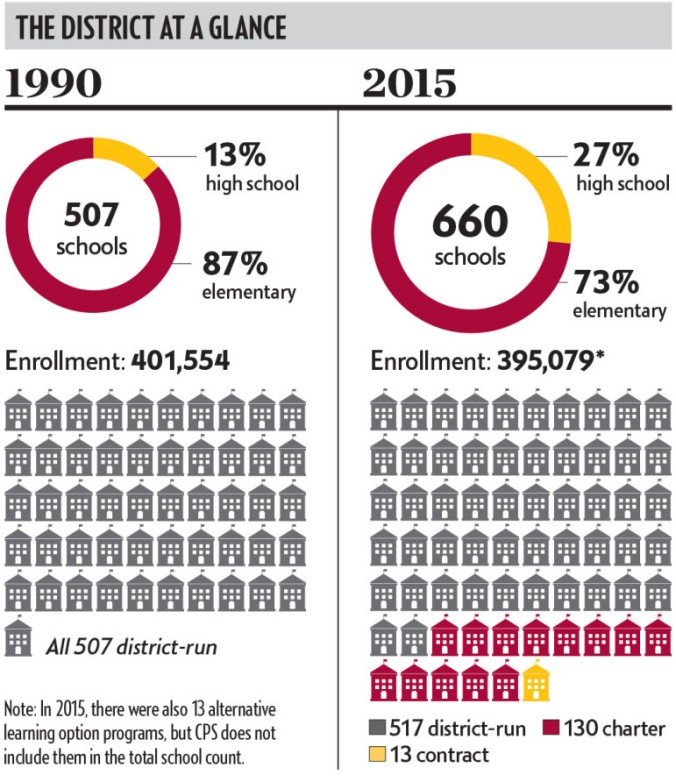
F15gfx_district-at-glance-771x892.jpg


 Graphic: Catalyst

The contract offer from CPS to the Chicago Teachers Union included a cap on charter schools.
One of the reasons I heard for rejecting the offer by the CTU’s Big Bargaining Committee was that the offer to cap charters was an empty one so long as the state’s Charter Commission could overrule the CPS board.
The skeptics on the CTU bargaining team were found to have cause yesterday as CPS received proposals for 21 new privately operated charter schools from 16 charter operators, including Noble and Kipp.
Reported the Sun-Times:
CPS publicized the letters right before February’s Board of Education meeting, during which the appointed seven members officially closed schools with enrollments that were already cleared out: Moses Montefiore Special Education School and the original Marine Math and Science Academy High School.

Using Teacher Shortage Talk to Justify Online Instruction

Using Teacher Shortage Talk to Justify Online Instruction:

Using Teacher Shortage Talk to Justify Online Instruction

Child looking at a computer. Computer addiction
A few weeks ago Nick Morrison wrote an article for Forbes titled “Sleepwalking Our Way into the Teacher-Less Classroom.” He insists that technology, specifically the takeover by online instruction in schools, is not the real danger facing education.
Instead, he claims it is a teacher shortage.
According to Morrison, teachers leave due to pressure, and if there are no more teachers left standing, the establishment has to move to online instruction because—well what else is there?
He was focused on England and he presented an audit report pointing to the problem there. England parallels America in its de-professionalization of teachers and the privatization of schools. The teacher shortage talk is just as prevalent here.
But the teacher shortage so-called concern has been around for thirty years! About the Using Teacher Shortage Talk to Justify Online Instruction:

Student can’t attend school because he’s African-American | FOX2now.com

Student can’t attend school because he’s African-American | FOX2now.com:

Student can’t attend school because he’s African-American


ST. LOUIS (KTVI) - A St. Louis mother is in shock after learning her son’s skin color will keep him from attending the school of his choice.  Edmund Lee is an African-American 3rd grader at Gateway Science Academy, a charter school in south St. Louis.  His family is moving to St. Louis County this year.
State law allows some county residents the opportunity to attend a city charter school, but they must live in a district participating in transfer programs, and can not be an African-American.
“When I read the guidelines I was in shock,” said La’Shieka White, Edmund’s mother.  “I was crying.”
School officials say their hands are tied because of state regulations created decades ago.  The rules were designed to address segregation problems with St. Louis schools.  Leaders at Gateway Science Academy believe it’s time to revisit those rules.
“If this helps us start a conversation about maybe some things that could be different with the law, then that is as good thing,” said Assistant Principal Janet Moak.
White launched a petition asking lawmakers to take notice of her situation.
She’s also heard from parents of white students unable to participate in transfer programs for African-Americans.
“I don’t want it to be just about an African-American boy,” said White.   “I want it to be about all children.”
Some staff members at Gateway Science Academy have signed White’s petition.
“To not see his face in the halls next year would be extremely sad,” said Tiffany Luis,” Edmund’s 3rd grade teacher.  “The family is saying they want to stay.  I don’t understand why they can’t.”Student can’t attend school because he’s African-American | FOX2now.com:

Mother of Girl Berated in Video Assails Success Academy’s Response - The New York Times

Mother of Girl Berated in Video Assails Success Academy’s Response - The New York Times:

Mother of Girl Berated in Video Assails Success Academy’s Response

Nadya Miranda, 23, is the mother of a student whose treatment by an angry teacher at Success Academy in Cobble Hill, Brooklyn, was surreptitiously videotaped. Ms. Miranda has withdrawn her daughter from the school. Credit Kirsten Luce for The New York Times

Nadya Miranda thought she had found a safe haven for her daughter: aSuccess Academy charter school in Cobble Hill, Brooklyn, where she hoped her daughter would get a good education and be put on a path to college.
Then she saw the video.
The video, which was recorded surreptitiously by an assistant teacher in the fall of 2014, captured a first-grade teacher at the school scolding Ms. Miranda’s daughter for being unable to explain to the class how she solved a math problem. The teacher ripped the girl’s paper in half, ordered her to leave the circle to sit in what she called “the calm-down chair,” and said that she was angry and disappointed.
When the video was published by The New York Times this month, Success Academy held a defiant news conference. The network’s founder, Eva S. Moskowitz, defended the teacher, Charlotte Dial, saying that she had apologized “in real time” to her students, and accused The Times of bias. A teacher suggested that the newspaper did not believe that black and Hispanic children could be academically successful. Two parents stood up to say that they did not need The Times to tell them what was happening in their children’s schools.
 
Continue reading the main storyVideo

A Momentary Lapse or Abusive Teaching?

In 2014, an assistant teacher at Success Academy Cobble Hill secretly filmed her colleague, Charlotte Dial, scolding one of her students after the young girl failed to answer a question correctly. The children's faces have been blurred and their names obscured to protect their privacy.
 By THE NEW YORK TIMES on Publish DateFebruary 12, 2016. Watch in Times Video »
Ms. Miranda, however, tells a different story.
In two lengthy interviews, she said that she did not know what was happening in her daughter’s classroom before she saw the video. She said that she was so upset by what she saw — and by the network’s rush to rally around Ms. Dial, while showing little concern for her daughter or other students — that she took the girl out of the school in late January.
Ms. Miranda said that while Ms. Dial had apologized to her, the teacher had never apologized to her daughter. She said that a public relations specialist for Success drafted an email for her, asking The Times not to publish the video, and that at a meeting Ms. Moskowitz held at the school on Jan. 20, Ms. Moskowitz asked the parents to support Ms. Dial and to defend the school to the paper. Ms. Miranda said that when she stood up, identified herself and objected that Ms. Moskowitz was asking parents to support the teacher without even showing them the video, Ms. Moskowitz cut her off.
“She’s like, ‘You had enough to say, you had enough to say,’ and she tried to talk over me,” Ms. Miranda said. “So I just really got frustrated, and I just walked out, and the parents that were concerned followed me, and the parents who were against me and for the teacher” stayed in the auditorium.
Ms. Miranda took her daughter home that morning and did not bring her Mother of Girl Berated in Video Assails Success Academy’s Response - The New York Times:

Senate Hearing Today to Nominate John King as Secretary of Education. Another Bipartisan Disaster or A Blessing in Disguise? – Missouri Education Watchdog

Senate Hearing Today to Nominate John King as Secretary of Education. Another Bipartisan Disaster or A Blessing in Disguise? – Missouri Education Watchdog:

Senate Hearing Today to Nominate John King as Secretary of Education. Another Bipartisan Disaster or A Blessing in Disguise?


 john king hearing
(The hearing will be held at 2 PM EST and you can watch it live here:  http://www.help.senate.gov/hearings/nomination-of-dr-john-king-to-serve-as-secretary-of-education.  It may be available to view/record on CSpan.)
Senator Lamar Alexander is following through with his 1989 speech at the first National Governors Association meeting and his desire for centralized control of education.  Via 2016, he again brings the taxpayers another bipartisan disaster rivaling that of No Child Left Behind (ESSA) and is eager to appoint the acting secretary of education (John King) so King can crack the whip of accountability.  These policies are not for academic excellence, rather, they are are policies once again wrapped up in a new law (over 1,000 pages) consisting of carrots and sticks.  FromSenate committee schedules confirmation hearing for John King as education secretary:
king nomination 1
Who is John King?  If you are in New York state, you know him as the embattled state superintendent who stepped out of that position due to taxpayer/parent displeasure and into ‘a high level position’ in the US Department of Education.  New York’s failed superintendent is now thrust onto all states.  How is King handling himself in his new position as acting Secretary?  Take a look and see during his recent appearance at theHouse Oversight Committee regarding the investigation of the Department of Education’s Chief Information Officer (CIO) Danny Harris and Harris’ lack of judgement and numerous legal violations.  Both Harris and King are masterful at not answering questions and/or deflection:

With A Brooklyn Accent: The Obama Administration- and the Democratic Party's- War On Teachers:

With A Brooklyn Accent: The Obama Administration- and the Democratic Party's- War On Teachers::
The Obama Administration- and the Democratic Party's- War On Teachers:


One of the most disturbing legacies of the Obama Administration's 7 years in office, which it shows every sign of continuing through its nomination of John King to be Secretary of Education, has been its war on the nation's public school teachers and on public education generally.

The President hit the ground running with this attack by appointing Arne Duncan, someone with no teaching experience, as Secretary of Education and set the tone for his Administration, shortly after his election, by praising the mass firing of teachers in Central Falls Rhode Island who refused to agree to dramatic modifications of their contract to lengthen the school day.


The attack escalated with the unveiling of Race to the Top, which gave huge grants to states who rated teachers on the basis of student test schools, closed schools designated as "failing"- also on the basis of test scores- and gave preference to charter schools over public schools. It was reaffirmed in subsequent years by the enthusiastic support given by the US Department of Education for the Common Core Standards- which were created with little teacher input, by the Admistration's grants to Teach for America and celebration of "National Charter School Week," and by the systematic exclusion of teachers by education policy bodies created by the administration

Worse yet, Administration's spokesperson in this area, Arne Duncan, took every possible opportunity to attack the nation's public school teachers as poorly trained, poorly qualified and in dire need of 
With A Brooklyn Accent: The Obama Administration- and the Democratic Party's- War On Teachers::

How easy should it be for schools to get rid of bad teachers? A landmark case may decide for California - LA Times

How easy should it be for schools to get rid of bad teachers? A landmark case may decide for California - LA Times:

How easy should it be for schools to get rid of bad teachers? A landmark case may decide for California


 e sides squaring off in a Los Angeles appeals courtroom on Thursday in the landmark case of Vergara vs. California agree on this: Teachers are key to whether students founder or thrive, and far too many students are failing or falling behind.

The debate over how to address that problem has erupted into a pivotal fight over the competing and complementary rights of students and teachers.
The people who slammed the state with this high-stakes lawsuit have a straightforward prescription: Make it easier for schools to get rid of bad teachers.
Their opponents, including Gov. Jerry Brown and the state's powerful teachers unions, characterize this solution as simplistic and even dangerous.
In 2014, L.A. Superior Court Judge Rolf M. Treu sided with the diverse group of nine students who brought the suit with support from a number of wealthy backers who want to see schools become more businesslike.
Treu threw out the state's tenure and seniority systems, saying they harmed all students, but especially poor and minority students, leading to outcomes that "shocked the conscience."
If that ruling holds up under appeal, teachers at unionized schools will no longer be entitled to a level of job security that's rare, even in the public sector.
Other rules making it difficult and expensive to fire teachers would disappear as well. And when districts lay off teachers, those who've been around longest would no longer be guaranteed that they'll be the last to get pink slips. Instead, districts could use a teacher's performance to decide who to let go.
Timothy Daly, former president of a group called the New Teacher Project, applauds the lawsuit, saying that those challenging the state "are trying to prove that the laws make it impossible for districts to do the right thing for kids."
This viewpoint holds that employment laws pushed through by unions — which are the state's largest contributors to political campaigns — are depriving young people of the education to which the state Constitution entitles them. Poor children and students of color, this side argues, are disproportionately harmed because the worst teachers tend to wind up at poorly performing schools.
Opponents of the lawsuit, however, insist that the approach endorsed by the Superior Court judge would result in a lower-quality teaching corps. They say that the profession How easy should it be for schools to get rid of bad teachers? A landmark case may decide for California - LA Times:
Big Education Ape: Vergara Lawsuit Targets Teaching Profession - California Teachers Association http://bit.ly/21slN2b

Phony School Reform Wilts, A New Education Story Takes Root | The Progressive

Phony School Reform Wilts, A New Education Story Takes Root | The Progressive:

Phony School Reform Wilts, A New Education Story Takes Root

https://commons.wikimedia.org/wiki/File:Rooted_in_Community.gif
For years, our public schools have been burdened by a “reform” narrative that education is “failing,” and that only a regime of standardized testing and charter schools will make administrators and teachers more “accountable.” Politicians and pundits across the political spectrum have adopted this doctrine and now easily slip into the rhetoric that supports it without hesitation.
But recently, the pillars of the “reform” agenda have begun to crumble. The whole notion of a top-down mandate for reform coming from state capitals and Washington, D.C. is being regarded with a new degree of skepticism.
A new narrative is emerging and it's coming from the ground up—from schools and communities where teachers, parents, and students are remaking the education policy landscape.
Over the next several weeks, the Progressive Education Fellows will be exploring this exciting movement for change in a series of posts at The Progressive and on our social media channels on Facebook and Twitter.
A big part of the progressive vision for education is taking shape in community schools—locally led schools that are taking progressive approaches to education, including restorative
- See more at: http://www.progressive.org/news/2016/02/188579/phony-school-reform-wilts-new-education-story-takes-root#sthash.poIG9Znq.dpuf

Souza brings back revised parental rights bill, gets it through Senate Education | The Spokesman-Review

Souza brings back revised parental rights bill, gets it through Senate Education | The Spokesman-Review:

Souza brings back revised parental rights bill, gets it through Senate Education


 Idaho Sen. Mary Souza has brought back her “parental rights” bill, with one change: An added paragraph defining “reasonable accommodation.” The bill still permits parents to withdraw their child from any program or activity to which they object; requires schools to develop parental involvement plans and a process by which parents can review all educational materials; and requires annual notice to parents of their rights.

The new “reasonable accommodation” definition says that schools must enable parents to exercise parent rights “without substantial impact to staff and resources, including employee working conditions, safety and supervision on school premises for school activities and the efficient allocation of expenditures, while balancing the parental rights of parents and guardians, the educational needs of other students, the academic and behavioral impacts to a classroom, a teacher's workload and the assurance of the safe and efficient operations of the school.”
“It does not obligate the school to do anything if the parent takes the child out of a particular activity,” Souza told the Senate Education Committee this afternoon. “But it does allow the parent that leeway to make that decision.”
 Sen. Janie Ward-Engelking, D-Boise, said she still worried that the opt-out provision could endanger Idaho’s compliance with the 95 percent participation rule for student testing – which could jeopardize millions in federal funds. Souza said she doesn’t think that’s such a big issue any more.
“I realize that that’s a concern, but I don’t think it’s as overwhelming a concern as it was last year,” Souza said. She said the latest federal education reauthorization bill “seems to have a little more latitude,” and said, “I think school boards and administrators have found that talking with parents … has created a situation where that’s not as big a concern or fear as it was.”
Sen. Cherie Buckner-Webb, D-Boise, called the bill, SB 1293, “better than it was.” It cleared the Senate Education Committee without objection and now heads to the full Senate.Souza brings back revised parental rights bill, gets it through Senate Education | The Spokesman-Review:

A South Dakota Bill Shows How K-12 Schools Are Becoming a Hotbed for Debates Over Transgender Students - The Atlantic

A South Dakota Bill Shows How K-12 Schools Are Becoming a Hotbed for Debates Over Transgender Students - The Atlantic:

The Power Struggle Over Transgender Students

Who should have the ultimate say over school policies pertaining to trans youth?

Last year, states across the country considered 17 bills that would’ve regulated transgender people’s use of sex-segregated spaces such as bathrooms. None of them passed. But the reality is looking a lot different this year: Twenty-nine such bills, many of them school-specific, are making their way through state legislatures so far, according to an analysis by the Human Rights Campaign. And they include one out of South Dakota that is very close to becoming law.
That bill, which was passed just last week by the state’s Senate and as of Wednesday was awaiting approval by Republican Governor Dennis Daugaard, would prohibit transgender students in public schools from using bathrooms and locker rooms that don’t match with their biological sex; if requested, schools would have to provide “reasonable” accommodations for transgender students, such as single-occupancy or unisex restrooms. The legislation is important because it would set a precedent—South Dakota would be the first state to enact such a law—and because many of the bills under consideration elsewhere are, not coincidentally, almost identical. It also shows how prickly things get when the federal government and local jurisdictions vie for control over what happens at the nation’s public schools.
As I reported last year, K-12 schools are becoming ground zero for clashes over LGBT rights. On the one side are those who fear that allowing transgender children to use facilities based on their gender identity—allowing a student who was born a boy but identifies as a girl, for example—violates other students’ privacy rights and threatens their safety. On the other are those who say such rules, even when they prescribe special accommodations, make transgender students vulnerable to harassment and can pose logistical challenges that undermine their academic performance and overall campus experience. Student surveys conducted by the Gay, Lesbian, and Straight Education Network (GLSEN) show that rules barring transgender students from using the facilities of their choice often end up discouraging the students from using them altogether; some of them end up skipping school. GLSEN has concluded that “policies and practices that enforce gender segregation” promote a sense of hostility on campus.
The same arguments are being disseminated in the media as the South Dakota proposal sits on the governor’s desk.
“South Dakota didn’t pick this fight—it was the parents and kids who call our organization every week … trying to maintain the privacy and safety of the people who don’t want to see this happen,” said Jeremy Tedesco, the senior counsel for The Alliance Defending Freedom, a conservative Christian nonprofit that helped precipitate many of the recent transgender-student bills. “We have to find a way to balance everybody’s interests in these equations.” The alliance released amodel policy in December 2014 that was distributed to school districts A South Dakota Bill Shows How K-12 Schools Are Becoming a Hotbed for Debates Over Transgender Students - The Atlantic:

New Texas education boss Morath offers intriguing option for standardized testing | | Dallas Morning News

New Texas education boss Morath offers intriguing option for standardized testing | | Dallas Morning News:

New Texas education boss Morath offers intriguing option for standardized testing

Mike Morath has been the Texas education commissioner only since Jan. 4 and already he's bringing some common sense to STAAR-replacement ideas. (NYT Photo)
Mike Morath has been the Texas education commissioner only since Jan. 4 and already he’s bringing some common sense to STAAR-replacement ideas. (NYT Photo)

 Former Dallas ISD trustee Mike Morath has spoken publicly about state-mandated testing for the first time from his new job as Texas education commissioner. And what he said yesterday provides an intriguing and hopeful path forward on this most contentious education topic.

Speaking to a testing advisory board in Austin — which is considering replacing the STAAR system — and reported in this Austin American-Statesman article, Morath said he  envisions a new testing protocol that would assess students on a smaller scale throughout the year.
The 15-member Texas Commission on Next Generation Assessments and Accountability group must make recommendations to lawmakers by Sept. 1 to improve or replace the STAAR testing system.
You may recall that Morath was named just last fall by Gov. Greg Abbott to serve as the presiding officer of that accountability group. Less than two months later, Abbott decided to put Morath in charge of the entire education operation.
The idea Morath floated yesterday to the group he formerly headed would allow teachers immediate feedback on student achievement, which would influence how they, in turn, adapt their instruction in the following months.
 “When you start looking at the state mandating one specific approach in every classroom, it becomes problematic,” Morath said, according to the Statesman story.
We know how passionate Morath was about using data to drive decisions during his four years on the Dallas school board. He also was known for his laser-focus on the achievement of students more than the bureaucratic needs of the system. My former colleague and education-smart-guy Bill McKenzie wrote in January about how Morath would bring these skills into play in Austin.
I think it’s a grand first step that Morath is open to different ways of going about testing. It seems that his suggestion could both lessen the pressure on students by test-as-you-go assessments and keep parents and teachers from end-of-session surprises. Yes, I know that interim testing is done already, but remodeling the state accountability system along these lines would be a significant change.
Many of us want to ensure that no system is put into place that causes Texas to backslide too far on accountability issues because such a slide would grow the achievement gap. However, I don’t believe anything about Morath’s background indicates he will let that happen. He has the common sense to find ways to make a system most recently called STAAR a more constructive protocol for all involved.
As I wrote last fall, I don’t have the magic formula for the best testing approach. McKenzie and I used to regularly dog cuss each other (well, as much as Bill dog-cussed anyone) about the testing issue when I joined the editorial board back in 2004. I had two sons in middle school and high school at the time, both of them in the TAG program New Texas education boss Morath offers intriguing option for standardized testing | | Dallas Morning News:

The Times They are a-Changin', Broader Bolder Approach

The Times They are a-Changin':

The Times They are a-Changin'

 June 2008 isn't really all that long ago. But in the education policy world, it feels almost like a different era altogether.

That month saw the launch of the Broader, Bolder Approach to Education, a national campaign with the mission of calling attention to the many impediments posed by poverty to student's achievement and school success. It also marked the emphatic establishment of an opposing camp, which rejected the proposition that poverty-related impediments drove achievement gaps, and that saw bad teaching and weak accountability as the root problem. Indeed, "no excuses" was the banner under which they began to fly.
In the years that followed, the no excuses camp notched notable victories, and its policy priorities were widely adopted at the federal and state levels. While US Secretary of Education Arne Duncan was the only notable signatory to both the BBA and opposing education reform platforms, it quickly became clear that he leaned toward the latter. His signature federal policy initiative, Race to the Top, required states to tie teacher evaluations to students' test scores on standardized tests and to categorize and issue consequences for schools based on those scores. And when he could not persuade Congress to reauthorize the long-overdue Elementary and Secondary Education Act, he offered states waivers to the then-requirements under No Child Left Behind on the condition that they enact similar policies. At the state level, affiliates of national groups like Students First, led by no-excuses champion Michelle Rhee, pushed similar policies.
At the same time, opposition to these policies began to grow. Proponents of BBA, who understood that these policies did not, in fact, address the root causes of problems in schools serving disadvantaged students, were joined by others who saw the damage the policies were doing in their schools and communities. The Times They are a-Changin':

Hundreds converge on city school board meeting to fight for higher teacher salaries - Sacramento News & Review -

Sacramento News & Review - Hundreds converge on city school board meeting to fight for higher teacher salaries - News - Local Stories - February 25, 2016:

Hundreds converge on city school board meeting to fight for higher teacher salaries

Board President Christina Pritchett

In what was not a typical school board meeting, hundreds of teachers, parents and students marched into the Sacramento City Unified School District’s board room this past Thursday to discuss a raise in pay and a dire lack of educators.
More than 20 people supported the Sacramento City Teachers Association during the meeting’s hour-long public comments period—a time usually reserved for about 20 minutes. Teachers and parents urged the board to do more to ensure the retention of teachers and the hiring of new ones.
The first step, SCTA says, is to give teachers a 5 percent retroactive salary raise for this school year, which will make their pay comparable to other districts like San Juan and Elk Grove. The district has offered 2.5 percent.
“Without having seen the numbers, teachers implicitly understand that the district’s priorities are out of whack,” SCTA President Nikki Milevsky told the board.
Milevsky presented statistics to the board Thursday night that showed wage disparities between SCUSD and the 12 other Sacramento County districts. According to the SCTA’s numbers, the average teacher salary ranks 12th out of the 13 county districts, but is second in school enrollment.
The wage gap between the competing districts, Milevsky said, is a large reason why SCUSD has 80 teaching vacancies, and why more vacancies are expected to open in the next school year. In a survey done by the SCTA, 54 percent of 914 teachers said they have considered leaving the district because of salary issues.
Board President Christina Pritchett told the audience that, although it is of high priority, the board must to Sacramento News & Review - Hundreds converge on city school board meeting to fight for higher teacher salaries - News - Local Stories - February 25, 2016:

Wednesday, February 24, 2016

Jeb Bush’s Presidential Failure | deutsch29

Jeb Bush’s Presidential Failure | deutsch29:

Jeb Bush’s Presidential Failure


On June 15, 2015, former Florida governor Jeb Bush formally announced his intention to run for president.
jeb bush drops out  Jeb Bush
What is intriguing about Bush’s failure in vying for the Republican presidential bid is that for years, it was assumed that Bush would run for president and that when he did, he would surely be “a strong presidential contender.” However, the reality is that not only was Bush not a strong contender; according to RealClearPolitics’ pollsof the contenders for the Republican nomination, Bush never secured a solid lead.
Moreover, even as his candidacy was formally announced, the Bush campaign was already showing signs that Bush would not be the frontrunner that many believed he would be.
For example, according to CNN’s Peter Hanby and Chris Moody, Bush was already facing a decent rivalry as he entered the race– even from Democratic hopeful, Hillary Clinton:
But for all his name recognition, Bush isn’t entering the race as a clear front-runner. A national CNN/ORC Poll released earlier this month found him virtually tied at the top of the field with Sen. Marco Rubio, a fellow Floridian. Behind them, 10% of those polled said they planned to support Wisconsin Gov. Scott Walker and former Arkansas Gov. Mike Huckabee.
When matched against Democratic candidate Hillary Clinton, Bush trails 51% 
Jeb Bush’s Presidential Failure | deutsch29: