Latest News and Comment from Education

Thursday, January 28, 2016

With A Brooklyn Accent: The Untold Story: How Immigrants Have Helped Revitalize Bronx Neighborhoods

With A Brooklyn Accent: The Untold Story: How Immigrants Have Helped Revitalize Bronx Neighborhoods:

The Untold Story: How Immigrants Have Helped Revitalize Bronx Neighborhoods

Most Americans probably still think of the Bronx through metaphors of decline and decay, epitomized by the phrase, "the Bronx is Burning," but that phrase doesn't begin to describe what is happening in the borough today.. Yes, from the late 60's through the late 70's, large portions of the Bronx south of the Cross Bronx experienced disinvestment, arson and elimination of vital services, leaving vacant rubble filled lots that attracted huge media attention. But in the last 30 years, through the hard work of local residents and community organizations, almost all those vacant lots have been filled with one and two family homes, apartment buildings and shopping centers. In fact the Bronx has become a great American Success Story, perhaps the only large urban area in the nation ( and there are many) where neighborhoods ravaged by de-industrialization and disinvestment have been completely rebuilt. If you think I am exaggerating, go visit Buffalo, Camden, Detroit, Gary Indiana, Baltimore or Philadelphia and then drive around the Bronx. The contrast will make your head spin
One of the major factors contributing to the Bronx's revitalization, and one which is little discussed, has been immigration. Recent immigrants from West Africa, the Dominican Republic, the West Indies, Mexico and South Asia compose a sizable proportion of the people who have moved into the new housing placed on once vacant lots, and run many of the businesses serving the residents of those areas
If you want to see that influence brought to life, drive up the hill from Yankee Stadium to Highbridge and Morris Heights, two neighborhoods hard hit by the abandonment cycle in the 1970's. Not only will you see lots of newly built housing, if you observe the street traffic, and walk into neighborhood businesses, you notice the presence of the neighborhood's large West African and Dominican population. You will also, if you observe carefully, notice some mosques and Islamic centers, as most of the West African immigrants are Muslim. Their peaceful interaction with their neighbors has won them great respect and helped contribute to the neighborhoods revitalization.
If you go Southward and Eastward into Mott Haven and Morrisania, you will see similar immigrant influences, only in these communities the Mexican presence is stronger than the Dominican one. Once again, the business district is a key indicator as these neighborhoods contain a growing number of Mexican groceries and restaurants.

Cut Scores on Standardized Tests Are Arbitrary; Pearson’s GED Recalibration Proves It | janresseger

Cut Scores on Standardized Tests Are Arbitrary; Pearson’s GED Recalibration Proves It | janresseger:

Cut Scores on Standardized Tests Are Arbitrary; Pearson’s GED Recalibration Proves It

It is hard to remember that standardized test scores have no real, objective meaning.  How easily we forget this truth.
The standardized tests that are used to rate and rank public schools—the ones that became ubiquitous after the passage of No Child Left Behind, and which, by the way, the Every Student Succeeds Act will leave in place—are graded with cut scores.  Somebody in your state education department decides on a cut score that will mean “passing” and other cut scores that will mean “proficient” or “outstanding.”  The people who set those cut scores have a lot of power because the scores on the tests confer value judgments on children and on their teachers and on their schools. The scores can shape the self concept of a child or determine whether a teacher gets a raise or even whether a teacher gets fired. Even if a third grader, who began the school year as a non-reader, learns how to read and makes a lot of progress, that child and that child’s teacher won’t get a passing mark unless the child makes the 3rd grade reading proficiency cut score.
But the cut scores are relatively arbitrary.  And sometimes they even get changed.  Here is a commentary from US News and World Report about Ohio last November:  “Last month, Ohio released initial results from its PARCC test, a standardized test used by a group of states, showing that nearly 65 percent of students were proficient in math and English language arts. These numbers were a whole lot better than those of other states on the PARCC, so is Ohio leading the way? Politically, yes. Academically, no.  Ohio got these results by rejecting PARCC’s recommended cut scores to designate proficiency and adopting more generous ones. Ohio claims that 69 percent of its fourth graders are proficient in English, but if the state were using Cut Scores on Standardized Tests Are Arbitrary; Pearson’s GED Recalibration Proves It | janresseger:


Seattle Schools Community Forum: McCleary? Anybody? It's Crickets at the Legislature

Seattle Schools Community Forum: McCleary? Anybody? It's Crickets at the Legislature:

McCleary? Anybody? It's Crickets at the Legislature

WA GOP gut bipartisan education legislation
RELEASE: Jan. 27, 2016  (this came via Senator John McCoy but I'm not sure of its origins)


Senate Republicans gut bipartisan McCleary bill


OLYMPIA – A cornerstone bill to address Washington state’s education funding obligations is at risk of being made irrelevant by amendments that will be proposed by Senate Republicans in the Senate Early Learning & K-12 Education committee on Thursday, Jan. 28 at 8:00 a.m.

SB 6195 is the result of months long negotiations between both parties in the Senate and House as well as the governor’s office. Sen. Christine Rolfes, D-Kitsap County and Sen. Andy Billig, D-Spokane, were the lead negotiators for Senate Democrats.

“It is extremely disappointing that Senate Republicans will turn a bipartisan agreement into a partisan plan,” said Rolfes. “They commit only to addressing local levies, without a commitment to the state paying its fair share – which is the reason the state was sued in the first place. People following this issue thought the plan couldn’t get weaker. Unbelievably, the Senate Republicans have lowered the bar.”

“I’m disappointed that after participating in a productive bipartisan workgroup, the Senate Republicans have decided to abandon our agreement,” said Billig. “It is our constitutional duty to fully fund education and it’s frustrating that the Republicans don’t see this as an urgent issue, because our more than one million public school kids and their families surely do.”
  • Only commits to addressing local funding


1/28/2016 – The School Choice We Have Vs. The Choice We Want

1/28/2016 – The School Choice We Have Vs. The Choice We Want:

The School Choice We Have Vs. The Choice We Want


The School Choice We Have Vs. The Choice We Want

By Jeff Bryant

“It’s that time of year when National School Choice Week is staged by – well, we really don’t know who – to elevate ‘education options,’ primarily, charter schools and vouchers, for K-12 students … But this year’s celebration of ‘choice’ plays out against a more compelling national news story in Detroit, where teachers have been staging a series of ‘sickouts’ to protest the deplorable conditions in their public schools … What we see in Detroit is increasing evidence of the ‘school choice’ American communities really have, especially in low-income communities of color. What kind of ‘choice’ is this?”
Read more …

NEWS AND VIEWS

Spending In Nation’s Schools Falls Again, With Wide Variation Across States

The Washington Post

“The nation’s per-pupil spending on K-12 public schools dropped in 2013 for the third year in a row … It shows that, in many places, funding for public education has not rebounded as the economy recovered from the Great Recession. 20 states saw per-pupil spending decline by 1% or more in the 2012-2013 school year, and some saw much larger decreases … State funding accounts for about 45% of schools’ revenue, and it declined two-tenths of a percent in 2013 … Federal spending on education dropped more dramatically – by nearly 10% … Local governments ponied up nearly 1% more … But in most states, local governments depend on property taxes to raise money for education, which means that poor communities have less wherewithal than affluent ones to fill budget holes.”
Read more …

Sick of Inequality: The Case For The Detroit Teacher Strike

The Progressive

New York City school teacher Jose Luis Vilson writes, “National attention is focused on inhumane conditions in two Michigan cities: Flint’s lead-filled drinking water and Detroit’s rotten public schools. The former has garnered the attention … The crisis in Detroit’s public schools has a long history but has not gotten the attention it deserves. For years, teachers have been complaining about miserable learning conditions for students … Part of the lack of media attention to DPS may have to do with the narratives about Detroit public schools told by current education ‘reformers.’ Charter schools and free market choice advocates have capitalized on the discord and lack of resources in public schools to recruit students … To whom is it not obvious that schooling is as much a public good as safe drinking water?”
Read more …

Special Education Graduation Disparities Highlighted In New Report

Education Week

“Many states are still doing a dismal job in getting students with disabilities across the high school finish line on time with a standard diploma. Fewer than half of the students with disabilities in Alaska, the District of Columbia, Georgia, Louisiana, Nevada, Mississippi, and South Carolina graduated with a regular diploma … 33 states graduated fewer than 70% of their students with disabilities.”
Read more …

New Education Secretary To Teachers: Our Bad

US News And World Report

“Acting Education Secretary John King offered teachers an olive branch … acknowledging his department’s role in creating a politicized education environment … King … addressed the Education Department’s laser-like focus on getting states to adopt new teacher evaluations that take into account student test scores … The Obama administration’s hallmark competitive grant program, Race to the Top, and its offer of waivers from the then-federal education law, No Child Left Behind, both pushed states to adopt new evaluation systems … Despite his previous comments about not always being inclusive of teachers, King reiterated the Obama administration’s continued belief that students’ test scores should be part of an evaluation system.”
Read more …

Parents’ Financial Debt Linked To Behavioral Problems In Their Kids

Live Science

“Children whose parents have certain kinds of financial debt may be more likely to have behavioral problems, a new study suggests … Children in the study whose parents had ‘unsecured debt,’ such as credit card debt or unpaid medical bills, were more likely to experience behavioral difficulties than kids whose parents did not have this type of debt … This type of debt may trigger stress and anxiety in parents, which may affect their parenting and, in turn, their kids’ emotional well-being … The researchers found that, among the parents who had unsecured debt, the average amount of the debt was $10,000.”
Read more …
1/28/2016 – The School Choice We Have Vs. The Choice We Want:


Ed. Dept. Outlines ESSA Transition on Tutoring, School Choice, Teachers - Politics K-12 - Education Week

Ed. Dept. Outlines ESSA Transition on Tutoring, School Choice, Teachers - Politics K-12 - Education Week:
Ed. Dept. Outlines ESSA Transition on Tutoring, School Choice, Teachers


The Every Student Succeeds Act may be an honest-to-goodness law, but it won't be fully in place until the 2017-18 school year, when we'll have a new president and secretary of education.
Between now and then, the feds, states, and school districts are in a sort of no-man's land between the previous version of the Elementary and Secondary Education Act, plus the Obama administration's waivers and ESSA.
ESSA will make the waivers null and void on August 1 of this year, making the 2016-17 school year a time of big transition. 
So how will that work? The U.S. Department of Education already gave states some specifics, and Thursday, they put out some more detailed information.
Some highlights of the latest guidance:

Choice and Tutoring for States Without Waivers

States that don't have waivers from the NCLB law (including California) have been asking the department if their districts will still need to set aside 20 percent of their Title I money for tutoring and school choice, for schools that don't meet achievement targets. The short answer: Nope, they won't have to do that anymore. 
Instead, non-waiver states will have a choice. They can either a) stick with tutoring and school choice, or b) come up with another plan that targets schools that have missed achievement targets for multiple years. If they go with Option B they don't have to set aside 20 percent  of their Title I funds for tutoring and school choice.
That piece of guidance affects just the eight states that don't have waivers from the NCLB law: California, Iowa, Montana, North Dakota, Nebraska, Washington, Wyoming, and Vermont. Those states can look forward to additional guidance from the department on how to craft their interim plans.

Teachers

States no longer have to continue to ensure that teachers meet NCLB's "highly qualified" definition (which calls for teachers to have a bachelor's degree and state certification in the subject they're teaching). That makes sense because ESSA gets rid of the requirement anyway. But importantly, states will still be expected to implement the plans for equitable teacher distribution that they submitted earlier this year. Many of those plans rely partly on HQT, but also other factors, including teacher effectiveness.

School ImprovementEd. Dept. Outlines ESSA Transition on Tutoring, School Choice, Teachers - Politics K-12 - Education Week:

As Scandals Plague Charter Schools, Calls for Oversight Grow - Yahoo News

As Scandals Plague Charter Schools, Calls for Oversight Grow - Yahoo News:

As Scandals Plague Charter Schools, Calls for Oversight Grow


Allegations of fiscal mismanagement at a now-defunct charter school in Kansas City. Questions in New Orleans about how taxpayer dollars are allocated and spent at charters. Sweetheart dealsamong charter officials in Rochester, New York, and charges that a flagship New York City charter is kicking out students who need the most help.  
Once hailed as a solution for struggling public schools—and still a favorite, education reform advocates, ambitious politicians, investment bankers, and some parents—charter schools from New York to New Orleans have made for ugly headlines recently, bad news that trails behind the industry like the tail of a high-flying kite.  
Given other longstanding problems, including charges of de facto segregation and accusations that charters cherry-pick the best students for more favorable test scores, some public school advocates are asking whether it’s time for increased oversight of charter schools. It’s an ironic idea, given that freedom from bureaucracy was a founding principle of the charter movement. And some education experts say provisions in the new federal Every Student Succeeds Act are a step in that direction.
Charter school advocates “argued for removing many if not most of the rules and regulations around schools because they saw those as unnecessary impositions,” that hindered academic performance, explains Christopher Lubienski, a professor at the University of Illinois.
When the movement launched nearly 20 years ago, charter school advocates envisioned publicly funded schools run by independent organizations, particularly in poor and underserved districts, where teachers would be encouraged to innovate in the classroom without asking permission from state or local education authorities. “But, as the saying goes, you might not want to tear down a fence until you know the reason why it was put up,” explains Lubienski.
According to a report released last year from the National Alliance for Public Charter Schools, a nonprofit advocacy group, more than 6,700 public charter schools enrolled about 2.9 million students nationwide during the 2014-2015 school year. But although 500 new charter schools opened that school year, 200 also closed their doors.
“These schools closed for a variety of reasons, including low enrollment, financial concerns, and low academic performance. The public charter school model gives charters the freedom to be more innovative while being held accountable for improving student achievement,” wrote the report’s authors. “Charter schools that do not meet the needs of its students should be closed. The school closures during this school year provide evidence that the accountability part of the As Scandals Plague Charter Schools, Calls for Oversight Grow - Yahoo News:


From the People Who Brought You Walmart: $1 Billion for Charter Schools | The Range: Tucson Weekly

From the People Who Brought You Walmart: $1 Billion for Charter Schools | The Range: The Tucson Weekly's Daily Dispatch | Tucson Weekly:

From the People Who Brought You Walmart: $1 Billion for Charter Schools

COURTESY OF FLICKR


In honor of School Choice Week (yes, that's really a thing), I'll be writing a few posts about charter schools. Today' post: The Walton Family Foundation plans to spend $1 billion on charter schools and other items on the school choice menu over the next five years.

Don't worry about the foundation funded by the Walmart fortune going broke spending all that money. It's already putting out about $200 million a year to promote the privatization/"education reform" agenda. Over the years, about one-quarter of the nation's charter schools have been recipients of Walton Foundation startup money. The foundation may be deciding to focus more of its regular expenditures on the charter sector, or maybe it's planning to pitch in a little more on top of what it's already giving.

The Foundation says it's planning to target low income communities in urban areas like Los Angeles and new Orleans, meaning it has a dual purpose of expanding charters in places like L.A. (the Waltons aren't the only philanthropists working on that, they have company) and tweaking the program in places like New Orleans which are already dominated by charters.

Which makes me wonder. Lots of big-bucks philanthropists along with mid-level players like hedge fund multi-millionaires and billionaires (yes, in today's wonderful world of growing income inequality, just having a billion or two makes you a minor player) are giving lots and lots of money to charters and the groups that support them. Yet one of the original selling points for charter schools was that they can do more than the bloated school districts, with their administrative overload and teacher union bosses, with less money. But if you look at the charters that get press for their accomplishments (some deserved, some not), they all get money beyond their state allotments, sometimes lots of it. Do charters, even successful charters, have any right to claim they're getting more educational bang for the buck, or are they proof that you can't do education on the cheap?

A "No, I Don't Hate Charters" Note: No, I don't hate charter schools. Some do a good job, some do an excellent job, some do a lousy job. But the charter school sector needs to be scrutinized more carefully in the press than is happening at the moment. No stone has been left unturned in criticizing what are usually referred to as "traditional schools," meaning schools run by school districts. There's a multi million dollar industry whose purpose is to portray those schools as failures—probably a multi-billion dollar industry if you start back in the Reagan years—and all too often, the media reads their press releases and "research papers" and reports on them like they're objective truth. And those same dollars are also being used to spread the idea that, "Traditional schools are the disease. Charters and private school vouchers are the cure." There are plenty of problems with charter schools that need to be exposed and explored, but no one is putting millions and billions into the process. So it falls to folks like me to point up some of the things going on in the charter school sector, hoping the national media will become more aware and will report on the entire spectrum of K-12 education more accurately.From the People Who Brought You Walmart: $1 Billion for Charter Schools | The Range: The Tucson Weekly's Daily Dispatch | Tucson Weekly:


When winners are losers: Private school vouchers in Louisiana | Brookings Institution

When winners are losers: Private school vouchers in Louisiana | Brookings Institution:

When winners are losers: Private school vouchers in Louisiana


This month’s Powerball winners collected $1.6 billion, but not all lotteries turn out well for winners. In Louisiana, students who won a lottery for tuition scholarships to private schools wound up with worse academic performance than their peers who were lucky enough to lose the lottery.[i]
The affected students had won a voucher to attend, at no cost, a private school in Louisiana. Nineteen states have such voucher programs, with Louisiana’s the fifth-largest in the country. The vouchers, averaging $5,311 per student, must be accepted as full tuition at the private schools that participate in the program; schools are not allowed to ask students to “top-up” their vouchers if the school has a higher sticker price. Further, schools can’t pick and choose among the voucher winners. Instead, they have to take any student who holds a voucher.[ii]
Nationwide, 141,000 students use a voucher to attend a private school.[iii] Louisiana’s voucher program launched in New Orleans in 2008. It was expanded to include the entire state in 2012. Students from families with incomes below 250 percent of the federal poverty threshold are eligible for the voucher as long as they attend a public school the state has labeled as low-performing. Over half of Louisiana’s public schools fall into this category.
Researchers have long attempted to understand the effectiveness of private schools. It’s a difficult task, because parents choose their children’s schools, either by living in a certain school district or by applying to a private or charter school. The challenges are identical to those in evaluations of charter-school effectiveness: kids who attend private school are different from those who attend a public, neighborhood school, who in turn are different from those who attend a charter school.[iv] When comparing school performance, researchers struggle to distinguish differences in schools’ effectiveness from variation in the types of students who choose those schools.
A voucher lottery provides an unusual opportunity to measure the effectiveness of private schools. The lottery serves as a randomized trial, which is the gold standard of research methods. Random selection means that lottery winners and losers are identical, on average, when they apply for the voucher. Any differences that emerge after the lottery can therefore be attributed to the private-school attendance of the winners.
The results were startling. The researchers, a team of economists from Berkeley, Duke, and the Massachusetts Institute of Technology, found that the scores of the lottery winners dropped precipitously in their first year of attending private school, compared to the performance of the lottery losers. The effects were very large: roughly a quarter of a standard deviation in math, social studies, and science. There were no effects on reading scores. On a per-year basis, these negative effects are as large as the positive effects that a similarly-designed study found for charter schools in Boston (the authors of the Louisiana study are my collaborators in the charter research).[v] 
It’s possible that the students entering private schools simply had a difficult transition year, and that’s why their scores plummeted. But similar studies in charter schools, as well as other voucher studies, have found no such negative, first-year effect. The only way to know When winners are losers: Private school vouchers in Louisiana | Brookings Institution:

Tough-Minded Federal Accountability Is Dead: What Will the States Do Now? - Top Performers - Education Week

Tough-Minded Federal Accountability Is Dead: What Will the States Do Now? - Top Performers - Education Week:

Tough-Minded Federal Accountability Is Dead: What Will the States Do Now?


The age of federally driven school accountability is now dead.  Only traces of the Bush administration's No Child Left Behind legislation, the Obama administration's signature education program Race to the Top and the waivers from No Child Left Behind that came with it are left. In their place is the Every Student Succeeds Act (ESSA), a new bipartisan agreement to roll back what everyone, in time, came to perceive as an overbearing and counterproductive role for the federal government in education. 
In this blog I will share my interpretation of the events that led to the passage of No Child Left Behind and its progeny, the great shrinking of the federal role we have just seen and the nature of the challenge ahead.  In several blogs that follow, I will put forward the outlines of a plan for states that wish to take advantage of their new freedom to build a state education system that is competitive with the best education systems in the world.
The new federal education law largely restores the status quo ante, the world before No Child Left Behind. The nation has spent 15 years going down a blind alley, while more and more countries' education systems have been successfully redesigned to outperform ours, some by very wide margins. 
At the time No Child Left Behind was passed, the federal role in education had been largely focused for 35 years on improving the education of the nation's disadvantaged children.  As the years went by, there was strong bipartisan support for this program. Early on in that history, the public and policy makers expressed a lot of confidence in the nation's educators, and saw the problem largely in terms of lack of resources for disadvantaged students.  They were inclined to trust professional educators' judgment as to how best to use the increased funds.
But, over the years, that confidence eroded.  It started with A Nation at Risk, the Reagan administration report that portrayed the nation's schools as having fallen a long way from some standard they had formerly met. That charge was false.  But, by 2000, the year No Child Left Behind was passed, the cost of educating an average student in the nation's schools had more than doubled in the preceding 20 years after accounting for inflation, an enormous increase.  But the performance of the nation's high school students had not changed at all. Where had all the money gone?  The new President, George W. Bush, charged educators with embracing the "soft bigotry of low expectations," saying, in effect, that they had accepted the money but had never actually expected low-income, minority and handicapped students to perform much better.  The Democrats agreed.  Both parties were angry.  The nation had lost confidence in its educators.  Their solution was to hold them strictly accountable for the results of their work.  The age of tough-minded accountability had begun with a vengeance.
The Bush administration tried to hold the schools accountable by imposing tough consequences for whole faculties if the schools did not meet expectations. The Bush administration's goal of having every student proficient by 2014 was a fantasy and everyone knew it.  As the deadline approached, entire states were populated with schools deemed failing.  No Child Left Behind had become politically untenable.
Enter the Obama administration, which used the impending implosion to replace the discredited Tough-Minded Federal Accountability Is Dead: What Will the States Do Now? - Top Performers - Education Week:
 yellingVsladder2.jpg


How School Fundraising by Affluent Parents Can Increase Public-School Inequality - The Atlantic

How School Fundraising by Affluent Parents Can Increase Public-School Inequality - The Atlantic:

How Rich Parents Can Exacerbate School Inequality

Fundraising efforts often give their kids an academic edge.

I’m a card-carrying member of three parent school associations. I write the weekly newsletter for the special-education parents’ group and help organize social events for disabled kids. But my involvement is minimal compared to the extraordinary efforts by others who raise money for schools in our town. With fundraising skills honed by former careers in business and law, these parents tap into the deep pockets of residents to collect large sums of money, which purchase items as small as a doormat in front of the school for muddy boots to costly gifts, like Chromebooks for every child. These groups also assist those in the community who are less affluent, providing college scholarships and helping create social connections for marginalized families with special-needs children.

But is all this work from parent-school groups—work that is done with the best of intentions—unfairly increasing advantages in already privileged communities? Are my volunteer activities magnifying the differences between rich and poor school districts? Education policy experts disagree about the impact of these groups in schools.
Parents often raise money for their schools through local affiliates of the nationalParent Teacher Association or, more commonly, independent parent-teacher organizations. Booster clubs support specific activities at local schools, such as sports teams, raising money for football gear, cultural field trips, and the like. Some towns also establish nonprofit, parent-run foundations, that assist public schools but operate independently from the district. Corporations and individuals receive tax benefits for their donations to these groups.

Clearly, affluent communities have greater financial resources to support their schools. Parents there also have the time and social capital needed to organize elaborate fundraisers and fill out the lengthy legal paperwork required to How School Fundraising by Affluent Parents Can Increase Public-School Inequality - The Atlantic:


Court weighs potential overhaul of California school financing - SFGate

Court weighs potential overhaul of California school financing - SFGate:

Court weighs potential overhaul of California school financing

The First District Court of Appeals in San Francisco hinted Wednesday, Jan. 27, 2016, that it was considering a potentially historic judicial intervention in California’s woeful school finance system — a ruling that it violates students’ constitutional right to an adequate education. (PRNewsFoto/SunPower Corp.) Photo: Associated Press
Photo: Associated Press
The First District Court of Appeals in San Francisco hinted Wednesday, Jan. 27, 2016, that it was considering a potentially historic judicial intervention in California’s woeful school finance system — a ruling that it violates students’ constitutional right to an adequate education. (PRNewsFoto/SunPower Corp.)

A state appeals court indicated Wednesday that it is considering a potentially historic judicial intervention in California’s woeful school finance system — a ruling that it violates students’ constitutional right to an adequate education.
The First District Court of Appeal in San Francisco heard arguments in a suit by many of the major participants in public education — school boards and administrators, the California Teachers Association and State PTA, and nine individual districts, including San Francisco and Alameda. They argued that the state’s 19th century constitutional guarantee of a school system to encourage “the promotion of intellectual ... improvement” is transgressed by a system that trails nearly every other state in student achievement, staffing and per-pupil funding.
During the 75-minute hearing, the three-justice panel seemed uncertain about how to define a legal standard that wouldn’t interfere with the Legislature’s authority to set funding levels for schools and other state programs. But when the state’s lawyer argued that no such standard exists and that courts should leave school financing to lawmakers, the justices responded sharply.
“The schools are inadequate. California’s at the bottom of the list,” said Justice Stuart Pollak, who noted that courts in other states have required wholesale changes in school financing. “Can’t we recognize that there is a basic, fundamental problem with our schools?”
“There must be a judicially manageable standard” to decide whether California is violating its students’ rights, Justice Martin Jenkins said. He suggested that the court could read “some broad policy standards” into the state Constitution and leave the details of any remedies to the experts.
That’s all the plaintiffs are asking, said their lawyer, Steven Mayer: for the court to declare that “the existing system’s inadequate. Legislature, fix it.”
Proposition 13 effect
The suit, filed in 2010, challenged a school finance system that plunged from the top to the bottom of the national rankings after passage of the Proposition 13 property tax cut in 1978 and subsequent reductions in state spending.
California, with more than 6 million public school students, has some of the nation’s most oversize classes, lowest staffing Court weighs potential overhaul of California school financing - SFGate:

Fact-checking Trump’s new anti-Common Core video - The Washington Post

Fact-checking Trump’s new anti-Common Core video - The Washington Post:

Fact-checking Trump’s new anti-Common Core video

Image result for Trump’s new anti-Common Core video


In the race for the GOP presidential nomination, Donald Trump has said little about education except to occasionally bash Common Core, the new academic standards that have been adopted by more than 40 states.
Now Trump has released a new 45-second video that reiterates his disgust with Common Core, a favorite target for many conservative politicians, but sheds little additional light on his ideas for how to improve American public schools.
“I’m a tremendous believer in education, but education has to be at the local level. We cannot have the bureaucrats in Washington telling you how to manage your child’s education,” Trump says in the video. “Common Core is a disaster. We can’t let it continue.”
Trump goes on to offer the nation’s high per-pupil spending and poor performance on international tests as proof of Common Core’s disastrous nature. His message is obviously resonating: The video has more than 1.7 million views. But is he right? Let’s take a look.
1. “We are rated 28 in the world, the United States. Think of it, 28 in the world. … Third-world countries are ahead of us.”
It’s not clear what Trump’s source for this figure is; his campaign spokeswoman did not respond to a request for clarification. It’s true, however, that the United States does not fare particularly well on Fact-checking Trump’s new anti-Common Core video - The Washington Post:

The Global Search for Education: Our Top 12 Global Teacher Blogs - Remembering Joe Bower and His Love of Learning

The Global Search for Education: Our Top 12 Global Teacher Blogs - Remembering Joe Bower and His Love of Learning:

The Global Search for Education: Our Top 12 Global Teacher Blogs - Remembering Joe Bower and His Love of Learning


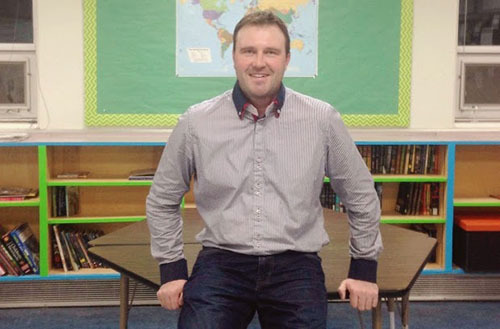
2016-01-27-1453859177-775811-cmrubinworldjoebowerRIP500.jpg
 Remembering Joe Bower 1978 - 2016
We miss our Top 12 Global Blogger Joe Bower very much. Joe, a progressive and gifted educator from Red Deer, Alberta, Canada recently died of a massive heart attack at the age of 37. Through his regular contributions to the Top 12 Global Teacher Blogger series each month, Joe inspired our team enormously as well as thousands of educators around the world.
On a personal note, I was delighted to discover I shared a mutual passion with Joe when I worked with him on our November 2015 blog that focused on games that really help students learn. During the back and forth on his article, he asked me if he could write about board games (versus video games). He explained that he'd been working in a Children's Inpatient Psychiatric Assessment Unit, and he found that board games were a great way in the first instance to establish a trusting, caring relationship with an emotionally challenged child. Being a lover and believer all my life in the many merits of board games, Joe's idea completely resonated with me. He wrote in his "For the Love of Learning" blog on this topic and noted that beyond being an important relationship builder, this form of play was also "a great way of assessing children's skills including their creativity, collaboration, adaptability, resiliency, critical thinking, problem solving, patience, literacy and numeracy."
And so Joe - thank you for your amazing mind, your compassionate soul, your ideas, your commitment to education - all of which will live on through your legacy. "For the Love of Learning" from you and from each other, so that we may ultimately help learners everywhere to shine, we shall continue to share teachers' perspectives each month as I know you would want us to.
This month, we posed this question to our Top 12 Global Teacher Bloggers: What The Global Search for Education: Our Top 12 Global Teacher Blogs - Remembering Joe Bower and His Love of Learning: