Latest News and Comment from Education

Monday, January 11, 2016

Special Nite Cap: Catch Up on Today's Post 1/11/15


CORPORATE ED REFORM


Cloaking Inequity makes Top 50 in World! – Cloaking Inequity
Cloaking Inequity makes Top 50 in World! – Cloaking Inequity: Cloaking Inequity makes Top 50 in World! Honored that Cloaking Inequity was ranked today as the 43rd best education blog in the world!Thank you to everyone who has contributed over the years!From Feedspot:Check out the top 50 education blogs to stay up to date on what people are talking about in the education space. This list is a resou
What's Going Down in Detroit Today? Teacher in a Strange Land - Ed Week Teacher
What's Going Down in Detroit Today? - Teacher in a Strange Land - Education Week Teacher: What's Going Down in Detroit Today? I follow K-12 policy and practice across the nation--teacher leadership and teacher professionalism are my personal passion. And I think teachers across the country know far more about what's happening in public schools in Chicago, New York, Washington D.C. and Los Angeles
Public Sector Unions Just Got Brutalized In The Supreme Court | ThinkProgress
Public Sector Unions Just Got Brutalized In The Supreme Court | ThinkProgress: Public Sector Unions Just Got Brutalized In The Supreme CourtWASHINGTON, DC — Let’s not beat around the bush.Public sector unions just had a simply terrible day in the Supreme Court on Monday. Justice Antonin Scalia, the justice who seemed most inclined to agree with them prior to oral argument, took a hard turn against
DPS emergency manager criticizes 'sickout' | Blogs | Detroit Metro Times
DPS emergency manager criticizes 'sickout' | Blogs | Detroit Metro Times: DPS emergency manager criticizes 'sickout'The list of Detroit schools closed due to a teacher-organized "sickout" protest has grown to over 60, according to a poston the Detroit Public Schools' Facebook page. (Read the full list of closed schoolsover at the Detroit Free Press.)Writing in The Guardian, former Metro
Argument analysisin Friedrichs v. California Teachers Association: The question not asked : SCOTUSblog
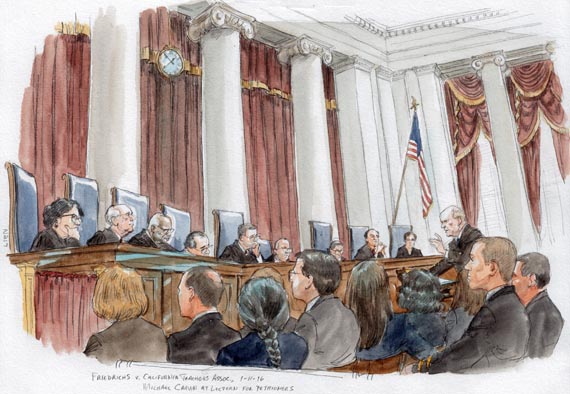
Argument analysis: The question not asked : SCOTUSblog: Argument analysis: The question not askedArguments in Friedrichs v. California Teachers Association. Michael Carvin at lectern for petitioners. (Art Lien)Early in the argument, a Washington, D.C., lawyer, Michael A. Carvin, made clear the basic complaint of the non-union California teachers he represents when he told the Court that the teache
The Argument transcript in Friedrichs v. California Teachers Association is here.: SCOTUSblog
Argument transcript : SCOTUSblog: Argument transcriptThe transcript in Friedrichs v. California Teachers Association is here.Posted in Merits CasesRecommended Citation: Andrew Hamm, Argument transcript, SCOTUSblog (Jan. 11, 2016, 2:05 PM), http://www.scotusblog.com/2016/01/argument-transcript-4/
Seattle Schools Community Forum: The False Promise of Choice
Seattle Schools Community Forum: The False Promise of Choice: The False Promise of ChoiceOne of the charms that ed reformers like to dangle before public school parents is choice.  It's quite the appealing siren call because 1) we're Americans and we love choices (even when they can overwhelm and even paralyze us) and 2) the idea that "wealthy people have choices when it comes to their childr
The Continuing Battle in the U.S. Over Free-Range Parenting and Letting Kids Walk to School Alone - The Atlantic
The Continuing Battle in the U.S. Over Free-Range Parenting and Letting Kids Walk to School Alone - The Atlantic: The Legal Standing of Free-Range ParentingAn amendment in the new federal education law seeks to clarify when kids are allowed to walk to school alone. A provision tucked deep within a gargantuan education bill passed in December clarifies the murky legal standing of free-range parenti
Education Spending Per Student by State
Education Spending Per Student by State: Education Spending Per Student by StateThe Census Bureau compiles data on education spending per pupil and elementary/secondary education revenues for each state.Spending amounts shown reflects current spending, which does not include capital outlays, interest on debts and payments to other governments. Data was last updated in June 2015 for fiscal year 201
Whistleblower Fights New York Officials to Enforce Their Own Child Safety Laws | gadflyonthewallblog
Whistleblower Fights New York Officials to Enforce Their Own Child Safety Laws | gadflyonthewallblog: Whistleblower Fights New York Officials to Enforce Their Own Child Safety LawsStephen and Cathy Cole with their device for safe use of gym partitions. Photo: Long Island Business Times.Are New York city and state officials doing enough to protect public school students?Kathy Cole says no.The co-ow
John Bel Edwards has said he wants to replace schools chief John White, but it's not clear he can | NOLA.com
John Bel Edwards has said he wants to replace schools chief John White, but it's not clear he can | NOLA.com: John Bel Edwards has said he wants to replace schools chief John White, but it's not clear he canGov.-elect John Bel Edwards finished up announcing most of his major cabinet appointments and other top staff selections this week -- with one notable exception. Edwards has been quiet recently
For Immediate Release: DPS Teachers Fight Back Rally, Monday, January 11, 2016, 12 p.m.
For Immediate Release: DPS Teachers Fight Back Rally, Monday, January 11, 2016, 12 p.m.: DPS TEACHERS FIGHT BACK!"A Union Within a Union""Teachers from more than 40 DPS schools are demanding safe conditions, adequate learning environments, and a level playing field for DPS Students."  Detroit- DPS Teachers Fight Back (A union Within a Union), is a group of teachers mobilizing t
Tentative agenda for the 2016 California Title I Conference. - Improving Academic Achievement (CA Dept of Education)
Tentative Agenda - Improving Academic Achievement (CA Dept of Education):Tentative agenda for the 2016 California Title I Conference.Early Check-in – Monday, February 29, 20163:00 p.m. – 6:00 p.m. Conference Check-InDay One – Tuesday, March 1, 20167:00 a.m. – 5:00 p.m. Conference Check-In7:00 a.m. – 8:00 a.m. Continental Breakfast Buffet8:00 a.m. – 9:15 a.m. General Session:Tom Torlakson, State Su
Parents Be on the Lookout: Districts Are Sending Opt Out Info Thanks to HB 2655! Oregon Save Our Schools
Oregon Save Our Schools: Parents Be on the Lookout: Districts Are Sending Opt Out Info Thanks to HB 2655!: Parents Be on the Lookout: Districts Are Sending Opt Out Info Thanks to HB 2655!Thanks to the efforts of all who helped to pass HB 2655 in this past legislative session, districts now have to inform parents of their right to opt out of state summative testing (currently SBAC) for any reason. 
A “Zombie” Reform: Outcome Based Education (OBE) in Medical Education and K-12 Schools | Larry Cuban on School Reform and Classroom Practice
A “Zombie” Reform: Outcome Based Education (OBE) in Medical Education and K-12 Schools | Larry Cuban on School Reform and Classroom Practice: A “Zombie” Reform: Outcome Based Education (OBE) in Medical Education and K-12 SchoolsOutcome Based Education (OBE) rolled through U.S. public schools in the 1980s and 1990s. Yes, OBE (a.k.a “mastery learning,” “competency-based education”) is still around (
L.A. schools insider and an outsider emerge as favorites to lead the district - LA Times
L.A. schools insider and an outsider emerge as favorites to lead the district - LA Times: L.A. schools insider and an outsider emerge as favorites to lead the districtAt the Los Angeles Board of Education closes in on choosing a new leader, attention appears to be focused on two candidates: Deputy Supt. Michelle King, an L.A. Unified School District insider, and Kelvin Adams, a superintendent from
Two NJ Cities Test Today’s School Reform: Disruption and Privatization Fail | janresseger
Two NJ Cities Test Today’s School Reform: Disruption and Privatization Fail | janresseger: Two NJ Cities Test Today’s School Reform: Disruption and Privatization FailI hope you read David Kirp’s fine commentary on school reform in yesterday’s NY Times.  As the author of one of two excellent recent books on school policy in New Jersey—the 2013,Improbable Scholars—Kirp, a Berkeley professor of publi
Mike Klonsky's SmallTalk Blog: WEEKEND QUOTABLES
Mike Klonsky's SmallTalk Blog: WEEKEND QUOTABLES: WEEKEND QUOTABLESThe mayor of San Francisco is sworn in — to boos and arrestsValerie Jarrett on #RahmResign“So I really shouldn’t comment on Chicago in particular because it’s under that investigation of [Loretta Lynch] hers.” In the interview with BuzzFeed at the White House Friday, Jarrett praised the protests, giving them credit for the current
Jersey Jazzman: The Friedrichs Freeloaders Go To Court
Jersey Jazzman: The Friedrichs Freeloaders Go To Court:The Friedrichs Freeloaders Go To CourtRebecca Friedrichs and her fellow plaintiffs going before the Supreme Court today are those kind of teachers.Those of you who've been working in schools for a while know what I mean. The kind of teacher who keeps pouring themselves coffee from the pot in the faculty lounge, but never thinks to put some mon
The Future of Big Data and Analytics in K-12 Education - Education Week
Schools Push Personalized Learning to New Heights - Education Week: SCHOOLS PUSH PERSONALIZED LEARNING TO NEW HEIGHTSFor most schools, reaching the next level of digitally driven, personalized learning is far from reality. Still, some schools are extending their digital reach in significant and sometimes groundbreaking ways, as the stories in this special report illustrate. They are making moves t
Transgender policy sparks heated debate at St. Paul charter school - StarTribune.com
Transgender policy sparks heated debate at St. Paul charter school - StarTribune.com: Transgender policy sparks heated debate at St. Paul charter schoolCase of 5-year-old is controversial territory as parents and outside groups weigh in. A heated debate over how to address the needs of transgender and gender-nonconforming students has dragged out for months at a public charter school in St. Paul,
John Thompson on Education and the Media | Diane Ravitch's blog
John Thompson on Education and the Media | Diane Ravitch's blog: John Thompson on Education and the MediaJohn Thompson, historian and teacher in Oklahoma, writes here about a growing awareness in the mainstream media of the infusion of Big Money into education. The New York Review of Books is a major influence among highly educated people and has a reach far beyond professional educators.The New Y
Friedrichs Case Threatens To Take Away Fairness - Lily's Blackboard
Friedrichs Case Threatens To Take Away Fairness - Lily's Blackboard: Friedrichs Case Threatens To Take Away FairnessThe U.S. Supreme Court will hear oral arguments Monday in a case over whether teachers in California and 22 other states working under a union contract must pay union fees even if they are not union members. Friedrichs vs. California Teachers Association seeks to make it harder for e
CURMUDGUCATION: DFER: Trust Clinton To Betray Unions
CURMUDGUCATION: DFER: Trust Clinton To Betray Unions: DFER: Trust Clinton To Betray UnionsIn his semi-regular email to supporters, allies, and hate-readers, Whitney Tilson led one item with this subheading:Hillary (and Bill) have a long history of breaking with the teachers’ unions, which bodes well: Tilson is a leading light of DFER (Democrats for Education Reform), a group of faux Democrat, hedg
4LAKids - Friedrichs v. CTA: 3 ARTICLES TODAY'S SUPREME COURT HEARING FROM THE NEW YORK TIMES
4LAKids - some of the news that doesn't fit: Friedrichs v. CTA: 3 ARTICLES ABOUT TODAY'S SUPREME COURT HEARING FROM THE NEW YORK TIMES: Friedrichs v. CTA: 3 ARTICLES ABOUT TODAY'S SUPREME COURT HEARING FROM THE NEW YORK TIMESIssues and Implications inSupremeCourt’s Public Union CaseWASHINGTON — The Supreme Court will hear arguments on Monday in a case that is making the labor movement nervous. Her
Educators are Ready to Lead on ESSA Implementation - Lily's Blackboard
Educators are Ready to Lead on ESSA Implementation - Lily's Blackboard: Educators are Ready to Lead on ESSA ImplementationWe want to see more listening, not less.More engagement, not less.More stakeholder engagement, not less.Read Lily’s testimony at the Department of Education on the implementation of the Every Student Succeeds Act¡Buenos días! My name is Lily Eskelsen García and I am proud to be
Teacher Autonomy Declined Over Past Decade, New Data Shows - NEA Today
Teacher Autonomy Declined Over Past Decade, New Data Shows - NEA Today: Teacher Autonomy Declined Over Past Decade, New Data Shows Not exactly breaking news: Teachers believe their classroom autonomy suffered during the No Child Left behind era. According to just-released federal data from theNational Center for Education Statistics (NCES), educators reported less classroom autonomy in school year
Common Core’s Lasting Damage – Missouri Education Watchdog
Common Core’s Lasting Damage – Missouri Education Watchdog: Common Core’s Lasting DamageHave you ever watched Americans line up informally? An ex-CIA analyst once said the best way to tell if you are not in America is to watch if people line up to receive things without instruction. In other countries, large mobs will rush the distributor. In America people line up. And where no formal stanchions
The Future of Big Data and Analytics in K-12 Education - Education Week
The Future of Big Data and Analytics in K-12 Education - Education Week: The Future of Big Data and Analytics in K-12 EducationAre schools ready for the power and problems of big data?By Benjamin HeroldImagine classrooms outfitted with cameras that run constantly, capturing each child's every facial expression, fidget, and social interaction, every day, all year long.Then imagine on the ceilings o
Teachers' unions unite to highlight 'national crisis' in profession | Education | The Guardian
Teachers' unions unite to highlight 'national crisis' in profession | Education | The Guardian: Teachers' unions unite to highlight 'national crisis' in professionSix unions call for pay increases above proposed 1% annual level, and warn more pupils are being taught by unqualified staffTeachers’ unions are urging the government to ward off a “national crisis” in the profession, warning that increa
Detroit teacher 'sick-out' closes many schools - CNN.com
Detroit teacher 'sick-out' closes many schools - CNN.com: Teacher 'sick-out' keeps thousands of Detroit students home from school(CNN)Thousands of students were out of school Monday in Detroit after a planned teacher "sick-out" forced the school system to close nearly two-thirds of the city's public schools, according to alerts sent out by the district.Detroit parents were warned Sunday
Anaheim School Board Calls for Statewide Moratorium on Charter Schools | Alternet
Anaheim School Board Calls for Statewide Moratorium on Charter Schools | Alternet: Anaheim School Board Calls for Statewide Moratorium on Charter SchoolsSaying no to privatization, profiteering and operating secretly.Editor's note: Across the country, a coalition of billionaires and entrepreneurs has been promoting and imposing charter schools on the traditional public school system. These schools
We Have A New Education Secretary. Here's Why It Matters. | ThinkProgress
We Have A New Education Secretary. Here's Why It Matters. | ThinkProgress: We Have A New Education Secretary. Here’s Why It Matters.It was a surprise to those working in education policy when Arne Duncan, who has served as the education secretary since the beginning of the Obama administration, announced he would step down by the end of last year. Now, with only one year to go until a new administ

YESTERDAY

New York stumbles, California advances on Common Core implementation | EdSource
New York stumbles, California advances on Common Core implementation | EdSource: New York stumbles, California advances on Common Core implementationIf there is a prime example of how one state mismanaged the implementation of the Common Core standards, triggering massive opposition, and how another did it deliberately, with a relatively smooth implementation and considerable public support, look
The Washington Teacher: Did You Know?
The Washington Teacher: Did You Know?: Did You Know?By: Candi Peterson, WTU General Vice PresidentStatements or expressions of opinions herein 'do not' represent the views or official positions of DCPS, AFT, Washington Teachers' Union (WTU) or its members. Views are my own. The recent emails you have received about me from Coach Spinner are accusations, half-truths and lies intended to mislead tea
My New Year's Resolve | The Jose Vilson
My New Year's Resolve | The Jose Vilson: My New Year’s ResolveI’m supposed to tell you that I want to lose weight. I’m rounder than ever, so that’s a lofty goal.But that’s no fun, and I’d rather not spend your time talking about dietary supplements and instead tell you about my visit to the US Department of Education, my second trip to Washington D.C. in as many months. This time, I got the chance
Second Charter School Fix is also a Framework for Fraud
Second Charter School Fix is also a Framework for Fraud: Second Charter School Fix is also a Framework for FraudEven though the Washington State Supreme Court ruled that charter schools are unconstitutional and ordered the State legislature to fully fund our real public schools, some of the leaders of the State legislature, in a blatant act of defiance, have decided to hold hearings on two "c
Special Nite Cap: Catch Up on Today's Post 1/10/15
CORPORATE ED REFORMA 'No-Nonsense' Classroom Where Teachers Don't Say 'Please' : NPR Ed : NPRA 'No-Nonsense' Classroom Where Teachers Don't Say 'Please' : NPR Ed : NPR: A 'No-Nonsense' Classroom Where Teachers Don't Say 'Please'Any classroom can get out of control from time to time. But one unique teaching method empowers teachers to stop behavior problems before they begin.You can see No-Nonsense


Cloaking Inequity makes Top 50 in World! – Cloaking Inequity

Cloaking Inequity makes Top 50 in World! – Cloaking Inequity:

Cloaking Inequity makes Top 50 in World!


Honored that Cloaking Inequity was ranked today as the 43rd best education blog in the world!
Thank you to everyone who has contributed over the years!
From Feedspot:
Check out the top 50 education blogs to stay up to date on what people are talking about in the education space. This list is a resource to help educators and those in the field of education find the most relevant blogs from across the Web. It is compiled based on number of ranking factors such as
  • Number of followers of these blogs on Feedspot, Facebook and Twitter.
  • Engagement as determined through its combined Facebook shares and Tweets of its most recent posts.
  • The frequency of a blog’s updates. The more frequently a blog is updated, the higher its ranking.
  • Relevancy & quality of the blog posts with respect to the Education category and its usefulness to the readers.
See the rankings here.
Please Facebook Like, Tweet, etc below and/or reblog to share this discussion with others.
Want to know about Cloaking Inequity’s freshly pressed conversations about educational policy? Click the “Follow blog by email” button on the home page.
Twitter: @ProfessorJVH

What's Going Down in Detroit Today? Teacher in a Strange Land - Ed Week Teacher

What's Going Down in Detroit Today? - Teacher in a Strange Land - Education Week Teacher:

What's Going Down in Detroit Today?


 I follow K-12 policy and practice across the nation--teacher leadership and teacher professionalism are my personal passion. And I think teachers across the country know far more about what's happening in public schools in Chicago, New York, Washington D.C. and Los Angeles than what's happening in Detroit.  Which is a shame, because many of the outrages--from democratic 

12540592_1135014346551324_7647915462567881827_n.jpgdisenfranchising to charter abuses--were pilot-tested here in the mitten state. With the same lousy results they're getting in bigger cities.
Tell any educator in this nation that you're a supporter of Detroit Public Schools and especially their teachers, and you'll get a disbelieving stare or headshake. Most people assume that it's way too late to save public education in Detroit, that it's permanently broken.
Most people, in fact, have a lot of incorrect assumptions about the Detroit Public Schools: They were so bad that they had to have an Emergency Manager come in to "save" them 15 years ago. Then, they were still so low-achieving that the state had to disenfranchise their elected board and create a separate, state-run "achievement" district to show some progress. The teachers are weak and lazy, but overpaid. The parents don't care. And on and on.
None of this is true, but it's what the nation (and a lot of people in Michigan) assume about the education in the once- great, big-hearted city that put us on wheels: Detroit schools can't help themselves, and are beyond hope.
Today, a group of Detroit teachers--fed up with Darnell Earley, the same Emergency Manager who presided over the Flint water scandal, and a raft of further harmful offences to real Detroit children and their education--organized a sick-out. They did so in frustration, knowing full well they would be accused of greediness, or keeping children from their federally subsidized meals. They did so knowing they will be labeled "unprofessional," led around by their unions (false)--when their actions represent what is ultimately the core of what professionalism means: autonomy over important work.
I have been hearing from Detroit PS teachers all day--sharing a range of anger and fear. Their voices, steeped in first-hand experience, are powerful. Here are some excerpts, the voices of Detroit PS teachers:
  • How DARE Darnell Earley, the EM for Detroit Public Schools and the EM responsible in part for poisoning the children and citizens of Flint, insinuate that it is the teacher's responsibility for whether children in Detroit eat or not! That sentiment has been used time and again to try and keep teachers "in line." Teachers are not responsible for the poverty in Detroit. Teachers are not the solution to poverty in Detroit. And this may come as a surprise to some, but not ALL students in Detroit go hungry at home. How insulting to hard working parents to insinuate that if the school doesn't feed their child, he/she will not eat that day! How disrespectful to the community as a whole.
  • This teacher sick-out is not an action spearheaded by the DFT! We teachers are sick and tired of always being the ones who compromise. We have lent the district money in good faith, we have remained frozen in our pay since 2008, we have taken decreases in health care--and that's not even half of it! If we were in school today every student and teacher would have had to wear coats hats and gloves, because there's no heat.
  • I have been a teacher in Detroit Public Schools for 24 years. I feel the need to respond to some of the comments Darnell Earley made during a press conference this week. He described the actions of protesting teachers as "unethical." I'm curious, then, how he would characterize the learning conditions of the children of Detroit Public Schools that have existed for years. These deplorable learning conditions happen to also be the teachers' working conditions. We deal with unsafe environments - both in the neighborhoods surrounding our schools and often within the schools themselves.
  • Unlike you, Mr. Earley, students and teachers do not have a driver and security guards. Students who travel to and from school pass numerous abandoned, dangerous buildings and have been robbed, assaulted, and raped. Teachers have been victims of violent crimes and have had their vehicles and personal property damaged and/or stolen, sometimes repeatedly. They suffer verbal abuse and some have been assaulted. Many schools have numerous plumbing problems in the lavatories, drinking fountains, and sinks. Many outdated school buildings are crumbling - roofs, floors, windows, doors, and locks that are broken or in desperate need of repair. Far too many classrooms are overcrowded, creating conditions that are not even safe, let alone conducive to learning. I'm wondering where the concern and outrage over that has been. 
  • In the past decade, teachers have lent the district almost $10,000 apiece, that we now fear we may never get back. We have taken a 10% pay cut in a salary that was already significantly lower than surrounding districts. And now DPS teachers have to worry about the security of our pensions and wonder if we will even be employed during the next school year. 
  • I felt like many of my colleagues are caught in the crossfire of feeling as though something must be done and this, apparently, was the time, even though the event is not sanctioned. The case seemed so compelling and I wanted to show solidarity and not be one of the "others." We have all been respectful, for the most part, of other teachers' decisions. I privately contacted one colleague who seemed to fear the disappointment of his colleagues but couldn't take the chance of losing a day's pay to support his family. 
  • Recent teacher sickouts ARE NOT a DFT union-led activity. These sickouts have been organized by individual groups of teachers. This is how dysfunctional Detroit is.Teachers, who have been largely apathetic in the past decade even in light of their diminishing pay, benefits and working conditions are standing up and saying No More! The district wants to paint these teachers as uncaring about their students' welfare when the truth is exactly the opposite. They are taking a stand and saying "Our students deserve better and we will not be complicit any longer."
  • Mr. Earley, you accuse us of drowning out the voices of our students. You stated we are "using students as pawns to advance a political position." You have it backwards. The children of Detroit HAVE been used as pawns. Their voices have indeed been drowned out. But make no mistake, this has not been done by the teachers. Educational decisions are now being made by politicians. Schools are being run like businesses. We have been vilified by these politicians. We have been made accountable for things we have little or no control over. We have been forced to administer numerous developmentally inappropriate tests to our students and then we and our students are judged by the meaningless scores. We have watched the debt increase to ridiculous, unsustainable levels under state appointed emergency managers, while the conditions we teach in have deteriorated alarmingly. We have been set up to fail in every way. The successes that happen in classrooms every day, both academic and emotional, largely go unseen, and most cannot be measured or displayed on a data wall. We, as teachers, know our students and what they need. It is heartbreaking to see that our students too often don't have what they need and certainly not what they deserve. 
And, finally, this:

The recent action of teachers is not an attempt to drown out the voices of the students. It is an attempt to finally make their voices heard.
What's Going Down in Detroit Today? - Teacher in a Strange Land - Education Week Teacher:


Public Sector Unions Just Got Brutalized In The Supreme Court | ThinkProgress

Public Sector Unions Just Got Brutalized In The Supreme Court | ThinkProgress:

Public Sector Unions Just Got Brutalized In The Supreme Court

WASHINGTON, DC — Let’s not beat around the bush.
Public sector unions just had a simply terrible day in the Supreme Court on Monday. Justice Antonin Scalia, the justice who seemed most inclined to agree with them prior to oral argument, took a hard turn against them within just a few minutes of argument. Justice Anthony Kennedy, who is normally this closest thing this Court has to a swing voter, appeared to grow increasingly angry with the unions as the argument proceeded. Plus the Supreme Court has already droppedtwo big hints that it’s ready to cut of a major source of funding for public sector unions. Oral arguments cannot always predict the outcome of the case — just ask the millions of Americans who are now insured because of Obamacare — but if they offer any predictive value, a lot of unions are very frightened right now.
Friedrichs v. California Teachers Association involves what are alternatively referred to as “agency fees” or “fair share fees,” which unions charge non-members to recoup the cost of services performed for those non-members. As ThinkProgress previously explained,
Unions are required by law to bargain on behalf of every worker in a unionized shop, even if those workers opt not to join the union. As such, non-members receive the same higher wages (one study found that workers in unionized shops enjoy a wage premium of nearly 12 percent) and benefits enjoyed by their coworkers who belong to the union.
Absent something else, this arrangement would create a free-rider problem, because individual workers have little incentive to join the union if they know they will get all the benefits of unionizing regardless of whether they reimburse the union for its costs. Eventually, unions risk becoming starved for funds and collapsing, causing the workers once represented by a union to lose the benefits of collective bargaining.
To prevent this free-rider problem, union contracts often include a provision requiring non-members to pay agency fees.
In essence, these fees exist to ensure that non-members do not get something for nothing. Instead, they require the non-members to pay their share of the costs of obtaining the benefits of unionization.
The plaintiffs in Friedrichs argue that such fees violate the First Amendment, at least with respect to public sector unions. As a general rule, the First Amendment does not permit the government to compel someone to say something they disagree with, and the plaintiffs claim that requiring non-union members to subsidize collective bargaining by a union that they may not agree with essentially rises to the level of compelled speech.
Were this a case where the government actually required private citizens to subsidize the union’s bargaining, the plaintiffs may have a point. The First Amendment is strongest when government uses its power as “sovereign” to compel individual action. It is much weaker, however, when the government only seeks to manage its own employees. As Justice Kennedy explained in his opinion for the Court in Garcetti v. Ceballos, “government employers, like private employers, need a Public Sector Unions Just Got Brutalized In The Supreme Court | ThinkProgress:


DPS emergency manager criticizes 'sickout' | Blogs | Detroit Metro Times

DPS emergency manager criticizes 'sickout' | Blogs | Detroit Metro Times:

DPS emergency manager criticizes 'sickout'


The list of Detroit schools closed due to a teacher-organized "sickout" protest has grown to over 60, according to a poston the Detroit Public Schools' Facebook page. (Read the full list of closed schoolsover at the Detroit Free Press.)

Writing in The Guardianformer Metro Times investigative reporter Ryan Felton says teachers are protesting what they describe as the district's "abominable" working conditions. (More on those later.)

Darnell Earley, the emergency manager for Detroit Public Schools, held a press conference last week in which he criticized the sickouts that have closed schools, due to "the negative impact that this is having on our students and our families.” He urged the community to "stand together and be the voice for the children of this community."

Feeling a bit of whiplash? If so, it might be because you remember Darnell Earley's role as the emergency manager of Flint, where the decision to draw untreated water from the Flint River may have had some "negative impact" on students and families — higher rates of lead poisoning that will plague them for the rest of their lives.

That's right: Earley — one of several officials being sued by Flint Residents in a class action lawsuit brought in federal court, and a man the state Democratic Party has been demanding be fired for three months now — saw fit to urge people to stand up against irresponsible behavior that is hurting children.

Of course, the Detroit Federation of Teachers say that they're already in that fight, and that the EM is to blame, noting his role in Flint. DFT Interim President Ivy Bailey wasn't shy about bringing lead levels into the discussion, saying, “The children of Detroit, Flint or any other community should not be exposed to atrocious, environmental hazards.” At DPS schools, they can include "rat and other rodent infestations, crumbling walls, holes in ceilings, cracked sidewalks, dangerous broken boilers and no heat." Bailey stressed that "conditions have gotten worse over the six years of state emergency management control."

Of course, these environmental concerns are just one category of complaints, but a significant one, given Earley's connection to Flint. We're still looking to see if any local press made mention of Earley's tenure in Flint, but Felton did at The Guardian.

And it wasn't just a passing mention, it was a direct comparison drawn between DPS and Flint by a guy who knows a thing or two: Thomas C. Pedroni, a Wayne State professor who has followed the progression of EMs through DPS

The close reader will find that Earley chooses his words carefully. He hasn't actually said anything like, "This irresponsible strike is damaging the young minds of DPS students, impairing their ability to learn for life, and making them more susceptible to crime and poverty. The people responsible for this strike should be fired and put in jail." After all, he must be aware it would be too easy to hurl his own role in Flint back in his face, or to have those words read back to him on the witness stand one day. So it's not surprising to see Earley avoid language that conjures memories of his days as Flint EM. 

And yet we wonder: Given that the Flint water crisis is such a hot national story right now, why isn't his role there mentioned every time he's quoted? Or at least why don't more people throw their shoes at him when he urges them to be "the voice for the children of this community"?

==========

The Strike to Win Committee program, adopted by unanimous vote at the Jan. 25, 2015, mass special DFT union membership meeting:DPS emergency manager criticizes 'sickout' | Blogs | Detroit Metro Times:


Argument analysisin Friedrichs v. California Teachers Association: The question not asked : SCOTUSblog

Argument analysis: The question not asked : SCOTUSblog:

Argument analysis: The question not asked

Arguments on California Teachers' union. Michael Carvin at lectern for petitioners
Arguments in Friedrichs v. California Teachers Association. Michael Carvin at lectern for petitioners. (Art Lien)
Early in the argument, a Washington, D.C., lawyer, Michael A. Carvin, made clear the basic complaint of the non-union California teachers he represents when he told the Court that the teachers don’t want to be forced to pay any support to “an outside advocacy group like a political party or like a union.”  It was not a slip of the tongue, yet no one challenged whether the two actually were equivalent political entities.
What may have been most revealing is that the five Justices whose votes are likely to control the outcome showed no sign of doubting the non-union members’ premises, so most or all of those five would appear to be inclined to conclude that any charge of an “agency fee” to a non-member would be a compelled endorsement, with their money, of “a group that advocates an ideological viewpoint” (as Carvin also described the teachers’ union).
Those are the Justices who made up the majority in a five-to-four ruling in 2014, Harris v. Quinn, that stopped just short of inviting the kind of First Amendment challenge that Carvin brought to the Court Wednesday, after rushing it through lower courts as a test case on whether the Court was ready to overrule its 1977 decision in Abood v. Detroit Board of Education.  That is the precedent which established the legality of an “agency fee” to be levied by public-sector unions on non-union members to support collective bargaining.
The four Justices who were in dissent in the Harris case appeared to be headed toward dissent again, even as they made no headway in shaking Carvin’s assault on the teachers’ union as a state-compelled advocate for workplace policies that the non-union members appear to find objectionable.  Those four appeared to be clinging to the Court’s usual reluctance to overturn a constitutional precedent that had been followed for nearly four decades.
The more liberal Justices gained a measure of support from Justice Anthony M. Kennedy, as they wondered what would be the fate of “agency fees” that now exist in thousands of union contracts affecting millions of workers, if the Court were to overrule the Abood decision.  The liberals seemed unpersuaded by Carvin’s suggestion that such fees outside the public sector were not in jeopardy.
Kennedy otherwise appeared to be lining up with the developing consensus against the Aboodprecedent.  He emphasized his worry about suppressing the views of individual workers who had Argument analysis: The question not asked : SCOTUSblog:

Union fees in jeopardy: In Plain English

For nearly forty years, it has been settled that, although public employees who don’t join a union cannot be required to pay for the union’s political activities, they can be charged an “agency” or “fair share” fee to pay for other costs that the union incurs – for example, for collective bargaining. After over an hour of oral arguments today, public-employee unions are likely very nervous, as the Court’s more conservative Justices appeared ready to overrule the Court’s 1977 decision in Abood v. Detroit Board of Education and strike down the fees. Let’s talk about Friedrichs v. California Teachers Association in Plain English.
The most telling sign that lead plaintiff Rebecca Friedrichs and her fellow teachers are likely to prevail may have actually come from the Court’s four more liberal Justices, who spent relatively little time on the main legal issue before the Court – that is, whether requiring non-members to pay the fee violates the First Amendment. Instead, many of their questions centered on whether, even if Friedrichs has a stronger legal argument, the Court should still rule against her based on a legal doctrine known as “stare decisis” – which counsels that the Court should not overturn its prior rulings unless there is a particularly compelling reason to do so. This suggests that the more liberal Justices realized that the battle on the merits of the case was not one that they could win. And so they shifted gears, trying to salvage a victory by convincing at least one of their colleagues that it would, as a matter of principle, be a bad idea to overrule the decision in Abood.
Justice Elena Kagan led the charge, telling Michael Carvin – who argued on behalf of Friedrichs – that public-employee unions have entered “tens of thousands of contracts,” governing “millions of employees, maybe as high as 10 million employees,” that would be disrupted if the Court were to overturn Abood. Therefore, she asked Carvin, “what special justification are you offering here” to do so? When Carvin answered that “the right of the citizen not to be subjected to unconstitutional treatment outweighs any reliance or predictability interests of stare decisis,” Kagan shot back, clearly unconvinced: “Your answer is essentially you don’t need a special justification if” the first decision denied a constitutional right? Justice Ruth Bader Ginsburg chimed in, asking whether employees who don’t join a union would ask for their fees back if Friedrichs wins and suggesting to Carvin that, if the Court overrules Abood, other cases that rely on it would also fall, with far-reaching effects.
In at least a brief flicker of hope for the unions, Justice Anthony Kennedy also seemed to express some concern, telling Carvin that, if they were to “assume that stare decisis is an important consideration for the Court,” what happens to the “many contracts, perhaps thousands of contracts?” Carvin stood his ground, telling Kennedy that the extent to which unions and governments may have relied on the Court’s decision in Abood is irrelevant.
Justice Stephen Breyer made an even broader appeal, focused on the effect that reversing course on the union fees would have on the public’s view of the Court, that may have been directed not only at Kennedy but also at Chief Justice John Roberts, who cares very much about the Court’s legitimacy.  Noting that the Court’s ruling in Abood has worked “reasonably well,” Breyer asked Carvin to explain, “from the point of view of this Court’s role in society,” when “you start overruling things,” “what happen to the country thinking of us as a kind of stability . . . in a world that is tough because it changes a lot?” “It’s a matter of considerable concern,” Breyer emphasized. Breyer acknowledged that some decisions should be overturned – for example, the Court’s 1896 decision in Plessy v. Ferguson, which upheld laws mandating racial segregation under the “separate but equal” doctrine. That decision, Breyer reasoned, “certainly should have been overruled” “because it was a right to treat people equally.” But, Breyer told Carvin, “I can’t find a basic principle here that’s erroneous.”
Questions from the Court’s more conservative Justices confirmed that the more liberal Justices had good reason to be concerned that Friedrichs had the advantage on the merits, as the more conservative Justices displayed skepticism about virtually all of the major arguments proffered in support of the union fees. Arguing on behalf of California, which supported the union, California Solicitor General Edward DuMont emphasized the long history of labor unrest in California in the 1960s, which prompted the state to adopt the current system of unions and fees. California has a critical interest in managing government workplaces, DuMont told the Justices, and it needs to be able to deal with a single union that employees also perceive as adequately representing their interests. The fees at issue in this case serve an important interest in ensuring that such a representative exists, he argued, by providing sufficient and stable funding for the union.
Justice Antonin Scalia voiced sympathy for the state’s need to run its workplaces smoothly, but he was nonetheless dubious about both the need to charge non-members a fee and the consequences if the Court were to strike down the fees. Scalia asked DuMont to explain why public-employee unions would not survive when unions representing federal employees don’t charge non-members similar fees but nonetheless “prosper,” in Scalia’s words. Michael Carvin returned to this point during his rebuttal, reminding the Justices that, in addition to the federal government, twenty-five states already prohibit such fees and were “all fine.”
And Justice Anthony Kennedy downplayed what the union characterizes as a “free rider” problem – the idea that a public employee who declines to join the union that represents him benefits from the union’s work on his behalf without having to pay for it. He told DuMont that “many teachers Union fees in jeopardy: In Plain English


The Argument transcript in Friedrichs v. California Teachers Association is here.: SCOTUSblog

Argument transcript : SCOTUSblog:


Argument transcript

Posted in Merits Cases
Recommended Citation: Andrew Hamm, Argument transcriptSCOTUSblog (Jan. 11, 2016, 2:05 PM), http://www.scotusblog.com/2016/01/argument-transcript-4/
Argument transcript : SCOTUSblog:

Seattle Schools Community Forum: The False Promise of Choice

Seattle Schools Community Forum: The False Promise of Choice:

The False Promise of Choice


One of the charms that ed reformers like to dangle before public school parents is choice.  It's quite the appealing siren call because 1) we're Americans and we love choices (even when they can overwhelm and even paralyze us) and 2) the idea that "wealthy people have choices when it comes to their children's schooling and so should you."

Number two is false on so many levels.  Wealthy people have many more choices period.  Houses, cars, vacations, clothes, colleges, you name it - wealthy people have so many more choices.  What's interesting is that the schools in our district are - almost to a school - full.  Now is that because there are more people in our city? Maybe but the private schools are full as well.  (Imagine if even half those private school parents came back.)

Here's a great essay by Chicago Schools' parent, Julie Vassilatos, The Frightening Implications of School Choice (bold hers, red highlight mine.) 


Because "choice" of this kind quietly diminishes the real power of our democratic voice while it upholds the promise of individual consumer preferences above all else.

In this model the local community is not important, and the voice of the local residents is not important. The neighborhood school is not the social epicenter for kids in one community and it is notthe locus of parent effort and investment of time.

But in a choice district, parents and kids rarely have the one option they most want--a strong, well resourced, nearby, neighborhood school.

With the choice model, what CPS is doing is investing insevering community. CPS has chosen a school model that fractures and breaks down local bonds among families and within neighborhoods.
Are public schools serving all children well? No. And that has always been the Seattle Schools Community Forum: The False Promise of Choice:

The Continuing Battle in the U.S. Over Free-Range Parenting and Letting Kids Walk to School Alone - The Atlantic

The Continuing Battle in the U.S. Over Free-Range Parenting and Letting Kids Walk to School Alone - The Atlantic:

The Legal Standing of Free-Range Parenting

An amendment in the new federal education law seeks to clarify when kids are allowed to walk to school alone.


 A provision tucked deep within a gargantuan education bill passed in December clarifies the murky legal standing of free-range parenting—sort of. Advocates for the practice—that is, encouraging kids to build self-reliance skills by traveling their neighborhoods solo—are hailing the 101-word section as a victory, though the law still leaves parents and journeying kiddos subject to state and local guidelines.

The amendment is on page 857 of the Every Student Succeeds Act, and is the work of Mike Lee, the Republican senator from Utah who has become something of a political patron saint of anti-helicopter parenting. The provision declares that nothing will “prohibit a child from traveling to and from school on foot or by car, bus, or bike when the parents of the child have given permission.”(Note that the language does not specify how parents are to give legitimate permission.)
It also shields parents who allow their kids to travel “reasonably and safely to and from school by a means the parents believe is age appropriate” from civil or criminal charges.

The state and local exemption could be a killer in this case, and one lawyer consulted by StreetsBlogUSA called the amendment a “symbolic effort.” But the legislation proves that people are heeding the call of the free-range movement, whose adherents believe that children need to be entrusted with independence in order to grow into independent adults.It also proves a point that Amanda Kolson Hurley highlighted at CityLab last year: Legislating when children are old enough to do anything is a tricky, tricky business.
Governments at all levels—city, state, and federal—have a patchwork of laws surrounding kids being alone. Some states have legislation prohibiting leaving children under a certain age in homes by themselves. (The cut-off in North Carolina is 10, in Illinois, 14, and Maryland, 8.) But most leave the question of what constitutes too much trust in children up to local agencies and law The Continuing Battle in the U.S. Over Free-Range Parenting and Letting Kids Walk to School Alone - The Atlantic: