Latest News and Comment from Education

Thursday, January 7, 2016

OPT-OUT LEADER TO CHALLENGE MULGREW FOR UFT PRESIDENT « Movement of Rank and File Educators
OPT-OUT LEADER TO CHALLENGE MULGREW FOR UFT PRESIDENT « Movement of Rank and File Educators:

OPT-OUT LEADER TO CHALLENGE MULGREW FOR UFT PRESIDENT

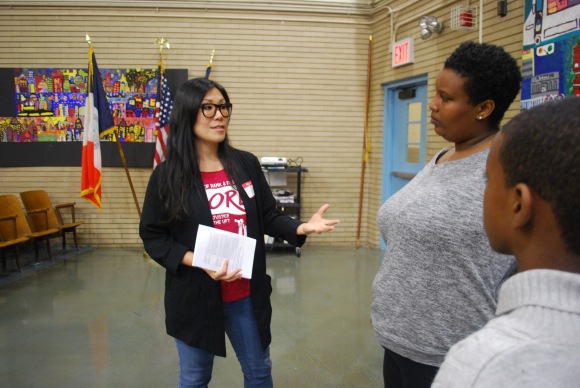
DSC_0034
JIA LEE, UFT CHAPTER LEADER OF THE EARTH SCHOOL WILL REPRESENT CLASSROOM TEACHERS AND SCHOOL BASED EDUCATORS AS CANDIDATE FOR UFT PRESIDENT


The Movement of Rank and File Educators (MORE) and New Action, two opposition caucuses of the United Federation of Teachers, have come together to nominate Jia Lee for UFT President in the upcoming  officers’ elections. Ms. Lee has opted-out of standardized testing as a teacher and parent.  She testified in January 2015 before the U.S. Health, Education, Labor and Pensions Committee Senate hearing on Testing and Accountability, for the reauthorization of the Elementary and Secondary Education Act (ESEA), stating, “I decided that I am obligated and accountable to my students and families, and that is why, as a conscientious objector, I will not administer tests that reduce my students to a single metric and will continue to take this position until the role of standardized assessments are put in their proper place.” Her fundamental belief that the over reliance on multiple choice tests betrays the educational promise that our children deserve, is shared by parents and educators throughout the city. The opt-out movement has been credited with influencing New York and national educational shift away from Common Core based high stakes testing to an approach that involves parents and educators in the decision making process.
Jia Lee has been an active UFT Chapter Leader for seven years. She is running for President because, “For too long, our union leadership has been complicit to damaging educational policies, such as test-based teacher evaluations and mayoral control over the city’s schools. This has led to the void in community voice and democratic decision making our public school students deserve.” Ms. Lee raised a resolution at the June 2015 UFT Delegate Assembly for a vote of “No confidence in the newly appointed State Education Commissioner, Mary Ellen Elia” which the leadership spoke against citing Ms. Elia “as a friend to public education.” Recently, the Commissioner affirmed her position to continue pushing accountability measures. Ms. Lee and MORE/New Action will continue to fight for our members to have a voice in our union and educational policies that impact the children we teach everyday.
MORE is a rank and file led caucus of the UFT,  that represents thousands of teachers, guidance counselors, paraprofessionals, secretaries, and school based support staff.  In the 2013 UFT elections, MORE won over 40% of the High School votes and more than 5,000 votes from the 20,000 active members that cast ballots. MORE has announced it will run as a joint slate with the long established New Action Caucus of the UFT. Their combined votes in 2013 would have won them 7 seats on the UFT Executive Board.
MORE has established itself as the leading voice for active educators by holding union meetings in local communities, supporting parent’s right to opt-out of standardized testing, organizing conferences for parents, students and educators, defending UFT members, providing free workshops on contractual enforcement, and fighting for the schools all our children deserve. New Action is the the oldest opposition caucus in the UFT and their members currently serve on the union’s executive board.OPT-OUT LEADER TO CHALLENGE MULGREW FOR UFT PRESIDENT « Movement of Rank and File Educators:
 

UOO Conference, February 26 – 28, 2016: Transcending Resistance, Igniting Revolution

UOO Conference, February 26 – 28, 2016: Transcending Resistance, Igniting Revolution


It is time for revolution. It is time for non-negotiable demands. It is time to reclaim our public schools and demand all for all children. Join us in Philly as we dialogue with an incredible group of revolutionary leaders whoRead more

Three Protagonists Controlling Public Education and Downton Abbey. Time for a *Downstairs* Rebellion. – Missouri Education Watchdog

Three Protagonists Controlling Public Education and Downton Abbey. Time for a *Downstairs* Rebellion. – Missouri Education Watchdog:

Three Protagonists Controlling Public Education and Downton Abbey. Time for a *Downstairs* Rebellion.

protagonist
The education reform novel contains characters mimicking actors in Upstairs, Downstairs and Downton Abbey.  Education reform and the miniseries delve into the lives of two definite classes: one which rules and one which takes orders.  The ‘downstairs’ class (the servants who take the orders) operates as the ruling class deems necessary for the existence and continuation of the ruling class.  In American education reform policy, parents are considered downstairs servants subject to the mandates of the ruling class: the Ed Reformers, NGOs, ed reform funded politicians, and Federal agencies. The mandates/laws are to justify the existence/continuation of this ruling class at the expense of the lower class: the taxpayers compelled to pay for these mandates/laws and offer their children to non-researched/non-data based educational theories.
Who are the ruling class protagonists in the Education Reform movement which supports Common Core, centralized education and the expansion of public/private partnerships?  A list would include both individuals and organizations, such as The Chamber of Commerce, NGA, and CCSSO.  Some of the characters in the novel of Public Education: 2016 Version of Common Core, have started a new ed reform chapter of directives/ideas.  Bill Gates, Jason Zimba and Michael Petrilli reveal how they really don’t trust the parents who are compelled to pay for the system these education reformers are attempting to control through public/private partnerships.  What frolicking escapades/statements are these protagonists up in the new year?
Character #1:
Bill Gates, who has supported the centralized blueprint of education (over $300 Million) and furthered his version of ‘philanthropy’ by donating funding to organizations to further his vision, controls the public/private partnership mechanism.  He starts out his position in the new year by his ‘contributions’ to organizations who will then support his vision.  He set the foundation of how public education policy is written: through NGOS, lobbyists and politicians indebted to Gates via grants and contributions.  From Gates, Koch, and Common Core: What Are Citizens to Do?:
Opposition to the Common Core and the closely aligned standardized testing regimen is strong in New York State. The Gates Foundation strategically chose to give $1.2 million to the United Way of New York City to“build [their] capacity as an advocate, school-based technical assistance provider and community-based organization trainer in support of Common Core in NYC and NY State.”
Other 2015 grants seemed to be made with the same goal of impacting the public debate around educational policy. With affiliates in each of the 50 states, it may not be a surprise to find that the National Congress of Parents and Teachers (PTA) was another 2015 Gates grantee, receiving slightly less than $1 million to“support the training and engagement of parent volunteers around Common Core assessments and forthcoming assessment results.” Stand for Children, an organization created to “ensure that all children, regardless of their background, graduate from high school prepared for, and with access to, a college education,” received $3,580,000 from the Gates Foundation to “support capacity building and increased public will around Common Core standards and aligned assessments in four states.” The publisher ofEducation Week, Editorial Projects in Education Inc., received a grant of $750,000 “to support reporting on issues related to the implementation of the Common Core.”
While individuals and foundations have always been able to target their giving to organizations with which they agree, the growth of a class of super-rich people who control such a large share of our national wealth 
Three Protagonists Controlling Public Education and Downton Abbey. Time for a *Downstairs* Rebellion. – Missouri Education Watchdog:


Time for Education Advocates to Get Behind Bernie Sanders? - Living in Dialogue

Time for Education Advocates to Get Behind Bernie Sanders? - Living in Dialogue:'

Time for Education Advocates to Get Behind Bernie Sanders? 


By Anthony Cody.
For the past seven months, I have been holding my breath hoping that Bernie Sanders would follow the logic of his passionate defense of working people and willingness to confront hedge funders and financiers, and apply this thinking to K12 education policy. As we know, many of the most ardent backers of the privatization of schools are these same wealthy individuals.
Last May, I wrote this column, suggesting ways that Sanders could win support from education activists like myself. Last night, Sanders made a clear statement of support for public schools, shared on Diane Ravitch’s blogHe said:
I’m not in favor of privately run charter schools. If we are going to have a strong democracy and be competitive globally, we need the best educated people in the world. I believe in public education; I went to public schools my whole life, so I think rather than give tax breaks to billionaires, I think we invest in teachers and we invest in public education. I really do. (see video here, statement at 1:48:32)
This morning I posted a longer transcript of remarks Sanders made at a gathering of the Massachusetts Teachers Association last October. He makes it clear that he supports the teaching profession, and our unions. It is also notable that when Sanders was in Chicago recently he made a point of stating that he did not need support from Mayor Rahm Emanuel, who has closed fifty schools and waged war on the teachers union.
I think it is time for education advocates to get behind the Sanders candidacy. I think support would be stronger were he to lay out policies along the lines I suggested, but I think there are several powerful reasons to support him. Here they are:
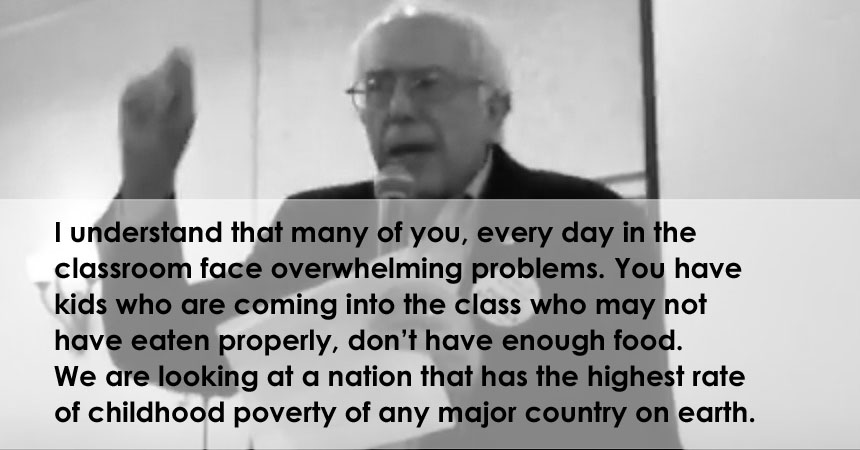
For years, we have argued that when attempting to improve educational outcomes for students, we cannot ignore the effects of poverty. We have called on leaders to directly address poverty – and Sanders has by Time for Education Advocates to Get Behind Bernie Sanders? - Living in Dialogue:'
Bernie Sanders Talks Education at the Massachusetts Teachers Association - Living in Dialogue http://bit.ly/1PMiBJ3

By Anthony Cody.
Educators have growing interest in the candidacy of Senator Bernie Sanders. Today I posted my own statement of support for his candidacy. This support has been a bit slow in coming,  because many, including myself, have expressed a desire for more specific policies regarding K12 education. Along those lines, Diane Ravitch yesterday shared this statement Bernie Sanders made on Jan. 3 in New Hampshire on her blog.
I’m not in favor of privately run charter schools. If we are going to have a strong democracy and be competitive globally, we need the best educated people in the world. I believe in public education; I went to public schools my whole life, so I think rather than give tax breaks to billionaires, I think we invest in teachers and we invest in public education. I really do. (see video here, statement at 1:48:32)
Last October 15, Bernie Sanders spoke to a gathering of members of the Massachusetts Teachers Association, and spent time addressing education issues. Below is a transcript I made of his remarks.
Bernie Sanders:
Let me just begin by saying thank you for what you do. You are the heroes and heroines of America today, and your job is enormously difficult, and it is enormously important. Certainly one of the goals of the campaign that we are running, which we call “the political revolution,” is to transform America in many respects, and certainly at the top of our lists is to transform how we prioritize education. I cannot think of anything more important to this country than to have the best public education system in the world. And I know we all love Tom Brady, and we have all these athletes that are making millions of dollars a year, but, you know, it might not be a bad idea if we made everybody in America realize that teaching is a great profession, it is an enormously important profession, it is a profession that should be respected and well compensated. We want the best and the brightest to go into teaching, and to stay in teaching.
I am for better or for worse – you’ll have to judge – a product of public education. I believe in public education and I believe that public education is one of the strongest Bernie Sanders Talks Education at the Massachusetts Teachers Association - Living in Dialogue http://bit.ly/1PMiBJ3

A School's Year in Hell, Through the Lens of a National Board Portfolio Entry - Living in Dialogue

A School's Year in Hell, Through the Lens of a National Board Portfolio Entry - Living in Dialogue:

A School's Year in Hell, Through the Lens of a National Board Portfolio Entry


 By John Thompson.

As explained previously, here in part 1 of this three part series, and here in part 2, since my book, A Teacher’s Tale has been released, I’ve been rereading the manuscript’s my first draft and some of its original sources.  My National Board (NBPTS) teacher certification entries are a contemporary record my school’s “Year from Hell” in 1998-1999. The following describes a challenging freshman class situation as our school was collapsing. (All names are pseudonyms)
My second videotaped National Board session documented freshmen group learning, and I believed it should have received a grade comparable to the whole class discussion’s grade of a 3.00, as opposed to a 2.00.  On the other hand, to have followed their rules of evidence, the graders would have to believe my description of the background to that lesson. And those of us who were living through our shared experience often had problems comprehending that what we were seeing was actually happening; too much of that year was a surreal and recurring nightmare.  Unless a grader had firsthand experience in the inner city, a suspension of disbelief might have been impossible.  Moreover, an evaluation of that lesson under the IMPACT rubric in the District of Columbia in the 21st century could have determined that I was “Ineffective.”
During the fall semester, the class that was videotaped was nearly perfect, and much of the credit belonged to two vocal leaders, Alice and Loren, and two quiet leaders, Kelli and Joe. The entry explained, “Last semester during a great class discussion, Loren interrupted and asked, ‘D.T., you aren’t going to leave us, are you?’”  She and her classmates then said that they knew that the best teachers had left for the magnet A School's Year in Hell, Through the Lens of a National Board Portfolio Entry - Living in Dialogue:

Torlakson Appoints Division Directors - Year 2016 (CA Dept of Education)

Torlakson Appoints Division Directors - Year 2016 (CA Dept of Education):

State Schools Chief Torlakson Appoints Division Directors to Help Districts Implement New Academic Standards and New Funding System


SACRAMENTO—State Superintendent of Public Instruction Tom Torlakson today named Brent Malicote Director of the California Department of Education's (CDE) new Standards Support Office and Jeff Breshears as Director of the Local Agency Systems Support Office.
Both appointments are key CDE leadership positions and reflect the department's increasing emphasis on supporting local districts and schools, Torlakson said.
The Standards Support Office will provide increased access to the tools and resources necessary to implement the new, more rigorous California learning standards, which cover English-Language Arts, Math, Science, and English Language Development.
Malicote is a high-energy leader with extensive field experience in teaching and administration in California's Central Valley. He most recently served as Principal of Pinewood Elementary School, which CDE honored as a California Distinguished School in 2014. He was named El Dorado County's Elementary Principal of the Year for 2015.
"We are fortunate that a proven school leader of Brent's caliber has joined the department," Torlakson said. "His success leading school teams with high-quality implementation of Common Core Standards will be a great addition to CDE and the students and families we serve."
The Local Agency Systems Support Office (LASSO) helps school districts achieve state and local goals in the Local Control Funding Formula (LCFF), which gives districts more resources and more flexibility in spending and requires them to work with their communities to create education plans.
Breshears brings 10 years of CDE experience supporting programs that serve high-need students. He supported critical phases of Local Control Funding Formula implementation, including extensive work with County Offices of Education to support design and implementation of Local Control Accountability Planning (LCAP).
Breshears has extensive teaching and administrative experience in California public schools, including innovative work with students with exceptional needs in middle schools and high schools in Solano County.
"Jeff's work with the initial stages of California's innovative Local Control Funding Formula implementation will provide the department with high-quality leadership needed to create and guide the next phase of this important program," Torlakson said. "He currently leads the department's LCAP Support Team, a new initiative designed to support local school districts as they design and implement effective plans for their schools and communities."
For additional information on the Local Agency Systems Support Office, visit the Local Agency Systems Support Office Web page.
# # # #
Tom Torlakson — State Superintendent of Public Instruction
Communications Division, Room 5206, 916-319-0818, Fax 916-319-0100
Last Reviewed: Thursday, January 7, 2016


State Board of Education approves charter school policy change :: WRAL.com

State Board of Education approves charter school policy change :: WRAL.com:

State Board of Education approves charter school policy change


 — The State Board of Education voted unanimously Thursday to give newer charter schools more chances to remain open if they are struggling to meet performance standards.


Under the old policy, the state board could revoke the charter of any school that, for two of three consecutive years, failed to meet or exceed expected growth on state tests and had a proficiency rate below 60 percent.


The new policy allows charter schools in the first five years of operation to be labeled "inadequately performing" instead of facing closure. They will be required to develop a strategic plan to meet goals for student performance. If they fail to make improvement within two years, the charter will revoked.


For charter schools that have been open more than five years and meet the definition of “inadequately performing,” the school board will revoke their charter.


The state board on Thursday also declined to vote on the annual charter schools report, which is due to the legislature on Jan. 15. They will delay the vote until next month, at the request of Lt. Gov. Dan Forest, who called the report "negative" and asked for more time to review it.
Read more at http://www.wral.com/state-board-of-education-approves-charter-school-policy-change/15217900/#uZgQSZPprYxBzRAk.99

Editorial: Taxpayers assume risk, little gain for charter schools | Tampa Bay Times

Editorial: Taxpayers assume risk, little gain for charter schools | Tampa Bay Times:

Taxpayers assume risk, little gain for charter schools


 Florida has invested heavily in privately run charter schools for years, and the payoff for taxpayers has been uneven at best. While some successful charter schools fill particular needs in local communities, too many have failed and research shows they have not outperformed traditional public schools in the state. Taxpayers also have lost millions in construction costs and other capital investments when charter schools have closed, and state lawmakers should revisit the oversight and funding for these schools.

The state has lost as much as $70 million in money for construction, rent and other costs when charter schools have closed over the last 15 years, a recent Associated Press analysis found. In Broward County, 19 now-closed charter schools received $16.5 million. In Hillsborough County, 17 now-closed charter schools received more than $5.4 million. In Pasco County, three now-closed charter schools received more than $900,000, and in Pinellas County three received almost $550,000. In Miami-Dade County, the Liberty City Charter that Jeb Bush helped establish before he ran for governor in 1998 received more than $1 million in capital money from the state before it closed with financial problems. Why should taxpayers be shouldering such financial risk and eating these losses for privately run schools?
It would be one thing if traditional public schools were flush with cash with no need for new construction or maintenance. In fact, the state's 67 school districts received no new construction money for three years before finally dividing a modest $50 million last year (a handful of rural counties got another $59.7 million). Those facilities are used by more than 2.7 million students, yet far fewer charter schools that served about 230,000 students split $75 million. This year traditional schools and charter schools each received $50 million, and Gov. Rick Scott recommends public schools and charter schools each get $75 million for construction and maintenance for 2016-17. But a 50-50 split of the money is hardly fair. Pinellas County schools alone have more than $400 million in construction and capital needs over the next five years, yet the district has received just $8.1 million in construction and maintenance money from the state over the last five years.
Charter schools, which are publicly funded but privately operated, overall have received more than $760 million from taxpayers for capital costs since 2000, the AP reported. In 2012 and 2013, they got virtually all of the state money for construction and maintenance. Charter school advocates argue that the money is critical to their success, and they point out they do not have the authority to levy local property taxes to pay for those capital costs like school districts can for traditional public schools. But charters are not always small operations. They are often managed by large, for-profit companies such as Charter Schools USA, which won approval from the Hillsborough School Board this fall to run four new schools with up to 4,650 students. Passing through tax dollars for per student funding, paying public money for construction and maintenance, and allowing for less regulation for charter schools where private management companies make a profit at little risk is a pretty sweet deal.
Florida taxpayers will never get back the $70 million lost on construction costs for failed charter schools. At the very least, the state should require that the school building or other capital assets be handed to taxpayers when that happens so at least some of the public's investment can be recovered.
Editorial: Taxpayers assume risk, little gain for charter schools 12/24/15 [Last modified: Thursday, December 24, 2015 11:55am]  Editorial: Taxpayers assume risk, little gain for charter schools | Tampa Bay Times:

Deep Pockets, Corporate Reform, and Teacher Education | VAMboozled!

Deep Pockets, Corporate Reform, and Teacher Education | VAMboozled!:
Deep Pockets, Corporate Reform, and Teacher Education


A colleague whom I have never formally met, but with whom I’ve had some interesting email exchanges with over the past few months — James D. Kirylo, Professor of Teaching and Learning in Louisiana — recently sent me an email I read, and appreciated; hence, I asked him to turn it into a blog post. He responded with a guest post he has titled “Deep Pockets, Corporate Reform, and Teacher Education,” pasted below. Do give this a read, and a social media share, as this one is deserving of some legs.
Here is what he wrote:
Money is power. Money is influence. Money shapes direction. Notwithstanding the influential nature of it in the electoral process, one only needs to see how bags of dough from the mega-rich-one-percenters—largely led by Bill Gates—have bought their way in their attempt to corporatize K-12 education (see, for example, here).  
This corporatization works to defund public education, grossly blames teachers for all that ails society, is obsessed with testing, and aims to privatize.  And next on the corporatized docket: teacher education programs.
In a recent piece by Valerie Strauss, “Gates Foundation Puts Millions of Dollars into New Education Focus: Teacher Preparation,” she sketches how Gates is awarding $35 million to a three-year project called Teacher Preparation Transformation Centers funneled through five different projects, one of which is the Texas Tech based University-School Partnerships for the Renewal of Educator Preparation (U.S. Prep) National Center.
A framework that will guide this “renewal” of educator preparation comes from the National Institute for Excellence in Teaching (NIET), along with the peddling of their programs, The Deep Pockets, Corporate Reform, and Teacher Education | VAMboozled!:


American Rage: The Esquire/NBC News Survey

American Rage: The Esquire/NBC News Survey:

American Rage: The Esquire/NBC News Survey

WE THE PEOPLE ARE PISSED. THE BODY POLITIC IS BURNING UP. AND THE ANGER THAT COURSES THROUGH OUR HEADLINES AND NEWS FEEDS—ABOUT INJUSTICE AND INEQUALITY, ABOUT MARGINALIZATION AND DISENFRANCHISEMENT, ABOUT WHAT THEY ARE DOING TO US—SHOWS NO SIGN OF ABATING. ESQUIRE TEAMED UP WITH NBC NEWS TO SURVEY 3,000 AMERICANS ABOUT WHO'S ANGRIEST, WHAT'S MAKING THEM ANGRY, AND WHO'S TO BLAME.
LET'S BEGIN WITH THE BIG REVEALS: Half of all Americans are angrier today than they were a year ago. White Americans are the angriest of all. And black Americans are more optimistic about the future of the country and the existence of the American dream. There are depths and dimensions, dark corners and subtle contours to our national mood, and setting aside the issue of who actually has a right to be angry and about what—these pages are neutral territory; everyone is allowed their beef—we found three main factors shaping American rage:
EXPECTATIONS: Are you disappointed? Do you feel stifled and shortchanged and sold a bill of goods? Then you're probably pretty angry. Consider the white men and women in our survey: From their views on the state of the American dream (dead) and America's role in the world (not what it used to be) to how their life is working out for them (not quite what they'd had in mind), a plurality of whites tends to view life through a veil of disappointment. When we cross-tabulate these feelings with reports of daily anger (which are higher among whites than nonwhites), we see the anger of perceived disenfranchisement—a sense that the majority has become a persecuted minority, the bitterness of a promise that didn't pan out—rather than actual hardship. (If anger were tied to hardship, we'd expect to see nonwhite Americans—who report having a harder time making ends meet than whites, per question three—reporting higher levels of anger. This is not the case.)
Indeed, despite having what many would consider a more legitimate case for feeling angry, black Americans are generally less angry than whites. Though they take great issue with the way they are treated by both society in general and the police in particular, blacks are also more likely than whites to believe that the American dream is still alive; that America is still the most powerful country in the world; that race relations have improved over the past eight years; and, most important in the context of expectations, that their financial situation is better than they thought it would be when they were younger. Their optimism in the face of adversity suggests that hope, whatever its other virtues, remains a potent antidote to anger.
EMPATHY: When we take a close look at our respondents by gender, women report a greater rise in anger than men over the past year. (See question two.) One possible explanation: Although they share many of the same frustrations with respect to dashed expectations, they are more likely than men to be angry about the treatment of others. (See question 14.) That perception of unfairness has a way of rubbing people the wrong way.
EXPERIENCE: Seventy percent of blacks express anger about the way they are treated by society. Forty-eight percent of women are angry about the way they are treated. Even 21 percent of white men say they are angry at how they are treated in this country. People get angry when they don't like how they and theirs are treated. People, we suppose, are funny like that.
A NOTE ABOUT TERMINOLOGY: Anger—the intensity and frequency with which it is felt—can be a challenge to measure, but for these purposes we kept it simple: We measured and compared anger primarily according to the frequency with which respondents report hearing or reading something that makes them angry. Those who report feeling angry a few times a day are considered angrier than those who report feeling angry once a day, who are angrier than those who get angry once a week, and so forth. To the lucky souls who say they rarely hear or read something that makes them angry, namaste: We'd love to know your secret.American Rage: The Esquire/NBC News Survey:

Let’s Make Community Schools the Schools Our Children Deserve – PCAPS Releases Plan | WeArePCAPS

Let’s Make Community Schools the Schools Our Children Deserve – PCAPS Releases Plan | WeArePCAPS:

Let’s Make Community Schools the Schools Our Children Deserve – PCAPS Releases Plan

CYEO4N1WEAQ7QB5


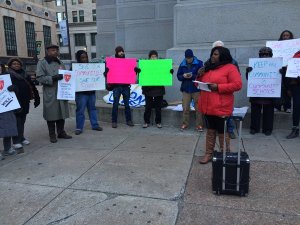
Spring Garden parent Sheila Armstrong speaking at City Hall press conference
Today, the Philadelphia Coalition Advocating for Public Schools announced theircomprehensive Community Schools platform, developed by over the last year by  a group of public school parents, educators, service providers, university partners and community organizations working with or in public schools. This platform outlines clear, concrete next steps that will ensure real Community Schools are built across the City, providing transformational education and resources to our neediest neighborhoods.
“We reached out during the last election cycle to candidates, calling for them to embrace a Community Schools initiative. We are here today to share the fruit of that work,” said Ron Whitehorne, retired teacher and PCAPS coordinator. “First, we applaud Mayor Kenney and Council President Clarke for their commitment to a community schools initiative. We hope to work with them as well as the School District to fashion a community schools plan.”
As an initial step, the group called for the City to establish a funded planning process led by a city-wide task force that includes parents, students, teachers and other school staff, community organization leaders, and city agency leaders. The group asserted that the task force should be charged with developing Philadelphia’s inclusive and effective plan for community schools, including fleshing out the ongoing governance structure, long-term funding, program components, school selection criteria, performance metrics, and processes and templates for partnership contracts.
The PCAPS plan also calls for embracing a vision of community schools that goes beyond a lowest common denominator.  “What has been emphasized to date is the development of partnerships housed in the school that provide support and services to students and families,” stated Ron Whitehorne. “That is critical, but we believe other things are essential as well, including a democratic culture and structure that draws on the energy and special knowledge of all elements of the school community… students, parents, teachers and neighborhood leaders.”
A series of speakers talked about why they saw community schools as a critical need.  Sheila Armstrong, a parent leader from Spring Garden elementary and co-chair of the POWER Education Committee, talked bout the gains a community schools approach has brought at the school.  “The leaders at Spring Garden School determined that one way we can see our students succeed is to find community resources to help our families with their issues that were not school related,” she explained, “The benefits we saw in the past three years were a reduction in missed days from school due to illness or medical appointments, Let’s Make Community Schools the Schools Our Children Deserve – PCAPS Releases Plan | WeArePCAPS:
 

1/7/2016 – Five Education Stories To Keep Your Eye On In 2016

1/7/2016 – Five Education Stories To Keep Your Eye On In 2016:

Five Education Stories To Keep Your Eye On In 2016

Education Opportunity Network -
THIS WEEK: Students Are Over-Stressed … Millions Go To Failed Charter Schools … Instead Of Suspensions … Who Profits From College Debt … Why Standardized Tests Suck

TOP STORY

Five Education Stories To Keep Your Eye On In 2016

By Jeff Bryant

“Here are five stories to look for … Vulnerable governors … Charter schools … The Test Rebellion … Friedrichs … Chicago.”
Read more …

NEWS AND VIEWS

Is The Drive For Success Making Our Children Sick?

The New York Times

“Expectations surrounding education have spun out of control … Even those not bound for college are ground down by the constant measurement in schools under pressure to push through mountains of rote, impersonal material as early as preschool … This drive for success is eroding children’s health and undermining their potential. Modern education is actually making them sick … A growing body of medical evidence suggests that long-term childhood stress is linked not only with a higher risk of adult depression and anxiety, but with poor physical health outcomes, as well … Working together, parents, educators and students can make small but important changes.”
Read more …

Florida Gave About $70 Million To Charter Schools That Later Closed; State Recouped Little

Miami Herald

“Charter schools, which are public schools run by private groups, have received more than $760 million from [Florida] taxpayers since 2000 … Yet charter schools in 30 districts have wound up closing after receiving as much as $70 million combined in such funding … Taxpayers usually can’t recover the capital money invested in those schools because most of it has been spent on rent or leasing costs. The Department of Education reported it has taken back just $133,000 in the last three years from schools that closed.”
Read more …

What Happens When Instead Of Suspensions, Kids Talk Out Their Mistakes?

The Hechinger Report

“There is now strong research that shows pulling students out of class as punishment can hurt their long-term academic prospects. What’s more, data show that punishments are often unequal. Nationally, more black students are suspended than white students … Alternative programs like restorative justice are gaining popularity in public schools from Maine to Oregon. Early adopters of the practice report dramatic declines in school discipline problems, as well as improved climates on campuses and even gains in student achievement … In addition … there is now federal pressure for districts to rethink their practices: Schools may face sanctions if discipline policies are found to unfairly target minority students. That is a significant milestone.”
Read more …

Who’s Profiting From $1.2 Trillion Of Federal Student Loans?

Bloomberg Business

“Congress created the loan program 50 years ago with the goal of encouraging students to attend college. Today, the Education Department is one of the largest financial institutions in the country. If it were a bank, it would rank fifth in the U.S. in assets … Companies that have benefited from the loan program range from debt servicer Affiliated Computer Services … to Education Management, which operates for-profit colleges … FMS Investment … was paid $227 million by the Education Department from October 2011 through September of this year… Florida Coastal is part of the InfiLaw System … A principal investor in InfiLaw is Sterling Partners, a private-equity firm that also owns a stake in Laureate Education Inc., which is planning an initial public offering next year … FMS’s parent, Ceannate, is one of about two dozen collection firms paid a total of $963 million in the fiscal year that ended in September… That’s down from a record $1.1 billion the previous year.”
Read more …

Straight Talk About Standardized Tests

The Progressive

Pennsylvania classroom teacher Peter Greene writes, “It may seem odd or even hypocritical for teachers to complain about standardized tests … These tests are scored by seasonal, minimum wage workers in temporary test-scoring sweatshops. The emphasis is on speed … The line drawn between success and failure … is drawn only after the tests have been scored … So students will not be able to find out what they need to do until after they have taken a test … This after-the-fact level setting also means that the line can be drawn differently every year … All of this means that even if they were great tests (that’s another conversation), they would not give parents or policymakers a picture of how a school is doing.”
Read more …
1/7/2016 – Five Education Stories To Keep Your Eye On In 2016:

A CEO’s Point of View: Children as Products for Corporate Consumers | janresseger

A CEO’s Point of View: Children as Products for Corporate Consumers | janresseger:

A CEO’s Point of View: Children as Products for Corporate Consumers


Business Gets Schooled, a long piece in the January 1, 2016, issue of Fortune, perches the reader as a fly on the wall of the corporate board room during a conversation among CEOs about public education.  This blog has argued that while public schools are the quintessential institution of the 99 Percent, education policy is being made by the One Percent.  Business Gets Schooled explains how that works.
The reporter, Peter Elkind—whose point of view dovetails nicely with the thinking of the business executives he is profiling—describes the involvement of Bill Gates, Exxon Mobil’s Rex Tillerson, and IBM’s Lou Gerstner, without even wondering what these people know that qualifies them for imposing the Common Core standards on the schools. One wonders if the corporate giants who hatched the standards ever leave their offices to spend time with their own children or grandchildren. As profiled in this piece, they do not acknowledge the existence of a credentialed education profession or of a vast body of academic literature on child and adolescent psychology or learning styles or the role of family economics in educational success. Neither does Elkind seem to know about any of this.
Exxon Mobil’s Tillerson stands out. For him schools are a kind of machine:  “I’m not sure public schools understand that we’re their customer—that we, the business community, are your customer… What they don’t understand is they are producing a product at the end of that high school graduation… Now is that product in a form that we, the customer, can use it?  Or is it defective, and we’re not interested? (American schools) have got to step up the performance level—or they’re basically turning out defective products that A CEO’s Point of View: Children as Products for Corporate Consumers | janresseger:

#TomPorton, Hero Teacher, retires | JD2718

#TomPorton, Hero Teacher, retires | JD2718:

#TomPorton, Hero Teacher, retires

I’ll save the comments for later. These are Tom Porton’s words. Please read. – Jonathan
To all my friends and supporters:… It is with mixed emotions that I announce that I will be retiring from the New York City Department of Education on February 1, 2016.
Looking back on 47 years in education (46 in the James Monroe building), I see a mosaic of thousands of faces…students, parents, colleagues. I have so many great memories of those years, from the excitement of the classroom, to the applause for shows I directed, to the impact of my many school and community projects. My heart is filled with so many great relationships that came from those years…so many of which I maintain even to the present day.
It is because of the joy I feel when I think of my teaching career that I have such mixed emotions about retiring. And yet, as this new year began and I took inventory of my daily routine, I realized there was a need to make a change in my professional life.
First and foremost, I do not feel that I have the same impact on young people that I have had in the past. The reason I continued teaching at Monroe for so many years was the fact that I really thought I was making a difference in the lives of my students, not only in the classroom, but especially through my work in school and community activities. It was that energy and excitement of creating and working with motivated, committed young people that kept me young and vital.
However, beginning this school year, my opportunities for continuing that impact have been lessened to the point where each day has become a struggle. For over 35 years, I began each day with my Leadership class, where I was able to create a core of 40-50 students who would facilitate a wide variety of school and community events in the Monroe Campus. Now, with that class programmed away by the current administration, making those events continue becomes harder and harder. I realized this during the past several months where I struggled to continue such projects as the Blood Drive, the Thanksgiving Community Dinner, the World AIDS Day commemoration, and the Holiday Caroling Celebration. #TomPorton, Hero Teacher, retires | JD2718: