Latest News and Comment from Education

Tuesday, December 22, 2015

Giving 'em Helen Gym in Phila. schools: deficient curricula

Pa.: Four Phila. schools offer deficient curricula:

Pa.: Four Phila. schools offer deficient curricula
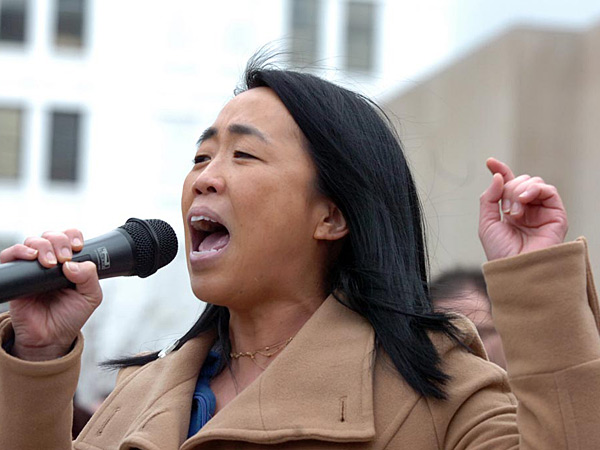
The Pennsylvania Department of Education has declared deficient curricula at four Philadelphia schools where parents complained after budget cuts forced sharp program reductions.
It is a "significant victory" for parents, education activists said, a signal that the state Department of Education is taking seriously its responsibility to monitor city schools' curricula and take action when necessary.
Parents from 75 Philadelphia School District schools filed 825 complaints detailing problems caused by budget cuts two years ago, issues ranging from a lack of arts and physical education to the absence of gifted programs. Initially, the state declined to act, saying it was a local matter. Seven parents then filed a lawsuit, forcing an investigation.
The suit continues, but the state's finding means that the district must create and implement corrective action plans at four schools - Bodine High, High School for Creative and Performing Arts, the Arts Academy at Benjamin Rush, and C.W. Henry Elementary - by mid-January.
But, activists said, the four complaints and the state's order, uncovered by plaintiff's attorneys as part of discovery in the case, are just "the tip of the iceberg."
Hundreds of complaints must still be investigated, lawyers said.
Robin Roberts, a Henry parent, lamented the district's elimination of all gifted programming, leaving her son and others with "inadequate academic classes," Roberts said.
"Our children were facing dire situations at schools, many of which persist today," said Roberts, a plaintiff in the suit.
Amy Laura Cahn, a lawyer with the Public Interest Law Center, which represents the plaintiffs, said she was delighted the state had finally intervened.
"It is long past time for the Pennsylvania Department of Education to take an interest in the quality of education in Philadelphia," Cahn said.
Tim Allen, a plaintiff whose son attends Bodine, stressed that the schools were not to blame; he named as heroes the school's principal and teachers, who he said persist in giving the highest-quality education possible under the circumstances.
But, he said, it is unacceptable that the school was forced to scrap Advanced Placement physics partway through the school year because of money, and that for a time it was looking at reducing foreign language offerings to the point where some students would not be able to fulfill college-entrance requirements.


"Nothing was changing," Allen said, "so I filed a complaint."
Christianne Kapps, mother of a senior at CAPA, said her daughter was attracted to the school because of intensive writing classes on top of the regular high-school English offerings. Reductions to the district's budget have seen those special classes halved, Kapps said.
Her daughter, always an eager student, "has been increasingly disappointed and frustrated with school" because of the cuts, Kapps said, and it feels like her family is being failed.
"We get her to school every day," Kapps said. "We're taxpaying citizens. We're doing our part. I just would really like to see the Pennsylvania Department of Education follow through and do what they're supposed to do."
Kapps said it felt like a validation of her and the other parents' longtime complaints.
"We're finally being taken seriously," said Kapps. "Yes, please listen to us when we say the School District isn't good enough. Please pass a budget that corrects that."
City Councilwoman-elect Helen Gym, a founder of Parents United for Public Education, which organized parents to file the complaints, said the state
Read more at http://www.philly.com/philly/education/20151222_Pa___four_Phila__schools_offering_deficient_curricula.html#u8veBAR34ApUdlTh.99


Why Has the Common Core Not Been Discussed on the Campaign Trail - The Atlantic

Why Has the Common Core Not Been Discussed on the Campaign Trail - The Atlantic:

What Happened to the Common Core Debate?

Several Republican presidential candidates have backed away from the term, but not the standards. Why?


The Common Core was expected to be a ubiquitous subject on the campaign trail in 2016. The education standards had, over time, become a political football as conservatives condemned them as federal overreach.
It’s so far hardly been the case. Governors in the race, like Jeb Bush, have backed away from using the term because of its negative connotation among the electorate, even if he still stands by the standards. Should he gain traction moving into the presidential primary it might become more relevant as early-voting states—and other governors, like Chris Christie—grapple with the standards.
The Common Core State Standards Initiative, known as the Common Core, is a set of academic standards for mathematics and reading for all ages. State school chiefs and governors collaborated to develop the standards, but since its rollout in 2009, it’s become a point of contention. A common criticism being that the standards aim to nationalize education, although they’re applied at the state level and weren’t ever explicitly mandated by the federal government.


Forty-two states, the District of Columbia, and four territories have adopted the Common Core. Christie, the governor of New Jersey and a Republican presidential candidate, agreed to adopt the standards in 2010, but has since dropped his support. “The truth is that it’s simply not working,” he said earlier this year.
The critique of the Common Core in part stemmed from the Obama administration’s Race to the Top initiative, which encouraged states to implement high standards, among other reform strategies, in exchange for grants. The competition at the root of Race to the Top sparked frustrations, as it gave the impression that the federal government was imposing the standards on the states, said Tamara Hiler, the policy advisor for education at Third Way.
The Common Core appeared to be at the forefront of issues to be tackled by presidential candidates come 2016. A year ago, The Washington Post had a headline that read “Common Core might be the most important issue in the 2016 Republican presidential race. Here’s what you need to know about it.”
The Common Core hasn’t been absent on the trail. In August, Jeb Bush called the term “poisonous,” adding “I don’t even know what it means.” Lots of people would agree with him, but, contrary to a majority of GOP presidential candidates, he backs the standards.
In August, some of the Republican presidential candidates attended a policy forum in New Hampshire where the standards were discussed. Ohio Governor John Kasich, who supports Common Core, conceded that it was troublesome. “Look, did I back away from it?” he asked. “Did I say what I thought?” The forum Why Has the Common Core Not Been Discussed on the Campaign Trail - The Atlantic:


Give the Gift of Student Voice—In New Orleans | EduShyster

Give the Gift of Student Voice—In New Orleans | EduShyster:

Give the Gift of Student Voice—In New Orleans

A holiday shout out to Kids Rethink New Orleans Schools

Rethinkers
Reader: this is typically the time of year when I ask you to open your hearts, meaning your wallets, on my behalf. But this year I’ve decided to roll a little differently. (This has nothing to do with the fact that last year’s fund drive, which I outsourced to the man to whom I’m *technically* married, was a dud!). So instead of asking for your love and largesse, I’d like you to consider making a generous donation to one of the most amazing student groups I’ve come across: Kids Rethink New Orleans SchoolsShall I pause here while you call your broker? 
Listen up
First: let’s conduct a little thought experiment together. I’d like you to run a quick mental sort through the roughly 10,000,000 stories that have been written about the New Orleans education experiment and ask yourself this one Logoquestion: how often have you heard from the students who are living through it? Ah—I thought so. Which is why the Rethinkers, as they’re called, are playing such an essential role. These students—hundreds of them, from charter schools all across New Orleans—start with a simple and powerful premise: that sharing their stories can help them change their schools, their neighborhoods and their city. It’s a concept that has proven remarkably successful in places like Lawrence, MA, as I wrote about in this happy, good news storyBut in New Orleans’ schools, where silence and strict discipline play such an outsized role, helping students not just find their voices but use them to push for change is even more important.
Now what did I do with that? 
Now I know what you’re thinking: *where did I leave my checkbook or some Rethink report 1other non-dated payment vehicle so that I can make a generous donation?* I’ll pause here to allow you to go and look for it. Back? Excellent. You’re curious about what the whole process of young people finding their voices and pushing for change actually looks like. Well, it look like this: Our New Orleans—The Black Youth Perspectivein which Rethinkers crisscrossed their city, interviewing their peers in three neighborhood about gentrification, youth incarceration and education. The result is a vivid, often startling picture of a city, its Give the Gift of Student Voice—In New Orleans | EduShyster:

Why 5+5+5=15 is wrong under Common Core - Business Insider

Why 5+5+5=15 is wrong under Common Core - Business Insider:

Why '5+5+5=15' is wrong under Common Core


Here's a "repeated addition" Common Core problem that's taught in third-grade in US schools.
Use the repeated-addition strategy to solve 5x3. If you answer the question with 5+5+5=15, you would be wrong. The correct answer is 3+3+3+3+3.
Mathematically, both are correct, but under Common Core, you're supposed to read 5x3 as "five groups of three." So "three groups of five" is wrong.
According to Common Core defenders, this method will be useful when students do more advanced math. This way of reading things, for instance, can be used when students learn matrices in multivariable calculus in high school.
But parents aren't happy about it.
Story by Jacob Shamsian and editing by Ben Nigh.Why 5+5+5=15 is wrong under Common Core - Business Insider:

This is what Americans think about transgender students in locker rooms - The Washington Post

This is what Americans think about transgender students in locker rooms - The Washington Post:

This is what Americans think about transgender students in locker rooms


Earlier this month, a suburban Chicago school district erupted in anger after a high school agreed to allow a transgender girl to change in the girls’ locker room. The school’s decision came after the girl had filed a Title IX complaint with the Department of Education’s Office of Civil Rights (OCR). The Obama administration, through OCR and other agencies, has taken the position that transgender discrimination is a form of sex discrimination—and had intervened on behalf of the transgender girl.
In public meetings, parents in District 211 were furious, arguing against the OCR’s mandate. Those parents’ opposition nearly scuttled the agreement between the OCR and the school district. As of this writing, the transgender girl will be changing in the girls’ locker room, in a private curtained area that will be available to any student who prefers privacy when she changes. This decision applies only to the student in the case, and is not a district-wide policy.
More such confrontations are likely to emerge in the next months and years. Transgender students have been coming out at younger and younger ages. As a result, school policy has become a prominent issue for the transgender movement. Until now there has been very little data on what most Americans think about the policies that transgender advocates seek.
And so in the summer of 2015, I conducted an online nationally representative survey that included a question about a recent California law—which many in the transgender movement consider to be a model bill–that allows students to “participate in sex-segregated programs, activities, and facilities” based on self-perception, regardless of sex assigned at birth.
Fifty-six percent of respondents supported formal policies protecting transgender students from discrimination. However, only 37 percent said they would support having their state pass a law similar to California’s. Only 30 percent supported transgender students using a restroom or locker room based upon gender identity rather than birth sex.
The survey tells us that while Americans are becoming aware of celebrity transgender individuals like Laverne Cox and Caitlyn Jenner, they have not yet become comfortable with the idea of transgender bodies in places that have been segregated based on sex assigned at birth, like locker rooms and bathrooms. In public meetings in the suburban Chicago school district, many insisted on calling the trans student a “boy.” “Bathroom panic” arguments helped defeat Houston’s expansion of its equal rights ordinance. Sixty-one This is what Americans think about transgender students in locker rooms - The Washington Post:

Rick Hess Cage-Busting Teacher and Escaping from the School Reform Cage | John Thompson

Rick Hess Cage-Busting Teacher and Escaping from the School Reform Cage | John Thompson:

Rick Hess Cage-Busting Teacher and Escaping from the School Reform Cage

I've long admired Rick Hess's iconoclasm and his realism. The conservative Hess also writes things that drive me up the wall. His recent defense of District of Columbia Chancellor Kaya Henderson and her kinder, gentler implementation of Michelle Rhee's teacher-caging policies is an example. But I usually enjoy the witty way that he presents his positions. And, I basically like his The Cage-Busting Teacher.
Hess's advice would really be on target if he had written the book in the 1980s. He offers good and great advice for teachers, then and now. Much of Hess's shared wisdom is the type of affirmation of democratic principles that our teachers and mentors taught to us Baby Boomers. His reminders that pragmatism is required to participate constructively in our constitutional democracy bear repeating.
Over the last two generations, however, conservative and, especially, liberal and neoliberal technocratic reformers have engaged in a crusade to place teachers in cages that they designed to be inescapable. Seeking rushed "disruptive" and "transformative" change, accountability-driven reformers have sought to lock us down so we can't argue against their risky and untested theories. We educators are long past the point where a how-to guide for slipping out of the bonds that have been gratuitously placed on teachers is enough to rescue our profession and our students.
Hess is articulate in indicting "stupid policies that have destructive effects that no one intended." He criticizes value-added evaluations, which are a perfect example of the "overflowing bucket of well-intentioned directives." For instance, he cites a Florida Teacher of the Year who taught students with autism and who was thus unfairly evaluated on his school's low value-added score.
Hess correctly says that teachers are "blindsided" by "simple-minded accountability Rick Hess Cage-Busting Teacher and Escaping from the School Reform Cage | John Thompson:


5 Attacks Against Teachers Unions By State Newspapers In 2015 | Research | Media Matters for America

5 Attacks Against Teachers Unions By State Newspapers In 2015 | Research | Media Matters for America:

5 Attacks Against Teachers Unions By State Newspapers In 2015


 Public school educators and their unions in major cities made national headlines in 2015 following strikes, contentious contract negotiations, school board elections, and funding battles. While research shows that teachers unions benefit students, educators, and communities, state newspapers editorializing on these union activities have ignored the facts and framed unions and educators as selfishly seeking higher pay at the expense of others. Amidst a victory year for teachers unions on several fronts, here are some of the most inaccurate claims state newspaper editorial boards pushed.

Research Shows Strong Teachers Unions Benefit Students And The Community

National Bureau Of Economic Research Study: Strong Teachers Unions Lead To Higher Teacher Quality. An October 2015 study from Wellesley College and the National Bureau of Economic Research (NBER) examining "the myth of unions' overprotection of bad teachers," explored patterns of teacher turnover in school districts with strong and weak teacher unionization, concluding that strong unions created a dynamic where high-quality teachers were retained at a higher rate, and lower quality teachers were dismissed at a higher rate. The research found that, as a result, teacher quality was overall higher in strongly unionized school districts, which in turn benefited students. From the study (emphasis added):
The model predicts that teachers unions, by negotiating higher wages for teachers, lower the quit probability of high ability teachers but raise the dismissal rate of underperforming teachers, as higher wages provide districts greater incentive to select better teachers. As a result, unions help the educational system reach an efficient equilibrium where high-quality teachers are matched with high wages... The data confirms that, compared to districts with weak unionism, districts with strong unionism dismiss more low-quality teachers and retain more high-quality teachers. The empirical analysis shows that this dynamic of teacher turnover in highly unionized districts raises average teacher quality and improves student achievement. [National Bureau of Economic Research, 10/5/15]
Rutgers University Education Scholar: Strong Unions Are Connected To Better Student Outcomes And Fairer School Funding. In a 2012 analysis reprinted on The Washington Post's Answer Sheet blog in 2014, Professor Bruce Baker of Rutgers University explored connections between states with strong teacher unionization and states' relative educational quality across several factors. Baker found that states labeled as strong union states were more likely to have above-average student outcomes and more fairly and better funded schools. States with stronger teachers unions were also found to have significantly more competitive wages for teaching, theoretically attracting more qualified individuals to join the teaching profession. [The Washington Post8/15/14]
Center For American Progress: Unions Improve Economic Mobility For Entire Communities. A September report from the Center for American Progress (CAP) found that children with parents who belonged to unions and communities with higher levels of union membership experienced better economic outcomes and increased economic mobility in the long term. The report summary concluded that many of the positive economic effects of unionization went beyond higher wages for union families, extending toincreases in mobility for nonunion families and entire communities (emphasis added):
There are strong reasons to believe that unions may increase opportunity. First, there are the direct effects that a parent's union membership may have on their children. Union workers make more money than comparable nonunion workers--what economists call the union premium--and when parents make more money, their children tend to make more money--which economists refer to as the intergenerational earnings elasticity. In theory, unionized parents should pass on a portion of the union premium to their children. There may be other channels through which children whose parents were in a union have better outcomes than other children: union jobs may be more stable and predictable, which could produce a more stable living environment for children, and union jobs are more likely to provide family health insurance.
But there are also a series of other ways that unions could boost intergenerational mobility for nonunion workers. It has been shown that unions push up wages for nonunion workers, for example, and these wage gains for nonunion members could be passed on to their children. Children who grow up in nonunion households may also display more mobility in highly unionized areas, for example, because they may be able to join a union when they enter the labor market. Finally, unions generally advocate for policies that benefit all working people--such as minimum wage increases and increased expenditures on schools and public services--that may especially benefit low-income parents and their children. A recent study on interest groups and political influence found that most of the national groups that supported middle-class priorities were unions. Another study found that states with higher union density also have higher minimum wages. [Center for American Progress, 9/9/15]
Princeton University Professor: Teachers Unions Give Political Voice To Poor And Middle Class.  A 2014 book by Princeton University Professor of Politics Martin Gilens explored the connections between policy, lobbying, and socioeconomic status and found that teachers unions -- along with several other advocacy organizations -- were responsible for the rare instances in which the preferences and concerns of people who are less advantaged were represented in national politics. The study concluded that teachers unions served as allies for low- and middle-income Americans and their lobbying support on select issues helped push policy toward the outcomes these groups supported. [Princeton University Press, accessed 12/16/15]
This Year, The Country's Largest Teachers Unions Have Formally Supported Social And Political Issues Beyond Teacher Wages And Benefits. In 2015, the National Education Association and the American Federation for Teachers -- the two largest teachers unions in the U.S. -- issued formal statements supporting racial justice protests on college campuses, taking a stance for comprehensive immigration reform, campaigning to end bullying, supporting parent-led hunger strikes for community schools in Chicago, supporting marriage equality, advocating for access to healthcare, expressing grief in the face of national tragedies, supporting increased access to community college, condemning bigotry against Syrian refugees, and recognizing the value of affirmative action in higher education. [National Education Association Press Center, accessed 12/14/15; American Federation of Teachers Press Releases, accessed 12/14/15]

State Newspaper Editorial Boards Ignored The Facts To Attack Teachers Unions

ATTACK: The Buffalo News Repeatedly Claimed Teachers Unions Want To Maintain "The Wretched, Costly, Dysfunctional Status Quo" At The Expense Of Student Outcomes 

Buffalo News: Teachers Union Pushing Back On Standardized Tests "Have Shown No Real Concern For The Kind Of Education That New York Provides To Its Students." In an April editorial discussing teacher union support for the growing movement in New York state for students to opt out of taking standardized tests, 5 Attacks Against Teachers Unions By State Newspapers In 2015 | Research | Media Matters for America:


Teachers Are About to Get the Data They Need to Educate Your Kids, Experts Say | Mother Jones

Teachers Are About to Get the Data They Need to Educate Your Kids, Experts Say | Mother Jones:

Teachers Are About to Get the Data They Need to Educate Your Kids, Experts Say

Nine big-city schools in California, covering almost 1 million kids, are trying to break away from "one size fits all" teaching.


When President Barack Obama signed the new Every Student Succeeds Act earlier this month, many school leaders, education advocates, and policy makers of all stripes rejoiced. The new law replaces the troubled No Child Left Behind Act and, for the first time in almost 20 years, gives states much more flexibility to design their own grading systems and make their own decisions on how to improve struggling schools. Under NCLB, school quality was measured primarily by the results of standardized test scores; the ESSA encourages states to use multiple measures, including at least one non-academic metric like student feedback about their schools and teachers.
Now that the bill is signed, state educators are starting to try to figure out what these new measures of school quality might look like. But a group of nine school districts in California have already been quietly tinkering with a new school grading system of their own. In 2013, a collaborative of nine of the biggest school districts in California—in Los Angeles, San Francisco, Fresno, Garden Grove, Long Beach, Oakland, Sanger, Santa Ana, and Sacramento—got permission from the federal government to create their own formula for grading and improving schools. The timing was perfect, since all states are now scrambling to find more sophisticated models for measuring schools at a time when state funding is in short supply.
"I think what these districts are doing is pioneering work that's really innovative and experimental," said David Plank, the executive director of Policy Analysis for California Education who has been working closely with the CORE districts, as they are known. "CORE is trying to create a system that's looking at schools deeply…including social and emotional learning."
So, what's new in the CORE school report cards?
Better academic data: Like the old system, what CORE calls the "School Quality Improvement Report Card" will still include academic factors like test scores in math and English and graduation rates. But CORE is working with a group of Stanford researchers at the John Gardner Center for Youth to make this data more useful for principals and teachers, according to Rick Miller, the executive director of CORE. For example, the state collects student attendance data, but right now that data only shows how many kids are going to school every day on average. "You might have 99 percent of students attending," Miller said, "but in fact there are six kids who are chronically absent." The new data will be able to point out to teachers the specific students who are consistently missing school, so the teachers could investigate the root causes behind absences and try to address them.
The state also collects high school graduation rates, but many students drop out in middle school. CORE is now collecting this information, as well as highlighting the names of individual students who are not on track to graduate on time.
Most states don't have the funds to create more sophisticated data collection systems. But CORE saw that there was a lot of data already available; it just wasn't always accessible.
Stronger equity lens: CORE's new school grading system also goes beyond the current federal requirements on reporting data by subgroups such as race, English-language proficiency, poverty, and special education. The collaborative breaks up Teachers Are About to Get the Data They Need to Educate Your Kids, Experts Say | Mother Jones:


Florida teachers union says new 'Best and Brightest' bonus program discriminates | Tampa Bay Times

Florida teachers union says new 'Best and Brightest' bonus program discriminates | Tampa Bay Times:

Florida teachers union says new 'Best and Brightest' bonus program discriminates

Florida's Best and Brightest teacher scholarship program had its critics from the moment it became law last summer.

It set aside $44 million to give teachers up to $10,000 in bonus money if they received a "highly effective" rating on their annual evaluations and scored at or above the 80th percentile on the SAT or ACT.
But some teachers hadn't even taken the tests when they were preparing to enter college. Many others had to scramble to get their scores by Oct. 1. Others questioned the practice of basing a professional bonus on a test they took as high school students. And many said the rating system itself is flawed.
The Florida Education Association raised those and other criticisms Monday in a complaint filed with the Equal Employment Opportunity Commission and the Florida Commission on Human Relations.
The union said the program discriminates against teachers over 40 because no percentile data is available from the ACT or SAT for teachers who took these tests before 1972, and many struggled to access their scores by the deadline. It said first-year teachers had the upper hand, too, because they were exempted from the "highly effective" evaluation qualification, and many of those teachers are under 40.
Best and Brightest also discriminates against African-American and Hispanic teachers, the union alleged, because the SAT and ACT are "racially/culturally biased tests that disparately impact test-takers" of those races. The complaint said there was no correlation between performance on those exams and teacher performance.
The FEA is seeking to ensure all qualified teachers have access to the money, which is to be distributed for the first time in the spring. About 5,200 teachers have been deemed eligible by their districts, putting them in line for about $8,500 each.
"Put together a system that makes it fair to everyone," said FEA president Joanne McCall. A better solution, she said, is to put the money into the state's budget formula.
State Rep. Erik Fresen, the Miami Republican who pushed for the scholarships, said in a statement that he looked forward to continuing to provide the program for teachers.
"It is unfortunate that the teachers' unions constantly oppose any payment structure effort that is not based on time served," wrote Fresen, who chairs the House Education Appropriations Subcommittee. "It's akin to the infantile argument of 'If I can't have any, neither can you.' "
An EEOC spokeswoman in Washington, D.C., said she was prohibited by law from confirming or denying the existence of discrimination charge filings.
The Florida Department of Education said it had not received a copy of the union's complaint. "The department has no comment other than to state that, as always, the department will cooperate fully with Florida teachers union says new 'Best and Brightest' bonus program discriminates | Tampa Bay Times:

Elia: Big changes coming for testing, evaluations, Common Core standards | POLITICO

Elia: Big changes coming for testing, evaluations, Common Core standards | POLITICO:

Elia: Big changes coming for testing, evaluations, Common Core standards


ALBANY — Substantive changes will be made to testing, teacher evaluations and the Common Core learning standards in New York State, state education commissioner MaryEllen Elia said in a television interview set to air Monday night.
“We’ve already started it,” Elia told WCNY’s Susan Arbetter on "Connect:NY," which airs on PBS.
Elia said the state Education Department already is working on changes to the standards, has shortened the state exams and is looking at the teacher evaluation system.
She said she understands the concerns of test refusal groups, which have said they willkeep urging parents to opt their children out of the state and local exams linked to the teacher evaluations until they see change.

MORE ON POLITICO


“I understand people saying, ‘Let me see it. I want to see it. I want to touch it. I want to make sure it’s there.’ Well, they’re going to be able to see it and touch it. That’s what we’re doing,” she said.
Elia was one of a number of guests on the show set to air Monday — among them State University of New York chancellor Nancy Zimpher, district superintendents, New York State United Teachers president Karen Magee and Lisa Rudley, a founding member of New York State Allies for Public Education, a parent-run group leading the charge on the opt-out movement.
The group discussed how dramatically the state of the education reform movement in New York State has changed in just the last few weeks — with the passage of a federal education law, the release Gov. Andrew Cuomo’s Common Core task force's final report and new regulatory changes from the Board of Regents.
On Dec. 10, President Barack Obama signed a broad federal education law, replacing No Child Left Behind, to give states more freedom over assessments and evaluations. What impact that law will have is still being interpreted by federal education officials, who have told POLITICO New York they have issued guidance to individual states.
That same day, Cuomo's task force — whose members included Zimpher and Elia — released its report, calling for an overhaul of the state's Common Core standards and recommending a moratorium on the use of student state test scores in teacher evaluations. And days later, the Regents passed emergency regulations enacting a moratorium through the 2019-2020 school year, saying they would review the system.
In the television interview, Rudley said she was skeptical of changes actually taking Elia: Big changes coming for testing, evaluations, Common Core standards | POLITICO:


The new educational philanthropy - AEI

The new educational philanthropy - AEI:

The new educational philanthropy
AEI's Rick Hess sits down with Education Next's Michael F. Shaughnessy


1) Rick, you and Jeff Henig have just edited a book, The New Education Philanthropy. What brought this about?
Just fifteen years ago, there were concerns that the nation’s philanthropic community was retreating from K-12, frustrated with what they regarded as school districts’ stubborn resistance to change. In March 2002, the $500 million Annenberg Challenge, which had been unveiled in 1994 at a joyous White House ceremony, petered out on a disappointing note. In the early 2000s, some traditional major funders redirected their efforts away from K-12 to pre-K or to other sectors. Education philanthropy has since roared back with a vengeance. The new giving is often targeted and policy-focused. As a result, philanthropy has taken on a shape that once would have been astonishing. This new approach, with its emphasis on metrics and advocacy, has proven hugely controversial.
Where it was once rare to hear attacks on education philanthropy, today many education funders are subject to furious backlash. Yet you don’t find a whole lot of measured assessment or scholarly looks at all this. The subject is a tough one because, all else equal, it’s not all that appealing for edu-scholars to write anything that might annoy those giving large sums to edu-scholars. The result is that we see remarkably little substantive examination of education philanthropy (though there are a few happy exceptions, like Dale Russakoff’s The Prize and Sarah Reckhow’s Follow the Money). I’d tackled all this a decade ago in the volume With the Best of Intentions, and Jeff and I agreed that it was time to revisit the topic.
2) Why now? Why a book on this topic?
Some of this touches on what I just said. To dig a bit deeper, in 2005, With the Best of Intentions examined the role of philanthropy in K-12, using the disappointing example of the Annenberg Challenge as a jumping-off point. At that point, Gates foundation officials were, for the first time, seriously considering whether to play an active role in shaping public policy. No one regarded New Orleans, Washington, D.C., or Newark as hotbeds of school reform. In short, it was a different educational world ten or fifteen years ago. This book is framed by our sense that what foundations do has changed in notable ways and that these changes matter. Our experience suggests that funders have become more intentional in their strategy, attentive to politics, focused on metrics of success, and aggressive about changing policy. These changes can be both good and bad, and the contributions to this volume try to help readers think about why that is and what it all means.
3) Who were some of the contributors to this text and what did they tackle?
Jay Greene, who had authored a seminal chapter on the limits of philanthropy in With the Best of Intentions, explores why big foundations overestimate their ability to drive policy change. Researchers Sarah Reckhow, Megan Tompkins-Stange, and Jeff Snyder document the extent of giving by a number of major foundations, their funding strategies, what gets funded, and some of the resulting dynamics. Andrew Kelly and Kevin James offer a pioneering look at how edu-philanthropy is playing out in higher education. Alexander Russo interviews a raft of current and former foundation officials to see what lessons they think they’ve learned over the past decade. Dana Goldstein dives deep into the history and lessons of the Gates Foundation’s wildly influential Measures of Effective Teaching project. Michael Q. McShane and Jenn Hatfield examine the extent, nature, and dynamics of anti-foundation backlash. And the inimitable Larry Cuban delves into the role teachers play as “classroom gatekeepers” and how it explains the disappointing track record of so much philanthropy.
4) What are a few of the key findings reported in the book?
Let’s see. There are a bunch, so let me flag a few interesting ones that come to mind. Jay Greene finds that more than two-thirds of philanthropic giving is non-self-sustaining; that is, it goes to efforts that don’t generate supporters who can The new educational philanthropy - AEI:


Monday, December 21, 2015

After-school program funding remains separate under new education law | EdSource

After-school program funding remains separate under new education law | EdSource:

After-school program funding remains separate under new education law

After-school and summer programs will not only retain a separate funding stream, they will also get a slight boost in dollars under the new federal education bill and budget.
At one point during the negotiations that resulted in the Every Student Succeeds Act21st Century Community Learning Centers were going to be part of a block grant with several other programs, pitting the expanded learning programs against popular programs such as Math & Science Partnerships and Advanced Placement courses. The U.S. Senate had also proposed a cut in funds for the learning centers.
Instead, the programs will get almost $1.17 billion in dedicated funds, which includes a $1.5 million increase. About 10 percent of the budgeted funds will likely come to California because of the large size of the state’s student population, said Jessica Gunderson, policy director for the Partnership for Children and Youth, an advocacy group based in Oakland.
But the slight increase will not do much to meet the demand, Gunderson said. Currently, less than 20 percent of programs that apply get funded, she said.
“The fact that the funding stream stayed separate and about the same through ESSA is a bigger statement,” she said.
The funds can be used to provide tutoring, field trips and other enrichment activities after school, in the summer, or as part of an expanded school day for After-school program funding remains separate under new education law | EdSource:

High Stakes Testing and the Black Community: Just Say NO! | Poetic Justice

High Stakes Testing and the Black Community: Just Say NO! | Poetic Justice:

High Stakes Testing and the Black Community: Just Say NO!


Please watch and share this video of Jamaal Bowman, principal of CASA Middle School in the Bronx, talking about the deleterious effects of testing on our children. Opting Out of high stakes testing and testing tied to teacher evaluations is a decision parents can and should be making for their children. As Principal Bowman explains in this video – let us work together to OPT IN to teaching and learning that will benefit the whole child and instill a lifelong love of education.
Here is the narrative from an interview by Your Black Education:
“Standardized tests? Principal Jamaal Bowman says ‘Know your rights’. President Obama recently spoke out against excessive standardized testing. The POTUS claimed that this issue, “takes the joy out of teaching and learning, both for them (teachers) and for the students”. Long before Obama’s declaration, Jamaal Bowman, Founding Principal of CASA (Cornerstone High Stakes Testing and the Black Community: Just Say NO! | Poetic Justice: