Latest News and Comment from Education

Monday, December 21, 2015

Charter School Approval Flea Flicker: Three charter schools closed by CPS file appeals with state | Chicago Sun-Times

Three charter schools closed by CPS file appeals with state | Chicago Sun-Times:

Three charter schools closed by CPS file appeals with state


The Charter School Approval Flea Flicker
flea flicker is an unorthodox play, often called a "trick play", in American football which is designed to fool the defensive team into thinking that a play is a run instead of a pass.
Three South Side charter schools that were ordered closed by Chicago Public Schools at the end of the academic year have asked the state to give them another shot at educating children.
And if the Illinois State Charter Commission grants any of their wishes, Amandla Charter High School, Betty Shabazz Charter School’s Sizemore elementary campus and Bronzeville Lighthouse Charter Elementary School would become the first schools reopened by the commission.

Any of the schools who win on appeal also essentially become mini-districts separate from CPS. As such, the schools would receive a full share of money from the state — including the cut that normally would go to CPS. The commission now has 75 days to review the applications, interview the schools and CPS and hold a public hearing. In the past, the Commission has only ever been asked to review new charter applications that have been denied.Three charter schools closed by CPS file appeals with state | Chicago Sun-Times:

Big Education Ape: Glendale Unified board denies charter school plans; petitioners say they will appeal to county -... http://bit.ly/1P9tvbD

Big Education Ape: Flea Flicker: Rocketship appeals to state board to build school in Concord - ContraCostaTimes http://bit.ly/1RVCrnq

Big Education Ape: Flea Flicker: Should state be able to approve charter schools in Virginia? - Daily Press http://bit.ly/1QPtgEg
Big Education Ape: Washington Charter Schools Find Another Source Of Public Money | KUOW News and Informationhttp://bit.ly/1QPtknC

AP Builds New Multi-Format Team for Education News Coverage - ABC News

AP Builds New Multi-Format Team for Education News Coverage - ABC News:

AP Builds New Multi-Format Team for Education News Coverage


A new national beat team has been established at The Associated Press to elevate coverage of issues in education, the news cooperative announced Monday.
The team will aim to generate more coverage off the news and explore trends affecting students of all ages, using text, video, photos and interactive multi-format storytelling about how trends in education are affecting children and families across America and around the world.
The team is comprised of experienced journalists who consistently break news and produce well-received enterprise on education trends and issues, including recent stories on racial tensions at college campuses after the University of Missouri protests and changes in high school and middle school sex education to address consent and sexual assault, not just pregnancy and disease.
"The creation of this team signifies the AP's commitment to this critically important topic," said Sarah Nordgren, director of U.S. news operations. "We are putting some of our top talent in a position to tell the stories of education for the entire suite of AP customers."
The team includes reporters, editors and visual journalists around the United States. They will work with AP bureaus around the globe to develop ambitious stories told in innovative ways for digital and traditional media platforms. The work will include projects with customizable datasets, enabling customers to localize strong national enterprise stories for their audiences.
Members of the team include reporters Lisa Leff in San Francisco and Collin Binkley in Boston, who will focus primarily on higher education. Reporters Christine Armario in Los Angeles and Carolyn Thompson in Buffalo, New York, are dedicated primarily to K-12 issues. Jennifer C. Kerr, a Washington-based reporter, will focus on federal education policy and its impact on schools, teachers and students.
Photo editor Marta Lavandier in Miami and video-first journalist Gillian Flaccus in Orange County, California, will work closely with the team to help incorporate video and photos into its storytelling.
The co-leaders of the team are Michael Melia, an administrative correspondent in Hartford,Connecticut, and Carole Feldman, a news editor in Washington.AP Builds New Multi-Format Team for Education News Coverage - ABC News:


CURMUDGUCATION: Coleman to Catholics: Never Mind Common Core

CURMUDGUCATION: Coleman to Catholics: Never Mind Common Core:

Coleman to Catholics: Never Mind Common Core

In an exclusive interview with Catholic Education Daily, David Colman, architect of Common Core and head honcho at the College Board, offered some of the same old same old. But he also told Catholic schools that they could just nevermind the Common Core.

Do Catholics not love the Core? 

Writer Adam Cassandra has put together a good overview of the odd and sometimes-difficult relationship between the Catholic school system and the Common Core-- or at least the Core's co-creator.

The Catholic system has been fairly direct about its resistance to the core, including a wholeCatholic Is Our Core campaign. Their objections are familiar to the umpty-gazillion educators, parents and people on the street who have objections to the Common Core. For instance, Dr. Dan Guernsey and Dr. Denise Donohue of the Newman Society wrote a report last May called “Disconnect between Common Core’s Literary Approach and Catholic Education’s Pursuit of Truth.” That included this Fairly Excellent Quote:

In Catholic schools, we know we are not just producing workers and scholars, we are producing living, breathing, complex, contradictory, eternally destined, unrepeatable and immensely valuable 
CURMUDGUCATION: Coleman to Catholics: Never Mind Common Core:


The Greatest Gift of 2015 - Lily's Blackboard

The Greatest Gift of 2015 - Lily's Blackboard:

The Greatest Gift of 2015

In this season of giving, educators, students and parents just received one of the best presents we’ve had in a while: the Every Student Succeeds Act (ESSA). The new law places student learning – instead of student testing – at the center of everything educators do.
When I count my blessings as 2015 ends, the ESSA will go straight to the top of my list. But as a teacher, I have to admit that my cup runneth over in the gift department.
Not too long ago, we posted a query on NEA Today’s Facebook page asking educators to tell us about some of their most cherished gifts from students. These ranged from the heartfelt to the hilarious.
I taught at Orchard Elementary School in the suburbs of Salt Lake City, and at homeless shelters. I taught students who struggled to succeed in harsh circumstances and those who were lucky enough to grow up well-off in the right ZIP code. No matter what their differences, they had something in common. Each of them taught me, and each of them enriched my life. Whether you’re a teacher, a guidance counselor, school secretary, college professor, coach, principal, or an education support professional, I know you can relate to that.
Many of the educators who responded on Facebook said that simply hearing a student say “Now I get it” was the best gift ever. I know the pure joy of that moment. Suddenly something clicks, and we get to watch it happen. The eyes get wider. The brow unfurrows. The grimace becomes a grin. And before you know it, that Pharrell song, “Happy,” is on repeat in your head.
.gift
A chemistry teacher said her best gift was hearing a student say, “I never liked science, but I liked this class.” Others had similar answers: “When a former student tells me about the positive impact I had on their life,” and “It’s the notes and letters! I keep them in a file and read them when I feel the need.”
For some educators, the most cherished presents are handmade. A kindergartener’s handprint Christmas tree. A bookmark. A detailed picture of a student’s favorite classroom activities. A book of poems, pictures, stories, and “what-nots” from one teacher’s entire class. An orange named Oscar with yarn for hair and eyes. Sometimes the best gifts are practical, like the plastic spoons a teacher received, labeled as “scientific stirrers.”
Often it’s the presents from students and families that are least able to give that touch the heart. A teacher in a high-poverty school will never forget the mom who gave her a $5 gift card to a fast-food restaurant. The mom cried and told her what a difference she’d made in her daughter’s life. Another mentioned the student who handed him a shoebox that held a few treasured items, including a book and a teddy bear.
Some gifts tell the heart-wrenching story of trauma. One teacher said a first grader who initially wouldn’t allow any adult even to hold his hand asked if he could give her a hug.
There is the constant gift of our students’ giggles – and then, there are the gifts that make us giggle. Consider: the bikini one teacher received (by the way, it was the correct size), and the two favorite snakes presented to another. (Were these gifts or gags?)
Whatever you’re giving or getting this holiday season, remember that as educators, we have the greatest gift of all: the privilege of inspiring our students’ curiosity, imagination, and desire to learn, and the opportunity to provide them with the caring, committed, and qualified educators they deserve.The Greatest Gift of 2015 - Lily's Blackboard:


John White Tells the Truth! Charter Schools are Not About Children or Choice, They are About Cashflow | Crazy Crawfish

John White Tells the Truth! Charter Schools are Not About Children or Choice, They are About Cashflow | Crazy Crawfish:

John White Tells the Truth! Charter Schools are Not About Children or Choice, They are About Cashflow


In the past I would write posts about John White’s lies.  However his lies have become so commonplace (and obvious) that eventually the public stopped paying attention.  It was generally accepted that if John White’s lips were moving, he was lying.  (“White Lies” is how they are frequently referred to online.) However John White is living proof that it’s difficult to lie all the time. Invariably you are going to let some truth out to someone, somewhere. Because this happens so infrequently the times he tells the truth are perhaps the most interesting now.
Take for instance this clip I made from the December 1st 2015 BESE meeting where John White explains to the public why he has chosen to authorize charter schools in public school districts that don’t want them, with plenty of options, choices and under financial strain, but is refusing to authorize them in New Orleans, which is 100% charter controlled.
Louisiana State Superintendent John White:
“If you were running a traditional school system you would never open a new school when you have an enrollment deficit.  And here we have a charter system.  So on one hand you’re called to authorize charter schools.  On the other hand [RSD] superintendent Dobard and I must determine what the right enrollment balance is, just like a traditional system.
I will tell you this type 2 charter school system, and I have told this to Dr. Triplett, cannot open this year.  It cannot open this year.
It may open in a year when the enrollment re-stabilizes and we have another need, but I have been very clear to them for this year, as a type 2 charter school because it would add to the number of seats when our kindergarten enrollment is down.
Now I think she has also applied for a type 5 charter school.  That type 5 charter school could take over for schools that are struggling. Uh. We are recommending its for approval as well.  And she could, uh, provide services within a currently existing school.  But a standalone new additional set of however many new kindergarten kids, 50 or 100 or so, I just do see how we can do that and be fair to the school system.”
This is very interesting because it goes against every idea the charter industry pushes as the need for new charter schools.  This decision limits choice at a time where only about 30% of the kids get their first choice by the OneAp system that John White Tells the Truth! Charter Schools are Not About Children or Choice, They are About Cashflow | Crazy Crawfish:


Fisher Letter Boston Globe Refused to Print | Cloaking Inequity

Fisher Letter Boston Globe Refused to Print | Cloaking Inequity:

Fisher Letter Boston Globe Refused to Print


The Boston Globe recently printed an opinion column entitled ‘Mismatched’ black students pay the price of affirmative action. Jeff Jacoby was either grossly ignorant of the facts or simply racially prejudiced.
Here is the letter I wrote responding to Jacoby:
The columnist neglected to mention important data that would better inform Globe readers in his column ‘Mismatched’ black students pay the price of affirmative action. Jacoby continues the insecurity and insidiousness of racial prejudice that has unfortunately permeated our society for centuries. Jacoby assumed that African Americans and Latina/os gained admission to UT-Austin at the expense of Abigail Fisher. He is wrong. Jacoby neglected to mention that Abigail Fisher was a very average student (See Entitlement by “race”: What Abigail Fisher didn’t tell you…). The facts are that Abigail Fisher did not finish in the top ten percent of her high school class, which would have automatically qualified her for admission to any public university in the state. Second there were five black students who were denied admission that had better scores and grades than Abigail. Third, there were 42 white students who gained admission that had worse test scores and grades.
Jacoby’s second failure was to follow Justice Scalia’s most recent judicial missteps by citing mismatch theory— which is racism parading as scholarship. In the latest Fisher arguments, Scalia sweepingly suggested that Blacks should just go to “slower track” universities. The social science world has extensively discredited the racialized ideas underlying mismatch theory. The data from Texas also discredits Scalia and Jacoby’s assertions.
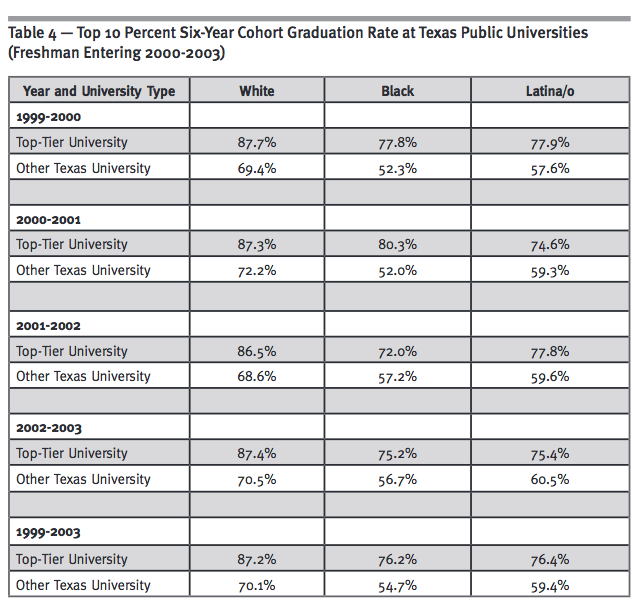
When I was a professor at the University of Texas at Austin we published a paper in the Harvard Journal of African American Public Policy that showed that, controlling for ability, students who attended the Texas’ flagship institutions actually graduated at much higher rates. So, in essence, Black students of the same ability, if they attend lower tiered institutions had much lower graduation rates.
Screen Shot 2015-12-21 at 10.42.12 AM
In sum, the actual data from Texas is mismatched with Scalia, Jacoby and Fisher’s highly racialized and wrong assertions.
Why is this even an issue? I wrote in the post Fisher v. Texas: Another civil rights movement on the way? that it’s because African American and Latino students continue to be severely underrepresented in our nation’s selective institutions— including UT-Austin.


Diversity in these institutions is again under attack in the Fisher v. Texas case currently being re-decided in the US Supreme Court. For past attacks see BakkeHopwoodGrutter and Gratz. Considering that Grutter upheld race as one of many factors under a decade ago, conservatives Fisher Letter Boston Globe Refused to Print | Cloaking Inequity:

Strike Rochdale from the record books. The Co-op began in Scotland | Business | The Guardian

Strike Rochdale from the record books. The Co-op began in Scotland | Business | The Guardian:

Strike Rochdale from the record books. The Co-op began in Scotland

Amateur historians uncover record of weavers who were discount store pioneers


Its famous four-letter logo and revolutionary system of profit-sharing - the "divi" - made the Co-op a high street institution, and generations of schoolchildren have been taught that it began in a humble store on Toad Lane in Rochdale.
Now two amateur historians claim the history books are wrong: the cooperative movement was born nearly 240 years ago in a barely-furnished cottage in Fenwick, East Ayrshire, when local weavers manhandled a sack of oatmeal into John Walker's whitewashed front room and began selling the contents at a discount. It is here, according to a document they unearthed, that the world's first co-op was founded, 230 miles north of the accepted home of the Co-op.
Fenwick's pre-eminence has been overlooked, locals say, in favour of the English town where the Rochdale Pioneers opened their store 83 years later.
The metropolitan borough in north-west England has long boasted of its association with the 28 mill workers who opened their store in 1844, devising the "principles" which became the model for cooperatives worldwide.
A sign on the railway bridge above the A664 leading into the town from the M62 states: "Rochdale: birthplace of cooperation", while the council's website describes the town as the "home of the worldwide cooperative movement".
Yet it seems that movement actually began on March 14 1761, when a group of self-employed weavers gathered secretly in the village of Fenwick, a straggling line of cottages, small shops and old coaching hotels near Kilmarnock which has changed little.
Written in a firm, precise hand, the yellowing document the 15 men signed bound members to be "honest and faithfull to one another ... and to make good & sufficient work and exact neither higher nor lower prices than are accustomed".
It was a revolutionary move. Fenwick survived on tweed and muslin weaving, shoemaking and farming; its tradesmen dependent on patronage by the local elite.
"Cooperation has been around since the year dot, but making it official was different," said John McFadzean, who researched the weavers' history with fellow amateur historian John Smith. "Getting the very much lower working class to fend for themselves, and having the ability to set up the infrastructure to run a documented cooperative was quite a feat ... no one has anything like it predating this."
'Being in need'
Records show the society quickly began lending money to needy members and their families - making it, argue both men, the first recorded credit union. Original records, now in the National Library of Scotland, record short-term loans of 10 and 12 shillings to members, at a flat rate of 5%. One accounts sheet from 1764 records: "Given to Margaret Mitchel at Finnick being in need ... 1s."
The weavers' society began by buying and sharing materials and looms, but in 1769 branched out into food and "victuals", first buying a sack of oatmeal wholesale to sell in smaller quantities at cut price. Savings were divided among the members - a measure Mr Smith insists was a prototype "divi" or dividend.
Those innovations spawned other initiatives; a cooperative subscription library was founded in 1808, and an "emigration society" to help villagers make new lives in the New World. In the early 1800s, the villagers established what became known as the "Fenwick parliament", open meetings to debate local affairs held at Strike Rochdale from the record books. The Co-op began in Scotland | Business | The Guardian:

NYC Public School Parents: 2015 year in review: Please give to Class Size Matters to keep us going strong!

NYC Public School Parents: 2015 year in review: Please give to Class Size Matters to keep us going strong!:

2015 year in review: Please give to Class Size Matters to keep us going strong!


Dear friend:

Please consider giving to Class Size Matters, as we rely on your donation to keep our organization going.  We had a very busy year and need your support.  Please click here to give a tax-deductible donation now. 

In February, we blew the whistle when we noticed a two billion dollar internet contract that was going to be awarded to a contractor who had been involved in a corrupt kickback scheme just a few years ago.  After I alerted the media, the NYC Department of Education hurriedly renegotiated the contract down to $1 billion.  The Panel for Educational Policy then voted to approve the contract 8-1, but luckily, the Mayor’s office took notice of the controversy and cancelled the contract – the first time this has happened in the history of the DOE.

In March, we helped organize “Protect our schools” rallies throughout the city, where thousands of teachers, parents, and students formed human chains around their schools,  to protest the Governor’s threatened budget cuts and damaging charter takeover proposals.

In April, we won a lawsuit we had filed against the DOE to ensure that School Leadership Team meetings remain open to the public.  Justice Peter Moulton agreed with us and the Public Advocate that DOE was violating the law by closing these meetings, and that SLTs, half of whose members are parents at every NYC public school, have more than “advisory” powers.  Though the DOE is unfortunately appealing his decision, we are confident we will eventually prevail on appeal. 

Our analysis of school overcrowding has been widely cited by other groups and officials, showing that there is a need for at least 100,000 seats in the school capital plan to alleviate overcrowding and address expected enrollment growth.  We are spearheading a campaign to convince the Mayor to double the number of school seats to be built, and to create a taskforce or commission to improve the accuracy and efficiency of school planning, which lags far behind residential development.  In June, the Public Advocate, twenty-two Council Members and many parent leaders sent a letter to the Mayor and Chancellor, urging them to do take these important steps.  

Along with NYC Kids PAC, we released an Education report card for the Mayor in the spring, in which he received mixed grades in several categories because he has failed to fulfill his promises in many critical areas, including on class size. This fall, we co-hosted a Parent Action Conference in Brooklyn, with workshops on many topics ranging from the Common Core, testing and Mayoral control to School Leadership Teams and overcrowding. 

When the DOE’s class size data was released last month, we reported that the number of students in extremely large class sizes in the early grades has nearly doubled since 2011, with more than 48,000 children in classes of 30 or more.   Our findings were cited in the Daily News and in an editorial in AMNY.   

Our City Council testimony on Renewal schools was also widely covered in the media,  revealing that despite repeated DOE promises,  class sizes have not be reduced in nearly half of all the Renewal schools, and the vast majority continue to have classes of thirty students or more.

The Parent Coalition for Student Privacy, the national organization we co-founded in 2014 following our defeat of inBloom Inc., continues to make waves.   Our members wrote op-eds and were quoted widely in the media, most recently about Google’s data-mining of students and Mark Zuckerberg’s intention to spend billions to expand risky and unproven online learning.  At the same time, we are working to inform parents about what they should demand in terms of privacy and security protections of their children’s data from their schools, districts and state. 

As part of our work with our state-wide coalition, NY State Allies for Education, we urged parents to opt out of the defective Common Core exams, leading to an unprecedented 240,000 students refusing to take the state tests last spring.  The opt out movement and nationwide rebellion against the flawed Common Core standards has led to significant revisions in the federal education law, and has  caused a  growing recognition among policymakers that it is wrong to use badly designed tests and inappropriate standards to label kids, teachers, and schools as failing.  

But many challenges remain. The need for student privacy protections is more critical than ever, especially as the use of digital learning and data-mining software is being promoted by the ed tech industry and government officials. Meanwhile, in NYC, excessive class sizes and school overcrowding continues to worsen, without any plan or commitment on the part of the Chancellor or the Mayor to seriously address the problem.

Please help us fight for students to be provided with a quality well-rounded education, including smaller classes and real personalized learning, rather than instruction delivered via computers.  We need your help to advocate for every student’s right to privacy, and for parents to have a voice in how their children’s schools are run.

Thank you immensely if you’ve given to Class Size Matters before and please give again as generously as you can.   Just donate online at byclicking here.  If you’d prefer to send a check, address the envelope to Class Size Matters, 124 Waverly Pl., New York, NY 10011.

Have a happy holiday and wonderful New Year,


Francis Marion Charter School Principal Mary Pinson arrested, accused of stealing funds | Ocala.com

Francis Marion Charter School Principal Mary Pinson arrested, accused of stealing funds | Ocala.com:

Francis Marion Charter School Principal Mary Pinson arrested, accused of stealing funds 


Francis Marion Charter School Principal Mary Pinson was arrested Friday and accused of stealing $20,000 in school funds.
Learning that a warrant had been issued for her arrest, Pinson was driven by school officials to the Marion County Jail and turned herself in about 5 p.m.
Ric Ridgway, chief assistant state attorney, said she faces one count of grand theft. Ocala police Detective Wayne Greene said Pinson funneled the money through the bank accounts of her sister and her 82-year-old mother. Withdrawals occurred between spring 2014 and May 2015, Ridgway said.
The arrest stems from a two-month investigation into financial mismanagement that came to light during an audit of the charter school.
A financial squabble between the school and Francis Marion Military Academy led the School Board to order a cursory audit. At the time, the schools were on the same campus, divided by a fence, and the middle school shared some expenses to use the campus.
Early in the audit, district officials found irregularities and decided to seek a thorough outside audit. The School Board agreed and the audit was conducted.
When the school district received the results, it called the State Attorney's Office for guidance. That's when an investigation was launched by the Ocala Police Department.
Pinson, a former teacher of the year in Highlands County, couldn't be reached for comment Friday evening.
The financial squabble that led to the audits began in June, when the military academy's administrators attempted to evict Francis Marion Charter School Principal Mary Pinson arrested, accused of stealing funds | Ocala.com:


Extra: Ohio Governor Kasich and State Supt. Ross Led Planning for Youngstown Takeover | janresseger

Extra: Ohio Governor Kasich and State Supt. Ross Led Planning for Youngstown Takeover | janresseger:

Extra: Ohio Governor Kasich and State Supt. Ross Led Planning for Youngstown Takeover


This blog is on winter break.  If there is something important or some earth-shaking news on education, I’ll put out an EXTRA.  Otherwise, check for a new post on January 4, 2016. Good wishes to you and yours!  Enjoy your family’s traditions, some good food, great music, and a good book. It is OK to put off until 2016 the project of figuring out what the new ESSA will mean!
Ah… it is just as we suspected.  Ohio Governor John Kasich, State School Superintendent Dick Ross, and then-Kasich chief of staff Beth Hansen were involved from the start in plotting the Youngstown school takeover—and the takeover in future of any other school districts posting very low state ratings for three years.  Hansen left the Kasich administration this fall to manage his campaign for President.
Ross and Kasich have continued to claim that Youngstown leaders came to them for help, butyesterday afternoon Plunderbund, the Columbus blog, released e-mails that confirm the involvement of Kasich and Ross beginning in September, 2014, nine months before the plan was sprung on the legislature as a 66 page amendment to a bill for expanding collaborative, wraparound schools in Ohio, the kind of schools that have medical clinics and social services housed in the school.  No opponent testimony was permitted on the amendment. The bill was fast-tracked in one afternoon and signed immediately by Governor Kasich.
You may remember that David Hansen, Beth’s husband, who was employed by the Ohio Department of Education as head of its charter school division, was at that time writing a proposal for charter school funding from the U.S. Department of Education.  Buried in David Hansen’s proposal was funding for the very Youngstown takeover his wife had been involved in designing.  David Hansen was fired very soon after writing that proposal when it was exposed by the Cleveland Plain Dealer that his proposed rating system for charter school Extra: Ohio Governor Kasich and State Supt. Ross Led Planning for Youngstown Takeover | janresseger:


With A Brooklyn Accent: A Little BAT History from Notorious Phd

With A Brooklyn Accent: A Little BAT History from Notorious Phd:

A Little BAT History from Notorious Phd


Now that the Badass Teachers Association has become a non profit organization, I wanted to review a little BAT history so that my own involvement and disengagement can be more easily understood
1. As the excerpt below indicates, I came up with the idea for the Badass Teachers Association as a fundraising device for a Bronx organization called the Rebel Diaz Arts Collective in early spring 2012, All we did was produce tee shirts for sale. No organization was created:
Rebel Diaz
March 27, 2012 •
You know about the BTA???? FInd out. Its The Badass Teachers Association!!! Here's Dr. Mark Naison explaining it.
BTA t-shirts on sale now help raise funds for The RDACBX
2. The Badass Teachers Association was created as a Facebook page on June 14 2013 by me and Priscilla Sanstead. I certainly had no idea that it would turn into an actual organization. Credit for creating the organization goes to Priscilla and to Marla Kilfoyle who developed the entire organizational structure which allowed BATS to grow precipitously over the next year. I did a lot of the writing for the group, but they were the ones who ran the day to day operations and put countless hours into building it. I could never in a million years have done what they did.
3. I left the BATS voluntarily in the Fall of 2014 after a group of internal disagreements with the other founders. I do not regret leaving the group as it gave me more freedom to work on other issues which were and still are important to me. I DO regret some of the bad feeling which led to my departure and still persists with some people in the organization.
4. The current group of leaders DESERVE to be leading BATS. They did the grunt work to build the group. Moreover, most of them are public school teachers and they are the ones who should be leading an organization which seeks to empower teachers.
5. Even if I had remained in BATS, I would have had to leave when it became a non profit organization because I had some bad experiences with activist organizations which became non-profits. This is a personal judgment rather than a political one. I wish BATS well in its current manifestation and support many of their initiatives,
That's it. I am very happy with where I am! And hope that the hard feelings that occurred when I left BATS will fade over time.With A Brooklyn Accent: A Little BAT History from Notorious Phd:

Why Has the Common Core Not Been Discussed on the Campaign Trail - The Atlantic

Why Has the Common Core Not Been Discussed on the Campaign Trail - The Atlantic:

What Happened to the Common Core Debate?

Several Republican presidential candidates have backed away from the term, but not the standards. Why?


The Common Core was expected to be a ubiquitous subject on the campaign trail in 2016. The education standards had, over time, become a political football as conservatives condemned them as federal overreach.
It’s so far hardly been the case. Governors in the race, like Jeb Bush, have backed away from using the term because of its negative connotation among the electorate, even if he still stands by the standards. Should he gain traction moving into the presidential primary it might become more relevant as early-voting states—and other governors, like Chris Christie—grapple with the standards.
The Common Core State Standards Initiative, known as the Common Core, is a set of academic standards for mathematics and reading for all ages. State school chiefs and governors collaborated to develop the standards, but since its rollout in 2009, it’s become a point of contention. A common criticism being that the standards aim to nationalize education, although they’re applied at the state level and weren’t ever explicitly mandated by the federal government.


Forty-two states, the District of Columbia, and four territories have adopted the Common Core. Christie, the governor of New Jersey and a Republican presidential candidate, agreed to adopt the standards in 2010, but has since dropped his support. “The truth is that it’s simply not working,” he said earlier this year.
The critique of the Common Core in part stemmed from the Obama administration’s Race to the Top initiative, which encouraged states to implement high standards, among other reform strategies, in exchange for grants. The competition at the root of Race to the Top sparked frustrations, as it gave the impression that the federal government was imposing the standards on the states, said Tamara Hiler, the policy advisor for education at Third Way.
The Common Core appeared to be at the forefront of issues to be tackled by presidential candidates come 2016. A year ago, The Washington Post had a headline that read “Common Core might be the most important issue in the 2016 Republican presidential race. Here’s what you need to know about it.”
The Common Core hasn’t been absent on the trail. In August, Jeb Bush called the term “poisonous,” adding “I don’t even know what it means.” Lots of people Why Has the Common Core Not Been Discussed on the Campaign Trail - The Atlantic:


Complaint cites charter school company's donation to campaign of prospective Utah senator | The Salt Lake Tribune

Complaint cites charter school company's donation to campaign of prospective Utah senator | The Salt Lake Tribune:

Complaint cites charter school company’s donation to campaign of prospective Utah senator
Violation? » Complaint cites school servicer’s donation to the legislator-elect, who runs his own such firm.


One day after being elected by Republican delegates in South Jordan to replace outgoing Sen. Aaron Osmond, businessman Lincoln Fillmore is facing accusations of violating campaign-finance law.
At issue is a $1,000 donation from American Preparatory Schools, a private company that — like Fillmore's own business — manages public charter schools and provides education consulting in Utah, Idaho and Nevada.
Mark Thomas, elections director for the Utah lieutenant governor's office, said Thursday that the state elections office is looking into the nature of the donation following a written complaint.
"Certainly if the school is using public funds to make the contribution, that would be a violation of the statute," Thomas said.
But Fillmore says the money came from a private company that works with charter schools, and not the schools themselves.
He compared it to his company, Charter Solutions, which contracts with charter schools to handle the business and financial side of education while leaving the teaching to teachers.
"We try to entangle ourselves in the red tape so the red tape doesn't fall to school principals and schoolteachers," he said.
While operating independently of the state's 41 school districts, charter schools are publicly funded on a per-pupil basis and are overseen by unelected governing boards.
American Preparatory Schools' executive director, Carolyn Sharette, compared her company to one that provides schools with food for school lunches.
"They're not the school," she said. "They're providing a service."
But the services provided by American Preparatory Schools go far beyond meals.
Sharette founded the American Preparatory Academy charter school in Draper before transitioning to her role as executive director of American Preparatory Schools.
The company offers a range of services to public and private schools, from curriculum materials and training to full management of a charter's day-to-day operations.
There are now seven American Preparatory Academy campuses in Utah and Nevada, which all have purchased the American Preparatory "brand" from the private company, Sharette said.
"It helps their enrollment if they purchase the brand," she said. "A school is an entity that has a brand just like anything else. They have a reputation."
Sharette said the contracts with her company vary among the seven campuses, but she maintains a loud voice on staffing at Complaint cites charter school company's donation to campaign of prospective Utah senator | The Salt Lake Tribune: