Latest News and Comment from Education

Thursday, December 3, 2015

Fact Sheet: Congress Acts to Fix No Child Left Behind | U.S. Department of Education

Fact Sheet: Congress Acts to Fix No Child Left Behind | U.S. Department of Education:


Statement by U.S. Secretary of Education Arne Duncan on House Passage of the Every Student Succeeds Act
DECEMBER 2, 2015
"It is good news for our nation's schools that the House has passed a serious bipartisan plan to fix the No Child Left Behind law. No Child Left Behind is the latest, now outmoded version of the Elementary and Secondary Education Act, which is, at its core, a civil rights law. Educators and leaders throughout this country have been clear in the need for an updated law, and we have joined them in that call for half a decade.
"We are encouraged that the bill passed by the House today would codify the vision that we have long advocated for giving a fair shot at a great education to every child in America – regardless of zip code. Nearly a year ago, I gave a speech setting the frame for what I believe is essential in the nation's preeminent education law. The bill that the House passed today reflects more of that vision than nearly any observer expected. It requires – for the first time in law – that every student in America be taught to high learning standards that will prepare them for college and a career. And it requires that schools – on a statewide basis – annually assess students' progress toward those standards, providing vital information to educators, families and communities. In a crucial step to protect civil rights, it enshrines in law the expectation that where schools serve students poorly or have low graduation rates over extended periods of time, and where groups of students aren't making progress, there will be accountability and action for change. It removes a harmful proposal from an earlier House bill that would have taken funds from the neediest students and schools. It doubles down on our investments to expand quality preschool. That's one of the most powerful steps we can take as a country to ensure opportunity for all students and a centerpiece of the Administration's education agenda. And it helps to support and grow local innovations, including for evidence-based and place-based innovations developed by local educators and leaders, consistent with our i3 and Promise Neighborhoods programs; and for the expansion of high-quality charter schools, serving high-need students.
"Our nation deserves a law that prioritizes both excellence and equity for our students and supports great educators. We are pleased the House has voted in strong bipartisan fashion in favor of a bill that does that, and we look forward to the Senate moving quickly to do the same."

Fact Sheet: Congress Acts to Fix No Child Left Behind

DECEMBER 2, 2015
We are a place that believes every child, no matter where they come from, can grow up to be anything they want… And I’m confident that if we fix No Child Left Behind, if we continue to reform American education, continue to invest in our children’s future, that’s the America we will always be.”
—Remarks by the President on the No Child Left Behind Act, March 14, 2011
Kenmore Middle School, Arlington, Virginia

Today, the Obama Administration is praising action by the House of Representatives to pass the Every Student Succeeds Act, a bipartisan bill to fix No Child Left Behind, and is calling on the Senate to take swift action on the legislation so that it can be signed into law before the end of the year. The bill rejects the overuse of standardized tests and one-size-fits-all mandates on our schools, ensures that our education system will prepare every child to graduate from high school ready for college and careers, and provides more children access to high-quality state preschool programs.
The bipartisan bill passed by the House includes many of the key reforms the Administration has called on Congress to enact and encouraged states and districts to adopt in exchange for waivers offering relief from the more onerous provisions of No Child Left Behind (NCLB). The bill helps ensure educational opportunity for all students by:
  • Holding all students to high academic standards that prepare them for success in college and careers.
  • Ensuring accountability by guaranteeing that when students fall behind, states redirect resources into what works to help them and their schools improve, with a particular focus on the very lowest-performing schools, high schools with high dropout rates, and schools with achievement gaps.
  • Empowering state and local decision-makers to develop their own strong systems for school improvement based upon evidence, rather than imposing cookie-cutter federal solutions like the No Child Left Behind Act did.
  • Reducing the often onerous burden of testing on students and teachers, making sure that tests don’t crowd out teaching and learning, without sacrificing clear, annual information parents and educators need to make sure our children are learning.
  • Providing more children access to high-quality preschool.
  • Establishing new resources for proven strategies that will spur reform and drive opportunity and better outcomes for America’s students.
In recognition of the Elementary and Secondary Education Act (ESEA)’s legacy as a civil rights law, the bipartisan bill upholds critical protections for America’s disadvantaged students. It ensures that states and school districts will hold schools to account for the progress of all students and prescribes meaningful reforms to remedy underperformance in those schools failing to serve all students. It excludes harmful “portability” provisions that would siphon funds away from the students and schools most in need, and maintains dedicated resources and supports for America’s vulnerable children – including students with disabilities, English Learners, Native American students, homeless children, neglected and delinquent children, and migrant and seasonal farmworker children. It also ensures that states and districts continue the work they’ve begun this year to ensure that all students – including students from low-income families and students of color – have equitable access to excellent educators.  

Embracing the Administration's Principles for Reform

College and Career-Ready Standards for America’s Learners: The bill affirms the path taken by 48 states and the District of Columbia to hold all students to challenging academic content standards that will prepare them to graduate from high school prepared for success in college and the workforce. In 2008, America’s governors and state education officials came together to develop a new set of college- and career-ready standards for their schools. The Obama Administration supported those efforts through its Race to the Top grant program and the federal-state partnership established in its ESEA flexibility agreements.
Rigorous Accountability for All Students: Consistent with the Administration’s legislative proposals and the policies in place under the Administration’s ESEA flexibility agreements, the bill builds on the federal-state partnerships in place in over 40 states to require meaningful goals for the progress of all students, and to ensure that every student subgroup makes gains toward college and career-readiness. States must set ambitious targets to close student achievement and graduation rate gaps among subgroups of students in order to meet their goals. In schools where too many students consistently fail to reach the goals and other indicators set by the state, school districts will ensure they receive tailored interventions and supports proportionate to the needs of those schools and the students they serve.
Reform and Resources for America’s Struggling Schools and Students: The bill will target resources, attention, and effort to make gains for our students attending schools most in need of help. Consistent with the policies in place under the Administration’s ESEA flexibility agreements, the bill moves away from NCLB’s one-size-fits-all accountability and ensures that states undertake reforms in their lowest performing schools, in high schools with high dropout rates, and in schools where subgroups are falling behind. It includes provisions that would require districts to use evidence-based models to support whole-school interventions in the lowest-performing 5 percent of schools and schools where more than a third of high school students do not graduate on time, and includes dedicated funding to support interventions in these schools. In schools where subgroups of students persistently underperform, school districts must mount targeted interventions and supports to narrow gaps and improve student achievement. If such schools are not showing improvement, the state will ensure more rigorous strategies are put in place. Moreover, the Department of Education has the authority it needs to ensure that states carry out their responsibilities. 
New Incentives to Improve Opportunities and Outcomes for Students: The bill includes initiatives modeled after the Administration’s programs to:
  • Establish or expand access to high-quality, state-funded preschool for children from low- and moderate-income families, building from the Administration’s Preschool Development Grants program.
  • Develop, refine, and replicate innovative and ambitious reforms to close the achievement gap in America’s schools, similar to the Administration’s existing Investing in Innovation (i3) program.
  • Expand incentives to prepare, develop, and advance effective teachers and principals in America’s schools.
  • Leverage resources to address the significant challenges faced by students and families living in high-poverty communities through the Promise Neighborhoods effort, supporting a full continuum of services from early learning through college.
  • Expand support for high-performing public charter schools for high-need students.
A Smart and Balanced Approach to Testing: The bill maintains important statewide assessments to ensure that teachers and parents can mark the progress and performance of their children every year, from third to eighth grade and once in high school. The bill encourages a smarter approach to testing by moving away from a sole focus on standardized tests to drive decisions around the quality of schools, and by allowing for the use of multiple measures of student learning and progress, along with other indicators of student success to make school accountability decisions. It also includes provisions consistent with the Administration’s principles around reducing the amount of classroom time spent on standardized testing, including support for state efforts to audit and streamline their current assessment systems.
Promoting Equity in State and Local Funding: The Administration has called repeatedly for states and school districts to more equitably distribute state and local dollars to schools with the greatest need. The bill includes a pilot program – similar to a proposal put forward by the Administration this year in the FY16 budget – that provides for weighted student funding. Under the pilot, districts must demonstrate a commitment to equitable distribution of state and local dollars—based on actual per-pupil expenditures—to their highest poverty schools. In exchange, districts would be allowed to allocate and use Title I and other federal formula funds in a more flexible manner to support comprehensive plans that improve achievement and outcomes for their neediest students. The bill also includes provisions that require reporting on actual school-level expenditures, allowing the public for the first time to see the amount of federal, state, and local funding distributed to each and every school.  The bill rejects so-called “portability” provisions in the House-passed bill that would have allowed states to shift federal funds away from the schools that need them most.Fact Sheet: Congress Acts to Fix No Child Left Behind | U.S. Department of Education:

End Voodoo Education: Vote "NO" on Revised no Child Left Behind | John C. Fager

End Voodoo Education: Vote "NO" on Revised no Child Left Behind | John C. Fager:
End Voodoo Education: Vote "NO" on Revised no Child Left Behind


Dear Senators Sanders, Warren, Tester, & Paul,
Next week you should vote a loud "NO" on the legislation to revise No Child Left Behind (NCLB), the current version of the basic American education law the Elementary and Secondary Education Act. You should do this -- Tester knows because he tried to eliminate it -- because it continues the abominable federal mandate that all states must give annual standardized tests.
Why do I call this Voodoo education because just like Voodoo or supply side economics it has been proven not to work. It just shifts to the states the administering of the worthless tests which was and is the heart of the problem with corporate test-based accountability.
Who says they're worthless? The National Research Council of the National Academies of Science in a 2011 report "Incentives and Test-based Accountability" says it. The report stated, Conclusion 1: "Test-based incentive programs...have not increased student achievement enough to bring the United States close to the levels of the highest achieving countries." One of those programs was NCLB.
President George W. Bush imposed it without any research that it works and we've known this for five years and yet President Obama and his non-educator secretary of education, Arne Duncan, expanded its use to evaluate teachers.
It is time to drive a stake into the heart of the federal testing mandate. 

If not, and the NCLB revision passes, then 20 million public school students and millions of teachers will waste most of the next five months -- that's half of this school year -- doing test prep and then getting upset, stressed, and even sick when they actually take the tests. My neighbor described what happened in her class on test day. "Most of the kids were stressed and one little girl just threw up; it was a disaster."
A whole generation of students attended school for seven years under President Bush's NCLB and then spent the last seven under NCLB on steroids, better known as the Obama Administration's Race to the Top. Ah yes, winners and losers racing to nowhere.
The waste of instructional time, genuine teaching and learning, is enormous. Students may spend 20 to 25 hours actually taking the math and ELA tests but a study, "TIME ON TEST: The Fixed Costs of 3-8 Standardized Testing in New York State", found that students had to wait over an hour each day for "testing related activities" -- 20 End Voodoo Education: Vote "NO" on Revised no Child Left Behind | John C. Fager:

How To Oust a Right-Wing School Board - NEA Today

How To Oust a Right-Wing School Board - NEA Today:

How To Oust a Right-Wing School Board

Jefferson County recall
Jefferson County election workers count and stamp recall petitions collected by parents and educators to remove anti-public education school board members. (AP Photo/Brennan Linsley, File)


Let’s rewind two years to Election Day 2013, in Jefferson County, Colorado, when it became quite clear that educators, parents, and students had lost — and lost big in a school board race that ushered in a three-person majority with an extreme anti-public education agenda.
“When those results came in, I would say we were completely deflated. There is no other word for it. We had hit rock bottom,” said John Ford, Jefferson County Education Association (JCEA) president.
Fast forward to Election Day 2015: “At 7 p.m., there was a collective gasp in the [hotel] ballroom that we could hear from the lobby. As the results came in, people just started screaming with joy,” said Jefferson County teacher Paula Reed, also a JCEA board of directors’ member.
The three right-wing board members—despite their deep-pocketed backing by Koch Brothers’ affiliated political organizations—had lost overwhelmingly in the community-led recall election.
The turnaround begs the question: What happened here between November 2013 and 2015? The answer is nothing short of an organizing marvel.
Over just 17 days this summer, the parents, students, teachers and education support professionals (ESPs) of Jefferson County gathered more than 110,000 signatures on petitions to hold a recall election. Then, in six weeks this fall, they knocked on more than 175,000 doors across 778 square miles, from the mountainous towns of the county’s south to the sprawling suburbs of the north, in an all-out effort to get voters to the polls.
“My members talked to their neighbors, and to their families, because this is where they live. They talked to the people at their bowling league, at their church, at their kids’ sporting events. At my grocery store, they just called me ‘Ms. Recall,’” said Nancy McCanless, president of the county’s Classified School Employees Association (CSEA).
“And we told everybody, ‘this is about what is best for our 81,000 kids and 12,000 employees, and the health and economy of the community where we live,” said McCanless.
“It’s about students, and it’s about public education.”
Before it Got Better, It Got Worse
If we start the story in 2013, when the “reformers” took office, we will miss the How To Oust a Right-Wing School Board - NEA Today:

Congress is getting rid of No Child Left Behind. Here’s what will replace it. - Vox

Congress is getting rid of No Child Left Behind. Here’s what will replace it. - Vox:

Congress is getting rid of No Child Left Behind. Here’s what will replace it.


The days of No Child Left Behind are numbered.
The House of Representatives voted Wednesday night, with a massive bipartisan majority of 359 to 64, in favor of a new education bill that would reduce the federal role in K-12 education for the first time since the 1980s.
The bill, the Every Student Succeeds Act, would keep the most familiar feature of No Child Left Behind: annual tests in reading and math for students in third through eighth grades. But it drops the 2002 law's other big idea: that the federal government, which spends $14 billion each year on poor schools, should directly hold those schools accountable for the quality of their education.
This is a major victory for the conservative vision for education policy, which puts the states, not Washington, in charge of holding schools accountable — and it means states could scale back their efforts to improve schools for poor and minority children.

No Child Left Behind gave the federal government more power over education

Since the 1980s, every major education law has expanded the federal government's power over state policy. This bill is the first to reverse that trend, undoing much of the federal control introduced in No Child Left Behind.
That law is best known for its emphasis on standardized testing. But the testing regimen was in service of a larger project: step-by-step prescriptions of what states had to do to hold schools accountable if they weren't making "adequate progress" toward the goal of nationwide proficiency in reading and math by 2014.
If schools that got federal money to educate low-income students weren't making enough progress, they faced an escalating series of consequences, ending with drastic changes such as replacing the principal and most of the staff.
Because closing the gaps in reading and math abilities between black and Hispanic students, students with disabilities, and their peers was No Child Left Behind's central goal, those consequences kicked in even if the entire school was making progress if certain groups of students — such as students with disabilities or students learning English — were still falling behind.
Research has found that many consequences were ineffective, with the exception of the most dramatic options, which kicked in only after schools had failed for years. Still, No Child Left Behind improved fourth- and eighth-grade math scores, particularly for African-American students and students from poor families.
The law failed to meet its goal of getting every student able to read and do math by the end of the 2013-'14 academic year, and because it became synonymous with standardized testing and Washington mandates, it also was politically unpopular. But it wasn't a complete failure.

Congress could get rid of nearly all of No Child Left Behind

The new education bill would keep some of No Child Left Behind's ideas. But states, not the federal government, would largely be in charge of holding schools accountable, reversing a trend toward greater federal control.
  1. Students would still have to take tests every year from third to eighth grade.
  2. Schools would have to report the results of those tests, including breaking out the scores for "subgroups" of students: racial minorities, students learning English, students in special education, and students from poor families.
  3. States would have to come up with a system to hold schools accountable for their progress toward goals. But the goals themselves would be up to states, and other factors besides standardized test scores will have to weigh in.
  4. States would be required to do something about the bottom 5 percent of schools, and to identify schools where individual subgroups of students were struggling.
That means states are free to design their own system. States decide what factors are most important, although they have a few guidelines: They need to pick three academic factors, including test scores and graduation rates, as well as one variable dealing with something besides a school's academic performance, such as surveys of students or parents.
Still, states decide how to weigh those factors, although academic factors must be most important. States decide what, if anything, happens to schools that don't make their goals. States decide what happens if large numbers of parents opt their students out of required standardized tests. And states decide what to do about the bottom 5 percent of schools where they're required to intervene.
The federal government would have to approve states' accountability plans within 120 days after the states submit them. But there are limits on whether they can reject them, part of a broader set of measures meant to curb the Education Department's power. The education secretary can't urge states to adopt academic standards, as Arne Duncan did with the Common Core. And they can't change the requirements for accountability systems to emphasize different priorities.

The big question: What will states do to hold schools accountable?

The struggle to reach the compromise bill was the latest example of a new dynamic in education policy. Republicans and teachers unions, historic enemies, were on one side, with civil rights groups and some Democrats on the other.
The final bill got a broad array of support. Conservatives support the Every Student Succeeds Act because it means states will take the lead on education, historically a local responsibility, although some conservatives are concerned that it doesn't go far enough. The National Governors Association also supported it. Teachers unions support it because they became strong opponents of No Child Left Behind's approach to testing and accountability, which they argued had a negative effect on classrooms.
Civil rights groups, which supported No Child Left Behind because of its mission to force states to pay attention to poor and minority students, were harder to win over, although they eventually endorsed the bill because they decided it was better than the status quo.
Before No Child Left Behind was passed in 2002, most states didn't hold all students to the same standard on standardized tests — instead, they were compared with their peers. Nearly half of states didn't break out scores by students' family income. And while 29 states had methods to hold schools accountable, that means 21 still did not.
In other words, some states didn't do anything to hold schools accountable for the performance of poor or minority children until the federal government forced them to. The question is whether states will continue to do so with less pressure from Washington.
Some almost certainly will. Compared with 2002, the education reform movement is better funded and has more national reach. And states will still be required to report test score data, meaning they can't return to the earlier days of sweeping the problem under the rug. Conservative supporters of No Child Left Behind argue that the bill will unleash energy for new solutions and greater improvement in individual states now that they're no longer required to all take the same steps to change their schools.
But states' track record on other issues, such as voting rights or expanding Medicaid, makes clear that they don't always act when they're not federally required to do so. And holding schools or teachers accountable isn't always politically popular.
Generally, parents think their own public schools are good, even if they have a negative view of public education in the US as a whole. And public opinion has turned against standardized tests. Even President Obama has backed off parts of his education agenda due to a backlash.

Against all odds, the bill seems poised to pass

Although No Child Left Behind has been overdue for renewal for years, a compromise that congressional Republicans could vote for and Obama would sign meant threading the tiniest of needles. It seems like Congress has actually pulled it off.
The bill includes some protections important to civil rights organizations and Democrats, such as the requirement that states identify schools where individual groups of students aren't performing well. It includes funding for preschool grants, a key priority for Senate Democrats. But it also rolls back the federal role in education and turns some federal programs into block grants. It checks off many boxes on the Republican wish list.
It wasn't conservative enough for some House Republicans. The Heritage Foundation has criticized the bill for maintaining federal funding and for not turning Title I, the federal program sending money to students in poor schools, into a voucher program. Heritage Action has named opposing the bill as a key vote. And conservative bloggers and activists who nearly derailed a House vote on an early, more conservative version of the bill have organized against this one as well.
But those opponents don't seem to be gaining traction: only 64 Republicans voted against the bill. And there's virtually no Democratic opposition. The White House strongly supports the bill.Congress is getting rid of No Child Left Behind. Here’s what will replace it. - Vox:

What proposed changes to ESEA mean for students of color | TheHill

What proposed changes to ESEA mean for students of color | TheHill:

What proposed changes to ESEA mean for students of color


“There’s no use in passing a federal education bill if it’s not a civil rights bill” —Sen. Chris Murphy (D-Conn.)
Many of us can agree that the most recent iteration of the Elementary and Secondary Education Act (ESEA), commonly referred to as No Child Left Behind (NCLB) and passed in 2001, has not lived up to its name and has been characterized by its many shortcomings. Despite those shortcomings, however, the strength of NCLB will always be the information it requires from states, particularly for subgroups of students.
After NCLB was passed, we were able to learn more about how black and Latino students, who are most commonly affected by the achievement gap, are being educated. The limitation of NCLB is that we do not know enough about how to better serve historically disadvantaged students. As NCLB approaches reauthorization, it is important to remember the students who are most adversely affected by the achievement gap.

Although achievement gaps are decreasing, they are still too wide. The Center for American Progress recently released a report that detailed why we need to track data by student subgroups. According to their research, about 1.2 million Black students, 1 million Latino students, 2.8 million students with disabilities, and 2.8 million low-income students are scoring 10 percentage points or more below the overall performance at their schools.
This means achievement gaps exist not only between schools, but within schools. This is particularly important as the racial and economic makeup of this country drastically changes. Low-income students are now the majority of students enrolled in public schools. In just five years, children of color will make up over half of the children in this country. Closing the achievement gap should be considered a national priority, not just an issue that impacts small subgroups.
Many would argue that NCLB required too much from teachers and schools without giving enoughresources for solving the problem that we already know exists—too many students are being left behind. NCLB’s subgroup data reveals inequities that most harshly impact disadvantaged students. The downfall was that it was too prescriptive and had a one-size-fits-all approach to schooling. While states should have the opportunity to tailor action plans to their populations, it is also important that states are being held accountable and receive some kind of oversight.
In the proposed ESEA bill, students would still be required to be tested in grades 3-8 and once in high school in reading and math. Instead of federal direction on the best way to measure success or intervene in low-performing schools, states would be given the power to decide what to do with tests, how to rate failing schools and what goals to set for schools. The proposed act also requires states to take action on schools with achievement gaps, but gives states complete freedom and oversight to determine what action they take.
But state and local agencies have a poor track record in protecting the rights of people of color. Had the federal government not stepped in after Brown vs. Board of Education, schools would still be What proposed changes to ESEA mean for students of color | TheHill:

All the philanthropic causes near and dear to the hearts of Mark Zuckerberg and Priscilla Chan - Quartz

All the philanthropic causes near and dear to the hearts of Mark Zuckerberg and Priscilla Chan - Quartz:

All the philanthropic causes near and dear to the hearts of Mark Zuckerberg and Priscilla Chan

Image result for All the philanthropic causes near and dear to the hearts of Mark Zuckerberg and Priscilla Chan

Welcoming his new daughter to the world, Facebook CEO Mark Zuckerberg announced yesterday (Dec. 1) that he and his wife Priscilla Chan plan to donate 99% of their shares in the social network to a new philanthropic foundation they created.

“Like all parents, we want you to grow up in a world better than ours today,” he wrote in a Facebook post addressed to his daughter, Max. “We will do our part to make this happen, not only because we love you, but also because we have a moral responsibility to all children in the next generation.”

The shares, currently worth $45 billion, will be doled out to the recently launched Chan Zuckerberg Initiative over the course of the Facebook CEO’s lifetime, according to a filing with the US Securities and Exchange Commission. The foundation will work “to advance human potential and promote equality for all children in the next generation.”

Zuckerberg, who is taking two months of paternity leave, outlined some initial areas of focus for the organization: curing disease, improving education and “connecting people and building strong communities.” Many of the details remain vague, but he said he plans to share more “in the coming months.”

However, previous donations from Zuckerberg and Chan provide clues into the causes and organizations they’re likely to support.

Education

Zuckerberg and Chan have become big champions of education. Chan was the first of her family to graduate from college, and told the Todayshow last May that “education is an incredibly personal issue for me.” A pediatrician who’s worked as a science teacher, she also encouraged Zuckerberg to teach a weekly after-school program for local underprivileged students.

In 2010, Zuckerberg made his name as a philanthropist with the announcement on Oprah that he was donating $100 million to schools in Newark, New Jersey. But five years later, the funds were found to have fallen short of his vision for urban school reform. As Dale Russakoff reveals in his book The Prize, much of the money was wasted on lavishly paid consultants, with little say given to the local community. In the end, Zuckerberg’s generous donation went to support bureaucracy.

Zuckerberg has learned firsthand how difficult it can be to change education, but he has remained dedicated to the cause. In an op-ed for the San Jose Mercury News last May, he and Chan pledged $120 million to improving the quality of education in underserved Bay Area communities through another organization they created, called Startup:Education. The money has gone toward purchasing computers, providing internet connectivity, training teachers, and more.

The couple has also donated about $1.5 billion to the Silicon Valley Community Foundation, which offers scholarships to students and gives to charities globally focused on a gamut of issues, including education, immigration, and economic security. And Chan is the cofounder of The Primary School, a free private school opening in August that will serve underprivileged students who live in East Palo Alto and Menlo Park.
In his letter to Max, Zuckerberg talks about how students will be able to “use personalized learning tools over the internet,” to improve education and overcome limitations of their local schools. In September, Facebook dedicated eight full-time engineers to help All the philanthropic causes near and dear to the hearts of Mark Zuckerberg and Priscilla Chan - Quartz:

Giving it away: A look at past decade's $1 billion donations

Giving it away: A look at past decade's $1 billion donations:

Giving it away: A look at past decade's $1 billion donations

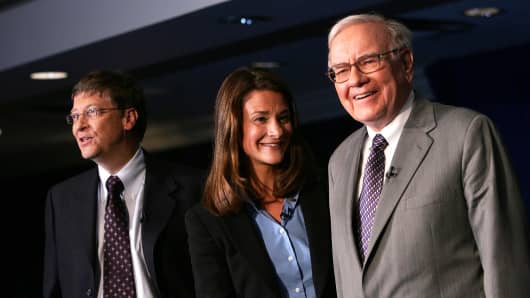
Warren Buffett, right, stands with Bill and Melinda Gates June 26, 2006 at a news conference where Buffett spoke about his financial gift to the Bill and Melinda Gates Foundation in New York City.


Warren Buffett, right, stands with Bill and Melinda Gates June 26, 2006 at a news conference where Buffett spoke about his financial gift to the Bill and Melinda Gates Foundation in New York City.
The elite list includes three men—Microsoft co-founder Bill Gates, stock market sage Warren Buffett and Oracle co-founder Larry Ellison—who are wealthier than Zuckerberg, according to Forbes magazine's latest rankings.
That trio and Zuckerberg are among the 138 wealthy individuals and families who have signed a "giving pledge" committing them to give away most of their fortunes in an attempt to fix society's problems.
Zuckerberg, 31, and his wife Priscilla Chan, 30, waited until the birth of their first child, a girl named Max, to reveal their intention to give away all but 1 percent of the Facebook stock that accounts for most of their fortune.
Here's a look at the donations of at least $1 billion announced during the past decade, as tracked by the Chronicle of Philanthropy:
—Buffett pledged to donate a total of $43.6 billion in 2006 to the Bill & Melinda Gates Foundation and three other foundations.
—Helen Walton, the wife of Wal-Mart Stores founder Sam Walton, donated her estimated fortune of $16.4 billion to a family foundation after her death in 2007.
—Leona Helmsley, who made her fortune in hotels and other real estate, donated an estimated $5.2 billion to charitable trust after her death in 2007.
—Medical entrepreneur James Sorenson donated an estimated $4.5 billion to a family foundation after his death in 2008.
—Buffett pledged to donate $3.1 billion to three different foundations in 2012.
—Zuckerberg donated $1.5 billion to the Silicon Valley Community Foundation in 2012 and 2013.
—Hotelier Barron Hilton pledged to donate $1.2 billion to the Conrad N. Hilton Foundation in 2007.
—Former investment banker Peter Peterson donated $1 billion to a foundation bearing his name in 2008.
—Ralph Wilson Jr., the longtime owner the National Football League's Buffalo Bills, donated $1 billion to a foundation bearing his name after his death in 2014.Giving it away: A look at past decade's $1 billion donations:

Teachers union president apologizes for remarks about ‘chronically tarded’ and ‘medically annoying’ kids - The Washington Post

Teachers union president apologizes for remarks about ‘chronically tarded’ and ‘medically annoying’ kids - The Washington Post:

Teachers union president apologizes for remarks about ‘chronically tarded’ and ‘medically annoying’ kids


The president of the nation’s largest teachers union has apologized for referring to “chronically tarded” and “medically annoying” children, remarks that drew stiff rebukes from parents of children with special needs and others in the disability rights community.
“Open mouth. Insert foot. That’s what I did,” Lily Eskelsen Garcia, president of the National Education Association, wrote on her blog. “Epic fail. In my attempt to be clever and funny, I stepped on a word in one phrase, and I created another phrase that I believed was funny, but was insulting. I apologize.”
Eskelsen Garcia made the remarks during an Oct. 27 speech addressing the Campaign for America’s Future. Speaking about her frustration with people who don’t understand the full range of what schools do, she rattled off a long litany of teachers’ responsibilities.
“We serve kids a hot meal. We put Band-Aids on boo-boos,” she said. “We diversify our curriculum instruction to meet the personal individual needs of all of our students the blind, the hearing impaired, the physically challenged, the gifted and talented, the chronically tarded and the medically annoying.”
The video of her talk made the rounds on social media as many teachers applauded Eskelsen Garcia’s sentiment: Being a great teacher is a difficult Teachers union president apologizes for remarks about ‘chronically tarded’ and ‘medically annoying’ kids - The Washington Post: