Latest News and Comment from Education

Saturday, November 28, 2015

Why Endless Shade for Donald, Crickets for Rahm? - LA Progressive

Why Endless Shade for Donald, Crickets for Rahm? - LA Progressive:

Why Endless Shade for Donald, Crickets for Rahm?

trump and emanuel


Trump and Emanuel

SDonald Trump is a narcissistic, bigoted, fascist.
Not exactly a surprise.
He’s also the Republican front runner for President. I’ll admit to being mildly shocked by that.

Astonishing are the chauvinistic and possibly illegal actions of Chicago Mayor Rahm Emanuel—and the fact that no major Democrat of note is calling him out for any of it.

However, much more astonishing are the chauvinistic and possibly illegal actions of Chicago Mayor Rahm Emanuel—and the fact that no major Democrat of note is calling him out for any of it.
Let’s review.
Trump made a name for himself during this election cycle callingMexican immigrants rapists and murderers. Then he insulted womenand the disabled. He proposes surveillance of mosques and registering all Muslims. He even incites supporters at his rallies tobeat Black protesters.
And every time this happens, his poll numbers rise.
Predictably Democrats have decried this state of affairs. They have pointed their fingers accusingly at a Republican base that would champion such an odious figure for leader of the free world. And rightly so!
By contrast, Emanuel isn’t currently a candidate for anything. He’s a second term Democratic Mayor of one of the most populous cities in the country.
During that time, he has closed 50 public schools – 46 of which serve mostly black students. Southside residents had to resort to a month-long hunger strike to keep their last neighborhood school open. In addition, his economic policy consists of closing public health clinics for the poor and installing red light cameras to increase fines – none of which has actually boosted the economy.
But perhaps worse than all of that is the recent revelation that Emanuel’s administration with full knowledge of the Mayor may have actually covered up the police killing of an unarmed black teen!
In October, 2014, Officer Jason Van Dyke shot 17-year-old Laquan McDonald 16 times. Most of those bullets went into the teenager after he was already flat on the ground and the officer was at least 10 feet away.
As usual, the police story includes all the usual racist clichés – a trained and experienced officer of the law fears for his life from a black teen. Van Dyke says he was attacked. The dashcam video, however, shows no such thing. McDonald did not lunge at the officer. The young man was walking away when Van Dyke shot, and after he fell, the officer unloaded a barrage of bullets at his prone and seemingly helpless body.
Then the cover-up began. Emanuel allegedly was told about the incident in February, 2015, while he was in the midst of a contentious re-election bid. His administration quickly issued a $5 million settlement to McDonald’s family on the condition they keep quiet about the incident. It wasn’t until May, after Emanuel had won re-election, that an independent journalist asked for the dashcam Why Endless Shade for Donald, Crickets for Rahm? - LA Progressive:

John Thompson: The Gates Foundation’s Losing War for Value-Added Assessment | Diane Ravitch's blog

John Thompson: The Gates Foundation’s Losing War for Value-Added Assessment | Diane Ravitch's blog:

John Thompson: The Gates Foundation’s Losing War for Value-Added Assessment


John Thompson, historian and teacher, says that the Gates Foundation is fighting a losing battle to justify value-added assessment. At its root, he says, is an assault on public education, facilitated by a worship of data and a belief in the value of teacher churn.
He writes:
One of the Gates Foundation’s star value-added scholars, Dan Goldhaber, has voiced “concerns about the use of VAM estimates at the high school level for the evaluation of individual teachers.” Two years ago, he asked and answered “yes” to the question of whether reformers would have placed less emphasis the value-added evaluations of individual teachers if research had focused on high schools rather than elementary schools.
I once saw Goldhaber’s statement as “a hopeful sign that research by non-educators may become more reality-based.”
As the use of estimates of test score growth in evaluations becomes even more discredited, Goldhaber is not alone in making statements such as, “The early evidence on states and localities using value added as a portion of more comprehensive evaluation systems suggests that it may not be differentiating teachers to the degree that was envisioned (Anderson, 2013).”
So, what is now happening in the aftermath of the latest warning against value-added evaluations? This time, the American Educational Research Association AERA Council “cautions against VAM being used to have a high-stakes, dispositive weight in evaluations.”
The logic used by the nation’s largest education research professional association is very similar to what I thought Goldhaber meant when he warned against using various tests and models that produce so many different estimates of the effectiveness of high school teachers. The point seems obvious. If VAMs are imposed on all types of schools and teachers with all types of tests and students, then they must work properly in that wide range of situations. It’s not good enough to say we should fire inner city high school teachers because some researchers believe that VAMs can measure the quality of teaching with random samples of low-poverty elementary students.
Goldhaber now notes, “AERA’s statement adds to the cacophony of voices urging either restraint or outright prohibition of VAMs for evaluating educators or institutions. Doubtless, these stakeholders are genuinely concerned about potential unintended consequences of adopting these performance measures.”
However, Goldhaber and other supporters of corporate reform still twist themselves into pretzels in arguing that we should remain on their value-added path. Ignoring the effects of sorting as one of the factors that John Thompson: The Gates Foundation’s Losing War for Value-Added Assessment | Diane Ravitch's blog:

Standardized Testing is not Teaching


Standardized Testing is not Teaching


The Assessment Landscape - Chris Tienken


Two nearby NYC schools have glaring disparities - Melissa Harris-Perry on MSNBC

Melissa Harris-Perry on MSNBC:

Two nearby NYC schools have glaring disparities


MELISSA HARRIS-PERRY 11/28/15

Two nearby NYC schools have glaring disparities

Two public schools in New York City, just nine blocks away from each other, are at the center of a debate on school zoning.

Duration: 9:36

No Art Left Behind: Introducing a New Series - Living in Dialogue

No Art Left Behind: Introducing a New Series - Living in Dialogue:

No Art Left Behind: Introducing a New Series


By Susan Dufresne and Anthony Cody.
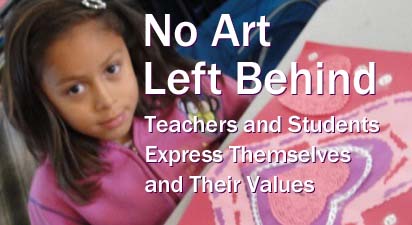
In the past 13 years of No Child Left Behind and Race to the Top test-driven education policies, art has been pushed to the margins in our schools. Students have lost countless hours for creating art, music and dance that expresses themselves. But artistic expression is like the seedling that forces its way through cracks in the asphalt. This blog series will explore how students and teachers use art to express themselves.
The series was inspired by a Facebook post authored by artist and kindergarten teacher Susan DuFresne. She wrote:
Art is healing and meditative for children and teachers. It is inspiring and allows a different kind of space for free and creative expression. Art builds self-confidence in a way that children need. It develops listening skills and an ability to work from part-to-whole. It develops trust in one’s teacher.
Art develops executive functioning skills, impulse control, delayed gratification skills, planning and organizing skills, fine motor skills, and visual spatial skills. Art develops meta-cognition skills, problem-solving and critical thinking skills. Art increases experiences of joy in all children and during the process of a shared joyful Art experience, our immune systems get the same kind of boost as a hug provides. Shared Art experience creates a strong sense of community. Art creates a sense of peace and satisfaction. Art creates children who think outside the box and can help students stand up for themselves and others. Art develops empathy. Art helps us learn about our world sometimes in a way nothing else could replace. Art can be full-on play! Art can create wonder and Art can answer wonderings. Art can be fiction or non-fiction. Art can come from within or from a power outside of oneself. #Art can incite emotion. Art can be visual music with rhythm and a melody of pattern. Art can engage all of our senses. Art can be science. Art is math. Art is visual poetry. Art can be social studies. Art can incite social justice! Art can be 
No Art Left Behind: Introducing a New Series - Living in Dialogue:

Sarah Puglisi: Art is Happening


This is the first in a series of blog posts focused on the value of art in our lives, and the role art can play in resisting the test and punish model of education.  See the intro and links to other posts in the series here.
By Sarah Puglisi.
When I was in training, in university, my Art Education teacher Bill Thomas once said something to the effect that if we can connect the home, and world in that home of the student, to our projects in an art room-if we can glimpse who the student is-then our lesson design was doing something profound.
He was teaching how to design starting points for children’s work as an art educator. Something we needed fieldwork to experience and understand but those days were in front of us. And indeed over my many years working as teacher and artist, art teacher,  I saw the bridge, but rarely.
He understood the elusive edge. To connect to who that child is, that was his point.
One time I glimpsed it. I had set up an “Olympics” for a wild two classes- days and days of events that I ran Sarah Puglisi: Art is Happening


Michelle Gunderson: Poetry as Subversive Activity


This is the second in a series of blog posts focused on the value of art in our lives, and the role art can play in resisting the test and punish model of education.  See the intro and links to other posts in the series here.
By Michelle Gunderson.
My first grade class was sitting in front of me gathered at our reading rug, and I asked them, “Could you write a poem about something important?” One of my students said, “Heck, yeah.” And off they went, paper in hand, to their tables – each child hunched over their paper scratching away words that were coming straight from the heart.
I did not teach the most extraordinary poetry unit. It was fairly simple, in fact. We read tons of poems, made lists of what we noticed, tried different techniques, and learned the mechanics of poetry. But at the end of the unit we read Whitman, Hughes, Dickinson, and Rosetti. We decided to add to our list of poetry features that poems can be about something important.
Writing a poem when you are six, and experiencing yourself as a poet is extraordinary.
Poetry is the natural language of childhood – we hear it in nursery rhymes, playground game, and jump rope Michelle Gunderson: Poetry as Subversive Activity

How I Studied the Teaching of History Then and Now | Larry Cuban on School Reform and Classroom Practice

How I Studied the Teaching of History Then and Now | Larry Cuban on School Reform and Classroom Practice:

How I Studied the Teaching of History Then and Now


From time to time, a few readers ask me how I, as a historian of education, go about collecting and analyzing data about teachers at work in classrooms especially those who have taught many decades ago and those who teach now. In my next book, Teaching History Then and Now: A Story of Stability and Change in Schools, I reconstructed how I taught history at Glenville High School in Cleveland (OH) and Cardozo High School (Washington, D.C.) in the 1950s and 1960s and then returned to those same schools in 2013-2014 to determine how history is taught there now (see here).
This post is for those viewers and curious readers who have asked me the direct question of how I dig into the past and recapture the present in answering the central question I asked in the forthcoming book: What has changed and what has remained the same in the content and pedagogy of high school history?
In carrying out this study to answer that central question, I had to deal with the following methodological issues.  
How did I reconstruct my teaching of history at Glenville and Cardozo High Schools between 1956-1967?
The design of the book is basically two case studies that answer the question: to what degree did the larger context of national and local reform-driven policies influence the teaching of history then and now? I used the common historical methodology of seeking out multiple primary and secondary sources to describe and analyze the macro- and micro-contexts, that is, national movements (e.g., civil rights, the New Social Studies), city and school district settings, and what happened during the decade I taught in Cleveland and Washington, D.C.
Primary sources included district school board minutes, local newspaper articles, How I Studied the Teaching of History Then and Now | Larry Cuban on School Reform and Classroom Practice:

Why does this Answer Sheet post make me want to stab my eyes out? @ THE CHALKFACE

@ THE CHALKFACE:

I’ve never really enjoyed the excessively sweet, sugary portrayals of teaching. I remember watching a Harry Wong video during my Masters program and there was some final scene with lighting a candle or something, like lighting the candle of imagination in a child. Stuff like that drives me insane. Maybe I lack sentimentality, or I’m too cynical.
I’m definitely not a motherly type.
The Answer Sheet, for which I’m generally supportive, just pulled a “white savior” move in a profile of a speech made by a white teacher who had an “a-ha” moment about teaching 


They say critique of charter schools is “tired.” Then I say it’s exhausting to see charter proponents cast some nebulous aspersions towards the nefarious “teachers’ contract.”
This, from the NY Daily “News.” The author touts the flexibility of charters to lengthen school days and years, but then:
While there is no direct correlation between increased learning and increased learning time, research shows that longer school days provide extended academic growth for children from impoverished backgrounds.
Correlation is not causation. Precisely. One has nothing to do with the other.
Extending a school day or year is hardly an “innovation.” To that end, why not have students from impoverished backgrounds sleep at the school, residing there year round if extended learning time increases academic growth, whatever that means. Test scores?
From my experience, there’s really not much that is “innovative” about charters. Learning is confined to a  

#StopESEA Live Hashtag Rally

#StopESEA Live Hashtag Rally:

Live #StopESEA Hashtag Rally
 Fri Nov 27th 9pm ET   Sun Nov 29th 9pm ET   Mon Nov 30th 7pm ET  
Enter Here
You can help right now at the ACTION PAGE (Updated Saturday Nov 28, 2015 10:53 


#StopESEA
to
#StopCommonCore

  • Join Like-Minded Twitter Users in Live Chat
  • 50 hard hitting #StopESEA Featured Tweet buttons
  • Informative & Entertaining YouTube Videos
  • Team Tweeting - your tweets from the rally get RT'd by other participants
  • Fun & Fellowship - make new friends

#PJNET's live hashtag rallies have a proven track record of generating 1000's of tweets with a consistent message. During the live event, we harvest 50 top #StopESEA tweets and present them in easy to use Tweet buttons with the tweet text already filled in and ready for you to tweet. All you do is click the tweet buttons to dispatch the tweet for yourself - adding your voice to the #StopESEA Twitter choir! 

But there's more! Each tweet button has an "RT" icon next to it that will list every tweet from those who have participated. All you do is go down the line and retweet others who have participated. It snowballs fast when everyone is supporting one another with retweets. #StopESEA Live Hashtag Rally:


More on FairTest and Why You Should Call Your Legislators TODAY | Save Maine Schools

More on FairTest and Why You Should Call Your Legislators TODAY | Save Maine Schools:

More on FairTest and Why You Should Call Your Legislators TODAY

keep-calm-and-get-on-the-phone-9[1].png


o days ago, I wrote a blog post warning that FairTest was giving bad advice regarding the ESEA rewrite.
Admittedly, I wrote the post in a bit of haste.  I had a baby tugging at my leg, family members begging me to get off the computer, a fiery incredulity at what FairTest  had written  regarding its support of the new ESEA, and – yes – a heart-pounding sense of panic over how much confusion there seems to be regarding what will be in the new ESEA, and how very little time we have left to stop or delay the vote (t-minus 5 days).
So, I apologize for not making clear my view on this issue.
First, let me be clear that no, I do not know Monty Neill or Bob Schaeffer of FairTest, and I trust those who tell me that they are both firmly dedicated to education and our students.
But here is what I also know.
I know that unbeknownst to many of us, two distinct Opt-Out movements have grown up side by side.
One is true grassroots – the parents, teachers, and students who have hadenough of corporate education reform, and who see opting out as a way to protest the usurpation of our schools
The other is what I will call “Corporate Opt Out” – the opt out movement quietly encouraged by groups like the  Education Commission of the States, next-gen ed reform masterminds like Tom Vander Ark, as well as the very testing companies that have already sold  their “summative testing” branches to focus on the  impending shift to embedded, competency-based assessment.
Corporate Opt Out has skillfully positioned the impending ESEA rewrites as a response to the voices of the people, who are worn down by years of NCLB-era reforms.
But this is not what the ESEA rewrites are.  They have been planned and  pre-cooked behind the scenes by the very industries we seek to protest against.
Somehow, whether intentionally or not, FairTest has become allied with Corporate Opt Out.
They have signaled this not only through their advocacy of the ESEA rewrites, but also through their work behind the scenes as part of the Forum for Educational Accountability.
Here is some of what the FEA, chaired by Monty Neill of FairTest,  advocates:
“Support development of local and  state assessments that enable assessment of higher order thinking and that are instructionally
useful. Authorize significant sums to encourage states to develop these new systems.”
 “FEA supports the Guidelines’ having states expand their collection of “statewide longitudinal data systems” to include out-of-school factors such as students’ health and postsecondary experience.”
“Reforming the school improvement process to provide more assistance and give schools more time to implement necessary changes once they adopt an improvement plan.”
Read carefully, and you will see that these recommendations are identical to those being advocated by a swath of corporate reformers – including the Gates Foundation.
“Assessment systems” may sound nice to the battle wary among us, but believe me when I say that all your most detested testing companies  More on FairTest and Why You Should Call Your Legislators TODAY | Save Maine Schools:

The Nazi Metaphor Question | Diane Ravitch's blog

The Nazi Metaphor Question | Diane Ravitch's blog:

The Nazi Metaphor Question


From time to time, a blogger or a commenter compares something to Nazism or to Hitler. As sure as night follows day, there will be outraged comments saying that any invocation of Nazis and Hitler is strictly forbidden, intolerable, unacceptable, verboten.
I disagree. I wrote a book in 2003 called The Language Police: How Pressure Groups Restrict What Students Learn, about efforts to censor what appears in textbooks and on tests. Everybody has some words that they want to ban, some topic they find execrable, some illustrations they can’t abide, some depictions that they consider stereotypes. The publishers are so fearful of controversy that they have written guidelines with long lists of words, topics, and illustrations that may not appear in textbooks or on tests. I learned about these guidelines when I was on the National Assessment Governing Board. That is when I discovered that every education publisher runs their material through a “bias and sensitivity review panel” to make sure that nothing appears that anyone might object to. You will never see an owl mentioned on a standardized test or witches or evolution or stories with disobedient children or any reference to a landlord or a cowboy. You will never see elderly people with a cane or sitting in a rocker. You will never see a mom making dinner. Instead, you might see a drawing of grandpa on the roof nailing in shingles and a female truck driver. You will see no reference to poverty or cancer or roaches or rats or nuclear war or suicide or abortion. No rainbow flags. No anatomically correct cows. Everyone is happy. Everything has been carefully scrubbed to avoid offending anyone, any group.
I don’t like censorship. It is true that I don’t permit certain well-known curse words on this blog, but I am not imposing my views on anyone else.
As for Hitler and Nazis, please see Mel Brooks’ movie “The Producers.” Mel Brooks said that the best way to deal with Hitler today is to laugh at him, to make him a fool, and the movie indeed made him into a butt of Brooks’ jokes. I also suggest the classic comedy “To Be or Not to Be,” with Jack Benny, Carole Lombard, and Robert Stack; it was made in 1942 when Hitler was no joke. But they made him into a laughing stock. The movie was remade in 1983 by Mel Brooks and his wife Anne Bancroft. Brooks turned it into a fabulous musical in 2001, which won multiple awards and was turned into another movie. Brooks told the German publication Spiegel that comedy robs Hitler of his posthumous power. Those who are afraid to speak his name confer power on him.
To those who say, “You can’t say that,” I say “Yes, you can, and so can I.” If you are afraid to use Hitler and Nazis as metaphors, that is your choice. It is not mine. If Jack Benny could do it in 1942, if Mel Brooks could do it in 1968 (To Be or Not to Be) and again in 1983 (The Producers), well, I say, let freedom of speech ring.
The Nazi Metaphor Question | Diane Ravitch's blog:


Mike Klonsky's SmallTalk Blog: Claypool on SpEd cuts: The 'formula' done it.

Mike Klonsky's SmallTalk Blog: Claypool on SpEd cuts: The 'formula' done it.:

Claypool on SpEd cuts: The 'formula' done it.


The great thing about Rahm's hand-picked chosen few who run the school system is, they can do no wrong -- unless they are caught, that is. Accountability is a one-way street, a word reserved for CPS' beleaguered teachers.

Case in point: In the face of mounting parent protest and appeals by principals, Forrest Claypool now says he's restoring nearly 150 lost special education positions system wide. And how did those positions get lost in the first place? It was "the formula", says Claypool. The formula done it.

Writes S-T's Lauren Fitzpatrick:

CPS said it based special ed positions on a “flawed funding formula” in late September and since has corrected the errors to make sure every child with an Individualized Education Program gets the services guaranteed to them under federal law. Following vociferous complaints from teachers and parents about shortages and cuts made Mike Klonsky's SmallTalk Blog: Claypool on SpEd cuts: The 'formula' done it.:

Guest Op-Ed: Teachers deserve thanks, not blame | Seattle Education

Guest Op-Ed: Teachers deserve thanks, not blame | Seattle Education:

Guest Op-Ed: Teachers deserve thanks, not blame

teaching3


TEACHERS DESERVE THANKS, NOT BLAME
by Dr. Tom Staszewski
It’s time to stop blaming and criticizing teachers and start thanking and acknowledging them.
Our schools reflect society, and society has undergone a dramatic shift from previous generations. A typical classroom today consists of many students with severe behavioral problems, limited knowledge of English usage, emotional and psychological difficulties, learning disabilities and attention-deficit disorders. And many suffer from abuse and other adverse home and socioeconomic conditions.
Unlike previous generations, many parents today send their kids to school unfed, unprepared and with little or no basic skills nor social skills. In many neighborhoods, it’s the school building, not the child’s home, that provides a safe, secure and predictable haven. Despite these societal problems, we need to focus on the success stories of what’s right with our schools rather than what’s wrong with our schools.
In my previous work as a motivational speaker and professional development trainer, I have personally worked with thousands of teachers nationwide. I have found them to be caring, hardworking, dedicated, industrious and sincerely committed to the success of their students.
Teachers’ duties have now grown to the added dimensions of counselor, mentor, coach, resource person, mediator, motivator, enforcer and adviser.
Instead of acknowledging that teaching is a demanding profession, critics will often focus on the supposedly shortened workday of teachers. Still others claim, “Yes, teachers are busy, but at least they get a planning period each day to help get things done.” In reality, the so-called planning period is really a misnomer. A typical teacher is so involved with the day’s activities that usually there is no time to stop and plan. Those minutes that are supposed to be devoted to planning are often filled with endless amounts of paperwork, meetings, interruptions, schedule changes, extra assigned duties, phone calls, conferences, gathering missed work for absent students, completing forms, submitting required data and on and on. Maybe they call it a planning period, because there’s NO time left for planning…period!
Most teachers leave the building long after the students’ dismissal time and usually with plenty of paperwork and tests to correct. Evenings are spent reviewing homework assignments and planning for the next day of teaching.
In addition to earning a bachelor’s degree and teaching certificate/license, once teachers begin to work in the classroom, they need to immediatelyGuest Op-Ed: Teachers deserve thanks, not blame | Seattle Education:

Is Bigger Always Better? The Case For Starting Small With New Learning Ideas : NPR Ed : NPR

Is Bigger Always Better? The Case For Starting Small With New Learning Ideas : NPR Ed : NPR:

Is Bigger Always Better? The Case For Starting Small With New Learning Ideas

Small student calling out to large business people


Our Ideas series is exploring how innovation happens in education.

Anytime there's an innovation in education, often the first question anyone asks is, "Will it scale?"

Sure, you've managed to improve learning outcomes for one classroom, one school, one district. But if you can't reach 50,000 — or 5 million — students, the thinking goes, then it's not real or worthy.

Matt Candler is one person arguing the opposite. And the White House, among others, is listening.

"We get drunk on scale, quickly forgetting that all big ideas were once small," he has written. He makes an argument for a buckshot approach: scattering more money and support across larger numbers of projects at earlier stages. The focus, he says, should be on small-scale approaches: identifying problems, coming up with solutions and testing prototypes.

Making a larger number of smaller bets, Candler argues, would also allow resources to flow to a more diverse group of leaders: perhaps people with on-the-ground experience and roots in the communities they serve.

Candler puts these ideas into practice with an organization called 4.0 Schools, in New Orleans. It's a community that holds gatherings of educators, entrepreneurs and engineers who create and test ideas for the future of school. At the recent White House Summit on Next Generation High Schools, 4.0 Schools announced that it will support the creation of 1,000 "tiny schools" to quickly prototype new ideas in communities around the country.

You could say that they're taking small, big.

Candler has spent a lot of time thinking and talking about this idea of scale with another New Orleans innovator, his friend Aaron Walker.

Walker is the head of Camelback Ventures, a nonprofit organization that runs a seven-month Fellows Program offering coaching, connections and capital to underrepresented entrepreneurs. Like Candler, he focuses especially on education-related ventures.

Please describe your organizations and their missions better than I just did.

Candler: Our mission is to create a community where educators, families and students Is Bigger Always Better? The Case For Starting Small With New Learning Ideas : NPR Ed : NPR:

Effects of Indiana's school reform to be topic for Dec. 9 panel discussion - Terre Haute Tribune Star: Local News

Effects of Indiana's school reform to be topic for Dec. 9 panel discussion - Terre Haute Tribune Star: Local News:

Effects of Indiana's school reform to be topic for Dec. 9 panel discussion


Hoosier School Heist TV is Doug Martin's channel featuring videos of his book tour across Indiana speaking on the corporate takeover of public education. Order Hoosier School Heist at http://hoosierschoolheist.com/.
Follow Hoosier School Heist on Facebook: https://www.facebook.com/HoosierSchoolHeist
Tweet with Doug Martin at: https://twitter.com/DougMartinED


The author of a book called “Hoosier School Heist” will moderate a panel discussion on Dec. 9 about recent Indiana school reform.
The Parke-Vermillion Retired Teachers are coordinating the event, which will be conducted from 7 to 8 p.m. at the Vigo County Public Library in its lower-level meeting rooms.
The panel discussion, according to a news release, will cover “what parents, teachers, local officials, and community members should know about the negative impact of recent school reform in Indiana and what they can do about it.”
The event, titled “School Reform and the Indiana Community,” is free and open to the public.
Among topics will be charter schools, school vouchers, and standardized testing. Martin, according to the press release, is an “expert on charter schools and Indiana government, [who] recently spoke at Purdue University and is soon scheduled to appear in a PBS documentary about charter school accountability.”
Martin says: “There are politically connected and extremely wealthy people and groups across American who seek nothing other than to use Indiana taxpayer money for their own benefit, to the detriment of students, parents, teachers, and your local community. Everyone needs to come to this event, hear the truth, and learn about what can be done to stop it.”
Joining Martin on the panel will be:
• Justin Oakley, the national radio host of “Just Let Me Teach.” He also represents the American Federation of Teachers in Indiana and is a former candidate for state superintendent of public education.


• Oren “Doc” Sutherlin, a member of the Parke-Vermillion Retired Teachers, will speak from his 40 years of experience in education. Sutherlin was the principal at North Vermillion High School for 14 years, previously worked at Eminence High School near Martinsville, and has been a business teacher and coach.
• Jason Waller, president of the United Auto Workers Local 2382 in Greencastle. He will address how school reform affects unions and workers. Waller studied labor at the School of Social Work at Indiana University Kokomo and currently serves on the Greater Marion County CAP Board.
Big Education Ape: Schools Matter: Doug Martin and Hoosier School Heist at Purdue University http://bit.ly/1lQoPgZ

Massachusetts’s Common Core Path - The New York Times

Massachusetts’s Common Core Path - The New York Times:

Massachusetts’s Common Core Path


To the Editor:
Rejecting Test, Massachusetts Shifts Its Model” (front page, Nov. 22) describes the challenge of comparing children’s progress, state to state, and state and country to country, as “one of the most stubborn problems in education.”
I am the proud parent of a child in a Massachusetts public school, and I believe that our schools face many pressing problems. In a world that is rapidly changing (and overheating), our children will need all the creativity and critical thinking — not to mention kindness, compassion and common decency — they can get. In a society where many children experience profound instability, schools are a lifeline.
I could easily list 500 priorities for my child’s education. But the question of how Massachusetts test scores compare with test scores in Minnesota, in Mississippi, anywhere, wouldn’t make the cut.
Somehow, though, this need to compare is so all-consuming that it has reshaped children’s entire school experiences. Science and social studies have been squeezed to the margins of the curriculum, and the arts sometimes disappear entirely. In gym, math and vocabulary exercises take the place of physical exercise.
The central promise of the national tests and the Common Core, of high standards for all, certainly sounds appealing. The results have been anything but.
Whatever the intentions, the implementation of Parcc (the Partnership for the Assessment of Readiness for College and Careers) and the Common Core have done real harm. As states begin to move in another direction, I hope that the voices of parents and teachers will be heard.
MIRANDA OUTMAN
Cambridge, Mass.
To the Editor:
As the state elementary and secondary education commissioner, I would like to make clear that neither my recommendation to the Massachusetts Board of Elementary and Secondary Education nor the board’s Nov. 17 voterejected Parcc or the Common Core.
In fact, both embraced Parcc as part of the future of statewide assessment in Massachusetts. As the article eventually mentions, Massachusetts will remain part of the Parcc consortium and will include Parcc content in our updated statewide assessment.
Massachusetts educators and assessment experts spent years helping to build Parcc, and Massachusetts students will continue to benefit from that work. The board’s 8-to-3 vote enables us to combine Parcc with parts of our existing state assessment, known as MCAS, and make any state-specific adjustments we require.
Participation in Parcc is not an all-or-nothing decision. It will be up to individual member states to decide how to participate in the consortium in the manner that best suits each of them.
MITCHELL D. CHESTER
Malden, Mass.
To the Editor:
I am a Massachusetts public-school teacher, and I take issue with the way your article characterizes the opposition to Parcc in my state.
First, the article dramatically underestimates the breadth and depth of educator opposition, which was evident in the testimony of hundreds of educators at hearings throughout the state this year, and in the number of teacher, administrator and parent organizations formally opposing the test and supporting legislation that would impose a three-year moratorium on the high stakes associated with standardized tests in Massachusetts.
Second, the article attributes our objections to concerns about the role of tests in teachers’ performance evaluation, but evaluation is secondary to a host of other concerns about this test: We find the Parcc test items ludicrously confusing, we don’t want a for-profit entity assessing our children, we think the time and number of personnel required to administer Parcc is absurd, and we have grave concerns about how to fund the technology requirements of this new testing system.
KAREN ENGELS
Cambridge, Mass.
To the Editor:
It is important to distinguish between the Common Core State Standards and tests tied to the Common Core.
The standards and the tests are not one and the same, though the news media, and thus the public, seldom make the distinction. The Common Massachusetts’s Common Core Path - The New York Times: