Latest News and Comment from Education

Monday, October 26, 2015

2016 California Teachers of the Year - Year 2015 (CA Dept of Education)

2016 California Teachers of the Year - Year 2015 (CA Dept of Education):

State Schools Chief Tom Torlakson Names 2016 California Teachers of the Year

Los Angeles County educator nominated for National Teacher of the Year honor


Los Angeles County educator nominated for National Teacher of the Year honor
SACRAMENTO—State Superintendent of Public Instruction Tom Torlakson today announced that five remarkable educators have been selected as the 2016 California Teachers of the Year.
"The teachers we are honoring today are dedicated, energetic, innovative and very effective," Torlakson said. "Every day in the classroom they inspire students to learn, excel and realize their full potential. Their work provides a great example for other teachers."
Presenting the five 2016 California Teachers of the Year:
Daniel Jocz is a tenth-through-twelfth grade social studies teacher at Downtown Magnets High School, Los Angeles Unified School District in Los Angeles County. Torlakson also nominated Jocz as California's representative for the National Teacher of the Year Competition.
Mitch Bahr teaches instrumental music to the ninth through twelfth grades at Foothill High School in Palo Cedro, Shasta Union High School District in Shasta County.
Michelle Cherland is a second grade multi-subject teacher at Carrillo Ranch Elementary School in Indio, Desert Sands Unified School District in Riverside County.
Doug Green teaches broadcast journalism to students in grades seven through twelve at both Valley Middle School and Carlsbad High School in Carlsbad, Carlsbad Unified School District in San Diego County.
Ann Park teaches writing and science to fifth graders at Greenleaf Elementary School in Oakland, Oakland Unified School District in Alameda County.
The California Teachers of the Year Program, presented by California Casualty, began in 1972 to honor outstanding teachers and encourage new teachers to enter the field.
County offices of education nominate winners through their regional Teachers of the Year competitions. A state selection committee reviews candidates' applications and conducts site visits to evaluate the teachers' rapport with students, classroom environment, presentation skills, and teaching methods, among other criteria.
The teachers are interviewed at the California Department of Education (CDE) in Sacramento. The State Superintendent then selects the five awardees.
The 2016 California Teachers of the Year, the finalists, and semi-finalists will be honored by Torlakson at a gala to be held in Sacramento on February 15, 2016.                       
The list of finalists and semi-finalists is below. For more information on the award program, please visit the CDE's California Teachers of the Year Web page.
THE 2016 CALIFORNIA TEACHERS OF THE YEAR
Daniel Jocz
National Teacher of the Year candidate
 Tenth-through-twelfth-grade social studies teacher
Downtown Magnets High School, Los Angeles
 Los Angeles Unified School District
"Each day I continuously strive to capture the magic, complexity, and wonder of history for my students from across Los Angeles's inner city neighborhoods. All too often my students from neighborhoods as diverse as South Central, East Los Angeles, and Chinatown rarely see themselves as being part of American history."
Daniel Jocz from his 2016 California Teachers of the Year Application
Mr. Jocz has been a social studies teacher for 11 years and all have been spent at the Downtown Magnets High School, where he is an integral part of the community not only as a teacher, but department chair, instructional leadership team member, and associated student body advisor. His Advanced Placement U.S. History passage rate is among the highest in the district.

His use of 21st century technology, specifically YouTube multimedia, is recognized nationally and worldwide. "My regular use of popular culture and music in my lessons has allowed me to create a curriculum that is not only rigorous, but also relevant, engaging, and develops media literacy skills," he said.
The first in his family to go to college, Mr. Jocz put himself through the University of California, Los Angeles by working full time and taking hourlong bus rides to get to campus. He graduated magna cum laude. As a student himself, he saw that many of America's minority communities were often underrepresented in the recounting of the nation's history.
"To not teach this history…is to do a disservice to our nation's rich, complicated past. This is why I committed my life to teaching history in an urban public school setting," he wrote in his application. He has traveled the world and worked with teachers and students in other countries – allowing him to broaden his own world outlook as well as his curriculum.
His classroom is where students gather. One of his student's parents said it "serves as the heart of (the school's) spirit and headquarters. Mr. Jocz instills a sense of success and pride that our students take with them throughout their day and beyond school hours."
Mr. Jocz may be reached at the Downtown Magnets High School at 213-481-0371 or at drj2277@lausd.net.
Mitch Bahr
Instrumental music 
Jazz Band, Ensemble, Band I, Band II
  Foothill High School, Palo Cedro
 Shasta Union High School District
"One thing I say often to my musicians is, ‘I don't care what kind of musician you are in 20 years, I care about what kind of person you are.' For now, music is simply the vehicle that can promote the values of: discipline, hard work, empathy, respect."
—Mitch Bahr from his 2016 California Teachers of the Year Application
Mr. Bahr has been teaching for 19 years, 14 in his current position at the rural Foothill High School. He took the high school's music program that was in serious disarray and grew it from 30 students to well over 150. Once mocked, the school band is now held in the highest regard, wildly cheered at sporting events and assemblies, and has won countless awards and honors.

He took the band out of the band room and they traveled. They played brilliantly in numerous music festivals up and down the state, often taking top honors. With a roomful of trophies, Mr. Bahr decided five years ago to turn his attention instead to taking his students on experience-rich trips to such cities as Chicago and New York.
"Achievement on these trips is found witnessing students step out of comfort zones and experiencing another part of the world. Music opens that world both at home and when we travel," he said.
Mr. Bahr, himself, is a gifted, award-winning musician, falling in love with music as well as teaching at a very young age. Then, watching the opening ceremonies of the 1984 Olympics in Los Angeles, the site of 84 white grand pianos playing Rhapsody in Blue simultaneously on the field, cemented his future: "it was ‘music or nothing' for him from then on."
Foothill High Principal James A. Bartow, says, "Mitch Bahr is simply the best teacher I have worked with…in my 33 years in education. He combines his high energy, knowledge of music and a multitude of instruments, an ear for music, and the ability to connect on a daily basis with high school students."
Mr. Bahr may be reached at Foothill High School at 530-547-1700 or mbahr@suhsd.net.
Michelle Cherland
 Second-grade multi-subject teacher
 Carrillo Ranch Elementary School, Indio
Desert Sands Unified School District
"‘Be Awesome Today!' is a sign that hangs over my desk. It ensures that today is the day that something new will be learned, a song will be sung, a laugh will be shared, a friend will be made and a moment may occur that will be remembered long after this day has passed."
Michelle Cherland from her 2016 California Teachers of the Year Application
Mrs. Cherland has been teaching for 14 years, 10 in her current position at Carrillo Ranch Elementary. A veteran of 12 different schools in 13 years when she was growing up, she never felt these many relocations (a result of her educator parents' career moves) were a disadvantage.
"I found it to be an adventure. Every school I attended had an entirely different culture. For instance, in fifth grade, the children were direct descendants of the rich and famous. Two years later, I went to a school composed of migrant workers' children who didn't speak much English," she said.
She is also an Army veteran having enlisted in 1991 when Operation Desert Shield had become Operation Desert Storm. She went from being an enlisted soldier to an army Captain during a wartime deployment – considered an extraordinary feat. Mrs. Cherland recently retired from the Army Reserves with 24 years of honorable duty.
 Highly decorated and serving three tours of active military duty, she always managed to keep education in her heart even during war. On a road march in Iraq, she brought to the convoy two heavy duffle bags and carried them the many miles to camp. As she unpacked, her fellow soldiers were amazed to see that those heavy bags were full of books for the Iraqi children.
Desert Sands Unified School District Superintendent Gary Rutherford calls the wife, mother to seven, teacher, and military officer "every superintendent's dream."
"She is respected among her peers, beloved by parents and students. She inspires and leads others to higher levels of performance and a deeper commitment to a student-centered philosophy," he wrote.
Mrs. Cherland may be reached at Carrillo Ranch Elementary at 760-238-9700 or michelle.cherland@desertsands.us.
Doug Green
 Seventh-through-twelfth-grade broadcast journalism
  Valley Middle School and Carlsbad High School, Carlsbad
Carlsbad Unified School District
"I am thankful each and every day that I am a teacher. I love watching my students develop as they become motivated learners, talented journalists and remarkable human beings. My best 12 minutes of the day occur each morning at 9:18 a.m. when my high schools take their broadcast live to a large audience. I stand back, stay out of their way, and watch 34 students work as a team."
Doug Green from his 2016 California Teachers of the Year Application
Teaching for 24 years, Mr. Green splits his day between Valley Middle School and Carlsbad High School. His students and their work have been seen not only on a high school campus, but nationally and internationally. Two stories—one about a 2010 shooting that injured two students at a nearby elementary school and the other a student-led documentary, "Invisible Threat" on the science of immunizations—lifted the young filmmakers and broadcasters onto the national stage.

Their commitment and Mr. Green's guidance and support have resulted in the district's programs being ranked the number one middle and high school scholastic broadcasts in the country.
Mr. Green's career began as a social worker and he would also assist schools in helping students who were struggling with reading. After receiving his teaching credentials, he began teaching eighth grade language arts, and eventually was asked to design a broadcast journalism elective.
"I love that my subject area has so much to offer to so many different types of learners. I love that the program is rigorous and that it reinforces life skills— students learn to manage deadlines, deal with technical challenges, and learn to become critical viewers. It is hands-on and academic."
Tom Bloomquist, principal of Valley Middle School, says, "Mr. Green's work has transformed his students, and led to successful high school, college, and career opportunities that were made possible by having him as a teacher. The work that students are able to do in Mr. Green's class is truly student-centered and student-driven, with the support of a charismatic and thoughtful teacher."
Mr. Green may be reached at Valley Middle School at 760-331-5300, at Carlsbad High School, 760-331-5100; or atdgreen@carlsbadusd.net.
Ann Park
Fifth grade writing and science teacher
Greenleaf Elementary School, Oakland
 Oakland Unified School District
"Teaching is an act of social justice. To be a teacher is to be an agent for change. It is a dynamic profession that promotes lifelong learning, as well as ongoing challenges to analyze student data to drive our instruction and rethink our approaches to pedagogy so that all learners' needs are met."
Ann Park from her 2016 California Teachers of the Year Application
Ms. Park has been teaching for 25 years — the last year at the Greenleaf TK-8 School, where she has chosen to take on a new opportunity after teaching since 2006 at Bridges Academy at Melrose, a K-5 elementary school in the Oakland Unified School District.

Throughout her teaching career, she has been tremendously active in the school community as a leader and team member, making collaboration a priority, encouraging teacher growth as a mentor, and has designed and facilitated numerous professional development workshops.
Her fifth-grade classroom is one of robust discussion, she says, where students are enthusiastically using hand signals to express agreement (fists closed, arms up, moving back and forth) or thoughtful disagreement (hands crossing back and forth across chest.) She employs a data-driven, student-centered approach to teaching.
Nyere da Silva, the lead new teacher coach for Oakland Unified, wrote of her: "Ann still truly loves teaching and the challenges that every unique class brings. She has an unwavering belief that every single one of her students can succeed and her high expectations are evident in all aspects of her practice."     
Ms. Park may be reached through Greenleaf Elementary School at 510-636-1400 or ann.park@ousd.k12.ca.us.


2016 California Teachers of the Year Finalists
CountyNameSubjectGradeSchoolDistrict
Humboldt
Anna Som
Mathematics
Eighth
McKinleyville Middle School
McKinleyville Union SD
Los Angeles
Maria Medina-Perez
Algebra I
Ninth
South Gate High School
Los Angeles USD
Riverside
Brian Harris
English
Tenth and Twelfth
Valley View High School
Moreno Valley USD
San Diego
Paul A. Messerle
Art
Ninth through Twelfth
Rancho Bernardo High School
Poway USD
San Diego
Janet Ratkovic Feilen
Special Education All developmental areas
Birth to three years
Sevick School
Cajon Valley Union SD
Tulare
Christopher Cumiford
World History, U.S. History, Civics, Geography Exploration
Ninth through Twelfth
Visalia Technical Early College High School
Visalia USD


2016 California Teachers of the Year Semi-finalists
CountyNameSubjectGradeSchoolDistrict
Contra Costa
Maria Katharine McClain
Mathematics
Tenth through Twelfth
Dear Valley High School
Antioch USD
Los Angeles
Martha Garibay
Self-contained Classroom
First
Fifty-Second Street Elementary School
Los Angeles USD
Los Angeles
May-Lynn Geronimo Montano
All-Multiple Subjects
Fourth
Miramonte Elementary School
Los Angeles USD
Los Angeles
Claudine Phillips
All Subjects
Second
Roscomare Road
Los Angeles USD
Orange
Lisa Moloney
Multiple Subjects
Second
John R. Perry Elementary School
Huntington Beach City SD
Riverside
Melanie Oliver
Multiple Subjects
Second
Highland Elementary School
Corona-Norco USD
Riverside
Marisela Recendez
General Education
Fourth/Fifth
Myra Linn Elementary
Alvord USD
Santa Clara
Susan Rocha
English
Tenth and Twelfth
Cupertino High School
Fremont Union High SD


# # # #
Tom Torlakson — State Superintendent of Public Instruction
Communications Division, Room 5206, 916-319-0818, Fax 916-319-0100

HERE IT COMES: Arne Duncan, John King: Don't Cap Testing at the Expense of Testing Quality - Politics K-12 - Education Week

Arne Duncan, John King: Don't Cap Testing at the Expense of Testing Quality - Politics K-12 - Education Week:

Arne Duncan, John King: Don't Cap Testing at the Expense of Testing Quality


Cross-posted from the District Dossier blog
By Denisa Superville
Washington
U.S. Secretary of Education Arne Duncan and Deputy Education Secretary John B. King Jr. joined others at a panel discussion at the National Press Club on Monday to discuss the state of testing in the nation's schools and efforts to correct what's seen as "overtesting."
The second was the release of a set of principles by the Education Department for states and districts to scale back on testing—and an acknowledgment of some responsibility on the Obama administration's part for the proliferation of those tests.
One of the Education Department's recommendations was for a cap on the time students spend taking tests to no more than 2 percent of instructional time.
King, the former New York State Education Commission who oversaw a similar cap on state-mandated tests and test-preparation in New York state, stressed that it was more important, however, to have quality assessments than to focus on the time.
Duncan—who is preparing to step down as education secretary and whose spot will be filled on an acting basis by King—agreed.
"The goal is to have good assessment that drives instruction, and if you reduce testing to 1 percent, and it isn't relevant ... it is not guiding instruction, that is a loss, that's a failure, not a win," he said.  
However, if students spend slightly more than 2 percent of instructional time on testing and the assessments are helping teachers, parents understand them, and students are part of the solution, that's a good outcome,  Duncan said.
Michael Casserly, the executive director of the council whose group commissioned the testing report in 2013, said that the sentiment to reduce testing time was the right one, but was concerned that a one-size-fits-all model could lead to unintended consequences.
Sticking hard and fast to a 2 percent cap could leave only federal-mandated tests and eliminate district benchmarks that help inform classroom instruction, in Casserly's view. Concentrating on time could also still leave poorly-designed and redundant tests in place, he said.
The debate about testing has reached fever pitch and has created unusual allies, including teachers' unions, who disagree with the use of high-stake tests for teacher evaluations, and conservatives, who see the proliferation of assessments in recent years as federal overreach.
The council's report showed that the system of testing was "disjointed, incoherent and redundant," Casserly said.
Students in urban school districts would sit for 112 mandatory standardized tests from pre-K to high school graduation. And that's not counting tests given to special populations or optional tests like the ACT or SAT.
"Everybody has had a hand in what our current testing system looks like—this situation was not created by just one entity," Casserly said, kicking off the panel. "Lots of people have played a role."
States and districts are already working on ways to correct the problem.
The panel also included Chris Minnich, the executive director of the Council of Chief State School Officers, and two educators, June Atkinson, the state superintendent of public instruction in North Carolina, and Alberto Carvalho, the superintendent of Miami-Dade schools, who both provided snapshots of what they were doing.
Carvalho said that the conversation needed to move past the quantitative aspect and more toward whether the assessments were improving teaching and learning.
Lest anyone was worried, Carvalho pointed out that no one on the panel wanted to eliminate assessments altogether. 
Still, he is moving ahead in his district to scale back. For example, Carvalho said, eliminating 24 district benchmark assessments has returned up to 260 minutes of classroom time in the district. And statewide efforts have eliminated hundreds of end-of-course assessments, he said.   
The last word went to Atkinson, whose districts are working to cull the number of tests in specific grades following focus groups with teachers, students, and parents about how to best assess what's happening in the classroom and use that to help teachers and students get better.
The state's "proof of concept" model consists of three or four tests during the year to quickly assess what students are learning. They provide immediate feedback so that teachers and students know what to do to improve.
As for the proposed cap, she, too, said it was less about the time and more about the quality of the assessment and the purpose of the tests.
In summing up the difficulty in finding the right balance, Atkinson said assessments must "pass the Goldilocks test." 
The tests must be "not too many, not too few—just right," she said. 
The Council of the Great City Schools representatives' were expected to visit the White House Monday to discuss the report's findings. Arne Duncan, John King: Don't Cap Testing at the Expense of Testing Quality - Politics K-12 - Education Week:

Response to Obama Administration Testing Statement – The Network For Public Education

PRESS RELEASE: Response to Obama Administration Testing Statement – The Network For Public Education:

Network for Public Education Fund Response to Obama Administration Statement on Testing


This weekend the Obama Administration released a statement calling for states to “cap testing” time in an effort to stop the parental outrage against annual, high-stakes testing. The suggested 2% cap represents nearly 24 hours of state-mandated standardized testing, for students as young as 8 years of age. To put that time into perspective, the Medical College Admission Test (MCAT) represents less than 6 hours of testing.
The Network for Public Education (NPE) is disappointed by the limited response to what it views as a national education crisis.
Anthony Cody, who serves as the vice-chairperson and treasurer of NPE, responded to the announcement by saying, “Limiting testing to 2% is a symbolic gesture that will have little impact so long as these tests are used for high stakes purposes.”
While the Department of Education remains wed to annual high-stakes tests, it is time for states and districts to call their bluff regarding flexibility. The research coming forward is clear. The overuse of standardized testing is educational malpractice. States should drop the destructive pseudoscience of VAM, empower educators to create their own meaningful assessments of learning, and get off the testing juggernaut.”
Network for Public Education President, Diane Ravitch agrees. “The Obama administration’s PRESS RELEASE: Response to Obama Administration Testing Statement – The Network For Public Education:

CURMUDGUCATION: The Correct Number of Standardized Tests

CURMUDGUCATION: The Correct Number of Standardized Tests:

The Correct Number of Standardized Tests


The national conversation will now swing around to figuring out exactly how many standardized test should be given in schools. What, we will all wonder, is the correct number of standardized tests necessary for every student to experience in a year, or in an entire school career.

Here's the correct answer.

None.

Zip. Zero. Nada.

Students need standardized tests like a fish needs a bicycle. Standardized tests are as essential to education as a mugging is essential to better financial health.

Is there a benefit to the child to be compared and ranked against the rest of the children in the country, to be part of the Great Sorting of children into winners and losers? No. Having such rankings and ratings may advance the agenda of other folks when it comes to writing policy and distributing money, but those benefits are for those folks-- not the children. The mugger may benefit from mugging me, but it does not follow that I enjoy a benefit.

Are there standardized tests from which a classroom teacher can glean useful information? Sure-- but those tests are best chosen to fit the needs and concerns of one particular teacher and one particular collection of students. A diagnostic test might help me with Chris, but there's no reason to believe it would help me better understand Chris if it were given to every other student at the same time.
  
Do the poor children of some non-white non-wealthy neighborhood need to take the Big Standardized Test just like the rich white kids so that we have equity? Maybe-- but you know how else we could even that out? We could have all the public school kids do what the very wealthy private school students do-- take no BS Test at all. That would also provide equity. 
Can I squeeze some useful information out of some standardized tests? Sure. I can grow and learn 
CURMUDGUCATION: The Correct Number of Standardized Tests:

The BESE Battle Continues. (Please support Kathy Edmonston and Mary Harris) | Crazy Crawfish's Blog

The BESE Battle Continues. (Please support Kathy Edmonston and Mary Harris) | Crazy Crawfish's Blog:

The BESE Battle Continues. (Please support Kathy Edmonston and Mary Harris)


To everyone who supported and believed in me and the other FlipBESE candidates you have my utmost respect, thanks, and gratitude.  With your help we terrified our opponents into outspending us in the 100’s to one range, to fabricate and promulgate lies about us, and to actually adopt OUR platforms to defeat us. 
None of the LABI backed candidates ran on platforms claiming Common Core and PARCC were outstanding or that the state should confiscate and run all of our schools, because they knew those claims would cost them the elections. So while LABI and their allies claim education reform got a mandate in Saturday’s election, nothing could be further from the truth. You won’t see LABI’s remaining lapdogs doing anything to promote the agenda they claim they have a mandate for in their runoffs.
That means it is crystal clear (even to our opponent’s highly paid political consultants) that it was FlipBESE that won Saturday, October 24th, NOT corporate ed reform and Common Core.
Now that LABI has most of the BESE seats, and has deceived and bribed their way into unseating two of our greatest champions (Carolyn Hill and Lottie Bebee) it is more important than ever to rally around our remaining champions.
We NEED Mary Harris and Kathy Edmonston to defend our teachers, parents, and students.
For this reason I am proud to endorse and support Kathy Edmonston for the BESE district 6 runoff race against LABI owned Jason Engen.
Please support her as you would have supported me had I made the runoff. She will need all the help she can get for the evil that is coming.
Kathy has assured me she will remain steadfast and confident in her role as one of the lone voices on BESE against Common Core, and the deceitful state Superintendent John White. 
Kathy has recommitted herself to the fight and has steeled herself to be ready for anything her opponents will try to throw at her, but she can’t do this alone.
Please consider a donation to get Kathy through these final weeks.  Her donation page is:http://www.kathyforbese.com/donate.html
Please also consider donating to Mary Harris of district 4. Her donation page is:http://www.harrisforbese4.com
Thank you again for all you’ve done, and all you will do.  While some of our candidates may have lost their races due to the unscrupulous tactics of our opponents and out of state billionaires using their obscene wealth to play god with other people’s lives, our ideas actually carried the day. 
The general public does not realize they just voted to enshrine Common Core and PARCC testing, and to continue the destruction of our public schools, the maligning of our  teachers, and the mental abuse of our children. The public will understand soon enough, and when they do we will need Kathy Edmonston and Mary Harris sitting on the board to explain why.  We will need Kathy and Mary to hold these liars responsible, and to inform the media what is really going on.  Please make sure our folks get to where they are needed.

Honoring Lilly Eskelsen García: Because The Teachers Were Right

Honoring Lilly Eskelsen García: Because The Teachers Were Right:

Honoring Lilly Eskelsen García: Because The Teachers Were Right


In 2004, Democrats were enraged when Rod Paige, U.S. Secretary of Education under George W. Bush, called teachers unions “terrorist organizations.”
According to accounts written at the time, Paige made the remark “in a private White House meeting with governors while answering a question about the National Education Association.” He was speaking “at length” about the implementation of the relatively new, back then, law called No Child Left Behind.
That law rolled out unfunded mandates for nationwide testing and unreachable “accountability” goals for the nation’s schools. At the time Paige made his remark, the NEA had said the law was “practically impossible to implement,” under-funded, and in need of more “flexibility” – criticisms today generally regarded as true.
Responding to the insult, Move On posted a petition, co-sponsored by the Campaign for America’s Future, on its website that got millions of signatures demanding Paige resign – something that indeed eventually happened as controversy after controversy dogged the secretary.
CAF stood by the NEA then and is standing by it now in honoring NEA President Lily Eskelsen García as a progressive champion at an upcoming event in Washington.
Other honorees include Massachusetts U.S. Senator Elizabeth Warren, Wallace Global Fund Co-Chair Scott Wallace, and the National People’s Network, a network of grassroots organizations running local campaigns to keep people and the planet first.
Honoring a teachers’ union leader – especially one as dynamic and outspoken as Eskelsen García – comes at a time when many prominent Democrats have become prone to criticize teacher organizations and question their progressive values.
When Democrats Turned Their Backs On Teachers
Liberal Newsweek columnist Jonathan Alter has called teachers’ unions “Paleolithic.” In the union bashing documentary “Waiting for Superman,” Alter said they were “a menace.”
New York Times columnist Nicholas Kristof has accused teachers’ unions of “protecting elements of a broken and unaccountable school system” and “turning a blind eye to a ‘separate but equal’ education system.” New York magazine columnist Jonathan Chait has accused teachers’ unions of “turning against Democrats,” even though, obviously, the reverse is true. Left-leaning columnist Matt Bai has compared teachers’ unions to the National Rifle Association.
Throwing slights, even downright insults, at teachers and public schools, which have always been a feature of political rhetoric from Republicans, are increasingly common among Democrats.
Democratic New York Governor Andrew Cuomo has called schools “public monopolies” that are in need of “real performance measures” like test-based evaluations and “competition” from charter schools. Connecticut Governor Dannel Malloy, a Democrat, has said teachers get their secure employment status, frequently called “tenure,” simply by showing up for work.
The 2012 Democratic convention opened with a pre-release screening of an anti-union drama Honoring Lilly Eskelsen García: Because The Teachers Were Right:

Where did Obama administration’s 2 percent cap on standardized testing come from? You won’t believe it. (Or maybe you will.) - The Washington Post

Where did Obama administration’s 2 percent cap on standardized testing come from? You won’t believe it. (Or maybe you will.) - The Washington Post:

Where did Obama administration’s 2 percent cap on standardized testing come from? You won’t believe it. (Or maybe you will.)


(Update: Where New York legislature got its 2 percent testing limit)
You won’t believe this. Wait. Maybe you will.
The Obama administration has issued a Testing Action Plan that it says should help reduce over-testing in public schools. That plan includes a cap of 2 percent on the classroom time students spend on mandated standardized tests. The plan says:
Time-limited: While it is up to states and districts how to balance instructional time and the need for high-quality assessments, we recommend that states place a cap on the percentage of instructional time students spend taking required statewide standardized assessments to ensure that no child spends more than 2 percent of her classroom time taking these tests. Parents should receive formal notification if their child’s school exceeds this cap and an action plan should be publicly posted to describe the steps the state will take to review and eliminate unnecessary assessments, and come into compliance. States and school districts should carefully consider whether each assessment serves a unique, essential role in ensuring that students are learning.
The 2 percent is not much less than the 2.3 percent that a new two-year studyon standardized testing says kids now spend on these mandated exams, a figure deemed excessive by the report issued by the nonprofit Council of the Great City Schools. Is 2 percent a wholesale change from 2.3 percent?
Where did the administration come up with its 2 percent recommendation? Was it borne out of research? Was it taken from a place where the 2 percent cap has been successful in freeing up instruction time, reducing test prep and allowing schools to stop obsessively focusing on math and English?
Well, no. It turns out, according to Education Secretary Arne Duncan, it came from New York State. That’s where standardized testing administration and Common Core State Standards implementation have been so mishandled in recent years that 20 percent of students opted out of the tests this past spring, and the governor, Andrew Cuomo, turned on John King, the commissioner of education who resigned late last year and this year turned up as No. 2 to Duncan. Now, King is the designated successor to Duncan when he leaves his post at the end of this year.
At a gathering at the National Press Club on Monday, a reporter asked where the 2 percent limit came from. Duncan said to ask King because New York had passed a 2 percent standardized testing cap. The New York State legislature last year passed a series of changes involving public education, including on test-taking (1 percent for local standardized tests and 1 percent for state-mandated standardized tests) and test prep (2 percent, though not for charter schools, just traditional public schools). The Testing Action Plan says:
New York has worked to limit the amount of time students spend on required state- and district-level standardized tests – no more than 1 percent of instructional time for state-required standardized tests, and 1 percent for locally required standardized tests. To support this work, New York also established a “Teaching is the Core” competitive grant which supported teams 
Where did Obama administration’s 2 percent cap on standardized testing come from? You won’t believe it. (Or maybe you will.) - The Washington Post:

President Obama’s Testing Remarks: What about Students with Disabilities?

President Obama’s Testing Remarks: What about Students with Disabilities?:

President Obama’s Testing Remarks: What about Students with Disabilities?

young girl sitting down with kness curled up looking depressed


The President suddenly cares about children and too much testing. What about all the students with disabilities that have been tested poorly or unnecessarily for years?
I shouldn’t say his sudden remarks. As many bloggers pointed out over the weekend, he has a long list of comments against high-stakes tests from the past. His actions have been different than his words on this issue since he took office. Here’s just one example from ProCon.org:
…[O]ne thing I never want to see happen is schools that are just teaching to the test. Because then you’re not learning about the world; you’re not learning about different cultures, you’re not learning about science, you’re not learning about math. All you’re learning about is how to fill out a little bubble on an exam and the little tricks that you need to do in order to take a test. And that’s not going to make education interesting to you. And young people do well in stuff that they’re interested in. They’re not going to do as well if it’s boring. Univision town hall meeting on education, www.whitehouse.gov (transcript), Mar. 28, 2011
In special education, most parents and teachers understand the value of some testing, but it should be relevant and lead to results that say something useful. It should also involve teacher and parent input. Teachers know what kinds of tests their students President Obama’s Testing Remarks: What about Students with Disabilities?:

Standardized Tests are a Form of Racial Profiling - Living in Dialogue

Standardized Tests are a Form of Racial Profiling - Living in Dialogue:

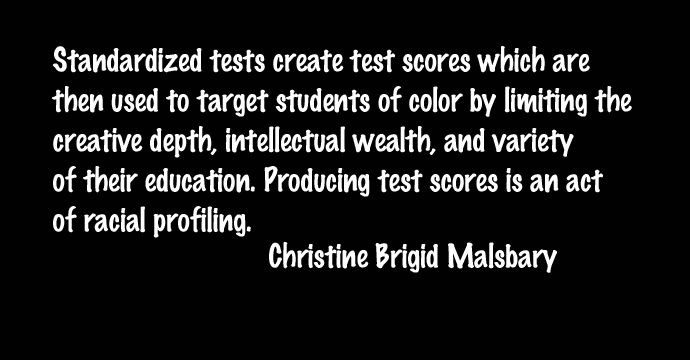
Standardized Tests are a Form of Racial Profiling


By Christine Brigid Malsbary.
Several days before writing this blog post, I visited a 12th grade class that I have been following since the beginning of their 11th grade year. I am a researcher and I study how education policy affects teachers and students in their daily lives. The youth I work with are all immigrants, students of color, and learning English as a second language. I sat next to student I didn’t recognize and asked the teacher who he was. The teacher explained the boy was simply in the class to try to pass the NY Regents’ exam—the test all high schoolers in New York state have to take in order to graduate from high school.
The boy had all the credits necessary for high school graduation, but hadn’t passed the Regents’ exams in math and English. Without passing scores, youth do not receive a high school diploma, their only other option to study for GREs. Now in his fifth year in the high school, the teachers had created a specialized plan for the young man so he only had to attend math and English classes to prep for the Regents’. “He isn’t going to graduate,” the teacher whispered to me. The teacher continued, “he is going to age out of high school in January when he turns 21. He won’t be able to get his scores up in time, his English is too weak. He has only been in the country for three years, and we think he may have some special needs as well.”
I asked the teacher what would happen to a young man of color and English Learner with no high school diploma in a neoliberal city like New York with a shrinking middle class. “I don’t know,” he said. “It breaks my heart. And guess who is going to have to tell him that he won’t graduate? Me. The policy makers won’t tell him. The people who are in the classroom with these kids have to deliver the news. After they moved here, got to class, did the work and learned English … that they won’t graduate. And then they evaluate me based on my students’ test scores when my kids barely speak English … it is not fair. The system is designed for these kids to fail.”
Of the 22 young people in the class of students I have been studying for 14 months, 22 will be attempt the Standardized Tests are a Form of Racial Profiling - Living in Dialogue:

End To Excessive Standardized Testing? Why Teachers Students and Parents Are Saying BS


End To Excessive Standardized Testing? Why Teachers Students and Parents Are Saying BS

For almost 15 years Teachers Students and Parents have been saying that there is too much emphasis on Standardized Testing!

Nothing got through the Corporate Education Reform Bubble!

The Oligarchy

In Their Bubble They Refused To Hear Teachers Students and Parents !

The Presidents 

In Their Bubble They Refused To Hear Teachers Students and Parents !


Governors 

In Their Bubble They Refused To Hear Teachers Students and Parents !

THE DEFORMERS

In Their Bubble They Refused To Hear Teachers Students and Parents !

Corporate Education Reform Bubble!

TODAY: Did Arne Duncan Just Surrender on Standardized Testing?

Days ago, the U.S. Department of Education announced a dramatic policy shift on standardized testing of public school students. Education Secretary Arne Duncan, echoed by President Obama, admitted that a Council of the Great City Schools study was right—there is too much reliance on standardized testing, hurting schoolchildren, teachers and administrators. The Education Department, therefore, published a Testing Action Planwhich they claim will help states and school districts to roll back over-testing, at least to some extent.
This about-face is astonishing because Arne Duncan is substantially responsible for our schools’ overreliance on standardized tests. He made evaluating teachers by student test scores a condition of both federal Race to Top funding and his Department’s waivers from No Child Left Behind (NCLB). And it was Duncan who forced states to add standardized tests in subjects like social studies, science, languages, and even physical education.
So what will the Department of Education actually do? Will future policies match this new rhetoric? The only specific change is to support the two percent solution—that schools should not spend more than two percent of classroom hours per year giving standardized tests. This idea is already enshrined in the U.S. Senate’s proposed rewrite of the No Child Left Behind law.
But such a requirement would be nearly meaningless. According to the National Center for Education Statistics, the average school day lasts 6.64 hours and the average number of school days is 180 per year. Do the easy math and you’ll find that two percent equals 23.9 hours of testing in a year.
Compare that to the number of hours that students sit for tests, according to Council of Great City Schools. Remember, these are the hours that even testing advocates now say are far too many:
GradeHours
Pre-K4.8
K8.5
1st10.4
2nd11.9
3rd20.6
4th22.1
5th23.2
6th22.4
7th23.2
8th25.3
9th22.6
10th23.9
11th22.5
12th15.9
Clearly, the two percent solution very marginally helps average 8th graders, but doesn’t help anyone else. In fact, it allows schools to increase the amount of testing in 12 different grades.
But entirely besides that nearly meaningless requirement, it isn’t the time spent taking tests Did Arne Duncan Just Surrender on Standardized Testing?

10 Years ago Wapo's Uncle Jay Mathews Warned Us ALL

Let's Teach to the Test

NOW


Big Education Ape: Obama meets with educators to talk about standardized testing - The Washington Post http://bit.ly/1Wegkr3

Big Education Ape: Obama encouraging limits on standardized student tests - Yahoo News http://bit.ly/1WegnDi

Big Education Ape: Study: Students Burdened By Local, State and Federal Tests - US News http://bit.ly/1Wegpel

Big Education Ape: Suspicions Confirmed: Testing Action Plan is Trojan Horse | Save Maine Schools http://bit.ly/1S69Hqr

Big Education Ape: Fact Sheet: Testing Action Plan | U.S. Department of Education http://bit.ly/1OZZUlM

Big Education Ape: How Should Educators Respond to the Obama Administration's Concession on Test and Punish? | John... http://bit.ly/1OZYUOy

Big Education Ape: Education Lessons From A Sparkly District: USED's Latest Nonsense http://bit.ly/1Wegz5r

Big Education Ape: Oh what a tangled web we weave…. | DCGEducator: Doing The Right Thing http://bit.ly/1WegzT4

Big Education Ape: Reading Between the Lines: Obama's Testing Action Plan - UNITED OPT OUT: The Movement to End Cor... http://bit.ly/1WegAGF

Big Education Ape: CURMUDGUCATION: Obama's Testing Action Plan Sucks (And Changes Nothing) http://bit.ly/1OZYYxP