Latest News and Comment from Education

Monday, October 26, 2015

“How to Ruin or Revive Public Education,” My Speech at Wellesley College | Diane Ravitch's blog

“How to Ruin or Revive Public Education,” My Speech at Wellesley College | Diane Ravitch's blog:

“How to Ruin or Revive Public Education,” My Speech at Wellesley College 


On October 22, I spoke at Wellesley College, my alma mater, to inaugurate a new annual lecture series on the subject of public education.
Here is a link to the speech, preceded by three introductions: one by Barbara Beatty, chair of the College’s Education department; Barbara Madeloni, president of the Massachusetts Teachers Association; and Linda Gottlieb, producer of the classic film, “Dirty Dancing,” a classmate of the class of 1960 and dear friend.
My purpose was to describe the current state of American education, the errors of the status quo, and what we must do to transform education for the future.
I am also funding student internships and research, and one day there will be a professorship. My hope is that one day Wellesley will be a center for generating sane and thoughtful education policy.
Next year’s speaker in this series will be Pasi Sahlberg, the great Finnish educational authority, who is a Visiting Professor at Harvard Graduate School of Education.
I am hopeful that the initiative at Wellesley will eventually grow to sponsoring scholarly work, seminars, and visionary thinking about a better education for every child.“How to Ruin or Revive Public Education,” My Speech at Wellesley College | Diane Ravitch's blog:


Obama meets with educators to talk about standardized testing - The Washington Post

Obama meets with educators to talk about standardized testing - The Washington Post:

Obama meets with educators to talk about standardized testing

South Valley Academy students protest new academic assessments after leaving class, Monday, March 2, 2015, in Albuquerque, N.M. (Roberto E. Rosales/AP)


President Obama is scheduled to discuss standardized testing with a group of educators at the White House on Monday, two days after acknowledging that his policies have helped lead to widespread overtesting in the nation’s public schools.
Obama is set to meet in the Oval Office with officials from the Council of the Great City Schools, which released a study Saturday that found standardized testing is overwhelming U.S. public schools.
Also expected at the private meeting are two teachers, Farida Mama, a 5th grade math teacher at UP Academy Dorchester , a Boston charter school, and Bootsie Battle-Holt, a math teacher at Marina Del Rey Middle School in Los Angeles. Both teachers are policy fellows with Teach Plus, a non-profit organization that aims to amplify the voices of teachers in education policy.
“We all have to look in the mirror and say what have we done to contribute to the issue,” U.S. Education Secretary Arne Duncan said Monday morning, speaking about the new study during a panel discussion at the National Press Club in Washington.
A typical student takes 112 mandated standardized tests between pre-kindergarten classes and 12th grade, the study found. By contrast, most countries that outperform the United States on international exams test students three times during their school careers.
But Duncan and other panelists emphasized that the time students spend testing is only part of the problem. Just as critical is the finding that the tests students take are disjointed, redundant and often fail to provide teachers with meaningful and timely information that they can use to improve instruction.
“For me, the biggest issue is not time, it’s the lack of instruction,” Duncan said.
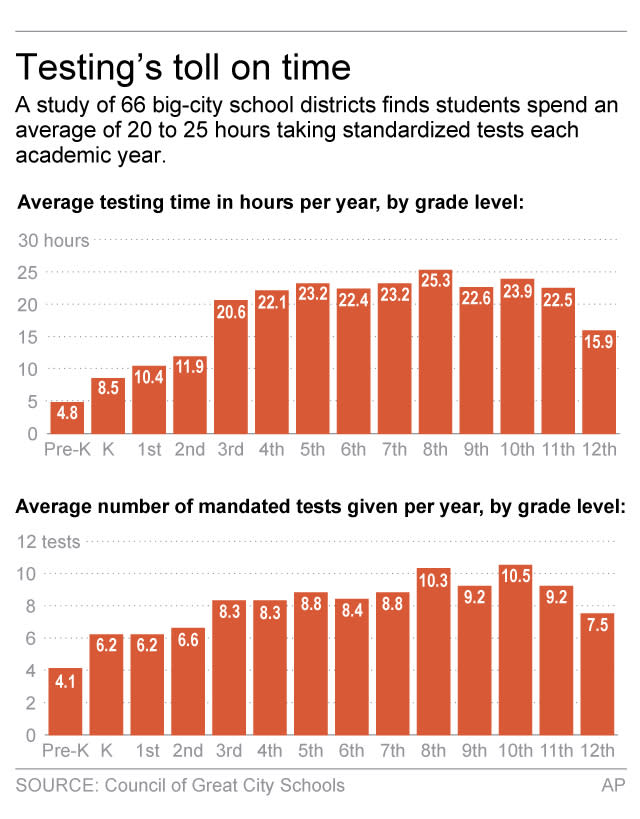
The heaviest testing load falls on the nation’s eighth-graders, who spend an average of 25.3 hours during the school year taking standardized tests, uniform exams required of all students in a particular grade or course of study. Testing affects even the youngest students, with the average pre-K class giving 4.1 standardized tests, the report found.
The study analyzed tests given in the country’s 66 largest urban districts in the 2014-2015 school year. It did not count quizzes or tests created by classroom teachers, and it did not address the amount of time schools devote to test preparation.
It portrays a jumble, where tests have been layered upon tests under mandates from Congress, the U.S. Department of Education and state and local governments, many of which the study argues have questionable value to teachers and students. Testing companies that aggressively market new exams also share the blame, the study said.
In response to the study, Duncan released a “testing action plan” that calls for capping the amount of time that students spend testing at 2 percent of overall instructional time. A similar proposal is part of an education bill pending in the Senate.
But Michael Casserly, the executive director of the Council of the Great City Schools, said that Duncan’s proposed testing cap could have the perverse effect of making the testing system more incoherent.
“There is a very strong possibility that people will eliminate the tests that are actually useful,” Casserly said. Casserly said, for example, that the Boston Public Schools has decided to reduce its testing by half in response to the study’s findings.
A better approach, he has said, would be a coordinated effort among all players — federal, state and local — to come up with a more thoughtful system.
Alberto Carvalho, the superintendent of Miami-Dade schools, has significantly reduced the number of tests his students take. But he too said that a focus on the number of tests, or the time spent testing, is too simplistic.
“The next phase of the conversation cannot be about a cap,” he said. “It’s really a quantitative analysis. ... Can they actually improve teaching and learning? Are they useful to teachers, and do they transparently inform communities and parents about performance?”
Duncan was asked at Monday’s event whether the administration’s mea culpa Obama meets with educators to talk about standardized testing - The Washington Post:

As school districts across Florida continue grappling with the state's class size restrictions, some are questioning whether the law is being misused. - Sun Sentinel

As school districts across Florida continue grappling with the state's class size restrictions, some are questioning whether the law is being misused. - Sun Sentinel:

Class size rules frustrate parents, districts


 As school districts across Florida continue grappling with the state's class size restrictions, some are questioning whether the law is being misused.
A father is suing the Palm Beach County School District for putting too many children in his son's kindergarten class at Boca Raton's Addison Mizner Elementary School. A state senator is asking whether districts are misapplying a loophole meant to exempt innovative schools by saying all of their schools meet that qualification.
In Broward County, meanwhile, school board members are looking at restricting the number of late-enrolling students who an be assigned to a teacher after October.
That's because state policy allows each core class at the high school level to have up to 30 students, above the normal cap of 25. What concerned board members was a teacher with seven class periods could end up getting 35 new students.
"It's almost like taking on an additional class by just adding additional students to each class," chairwoman Donna Korn said at the board's meeting Tuesday.
The school district has historically struggled to meet the class-size restrictions and in 2011 was hit with initial penalties of $8.4 million. Only half of the classrooms complied with the law at that time.
Administrator Leslie Brown told board members no penalty is expected this year and that 91 percent of classes are currently within the state's parameters.
Many districts have faced similar challenges since Florida's class size law was enacted in 2002, after voters approved a constitutional amendment. It limits classes to 18 students in pre-kindergarten through third grade; 22 in fourth through eighth grade and 25 in ninth through twelfth grade.
To parent Paul Kuhn, who filed his lawsuit against the Palm Beach County School District last month, those restrictions help create a better learning environment for students.
"Even 18 kids is a lot of kids to control and to get one-on-one time and give attention to," he said. "The more kids you have, the less attention each kid gets."
His suit accuses the district of misapplying a state policy that gives class-size flexibility to schools of choice --charter schools and others that offer specialized education programs. Using that policy, the school placed 21 students in his son's class.
"They're not trying to comply," Kuhn said. "They're trying to find ways around compliance with the constitutional amendment."
Palm Beach shool district spokeswoman Kathy Burstein said administrators are responding to the suit and will continue defending the matter.
Senate Education Committee Chair John Legg is taking issue with the same provision. In a letter sent Monday to Education Commissioner Pam Stewart, he wrote that some districts have "expanded the intent of state policy by naming themselves a 'district of choice' or a As school districts across Florida continue grappling with the state's class size restrictions, some are questioning whether the law is being misused. - Sun Sentinel:

Next UNC president is study in contradictions | News & Observer


Next UNC president is study in contradictions | News & Observer:

Next UNC president is study in contradictions


Margaret Spellings apparently wasn’t angered years ago when a Texas teachers group referred to her as the “princess of darkness.” Instead, she got herself a black cape with the moniker stitched on the back.
Spellings, who’s leaving the George W. Bush Presidential Center to become the president of the University of North Carolina system, once told a Washington Post reporter that she didn’t like the limelight. But in one of her first acts as Bush’s education secretary, she touched off a culture war skirmish when she denounced PBS for spending money on an episode of the animated children’s show “Postcards from Buster” that included lesbian characters. Gay rights activists pounced, and Rep. Barney Frank fired off a letter calling out Spellings’ “meanness.”
Conservatives didn’t like it, though, when Spellings responded “So what?” to a question about the decline of traditional two-parent families. There are all types of families, argued Spellings, who at the time was the divorced mother of two young children who had moved to Washington to work in the West Wing.
Spellings’ blunt words are softened by a Texas drawl. She doesn’t mind ruffling the feathers of the education establishment when she talks about productivity and accountability. She is insistent about the need for schools and colleges to serve more and better serve low-income and minority students.
“She brings out strong feelings. She is a bundle of contradictions,” said Andy Rotherham, a former policy adviser in Bill Clinton’s administration, who describes himself as “a Margaret fan.”
“She is this big, bold woman from Texas, but she has a heart of gold,” said Rotherham, co-founder of Bellwether Education Partners, a Boston area education nonprofit. “She is someone who cares and believes deeply in public education ... but she also believes public education needs to do much better.”
Spellings has spent her career in education policy and didn’t mind a little hard knuckle politics along the way. Karl Rove first brought her in to advise Bush on education when he ran for governor of Texas, after she had worked in the Texas legislature and the state school boards association. From then on, she would be in Bush’s inner circle, becoming domestic policy adviser in his first term and as education secretary in the second term. She’s now head of Bush’s presidential library and institute in Dallas.
Michael Petrilli, president of the Thomas B. Fordham Institute, said Spellings navigates the world of politics without ever talking like a politician.
“She comes off as very down to earth,” Petrilli said. “She’s tough. She’s a tough cookie, and she likes that reputation of being a tough cookie.”
I’M ASSUMING THAT (THE GOVERNORS) AT UNC KNOW THAT THEY’RE HIRING A CHANGE AGENT.
Michael Petrilli, president of Thomas B. Fordham Institute
Spellings, he said, is a big believer that the higher education system needed more accountability, that it had become complacent and that its outcomes weren’t as good as they could be.
“I’m assuming that (the governors) at UNC know that they’re hiring a change agent,” he said.

Envisioning a data revolution

Last year, Spellings wrote an op-ed piece for the Wall Street Journal in which she described what education would look like in 20 years.
Students and parents will be empowered by the data revolution, able to choose education in an a la carte fashion without regard to geographic or institutional boundaries, she wrote. Students will move at their own pace and individualize their education based on the outcomeNext UNC president is study in contradictions | News & Observer:
Margaret Spellings speaks after she was elected president of the University of North Carolina system during a meeting of the UNC Board of Governors at the Spangler Center in Chapel Hill, N.C., Friday, Oct 23, 2015.
Margaret Spellings speaks after she was elected president of the University of North Carolina system during a meeting of the UNC Board of Governors at the Spangler Center in Chapel Hill, N.C., Friday, Oct 23, 2015. Ethan Hyman ehyman@newsobserver.com

How robots, artificial intelligence, and machine learning will affect employment and public policy | Brookings Institution

How robots, artificial intelligence, and machine learning will affect employment and public policy | Brookings Institution:

How robots, artificial intelligence, and machine learning will affect employment and public policy


Emerging technologies like industrial robots, artificial intelligence, and machine learning are advancing at a rapid pace, but there has been little attention to their impact on employment and public policy. Darrell West addresses this topic in a new paper titled What Happens If Robots Take the Jobs? The Impact of Emerging Technologies on Employment and Public Policy. It examines what happens if robots end up taking jobs from humans and how this will affect public policy.
While emerging technologies can improve the speed, quality, and cost of available goods and services, they may also displace large numbers of workers.  This possibility challenges the traditional benefits model of tying health care and retirement savings to jobs.  In an economy that employs dramatically fewer workers, we need to think about how to deliver benefits to displaced workers. 
The impacts of automation technologies are already being felt throughout the economy. The worldwide number of industrial robots has increased rapidly over the past few years.  The falling prices of robots, which can operate all day without interruption, make them cost-competitive with human workers.  In the service sector, computer algorithms can execute stock trades in a fraction of a second, much faster than any human.  As these technologies become cheaper, more capable, and more widespread, they will find even more applications in an economy.
The recent trend towards increased automation stems in part from the Great Recession, which forced many businesses to operate with fewer workers. After growth resumed, many businesses continued automating their operations rather than hiring additional workers. This echoes a trend among technology companies that receive massive valuations with relatively few workers.  For example, in 2014 Google was valued at $370 billion with only 55,000 employees, a tenth the size of AT&T’s workforce in the 1960s.
“There needs to be ways for people to live fulfilling lives even if society needs relatively few workers.”
Experts disagree on the size of the impact that automation technologies will have on the workforce.  While some warn of staggering unemployment, others point out that technology may create new job categories that will employ displaced workers. A third group argues that the computers will have little effect on employment in the future.  Any policy measures that address the future of employment must account for the uncertainty of outcomes on employment.
If automation technologies like robots and artificial intelligence make jobs less secure in the future, there needs to be a way to deliver benefits outside of employment.  “Flexicurity,” or flexible security, is one idea for providing healthcare, education, and housing assistance How robots, artificial intelligence, and machine learning will affect employment and public policy | Brookings Institution:

Folsom Cordova Unified School District PIOs: Critical link between schools, community - SI&A Cabinet Report

District PIOs: Critical link between schools, community :: SI&A Cabinet Report :: The Essential Resource for Superintendents and the Cabinet:

District PIOs: Critical link between schools, community

District PIOs: Critical link between schools, community


(Calif.) One hand drags a cursor across a computer screen as the other flips through a pile of papers on his desk. Simultaneously, Dan Thigpen, public information officer for Folsom Cordova Unified School District, rattles off the day’s itinerary from memory.
“What a typical day looks like fluctuates between working proactively and reactively,” said Thigpen, also president of the California School Public Relations Association.
“Proactive work includes strategic planning for ongoing, short-, medium- and long-term initiatives,” he explained. “The reactive side is communicating in an emergency and responding to media calls.”
Typically relegated to a behind-the-scenes role, a district communication officer serves an important position in bridging public schools with the community they serve. Few other public institutions enjoy as much public trust and responsibility as the school district, and thus, the job of communicating what happens on the campus – both routine and extraordinary – is complex and demanding.
Not every district has the benefit of hiring a communications specialist to fill this role. Just as the number of school nurses, librarians and counselors were cut during the recession, so too were many PIO jobs – only some of which have been restored.
A common misconception revolves around the idea that a school communications person simply fields media calls, but according to Thigpen, that is only a portion of his job description. At its core, the purpose of a public information officer is to take the complex inner workings of a district, simplify them, and tailor a message to different audiences.
A look at his schedule one morning included an early meeting with the director of Categorical Programs and Grants; then a phone call with an Internet sales representative; followed by a meeting with Comcast after lunch; a session with members of the local Chamber of Commerce; and then a chance to pitch a story idea to the local morning TV show, Good Day Sacramento. All of this comes while also handling a number of smaller tasks in between.
The PIO needs to have some knowledge of every department, the work they do and the acronyms they use, he said.
Thigpen’s first meeting of the day, for instance, was with Elena Cabrera, director of Categorical Programs, who wanted to discuss how best to persuade families who would likely be approved for free and reduced price lunch to sign up.
At issue is a dichotomy between the number of lower-income families on the Rancho Cordova side of the district that apply for free and reduced price lunch, and those on the Folsom side who may be District PIOs: Critical link between schools, community :: SI&A Cabinet Report :: The Essential Resource for Superintendents and the Cabinet:

Mike Klonsky's SmallTalk Blog: WEEKEND QUOTABLES

Mike Klonsky's SmallTalk Blog: WEEKEND QUOTABLES:

WEEKEND QUOTABLES

Comey is "confused"

FBI Director James Comey

 “To speak of mass incarceration, I believe, is confusing and can obscure reality.” -- Sun-Times
Pres. Obama

"Learning is about so much more than just filling in the right bubble. So we're going to work with states, school districts, teachers, and parents to make sure that we're not obsessing about testing." -- Fox News
Arnie Duncan

“It’s important that we’re all honest with ourselves. At the federal, state and local level, we have all supported policies that have Mike Klonsky's SmallTalk Blog: WEEKEND QUOTABLES:

DIANE RAVITCH: Our real charter school nightmare: The new war on public schools and teachers - Salon.com

Our real charter school nightmare: The new war on public schools and teachers - Salon.com:

Our real charter school nightmare: The new war on public schools and teachers

Our kids deserve strong schools and great teachers under local control. That's what the charter fight is all about


Peter Cunningham, who previously served as Arne Duncan’s assistant secretary for communications, is a very charming fellow. When he left the administration, he returned to Chicago. The Eli and Edythe Broad Foundation invited him to start a blog defending “reformers” who advocate for charter schools, high-stakes testing, teacher evaluation based on student test scores, and the rest of the Race to the Top agenda. The blog, called “Education Post,” received $12 million from several billionaires, including the Broad Foundation, the Michael R. Bloomberg Foundation, the Walton Family Foundation, and an anonymous donor.
Peter just wrote a column that puzzled me. It appeared on Huffington Post. He says that teachers’ unions should embrace “reform” if they want public education to survive. I was puzzled because the major thrust of “reform” as currently defined is to privatize as many schools as possible and to eliminate teachers’ unions.
He writes:
“America’s teachers unions probably will not put reform leaders like Newark’s Chris Cerf, Philadelphia’s William Hite, D.C’s Kaya Henderson, or Denver’s Tom Boasberg at the top of their Christmas card mailing list. But they should, because no one is working harder to improve and preserve traditional, unionized, district-run schools.
“Yes, these and other reform superintendents support creating new, high-quality schools, including public charters, and giving all parents the power to choose the right schools for their children. But they and their leadership teams are most deeply committed to investing in and strengthening the existing district-run schools. No one wants these schools to work for kids more than these district leaders.”
Cunningham attributes opposition to charters solely to unions trying to protect their membership and their revenue. Why should unions feel threatened by privately managed charters? As Cunningham notes, 93% of charters are non-union. Cunningham thinks that everyone who opposes turning public tax revenues over to private operators has the sinister motive of protecting the unions. He even says that pro-public education bloggers are merely union fronts. Whether they are teachers, academics, or journalists, Cunningham can’t see any reason for them to question charters other than their allegiance to the unions. Unlike those who post on Cunningham’s “Education Post,” pro-public education bloggers are not paid for expressing their views.
Cunningham writes:
“Charter critics claim that charters pull resources and higher achieving students away from traditional public schools, but, in a poll conducted by Education Post, 65 percent of parents rejected this argument. Instead, they agreed that public charters offer high quality options to parents who have been traditionally denied the power of school choice.
“Teacher unions, who need unionized teachers and dues in order to exist, are fighting desperately to convince parents to stay with the traditional, district-run 
Our real charter school nightmare: The new war on public schools and teachers - Salon.com:


Bill lets retirees teach, get pension due to lack of subs

Bill lets retirees teach, get pension due to lack of subs:

Bill lets retirees teach, get pension due to lack of subs


Lansing — Michigan lawmakers are under pressure to let retired teachers return to the classroom because of a shortage of substitutes and not enough full-time teachers in special education, pre-kindergarten and certain subjects.
A 2012 law allowing teachers who retired after mid-2010 to teach again without losing their pension expired more than 15 months ago. That left provisions of a 2010 teacher retirement incentive law on the books.
Pension and health care benefits must be suspended once retirees directly employed by a school district are paid more than one-third of their average final compensation in a year. Retirement benefits are off limits entirely for retirees hired by an independent contractor to perform a school’s “core services.”
Reasons for the substitute teaching shortage are varied, including an improved unemployment rate that has meant job seekers who might have taken a part-time job substitute teaching landed full-time positions in education or another field. But school administrators and the companies they contract with for substitutes say legislators also are at fault.
“The Legislature disallowed retirees to come back who were deemed our best substitutes,” said Clark Galloway, president of EDUStaff, which finds substitutes for more than 300 of the state’s 541 districts. The firm, which recruits, screens, hires, trains, places and pays substitutes, is doing everything “within reason” to search for candidates, he said.
That includes job fairs, highway billboard advertising, yard signs and placements with newspapers, radio stations and on music streaming service Pandora.
One in 10 Michigan classrooms has a substitute teacher on average, more on Mondays and Fridays. A 95 percent fill rate was considered good up until a few years ago. The current fill rate is 85 percent, Galloway said, which means “we now have 1,500 classrooms on a daily basis that are not getting a substitute teacher or districts are scrambling.”
Rep. Holly Hughes, R-Montague, who sponsored the 2012 legislation allowing for exemptions, is spearheading a bill to re-enact the expired provisions. She said retired teachers were snared in lawmakers’ crackdown on superintendents making six figures who “double dipped” by retiring, collecting a pension and being rehired by an outside Bill lets retirees teach, get pension due to lack of subs:

And now Luke Bronin is collecting big bucks from developers of the Hartford Dunkin’ Donuts Stadium - Wait What?

And now Luke Bronin is collecting big bucks from developers of the Hartford Dunkin’ Donuts Stadium - Wait What?:

And now Luke Bronin is collecting big bucks from developers of the Hartford Dunkin’ Donuts Stadium


In the weeks leading up to Hartford’s Democratic Mayoral Primary, Greenwich native and political newcomer Luke Bronin repeatedly attacked incumbent Mayor Pedro Segarra for his support of the minor league baseball stadium that is now under construction in Hartford.
Luke Bronin told the Hartford Courant,
“I had real concerns about it. I still have real concerns about it and our ability to fund it.”
But despite Bronin’s “real concerns” about the stadium, the moment Luke Bronin got past the deadline for making his campaign contributions public prior to Primary Day he started loading up with money from the very developers who were given the extraordinary contract to build the stadium.
Connecticut State Law required that Bronin and any other candidate running for municipal office file a special campaign finance report exactly one week before the September 16, 2015 Primary Day.
However, although the filing date for the report was Wednesday, September 9, 2015, only contributions received by Monday, September 7, 2015 had to be listed on the report.
On Tuesday, September 8, 2015, only hours after a contribution reporting deadline had passed, Luke Bronin received eight $1,000 checks from individuals associated with the stadium developer.
And as Bronin’s latest campaign finance report reveals, the $8,000 collected on September 8, 2015 was only the beginning.
In the following days, the Bronin campaign pocketed additional $1,000 checks from the corporate executives of DONO Hartford LLC, CENTERPLAN DEVELOPMENT And now Luke Bronin is collecting big bucks from developers of the Hartford Dunkin’ Donuts Stadium - Wait What?:

Latina Style Magazine: Equality and Fairness For All - Lily's Blackboard

Latina Style Magazine: Equality and Fairness For All - Lily's Blackboard:

Latina Style Magazine: Equality and Fairness For All

Screen Shot 2015-10-26 at 10.28.56 AM


Whenever I whined about my homework, mom would tell me that every piece of knowledge could be put to good use. She would say, “That’s a key. You never know when that key might open a door for you.” Some activists march. Others help us find the keys to open doors.
As the first Latina to head the National Education Association, for me, Hispanic Heritage Month is about paying tribute to the many people who opened doors for us. It’s also about acknowledging that today, we must keep pushing, pulling, and even kicking down those doors so that all young people can walk through them. And that means ensuring that all our kids – no matter where they live – have access to the best public education possible.Latina Style Magazine: Equality and Fairness For All - Lily's Blackboard:

Former elementary school principal reveals why she'd never want her daughter to go into teaching - Yahoo Finance

Former elementary school principal reveals why she'd never want her daughter to go into teaching - Yahoo Finance:

Former elementary school principal reveals why she'd never want her daughter to go into teaching

Former elementary school principal reveals why she'd never want her daughter to go into teaching


After spending nearly two decades as a teacher and school administrator, you might expect Kristi Rangle to enthusiastically praise the teaching profession.

She did the opposite, however, in a powerful blog post on The Urban Edge, where she largely disparaged the current state of teaching and explained the reason why she advises her daughter, currently pursuing an education degree, not to go through with it.
"I fear she – like many other teachers – will be scapegoated as the reason public education is failing," Rangle wrote.
She laid out the systemic reasons for the failure of public education, asserting that the quality of teachers, while touted as the most important factor of student success, is not the real problem.
"We have created schools that are functioning well below their capacity because of a lack of funds," Rangle explained. She spoke about the need for adequate funding, especially for teachers who work with disadvantaged populations of students.
The lack of funding sets teachers, and students, up for failure, according to Rangle. She argued that teachers these days are required to pick up more responsibilities that traditionally fell upon other faculty members, like school counselors and social workers.
Though Rangle's piece focuses on her experience teaching in the Texas school system, her argument could apply to many school systems in the US.
More than half of states are providing less per-pupil K-12 funding for kindergarten through 12th grade than they did in 2008 during the financial crisis, the Center for Budget and Policy Priorities found last year. 
Funding is not the only problem, however. Rangle also fears that in today's system where teachers are evaluated based on student performance, good teachers who work with low-income populations have been set up for failure.
She's troubled by this trend, but says experienced teachers can't in good faith recommend that new teachers try to work in low-income school districts.
"New teachers, like my daughter, are urged by veteran educators not to begin their careers in the types of schools where we found our passion for students and learning – the sort of places that need eager, energetic teachers the most," Rangle wrote.
Former elementary school principal reveals why she'd never want her daughter to go into teaching

Why "5+5+5=15" is wrong under Common Core - Business Insider

Why "5+5+5=15" is wrong under Common Core - Business Insider:

Why "5+5+5=15" is wrong under Common Core


Here's a "repeated addition" Common Core problem that's taught in third grade in US schools:
Use the repeated-addition strategy to solve: 5x3
If you answer the question with "5+5+5=15," you would be wrong.
The correct answer is "3+3+3+3+3."
Mathematically, both are correct. But under Common Core, you're supposed to read "5x3" as "five groups of three." So "three groups of five" is wrong.
According to Common Core defenders, this method will be useful when students do more advanced math. This way of reading things, for instance, can be used when students learn matrices in multivariable calculus in high school.

Obama encouraging limits on standardized student tests - Yahoo News

Obama encouraging limits on standardized student tests - Yahoo News:

Obama encouraging limits on standardized student tests


WASHINGTON (AP) — Addressing one of education's most divisive issues, President Barack Obama on Saturday called for capping standardized testing at 2 percent of classroom time and said the government shares responsibility for turning tests into the be-all and end-all of American schools.
Students spend about 20 to 25 hours a school year taking standardized tests, according to a study of the nation's 66 largest school districts that was released Saturday by the Council of the Great City Schools. But it's not known how much class time students spend preparing for tests that became mandatory, starting in third grade, under the George W. Bush-era No Child Left Behind law and are a flashpoint in the debate over the Common Core academic standards.
"Learning is about so much more than just filling in the right bubble," Obama said in a video released on Facebook. "So we're going to work with states, school districts, teachers, and parents to make sure that we're not obsessing about testing."
To drive the point home, Obama and Education Secretary Arne Duncan plan an Oval Office meeting Monday with teachers and school officials working to reduce testing time.
And from the 2016 presidential campaign, Democratic contender Hillary Rodham Clinton embraced the principles laid out by Obama. "We should be ruthless in looking at tests and eliminating them if they do not actually help us move our kids forward," she said in a statement.
In all, between pre-K and 12th grade, students take about 112 standardized exams, according to the council report. It said testing amounts to 2.3 percent of classroom time for the average 8th-grader.
"How much constitutes too much time is really difficult to answer," said Michael Casserly, the council's executive director.
Obama cannot force states or districts to limit testing, which has drawn consternation from parents and teachers. But Obama directed the Education Department to make it easier for states to satisfy federal testing mandates and he urged states and districts to use factors beyond testing to assess student performance.
The Obama administration said it still supports standardized tests as a necessary assessment tool, and there are no signs they are going away soon.
Both the House and Senate versions of an update to No Child Left Behind would preserve annual reading and math exams, although the House version would diminish their significance in determining whether schools are up to par. The legislation is in limbo while House and Senate negotiators figure out how to reconcile the competing versions.
Administration officials said that in many cases, testing is redundant, poorly aligned with curriculum or simply overkill. They said the administration supports legislative proposals to cap testing time on a federal level, but wanted to offer states a model for how to cut down on testing absent congressional action.
"There's just a lot of testing going on, and it's not always terribly useful," Cecilia Munoz, the director of the White House's Domestic Policy Council, said in an interview. "In the worst case, it can sap the joy and fun out of the classroom for students and for teachers."
Casserly said his group found examples of testing redundancy that could be cut to create more instructional time. For example, some states and school districts were requiring both end-of-year tests and end-of-course tests in the same subjects in the same grade.
To ease the testing burden, the administration will provide states with guidance about how they can satisfy federal testing requirements in less time or in more creative ways, including federal waivers to No Child Left Behind that the Education Department readily has handed out. For example, some 8th-grade students who take high school-level coursework currently take both 8th-grade and high school assessments, but the administration will allow them to opt out of the 8th-grade tests.
The value of standardized tests taps into the national debate about the federal government's role in local schools; both political parties generally support scaling back Washington's reach.
Central to that debate is Common Core, a set of universal, college-ready academic standards in reading and math developed by state education officials. The federal government doesn't require Common Core, but the administration has backed it with money. About 12 million students last spring took tests based on the curriculum.
Teachers' unions have fought hard against one-size-fits-all tests for students being tied to their teachers' performance evaluations. Among parents with children in public schools, 63 percent were opposed to linking teacher evaluations to their students' test scores in a recent Gallup Poll.
Among other findings in the council report:
—The most tests were required in 8th and 10th grade; the fewest were in pre-K, kindergarten and 1st grade.
—Four in 10 districts report having to wait between two months and four months before getting state test results.
—Some pockets of the country had substantial numbers of students opting out of standardized tests. But the overall opt-out rate was usually less than 1 percent.
Reach Josh Lederman on Twitter at http://twitter.com/joshledermanAP and Jennifer C. Kerr at http://twitter.com/jckerr9

Study: Students Burdened By Local, State and Federal Tests - US News

Study: Students Burdened By Local, State and Federal Tests - US News:

Students Stuck in Maze of Testing

Exams in just a sampling of districts were given more than 6,570 times last school year, a new study finds.

Taking the February LSAT will require submitting law school applications in early spring and competing for fewer available admissions slots.


A landmark study of the country’s largest urban school districts shows students are caught in a dizzying web ​of federal, state and local tests, and nearly everybody in the education community is to blame.
“Everybody has had a hand in what our current testing system looks like,” said Michael Casserly, executive director of the Council of the Great City Schools, which represents 66 urban school districts and spent the last two years analyzing the number of tests those districts gave in the 2014-2015 school year.
“Lots of people I know have pointed fingers at each other, and we have concluded that they were all correct,” he said.
On average, students in the school districts were required to take 112 tests from the time they entered pre-K through grade 12, though that number does not include optional tests or those required specifically by a school alone.
Overall, students sat for tests more than 6,570 times. Students in eighth grade spent the most time taking tests – approximately four days, or 2.3 percent of their school year.
The testing burden, the report found, was particularly high at the high school level, although much of that testing was optional and included, for example, college entry exams like the SAT or ACT.
“This report really represents an opportunity to recalibrate our assessments structure,” said Richard Carranza, superintendent of the San Francisco Unified School District. “It’s time to weed the garden.”
The report comes on the heels of guidance from the Department of Education that recommends states and school districts evaluate their current testing regimens and eliminate any exams deemed ineffective or duplicative – a move that was cheered by the two national teachers unions and Democratic presidential front-runner Hillary Clinton.
The federal government requires states to test students 17 times before graduation: annually in math and reading in grades 3 through 8, once in those subjects during high school, and then once in science during elementary, middle and high school.
But the No Child Left Behind Act, the current version of the federal K-12 law, is largely blamed for ushering in an era of high-stakes testing to the public education system. The accountability at the heart of the law required states to ensure a specific percentage of students was proficient in reading and math each year, and each year that percentage had to increase.
If states didn’t reach annual proficiency goals, they could be subject to a series of sanctions. And that type of accountability system resulted in states and school districts piling on their own tests to ensure Study: Students Burdened By Local, State and Federal Tests - US News: