Latest News and Comment from Education

Friday, October 23, 2015

High-powered secret panel examining LAUSD finances - LA School Report

High-powered secret panel examining LAUSD finances - LA School Report:

High-powered secret panel examining LAUSD finances


A blue-ribbon panel of leading figures in education, politics and finance has been working behind the scenes to help LA Unified identify financial challenges and solutions as the district faces budget deficits in the near future.
The panel includes people have worked with the district in the past, and many have won awards or honors for their involvement in education. One member is now working for the search firm hired to find the district’s next superintendent.
Known as the Independent Financial Review Panel, the group was formed in March by SuperintendentRamon Cortines and is being supported by $250,000, approved by the board. The panel’s findings and recommendations are due before the end of the current academic year. Cortines has expressed his desire to step down by the end of the calendar year.
The money to support the examination was approved in June, but no one is being paid, said a district spokesperson, adding, “We will be buying them sandwiches.”
Despite the constant refrain by board members to bring transparency and accountability to the business of the district, the work of the panel is being conducted in private. The members of the panel were not identified publicly (see below), and meetings are not open to the public. The panel was mentioned almost as an afterthought in a report earlier this week before the Budget, Facilities and Audit Committee by Chief Financial Office Megan Reilly, whose office is overseeing the panel’s work.
In her presentation, Reilly said it is an “all-volunteer” panel that will take “a comprehensive deep dive and look at the financial problems facing the district.” She said they were “outside experts asked to join us on behalf of Mr. Cortines.”
Reilly has projected a budget shortfall of $333 million in 2017-18, presumably one of the reason the group was impaneled.
During the public forum section of the committee meeting, led by board memberMónica Ratliff, a former school board member, David Tokofsky, pointed to the secrecy surrounding the panel and its work.
“This is the first time in a public meeting that this financial review panel has ever been mentioned,” he said.
The district did not immediately respond to a request for more detailed information about the panel and its progress.
According to Reilly, Cortines asked her in March to establish a group of experts in California public finance and education. The panel convened that month to “help review and make recommendations concerning the long-term financial sustainability and health of the district,” according to a slide she presented at the committee meeting. She added, “Their work is intended to provide a foundation for our discussions regarding the district’s long-term priorities and investments.”
This is the first time such a high-profile panel of outside experts have been asked to look at LAUSD’s budget.
According to another statement, the panel is “expected to review and make recommendations concerning long-term financial matters, financial priorities and the health of the district’s finances.” The report says the panel “will not be involved in the development of current budget plans or discussions with the district’s collective bargaining units.”
These are the members of the panel:
  • Maria Anguiano, an architect of the University of California-wide fiscal improvements plan and a former senior advisor to the Bill and Melinda Gates Foundation Post-Secondary Success Team.
  • Delaine Eastin, the 25th California State Superintendent of Public Instruction and the first woman to be elected to that position.
  • Michael Fine, a deputy superintendent for the Riverside Unified School District.
  • Bill Lockyer, former California Treasurer and veteran politician.
  • Darline Robles, the former superintendent of Los Angeles County Office of Education and the Salt Lake City School District who is now part of the search firm seeking the next LAUSD superintendent.
  • Miguel Santana, former city administrative officer for Los Angeles Antonio Villaraigosa and deal with a time of severe belt-tightening for the city.
  • Darrell Steinberg, longtime state politician and president pro tem of the Senate who authored more than 70 bills involving education, mental health and foster care.
  • Peter Taylor, president of ECMC Foundation, chaired the James Irvine Foundation and is on the boards of the Kaiser Family Foundation and the J. Paul Getty Trust.
  • Kent Wong, the director of the UCLA Labor Center, and former staff attorney for the Service Employees International Union.High-powered secret panel examining LAUSD finances - LA School Report:

Louisville Educators and School Board Work Together to Reduce Testing - NEA Today

Louisville Educators and School Board Work Together to Reduce Testing - NEA Today:

Louisville Educators and School Board Work Together to Reduce Testing

reducing_testing


When the Jefferson County Board of Education Kentucky hosted the first of 10 town hall meetings beginning in Louisville back in May, members were looking for feedback on which “big rock” education policies to address over the next five years.
“We wanted to learn from educators, parents, students, and community members what to continue, what to change, and what to stop,” says Brent McKim, president of the Jefferson County Teachers Association (JCTA) and a member of the district’s Strategy Work Group that coordinated the meetings. “A pretty consistent message was to cut back on the volume of testing.”
With the reauthorization of the Elementary and Secondary Education Act (ESEA)currently being rewritten in Congress and set for a vote possibly this session, school districts across the country are assessing the need to address over-testing and a one-size-fits all punitive culture that is a hallmark of the prior reauthorization known as No Child Left behind (NCLB). Overwhelmingly, educators, parents and policymakers alike are demanding that students receive more time to learn.
At Jefferson County Public Schools (JCPS), McKim and other members of the work group will report their findings from the public meetings at the next board meeting November 9. Aspects of the report will be voted on, adopted and built into Vision 2020, the district’s document that will be the basis for targeting resources and strategies for everything from kindergarten readiness and early childhood literacy to college- and career-readiness.
“One of those big rocks is to broaden assessment of student learning beyond what’s currently covered by standardized tests to include capacities and dispositions – sometimes called soft skills – essential to 21st century success,” says David Jones Jr., board chair.
Jones says policies involving professional development, classroom time management, and other big-picture issues listed in the work group’s report will be discussed at the next board meeting. Of all policies included in the report, Louisville Educators and School Board Work Together to Reduce Testing - NEA Today:

'Education in Black and White' explores issues from 19th century to now | Philadelphia Public School Notebook

'Education in Black and White' explores issues from 19th century to now | Philadelphia Public School Notebook:

'Education in Black and White' explores issues from 19th century to now


Last week, the Moonstone Arts Center held a three-day festival titled “Education in Black & White” as part of its Hidden History project with panel discussions and presentations focusing on the struggle for African American education in the city. Two of them included a historical look at the impact of the Institute for Colored Youth and a modern day take on the importance of Black teachers for Black students.
“What’s interesting and scary is that these are the same issues in education today as there were 150 years ago,” said Larry Robin, director of Moonstone, introducing the panel talk on the Institute for Colored Youth.
Opened in 1852 on Lombard Street, the ICY was a Quaker project that fostered “some of the best and the brightest of the city’s African American community,” according to Villanova history professor Judith Giesberg, who directed a study of the school’s 37 graduates from 1852 to 1866
Giesberg said that ICY students were the cream of the crop who studied mechanical arts and also took a rigorous academic regimen that included math, Greek, Latin, and social sciences. They learned to read the New Testament in Greek and needed to pass oral exams that were open to the public.
“These men and women were really bright and had nerves of steel,” Giesberg said.
The school, she continued, served a welcome counterpoint to the segregation, discrimination and prejudice of the day. As an example, she said, ICY principal Caroline Le Count tried to flag down a streetcar in March 1867 as a new law had been passed banning streetcar segregation. The driver sneered at her. She showed a copy of the new law to a police officer, who arrested and fined the streetcar conductor.
“It’s not a Rosa Parks story, but they were getting on streetcars and protesting the segregation of streetcars,” Giesberg said.
“The awful part of this is a lot of the history hasn’t been written yet, which is a crime,” said Daniel Biddle, co-author of Tasting Freedom: Octavius V. Catto and the Battle for Equality in Civil War America. “I cannot get over how much of this history we were not taught. A lot of these stories remain untaught and untold.”
Biddle’s co-author, Murray Dubin, recalled how ICY opened a public library with 1,300 volumes with the recognition that “education must become a family ambition. It must become a habit.” The library worked, he said, and became the most important source for books in Philadelphia’s Black community.
The ICY rose to prominence during a time when African Americans were particularly under siege, said Kambria Bumgartner, associate professor of history at the College of Wooster. Mobs attacked Black schools, she said, and some were burned down. Educators were threatened with tar and feathering. “And Philadelphia wasn’t immune to this violence,” she said. “But the ICY is a cultural center, a monument in the face of this climate.”
Linda Perkins, associate professor of history at Claremont Graduate University, grew up in Mobile, Ala., and said she had seen up close the struggle African Americans face securing an education. “But they always said, education is the one thing White people can’t take from you,” Perkins said.

Black teachers for Black students

On Friday, the gathering featured a panel that talked about the philosophical and psychological importance of Black teachers for Black students, which had been a guiding principle of the ICY. Rosalind Jones-Johnson, education director for the Philadelphia Federation of Teachers, pointed out that while the student population nationally is becoming increasingly diverse (about 50 percent minority), the number of minority 'Education in Black and White' explores issues from 19th century to now | Philadelphia Public School Notebook:

Students Earning the State Seal of Biliteracy - Year 2015 (CA Dept of Education)

Students Earning the State Seal of Biliteracy - Year 2015 (CA Dept of Education):

State Schools Chief Tom Torlakson Reports Increase in Number of Students Earning the State Seal of Biliteracy 


SACRAMENTO—More high school students graduated with a State Seal of Biliteracy in 2015 than ever before, State Superintendent of Public Instruction Tom Torlakson announced today.
The program, which California was the first in the nation to create in 2012 and since has been emulated across the country, recognizes high school graduates who have attained a high level of proficiency in speaking, reading, and writing in one or more languages in addition to English.
"Becoming multilingual is a huge asset in today's global economy, so I applaud the rising numbers of students attaining high levels of proficiency in multiple languages," Torlakson said. "These skills will help students to live, work, and thrive in a multicultural, multilingual, and highly connected world."  
 The State Seal of Biliteracy was established by Assembly Bill 815. Since then, Washington D.C. and several other states—Washington, Nevada, New Mexico, Texas, Louisiana, Minnesota, Illinois, Indiana, Virginia, New York, and Hawaii—have commenced their own state seal of biliteracy programs.
 In 2015, 31,816 graduating California public high school students earned the biliteracy gold seal, which was affixed to their diplomas, for achieving proficiency in multiple languages. This number is nearly three times the 10,685 reported in 2012. That number increased to 19,586 in 2013, and 24,151 in 2014.
 Of the total number of gold seals issued in 2015, 67.64 percent were for Spanish, 9.52 percent for French, 5.64 percent for Mandarin, 2.05 percent for German, 1.91 percent for Japanese, 1.73 percent for Latin, 1.25 percent for Korean, 0.84 percent for Vietnamese, and 0.30 percent were for Cantonese.
 The recognition is awarded by the State Superintendent of Public Instruction in accordance with specified criteria set forth in Education Code Section 51461.
For more information, please visit the California Department of Education's State Seal of Biliteracy Web page. For information on other states with seal of biliteracy programs, please see the Seal of Biliteracy External link opens in new window or tab. Web site.
# # # #
Tom Torlakson — State Superintendent of Public Instruction
Communications Division, Room 5206, 916-319-0818, Fax 916-319-0100

EMAIL RESPONSE FROM SENATOR KIRSTEN GILLIBRAND | DCGEducator: Doing The Right Thing

EMAIL RESPONSE FROM SENATOR KIRSTEN GILLIBRAND | DCGEducator: Doing The Right Thing:

EMAIL RESPONSE FROM SENATOR KIRSTEN GILLIBRAND

Retouched


Dear David,

Thank you for contacting me regarding the issue of excessive standardized testing in elementary and secondary education. I share your view that there is much more to education than how well a student performs on a standardized test. We must find a balance between ensuring educational equity and providing a well-rounded education for our children.
As a mother of two young children, I know firsthand the critical role education plays in preparing our youth for a lifetime of learning and future success. Few issues that we deal with in Congress are as pressing as the education of our children. When Congress first passed the Elementary and Secondary Education Act in 1965, the purpose was to ensure that all children have an opportunity to reach their full potential. As Congress works to reauthorize the Elementary and Secondary Education Act this year, we must preserve that original intent – of making sure that all students have the opportunity to learn – while at the same time making important improvements to the law on issues like assessments and accountability.
Meaningful assessments can provide valuable information to parents and help teachers support students who are struggling. However, the excessive use of standardized testing serves no one. An overemphasis on testing and test preparation deprives our children of the engaging and enriching educational experiences they need to reach their full potential. It is clear that Congress must address the proliferation of federal, state and local testing, and I will EMAIL RESPONSE FROM SENATOR KIRSTEN GILLIBRAND | DCGEducator: Doing The Right Thing:

Billionaires Can’t Teach Our Kids | ITPI | In the Public Interest

Billionaires Can’t Teach Our Kids | ITPI | In the Public Interest:

Billionaires Can’t Teach Our Kids


Last month, the Los Angeles Times released a terrifying confidential roadmap for privatizing L.A.’s schools that was produced by billionaire Eli Broad. Broad plans to raise and spend $490 million to create enough privately operated charter schools to house half of the city’s public school students.  
The ‘Broad Plan’ is an ambitious, all-sided assault on public schools, potentially funded by money from a who’s who of the nation’s billionaires, including the Walton heirs, Elon Musk, and Steven Spielberg.
Broad’s strategy is to compete directly with the Los Angeles Unified School District (LAUSD) for what he calls “market share” by more than doubling the number of charters already in the city. Diane Ravitch writes that Broad wants to “decimate the remaining public schools by draining them of students and resources.” Former LAUSD board president and state Assemblywoman Jackie Goldberg, calls it a plan to “privatize and destroy public education.”

The ‘Broad Plan’ is an ambitious, all-sided assault on public schools.


Just imagine what these resources—which are in the Broad Plan budget—could do for L.A.’s existing public schools:
  • $21 million in what he’s calling “civic engagement, and communications, grassroots organizing, and advocacy organization support”
  • $43 million on recruiting teachers
  • $280 million to build new schools
  • $135 million to grow existing charters and start new ones. 
To raise and spend that money, Broad has put notorious corporate ‘reformer’ Paul Pastorek in charge. Pastorek dismantled public education in New Orleans after Hurricane Katrina, and was a member of Jeb Bush’s ‘Chiefs for Change’, who pushed for high-stakes testing and privatization.
Broad and his billionaire friends have decided that instead of investing in our public schools, they’ll just create new ones with less accountability and fewer standards, and more control private control. They’re doing the same thing in Louisiana, where Broad and two Arkansas billionaires have been dumping hundreds of thousands of dollars into school board races to push the school privatization agenda.
If history is any guide, corporate ‘reformers’ have done more harm than good for students, teachers, and families. The Center for Media and Democracy (CMD) recently released figures on shuttered charter Billionaires Can’t Teach Our Kids | ITPI | In the Public Interest:

The ACLU is investigating whether the Oceanside Unified School District unlawfully approved a charter school application. | SanDiegoUnionTribune.com

The ACLU is investigating whether the Oceanside Unified School District unlawfully approved a charter school application. | SanDiegoUnionTribune.com:

ACLU says Oceanside unlawfully approved charter school


 — The ACLU of San Diego and Imperial Counties is urging the Oceanside Unified School District to reconsider its decision to allow a performing arts charter school to open on the campus of what is now Jefferson Middle School, saying the move was “unlawful” because it creates barriers to admission for Latino students and others.
In a letter to the Oceanside school board, the ACLU’s legal director David Loy said that by approving the charter school plan, the board unlawfully agreed to academic and audition prerequisites for charter school admission, failed to guarantee future preference to students in Jefferson’s former attendance area, and “risked creating an unjustified disparate impact on Latino students.”
He advised the school board to “slow down, step back, and start over,” and allow the community to become engaged in how the district decides to use the Jefferson campus, which is set to close next spring to make room for a charter program operated by the Orange County School of the Arts.
“I would not rule out litigation,” Loy said in an interview Wednesday.
He said that the district should promote equal educational opportunity for all students, and not convert a public school campus to a “private school run at public expense.”
Oceanside Superintendent Duane Coleman said a meeting is planned on Friday in San Diego with Loy and OCSA founder Ralph Opacic, to address the ACLU’s concerns. “Of course, we take this seriously,” Coleman said.
Last month, the school board unanimously approved the Orange County charter school’s petition to move into the Jefferson campus, saying that declining enrollment at the middle school had forced the district to look at other options for the site. Many Jefferson parents and teachers opposed the switch, saying they were worried about how the plan might affect district students.
The Santa Ana-based Orange County School of the Arts approached the district last spring about opening a branch of its popular performing-arts charter school for seventh- through- 12th graders. Under the plan approved by the district board, Oceanside Unified will operate a kindergarten-through sixth grade arts magnet school at Jefferson, alongside the Orange County School of the Arts program for older students. Nearby Laurel and Mission elementary schools would be expanded to kindergarten- through eighth-grade campuses in order to absorb students displaced by the shift.
If students want to attend the charter school, they’d have to maintain a 2.0 grade-point average and pass an The ACLU is investigating whether the Oceanside Unified School District unlawfully approved a charter school application. | SanDiegoUnionTribune.com:

State change increases number of low-performing schools | News & Observer

State change increases number of low-performing schools | News & Observer:

State change increases number of low-performing schools


Changes made by North Carolina state legislators in defining low-performing schools have doubled the number of Wake County schools receiving that designation this year.
Families at 20 Wake County schools received letters this week notifying them their schools have been identified as low-performing and that plans will be developed to try to improve their performance. Schools are now considered low-performing if they receive a D or F school performance grade and didn’t exceed academic growth expectations on state exams.
Lexie Serrano, the PTA president at Poe Elementary School in Raleigh, said she was surprised to find out this week that her school is now considered low-performing. Poe would not have been considered as low-performing under a previous definition because students met growth expectations. But the new definition requiring schools to exceed growth targets tripped up several Wake schools.
“I think it’s sad that the school is getting a stigma,” Serrano said. “I’m worried that maybe this will cause some of our magnet families not to want to come here.”
Only 10 Wake schools would have been labeled low-performing this year under the previous state definition, which covered schools where a majority of students didn’t pass state exams and didn’t meet growth expectations. But the General Assembly inserted the new definition into the budget adopted in September, resulting in more North Carolina public schools being labeled as low-performing.
Supporters of the change say it streamlines the process of identifying low-performing schools, but critics say it labels schools using a flawed measurement system.
“This has done nothing but stigmatize our school staffs and our students that attend these schools,” Wake County school board Vice Chairman Tom Benton said at this week’s board meeting. “I would challenge the state to answer, if their purpose was not to stigmatize, why was not one cent of money put into the budget to offer additional resources?”
But Wake school board member Keith Sutton says the changes are raising awareness about the challenges those schools face. Most of the 581 schools statewide now labeled as low-performing have high concentrations of students receiving federally subsidized lunches and large minority populations.
“Inspite of the legislation, I think it still calls some attention and raises a call to action that we’ve got to address,” Sutton said at the board meeting.
Much of the acrimony about the change centers on using the state’s A-F letter grades to determine which schools are labeled low-performing.
Each school's letter grade is calculated from student testing scores, which account for 80 percent of the letter grade, and the measured growth of students. The growth component – which tracks improvement of students – makes up 20 percent of each school's grade.
Results for the last two years show a high correlation between students’ family income and school letter grades.
School districts around the state are attempting this month to notify parents and adoptState change increases number of low-performing schools | News & Observer:


Read more here: http://www.newsobserver.com/news/local/education/article41018970.html#storylink=cpy

Mike Klonsky's SmallTalk Blog: Chicago's two-tier school system bad for the city.

Mike Klonsky's SmallTalk Blog: Chicago's two-tier school system bad for the city.:

Chicago's two-tier school system bad for the city.

Ald. Pawar (47th)


Ald. Ameya Pawar's (47th)got a point. 
"I think selective enrollment and magnets and [charters] strip the connection between the community and their neighborhood school," Pawar said, adding that in his North Center area there's a "churn" in new parents buying into the area with its relative wealth in elementary schools, then leaving as their children approach high school and the entire uncertain process of qualifying for a selective-enrollment school or not.
"You build a school system from K-12," Pawar said. "That's the stability that I think every family is seeking out in the City of Chicago.
The whole CPS rating system, which labels schools as Level 1-5, has more to do with gentrification and segregation than it does with the quality of neighborhood public schools and their teachers.

It's a system that's being used to market real estate, gentrify neighborhoods and 
Mike Klonsky's SmallTalk Blog: Chicago's two-tier school system bad for the city.:

Senate Democrats press education chief to take action against covert for-profit colleges - The Washington Post

Senate Democrats press education chief to take action against covert for-profit colleges - The Washington Post:

Senate Democrats press education chief to take action against covert for-profit colleges


Lawmakers are calling on the Department of Education and the Internal Revenue Service to crack down on for-profit colleges that are converting to nonprofits to evade federal income taxes and regulations.
On Friday, a group of Senate Democrats, including Sens. Elizabeth Warren (Mass.) and Richard Blumenthal (Conn.), sent a letter to Education Secretary Arne Duncan and IRS Commissioner John Koskinen demanding they “prevent former for-profit education companies from abusing their tax-exempt status and to protect students from predatory actors.”
“These sham non-profits make a mockery of traditional non-profit governing and accountability structures. Their incestuous leadership arrangements and troubling debt structures enable them to continue posting hefty profits while providing questionable results for students,” the senators wrote.
The letter comes two weeks after a report from the Century Foundation questioning whether some of the newly minted nonprofit schools are still reaping the financial benefits of operating as for-profit institutions.
“This is a problem that has fallen through the cracks. I am hopeful that the senators’ recognition of the urgency will elevate the issue at the IRS and at the Department of Education,” said Robert Shireman, author of the report and a senior fellow at the Century Foundation.
Shireman examined records and communications between the IRS, which grants nonprofit status, and four schools that recently shed their for-profit status. He found conflicts of interest with owners of former for-profits still being paid millions of dollars and remaining heavily involved in the governance of the new nonprofits. The findings run counter to what it means to become a nonprofit school, relinquishing ownership and placing control in the hands of trustees who operate in the interest of the public good with no financial benefit, the report said.
In the example of Everglades College, Arthur Keiser lent the nonprofit school $321 million to purchase and convert his eponymous for-profit university in Florida. Everglades, where Keiser serves as president, paid more Senate Democrats press education chief to take action against covert for-profit colleges - The Washington Post:

Oregon Officials Wonder Why Children Act out: Maybe It’s Because…

Oregon Officials Wonder Why Children Act out: Maybe It’s Because…:

Oregon Officials Wonder Why Children Act out: Maybe It’s Because…

playground


They’ve got behavioral problems in Oregon. Kids throwing tantrums, despondence, and there’s plenty of physical aggression to go around. Officials don’t know why. Their data isn’t helping much–and they can’t figure it out–exactly. They know many of the children live in poverty. They might be traumatized due to violence in their lives, and this could be a reason why students are acting out.
Also there is this: Oregon adopted Common Core Standards in 2010, requiring kindergarten students to talk about vertices and angles, for example, not just the basics about shapes. Could Common Core be getting under their skin?
It sounds like Oregon teachers have some good ideas on how to resolve the problem. Talking about feelings and situations with children, problem solving isn’t bad either. Color coded materials representing feeling levels remind me a bit of Homeland Oregon Officials Wonder Why Children Act out: Maybe It’s Because…:

As Graduation Rates Rise, a Call to Focus on Nurturing Students - Living in Dialogue

As Graduation Rates Rise, a Call to Focus on Nurturing Students - Living in Dialogue:

As Graduation Rates Rise, a Call to Focus on Nurturing Students


By John Thompson.
The good news is that graduation rates are improving across the nation (see this announcement from a few days ago.) The best news is that social science points the way to even greater progress.
Ironically, corporate school reformers, who have focused obsessively on improving student “achievement” as measured by test scores, are now shifting attention to graduation rates and away from their failure to improve teaching and learning. Although this pivot is public relations-driven, designed to distract from the lack of gains produced by their competition-driven mandates, educators should welcome it and offer to work collaboratively with anyone who will help improve children’s life prospects.
We must also remind the non-education press that the fundamental reason for test-driven reform, supposedly, was that accountability hawks demanded “output-driven” mandates to replace “input-driven” school improvement. The effort to raise graduation rates is a classic input-driven reform, and it still works.
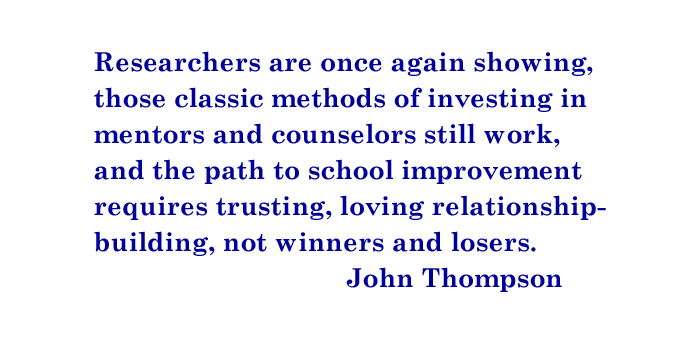
As Jack Jennings reminds us, the old-fashioned input-driven policies that preceded standards and testing were not perfect. The old progressive efforts to build student supports became underfunded, but they produced positive results that are greater than the expensive accountability-driven pedagogies that were supposedly more tough-minded. Now, as University of Chicago researchers are once again showing, those classic methods of investing in mentors and counselors still work, and the path to school improvement requires trusting, loving relationship-building, not winners and losers.
To further prepare students for a meaningful and healthy life, we must heed the findings of Don’t Quit on Me, by The Center for Promise at America’s Promise Alliance.  It begins with the seemingly unchallengeable As Graduation Rates Rise, a Call to Focus on Nurturing Students - Living in Dialogue:

Ed Dept. to Schools: You Must Teach All Students, Regardless Of Legal Status

Ed Dept. to Schools: You Must Teach All Students, Regardless Of Legal Status:

Ed Dept. to Schools: You Must Teach All Students, Regardless Of Legal Status

A new guide offers pointers on how to educate undocumented students.


The Edu­ca­tion De­part­ment just is­sued a subtle re­mind­er to edu­cat­ors across the coun­try: Re­gard­less of cit­izen­ship or im­mig­ra­tion status, all stu­dents are leg­ally en­titled to edu­ca­tion in the United States.
Aimed at high school and col­lege stu­dents as well as edu­cat­ors, a new guide lays out in­form­a­tion about de­ferred ac­tion for child­hood ar­rivals (DACA), which of­fers some young people a tem­por­ary re­prieve from de­port­a­tion and opens ac­cess to some jobs and schol­ar­ships. The guide also out­lines which states al­low un­doc­u­mented col­lege stu­dents to ap­ply for fin­an­cial aid.
Right now, 65,000 un­doc­u­mented stu­dents gradu­ate high school each year, but only about 54 per­cent of all un­doc­u­mented young people have a high school dip­loma, com­pared to 82 per­cent of those born in the United States. The Edu­ca­tion De­part­ment es­tim­ates that 5 to 10 per­cent of un­doc­u­mented high school gradu­ates en­roll in col­lege. A frac­tion gradu­ate.
“That’s tra­gic,” John King, who will be­come act­ing edu­ca­tion sec­ret­ary at the end of the year, told Next Amer­ica. “We’ve got to fix that.” He hopes that the guide will help stu­dents and clear up any “mis­con­cep­tions,” and en­cour­age teach­ers and coun­selors to edu­cate stu­dents and their fam­il­ies about DACA re­new­al and the col­lege ap­plic­a­tion pro­cess. Some school sys­tems, in­clud­ing the Hemp­stead Uni­on Free School Dis­trict, have been in­vest­ig­ated for fail­ing to ad­equately edu­cate un­doc­u­mented stu­dents.
While the guide lists private schol­ar­ships and states that give fin­an­cial aid to un­doc­u­mented stu­dents, im­mig­rant act­iv­ists have raised con­cerns that these stu­dents are not eli­gible to re­ceive fed­er­al fin­an­cial aid. A Lu­mina Found­a­tion re­port on the bar­ri­ers to high­er edu­ca­tion that un­doc­u­mented stu­dents face calls on the de­part­ment to waive the cit­izen­ship or per­man­ent res­id­ency re­quire­ment of Pell Grants through an Ex­per­i­ment­al Sites Ini­ti­at­ive. The na­tion’s High­er Edu­ca­tion Act al­lows the edu­ca­tion sec­ret­ary to waive some reg­u­la­tions to study their ef­fect­ive­ness, which Edu­ca­tion Sec­ret­ary Arne Duncan used re­cently to give some pris­on­ers ac­cess to Pell grants.
When asked wheth­er the de­part­ment will con­sider such ac­tion, King de­murred, say­ing, “We would love to see Con­gress move on this is­sue.” Pro­ponents of com­pre­hens­ive im­mig­ra­tion re­form have said they would like to see ac­cess to aid built in­to im­mig­ra­tion re­form, but the chances of a plan clear­ing Con­gress any­time soon are slim.
But Sarah Aude­lo, policy dir­ect­or for Gen­er­a­tion Pro­gress, the youth arm of the left-lean­ing Cen­ter for Amer­ic­an Pro­gress, thinks the guide comes at an im­port­ant time. As the pres­id­en­tial elec­tion ramps up, Aude­lo hears a lot of “hate-mon­ger­ing” to­ward im­mig­rants. Texas and Ari­zona are among states that have sought to roll back rights for un­doc­u­mented stu­dents in re­cent years. Like King, Aude­lo called on law­makers to do more to aid un­doc­u­mented stu­dents. The Cen­ter for Amer­ic­an Pro­gress put out a schol­ar­ship guide for un­doc­u­mented stu­dents. It is one of the most viewed pages, she said.
While this new guide is geared to­ward older stu­dents, the Edu­ca­tion De­part­ment will re­lease sim­il­ar guides fo­cused on ele­ment­ary and early-child­hood edu­ca­tion in the com­ing months. Ed Dept. to Schools: You Must Teach All Students, Regardless Of Legal Status:

Cartoons on School Boards, Superintendents, and Principals | Larry Cuban on School Reform and Classroom Practice

Cartoons on School Boards, Superintendents, and Principals | Larry Cuban on School Reform and Classroom Practice:

Cartoons on School Boards, Superintendents, and Principals


This monthly cartoon feature looks at those in authority in the 14,000-plus school districts in the U.S.  Cartoonists’ pens caricature those in positions of authority–a favorite among those who draw for a living–and reveal both the strengths and shortcomings of citizens and educators who serve the community’s children and adults. Enjoy!
'The superintendent is saving money by training driver's ed students in school buses.'

154374_600

5d2b3f6b20525fbc4f8ce994d73fd458

'The recurring poor enrollment prognostications plays havoc with our school district's budget. What will next year's enrolment be.'

mission-statement-chorus

'There's a meeting at school tonight, Dad. The superintendent, the principal, the school board, and you.'

Wrong School Policies

Wrong School Policies:

The Wrong School Policies for Hard Times

Wrong School Policies


hese are hard times in the USA. According to the latest report, 51% of jobs pay $30,000 a year or less. Homelessness is growing in most US cities and families are living doubled and tripled up all over the nation even though foreclosures have left millions of homes empty. Young couples find it hard to purchase a home and many older workers and senior citizens live in fear of losing theirs.
Young people are feeling the pinch. There is a heroin epidemic sweeping through small town and rural America and gang issues plague many urban areas. Gentrification has intensified racial profiling and police monitoring of low-income youth. For some young people—avoiding violence, whether in their homes or in the streets—is a daily challenge; for others, looking at what is happening to the adults around them, the future looks extremely grim.

In circumstances like these, where so many young people live with stress and danger and worry, you would think it would be national policy to make schools supportive and nurturing places.

In circumstances like these, where so many young people live with stress and danger and worry, you would think it would be national policy to make schools supportive and nurturing places.
There would be push for smaller class sizes, more counselors, and time for exercize, sports, and the arts.
Multiple paths to graduation would be developed and vocational and technical programs created for those who are not ready or able to go straight to college.
Teachers who love, comfort and inspire their students would be valued; and special incentives would be created to encourage teachers to stay in their jobs for a long time and teach in the communities where they live.
Instead, policymakers are doing the exact opposite. They are deluging schools with tests. They are raising class sizes and cutting sports and arts programs to make room for the testing and test prep they insist must be the core of the school experience. They are slashing vocational and technical programs, insisting all students master a common curriculum, raising graduation requirements—and in all too many schools, subjecting students to punitive discipline
And while all this is happening to students, they are using test-based evaluations and almost daily observations to force teachers to commit educational malpractice by neglecting relationship-Wrong School Policies: