Latest News and Comment from Education

Saturday, October 10, 2015

Jersey Jazzman: Chris Cerf Finally Sees The Light! Schools Need Adequate Funding

Jersey Jazzman: Chris Cerf Finally Sees The Light! Schools Need Adequate Funding:

Chris Cerf Finally Sees The Light! Schools Need Adequate Funding


It's taken years, but it appears that my most stubborn congregant, Chris Cerf, is finally starting to understand that money matters in education. Let me tell the tale of this poor sinner's ascent into grace:

All the way back in 2012, when Cerf was New Jersey's Education Commissioner, a big part of his job was to go around the state and defend Governor Chris Christie's cuts in state aid to schools:


The state’s top education official today defended the Christie administration’s proposed changes to the school funding formula, including a plan to spend less money on poor students.  
Testifying before the Senate Budget Committee in Trenton, acting Education Commissioner Christopher Cerf said adjusting the way public schools get state aid is good for students and will encourage teachers and administrators to boost student achievement. 
"We need to collectively get out of the box that says we can define success in education by how much we spend," Cerf said. "It’s not only how much we spend — the box we’ve been pushed into by the courts — it's about an integrated strategy of policy and funds."  
[...]
State Sen. Paul Sarlo (D-Bergen) questioned the logic of adjusting the funding before the state can fully fund the formula that was approved in 2008 by the Legislature and the state Supreme Court.  
"Is it prudent to be tinkering with this when we haven’t funded what we already found to be constitutional?" Sarlo asked.  
Cerf said the formula as it stands is "unfair" and "ill serves our children." 
State Sen. Teresa Ruiz (D-Essex), however, called the proposed changes unfair because they will "punish" the same districts,
- See more at: http://jerseyjazzman.blogspot.com/2015/10/chris-cerf-finally-see-light-schools.html#sthash.GEy62fTL.dpuf


Will Reformers Learn a Lesson From Newark? - Living in Dialogue

Will Reformers Learn a Lesson From Newark? - Living in Dialogue:

Will Reformers Learn a Lesson From Newark?


By John Thompson.
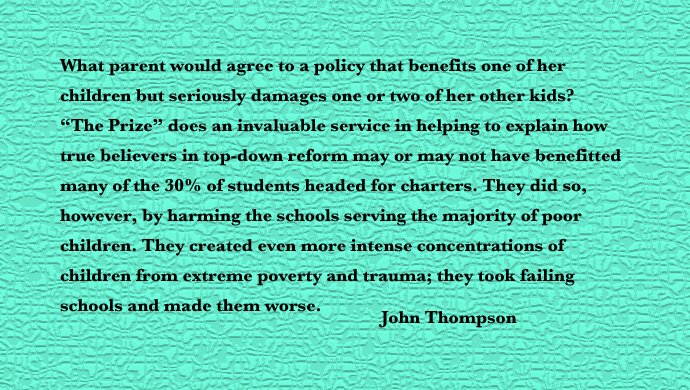
When Dale Russakoff conceived of The Prize, she “viewed education reform from a distance but as a movement full of promise.”  She was eager to follow the story of Mark Zuckerberg’s $100 million matching gift to the Newark schools.  The subtitle, “Who’s in Charge of America’s Schools?,” gets to Russakoff’s main point.
The best thing about The Prize is that it is an objective analysis of one of the nation’s most prominent corporate school reform failures. And, it comes at great time. Even after the repudiation of Michelle Rhee inWashington D.C and John Deasy in Los Angeles, edu-philanthropists in love with test, sort, reward, and punish plan to create so many charters in those two cities that it would leave the rest of their schools and unions in ruins.  Anyone who reads Russakoff’s balanced narrative about the way that Cory Booker, Chris Christie, Christopher Cerf, Cami Anderson and other corporate reformers squandered the $200 million fund that Zuckerberg made possible, will understand that the new assaults are the same as the old ones. They will cause more harm than good for students, and leave the teaching profession and their cities’ public education in tatters.
Mark Weber, The Jersey Jazzman,” criticizes the way that reviewers ranging from Conor Williams to Joe Nocera cite The Prize. But, Williams writes for The 74, which spins anything and everything as evidence that teachers unions must be destroyed. I’m more struck by Nocera’s New York Times review of Russakoff’s book. He doesn’t come completely over to the side of teachers who oppose market-driven, test-driven reform, but Nocera comes much closer with his critique of One Newark: 
It’s great for the 30 percent who are learning from charter school teachers. But as Russakoff puts it in the most poignant line in her book, “What would become of the children left behind in district schools?”
There is another way to approach reform, a way that includes collaboration with the teachers, instead of bullying them or insulting them. A way that involves the community rather than imposing top-down decisions. A way that allows for cross-pollination between charters and traditional public schools so that the best teaching practices become commonplace in both kinds of schools.
I no longer believe that cross-pollination between charters and neighborhood schools is likely. I also suspect that Russakoff (and Nocera) would not agree with my position on seniority – that we must mend it, but not end it. And some may believe she is too critical of collective bargaining contracts that defend the due Will Reformers Learn a Lesson From Newark? - Living in Dialogue:

This crocodile problem had Scottish maths students in tears

This crocodile problem had Scottish maths students in tears:

This crocodile math problem had Scottish students in tears

LONDON — How quick can a crocodile swim upstream to catch a zebra?
Very few of us will ever know the answer, it seems, as the maths problem was one of many that brought Scottish sixth-form students (ages 16-18) to tears and resulted in the pass mark being lowered for their Higher Maths exam in May.
The Scottish Qualifications Authority (SQA) said the problem was with the overall difficulty of the exam, not individual questions.
But the crocodile question has taken on a life of its own online as a symbol of just how hard that exam was. (Here's the entire exam.)


SQA


The question that brought students to tears.


If your head is spinning, here's how to solve it:

In May this year, the frazzled students who had to take the exam took to social media to say it was unjust. More than 14,000 people online signed two online petitions about the exam.
The pass mark for the exam — the level at which students could get a C — was lowered to 34%, compared with 45% the year before.
A former exam assessor told the BBC the SQA should have seen this coming, because the This crocodile problem had Scottish maths students in tears:

Common Core Has Not Created Consistent Testing Standards

Common Core Has Not Created Consistent Testing Standards:
Report: Common Core Has Not Created Consistent Testing Standards as Intended


The primary purpose of Common Core’s implementation throughout the U.S. was to create a standardized testing system across states to level education requirements, but The New York Times found that the new guidelines have done nothing to spur this anticipated consistency.
State officials in Ohio, for example, announced last month that two-thirds of students were proficient in reading and math, according to tests taken under Common Core standards. But in Illinois, despite students receiving similar scores, education officials said only about one-third were deemed proficient.
The discrepancy played out in Massachusetts as well, where about half of the students who took identical tests to those in Ohio were measured proficient.
The inconsistency was not because students were performing at vastly different levels among states, the Times reported, but was rather the result of states using different labels to define the same scores.
In California and North Carolina, for instance, state officials combined students who either passed or nearly passed the tests into the same category. In Florida, the Times continued, officials pushed for “less stringent” passing rates.
Initially, 46 states adopted the standards, but lawmakers in more than a dozen states have since moved to drop out of Common Core, while Indiana, Oklahoma, and South Carolina have repealed it fully.
The Times noted that fewer than half of the states that originally implemented the assessments are still using the same tests developed under Common Core, “making it difficult to equate results from different states.”
Lindsey Burke, a fellow in education policy at The Heritage Foundation, said that not only are states evaluating outcomes differently, but many are now deviating from Common Core standards to follow their own assessments.
“Proponents have long touted the ‘common’ in Common Core—that every child would be held to the same standard. But it appears the common is being lost as the real world implementation moves forward in some states,” Burke said.
This result, she continued, is the “folly” of believing that a single standard could be effective for all states and students.
“Now more than ever, states should exit the Common Core boondoggle and work to improve their own standards and assessments.”Common Core Has Not Created Consistent Testing Standards:

CURMUDGUCATION: Utah's Brave New Pre-K World

CURMUDGUCATION: Utah's Brave New Pre-K World:
Utah's Brave New Pre-K World


Utah has decided that pre-school can be delivered as a software package.

As reported Emma Brown in yesterday's Washington Post, the state has decided-- with the generous financial assistance of the federal government-- to try shrinking the entire pre-school experience into fifteen minutes a day of computer time. 

You get an idea of the kind of thinking involved here when you see the name-- Utah Preparing Students Today for a Rewarding Tomorrow! UPSTART!! In it, children will deal with a series of games, songs and lessons, aided by two cartoon raccoons named Rosy and Rusty (fun fact: Utah is one of the few states in the US where raccoons do not live).

Why has Utah decided to launch this brave new world in which fifteen minutes of computer-and-mouse-time (because if there's anything three- and four-year-olds are great at, it's operating a computer mouse)? Well, Utah is one of ten states that doesn't fund pre-school, and it is at the bottom of the barrel for per-student funding in K-12. So you could explain the appeal of this idea as the sponsor of the bill, State Senator Howard A. Stephenson,  does:

“We want to reach the greatest number of children with the resources that we have,” Stephenson said. “I don’t think we’re being cheap at all. We’re being smart.”

Or you might go with this theory:

“It’s wishful thinking by state legislatures,” said Steven Barnett, the director of the National ­Institute for Early Education ­Research at Rutgers University. “We want preschool, we want to get 
CURMUDGUCATION: Utah's Brave New Pre-K World:


LAUSD Rents Out Schools for Racy Entertainment | NBC Southern California

LAUSD Rents Out Schools for Racy Entertainment | NBC Southern California:

LAUSD Rents Out Schools for Racy Entertainment

NBC4 investigates how some raunchy jokes and sexy shoots are interfering with student learning


K-12 NEWS NETWORK'S THE WIRE: For Once, The Local Media Uncovers The LAUSD Wizard http://bit.ly/1RA2vm4


This is the first of two stories on the impact on Hollywood filming on Los Angeles public schools. The second story is available here.
UPDATE: LAUSD Superintendent Ramon Cortines Thursday suspended all commercial filming at LAUSD schools pending an examination of the policies, a day after the first part of this story aired.
Citing limited budgets and a need for additional funding, Los Angeles Unified public schools have embraced Hollywood dollars.
To those in the entertainment industry, LAUSD properties offer a premium convenience: beautiful elementary, middle and high school campuses that can be dressed up as any school in America, as they have for films like "Drillbit Taylor" and "Mother's Day".
But after six months fighting for access to public records, reviewing thousands of pages of emails, permits and receipts from LA public schools, NBC4 has learned the millions of production-company dollars made each year by California's largest public school district may come at the cost of education.

Documents we obtained indicate school officials operating without much oversight into the type of content allowed on campus — or the interruptions to teachers and students.
Superintendent Ramon Cortines refused to interview with NBC4 on the topic, and later told investigative reporter Jenna Susko that is because the district's Office of Inspector General is now investigating. The district would not confirm whether any investigation was taking place at this time.
Raunchy jokes laced with obscenities from films such as "Bad Teacher" and television series such as HBO's "Shameless" are common at LA public schools. Records show much of the edgy content found on premium-cable shows such as HBO's "Big Love" and Showtime's "Masters of Sex" is filmed at schools.
And schools also rent to music video production crews, like the one that produced YouTube personality Trisha Paytas' "Hot for Teacher" video, which suggests a teacher having sex with a student in a bathroom stall, and a hit single "Break the Rules" from breakout singer CharliXCX, which glorifies "getting high and getting wrecked."
At Hollywood High School, the cast members of Glee posed for racy pictures, dressed as underage students, in the school's locker room.
The R-rated "Bad Teacher", which starred Cameron Diaz, Justin Timberlake and Jason Segal, filmed numerous scenes at two LAUSD middle schools, a scene depicting marijuana use on the drug-free campus and Diaz performing a LAUSD Rents Out Schools for Racy Entertainment | NBC Southern California:

Parents can’t opt out of Common Core testing, AG says | Arizona Capitol Times

Parents can’t opt out of Common Core testing, AG says | Arizona Capitol Times:

Parents can’t opt out of Common Core testing, AG says


Parents of students in public schools have no legal right to withdraw their children or opt out of statewide standardized tests, Attorney General Mark Brnovich concluded today.
In a formal opinion, Brnovich acknowledged that state law does permit parents to exempt their children from certain learning materials and activities they find objectionable. That even includes keeping them out of a class or lesson where the material is being used or discussed.
But Brnovich, in response to a question raised by state schools chief Diane Douglas, said standardized tests are “separate and distinct” from such materials or activities. And he said nothing in the exemption law specifically includes a right to withdraw from standardized tests.
The attorney general also rejected Douglas’ suggestion that parents gained new rights in 2010 when the Legislature passed a “Parents Bill of Rights.”
That law, he said details the obligation of local school boards to ensure they inform parents about their rights to opt out of certain assignments. It also includes the ability to refuse to have children immunized and the right not to have children taught about AIDS.
But nowhere in that law, Brnovich said, did lawmakers include testing.
“The Legislature’s failure to include such a right is especially telling because the statute specifically mentions the ‘right to review test results’ and the `right to receive a school report card,’” he wrote.
Yet Brnovich pointed out that, even in amending the law in 2010, the Legislature did not see fit to include opting out of testing in that list. And he said that when lawmakers make an extensive list like this, it is presumed they know what is not on it.
Brnovich said parents do have the right to direct the education of their children.
He said, though, that involves whether to send a child to a public district or charter school, a private or parochial school, or to choose to school a child at home.
“It does not allow a parent who sends a child to a public school to prescribe the details of that child’s education,” Brnovich wrote.
The formal opinions of a state attorney general of the meaning of a state law are not the same as a court ruling. But they can be cited by parties who argue a case and provide a legal defense to schools that follow the ruling.


Read more: http://azcapitoltimes.com/news/2015/10/09/parents-cant-opt-out-of-common-core-testing-ag-says/#ixzz3oB8BtRIT


Teach For America co-CEO Matt Kramer has announced that he is ‘stepping down.’ | Gary Rubinstein's Blog

CEO Ya! | Gary Rubinstein's Blog:

CEO Ya!


Teach For America co-CEO Matt Kramer has announced that he is ‘stepping down.’  His partner in crime, Elisa Villanueva-Beard, will be promoted to sole CEO.  I expected some kind of top-level shakeup and predicted six months ago that one of them was on the way out.
When Wendy Kopp resigned and they took over in March of 2013, TFA’s stock was at an all time high.  There were over 6,000 new corps members, TFA alumni like Michelle Rhee, Kevin Huffman, and Cami Anderson were shaking things up at StudentsFirst, Tennessee, and Newark.  Like a giant ship with a lot of momentum, it seemed like it didn’t matter who was steering it — just keep your foot on the gas (not sure that ships have gas pedals, but surely they have something that serves that purpose) and don’t make any sudden movements with the steering wheel.
I found the co-CEO arrangement very odd.  For a company bringing in over $300 million a year, the person, or people, in charge need to relocate to the city of the home office, in this case New York City.  Yet Kramer remained in Minnesota and Villanueva-Beard remained in Texas.  Whereas Wendy Kopp made around $400 thousand as the sole CEO, Kramer and Villanueva-Beard made, combined, over $700 thousand as co-CEOs.
I started monitoring their activity right after their appointment.  I then met up with them on their ‘Listening Tour’ and gave them a piece of my mind (Don’t worry, I had plenty to spare).  Kramer was much more friendly to me than Villanueva-Beard was.  He told me that he liked reading this blog, which I appreciated.  Then over the next year and a half I really didn’t see much substance in either of them in their public appearances.
I didn’t expect much from Kramer.  He’s never taught.  The only time he ever sees a school is when he is some kind of honored guest where the kids are on their best behavior (the CEO Ya! | Gary Rubinstein's Blog:


New Mexico’s Teacher Evaluation Lawsuit: Final Day Five | VAMboozled!

New Mexico’s Teacher Evaluation Lawsuit: Final Day Five | VAMboozled!:

New Mexico’s Teacher Evaluation Lawsuit: Final Day Five


VAMboozled!


The final day in the New Mexico’s Teacher Evaluation Lawsuit in Santa Fe was this past Thursday, October 8th. Unfortunately I could not attend day five (or day four) due to a prior travel engagement, but here are two articles that highlight the events of the final day (for now) in court.
The first comes from The Santa Fe New Mexican. This article captures some of the closing arguments on the plaintiffs’ side, primarily in terms of (1) the state model “incorrectly rating nearly 10 percent of the state’s 20,000 teachers,” (2) the state using flawed data, leading to incorrect results, and (3) attempts to convince Judge Thompson tosuspend the provision that these teachers — who purportedly post low value-added scores — be put on “growth plans” that lead to termination. As per one of the plaintiffs’ two lawyers: “The mere issue of a notice that you are minimally effective or ineffective puts each district in a position where they can terminate these employees…These are the [high-stakes consequences and] provisions that need to be removed” from New Mexico’s teacher evaluation model.
The main attorney on the defendant’s side avoided talking about #1 and #2 above, and instead focused on #3, “that no teacher had reported losing a job, license or promotion as a result of the teacher evaluations”…yet. In other words, so the defense argued, the system in New Mexico has not (yet) caused “irreparable harm,” although how one defines that is certainly also up for debate (e.g., good teachers leaving teaching because of the system in and of itself might be considered “irreparable harm”).
This defendant’s attorney also focused on what it might mean for the state of New Mexico to lose its No Child Left Behind (NCLB) waiver, which by federal mandate requires New Mexico (and all other states) to have a teacher evaluation system in place as based on student test scores. However, the defendant’s key witness on this topic – Matthew Montaño, Educator Quality Division, New Mexico Public Education Department (PED) – evidently overstated claims about these purported threats while on the stand, after which New Mexico’s Teacher Evaluation Lawsuit: Final Day Five | VAMboozled!:

Education: Too much, too soon? (Opinion) - CNN.com

Education: Too much, too soon? (Opinion) - CNN.com:

Are we hurting kids at school?


Susan Ochshorn is the author of "Squandering America's Future: Why ECE Policy Matters for Equality, Our Economy, and Our Children." The views expressed are her own.
(CNN)This fall, some 65,000 4-year-olds, backpacks hanging from their tiny frames, converged on the nation's largest public school district.
In just a year, New York City had nearly tripled its number of full-day prekindergarten slots. And before they entered their classrooms, Mayor Bill de Blasio crowed about his signature initiative -- a key part of a campaign promise to fight inequality, but a goal that has had more than its share of skeptics.
    I'm not one them.
    Universal prekindergarten is essential to developing America's human capital. True, preschool isn't enough -- it's not a silver bullet for inequality, and we need to start earlier, with better care of infants and toddlers. Still, it's a critical piece of the enterprise, especially when you consider that the United States stands in the lower half of the Economist Intelligence Unit index for provision of preschool across 45 countries. Indeed, nearly 6 in 10 children are not enrolled in preschool in the United States, while the highest quality programs are off limits to many.
    Sadly, early education is perennially on the chopping block, a casualty of Washington's gridlock and polarization. But one of de Blasio's comments didn't sit right with me: The city, he said, was planning to use the Common Core curriculum in prekindergarten. A child who's had the benefit of a full day of rigor, he assured us, would be imbued with a great love of learning.
    Rigor for 4-year-olds? What about their social-emotional development, which goes hand-in-hand with cognitive skill-building? What about play, the primary engine of human development?
    Unfortunately, it seems like we're subjecting our young children to a misguided experiment.
    "Too many educators are introducing inappropriate teaching methods into the youngest grades at the expense of active engagement with hands-on experiences and relationships," Beverly Falk, author of Defending Childhood told me. "Research tells us that this is the way young children construct understandings, make sense of the world, and develop their interests and desire to learn." She isn't alone.
    Early academic training has become an obsession among child development experts and teachers of young children as the Common Core standards have encroached upon the earliest years of schooling.
    Kindergarten has already undergone a radical transformation. University of Virginia researchers Daphna Bassok and Anna Rorem found that in 2006, 65% of kindergarten teachers -- more than double the number in 1998 -- thought most children should learn to read on their watch. Meanwhile, the exposure to social studies, science, music, and art -- the staples of a well-rounded early childhood education -- had declined. And nearly 20% of teachers never had physical education.
    All these trends have accelerated rapidly with recent education reform policies, including Race to the Education: Too much, too soon? (Opinion) - CNN.com:

    A New Report Gives a Discouraging Portrait of America's Urban Public School System - CityLab

    A New Report Gives a Discouraging Portrait of America's Urban Public School System - CityLab:

    A Discouraging Portrait of America's Urban Public Schools

    The report card for public and charter schools in 50 U.S. cities shows room for improvement.


    Researchers have examined the inequities between city schools districts and also evaluated the performance of urban charter schools. What they haven’t been able to do is a take a comprehensive city-by-city look at public and charter schools together—until now.
    “If you're a city leader—a mayor or some other community leader—it's hard to gauge the overall health of the city schools. That can make it hard to frame where the city's doing well, and where it needs to do better,” says Michael DeArmond, senior analyst at the University of Washington’s Center on Reinventing Public Education, and lead author of CRPE’s new study that seeks to plug this hole in education data.
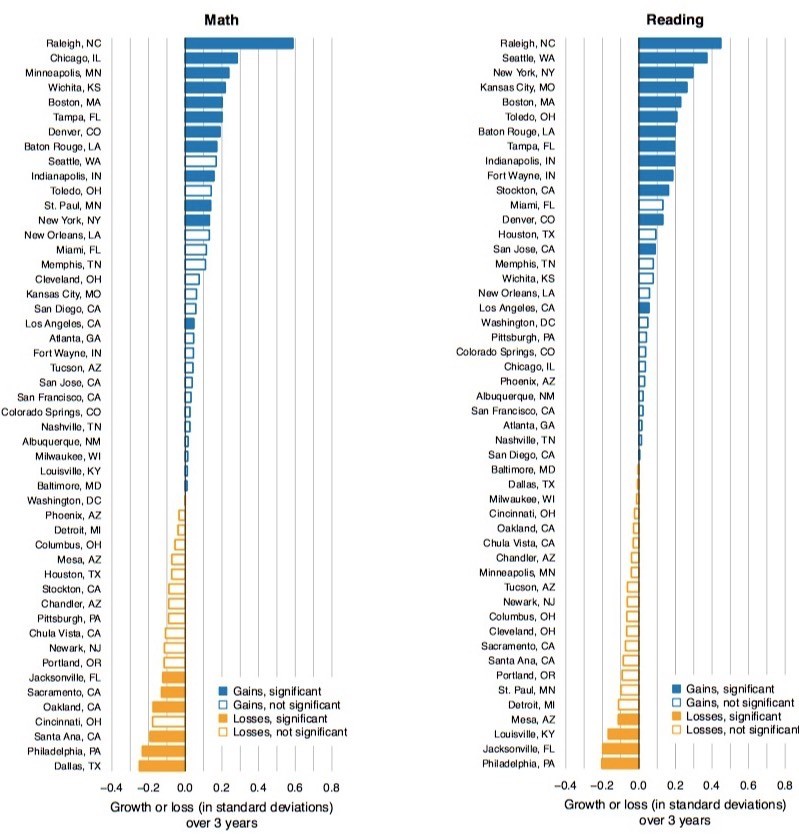
    In the report, DeArmond and his colleagues analyzed recent federal and state data on public and charter schools in the 50 cities with the highest school enrollment. Their measures included test scores, graduation rates, and even suspension rates for students by race. The resulting portrait of the city public school system in the U.S. is “discouraging,” DeArmond says.
    CPRE summarizes the findings on its site:
    Our analysis shows some brights spots, but performance in most cities is flat. Poor and minority students face staggering inequities, and the picture is especially bleak for black students.

    Most city public schools aren’t improving

    Across all 50 cities, the average graduation rate was around 75 percent. This varied widely from one city to another. While Toledo, Ohio, saw just slightly over half of their public school students graduate, Fort Wayne, Indiana, reached a 90 percent graduation rate.
    In terms of testing, less than a third of the cities analyzed in the report improved their math and reading scores relative to the state average. Only 12 cities saw gains in math scores (below, left) while 14 saw improvements in reading (below, right):A New Report Gives a Discouraging Portrait of America's Urban Public School System - CityLab:

    American schools are modeled after factories and treat students like widgets. Right? Wrong. - The Washington Post

    American schools are modeled after factories and treat students like widgets. Right? Wrong. - The Washington Post:

    American schools are modeled after factories and treat students like widgets. Right? Wrong.


    A worker prepares assembled stand mixers for packaging on the production line at the Whirlpool Corp. KitchenAid manufacturing facility in Greenville, Ohio, U.S., on Thursday, Sept. 24, 2015. (Luke Sharrett/Bloomberg)


    How many times have you heard that public schools in the United States were modeled in the 20th Century on factories and have yet to be restructured to meet 21st Century needs? A lot, I’d bet. But what if that isn’t true? In this post, education historian Jack Schneider looks at the truth behind the “factory model” theory and whether school design is really the cause of student disengagement and inadequate learning. Schneider is an assistant professor of education at the College of the Holy Cross and the author of “Excellence For All: How a New Breed of Reformers Is Transforming America’s Public Schools” and “From the Ivory Tower to the Schoolhouse: How Scholarship Becomes Common Knowledge in Education.” Follow him on Twitter @Edu_Historian.

    By Jack Schneider
    American schools were modeled after factories. And they treat students like widgets. As a consequence, learning is often irrelevant to young people—failing to target their interests or to recognize their unique needs.
    The claim has been repeated so often—by entrepreneurs, by policy wonks, by the secretary of education—that it has achieved a kind of truth status. And increasingly, it’s a rallying cry for reform. Our schools need reinvention,reformers assert. If we want to promote real learning, we need to tear down the factory and rebuild around technologies of the Information Age.
    It’s the stuff of great TED talks. It just happens to be wrong.
    Now, reformers aren’t wrong that school all too often feels irrelevant to young people. Students are regularly bored and disengaged in the classroom. They memorize meaningless minutia that makes only a shallow imprint on their brains. And they rarely have the opportunity to pursue their passions.
    But that isn’t because of a “factory model.”
    To start with, American schools were not actually modeled after factories. That’s an invented history full of errors and omissions. It illustrates very little knowledge of how actual factories operated. And it happens to totally American schools are modeled after factories and treat students like widgets. Right? Wrong. - The Washington Post:

    Teachers union changes stance in eval suit | Albuquerque Journal News

    Teachers union changes stance in eval suit | Albuquerque Journal News:

    Teachers union changes stance in eval suit


    The head of the American Federation of Teachers-New Mexico acknowledged that her union has changed its approach on the injunction it is seeking against teacher evaluations but denied that they have reduced their demands.
    Stephanie Ly, president of AFT-New Mexico, said the organization is seeking a stop to growth plans put in place for teachers who receive “minimally effective” and “ineffective” ratings on evaluations – not the entire “value-added” teacher evaluation system, which they targeted when the injunction hearing began in September.
    The union contends that the growth plans are a step toward possible termination and also disrupt teachers’ progress through licensure.
    The New Mexico Public Education Department’s witnesses disputed that stance during the hearing, which wrapped up Thursday in 1st Judicial District Court after five days of testimony.
    AFT-New Mexico and the Albuquerque Teachers Federation have filed a lawsuit against PED over “value-added” teacher evaluations, a system that uses student achievement on standardized tests as 50 percent of the score. A trial is scheduled for April.
    In an emailed statement, PED spokesman Robert McEntyre said that the unions have “realized there’s no evidence to justify an injunction and have significantly retreated.”
    “Sadly, the union’s ‘Plan B’ is to have the court prohibit schools from implementing professional development plans for struggling teachers, which makes no sense and wouldn’t benefit our teachers or students,” he wrote.
    Ly said that AFT made the change on the injunction because PED’s legal counsel brought up possible risk to New Mexico’s waiver on certain No Child Left Behind provisions if the state drops its “value-added” system. Washington lost its waiver after failing to set up a teacher evaluation process that meets U.S. Department of Education standards.
    Ly said the union disagrees with PED’s stance on the loss of the waiver but doesn’t want any questions about NCLB to impact the injunction.
    Other states have similarly stopped tying negative consequences to teacher evaluations without violating the waiver’s requirements, she said.
    The union president stressed that AFT is still targeting the aspects of evaluations that have the potential to harm teachers.
    “It is not a reduction (of demands),” Ly said. “We heard that they (PED) are concerned about the Teachers union changes stance in eval suit | Albuquerque Journal News:

    Expert: Common Core flawed in trying to standardize children

    Expert: Common Core flawed in trying to standardize children:

    Expert: Common Core flawed in trying to standardize children


    LAKE GEORGE  Common Core is not developmentally appropriate for students and was pushed down the throats of educators without teacher input, says a veteran educator who now speaks out against it.
    “This was not led by the states. It was fed to the states,” said Peg Luksik, chairwoman of Founded on Truth, an organization speaking against the learning standards.
    Luksik, a 35-year elementary and special education teacher from Pennsylvania now living in Virginia, was invited to speak by New Yorkers United for Kids, a group opposing Common Core.
    About 40 people attended the event held Thursday at Lake George Town Hall.
    Luksik was an adviser to President Ronald Reagan and worked in the U.S. Department of Education reviewing curriculum. She explained that although the Constitution does not say anything about the federal government having a role in education, presidential administrations from Lyndon Johnson through Barack Obama have attempted various reforms.
    Starting with President George W. Bush’s No Child Left Behind law, education shifted to standards-based reforms. The goal was that every child in America was going to be 100 percent proficient.
    Luksik said that was unrealistic. It is like saying that every third-grader will weigh 90 pounds and be 4 foot 1 inches tall, she said.
    “Your ability to learn is as unique as your height and weight. Developmentally, you can’t mandate how you learn. That’s what this did,” she said.

    State inequities

    Another major problem is that the states could develop their own assessments and set the bar for passing the tests where they wanted. She said states, by and large, set low passing marks so they could show proficiency.
    Not one single state set their passing marks to align with the standard set by the National Assessment of Educational Progress, Luksik added, which is a different test that students take and considered a top standard.
    Despite statistics saying they were passing, students were not ready for college-level work, according to Luksik. Many students had to take remedial classes that don’t earn them credit.
    There was a push by education reformers to create a new curriculum. The Bill & Melinda Gates Foundation gave large sums of money to educational groups for this project. The National Governors Association and the Council of Chief State School Officers picked up on the idea and wanted to create a set of common standards, which came to be known as “Common Core.”
    “We don’t know who did what inside that work group. Everything to date remain shrouded in Expert: Common Core flawed in trying to standardize children: