Latest News and Comment from Education

Sunday, October 4, 2015

The tenure of Education Secretary Arne Duncan — in his own sometimes startling words - The Washington Post

The tenure of Education Secretary Arne Duncan — in his own sometimes startling words - The Washington Post:
The tenure of Education Secretary Arne Duncan — in his own sometimes startling words


Education Secretary Arne Duncan, who took office in 2009, is stepping down in December as the most powerful federal education chief in the department’s history. He involved the federal government in areas that traditionally had been left to states — such as teacher evaluation systems and standards — in a controversial tenure that has prompted Congress to consider legislation that would reduce the federal role in public education.
Here are a few of the sometimes startling things that he has said over the years that, when looked at together, reveal his reform mind-set — and something about his reaction to his critics, many of whom had hoped that the Obama administration would focus federal education policy on issues such as inequitable school funding and support services for children who live in poverty.
And so we have to stop lying to children. We have to tell them the truth. We have to be transparent about our data. We have to raise the bar so that every child knows on every step of their educational trajectory what they’re going to do.
In this May 29, 2009, speech at the National Press Club, Duncan sets himself and his Education Department as the truth-tellers in education. Here he is is talking about how states have set low bars for students to pass, and he is encouraging them to adopt — or congratulating them for adopting — the Common Core State Standards. These are standards in math and English Language Arts that were, by 2013, approved in full by 45 states and the District of Columbia in what Duncan said was an effort to raise standards and allow legitimate comparisons of student test scores across states. The initial bipartisan support of the Core was a big triumph for Duncan, but as questions were raised about who wrote and funded them, as well as the content of some of the standards, Duncan found himself on the defensive, with some states dropping them or re-branding them.
Duncan’s “we have to stop lying” phrase became something of a mantra. He repeated it, or some version of it, frequently:
February 2010 to the National Governors Association: “We have to stop lying to children. We have to look them in the eye and tell them the truth at every stage of their educational trajectory.”
March 2010 to the National League of Cities’ Congressional City Conference:“We simply have to stop dummying-down standards due to political pressures. We have to stop lying to children and families by giving them a low bar and telling them that they will be okay, when we know they are not adequately prepared to go on to college or a job.”
August 2010 in Little Rock:  “I congratulate your state, Arkansas, on taking this bold step for your students last month. These higher standards are an absolute game-changer — as a country we will finally stop dummying-down standards, and stop lying to our children and their families.”

Let's Play CharterLand! | The Range: The Tucson Weekly's Daily Dispatch | Tucson Weekly

Let's Play CharterLand! | The Range: The Tucson Weekly's Daily Dispatch | Tucson Weekly:
Let's Play CharterLand!


How do "open enrollment" charter schools end up with selective student bodies? Watch the CharterLand video and find out. (You can download the game board here.)

Let's Play CharterLand! | The Range: The Tucson Weekly's Daily Dispatch | Tucson Weekly:


What 5-Year-Olds are Doing Overseas While Kindergartners in America Struggle with Common Core

What 5-Year-Olds are Doing Overseas While Kindergartners in America Struggle with Common Core:
What 5-Year-Olds are Doing Overseas While Kindergartners in America Struggle with Common Core
Kindergartners in Finland don’t have to worry about learning complexCommon Core math problems like this:

Embedded image permalink

Instead, they get to “play” much of the day. Tim Walker, an American educator who has been teaching fifth and sixth graders in Finland for the last few years recently wrote in The Atlantic that:
Approaching the school’s playground that morning, I watched as an army of 5- and 6-year-old boys patrolled a zigzagging stream behind Niirala Preschool in the city of Kuopio, unfazed by the warm August drizzle. When I clumsily unhinged the steel gate to the school’s playground, the young children didn’t even lift their eyes from the ground; they just kept dragging and pushing their tiny shovels through the mud.
At 9:30 a.m., the boys were called to line up for a daily activity called Morning Circle. (The girls were already inside—having chosen to play boardgames indoors.) They trudged across the yard in their rubber boots, pleading with their teachers to play longer—even though they had already been outside for an hour. As they stood in file, I asked them to describe what they’d been doing on the playground.
“Making dams,” sang a chorus of three boys.
“Nothing else?” one of their teachers prodded.
“Nothing else,” they confirmed.
“[Children] learn so well through play,” Anni-Kaisa Osei Ntiamoah, one of the preschool’s ‘kindergarten’ teachers, who’s in her seventh year in the classroom, told me. “They don’t even realize that they are learning because they’re so interested [in what they’re doing].”
According to the article, most Finnish children start “preschool” when they are six years old. NPR notes that all preschool teachers have bachelor’s degrees, and because it is paid for by taxpayer money, 97% of eligible kids end up attending some form of preschool.
Osei Ntiamoah added that the interaction allows the students to develop their language, math and social-interaction skills.
A recent research study commissioned by the Minnesota Children’s Museum supports her findings. Dr. Rachel E. White, who managed the study for the museum, wrote:
“In the short and long term, play benefits cognitive, social, emotional, and physical development … When play is fun and child-directed, children are motivated to engage in opportunities to learn.”
Osei Ntiamoah’s colleagues also share her sentiments toward playtime. Added Maarit Reinnikka, the school’s director:
“It’s not a natural way for a child to learn when the teacher says, ‘Take this pencil and sit still’.”
Another major difference between Finnish and Americans schools is that Finnish teachers work from a weekly schedule that only includes a few major activities a day, rather than a daily itinerary broken down into regularly-scheduled periods like most American educators do.
Walker noted that the itinerary he was shown, for example, had the What 5-Year-Olds are Doing Overseas While Kindergartners in America Struggle with Common Core:

Time to throw out Bush-era education reforms | Tampa Bay Times

Romano: Time to throw out Bush-era education reforms | Tampa Bay Times:

Romano: Time to throw out Bush-era education reforms


For the longest time, it seemed educational reformers could do no wrong. They had the theories, they had the platform and, most importantly, they had the power.


So George W. Bush's Texas Miracle begat the nation's No Child Left Behind law, which was around the same time Jeb Bush's accountability crusade took hold in Florida.
They were our models for education. They were going to revolutionize schools and rescue generations of students from despair.
And yet today, they are being attacked from all sides.
The U.S. Senate and House have passed separate bills that would revamp the No Child Left Behind law and return more authority to local school districts.
Around here, the state School Board Association on Thursday called Florida's accountability system broken. That came a few days after the Florida PTA called the system a mess. And that came a few days after the Florida Association of District School Superintendents announced it had lost confidence in the system.
So is it time to finally admit the Bush-era reforms have failed?
The answer is yes, but with a caveat.
The big-picture philosophy behind some of these reforms is sound. Some level of accountability — for everyone involved — is necessary. Standardized tests and a comparable curriculum can also help make sure students across the nation are learning similar things.
The problem, particularly in Florida, is lawmakers took reforms to an absurd extreme. They turned accountability into a weapon, and that turned schools into sweatshops.
The Legislature heaped so much responsibility on a handful of tests that teachers feared for their jobs, districts worried about funding and everything else became an afterthought.
Senate Education Committee Chairman John Legg, R-Trinity, acknowledges missteps along the way, but says the Legislature has corrected many of the problems in the past two years.
What lawmakers have not corrected is their perception problem.
Leaders in Tallahassee have zealously protected the Bush legacy for far too long. They have been slow to listen to parents and educators, and even slower to compromise.
So when Department of Education Commissioner Pam Stewart tried to justify a mistake-riddled launch to a new state assessment this year, no one wanted to listen.
Instead, it seems the tide of unrest has finally reached local shores.
Where critics once seemed to be on the fringe, they are now showing up in greater numbers and in more Romano: Time to throw out Bush-era education reforms | Tampa Bay Times:

Diploma Options for Students with Developmental Disabilities | The Opt Out Florida Network

Diploma Options for Students with Developmental Disabilities | The Opt Out Florida Network:

Diploma Options for Students with Developmental Disabilities


IF YOUR HIGH SCHOOL STUDENT HAS DEVELOPMENTAL DISABILITIES…
Senator Darren Soto would like to hear from YOU.
Senate Bill 1512, sponsored by Senators Stargel, Thrasher, Gardiner and Galvano, became the law in 2014, eliminating the option for students with intellectual disabilities, who cannot pass the FSA to obtain a ‘special diploma’. Curricula have been changed so that students with documented disabilities must now take the same subjects and lessons and in the same time frames to learn as mainstream students at the same grade level. There are also multiple changes due to the academic requirements.
Most high school seniors, who were enrolled in the special diploma option since the 10th grade, will likely not earn a diploma this year.  Current sophomores and juniors, who were also enrolled in a special diploma program, have had these options taken away from them as well.
Students no longer have the option to earn a special diploma and are now forced to earn a standard diploma, which many may not have the potential to complete… Parents, students, and educators must be made aware of what this Standard Diploma means and what outcomes they can expect.
The Standard Diploma Option for Students with Disabilities Pathway was originally intended to provide students with the most significant intellectual and developmental disabilities an employment competency pathway for accessing a Standard Diploma. However, initial discussions regarding implementation include not permitting a modified curriculum and requiring a level of paid employment that Diploma Options for Students with Developmental Disabilities | The Opt Out Florida Network:

“It was truly what democracy looks like.” | Intercepts

“It was truly what democracy looks like.” | Intercepts:
“It was truly what democracy looks like.”

That’s what NEA president Lily Eskelsen Garcia told members about the endorsement of Hillary Clinton by the union’s board of directors. And there’s no question the prescribed democratic process in the union’s by-laws was followed. The board reportedly voted 118-39 in favor of the endorsement, with 8 abstentions, clearing the required 58 percent hurdle.
Sanders supporters are complaining that NEA should have gone to the members before endorsing. But NEA has never gone to the members for anything. It operates solely on representation. And in the union’s defense, there is no empirical reason to believe that had it polled every one of its 3 million members the result would have turned out differently.
It is also true that 99 times out of 100 there would be no discernible difference between the majority opinion of the board of directors and the majority opinion of the 7,000-member Representative Assembly.
Oh, but there is that one time out of 100. And if a board of directors vote truly represented democracy in NEA, there would have been no board of directors meeting this weekend, because the board of directors would have disbanded 17 years ago.
You see, back in May 1998 the NEA board of directors voted on the Principles of Unity, which would have merged NEA and AFT at the national level. The new organization would have had a 37-member executive board, similar to the structure of AFT, and a 400-member “leadership council,” which was to meet only three times a year and had little policy power.
Despite the fact that they were voting to eliminate their positions, the directors approved the plan by a vote of 106-53.
Two months later, however, the Representative Assembly had its say, and handily defeated the Principles of Unity in a secret ballot vote – 4,091 in favor, 5,624 against.
What democracy looks like changes as you alter your viewing angle. Getting the result you want isn’t the indicator that it’s working.“It was truly what democracy looks like.” | Intercepts:

CURMUDGUCATION: Driven By Parent Choice

CURMUDGUCATION: Driven By Parent Choice:
Driven By Parent Choice


That's the dream for some reformsters-- a school system that is driven not by regulation or government edict and certainly not by the professional educators who work there, but a system that is driven by parent choice.

I believe there are probably idealistic purists among the visionaries who really do believe that we'd have a system where parents peruse sets of pure and transparent data and then make informed choices based on that data, allowing schools to compete and improve by responding to how their data plays out in the marketplace. These purists are sweet, like delightful five year olds who still wait breathlessly for Christmas morning and the proof of Santa's arrival.

But there are also advocates of choice who are less idealistic and less pure. They understand what having a system "driven by parent choice" really means. I'll give you a hint-- it doesn't mean a system driven by parent choice.

Idealists talk about parent choice as if it occurs in some sort of iron-clad vacuum, influenced by nothing by clean data and clear thinking.

That's silly. Parent choice is malleable, shapeable, bendable, and open to influence. Yes, technically, in a choice system, the ultimate decision is theoretically made by parent choice. But that parent choice does not begin and end with parents-- it is molded and directed by a hundred other forces.

Purists imagine parents poring over spreadsheets, consuming mounds of impartial school information 
CURMUDGUCATION: Driven By Parent Choice:


ICYMI: This Week's Edubloggery Sampler


Well, this has been a week. I will leave you to find your own pieces about John King failing upward and the NEA deciding to shove a Hillary recommendation down membership's throat. In fact, maybe you'll enjoy some reading to take your mind off all of that.

Highlighting Websites and Blogs
Nancy Bailey offers a great, mostly-organized list of some of the folks writing about the Great Public Education Debate. I include this not because she says nice things about me, but because it's always good to expand your reading horizons

Does Subject Matter Knowledge Matter As Much As We Think?
A look at some research about what has impact in the classroom. The most powerful part is seeing what does have an impact

A Charter Place Parable
Short and sweet tale of why charters are a bad idea, from the superintendent of Chapel Hill schools (so you really might have missed it)

AP Classes Are a Scam
This article from the Atlantic is actually three years old, but it's still worth a read now that the PSAT is more directly set up as a marketing tool for AP courses.

A Look Back at DeVos
Links to three videos of reformsters gabillionaire Richard DeVos talking about how public education needs to be the next frontier of trashing democracy for fun and profit. Oh, and the videos go back to 2002.

The Reformy Arguments Are Getting Worserer
This week the Jazzman got himself into an argument with one of the crack writers over at Education Post. This is the final piece of the series-- you can backtrack if you like, but this captures the Jazzman at his fact-wielding best.

Class Is In Session With Jose Luis Vilson
Vilson was profiled this week, and actually, sadly, it would be notable enough that any publication decided to profile an actual working teacher, Vilson is also an accomplished author and activist, so this profile is doubly rewarding. Lift yourself up by reading about one of the good guys who is actually making his voice heard from inside the profession.

Principal Eric Guthertz of Mission High School in San Francisco (Kristina Rizga) | Larry Cuban on School Reform and Classroom Practice

Principal Eric Guthertz of Mission High School in San Francisco (Kristina Rizga) | Larry Cuban on School Reform and Classroom Practice:

Principal Eric Guthertz of Mission High School in San Francisco (Kristina Rizga)


This is the fourth and final excerpt taken from Kristina Rizga’s new book Mission High. With her permission I have published descriptions of math, English,  and history lessons. In this post, Rizga describes the principal of the school. Mission High School has 950 students with the vast majority coming from Latino, African American, and Asian American families. Seventy-five percent are poor and 38 percent are English Language Learners.

As the head of a school at which students carry passports from more than forty countries, Eric Guthertz probably has one of the most multicultural closets of any principal in the nation. Dressed in his usual getup this morning—slim-fitted, button-down shirt, dark grey slacks, and a large, black walkie-talkie pinned on his belt—Guthertz shows off dozens of his favorite clothing items that he wears throughout the year for various cultural events. Hanging on the wall in his office that doubles as a closet, there are several guayaberas—formal men’s shirts worn in Mexico, Central America, and the Caribbean—which he wears to the students’ Latino Club celebrations. There is a traditional Moroccan cream-colored shirt with black buttons that a student from Morocco gave him. The Black Student Union gave him a traditional kufi hat and scarf from West Africa. His favorite piece is a dark navy, three-piece suit that students from the Chinese Club gave him five years ago.
In Guthertz’s universe, hustling to find funding to keep Mission’s cultural clubs and events alive is as important as improving test scores. As an educator with twenty-seven years of experience in inner-city schools, Guthertz is convinced that multicultural and student-run clubs, after-school programs, and extracurricular Principal Eric Guthertz of Mission High School in San Francisco (Kristina Rizga) | Larry Cuban on School Reform and Classroom Practice:

Let us all conduct a little experiment about Pre-K education | @ THE CHALKFACE

Let us all conduct a little experiment about Pre-K education | @ THE CHALKFACE:

Let us all conduct a little experiment about Pre-K education


“Money doesn’t guarantee good outcomes, but it helps,” they say.
Even as more 4-year-olds attend pre-K, many states are delivering it on the cheap. While Boston spends $10,000 for each preschooler, in 2014 the average expenditure, nationwide, was $4,125. That’s $1,000 less (adjusted for inflation) than the 2002 average — and a third of what’s spent for each K-12 student. In education, as in much of life, you get what you pay for.
I can definitely tell the difference when an incoming Kindergartener has or has not been to school before. A year of Kindergarten will mitigate those differences. A child’s individual development will also likely determine whether the impacts of pre-K are realized or simply vanish.
But rather than speculate about the impacts of money and whether low-income children are equally Let us all conduct a little experiment about Pre-K education | @ THE CHALKFACE:
Let us all be clear on this.
When teachers disparage students to their faces, call them “evil,” “bank robbers,” “murderers,” and then lament how behavior is out of control, perhaps you suggest that this attitude is not the best strategy.
I can attest to the fact that teachers in high-poverty schools must dig very deep to get through a school year. We experience furniture being thrown, hallway tantrums accompanied by blood curdling screams, fights, threats of violence against adults, and additional threats of violence from members of the community. It can be very frustrating.
But I don’t care if I’m a green monster and you’re a purple people eater, I say something about your attitude. We’re all stressed, we all struggle, and not one struggle is more important than another.

More than 50% of teachers in England 'plan to quit in next two years' - BBC News

More than 50% of teachers in England 'plan to quit in next two years' - BBC News:

More than 50% of teachers in England 'plan to quit in next two years'


Stressed teacher
Teachers often complain about their workload
More than half of teachers in England (53%) are thinking of quitting in the next two years, a survey has suggested.
The survey, conducted by the National Union of Teachers, found 61% of those wanting to leave blamed workload and 57% desired a better work/life balance.
Two thirds of the 1,020 primary and secondary school teachers questioned felt morale in the profession had declined over the past five years.
Schools minister Nick Gibb pledged to tackle excessive workloads.
The findings of the survey are timely, because last month the five main teaching unions warned of a crisis in recruitment and retention, although the government maintains the vacancy rate has stayed stable at about 1%.
The survey, undertaken with a representative sample of teachers, also suggested many were unhappy with some of the government's plans.
  • 76% said forcing schools that require improvement to become academies would damage education
  • 62% said the plans for 500 new free schools would also damage education
  • 54% were not confident the new baseline test for four-year-olds would provide valid information about a child's ability
General secretary of the NUT, Christine Blower, said: "This survey demonstrates the combined, negative impact of the accountability agenda on teacher workload and morale.
"Teachers feel that the Department for Education's work thus far to tackle workload has been totally inadequate.
"Meanwhile, nearly one million more pupils are coming into the system over the next decade. The government's solution so far has been to build free schools, often where there are surplus places, and to allow class sizes to grow.
"Add to this a situation where teachers are leaving in droves and teacher recruitment remains low. We now have a perfect storm of crisis upon crisis in the More than 50% of teachers in England 'plan to quit in next two years' - BBC News:

What will next Indianapolis mayor do with charter schools?

What will next Indianapolis mayor do with charter schools?:

What will next Indy mayor do with charter schools?


The next Indianapolis mayor will inherit a power that gives him direct control in shaping the city’s educational landscape, an elevated role that is essentially unprecedented in the state and across the country.
It’s a political hotbed that will put the city’s new chief executive in charge of a growing network of charter schools, which with about 14,000 students ranks as the fifth-largest school district in Marion County behind Perry Township.
The intent of charter schools was to provide students and parents more options for a public education beyond a traditional public school, particularly in low-performing districts such as Indianapolis Public Schools.
Charter schools enjoy more autonomy than their traditional counterparts. With those freedoms came the hope they would elevate student achievement and new methods for instruction.
While results have been mixed, both candidates for Indianapolis mayor say they support charter schools. But key differences are the pace at which Republican Chuck Brewer and Democrat Joe Hogsett would open new charter schools — and their party-line take on the unionization of charter teachers.
Brewer said any time a neighborhood is at risk of losing residents because of a low-performing school he’d consider opening a charter. Hogsett said he’d focus more on quality , and not quantity, when it comes to charters.
In 2002, former Mayor Bart Peterson’s administration authorized the first round of charter schools under a new power provided by the Indiana General Assembly. The Indianapolis mayor is the only mayor in the state with such authority.
Today, the mayor oversees 33 charter schools, some with multiple campuses.
The winner of the mayor’s race will play a lead role in the opening, overseeing and closing of charter schools in the city. The mayor also will preside over a city that’s seeing an emergence of innovation network schools, a new model similar to charter schools that both candidates say they support.
Brewer said he ultimately wants traditional public schools to win. Until Indianapolis Public Schools and other school districts innovate and raise their level of performance, he said, charter schools are needed to “bridge that gap.”
Hogsett has called for “bold, persistent experimentation” as part of his broader educational platform.
Beyond charters, Brewer and Hogsett also say if elected mayor they’d strongly What will next Indianapolis mayor do with charter schools?:


Supreme Court Prepares to Take On Politically Charged Cases - The New York Times

Supreme Court Prepares to Take On Politically Charged Cases - The New York Times:
Supreme Court Prepares to Take On Politically Charged Cases


WASHINGTON — The last Supreme Court term ended with liberal victories, conservative disarray and bruised relations among the justices. The new one, which starts on Monday, marks the start of Chief JusticeJohn G. Roberts Jr.’s second decade on the court and will reveal whether the last term’s leftward drift and acrimony were anomalies or something more lasting.
The court will decide major cases on politically charged issues, includingthe fate of public unions and affirmative action in higher education. It will most probably hear its first major abortion case since 2007 and will revisit the clash between religious liberty and contraception coverage.
It will consider three cases that could make it harder for workers and consumers to band together in class actions. And it will hear cases on the death penalty, a topic that twice led to unusually sharp and bitter exchanges on the bench last term, after Justice Samuel A. Alito Jr. accused opponents of capital punishment of pursuing a “guerrilla war” against executions. Justice Sonia Sotomayor responded that supporters of the death penalty would be content to allow condemned inmates to be burned alive.
Some of last term’s opinions were unusually barbed even by the standards of Justice Antonin Scalia. Dissenting from the decision establishing a right to same-sex marriage, Justice Scalia called Justice Anthony M. Kennedy’s majority opinion pretentious, egotistic and incoherent.
Chief Justice Roberts, who has said that he hopes to guide his court toward modest and unanimous rulings, cannot have enjoyed the rancor. Nor was his summer brightened by attacks on him from Republican presidential candidates unhappy with his sustaining of the Affordable Care Act for the second time.
The new term’s biggest rulings will land in June, as the 2016 presidential campaign enters its final stretch, and they will help shape the political debate.
“Constitutional law and politics are certainly not the same thing, but they are interrelated, never more so than in a presidential election year that will likely determine who gets to appoint the next justice or two or three,” saidVikram D. Amar, dean of the University of Illinois College of Law.
By the time the next president is inaugurated, Justice Stephen G. Breyer will be 78, Justices Scalia and Kennedy will be 80, and Justice Ruth Bader Ginsburg will be 83.
“This coming term will again put into focus that the court is divided along partisan lines and that the 2016 presidential elections will be hugely consequential in shaping constitutional and other law for perhaps a Supreme Court Prepares to Take On Politically Charged Cases - The New York Times:


Olympia’s Freedom Foundation has unions in its sights


An employee in a unionized workplace in Washington has had few options if, like Mary Jane Aurdal-Olson, she didn’t want to contribute money to a labor union.
Workers must pay a share of the cost of bargaining, since every worker is supposed to benefit from the improvements a union secures.
But that principle is under fire. The U.S. Supreme Court cracked the door last year for some employees to withhold their money and in the court term that starts Monday it might swing the door wide open. At least one union branch in Washington has taken a financial hit in the wake of the 2014 decision.
An Olympia-based conservative group is trying to ensure the rulings hit home. The Freedom Foundation helped Aurdal-Olson stop her paycheck deduction and has campaigned via phone, mail, airwaves and doorsteps to encourage other dissenters.
It’s part of a strategy targeting unions — especially SEIU, one of the largest spenders in Washington elections — on multiple fronts. The foundation has seen sporadic success, including a recent decision by the state’s Democratic attorney general to sue one SEIU branch and a finding made public Friday by campaign-finance investigators that could lead to pursuit of a second branch.
Foundation CEO Tom McCabe took the helm nearly two years ago and brought an aggressive mentality from a previous job leading attacks on Democrats at the big-spending state home http://www.theolympian.com/news/local/politics-government/article37688049.html

Charter schools suspend kids, public schools don’t — which does better?

Pushed Out: Charter Schools Contribute to the City’s Growing Suspension Rates | School Stories:

Pushed Out: Charter Schools Contribute to the City’s Growing Suspension Rates


A recent report by the New York Civil Liberties Union exposed the escalating number of students who have been suspended since Mayor Michael Bloomberg took control of the city’s schools more than a decade ago. Some believe one contributing factor may lie in the growing number of the public charter schools created during his tenure that develop their own discipline codes and have higher than average suspension rates.
Advocates for Children, a nonprofit that represents the legal rights of public school children, believe that the rise in charters (77 in 2008 and 135 in 2012) has gone hand in hand with the fact that a number of them exclude children–particularly those with special needs–at higher than average rates.
“One thing that’s great about charters is that they have access to resources others may not have, and said Paulina Davis, an attorney with Advocates for Children, who works specifically on the organization’s Charter School Initiative. “We want them to use them for benefit, not for exclusion.”
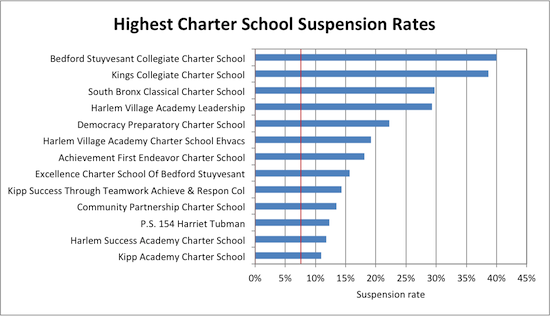
Some, not all, of the more well-established charter networks known for their “No Excuses” curriculum suspend kids at some of the highest rates in the city.  Two Brooklyn Collegiate Charter Schools in the UnCommon Schools network suspend students at 35 and 40 percent rates. Achievement First, another charter network with strict behavior codes suspends 4 to 18 percent of its students at its five city schools, higher than the city’s average.
Democracy Preparatory Charter High School in Harlem suspended 22 percent of its students. Its other four locations did not list suspension data. Others ranged from lower to higher-than-average suspension rates. The Harlem Success Academy suspended 5 to 12 percent of its students at its four locations. The city’s four Knowledge is Power Program charters, which are part of a national network of “no excuses” schools, suspended between 6 and 14 percent of its students. For the 2008-09 data, the average suspension rate for the city’s 77 charter schools at the time was 7.6 percent. All numbers are based on the 2008-09 school year, the most recent data available.
Dixon Deutsch, director of the Special Education Collaborative at the New York Charter School Center said there are two sides to the charter suspensions debate, and that schools that use the “no excuses” model believe in trying to ensure a productive and safe environment for all students, Deutsch said.
“I think it’s important to have a discipline policy that is rigorous and also fair,” said Deutsch. “My particular plan is to believe in high expectations for kids, but also sweat the small stuff, because small stuff builds up over time and becomes very large stuff very quickly.”
Many public charters do provide better than average environments for special needs children, Deutsch said. But it’s tricky to create a productive environment for all children that does not compromise the rights of students with behavioral and learning needs. Some teachers feel the pressure to clear behavior problems from their classrooms in order to boost test scores. Others simply are unaware of the proper procedures for handling behavior and learning issues.
As of 2012, about 125 of the city’s current 135 charters belong to the Special Education Collaborative that just recently began providing behavioral specialists to charter schools, Deutsch said.
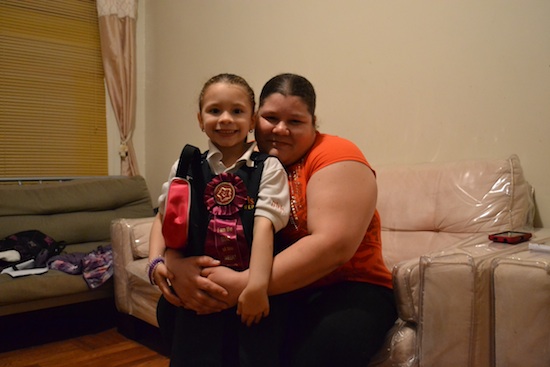
Brianna Pena, 5, was suspended from her "No Excuses" charter on her very first day in school. (Photo by Sarah Tan)
One kindergarten girl, Brianna Pena, 5, was recently pushed out of her strict disciplinary school, the Harriet Tubman Charter in the Bronx, after throwing a tantrum on her first day of school. Brianna’s mother, Milagros Lopez, had transferred her from another similar charter, South Bronx Classical, in October, after she felt the rules and standards for behavior were too strict. The experience was no different at the Harriet Tubman Charter, however, where Brianna spent less than a day there before the school suspended her and demanded she be psychologically evaluated before she be able to return.
“Her first day of school at Tubman, they didn’t even let her stay, she wasn’t even there for an hour,” Lopez said.
The school reported Brianna had been “yelling and throwing chairs,” a school document of the incident stated. Video footage taken by a teacher shows a small girl crying on the floor of a classroom.
“If there was an issue, they should have called me into the office,” Lopez said. “Obviously, she was just having adjustment issues, it was her first day there.”
Lopez has since placed Brianna at Girls Prep, an all-girls charter in the Bronx, where she said that though Brianna has had minor behavior and adjustment issues, the school has made an effort to work with her and Pushed Out: Charter Schools Contribute to the City’s Growing Suspension Rates | School Stories:

Charter schools suspend kids, public schools don’t — which does better? | New York Post http://bit.ly/1L7O0jY

Are Sex Abuse and Charter School Scandals Catching Up With Sacramento Mayor Kevin Johnson? | Alternet

Are Sex Abuse and Charter School Scandals Catching Up With Sacramento Mayor Kevin Johnson? | Alternet:

Are Sex Abuse and Charter School Scandals Catching Up With Sacramento Mayor Kevin Johnson?

A former NBA star plays fast and loose with young women and taxpayer funds.


Is Kevin Johnson the Democratic Party’s Bill Cosby?
Johnson is the famous ex-NBA basketball star who became a charter school founder, then the mayor of Sacramento, CA, and was recently president of the U.S. Conference of Mayors. But according to a series of investigative reports on Deadspin.com., a sports blog, Johnson’s past is filled with underage women who he molested as a sports star two decades ago, to teenage students and teaching assistants he fondled as the principle of a charter school that he founded. Some are now speaking up and not burying that past.
“There was no penetration. No rape. No knife to the throat threatening death. Just something that happened,” writes Mandi Koba on her blog, recounting the summer two decades ago when she was 15 and hanging out with Johnson the basketball star. “But it nearly destroyed me. It’s not been the physical harm that was caused me that’s taken the longest to heal from. Not the way his hand felt on my body. Not his hot breath on my face. Not even the words that he whispered. It’s been the messages. The feelings of worthlessness. Feelings that I was responsible.”
Koba, now in her mid-30s, wrote that she “lost control” of her life “because of who my abuser was.” Like many of the women who have kept secret their abuse by Bill Cosby years ago and are now speaking up, Koba said she is trying to “support victims on their journey to becoming survivors, [to] use my own story to add to the other voices of survivors who choose to speak out and try to dispel the many myths people have about sexual abuse.”
Johnson’s history with Koba is detailed in a 1996 Pheonix, Arizona, police report that describes how he gained her trust and began physically imposing himself. Her therapist contacted police and an investigation ensued. No charges were filed, as is often the case when celebrities are involved and the details less than black and white. A decade later, Johnson’s personal attorney, Fred Hiestand, told the L.A. Times that “his accuser was mentally unstable and had been swayed by a zealous therapist.”
But what’s telling in the Deadspin article by Dave McKenna is that Johnson apparently didn’t change his behavior after that sordid chapter—where he writes that “Kevin Johnson paid [Koba] precisely $230,600 for her silence.” A decade later, in 2007, Johnson was back in hometown, Sacramento, and the founder of a charter school, St. HOPE, where he laid the building blocks for his political ascent. Yet at St. HOPE, Johnson’s history of crossing innappropriate personal lines repeated itself.
A teacher, Erik Jones, “went to police in 2007 after a student told him that she and other kids at St. HOPE had been molested by Johnson,” McKenna writes. A child abuse report filed with police by Jones quoted one of the young women saying, “Mr. Johnson [a teacher and President of St. HOPE publics Schools] came up behind me and started to massage my shoulders. Soon his hands Are Sex Abuse and Charter School Scandals Catching Up With Sacramento Mayor Kevin Johnson? | Alternet: