Latest News and Comment from Education

Tuesday, September 29, 2015

Pennsylvania School Funding War Drags On | janresseger

Pennsylvania School Funding War Drags On | janresseger:

Pennsylvania School Funding War Drags On


Pennsylvania doesn’t yet have a state budget, something the state is required to have in place on June 30. A protracted, years-long, and politically contentious fight about inadequate and grossly inequitably distributed school funding is a primary reason for the impasse.
A Republican-dominated state legislature has refused to compromise with the new Democratic governor on a plan that would fund the government and restore desperately needed money for the public schools.  Former governor, Tom Corbett, who ripped more than a billion dollars out of the state budget for public schools, was soundly defeated last November.  But Governor Tom Wolf has not been able to move Corbett’s allies in the legislature to do the right thing for Pennsylvania’s children.  Wolf defeated Corbett last November in large part due to a statewide school funding crisis created by Corbett’s tax cuts.  Corbett and the legislature had pretended to help the School District of Philadelphia—already devastated by school closures and staff layoffs—to survive by passing enabling legislation to permit Philadelphia to enact a cigarette tax on its own residents, a local sin tax dedicated for the public schools.
Last Thursday the editorial board of the Philadelphia Inquirer supported Governor Tom Wolf’s pledge to veto a stopgap, temporary budget presented to him by the legislature on September 18: “Republican legislators have put their old, irresponsible fiscal plan in a new wrapper and called it a stopgap budget.  While their plan promises to fund the state until November, it also threatens to delay sincere negotiations, allowing the state’s elected officials—already nearly three months late—to go that much longer without performing one of their most basic duties: passing a budget.  The Democratic governor has already rightly rejected the legislature’s proposal, which would perpetuate Harrisburg’s habit of leaving bills unpaid, relying on one-time gimmicks, and raiding dedicated funds.  Nor would it adequately fund schools or force the shale-gas industry to shoulder its share of the tax burden at long last.”
Then there is the lawsuit filed by plaintiffs across Pennsylvania that the state’s school funding system fails to meet the “thorough and efficient” and equal protection clauses in Pennsylvania’s constitution—the same language to protect adequate and equitably distributed funding that appears in many state constitutions.  The lawsuit, William Penn School District v. State was filed in November of 2014.  The state has requested that the case be dismissed based on precedents when similar school funding lawsuits were previously brought in Pennsylvania.  While a lower court did dismiss the William Penn School District case, plaintiffs and advocates who filed an amicus brief on their behalf last week, simply ask that plaintiffs be granted the right to present their case and evidence to the Supreme Court, which is scheduled to hear an appeal of the case early in 2016.
Derek Black explains the history of the case at the Law Professors Blog Network: “Last fall, plaintiffs filed suit against Pennsylvania, arguing that education is a fundamental right under Pennsylvania School Funding War Drags On | janresseger:

CURMUDGUCATION: NY: Turning Screws on Opt Out

CURMUDGUCATION: NY: Turning Screws on Opt Out:

NY: Turning Screws on Opt Out


If you are a struggling school in New York, congratulations-- you've been drafted to fight against the state's burgeoning opt out movement.

As reported yesterday at Politico, one new requirement for struggling and persistently struggling schools to avoid a state takeover is to get their participation on the Big Standardized Test above 95%.

Those of you who are living above ground may recall that last year upwards of 200,000 New York students refused to take the BS Test. This prompted a variety of reactions. The feds made veiled threats. Governor Andrew Cuomo and chancellor Merryl Tisch reaffirmed their belief in a parent's right to choose. New education commissioner MaryEllen Elia was a bit more stern. 

But when life hands you lemons, say reformsters, you can always make one more mechanism for privatizing schools, and right now NY Ed department has figured out how to turn Opt Out into Win Win.

Elia's position remains that NY parents just don't understand how awesomely wonderful the tests are. Asked for a comment on the new takeover participation requirement, the department of ed told Politico:

We encourage and support the efforts of all schools and districts to explain to parents the benefits that parents, students, teachers, schools, and district and state policymakers derive from student participation in state assessments.

In other words, struggling school districts are welcome to get stuffed or start working for us in 
CURMUDGUCATION: NY: Turning Screws on Opt Out:


NY: Cuomo's New Common Core Faux Commission


My absolute favorite part of Gov. Amdrew Cuomo's announcement about the Common Core Task Force is this stock art student on the front page
This is a face that says, "Yeah, like that shit's gonna happen."

The task force has been charged "with comprehensively reviewing and making recommendations to overhaul the current Common Core system and the way we test our students." It features several return appearances by members of the governor's "successful" NY Education Reform Commission-- you remember their big hit, the edu-improving report of January 2014.

So who do you get to head up a group that is going to re-examine and possibly rewrite the baseline education standards for an entire state? A top educator? A leading expert in educational standards? An experienced educational scholar?

Ha! Of course not, you dope. You get a financial master of the universe like Richard Parsons, former 

NY: Cuomo's New Common Core Faux Commission

Education Research Report: Usage of Policies and Practices Promoted by Race to the Top and School Improvement Grants

Education Research Report: Usage of Policies and Practices Promoted by Race to the Top and School Improvement Grants:

Usage of Policies and Practices Promoted by Race to the Top and School Improvement Grants


The American Recovery and Reinvestment Act of 2009 injected $7 billion into two of the Obama administration's signature competitive education grant programs: Race to the Top (RTT) and School Improvement Grants (SIG). While RTT focused on state policies and SIG focused on school practices, both programs promoted related policies and practices, including an emphasis on turning around the nation's lowest-performing schools. Despite the sizable investment in both of these programs, comprehensive evidence on their implementation and impact has been limited to date. 
 This report focuses on two implementation questions: (1) Do states and schools that received grants actually use the policies and practices promoted by these two programs? (2) Does their usage of these policies and practices differ from states and schools that did not receive grants? Answers to these questions provide context for interpreting impact findings that will be presented in a future report.

The first volume of this report details the RTT findings, which are based on spring 2012 interviews with 49 states and the District of Columbia. Key findings include:


  • Early (Round 1 and 2) RTT states reported using more policies and practices promoted by RTT than non-RTT states in five of the six major areas examined: state capacity, standards and assessments, data systems, teachers and leaders, and charter schools (school turnaround was the exception). Later (Round 3) RTT states reported using more policies and practices promoted by RTT than non-RTT states in just one area: teachers and leaders.
  • Across all states, usage of policies and practices promoted by RTT was highest in the state capacity and data systems areas (66 and 68 percent of policies and practices examined) and lowest in the teachers and leaders area (24 percent or policies and practices examined).
  • There were no differences between RTT and non-RTT states in usage of English Language Learner (ELL)-focused policies and practices promoted by RTT. States with higher percentages of ELLs used more ELL-focused policies and practices than states with lower percentages of ELLs, but there were no differences in usage between states with higher and lower ELL/non-ELL achievement gaps.
The second volume of this report details the SIG findings, which are based on spring 2012 surveys of approximately 470 schools in 60 districts and 22 states. Key findings include:


  • Schools implementing a SIG-funded model reported using more practices promoted by SIG than schools not implementing such models in all four areas examined: comprehensive instructional reforms, teacher and principal effectiveness, learning time and community-oriented schools, and operational flexibility and support.
  • Across all schools, usage of practices promoted by SIG was highest in the comprehensive instructional reforms area (90 percent of practices examined) and lowest in the operational flexibility and support area (46 percent of practices examined).
  • There were no differences between schools implementing a SIG-funded model and schools not implementing one in usage of ELL-focused practices promoted by SIG. Schools with higher percentages of ELLs used more ELL-focused practices than schools with lower percentages of ELLs, but there were no differences in usage between schools with higher and lower ELL/non-ELL achievement gaps.Education Research Report: Usage of Policies and Practices Promoted by Race to the Top and School Improvement Grants:


Portland Public Schools leader: LGBTQ training makes schools 'safe' for students (Q&A) | OregonLive.com

Portland Public Schools leader: LGBTQ training makes schools 'safe' for students (Q&A) | OregonLive.com:

Portland Public Schools leader: LGBTQ training makes schools 'safe' for students (Q&A)


School
(Faith Cathcart)


Earlier this week, The Oregonian/OregonLive brought you the story of a transgender teacher in the Gresham-Barlow School District. Oregon and Washington have long barred employers from firing workers because of their gender identity. Yet most schools remain unprepared for the coming wave of transgender teachers, staff and students.
Portland Public Schools is one of the most progressive districts in the nation when it comes to lesbian, gay, bisexual and transgender issues. Each year, the district trains teachers at its 90 schools to better serve LGBTQ students. Principals begin school years by telling teachers to ask students which pronouns they prefer to use. And a widely distributed FAQ reminds teachers they have the right to be out, keep photographs of their partners in their classrooms and use the pronouns and bathrooms that suit them.
The Oregonian/OregonLive spoke with Rudy Rudolph, a project manager for Portland Public's equity department, about why the district prioritizes this work.

Oregon law says you can't fire teachers because of their gender identity, but the law doesn't require you to offer training. Why is that professional development important?
If we don't give people an opportunity to understand what life is like for an LGBTQ person in the schools and at work, how can we ever really truly say that PPS is a safe place for all?
People have been so appreciative that the district is making people aware and giving them the tools to move forward.
The first question some districts ask is, 'How much is it going to cost?'
The first question I get is, 'What do you need? How can we help you?' I've never once gotten a no. They want to make it right.
Were there any challenges in getting this off the ground?
Yes. There are so many important things that the leaders of our schools need to know about and do, involving curriculum, new teaching techniques, all the testing that goes on.
What's challenging is being able to get in front of them with all the other things that are important. Every year, we have gotten in front of the whole leadership to make Portland Public Schools leader: LGBTQ training makes schools 'safe' for students (Q&A) | OregonLive.com:

BESE Campaign News as of 9/28/15 | Crazy Crawfish's Blog

BESE Campaign News as of 9/28/15 | Crazy Crawfish's Blog:

BESE Campaign News as of 9/28/15


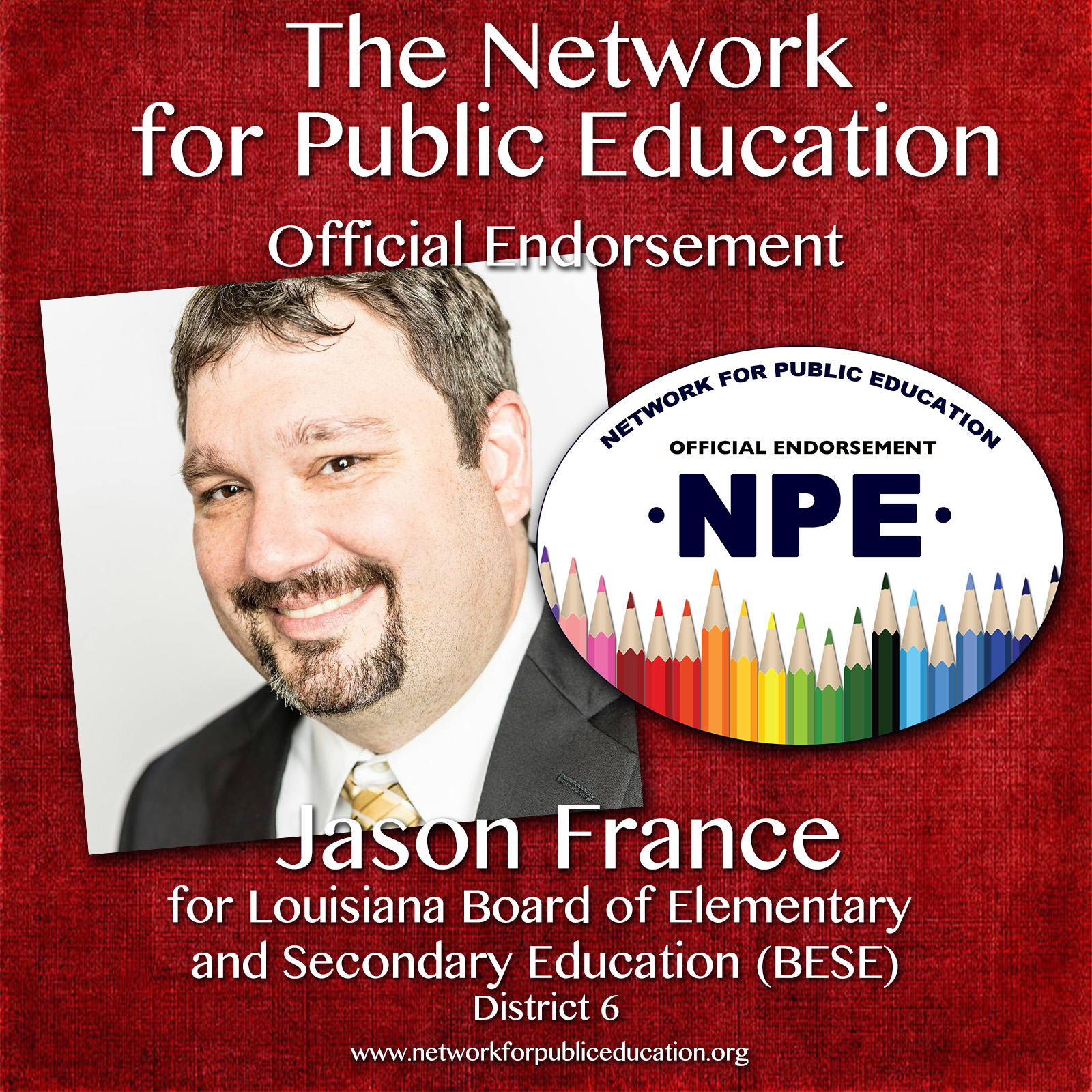
Jason France Endorsement Graphic
Big Education Ape: NPE Endorses Jason France, AKA Crazy Crawfish, for BESE – The Network For Public Education http://bit.ly/1TXoLG8


I want to apologize to my regular readers of the blog.  I have been remiss with  my postings of late and there are a lot of great stories to write about.  However one of the biggest potential stories is the campaign I am working on now, my own, and it’s been keeping me very busy.
Some curious and wonderful events have transpired that most of you are not aware.  For starters I made my candidacy to BESE official.  I am on the October 24th ballot.  That’s just 4 weeks away folks.
In addition the incumbent, Chas Roemer, announced at the last minute (during the qualifying period) that he would not be seeking re-election for a third term.  This announcement was made a few hours after I registered my candidacy.  I’m not sure if the two are related, but I like to think so.  I have not been easy on Chas these last few years and I had plenty of material I was saving up to use on him in the primary had he chosen to run.
This last minute announcement of the incumbent not seeking re-election lured three new challengers to the race for district 6.  One of these challengers is backed by business and industry and Roemer.  All three are relative unknowns, just as myself and my original campaigning counterpart.
This race could be very interesting.  District 6 is a very conservative district by the numbers, by the way it was gerrymandered, although not all parishes and people are aligned that way. Public sentiment is very anti-common core, especially among conservatives, and I was one of the very first people in our state to speak out against Common Core publicly, and certainly the first person in my race.
In addition, a new group called “FlipBESE” has formed with parent activists across the state which has honored me with their endorsement.  FlipBESE has endorsed a candidate in every race in the state which is a stark contrast to the incumbent or challenger supported by the business and industry lobby “LABI”.  This year there is a unified message and slate of challengers to the business and vendor sponsored status quo and most races are head-to-head match-ups and with only one party on the ballot (Republican or Democrat.)
My race is the exception and will be one of the few requiring a run-off.  My race has 5 candidates.  Four candidates are Republicans and one candidate is a Libertarian.  The Libertarian candidate happens to be me.
My platform is to remove the destructive influence of the state and federal government and to restore our local education systems to our local governments.  Our state and federal governments don’t have a clue what’s going on in our schools, and they don’t seem to care.  Rather than working with children and parents they prefer to work with numbers and 


Common Core and Professional Development: Survey Results - Education Week

Common Core and Professional Development: Survey Results - Education Week:

Common Core and Professional Development: Survey Results


Survey: Core PD Needs


In February 2015, the RAND Corp. surveyed its American Teacher Panel, a random selection of 1,129 K-12 teachers, on current professional-development needs, focusing on topics related to the Common Core State Standards. In all, 655 teachers responded; the results were weighted for differential sampling and non-responses. The tables below show the percentages of teachers who said they had a high or moderate need for PD in the topics listed. The chart below looks at the amount of time teachers said they have for collaboration; most teachers also said they have limited opportunities to give or receive feedback on lessons.

The ‘moral and spiritual culture’ that elevates education - Yahoo News

The ‘moral and spiritual culture’ that elevates education - Yahoo News:

The ‘moral and spiritual culture’ that elevates education

A Christian Science perspective: A response to revising American history curriculum.


 With school in the U.S. and elsewhere in full swing, it’s a good time to remember there’s more to education than just learning core facts and developing basic skills.

The Monitor reported on the U.S. College Board’s rewrite of the 2015 Advanced Placement (AP) U.S. History course, to pare down issues on slavery and give more emphasis to American “exceptionalism.” Arguments and protests about what some see as a politicization of the AP curriculum have raised questions about education.
One historian interviewed for the article said, “History needs to deal with unpleasant topics as much as high achievements. You can’t just ignore past injustices because you don’t like them” (“New guidelines for AP history: Are they still unpatriotic?” CSMonitor.com).
Today’s scholars rapidly become the world’s thinkers and doers of tomorrow. Within a broad classroom experience of history, science, language, math, and the arts, they’re encouraged to explore not just the triumphs, but also the struggles, failures, and excesses of their nation. This is vital to charting their own course, as well as the collective course of society into the future.
Yet another form of education to shape society involves exploring and answering the even deeper needs that come from understanding who we are and what shapes us. The Monitor’s founder, Mary Baker Eddy, wrote, “... it is not so much academic education, as a moral and spiritual culture, which lifts one higher” (“Science and Health with Key to the Scriptures,” p. 235).
To be clear, this isn’t advocating that public schools teach religion; rather, a deeper “spiritual culture” is an individual journey of thought that begins at home, and sets one on the path of progress toward right living through the development of right thinking. And right thinking certainly does complement and even enhance education.
The verb “to educate” comes from the Latin meaning “to lead out of.” To me, spiritual education is a lifelong journey out of conventional, mortal-based thinking into better conditions of thought and living through understanding the law of God. Knowing God better as the creator of all can greatly magnify a full academic experience by fueling more meaningful curiosity and engagement with the world around us. It enables us not only to discover our true, spiritual purpose, direction, and worth, but to help others discover theirs, as well.
Mrs. Eddy also wrote: “Academics of the right sort are requisite. Observation, invention, study, and original thought are expansive and should promote the growth of mortal mind out of itself, out of all that is mortal” (Science and Health, p. 195). In my own experience as a Christian Scientist, I’ve found that as I grow in my understanding of God, I’m able to define knowledge and learning The ‘moral and spiritual culture’ that elevates education - Yahoo News:

This Is How Out of Control Testing Has Gotten in Schools - Yahoo News

This Is How Out of Control Testing Has Gotten in Schools - Yahoo News:

This Is How Out of Control Testing Has Gotten in Schools


For anyone who doubts that education in the U.S. has become overrun by testing, consider this. My daughter's first day of kindergarten -- her very first introduction to elementary school -- consisted almost entirely of assessment. She was due at school at 9:30, and I picked her up at 11:45. In between, she was assessed by five different teachers, each a stranger, asking her to perform some task such as cutting, coloring in the lines, reciting her address and phone number, identifying letters and their sounds, and counting. She then had to wait two days, while all the other incoming kindergartners were assessed, to learn of her teacher and begin the school year in earnest.
From an educator's point of view, this approach makes good sense. Determine what it is that kids know. Then use that baseline knowledge to assemble a class.
But this was an intimidating initiation from a child's perspective. Usually an outgoing and independent girl, my daughter was clingy and nervous on her first day of kindergarten. When I asked how she was feeling as we approached the front door of the building, she said she did not want to go to school. She did not have any friends yet. She did not know her way around the building. She worried that there would be too many people. What if her teachers were mean? What if kids made fun of her when they heard her name? What if she had to use the restroom? She was a bundle of nerves. I'm sure this testing scenario did little to quell her concerns. I have no doubt that however she was assessed, she did not perform from a place of confidence or comfort. Even under less trying circumstances, such one-shot assessments are of questionable validity.
Indeed, by the time I picked her up, she had not relaxed at all. She did not want to talk about what she had done in school, but she did say that she did not want to go back. She did not know the teachers' names. She did not make any friends. Later that afternoon, as she played with her animals in her room, I overheard her drilling them on their numbers and letters.
My husband and I will do our best to help her unlearn what she learned about school on her first day: that it is a place where you are judged for what you know -- not how eager you are to learn; that performance matters more than understanding or inquiry; that schoolwork is hard and uninteresting. We will work with her teacher (whomever he or she is) to ensure that the strengths she brings to kindergarten -- curiosity, compassion and creativity -- are recognized and nurtured. We will encourage her love of learning and her self-confidence; I just wish we did not have to work against the school system in doing so.
Our educational system's drive to assess, to label and sort kids, to make decisions on the basis of data of dubious quality has gone too far, and it is time for a course correction. We must remember that "data" are social constructions, shaped by the circumstances under which they are obtained. And just as these circumstances affect the nature of the information we collect, they have bearing on other things that matter, such as a child's first impressions of school. I submit that these impressions matter more than any purported snapshot of a child's abilities.
Yes, it is good for teachers to get a sense of what their students might know at the beginning of the school year, but there is no reason such formative assessments cannot wait until after the This Is How Out of Control Testing Has Gotten in Schools - Yahoo News:

Clinton endorsement divides teachers union - POLITICO

Clinton endorsement divides teachers union - POLITICO:

Clinton endorsement divides teachers union

State officials and rank-and-file members plan to protest upcoming vote to endorse Hillary Clinton.


Top brass of the 3 million-strong National Education Association, the country's largest union, are recommending an endorsement of Hillary Clinton, according to an email obtained by POLITICO -- a move that has many state leaders and rank-and-file members planning to protest the early endorsement.

The email, sent from the union's campaign office, states that the NEA PAC, the union’s political arm, is planning to hold an upcoming vote “recommending Hillary Clinton for the presidential primary.”

Story Continued Below

“After months of interactions with the three candidates who chose to participate in our process [Clinton, Martin O’Malley and Bernie Sanders], certain things became clear,” the email states. “Clinton is the best positioned candidate to win both the Democratic primary and general election. She has unmatched organizational strength, ground game, and fundraising ability to defeat the candidate of the Koch brothers.”

The email noted that while Clinton is the candidate the union believes is most likely to win, both Clinton and Sanders received “A” rankings on NEA’s congressional legislative scorecard, and O’Malley was voted NEA’s Governor of the Year. The email says the union hired a Republican consultant to reached out to Republican candidates, but none chose to participate in the endorsement process.

The email also defends the timing of the early recommendation process as a chance for the union to try and identify a winner early so as to “play a significant role in the next administration’s conversation and decision-making about public education.” (In 2008, the union did not endorse Barack Obama until after he had wrapped up the nomination.)

But the reaction is following a pattern that has played out in many major unions that have gone through the endorsement process this year -- anger and opposition from rank-and-file members who support Sanders and want their unions to hold off on any endorsement in the primary. Many teachers protested vigorously after the American Federation of Teachers endorsed Clinton in July.

Some NEA members supporting Sanders said they simply do not trust Clinton to fight for their interests -- and plan to fight back against any union endorsement. “Even if she says things that today sound supportive, she’s not going to be a steadfast friend of organized labor,” said Jamie Rinaldi, a teacher from Newton, Mass., and a union activist. “We don’t know she’s going to be the ally that’s going to stand with our legislative agenda.”

Other state leaders have expressed concern that an early endorsement does not allow members to be participants in a real debate around the issues that is still


Read more: http://www.politico.com/story/2015/09/hillary-clinton-teachers-union-214190#ixzz3n8cXTXNu

Charter Schools defend law that lets them set aside seats - WSJ

Teachers Union Criticizes Charter Perk - WSJ:

Teachers Union Criticizes Charter Perk

Charter Schools defend law that lets them set aside seats for employees’ children


The new ability of New York charter schools to set aside seats for employees’ children drew fire Monday from the United Federation of Teachers, which said such “nepotism” defied charters’ stated goals of serving the neediest children.
A state law letting charters give first dibs to staff for up to 15% of enrollment passed in June. Union officials chose to highlight it in advance of a pro-charter rally on Wednesday that is expected to draw a big crowd in Brooklyn.
The union and other critics of charters often accuse them of failing to serve their fair share of the most challenging students. UFT President Michael Mulgrew said at a news conference Monday that charters have long promised to teach the neediest children better than the district, so set-asides for largely middle-class staff were the “height of hypocrisy”—especially when charters say more than 40,000 applicants are on wait lists in New York City.
Charter advocates fought back. They said letting staff enroll their children where they work helps retain talented teachers. “I can’t think of a better endorsement than a teacher who is willing to send her own child to the school she teaches in,” said James Merriman,chief executive of the New York City Charter School Center. “Sadly, for way too many teachers in way too many traditional schools, the school they teach in is one to which they’d never send their own child.”
By law, charters admit students by lottery, but must give preferences to siblings and children in their neighborhoods. Some charters say they also give preference to students who are at-risk, struggling with disabilities and English language learners.
About 6% of charter students were English language learners, compared with 14% citywide, according to a New York City Charter School Center analysis of 2013-14 enrollment. About 16% of charter students had special needs, compared with 18% citywide.
The new policy was passed too late to affect admissions for this fall. Officials at Uncommon Schools, which has 21 charters in Brooklyn, expect that next year fewer than 20 of its 1,400 openings will go to staffers’ children. Barbara Martinez, a spokeswoman for Uncommon Schools, said, “This new opportunity allowed by law gives educators one more reason to choose teaching as a long-term profession.”
Charters are taxpayer-funded and independently run, usually free of union rules. They have grown rapidly in recent years. The New York City Charter School Center released a report Monday saying that one in three students in Harlem, the South Bronx and central Brooklyn attends a charter.
The center says more than 90% of the city’s charter students are African-American or Latino, and over 70% are from low-income families. This school year, 205 charter schools Teachers Union Criticizes Charter Perk - WSJ:

Point: Charter schools need to be shut down in Washington | Crosscut

Point: Charter schools need to be shut down in Washington | Crosscut:

Point: Charter schools need to be shut down in Washington


Last month, the Washington Supreme Court ruled that charter schools in the state – which voters approved in 2012 – are unconstitutional, due to the fact they are not governed by elected boards and are therefore unaccountable to taxpayers. As Washington Attorney General Bob Ferguson asks the court to reconsider their opinion, we present two differing views on the issue. The below opinion is from Angel Morton, a kindergarten teacher and president of the Tacoma Education Association. To read a pro-charter school opinion from parent Shirline Wilsonclick here
When the Washington Supreme Court recently threw out our state’s controversial charter school law, the timing was a surprise, but the decision itself was predictable – and correct.
In a 6-3 decision, the Court ruled the law was unconstitutional because it diverted funding from existing K-12 public schools to new charter schools operated by private organizations that are not held accountable to the public. The court was clear: Under our state’s Constitution, schools that are funded with taxpayer dollars must be accountable to the voters who fund them.
There’s another important principle at stake: Washington state has both a moral and a legal obligation to provide all students a quality public school education, regardless of their ZIP Code. It’s impossible to discuss the charter school ruling without viewing it in the context of the Supreme Court’s 2012 McCleary decision, which ruled the state is violating the constitution by not amply funding basic education. The Supreme Court is fining the legislature $100,000 a day and holding it in contempt for their failure to fully fund our public schools. In that light, it’s indefensible to divert a single penny away from existing public schools into new, unproven charter schools that serve a tiny fraction of our state’s students.
Angel Morton.
Angel Morton.
The need to invest in our existing public schools instead of siphoning scarce resources into unaccountable, privately run charter schools has been at the forefront of the charter debate for years. Public accountability was one of the primary arguments against charter schools when the law passed in 2012. Just this past month, the state’s first charter school made headlines for accounting problems involving taxpayer dollars. Yet if you’re a taxpayer in Seattle, whom do you hold responsible for that school’s problems?
If you have a concern about your local public school, you can go to your elected school board and be heard. Charters are overseen by an unelected commission, and they are operated by private organizations. That means that as a taxpayer, you help fund these schools, yet you have no say in Point: Charter schools need to be shut down in Washington | Crosscut:

What Boehner's Resignation Means for NCLB Rewrite - US News

What Boehner's Resignation Means for NCLB Rewrite - US News:

Boehner's Resignation Could Upend NCLB Rewrite

The House speaker was a principal architect of the No Child Left Behind Act.


In this Jan. 8, 2002, file photo President George W. Bush, seated, signs into law a sweeping federal education bill, No Child Left Behind, at Hamilton High School in Hamilton, Ohio.


Congress is closer than it's ever been to overhauling the No Child Left Behind Act, the much-maligned and latest iteration of the federal K-12 law. But the announcement made last week by House Speaker John Boehner that he plans to resign at the end of October, could disrupt those efforts.
The Ohio Republican was a principal architect of NCLB, the 2002 law that's now widely criticized for giving the federal government too much control over education. And for that reason, he's taken a personal interest in getting a reauthorization of the law to the president's desk, even rebuffing powerful special interest groups to do so.
But now, as the House and Senate are conferencing to reconcile the NCLB reauthorization bills passed in each chamber, it's unclear whether a new speaker will continue to prioritize the legislation, especially given how difficult it was to shepherd a Republican-backed version through the House.
"I’m not saying it’s going to be impossible, but I do think it makes getting a conference report that [President] Obama could sign a lot less likely," said Charles Barone, director of policy at Democrats for Education Reform and formerly an aide to former Rep. George Miller, D-Calif., during NCLB negotiations.
Boehner's announcement put the education community on high alert Friday, prompting responses from some of the most powerful education groups about the need to broker a final version of the rewrite, especially since so many states are currently operating under NCLB waivers from the Department of Education.
"We need to reauthorize the law because students and educators across the country need a stable long-term federal policy," says Chris Minnich, executive director of the Council of Chief State School Officers. "Living waiver to waiver each year is not the way to run the country's education system."
In particular, Boehner has supported the House version of the NCLB rewrite, the Student Success Act, authored by Rep. John Kline, R-Minn., the chairman of the House education committee who had a difficult time pushing the proposal through the House. NCLB is the latest iteration of the Elementary and Secondary Education Act.
Amid waning support for the bill from Republicans who didn't think it went far enough in limiting the role of the federal government, leadership yanked it off the floor after two days of debate. What followed was months of aggressive whipping to educate Republicans about what the bill would do and how it would be better than current law.
The bill would, for example, prevent the Secretary of Education from coercing or in any way incentivizing states to adopt certain academic standards, including the Common Core State Standards – a major Republican priority.
Still, there were a lot of folks who didn't want the measure back on the floor, including Heritage Action, the policy arm of the conservative Heritage Foundation, and the right-wing Club for Growth. But with Boehner's nudging, they brought it up again. As the clock ran out on final passage, Republicans still didn't have enough support, but scrambled to garner the additional votes needed.
The measure ended up passing, 218-213.
The Senate, on the other hand, passed a bipartisan rewrite with broad support from both parties. The two bills are now being conferenced, but the expectation is that the final version will look much more like the Senate bill than the House's. And it's unclear if a new speaker would prioritize a conferenced ESEA bill the way Boehner would.
"I think it cannot go unnoticed that speaker Boehner is the last of the big four, as they were called back then, who negotiated NCLB in Congress," says Mary Kusler, director of government relations for the 3 million-member National Education Association. "Now we're closer than we've ever been in a rewrite of this law while Boehner is speaker of the House, and he has been very close and supportive of the efforts that Chairman Kline has been going through in this process."
But instead of derailing the effort, Kusler sees Boehner's resignation as a "shot in the arm" for beginning the conference process in earnest and having the tough conversations about the major policy gaps that exist between the House and Senate bills. Chief among those differences is how to hold states accountable for disadvantaged students while also limiting the role of the federal government.
"Certainly the outcome of the leadership race will impact the ability of the caucus to operate and how the floor will run," Kusler says. "But we knew going into conference, especially given the House vote this summer, that we would need a combination of Republicans and Democrats to pass [a final bill].
Frederick Hess, director of education policy studies at the American Enterprise Institute, a right-leaning think-tank, says Boehner's forthcoming resignation won't impact the reauthorization process, which he predicts is unlikely to happen at all.
"It's not like he was going to woo any votes," Hess says of Boehner's relationship with those on the far-right of his caucus. "Some of them were so frustrated with him they were just going to cross their arms at anything he brought to the floor."
House Majority Leader Kevin McCarthy, R-Calif., who is the front-runner to be the next speaker, has a What Boehner's Resignation Means for NCLB Rewrite - US News:

Right Wing School Choice Fan Rep. Kevin McCarthy Could Be Next Speaker - Politics K-12 - Education Week

School Choice Fan Rep. Kevin McCarthy Could Be Next Speaker - Politics K-12 - Education Week:

School Choice Fan Rep. Kevin McCarthy Could Be Next Speaker


So Rep. John Boehner, R-Ohio, the Speaker of the House, former education chairman, and a lead author of the No Child Left Behind Act, is out as of the end of the month—and Rep. Kevin McCarthy, R-Calif., will almost certaintly replace him.
McCarthy doesn't have nearly as long a resume on K-12 as Boehner did going into the job. (To be fair, very few lawmakers could.) He hasn't sponsored or co-sponsored many education bills since joining Congress in 2007.
He's co-signed a bill overhauling the Impact Aid program, which offers federal money to districts with a big federal presence, to help them make up for lost tax revenue, and a bill that would allow states to use existing money for technology to address cyber-bullying and protect kids from Internet predators.
And last year, he wrote an op-ed comparing school choice and ... milk choice. If one store is selling spoiled milk, customers can go to another grocery store and buy the fresh stuff, he noted. The same thing should happen with schools, he argued: 
"When a grocer sells bad milk, customers are free to shop at another store. If there is no other store, a new one will be opened, promising and providing fresh milk. ... The message is simple: if you'd like to be a successful grocer, sell fresh milk ... This principle—that people are free to choose among alternatives—operates in almost every aspect of our society.
But imagine if this sour-milk grocery store were state-owned, the only grocer in town, and that you were barred from shopping at grocers outside the city limits. Then, imagine that laws barred any new, privately managed grocery stores from opening. In effect, you would be forced to purchase milk at a store that sells bad milk or go without milk altogether. The grocer would have a monopoly on milk. While such limitations would be ridiculous in the world of groceries, it is all too common in education. For many families trapped in failing schools, the only way to access a quality education is to leave their homes for another district or take on extreme financial burdens to cover tuition at a private school."
Interestingly, McCarthy isn't the first GOP policymaker to use a milky metaphor in selling school choice. Former Florida Gov. Jeb Bush, now a Republican presidential candidate made it a centerpiece of his speech on education to the GOP convention in 2012.
Another interesting tidbit: One of McCarthy's key policy aides, Barrett Karr, was the staff director for the Education and the Workforce committee, chaired by Rep. John Kline, R-Minn. So she clearly has some experience with K-12 issues—and might want to help her former boss get a big win on passage of a bill rewriting the NCLB law before Kline retires.
"She's the X factor," one source said. In fact, the source credited Karr with playing a major role in getting the bill off the House floor this summer. "There's a reason the same bill that couldn't pass in February made it the second time around." 
Still, many folks expect Boehner's retirement to put the brakes on an NCLB rewrite. More here

Don't miss another Politics K-12 post. Sign up here to get news alerts in your email inbox.

How the GOP Turned on Common Core

How the GOP Turned on Common Core:

How the GOP Turned on Common Core


10_09_CommonCore_02


Chris Christie was for it before he was against it. So, for that matter, was Mike Huckabee. When the Common Core education standards were introduced in 2009 by the governors and school superintendents of 46 states, most of the would-be Republican nominees for president were for this voluntary approach to kids’ education. In 2013, Louisiana Governor Bobby Jindal lauded the program, but a little over a year later, he was comparing it to Stalinism: “Let’s face it: Centralized planning didn’t work in Russia, it’s not working with our health care system, and it won’t work in education.”
Christie’s flip-flop was equally acrobatic. “We’re doing Common Core in New Jersey, and we are going to continue,” he thundered in 2013. By 2015, he was thundering against Common Core. “We need to take [education] out of the cubicles of Washington, D.C., where it was placed by the Obama administration, and return it to the neighborhoods of New Jersey.”
How did eliminating Common Core, a rather benign set of voluntary goals and best practices for teaching K-12 students, become one of the biggest applause lines in the Republican presidential race? (Only Jeb Bush and John Kasich are standing by the idea.) “It’s mystifying to me why there are individuals so entrenched in fighting this fight when you consider all the problems this country has,” says Dane Linn, vice president of the Business Roundtable, chuckling in exasperation. “How did Common Core become the whipping child?”
His group, which represents CEOs of the nation’s largest corporations, along with the U.S. Chamber of Commerce and education reformers, has been pushing for years for something that would lift educational standards, putting them on par with high-achieving nations around the world. Now that they have that something, the pro-business party is denouncing it.
To understand how this happened, you need to know that Common Core was in part a reaction to the oft-criticized No Child Left Behind Act, the 2001 law that poured vast new federal resources into education and demanded that school districts meet performance thresholds or face sanctions. Even though No Child Left Behind passed Congress with overwhelming bipartisan support—the late Senator Ted Kennedy championed the George W. Bush proposal—it soon drew enemies from all sides, including teachers who found it meddlesome, parents who tired of the endless emphasis on testing and politicians, left and right.
Common Core was meant to be different. First, these standards weren’t some burdensome federal mandate. The states collaborated on new benchmarks—third-graders should be able to work with fractions, for example—and they were meant to promote best practices for how to teach English and math.
The business community, and business-minded nonprofits, loved it. They had been fretting for decades about American education. The American Federation of Teachers gave it qualified support. The result? School districts are adopting the standards, and they appear to be working. Test scores are up slightly, and up slightly more in states that embraced Common Core enthusiastically.
Opponents of Common Core like to say opposition to the law arose organically, from parents frustrated by ever-proliferating homework assignments. The truth is that the stunningly swift reversal by Republican politicians didn’t happen by accident. It was the result of an organized effort by Tea Party-affiliated groups anxious to make a mark after a series of legislative losses. Although the Tea Party had struck fear in the GOP establishment with the landslide elections of 2010, it had little to show for it despite antics like the government shutdown. The debt limit was raised again. Spending continued to rise. Obamacare was never repealed.
With Common Core, Tea Partiers spotted a chance to rebrand their image, from the tightfisted guardians of budgetary matters to the protectors of kids. FreedomWorks, the Heritage Institute, the American Principles Project, the Heartland Institute and a whole network of conservative advocacy groups and think tanks began alerting their members through emails, conference calls, emails and local organizing to oppose Common Core.How the GOP Turned on Common Core: