Latest News and Comment from Education

Friday, September 25, 2015

The latest undemocratic effort to dismantle public education | NC Policy Watch

The latest undemocratic effort to dismantle public education | NC Policy Watch:

The latest undemocratic effort to dismantle public education

FF-CharterSchool-Funding


The formal budget fight may be over in the General Assembly but the battle over education funding and the crusade to dismantle traditional public schools continue in the session’s waning days.
Senate leaders unveiled a proposal in the Senate Finance Committee Monday afternoon that would divert more funding from the majority of local school districts across the state to charter schools, including federal support for transportation and school lunches that many charters don’t even provide.
The proposal appeared of out nowhere as a bill about school playgrounds was gutted and replaced with the controversial charter school funding provisions, a version of legislation that passed the Senate months ago but stalled in the House.
Very few people seemed to know the charter bill was coming, including public school officials and most of the committee members themselves.
A representative of the school administrators association, also blind-sided by the proposal, told the lawmakers that it would adversely affect their local schools and that their school officials would be strongly against it.
That didn’t deter supporters of the funding change, led by Senator Chad Barefoot, whose only answer to every question was that the “money should follow the child,” a talking point that is not only an oversimplification, but a statement that makes little sense if a charter school is receiving federal funding for services it doesn’t have to provide or if a student attends a school outside a special tax district.
Senate Majority Leader Harry Brown admitted he was confused by the effect of all the complicated provisions transferring money from school districts to charters and he wasn’t the only one.
Even Barefoot acknowledged that he wasn’t an expert on the legislation and was handling it because Senate The latest undemocratic effort to dismantle public education | NC Policy Watch:

OMG "I'm A Grown-Up Now": The Teen Who Accused Kevin Johnson Of Sexual Abuse Speaks Out

"I'm A Grown-Up Now": The Teen Who Accused Kevin Johnson Of Sexual Abuse Speaks Out:

"I'm A Grown-Up Now": The Teen Who Accused Kevin Johnson Of Sexual Abuse Speaks Out


"I'm A Grown-Up Now": The Teen Who Accused Kevin Johnson Of Sexual Abuse Speaks Out


There is a photograph of a pile of pink and white paper hearts atop Mandi Koba’s Facebook page. She cut the hearts out of hard copies of a 1996 police report from Phoenix, Ariz. The cops, according to the vintage report used in the arts and crafts project, were investigating “a celebrity involved in a reported child molestation.”
Kevin Johnson was the celebrity. These days he’s a politician, a national figure with aspirations to the governorship of California who’s proclaimed himself “Little Barack” and worked closely with the Obama administration. Married to Michelle Rhee, face of the charter-school movement, he’s positioned himself throughout his adult life as a sort of catcher in the rye for at-risk inner-city children through his work with a variety of charter schools and foundations, setting him up for his current run as the scandal-prone mayor of Sacramento, Calif. In 1996, though, he was one of the NBA’s top stars, at the very height of a career with the Phoenix Suns that saw him make three All-Star teams and earn tens of millions of dollars.
Mandi Koba, 15 years old at the beginning of the events described in the report, was the child.
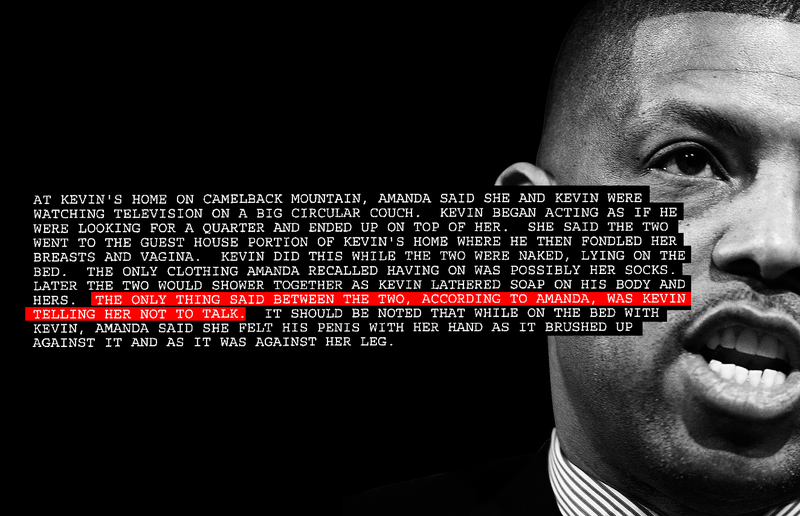
In time, there would be a fair amount of public discussion of the allegations made in that report, which involved Johnson fondling the teenager, showering with her, rubbing his genitals against her bare thigh, suggesting they pray together and ask for forgiveness, and making the only child from a single-parent home give a “pinky promise” that she wouldn’t tell her friends or mother what he’d done. But the investigation produced no physical evidence that any crime had been committed, no criminal charges were ever filed against Johnson, and the accuser never spoke out.
A year after prosecutors decided not to indict, word about Koba’s molestation allegations got out around Phoenix. In May 1997, the Phoenix New Times reported that a lawyer representing the girl was trying to get money out of Johnson. Koba was not named—the pseudonym “Kim Adams” was used—but she took a beating in the story. Attorney Fred Hiestand, an advisor to Johnson at the time and to this day, told the paper "I'm A Grown-Up Now": The Teen Who Accused Kevin Johnson Of Sexual Abuse Speaks Out:

WTF? Principal for new Dyett High School reprimanded in previous job - Chicago Tribune

Principal for new Dyett High School reprimanded in previous job - Chicago Tribune:

Principal for new Dyett High School reprimanded in previous job


Hunger strikers
Hunger striker Jitu Brown, shown Sept. 4, 2015, says Chicago Public Schools’ proposal for reopening Dyett High School shows the district doesn’t respect the community’s voice. “Bronzeville is not satisfied,” he said. “We did not ask for an arts center.” (Zbigniew Bzdak / Chicago Tribune)
Chicago Public Schools on Thursday named a principal for the new Dyett High School, selecting an administrator who was reprimanded last year during an investigation into the theft of more than $870,000 from two city high schools.
Under pressure from residents who staged a weekslong hunger strike, the district decided to reopen Dyett as an arts-focused school next fall. The principal named Thursday, Beulah McLoyd, has been the principal at Clark High School in the South Austin neighborhood since 2010, and before that was an assistant principal at Gage Park High School.
Earlier this year, five men were charged with felony theft for alleged fraudulent billing for goods and services that were never delivered to Clark and Gage Park high schools. McLoyd was issued a "warning resolution" in August 2014, and the district said its investigation found she improperly handled her password.
CPS acknowledged the issue in its news release on McLoyd's appointment to Dyett, noting the investigation "did not conclude she committed any intentional wrongdoing."
"I know the inquiry was an important learning experience for Beulah that has made her a stronger and wiser leader, and that she has taken to heart the old saying: 'Trust, but verify,'" CPS Chief Education Officer Janice Jackson said in a statement.
Protesters who wanted to reopen Dyett as a green-technology school remain unhappy with the district's plans for Dyett. The district was prepared to close Dyett, on the northern edge of Washington Park, after years of declining enrollment and poor performance.
McLoyd, in a statement, said she was "fully committed to ensuring (Dyett) is the world-class success that the community deserves."

Join us at the Northwest Teaching for Social Justice Conference (NWTSJ) | Seattle Education

Join us at the Northwest Teaching for Social Justice Conference (NWTSJ) | Seattle Education:

Join us at the Northwest Teaching for Social Justice Conference (NWTSJ)


rethinking
Educators, students and parents are invited to attend the Northwest Teaching for Social Justice Conference
October 17, 2015
“We Still Need to Trouble the Water: Race, Revolution and the Struggle for Quality Education”
8AM to 4:30PM
Chief Sealth High School, Seattle
Sample Workshops:
A Human Face on War: Poetry and Art
Prison Labor Cycle: Players in a System
Building an Opt-Out Movement in Your Community
Papers Black Students’ Lives Matter Educating Activist Allies
Hashtag Essay Writing
OVER 60 Workshops in three different sessions
Register online at http://www.nwtsj.org
Hosted by: Puget Sound Rethinking Schools, Portland Area Rethinking Schools, Social Equality Educators, Oregon Writing Project at Lewis & Clark College, and Rethinking Schools magazine
Wayne Au, Jesse Hagopian and I (Dora Taylor) will be hosting a workshop titled:
Testing, Charters, and Strikes, Oh My! : Resisting Corporate Education Reform in Seattle and Beyond
The Seattle area has been a hotbed of education activism in recent months, including significant victories in the defense of democracy and public education. In this panel discussion and conversation, local education activists Dora Taylor, Jesse Hagopian, and Wayne Au will talk about the local movement to opt out of high-stakes testing, the political gains earned during the Seattle educators’ strike, and the recent Washington State Supreme Court ruling declaring charter schools unconstitutional here. Local strategies as well as implications and nation connections will be discussed.
I have found these conferences to be not only full of relevant information but also energizing and uplifting. It is a highly recommended event.


Seattle - What happens when teacher union leaders step up to support teachers, students, parents and public schools - Wait What?

Seattle - What happens when teacher union leaders step up to support teachers, students, parents and public schools - Wait What?:

Seattle – What happens when teacher union leaders step up to support teachers, students, parents and public schools


For those union members, education advocates and parents who are consistently frustrated by the fact that some union leaders spend more time maintaining their close relationship with the power elite than fighting for their members and public education, the recent teacher strike in Seattle, Washington is proof that real champions have been stepping up in Seattle, Chicago, at the state level in New York and Massachusetts, and elsewhere.  These teacher union leaders are making a fundamental difference in the fight to improve public schools and provide greater support for teachers, students and parents.
For an update on the Seattle Teacher Strike check out, The surprising things Seattle teachers won for students by striking.
The post appears on Valerie Strauss’s blog, The Answer Sheet.  Strauss is a reporter with the Washington Post and her bog is one of the most important resources in the nation for information about education policy and the unprecedented assault on public schools and public school teachers by the Charter School and Corporate Education Reform Industry.
If you don’t read Strauss’ blog you should book mark it and sign up for her regulator updates at: https://www.washingtonpost.com/blogs/answer-sheet/
Seattle teachers went on strike for a week this month with a list of goals for a new contract. By the time the strike officially ended this week, teachers had won some of the usual stuff of contract negotiations — for example, the first cost-of-living raises in six years — but also some less standard objectives.
For one thing, teachers demanded, and won, guaranteed daily 
Seattle - What happens when teacher union leaders step up to support teachers, students, parents and public schools - Wait What?:

Do the Rights Thing | EduShyster

Do the Rights Thing | EduShyster:

Do the Rights Thing


teenamarie


These Boston students are at the forefront of a movement to give students more voice. So help them speak up!

It’s time for something a little different, reader: a happy good news story! I’m shouting out to my fave Boston student activists, who are doing some of the best work in the country around student rights and voice. And best of all, this story comes with an action component—a *do now,* you might say. 
Here’s the deal
Youth on Board, which oversees a citywide body of elected student leaders from high schools across Boston, is up for a big cash money award from the Nellie Mae foundation. How much of a big cash money award? $100K, which would help this largely volunteer-run operation take its campaign to put students at the center of the conversation about schools to not just the next level, but the next three levels. I’m going to pause here so that you can cast your vote for Youth on Board. Wait. You’re still not done. Quick—go to your email and click on the confirmation link. Wait for it. Wait for it. There. You’ve just done the rights thing! Now alert your family, friends and colleagues and ask them to do the same thing.


Why I am such a huge fan of these students
BSACIt isn’t often that I suspend my steady volley of snark-filled diatribes against [insert current target here] in order to sing the praises of someone or a great many someones I admire. Which tells you that these Boston student activists must be pretty great. This summer they rolled out the first student rights app in the country, so that Do the Rights Thing | EduShyster:

The surprising things Seattle teachers won for students by striking - The Washington Post

The surprising things Seattle teachers won for students by striking - The Washington Post:

The surprising things Seattle teachers won for students by striking


Striking Seattle School District teachers and other educators walk a picket line, Thursday, Sept. 10, 2015, near Franklin High School in Seattle. (AP Photo/Ted S. Warren)


Seattle teachers went on strike for a week this month with a list of goals for a new contract. By the time the strike officially ended this week, teachers had won some of the usual stuff of contract negotiations — for example, the first cost-of-living raises in six years — but also some less standard objectives.
For one thing, teachers demanded, and won, guaranteed daily recess for all elementary school students — 30 minutes each day. In an era when recess for many students has become limited or even non-existent despite the known benefits of physical activity for children, this is a big deal, and something parents had sought.
What’s more, the union and school officials agreed to create committees at 30 schools to look at equity issues, including disciplinary measures that disproportionately affect minorities. Several days after the end of the strike, the Seattle School Board voted for a one-year ban on end suspensions of elementary students who commit specific nonviolent offenses, and called for a plan that could eliminate all elementary school suspensions.
Other wins for students in Seattle’s nearly 100 traditional public schools include:
Teachers won an end to the use of student standardized test scores to evaluate them — and now, teachers will be included in decisions on the amount of standardized testing for students. This evaluation practice has been slammed The surprising things Seattle teachers won for students by striking - The Washington Post:

Elia: We Are Sticking with Common Core, No Matter What the Public Thinks | Diane Ravitch's blog

Elia: We Are Sticking with Common Core, No Matter What the Public Thinks | Diane Ravitch's blog:

Elia: We Are Sticking with Common Core, No Matter What the Public Thinks 


State Superintendent MaryEllen Elia said Néw York would stick with Common Core, no matter that public opinion does not support it.
A Siena College poll found that 64% of Néw York voters either oppose Common Core or thinks it has made no difference.
She also said, ““The United States used to lead the world educationally, but we’ve fallen to the middle of the pack. Our students are lagging behind, and the global economy is growing more competitive every day.”
Actually, that’s not true. The U.S. never led the world on test scores. When the first international tests were given in the 1960s, the U.S. students came in last. Yet over the next 50 years, our nation surpassed the other 11 nations that took the same test by every measure: economic productivity, technological innovation, military might, creativity, and democratic institutions. The test scores of 15-year-olds do not predict our future. The policies of our government, the decisions of corporations to outsource jobs, our treatment of our children and communities matter more.
When I met Commissioner Ekia, I have her a copy of “Reign of Error,” which explains this in greater detail. Obviously she hasn’t had time to read it.
Given the debacle of the Gates teacher evaluation in Hillsborough County, where Elia was superintendent until January, she should rethink her views.Elia: We Are Sticking with Common Core, No Matter What the Public Thinks | Diane Ravitch's blog:

CURMUDGUCATION: Grove City & The College Scoreboard

CURMUDGUCATION: Grove City & The College Scoreboard:

Grove City & The College Scoreboard


First, let me confess that I like the idea of the new USED College Scorecard. It is the right sort of approach-- providing information without making judgment. I compare it to the nutritional facts panel now included with all our food. Don't give me some government rating of "Good" or "Awesome" or "Sucky." Don't decide for me how many grams of fat I should eat-- just tell me how many are in there and let me decide.

I know the feds wanted to offer their judgment on how great colleges are, because Duncan's ed department is devoted to the idea that only they are wise enough to understand and all citizens are dopes. But if we pretended for a moment that all citizens weren't dopes, and we just provided them with information so that they could make informed choices. Maybe I don't care how much calcium is in my Twinkies, but if I want to know, it's there, and if I still don't care, I'm free to ignore it.

But the Washington Post noted this week that a handful of colleges are not in the data base, and that grabbed my interest, because one of them is Grove City College of Pennsylvania.

Grove City College is right up the road from me. My brother attended there. Members of my extended family graduated from there. We send lots of our graduates there. I've had several student teachers from there.

It is an excellent school, though certainly less liberal than many. It's major (but loose) church affiliation is with the Presbyterians, and you know how wild those folks get. GCC has a great reputation as a school for engineers, a strong humanities emphasis, and also as a place for young ladies to get their MRS degree (at orientation: "Look to your left. Look to your right Your future mate may be in sight"). They are not LGBT friendly, but then, they aren't really very excited about CURMUDGUCATION: Grove City & The College Scoreboard:


Miss Ruby and Her Pretty Pink Pastel Library - Lily's Blackboard

Miss Ruby and Her Pretty Pink Pastel Library - Lily's Blackboard:

Miss Ruby and Her Pretty Pink Pastel Library 


The irony is that there is nothing, and I mean absolutely nothing “brown” about Brown Elementary. It sparkles.
The principal, Serenity Luckett, shines when she shows off her school. The students beam when they greet you. The new PTA officers glow when they explain how they are putting in new resources in the new Parent Center.
But nothing would prepare you for Miss Ruby. Her parents were prescient in bestowing this particular name upon their little girl. The woman is a precious gem.
She’s the school librarian. And she was running to a meeting when we arrived at Brown Elementary in Jackson, Mississippi on our Back to School Tour. She was not so patiently waiting for us when someone told her we were starting with the little ones on the first floor.
21477045991_886285c298_o


“Oh, no you’re not. You’re starting with me,” she said. It wasn’t a request. “You need to start with the library so I can show it to you before I have to leave for a meeting. There is no way you are leaving this school without me showing you my library.”
Well, ok, why not, I thought. She and I left the others and went upstairs to a converted classroom and she opened the door. And oh… Oh, my. Oh, the pinks and the reds and the yellows and the blues! Oh, the colors that popped and spilled and exploded over the books and posters and art and magazines and toys.
I’m not sure there is such a school library in the whole wide world as beautiful as Miss Ruby’s Popping Pink Pastel Library. I ran downstairs to get the rest of the Back-to-School crew. I needed documentation. They have cameras and microphones. They walked in and gasped.
Miss Ruby just glistened like the jewel she is. Her smile told us that she’s seen this reaction before. “It’s something, isn’t it?” she asks us. We just giggle. There are no words. It’s breathtaking.
There are two lawn chairs in the back of the room next to the puppets. I suggested we sit down. I wanted to hear her story.
“This is my last year at Brown,” she says. “I’m retiring. This is the second time I’ve retired, but this time it’s probably for good.”
Miss Ruby went to college to become a librarian, but something had her turn in another direction. She became an accountant and worked for Ford Motor until she retired. Then she thought about that library she’d always wanted to run. She applied for an opening at Brown Elementary as the school librarian.
The principal back then showed her the empty classroom that was being used as the school library. It had grey shelves. It had beige walls. It had a black carpet.
“Now that carpet still makes me mad,” she told me. “Who ever thought a place that should be the heart of a school Miss Ruby and Her Pretty Pink Pastel Library - Lily's Blackboard:


CURMUDGUCATION: The Big Map O' Charter Failure

CURMUDGUCATION: The Big Map O' Charter Failure:

The Big Map O' Charter Failure


The Center for Media and Democracy has done a great public service, collecting and sorting a big pile of charter school failure data that the USED somehow just wasn't interested in pursuing all that much.

They have taken the NCES data from 2000-2013 and pulled out a state-by-state list of failed charter schools. This gives you, or your local press if they actually feel moved to pursue a story, a heaping database of charter failure info. One interesting feature from a Your Tax Dollars at Work perspective-- the charter schools that hoovered up some tasty public tax dollars and never even opened in the first place! In Michigan in the 2011-2012 school year, according to CMD, twenty-five charters received grants and never opened.

But for those of you who are visual learners, CMD has a big interactive map. I'll include that here, but I recommend you go over to CMD and read the whole piece for more details. Here's what charter failure to the tune of 2,500 schools (2,500!!) looks like. (And remember-- this is only through 2013)


Source: NCES Common Core of Data Public Elementary/Secondary School Universe Survey for school years 2000 to 2013. Data are available at https://nces.ed.gov/ccd/pubschuniv.asp. For purposes of this analysis, schools coded in the survey as “closed since last report,” and “inactive-temporarily 
CURMUDGUCATION: The Big Map O' Charter Failure:


Kansas Solves Teacher Eval Riddle


Governor Sam Brownback wants to pay teachers strictly based on merit, and some legislators think that's a darn fine idea.

For instance, here's a member of the special committee to find a new finance formula for schools

“I say the highest paid individual in your school should be your best teacher, period, and I believe that,” said Rep. Ron Highland, a Republican from Wamego

Of course, lots of folks find that idea appealing, but the problem remains-- how exactly does one determine who that best teacher is? What are the qualities that are most valued in a teacher, and how does one measure those qualities or outcomes or what-have-you? Well, Rep. Highland has that puzzle solved as well.

“I can walk into any school and talk to the janitor and I can tell you who the best teacher is in every school. They all know, so telling me you can’t figure that out, I don’t buy that argument,” said Highland.

So there you have it. Just ask the janitor.

Highland may have a point. I'll bet if I ask a janitor in a school building who the best teacher is, he can give me an answer.

In fact, if I ask two janitors-- or two janitors, a cafeteria lady, the floating specialist, the principal, 
Kansas Solves Teacher Eval Riddle


Hunger strike ends; Dyett protesters want elected school board - Chicago Tribune

Hunger strike ends; Dyett protesters want elected school board - Chicago Tribune:

Hunger strike ends; Dyett protesters want elected school board


Dyett hunger strikers
Participants in a hunger strike pray Sept. 4, 2015, after responding to the city's proposal for Dyett High School in Chicago. (Zbigniew Bzdak / Chicago Tribune)
Activists on Monday formally declared an end to a weekslong hunger strike mounted in an effort to pressure the city into reopening a South Side high school, and said they would now focus on a campaign for an elected school board.
"We are by no means broken," organizer Jitu Brown, one of the hunger strikers, told reporters Monday while standing with supporters including the Rev. Jesse Jackson.
"We are elevated, energized and inspired by this fight," Brown said. "This was a righteous fight. This was 'good versus bad,' and making sure that our children and our communities get the respect we deserve. And we will make sure that Dyett High School meets the needs of children in Bronzeville."
Chicago Public Schools earlier this month said it planned to open a new arts-focused, neighborhood school on the Dyett High School campus in fall 2016. The district's plan did not satisfy community activists who wanted the city to accept their proposal for the school.
In addition to the hunger strike, organizers led by the Kenwood-Oakland Community Organization had mounted spirited protests that in one instance forced Mayor Rahm Emanuel to leave the stage during a public budget hearing.
"We have elevated the fight for educational justice by demonstrating that we can and we must fight back, but on our terms," said Monique Redeaux, one of the protesters. "Not the terms of those who do not love our babies."
The district's plans for the Dyett campus on the northern boundary of Washington Park include a scientific branch assisted by the Illinois Institute of Technology. On Monday, the district announced that two groups of "technical advisory committees" would collect Hunger strike ends; Dyett protesters want elected school board - Chicago Tribune:

Charter Sector Sucks Public Funds Out of Underfunded Public Schools | janresseger

Charter Sector Sucks Public Funds Out of Underfunded Public Schools | janresseger:

Charter Sector Sucks Public Funds Out of Underfunded Public Schools


Now that charter schools have been operating for two decades, our collective experience with these publicly funded and privately managed schools is increasingly raising questions about their impact on the traditional public school districts of which they are supposedly a part.  The deep fiscal threat is far more basic than the scandals arising from place to place due to lack of regulation by state legislatures.  Charter schools serve only about 6 percent of children across the United States.
Here are four recent reports in the press.
The Eli and Edythe Broad Foundation is reported this week by Howard Blume of the Los Angeles Times to have been circulating a memo proposing that the Los Angeles Unified Schools create 260 new charter schools intended to enroll 130,000 students.  Blume explains, “L.A. Unified already has more charters than any school system in the country, representing about 16% of total enrollment… But the proposed expansion would mean more than doubling the number of charter schools in Los Angeles, a feat that even backers say might prove demanding… Critics say charter schools create greater inequities because they frequently draw more-motivated and higher-achieving students and leave traditional schools worse off.  The situation, they say, leaves district schools with less money to serve a larger percentage of students with behavior problems and disabilities and those who need to learn English.”  A follow-up piece in the same newspaper quotes Los Angles school board president Steve Zimmer: “Everyone understands 250,000 kids will not be part of this.  There is collateral damage: We won’t be able to lower class size or provide comprehensive support our kids need.”  Zimmer and other board members accuse the Broad Foundation of trying to divert $490 million to charters, money that should be used for existing public schools.
In the School District of Philadelphia, Pennsylvania, an investigation last week posted at the joint website of the Philadelphia Inquirer and the Philadelphia News describes charter schools’ issuing bonds with very high interest rates to pay for exorbitantly expensive school buildings.  To cover their interest payments, several charters have sought rapidly to expand their Charter Sector Sucks Public Funds Out of Underfunded Public Schools | janresseger:

Mike Klonsky's SmallTalk Blog: Chicago aldermen finally say 'no' to charter expansion

Mike Klonsky's SmallTalk Blog: Chicago aldermen finally say 'no' to charter expansion:

Chicago aldermen finally say 'no' to charter expansion


"The vast majority of aldermen oppose the opening of new charters this year, while we face a massive budget crisis and no path to adequately funding our neighborhood schools... The current system pits charters against neighborhood schools in a "zero-sum game." --Ald. Rod Sawyer (6th)

In a strong rebuke of current Rahm/Claypool school closing/charter opening policies, 42 Chicago aldermen have signed on to a resolution seeking a moratorium on new charter schools this year. 

Ted Cox at DNAInfo writes:
State law allows charters to open even if the local district doesn't want them. CPS has denied some charter applications, only to have them approved by the Illinois State Charter School Commission. At that point, CPS has to fund the schools, without having any say over their operation.
The resolution, submitted by Progressive Caucus member Roderick Sawyer, asks for a freeze on new charters both in the city and across the state through the Illinois State Board of Education. 

MORE SAWYER..."With so many neighborhood schools taking severe budget cuts, it is common sense that we should attempt to steady the ship before pushing Mike Klonsky's SmallTalk Blog: Chicago aldermen finally say 'no' to charter expansion:

Jersey Jazzman: Common Core Testing: Who's The Real "Liar"?

Jersey Jazzman: Common Core Testing: Who's The Real "Liar"?:

Common Core Testing: Who's The Real "Liar"?


By way of Peter Greene, it looks like our SecEd is back on his crusade against all that awful "lying" going on in our schools:

U.S. Secretary of Education Arne Duncan said Pennsylvania won’t be alone in seeing lower standardized test scores after aligning its tests with core standards, and that the lower scores don’t mean students aren’t smart.
Test scores across the country are expected to be lower as they are released in the coming weeks because standards have been raised on the tests that are based on the Common Core. In Pennsylvania, the tests are aligned with Pennsylvania Core.
“Obviously, students aren’t going to be less smart than they were six months ago or a year ago,” Mr. Duncan said. “In far too many states, including Pennsylvania, politicians dummied down standards to make themselves look good.”
Mr. Duncan made his comments during a visit to Carnegie Mellon University, which was the final stop on his seven state, 10-stop tour titled “Ready for Success.”
The secretary said children and parents “were lied to and told they were on the track to be successful” when they weren’t. He called that
- See more at: http://jerseyjazzman.blogspot.com/2015/09/common-core-testing-whos-real-liar.html#sthash.FVByxb5a.dpuf

Richest and Poorest School Districts - 24/7 Wall St.

Richest and Poorest School Districts - 24/7 Wall St.:

Richest and Poorest School Districts


Many factors determine the quality of education in a particular state, including federal, state, and local funding levels, the curriculum, and teacher and staff quality. A district’s wealth, however, is often a very good indicator of how well the area’s students are likely to perform.
In San Perlita, Texas, the poorest school district in the United States, the median annual household income is just $16,384, or less than a third of the national median income level. A typical household in the Scarsdale, New York, school district earns $238,478 per year. The quality of life for the 291 students in San Perlita and the 4,721 in Scarsdale is likely very different. 24/7 Wall St. reviewed the wealthiest and poorest school districts in the country.
Property taxes play a significant part in the funding of school districts, and for this reason, the public school systems in the nation’s wealthiest districts are among the best funded in the country. Nationally, public schools spend an annual average of $10,700 per pupil. In eight of the 10 wealthiest districts, spending is at least $20,000 per pupil.
The poorest districts pull in relatively scant funding from local sources, but this does not mean these districts are necessarily underfunded. In fact, half of the 10 poorest districts spend more on average than the national average per pupil spending. This is largely because state and federal funding, which is often targeted to economically disadvantaged areas, can make up much of the difference.
Nationally, an average of 45.3% of total school funding comes from local sources. Only in one of the poorest districts does local spending account for more than 20% of the district’s budget. In those same districts, state sources account for an average of 66% of total funding, and federal sources account for 18.1% of funding on average. Nationwide, state funding comes to 45.6% of total funding, and federal funding comes to just 9.1%.
Income has a strong correlation with educational achievement on a national level, and that is the case in these districts as well. There is a correlation between students who come from wealthier households and their achievements and graduation rates, likely because of the many advantages they receive. The majority of the wealthiest districts have at least a 95% graduation rate. Only two of the 10 poorest districts have graduation rates higher than 75%.
Policymakers cite to the importance of funding for student achievement. But the districts that receive large state and federal funding to make up for low local sources, primarily property taxes and parent contributions, highlight the fact that funding is often not enough to make up for the inequalities in a region that lead to poor achievement.
Sterling Lloyd, senior researcher with national education newspaper Education Week, explained that the relationship between funding and achievement is a complex and controversial one. “There’s no consensus in the research about the precise role of school spending for student achievement. It’s a perennial debate. You can find studies that indicate there is a relationship between funding and student achievement, and you can find studies that say there isn’t a relationship.” Sterling added that in addition to family poverty, policies related to teacher quality and spending can also make a significant difference.
To identify the richest and poorest school districts in America, 24/7 Wall St. reviewed the districts with the 10 highest and 10 lowest median household incomes among the 9,627 U.S. school districts serving at least 250 students from the U.S. Census Bureau’s American Community Survey (ACS). School spending figures, which do not include private education spending, are as of the end of 2013 and come from the U.S. Census Bureau’s Survey of School System Finances. Graduation rates come from National Center for Education Statistics (NCES)
These are the richest (and poorest) school districts in America.
Read more: Richest and Poorest School Districts - 24/7 Wall St. http://247wallst.com/special-report/2015/09/25/richest-and-poorest-school-districts/#ixzz3ml30ceao
Follow us: @247wallst on Twitter | 247wallst on Facebook