Latest News and Comment from Education

Saturday, August 29, 2015

The Real Reason the SBAC Math Test Fails 67 Percent of All Students

The Real Reason the SBAC Math Test Fails 67 Percent of All Students:

The Real Reason the SBAC Math Test Fails 67 Percent of All Students


In this article, we will review the meaning of four important scientific terms and explain why understanding these terms is essential to understanding why the SBAC math test fails 67% of all students who take this test. The four terms we will look at are Reliability, Validity, NAEP Basic and NAEP Proficient. 
01

The SBAC math test is one of two tests developed to align with the Common Core national math standards. The other Common Core test is called PARCC. 

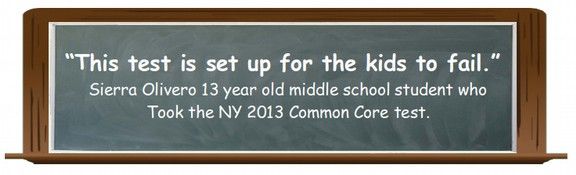
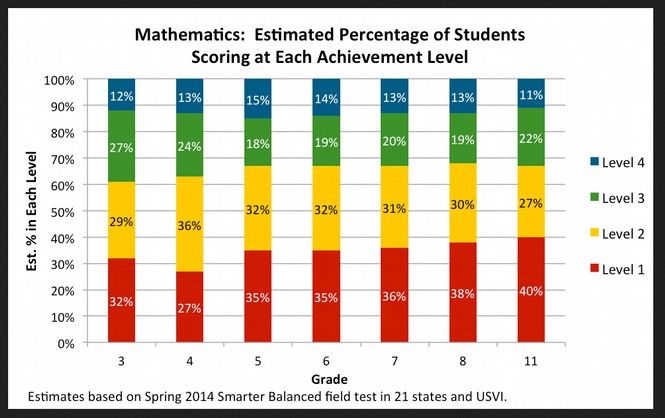
In September 2014, the group that developed the SBAC test announced for the first time that the SBAC test would fail 67% of the students who took the test. Here is a quote from their press release: “Smarter Balanced estimates that the percentage of students who would have scored “Level 3 or higher” in math ranged from 32 percent in Grade 8 to 39 percent in Grade 3. See the chart below for further details.”
http://www.smarterbalanced.org/news/smarter-balanced-states-approve-achievement-level-recommendations/


Here is the chart that came with this press release: 

02

Look at blue and green areas of the far right column and you will see that only 33% of all 11th grade students will score a Level 3 or 4 on the SBAC Math test. This means that 67% of all 11th Graders will be labeled as failures by the SBAC math test. 

Legislators and the public have repeatedly asked why the SBAC test was designed to fail 67% of all students. In a moment we will provide the official reason and then explain the real reason. But first, we will describe some of the many extremely unusual characteristics of the SBAC math test. 

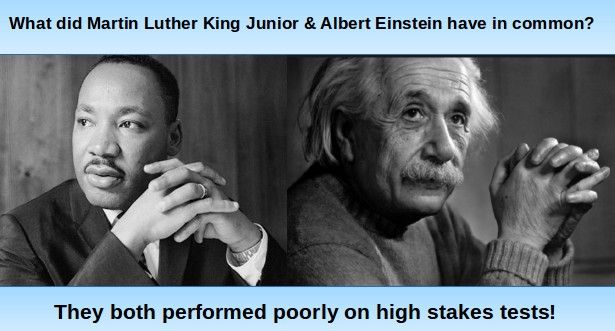
The SBAC math test is unique in several respects. First, it was paid for with hundreds of millions of dollars in federal “Race to the Top” funds. It is likely the single most expensive – and most profitable - high stakes test ever created. Second, the group that developed this test claims that the math test has over 40,000 possible math questions. Neither the public that paid for the test, nor teachers nor parents are allowed to see these questions. So the fairness of these questions and their alignment or lack of alignment to Common Core standards cannot be independently evaluated. But it would not matter if parents and teachers could see these 40,000 math questions because the SBAC math test varies from student to student. Each student gets a different test based upon their answers to the first few questions. There is no way of telling which questions were given to which students. This makes it impossible to assess the reliability of validity of the nearly infinite number of possible SBAC math tests. As many educational researchers have claimed that the SBAC math test is not reliable or valid, we should take a closer look at what these terms actually mean. 

03

Research on the Lack of Reliability and Validity of High Stakes Tests
Reliability means whether a test gets consistent results from 
The Real Reason the SBAC Math Test Fails 67 Percent of All Students:


CURMUDGUCATION: Trib Writer Tries To Spank Dyett Protest #FightForDyett

CURMUDGUCATION: Trib Writer Tries To Spank Dyett Protest:

Trib Writer Tries To Spank Dyett Protest


Eric Zorn decided to just wade on into the Dyett High Hunger Strike yesterday with a piece that is as stunning as it is ill-informed. But it underlines the problem of effectively organizing for a cause.

Zorn apparently didn't do any more reading on the hunger strike except to learn that there is one, and that it has something to do with a high school. Apparently some folks have tried to convince Zorn that the strike "requires coverage of their cause, which is the establishment of a particular type of new school in the Dyett High School building in Washington Park."

But Zorn says he's turned off by the tactics, and goes on to equate a hunger strike with holding hostages and/or slow-motion suicide. But we don't negotiate with hostage takers, and suicide is, I guess, rude. And what Zorn is really saying is that he doesn't believe that it's that big a deal, not even to the hunger strikers:

Would today's protesters rather die than live in a world without the Dyett Global Leadership and Green Technology Community High School, the academy they want CPS to establish?

The piece is spectacular in its lack of nuance or understanding. He talks about the proposed high school as if they want it established from scratch, and not as if they are proposing a way for the community to hold onto its last open-enrollment, community-based school. A school that they 
CURMUDGUCATION: Trib Writer Tries To Spank Dyett Protest:


Gentrification’s Ground Zero | Jacobin

Gentrification’s Ground Zero | Jacobin:

Gentrification’s Ground Zero

In the ten years since Katrina, New Orleans has been remade into a neoliberal playground for young entrepreneurs.


his week marks a decade since Hurricane Katrina devastated New Orleans. In those ten years New Orleans has, with unprecedented swiftness, become the most neoliberal city in the United States.
This development is not entirely surprising — one need only look at the harrowing weeks and months after the storm to see that reconstruction would be used to implement a series of revanchist reforms that further deregulated labor, undermined unions,diminished educational and employment opportunities for working-class people, and excised public and affordable housing from the speculative urban landscape.
Members of the redevelopment team hurriedly pitched strategies to “reduce the city’s footprint” through planned shrinkage and more “responsible” zoning practices — strategies that would have virtually erased many of the city’s low-income black neighborhoods.
Long before the floodwaters had receded, any chance of progressive reconstruction — rebuilding as a restorative public works program aimed at meaningful redistribution — was stamped out by policy wonks and TV commentators, liberal city councilmembers, feisty NGOs, speculative real-estate developers, and boutique hotel owners.
At the same time, it would be a mistake to view the crisis — brought on by the state’s gross mismanagement of Hurricane Katrina — as inaugurating something entirely new. Rather, the crisis expanded the ability of city elites to rapidly entrench policies and governance models that had been on the docket for years.
For nearly four decades, New Orleans governing officials have exploited intentional loopholes in federal urban aid policy to reorganize the city around private interests at the expense of public benefit, deploying decentralized forms of urban aid, such asCommunity Development Block Grants, as a mechanism to leverage speculative growth.
Since the 1970s, successive mayors have diverted federal dollars earmarked for low-income neighborhoods to finance hotels, tourism centers, and corporate headquarters, legitimizing their actions as a response to federal retrenchment or as facilitating trickle-down growth.
Investing in the highly uneven tourism sector, city officials and their private sector beneficiaries pushed for containment, and then Gentrification’s Ground Zero | Jacobin:

New CA Community College Accreditor Needed ... NOW! | Rosemont, CA Patch

New CA Community College Accreditor Needed ... NOW! | Rosemont, CA Patch:

New CA Community College Accreditor Needed ... NOW!

Task force stated Friday that confidence is lost with current agency, and our state's 113 junior colleges deserve better.


A task force comprised of education experts released a report Friday concluding that the accreditor tasked with overseeing California’s 113 community colleges has lost the confidence of its member institutions and should be replaced.
The accreditation task force released the 2015 California Community Colleges Chancellor’s Office Task Force Report on Accreditation, in which they recommended the chancellor and the Board of Governors of the California Community Colleges replace the Accrediting Commission for Community and Junior Colleges (ACCJC) and investigate all available avenues for establishing a new model for accreditation.
Among the issues with the ACCJC identified by the task force was the commission’s decision two years ago to revoke the accreditation of City College of San Francisco. In response, the City Attorney’s Office sued the accrediting commission resulting in the college remaining open and accredited today.
In recent years, other member institutions have raised consistent concerns about the accrediting commission, especially in areas related to transparency, collegiality and consistency, according to the report. The task force also found that the ACCJC issued an “inordinately high” number of sanctions from 2005 to 2015, compared to other accreditors.
The task force stated that further delays in resolving the issues with the ACCJC would have “adverse effects on our colleges, on our students, and on California’s economy and future and will prevent the timely development of the robust accreditation structure that other regions enjoy and that California lacks.”
The task force urged an evaluation of possible accrediting agents for the California New CA Community College Accreditor Needed ... NOW! | Rosemont, CA Patch:

The Irrationality of the Market “Reform” of Education - Living in Dialogue

The Irrationality of the Market “Reform” of Education - Living in Dialogue:

The Irrationality of the Market “Reform” of Education 


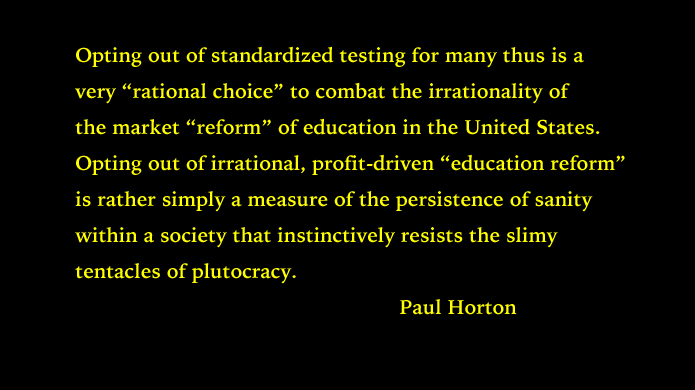
By Paul Horton.
A couple of years ago I had the privilege of listening to the late Nobel Economics laureate Gary Becker speak at my school. Professor Becker won the Nobel Prize for his book Human Capital that argued that the marketplace provides consumers with “rational choices” that rational people will follow to become successful. In this way of thinking, markets rationalize “human capital” to enable smart economic actors to achieve more efficient outcomes.
Not surprisingly, Becker argued that the market would have corrected itself and that we would all be better off without the Keynesian stimulus of President Obama’s Recovery Act.
I really tuned in when Becker began to talk about the privatization of schools. He said that he “loved teaching and that a great teacher should be willing to teach sixty students in a class. If students thought that they could learn more from a given teacher, they should be able to choose that teacher and that teacher should be paid more.”
He went on to say that things should work the same way with schools; that all students should be able to choose their schools and that a public monopoly on schools and schooling prevented them from doing so. He supported starting as many charter schools as possible to end the public school monopoly and to introduce The Irrationality of the Market “Reform” of Education - Living in Dialogue:

Teacher Concerns about Age Discrimination and the Teacher Shortage

Teacher Concerns about Age Discrimination and the Teacher Shortage:

Teacher Concerns about Age Discrimination and the Teacher Shortage


Portrait of happy old african american woman with glasses and wig smiling at camera


Many teachers raised concerns about age discrimination relating to the current teacher shortage after a recent post. I gathered what I had learned and I have added additional information. I also provide links at the bottom to other important articles about this topic.
It is important to state that older teachers want to encourage young people to go into teaching as a long-term career. Children and teens need teachers of all ages leading their classrooms.
But there is no doubt a serious effort is underway to make teaching into a short term service job—one could liken it to young people who join the Peace Corps.
Teaching should be a profession, and long-term experience valued. It should not be seen as a stepping-stone to build one’s career and enter another profession.
Here is a list of condensed comments concerns and also added information I found on this topic.

What the pro-Jeb Bush, pro-Common Core Washington Post Editorial Board Would Not Print | deutsch29

What the pro-Jeb Bush, pro-Common Core Washington Post Editorial Board Would Not Print | deutsch29:

What the pro-Jeb Bush, pro-Common Core Washington Post Editorial Board Would Not Print


On August 17, 2015, the editorial board of the Washington Post published an opinion piece in which it asserts that Common Core and high-stakes testing are just fine and how pro-Common Core, Republican presidential would-be Jeb! Bush has been put in a terrible position to no longer express his support for Common Core by name due to “inflammatory rhetoric” that has “poisoned” the good, Common Core name.
On August 19, 2015, I submitted an op-ed in response, and on August 20, 2015, my submission was forwarded to Letters to the Editor, where it conveniently and conspicuously died.
That is how life in the political world goes.
Below is the content of my submission. I had to keep it to 800 words, but it is still packs a punch:
On August 17, 2015, the Washington Post editorial board published an op-ed entitled, “The Right and Left Poison Common Core with Inflammatory Rhetoric.”
The WashPost piece is a lament of Jeb Bush’s recent backpedaling on what he previously promised would be his unshaken support for the Common Core State Standards (CCSS).
Now all Bush will say is that he is for “higher standards, state-created, locally implemented, where the federal government has no role in the creation of standards, content or curriculum.”
Bush left out the fact that the federal government agreed to foot the bill for the CCSS-aligned, consortium-developed assessments in 2009, before there was a CCSS.  Bush also omitted the fact that in 2009, the federal government 
What the pro-Jeb Bush, pro-Common Core Washington Post Editorial Board Would Not Print | deutsch29:


CURMUDGUCATION: Can Tech Fix Teacher Shortage?

CURMUDGUCATION: Can Tech Fix Teacher Shortage?:

Can Tech Fix Teacher Shortage?


If you don't have a lot of time to read right now, I'll cut to the chase.

No.

The topic is being heavily discussed because, for many folks, "shortage" is spelled o-p-p-o-r-t-u-n-i-t-y. As in, golden opportunity to push TFA, alternative certification, and technology in (or instead of) the classroom. As the teacher "shortage" story has continued to bounce around the edusphere, some writers have stepped up to talk about how technology and blended learning could help solve the problem.


First off, we don't really have a teacher shortage. We have a shortage of employers offering the working conditions necessary to attract people to the teaching profession.

The worst pockets of unfilled teaching positions are not marked by leaders saying, "How can we attract and retain more high quality teachers?" Instead, they're asking, "Where can we find people who will settle for working under the conditions that we're offering?"

There are plenty of creative answers to that question, including fast track programs, lots ofalternative certification programs, and even proposals that some classes be taught by people who have only a high school diploma. But of course the people who are most willing to fill teaching jobs under even the lowest of conditions are not actual people at all, but pieces of technology.

But there are several large obstacles to using technology to plug the teacher "shortage." Here 
CURMUDGUCATION: Can Tech Fix Teacher Shortage?:


PA: Districts Now Short $1.18 Billion


Last Thursday, schools started to feel the impact of our elected legislators' perennial inability to get their job done.

Thursday was the day that $1.18 billion-with-a-b in subsidy payments were supposed to go out to school districts. But they can't. Because Pennsylvania still doesn't have a budget. The Pennsylvania Association of School Business Officers surveyed 171 districts and learned that 83% of those will be dipping into their reserve funds. 60% may delay vendor payments, 53% may delay maintenance work, and 29% may put off filling positions. Other districts are looking at the necessity of borrowing money, which means that for some districts, Harrisburg's failure will translate into real dollar-amount costs for local taxpayers.

Of course, the most notable impact is being felt in Chester Uplands School District, where the lack of a payment Thursday meant that the district could not meet their payroll. District teachers and staff voted to work without pay as long as "individually possible."

Does Pennsylvania do this a lot? Well, "Pennsylvania Budget Impasses" has its own Wikipedia page. In the last decade, we've been stuck in this place five times (2007, 2008, 2009, 2014, and 2015). Back in 2003, the fight dragged on until December.
The process is always grueling and tense, because those of us who are mere citizens in the  http://curmudgucation.blogspot.com/2015/08/pa-districts-now-short-118-billion.html


Schools that respected parents’ right to opt their children out of unfair Common Core SBAC tests - Wait What?

Schools that respected parents’ right to opt their children out of unfair Common Core SBAC tests - Wait What?:

Schools that respected parents’ right to opt their children out of unfair Common Core SBAC tests


After withholding Connecticut’s Common Core SBAC results for weeks, the Connecticut State Department of Education announced that approximately 267,000 Connecticut public school students took the SBAC test in 2015, which is just over 95% of all students.
By comparison, in New York State, more than 200,000 public school children were opted out of that state’s Common Cores testing program.  That means MORE than 20% of all  public school students did not take the test.
In New York, Connecticut and all across the nation parents have a fundamental, inalienable right to protect their children from the abusive nature of the Common Core SBAC testing scam.
However, in Connecticut Governor Dannel Malloy and his administration led an unethical and immoral campaign that lied, mislead and bullied parents into believing that they did Schools that respected parents’ right to opt their children out of unfair Common Core SBAC tests - Wait What?:

SBAC Results – Telling us what we know about poverty, language barriers and unmet Special Education needs

Academic experts have proven over and over again that the major factors influencing standardized test results are poverty, language barriers and unmet special education needs.
Wealthier students, students who are fluent in English and students who don’t need special education services do better.
For students who do need special education services, when schools properly fund those programs, students do better.
The Common Core SBAC test is not only designed to fail the majority of public school students, but is particularly discriminatory because the SBAC scam’s definition of “success” is even more directly connected to wealth, proficiency in the English language and the lack of any need for special education services.
The following chart makes the unfair, inappropriate and discriminatory nature of the Common Core SBAC test extremely clear.  The chart rank orders the percent of students deemed “proficient” in MATH, by town, according to the 2015 Common Core.
Note that eighth graders who live in wealthier towns with few English Language Learners and the funds necessary to provide special education services score higher on the SBAC Math test, while students who come from communities in http://jonathanpelto.com/2015/08/29/sbac-results-telling-us-what-we-know-about-poverty-language-barriers-and-unmet-special-education-needs/

Perdido Street School: The Next Time You Hear Some Edubabble Starting With The Words "Research Shows..."

Perdido Street School: The Next Time You Hear Some Edubabble Starting With The Words "Research Shows...":

The Next Time You Hear Some Edubabble Starting With The Words "Research Shows..."


..You can cut the person off by asking if they're sure the "research" they're citing isn't horseshit:


A painstaking yearslong effort to reproduce 100 studies published in three leading psychology journals has found that more than half of the findings did not hold up when retested. The analysis was done by research psychologists, many of whom volunteered their time to double-check what they considered important work. Their conclusions, reported Thursday in the journal Science, have confirmed the worst fears of scientists who have long worried that the field needed a strong correction.

The vetted studies were considered part of the core knowledge by which scientists understand the dynamics of personality, relationships, learning and memory. Therapists and educators rely on such findings to help guide decisions, and the fact that so many of the studies were called into question could sow doubt in the scientific underpinnings of their work.

...

More than 60 of the studies did not hold up. The project began in 2011, when a University of Virginia psychologist decided to find out whether suspect science was a widespread problem. He and his team recruited more than 250 researchers, identified the 100 studies published in 2008, and rigorously redid the experiments in close collaboration with the original authors.

Only 36% of the studies held up to scrutiny.  If you add in the so-called research in other fields, even that kind of accuracy is probably too high:


Dr. John Ioannidis of Stanford, who predicted in the early 2000s that about half of the findings across medicine were inflated or wrong, said that the 36 percent replication rate for psychology might even be high once the results for other disciplines, like economics, animal research, cell biology and other areas of biomedicine, were also tested.

“Many of the biases found in psychology are pervasive,” Dr. Ioannidis said.

It would be interesting to see a painstaking yearslong effort to reproduce 100 studies of education research to see what the replication rate is.

You hear people on all sides of education reform issues throw out the words "Research shows..."

Our culture has fetishized "research" and "science," as if to say if something has been found by "research" in a "scientific study," it must be so.

This is not so, as one commenter at the NY Times notes:


I applaud the researchers ability to recognize the limitations of their research and their standard of peer review. There is an old saying in medical research: "half of what is published is Perdido Street School: The Next Time You Hear Some Edubabble Starting With The Words "Research Shows...":

Seattle: Students Lead Protests To Change School & Transit Policies | PopularResistance.Org

Seattle: Students Lead Protests To Change School & Transit Policies | PopularResistance.Org:

Seattle: Students Lead Protests To Change School & Transit Policies


Screen Shot 2015-08-29 at 10.46.22 AM


In 2001, my parents, my siblings and I emigrated from Uganda for a better life. We traveled across seas, leaving everything tangible behind, in hopes of an idealized life abroad. We battled internal pains, suffered tremendous loss, and sold a piece of each of our souls to arrive in the land where dreams come true. Once we got here, we quickly realized the illusions we had seen on pamphlets in Africa were just that, illusions. The promises that were offered were nothing but solid sales pitches.
Traveling to America, we never dared to assume that we would be characterized by the color of our skin. We too had heard the great words of Dr. Martin Luther King, Jr. and expected to be judged on the content of our character. In Uganda, everyone was the same color; racial discrimination and prejudice were newfound pains pushed upon us in the United States. Through our everyday struggle of searching for employment and housing, we never expected our skin color would be such a negative barrier in a country that claimed to be dedicated to “freedom and justice for all.”
How naive of us.
As a black and Muslim immigrant, I could write for days about the ways in which my family has experienced racism in the United States – both at the individual and institutional levels. Being a young person, one of the primary sources of the institutional racism I experience is the public school system.
The school I currently attend is Rainier Beach High School, located in South Seattle. Although Seattle is one of the most homogeneous major cities in the country, with nearly 70% of the population being white, my neighborhood in the South End is very much the opposite. In fact, a few years ago the neighborhood where my school is located, 98118, was considered to be among the most diverse zip codes in the country.
At Beach, we have approximately 95% students of color and over 50 languages spoken, making us the most diverse school in the Seattle School District. Nearly nine in ten students here receive free/reduced lunch, meaning the majority of us come from low income families, many of whom are immigrants. These statistics are exactly why I selected Beach when choosing a high school. I wanted to receive my education in a diverse multi-cultural setting. I didn’t want to be the only brown girl in my class. I wanted to belong.
In addition to our status as a culturally rich school, we also have impressive athletic achievements, most notably multiple state championships in basketball, as well as academic achievements. For instance, Beach achieved the highest graduation rate in the district, and we are seeing a steady upward trend in test scores and attendance rates. We’ve also been recognized on the national level for our International Baccalaureate program. Given all the positive data, one would expect the city and school district to shower Rainier Beach with resources and support. Unfortunately, this has not been the case.
For so long we have been told that there is no funding in the district budget to give RBHS the support it needs. Built in 1960, our school is the only one in the district that has not yet received a full renovation. Just last year we had nearly 15 power outages, some of them causing us to attend school in the dark and cold, or even to close school for the day. Our school still has chalkboards, whereas schools in whiter and more affluent neighborhoods have smart boards and more advanced technological tools that enhance student learning. Each year, students here organize walk outs and protests, and attend school board and city hall meetings – but we only receive promises of a new building. Promises that go unfulfilled.
Another public school policy that disproportionately affects students and families of lower Seattle: Students Lead Protests To Change School & Transit Policies | PopularResistance.Org:
Screen Shot 2015-08-29 at 10.46.43 AM
Screen Shot 2015-08-29 at 10.47.01 AM

Neither TFA nor edTPA. Becoming a teacher. | Fred Klonsky

Neither TFA nor edTPA. Becoming a teacher. | Fred Klonsky:

Neither TFA nor edTPA. Becoming a teacher.


Thanks to Debbie Meier for posting this article, Great Teachers are Not Built Overnight by Vanessa Rodriguez.
Teaching is not a skill that you either have or don’t have. It is not a skill that is stagnant, nor is it a skill that grows and approaches some maximum upper limit that everyone will reach eventually. The teaching skill that is being exhibited in a classroom by an experienced, thoughtful, aware teacher is not at all the same skill exhibited by a toddler, a teenager, or even your average parent. While looking at how children and parents teach can help us see the basic elements and characteristics of teaching, it doesn’t allow for a deep understanding of what a professional expert educator does. What makes an expert teacher?

Like learning, teaching is many things at different times and in different people. It’s a skill that develops over time and can be honed to the level of expertise by those with natural ability (all of us), training, experience, and great effort and dedication. In fact, we often argue over whether teaching is a trainable skill or an art form. That’s the wrong argument. It stems from an inadequate definition that equates teaching with a tool for learning: an individual static variable that delivers information to learners. Redefining teaching as a natural human skill that develops over time, as we’ve begun to do, means it is both a trainable skill and an art form, making it similar to many other skilled professions. Not surprisingly, at its onset skill Neither TFA nor edTPA. Becoming a teacher. | Fred Klonsky:
Keeping retirement weird. Call your state rep.


Our family time on Block Island is winding down. Tomorrow we take the ferry back to Point Judith and after stopping to see an old friend in the Catskills, we will dead-head it back to Chicago getting home by Wednesday.
We will celebrate the end of our glorious week tonight by going to the Block Island Maritime Institute’s oyster festival down by Payne’s dock.
Fifteen buck for all the raw oysters you can eat. I can eat plenty, but will https://preaprez.wordpress.com/2015/08/29/keeping-retirement-weird-call-your-state-rep/

Dyett Hunger Strike-Day 10 /AFT President Randi Weingarten #FightForDyett #SaveDyett


Dyett Hunger Strike-Day 10 /AFT President Randi Weingarten #FightForDyett #SaveDyett


Why hunger strikers are risking their health to save a Chicago public high school - #FightForDyett #SaveDyett

Why hunger strikers are risking their health to save a Chicago public high school - The Washington Post:

Why hunger strikers are risking their health to save a Chicago public high school


A dozen people are nearing the end of their second week of a hunger strike aimed not only at keeping alive Walter H. Dyett High School High School in Bronzeville on the South Side of Chicago, but also at underscoring the damaging effects of modern school reform. As one of the hunger strikers, 32-year-old  Monique Smith, told my Post colleague Lyndsey Layton in this story:
“This is really about the privatization of education, it’s about having sustainable community schools in every neighborhood. This is a much larger struggle.”
The Dyett hunger strike — begun Aug. 17 by education activists, public school parents and community and faith leaders — has been years in the making. In 2012, authorities with Chicago Public Schools, who have closed scores of public schools in recent years, announced they were going to shutter Dyett in June 2015, blaming academic achievement and enrollment (but not giving the school adequate resources to improve). New students were not accepted, and so the last 13 seniors graduated this past June.
The Chicago Board of Education has yet to make a decision about what to do with the building. Community members have been telling the board for years what they want: for Dyett to stay open as a publicly operated school, the last open-enrollment school in Bronzeville. Eve L. Ewing, on sevenscribes.com, explained why that is important in a post titled, “Why the Fight for Dyett is Bigger Than One Chicago School Closing”:
If you read any of the articles or blog posts about the hunger strike to save Dyett, or check the #saveDyett hashtag on Twitter, you’ll hear that Dyett is “the last open-enrollment school in Bronzeville.” If, like the majority of Americans, you grew up in a place where there is no such thing as “deciding” where you attend 
Why hunger strikers are risking their health to save a Chicago public high school - The Washington Post:

Parents, here's 9 ways you drive teachers nuts - TODAY.com

Parents, here's 9 ways you drive teachers nuts - TODAY.com:

9 annoying things parents do that drive teachers crazy


best teacher mug;


Every parent wants to make a good impression on their children's teachers, but ask any teacher what the hardest part of their job is, and there's a good chance they will say: parents. (OK, they might also say bureaucracy or mandatory testing but we bet annoying parents are right up there.) So, how do you avoid being THAT parent? Here, teachers from preschool through high school tell us 9 things parents do that drive teachers crazy:


Confused woman
1. Give them yet another coffee mug as a back-to-school gift.
Liz Zahn teaches elementary school, and says teachers grow tired of adding mug after mug to their kitchen cabinets, when there are more useful things parents could gift them with at the start of the school year.
"I have about a hundred mugs - they're the go-to teacher gift," said Zahn.
Zahn suggests giving your child's teacher a more helpful back-to-school gift, such as school supplies or a gift card they can use to treat themselves after a long day.
Woman driver reading a text message on a mobile

2. Ignore information from the school, and then complain that you don't know what's going on.
Melva, who asked that we not use her last name to avoid offending current parents, has been teaching elementary school for nearly 40 years. She says, in a world where parents spend all day checking Facebook, she finds it frustrating to hear them say they don't have time to check the school website for information, read the school newsletter or check their child's backpack for notes that are sent home.
"Many schools are going green, so less and less is coming home in hard copy - but if you request hard copies, they will send it," she said. "Usually it is spelled out what online communication a school uses in the first few newsletters. But it's also important to check that backpack!"
School Supplies

3. Refuse to put your cell phone away during drop-off and pick-up.
With 25 years of teaching pre-k under her belt, Donna Stewart says distracted, cell-phone-toting parents are an increasing frustration for her and fellow teachers.
"This is the one thing that really makes me crazy - parents who won't put their cell phone down and greet their children at dismissal time," said Stewart. "The kids have been away from their parents for several hours, and they're trying to show their parent what they made or tell them what they did that day and the parent just holds up the 'wait a minute' finger. It's frustrating and sad at the same time."Parents, here's 9 ways you drive teachers nuts - TODAY.com:

Hilarious Letter From PTA Speaks the Truth

Hilarious Letter From PTA Speaks the Truth:

Hilarious Letter From PTA Speaks the Truth


This form, from a Texas middle school, has plenty of parents wishing their schools would adopt the same approach. (Photo: Facebook/Dee Wise Heinz)
A PTA fundraiser handout from one Texas school has been making the rounds online for its newfound approach to the classic school bake sales, wrapping-paper drives, and fun runs.
On Tuesday, Rockwell mom Dee Heinz posted a photo of a form that her son, a seventh grader, brought home this week. Heinz blocked out the name of the school, but the form promoted the PTA’s “alternate fundraiser,” explaining: “This fundraiser is in lieu of sending students home with the task of selling door-to-door, collecting money, and delivering goods. Please help us avoid that by supporting our PTA with your donation, and helping us achieve our goals to support our students and faculty.”
The form goes on to offer donation options from $15 to $100, each with a witty caption explaining what the money might have been used for if the school had gone the traditional fundraising route. For $15: “I do not want to bake, so here is the money I would have spent on those cupcakes.” $50: “I do not want to walk, swim, or run in any activity that has the word ‘thon’ in it. Here is the money I would have spend on my child’s ‘free’ T-shirt.” And $100: “I really wouldn’t have helped anyway, so here is $100 to forget my name.”
On her post, Heinz wrote, “I love that our school PTA has a great sense of humor.” And plenty of users were with her. The post has been shared more than 165,000 times, with commenters mostly in total agreement. “Our schools SO need to get on board with this! Having 4 in school this year I would gladly just donate!” wrote one mom. Another wrote, “This should be for all schools everywhere!”
Heinz explained on her Facebook page, “I’m all about helping out at the schools and supporting my children but when you have 3 kids in school who are also doing extracurricular activities as well, sometimes even one ‘simple’ fundraiser is just more than I can tackle. It’s never that simple, and in our house, it’s never just one. I loved their sense of humor, obviously coming from parents who’ve been there-done that, and they understand.”
Though Heinz didn’t respond to Yahoo Parenting’s request for comment, she told CNN on Thursday that while she understands the value of the various school initiatives, this handout was a welcome change. “Fundraisers serve a purpose, and I’d never want to diminish that,” she said. “But for us, this is the better option. Time is valuable, too.”
As for fundraisers teaching students responsibility, Heinz told CNN there are other ways. “They learn responsibility from making sure their homework is completed, or through extracurriculars like playing sports and being part of team,” she said. “They’re not lacking in opportunities to learn responsibility, and there’s only so many hours in a day that you can commit to activities.”
Please follow @YahooParenting on FacebookTwitterInstagram, andPinterest. Have an interesting story to share about your family? Email us at YParenting (at) Yahoo.com.Hilarious Letter From PTA Speaks the Truth: