Latest News and Comment from Education

Sunday, August 9, 2015

Ohio’s charter chaos - Toledo Blade

Ohio’s charter chaos - Toledo Blade:

Ohio’s charter chaos


As the start of the school year approaches, who is cleaning up Ohio’s wretched charter school system?
Not the Republican-controlled Ohio House. Its members fled the Statehouse for summer vacation without enacting a bill approved by the GOP-majority Senate that would have strengthened the state’s notoriously lax regulation of charter schools.
Not Gov. John Kasich, despite his warning in his State of the State message last February that he would work to prohibit charter operators “from sponsoring new schools if they’re not doing their job.” Mr. Kasich is spending more time these days pursuing the Republican presidential nomination than charter school reform. Last week, he dismissed the charter controversy as “just a political thing.”
Not the Ohio Department of Education, where a top official recently admitted tossing out poor test scores for some online charter schools, thus improving the state evaluations of their sponsors on which funding decisions are based. That official, David Hansen, has quit, but state Schools Superintendent Richard Ross is slow-walking his response to what critics call a violation of state law. The department has rescinded the bogus evaluations, but has not corrected them.
Not State Auditor Dave Yost, a Republican, who says he will not conduct a special examination of the department’s statistical manipulation. Mr. Yost previously has demanded enhanced financial transparency for charter schools, and aggressively investigated incidents of data scrubbing by several urban school districts in Ohio, including Toledo Public Schools.
And surely not the operators of Ohio charter schools, many of whom are for-profit entrepreneurs and some of whom are big contributors to the campaigns of Republican elected officials across the state. They are lobbying lawmakers to relax performance standards for charter schools further, making it even easier for bad schools to stay in business.
These operators claim it’s unfair to hold charter schools that primarily serve students who are poor, disabled, at risk of educational failure, or not fluent in English to the same standards as traditional public schools in general. That position ignores consistent findings that charter schools perform no better overall — and often worse — than Ohio’s traditional schools.
Last week, seven of the 19 members of the State Board of Education sent Superintendent Ross a bluntly worded letter, calling him “a prime suspect in what has occurred. Mr. Hansen may have taken the fall, but you were his boss. Whether by mismanagement, or deliberate instruction to Mr. Hansen, you are culpable as well.”
The board members demand a “full and thorough investigation” of the Education Department to be conducted by an independent firm hired by the full board, whose results would promptly be made public. The members call Ohio’s current practice of allowing charter sponsors to monitor their own schools “a huge conflict of interest that results in an entirely unreliable and incredible investigative outcome.”
State Rep. Teresa Fedor (D., Toledo) wants the U.S. Education Department to reject state applications for federal grants to new charter schools. She cites “the abysmal lack of regulations for charter schools in Ohio, as well as the failed, unacceptable leadership of the state superintendent.” The Education Department responded that it has “little interest or time to play politics.” That’s reassuring.
The reforms needed to end abuses within Ohio’s charter school system and improve schools’ performance are evident. Charter sponsors must provide more-active oversight of their schools and be Ohio’s charter chaos - Toledo Blade:

Big Education Ape: Shame on the Ohio House for pushing off action on critical charter school reform bill: http://bit.ly/1MjatQZ

Big Education Ape: Will John Kasich Stand Up to the Republican Donors Taking Billions from Ohio’s Charter Program? ... http://bit.ly/1MjauVd

Big Education Ape: Could Charter School Scandal Weaken The Kasich Campaign? | John A. Tures http://bit.ly/1MjaxAg

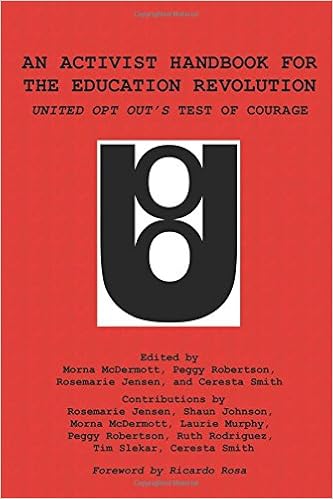
An Activist Handbook for the Education Revolution

IAP || Book || An Activist Handbook for the Education Revolution:

An Activist Handbook for the Education Revolution

United Opt Out's Test of Courage


 Edited by:

Published 2014
Contributions by: Rosemarie Jensen, Shaun Johnson, Morna McDermott, Laurie Murphy, Peggy Robertson, Ruth Rodriguez, Tim Slekar, Ceresta Smith,United Opt Out National

Forward by Ricardo Rosa, University of Massachusetts, Dartmouth


This book is intended for educators, parents and community activists interested in reclaiming our public schools and reclaiming the public narrative around education policy. The book infuses research about the recent history of education policy reform, the strategies United Opt Out uses for fighting back against these policies, and proposes solutions that work to create sustainable, equitable, anti-racist, democratic and meaningful public education. This book is for anyone interested in an “insider’s look” behind the scene of forming an organization, or leading a resistance. Simultaneously the book provides scholarly-based research about the broader issues, policies and data around education reform, and the opt out movement.

Education policy has been heating up ever since NCLB but especially since the roll out of Race to The Top and the Common Core State Standards. Nationally publicized debates and discord over these policies are garnering public attention of teachers, parents, and whole communities. We hope this book will add to the library of other recent books such as Mercedes Schneider’s A Chronicle of Echoes (2014), Diane Ravitch’s Reign of Error (2013) and Bowers & Thomas (eds) Detesting and Degrading Schools (2012), that have exposed the complex corporate interest in shaping education policies and the destructive influence such policies will have on our children and on our democracy. This book uses first person narratives infused with research and scholarship, to create personalized accounts into the life of education activism. Each chapter includes an Activists Handbook section to provide support for our activist/readers in their own efforts. We hope that our experiences will inspire others to take this charge upon themselves as well.
CONTENTS
Acknowledgements. Forward by Ricardo Rosa. Introduction- by Peg Robertson. CH 1: Predators, Colonizers, and Corporate-Model Reform- ByMorna McDermott. CH 2: Who We Are- By Morna McDermott. CH 3: Changing the Narrative- By Ceresta Smith. CH 4: Occupy This- By Peg Robertson. CH 5: Taking Action- By Shaun Johnson, Ceresta Smith, and Morna McDermott. CH 6: Every Narrative Has a Lens: The Value of Social Justice- By Ceresta Smith and Morna McDermott. Ch 7: A Case Study in Reform Failure: The Inconvenient Truth- By Ruth Rodriguez. Ch 8: Strategizing 101- By Laurie Murphy. CH 9: Where Do We Go From Here -By Tim Slekar. Conclusion- ByRosemarie Jensen. APPENDIX. IAP || Book || An Activist Handbook for the Education Revolution:

"MORE CHARTER SCHOOLS AHEAD?" MORE ILLUSION OF IMPROVEMENT IN PUBLIC EDUCATION - Perdaily.com

"MORE CHARTER SCHOOLS AHEAD?" MORE ILLUSION OF IMPROVEMENT IN PUBLIC EDUCATION - Perdaily.com:

"MORE CHARTER SCHOOLS AHEAD?" MORE ILLUSION OF IMPROVEMENT IN PUBLIC EDUCATION


Integration.jpg


In reporting the "Broad Foundation seeks an expansion of L.A. charters to boost student success..," yet again Los Angeles Times "reporter" Howard Blume uncritically swallows the Broad, Keck, and Walton Foundations completely unsubstantiated- and in fact- clearly contradicted claims that more charters would be better than traditional public schools- instead of finally addressing and pragmatically fixing our long failed public education system.

The fact that traditional public schools remain de facto segregated- and shunned by Whites- with their 90% undereducated Latino and African American student body is never mentioned, even though continued segregation remains the predominant factor in maintaining the continued failure of public education as was clearly pointed out in a recent two-part series on NPR entitled, The Problem We All Live With.

First the corporate and foundation dictated dominant narrative sets up the strawman of longstanding and purposefully failed public education systems- like LAUSD- and then Blume yet again reports the corporate-public-education-charter-privatization party line story that presupposes charter schools do better, when the clear and uncontradicted data show exactly the opposite:

"A study done by Stanford University found that charter schools on average perform about the same or worse compared to public schools."

True integregation would turn things around more than charters, but that option is never on the table 61 years after Brown vs. Board of Education (1954) said segregated education is "inherently unequal."

Another fact worth mentioning and yet completely ignored by Howard Blume and others like him in a corporate pre-digested media is that the vast majority of charters are well over 90% Latino or African American with few, if any, Whites.

Given these circumstances it is no surprise that the vast majority of the several hundred charters in the Greater Los Angeles area already do as bad or worse than the LAUSD schools from which they are drawing their population. So now, you have a failed LAUSD that can only do worse as student average daily attendance money (ADA) is drawn off to equally abysmal charters, where the well being of their vendors of goods and services at inflated over fair market prices continues to take precedence over the academic needs of students.

Now in fairness to charters, their are some organizations like the KIPP Charters that have succeeded beyond expectation- KIPP Comienza had a 978 Academic Performance Index (API) in 2013- in raising the level of their students coming from the same ethnic and low socio-economic areas- be they LAUSD or charter- where the vast majority of students continue to "MORE CHARTER SCHOOLS AHEAD?" MORE ILLUSION OF IMPROVEMENT IN PUBLIC EDUCATION - Perdaily.com:


For sale: Student ‘hopes and dreams’ - Stephanie Simon - POLITICO.com

For sale: Student ‘hopes and dreams’ - Stephanie Simon - POLITICO.com:

For sale: Student ‘hopes and dreams’


This story is part of a new POLITICO series examining the unchecked expansion of private-sector data collection and the implications for consumer privacy

Each year, more than 2 million middle school and high school students fill out comprehensive surveys for the National Research Center for College & University Admissions detailing their academic records, their athletic skills, their religious leanings, their aspirations.
In short, it’s “their hopes and dreams,” said Ryan Munce, the group’s vice president. He compiles profiles on each child.
Then he sells them.
The recent flurry of interest in updating federal privacy law focuses on preventing children’s personal information from being sold without parental consent. Left unnoticed: The huge and lucrative market of peddling profiles with student consent — even when that consent may not be entirely informed.
Munce sells student profiles to colleges, summer camps, test-prep firms and other companies eager to promote education-related products and services to students. The revenue supports a staff of 83 at the NRCCUA. But Munce said it also helps students. The in-depth surveys “allow us to be the smartest guidance counselor in the world,” connecting participating teens to colleges and camps interested in kids just like them, Munce said.
He’s even planning to expand into offering free career interest surveys to every high-school freshman in the country, though he says he has no plans to sell that data.
The NRCCUA surveys are typically distributed to teens in school: Each year, 55,000 teachers participate, Munce said.
Many kids also put their personal profiles on the market — whether they realize it or not — when they take college entrance exams.
Students taking the SAT, ACT, Advanced Placement exams and other standardized tests are asked to check off a box if they want to receive information from colleges or scholarship organizations.
Depending on the exam, at least 65 percent — and as many as 85 percent — of test takers check that box, according to the College Board and ACT.
That consent allows the College Board and ACT, both nonprofits, to market students’ personal profiles for 37 cents apiece.
Those profiles can include information about the students’ grades and academic coursework — and also religion, ethnicity, citizenship status and expected need for financial aid in college. The ACT also lets customers filter student profiles by family income, parents’ education levels and student disabilities.
Because the profile data does not come from students’ official school records, but gleaned from their answers to survey questions attached to the exam, no parental consent is needed. Federal privacy law only requires parental consent for the release of school records or the collection of data from children under 13.
ACT spokesman Ed Colby wouldn’t give exact figures but said the sale of student profiles accounted for less than 5 percent of ACT’s total revenue, which topped $300 million in the fiscal year ending mid-2012. The College Board, which took in nearly $760 million that year, would not disclose revenue from its Student Search Service.
Both organizations were sued last fall by an Illinois woman who said she was upset to learn that her personal information was sold for profit. It turned out she had never even taken a College Board exam and the case was dropped earlier this year. But the College Board did recently


Read more: http://www.politico.com/story/2014/05/student-data-privacy-market-106692.html#ixzz3iLi0RR1T


A Firsthand Report on #BlackLivesMatter and Bernie Sanders - Living in Dialogue

A Firsthand Report on #BlackLivesMatter and Bernie Sanders - Living in Dialogue:

A Firsthand Report on #BlackLivesMatter and Bernie Sanders


By Susan DuFresne.
I was there. I was there to hear Bernie speak at Westlake in Seattle yesterday.
To get it out in the open, I am a white ally and still learning, still reflecting, still processing what happened yesterday in Seattle, when Black Lives Matter (BLM) protestors took over the stage at the Sanders event.blm0
I was close to the stage and watched it unfold. It would be unfair to say that all whites were booing. It would be unfair to say that the crowd that was there to hear Bernie are all white supremacists. It would be accurate to say we are all playing a part in a system of institutional racism and that for too long, we have let it slide. We haven’t done enough to end it.
What happened was interesting in a crowd of mostly whites, many elderly, many Baby Boomers… Because the event was about social security. People of color seemed to be at least half of the speakers and musical parts of the program. I don’t know if BLM was invited in advance. Security was very light. Almost absent.
I have been to many protests there, even co-organized them and there has been more of a police presence at other events, yet THIS was a MUCH bigger crowd. In fact I didn’t see police there at Westlake yesterday until AFTER the BLM group disrupted Bernie’s speech. Even then, they stood back from the event on their bikes.
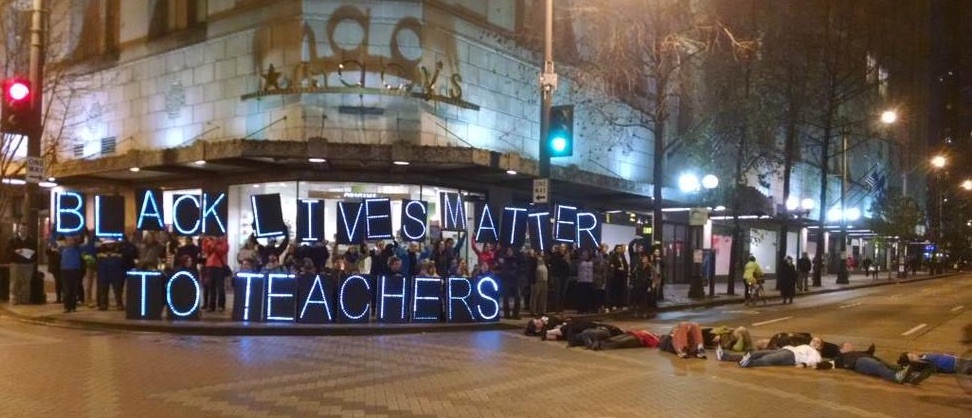
When the BLM group began to disrupt it was interesting to observe the crowd. I was there with a group of teachers. We stood next to a group of nurses. Some in our group have participated in seeking cultural competency training from Denisha Jones and have participated as white allies in BLM events. I was wearing my arm band from a Black Students Lives Matter event as my hat band — which I got at a Feb. 6 protest in Seattle, where I, with other teachers, used civil disobedience to block rush hour traffic by laying in the crosswalk at Westlake for 4 1/2 minutes to signify the importance of the life and the death of Michael Brown.
BLMteachers2

The crowd’s response showed they had mixed feelings about the BLM disruption as an act of civil disobedience. Some had traveled far to hear Bernie speak. Some did boo. But many also chanted “Let HER speak! Let HER speak!” Many of us whites were telling the other whites who were booing or talking during the time BLM was trying to speak to be quiet and let her speak. Whites in the crowd were shushing other A Firsthand Report on #BlackLivesMatter and Bernie Sanders - Living in Dialogue:

Test scores also measure effects of the opt-out movement - City & Region - The Buffalo News

Test scores also measure effects of the opt-out movement - City & Region - The Buffalo News:

Test scores also measure effects of the opt-out movement

School districts face possible funding loss


Area schools were at the epicenter of the opt-out movement for standardized tests earlier this year, and this is the week when districts will learn what effect the large number of students refusing to take the tests had on overall test results.
When the state releases the standardized test scores later this week, some districts will see whether the opt-out students affected the overall proficiency of their students. And some districts could face repercussions, including redirection of federal money, if too many students refused to take the standardized test and thus failed to meet federal requirements.
No school district in New York has ever faced financial sanctions because too few students took the state tests, and local educators are still not sure how the state will handle the opt-outs this year. And because many wealthier suburban districts get relatively little federal money, that sanction – even if imposed – might have little impact.
That’s why some educators believe the state will have to respond to what has swelled from a few hundred families refusing the test to a massive political movement that some estimate involves 200,000 students statewide, along with the influential teachers union.
“Opt-out is potentially a political movement that needs to be reckoned with,” said Donald A. Ogilvie, a former superintendent in Buffalo and Erie 1 BOCES. “As the numbers grow, it adds to the movement.”
Added to the mix is a new state education commissioner, who already has made it clear she sees the opt-out movement as a problem and intends to work with districts to put an end to it.
Whether that will come with mere persuasion, or a hammer, is yet to be seen.
“We have an issue we have to address,” Commissioner MaryEllen Elia told educators in Sweet Home last month. “The opt-out issue is very problematic.”
New York State has been giving standardized tests to students for years with little push back from parents and teachers. That was partially because the harshest penalties tied to the tests were largely felt by urban school systems receiving significant amounts of federal anti-poverty money the government could use as leverage to force sanctions. Most suburban school districts where students generally fared well had little to say about the annual testing.
That dynamic changed when state and federal leaders started pushing to use those standardized test scores as a factor in teacher evaluations.
That push came at the same time New York introduced the Common Core Learning Standards and accompanying tests, which are significantly tougher. Many traditionally high-performing school districts saw their performance dip.
The first year the test was given, the percentage of students statewide deemed proficient in Test scores also measure effects of the opt-out movement - City & Region - The Buffalo News:

Master teacher suing New York state over ‘ineffective’ rating is going to court - The Washington Post

Master teacher suing New York state over ‘ineffective’ rating is going to court - The Washington Post:

Master teacher suing New York state over ‘ineffective’ rating is going to court


Former New York State education commissioner John King, who is being sued by a N.Y. teacher over the state's educator evaluation system. (Mike Groll/AP File Photo)
Former New York state education commissioner John King, who is being sued by a N.Y. teacher over the state’s educator evaluation system. (Mike Groll/AP)


A veteran teacher suing New York state education officials over the controversial method they used to evaluate her as “ineffective” is expected to go to New York Supreme Court in Albany this week for oral arguments in a case that could affect all public school teachers in the state and even beyond.
Sheri G. Lederman, a fourth-grade teacher in New York’s Great Neck public school district, is “highly regarded as an educator,” according to her district superintendent, Thomas Dolan, and has a “flawless record”. The standardized math and English Language Arts test scores of her students are consistently higher than the state average.
Yet her 2013-2014 evaluation, based in part on student standardized test scores, rated her as “ineffective.” How can a teacher known for excellence be rated “ineffective”? It happens — and not just in New York.
The evaluation method, known as value-added measurement (or modeling), purports to be able to predict through a complicated computer model how students with similar characteristics are supposed to perform on the exams — and how much growth they are supposed to show over time — and then rate teachers on how well their students measure up to the theoretical students. New York is just one of the many states where VAM is one of the chief components used to evaluate teachers.
Testing experts have for years been warning school reformers that efforts to evaluate teachers using VAM are not reliable or valid, but school reformers, including Education Secretary Arne Duncan and New York Gov. Andrew Cuomo, both Democrats, have embraced the method as a “data-driven” evaluation solution championed by some economists.
Lederman’s suit against state education officials — including John King, the former state education commissioner, who now is a top adviser to Duncan at the Education Department — challenges the rationality of the VAM model used to evaluate her and, by extension, other teachers in the state. The lawsuit alleges that the New York State Growth Measures “actually punishes excellence in education through a statistical black box which no rational educator or fact finder could see as fair, accurate or reliable.”
It also, in many aspects, defies comprehension. High-stakes tests are given only in math and English language arts, so reformers have decided that all teachers (and, sometimes, principals) in a school should be evaluated by reading and math scores. Sometimes, school test averages are factored into all teachers’ evaluations. Sometimes, a certain group of teachers are attached to either reading or math scores; social studies teachers, for example, are more often attached to English Language Arts scores, while science teachers are attached to math scores. An art teacher in New York City explained in this post how he was evaluated on math standardized test scores and saw his evaluation rating drop from “effective” to “developing.”
A teacher in Florida — which is another state that uses VAM — discovered that his top-scoring students actually hurt his evaluation. How? In Indian River County, Fla., an English Language Arts middle school teacher named Luke Flynt told his school board that through VAM formulas, each student is assigned a “predicted” score — based on past performance by that student and other students — on the state-mandated standardized test. If the student exceeds the predicted score, the teacher is credited with “adding value.” If the student does not do as well as the predicted score, the teacher is held Master teacher suing New York state over ‘ineffective’ rating is going to court - The Washington Post:

Left-Right Alliance for Education: Multi-Partisan Opposition

Left-Right Alliance for Education: Multi-Partisan Opposition:

Left-Right Alliance for Education

We oppose the CCSSI because it continues the failed education reforms of the past and violates privacy rights as it builds a system for centrally managed student training for the future workforce of the “Global Economy.” This central goal will dismantle liberal arts education, which most contributes to the development of mature thinkers who are prepared to thrive in any chosen life path and sustain a free civilization.


Multi-Partisan Opposition

The Left-Right Alliance was formed as a spontaneous gathering of education advocates. Each of the participants volunteered their time to work toward our purpose and process, the effort received no funding. Our hope is that the work we have completed here will be a message that Stop Common Core efforts nationwide can endorse and utilize. The report below is the result of our efforts. (For more on our purpose and process see our "About Us" and "Purpose and Process" tabs)


We oppose the CCSSI because it continues the failed education reforms of the past and violates privacy rights as it builds a system for centrally managed student training for the future workforce of the “Global Economy.” This central goal will dismantle liberal arts education, which most contributes to the development of mature thinkers who are prepared to thrive in any chosen life path and sustain a free civilization.


After weeks of deliberate, methodical discussions on key points of current education reforms in the U.S., the Left-Right Alliance for Education has concluded that there is a solid foundation for multi-partisan opposition to the Common Core State Standards Initiative. Below are our statements of opposition to the CCSSI and the rationales for them.

  1. We oppose the philosophy of standardization built into all federal education initiatives, including the Common Core State Standards Initiative.
  2. We oppose high-stakes testing.
  3. We oppose a national student data system.


Our Rationale:


1. We oppose the philosophy of standardization built into all federal education initiatives, including the Common Core State Standards Initiative.

  • The CCSSI will expand the failed philosophy of standardization in an attempt to build a workforce-oriented school system at the expense of the greater characteristics of sound education.
  • Education policies based on the philosophy of standardization lead to a hyper-focus on quantifiable skills that fail to provide students with the instructional supports that develop mature thinkers prepared to thrive in any chosen life path.
  • These policies ignore accepted scientific research on human development and correlate education with the processes applied in the manufacturing sector; deluge kids with test taking and assignment rubrics; bore and frustrate; squash the love of learning; impede quality teaching; pit schools against parents, and fail to develop creative, mature human beings.
  • The standardization intrinsic in the CCSSI, and others like it, causes great harm to the development of children and is especially detrimental to disadvantaged children.
  • Local decision making for education and educational choice serve both students and teachers better, facilitating individualized learning and teaching styles instead of putting every child and teacher in the same box.
2. We oppose high-stakes testing.

  • The CCSSI high-stakes assessments lead to a hyper-focus on a narrow set of quantifiable skills at the expense of the greater characteristics of education founded in a broad curriculum.
  • These assessments rely on computer-generated testing, excludes other ways students demonstrate proficiency and progress, and ignore the fact that teachers and parents are best able to judge a student's progress.
  • The infrastructure and technology demands divert school and classroom resources away from those components that most impact student success.
  • High-stakes testing has transformed schools into centers for test preparation and chip away at a child’s innate love of learning.
  • Federal and state mandated high-stakes tests lead to excessive pressure on students and teachers and to bullying and punitive actions when parents choose to opt their children out of testing.


3. We oppose national student data systems.

  • We oppose the CCSSI P-20 State Longitudinal Data Systems being integrated across state lines with some data available to government agencies and research organizations without parental consent via U.S. DOE regulatory change.
  • We are concerned that these databases are not secure and unnecessarily expose student data to hacking, misuse, and publication, and violate the intent of protecting student privacy provided under FERPA.
  • The rush to implementation is enticing for-profit companies to provide products and services without accountability to parents, individual students, and taxpayers.
  • When coupled with highly predictive computer testing and learning data, which includes physiological and behavioral profiles, the database will store a “learning profile” that will follow students into their adult lives and may negatively impact future opportunities.
  • When commercial interests are combined with the core vision of the CCSSI to build a system for centrally managed student training with the purpose of fitting the future generation in a managed workforce for the “Global Economy,” the data systems may be the component that most concerns parents.
Left-Right Alliance for Education: Multi-Partisan Opposition:

Stop Privatization in California! | Diane Ravitch's blog

Stop Privatization in California! | Diane Ravitch's blog:

Stop Privatization in California!


It’s not too late to save public education in California! With Eli Broad and his fellow billionaires poised to privatize education in Los Angeles, it is time to say NO! Join the campaign to repeal the charter law in California.
Join Voices Against Privatizing Public Education’s efforts to repeal the California charter school law
There is a small grass-roots group that has been working diligently to create a ballot proposition to repeal the charter school laws. While a seemingly daunting task, there might not ever be another chance to do this before the privatizers eliminate public schools altogether (Eli Broad just announced his plans to cut LAUSD’s public schools in half). The group has an online petition that now has over 600 signatures. They also have a facebook group. (Open the link.)
Ballot Initiative to REPEAL the CA Charter School Act of 1992
Voices Against Privatizing Public Education
Most importantly, they have picked up a handful of key labor leaders and organizations:
AFT Local 6161 (Palomar Faculty Federation)
North County Labor Alliance
Escondido Public School Advocates
Bill Freeman- NEA Board member for California
Alita Blanc- United Educators of San Francisco
The coalition is working hard to get several more organizations on board, including local Democratic party clubs in several large cities. Please consider getting involved, and perhaps even endorsing the efforts of the group.Stop Privatization in California! | Diane Ravitch's blog:


Hillsborough school district has been dipping into emergency funds to cover MaryEllen Elia's Hole | Tampa Bay Times

Hillsborough school district has been dipping into emergency funds to cover expenses | Tampa Bay Times:

Hillsborough school district has been dipping into emergency funds to cover expenses


TAMPA — In the last four years of superintendent MaryEllen Elia's administration, the Hillsborough County School District went on a spending jag, tearing through more than half of its $361 million reserve fund, officials revealed this week.

Left unchecked, the pattern would have resulted in another operating deficit this year — a $75 million hit that would bring the fund down near its legal minimum threshhold.
The situation has surprised Elia's successor, unsettled School Board members and put bonding agencies on alert, which could lead to the district facing higher interest rates when it has to borrow money.
Jeff Eakins, who took over as superintendent after serving as Elia's deputy, says he was caught off guard when he realized the district used $68.5 million in non-recurring funds to meet this year's payroll.
"We're not in any kind of financial crisis," Eakins told the Tampa Bay Times editorial board Tuesday. But, he said, "we need to put some measures in place right now."
Eakins was careful not to criticize Elia, a onetime national finalist for superintendent of the year who, after her Jan. 20 firing in Hillsborough, landed a job as state education commissioner in New York.
Asked if he knew about the spending imbalance before Elia left in March, Eakins said, "not to this extent." Meeting one-on-one with School Board members in recent weeks, he was similarly discreet, said member Sally Harris. "He never mentioned names, just numbers," she said.
Elia's critics on the board were far less subtle.
"We have time and time again requested information that was not given to us, as has been documented for years in her evaluations," said board member April Griffin.
Added member Cindy Stuart: "To me, this validates every reason why we pushed the yes button to fire MaryEllen."
Elia did not return calls for comment Monday and Tuesday.
Board member Melissa Snively, who voted against firing Elia, said of the controversy, "I hope it doesn't overshadow the good things she did in this district. She did a lot of positive things for the children that put us on the map."
While disappointed to learn of the dwindling reserve fund, Snively said, "I'm not one to dwell on the past, except what we can learn from it."
Eakins said he is still gathering information as he tries to get a full understanding of the budget issue.
For example: Teachers were given pay raises in the summer after negotiations with their union. School Board members were told how much those raises would cost.
But those were estimates that fell short of the real number because they did not take into account a new pay structure offered under Empowering Effective Teachers, the system Elia initiated in 2009 with a grant from the Bill & Melinda Gates Foundation. That's because teachers don't decide whether they want Hillsborough school district has been dipping into emergency funds to cover expenses | Tampa Bay Times:

CURMUDGUCATION: So, I Have a Book

CURMUDGUCATION: So, I Have a Book:

So, I Have a Book

Curmudgucation


CURMUDGUCATION: What Fresh Hell

Authored by Peter Greene 
Peter Greene blogs about the current state of public education with plenty of sass and not much rigor. This book includes almost 100 favorites from his popular blogs Curmudgucation and View from the Cheap Seats, and makes the case that there is much to love at US public education and much not to take serious about many of the folks who want to tear down one of our most 
I am a fan of self-publishing. The new world of Print on Demand makes it possible to put just about anything in a book at little-to-no cost. I've used it to publish collections of pieces from my newspaper column, create book-like memorabilia for my tiny region, and to publish the history of the 159-year-old town band I play in. Every year I now collect the major project from my honors students and publish it in book form. For our first anniversary, I made my wife a book.

I'm old school. I think books are awesome. I think holding the object, turning the pages, feeling that sheet of paper move under my fingers as it shifts to reveal another field of words-- it's just awesome. Other things in the world, particularly the cyber-world, could vanish tomorrow without a trace, but a book is real, solid (yes, I know it will dry up and blow away eventually, but somehow, that's different).

So I've published a book for this blog, and I am pleased to say that it's available to the world.


The book is a collection of ninety-some pieces from this blog, and I feel it only fair to point out that there isn't anything in the book that you can't read right here for free. Some popular old favorites are in the book, like the Arne Duncan spleen piece and the Hard Part, a blog that blew up on Huff Post. If you would like your dosage of Curmudgucation in a handy read-on-the-porch-with-a-cup-of-coffee format, or if you've been trying to get people in your life to read about what's happening in education but they just hate that whole interwebs thing, this is one more available option.For me, this will be a handy Christmas gift for family members.

And if you prefer not to fund amazon, you can buy a copy directly from the publisher (which is owned by amazon, but Bezos will still get less of your money less directly).

At any rate, I'm pleased to offer rantings in a different format as one more way to get the word out. One thing I've learned over the years is that I'm very bad at doing the whole "Hey, buy my book," thing. But if you have enjoyed the blog and would like some copies of classic material in book form, hey, buy my book.
CURMUDGUCATION: So, I Have a Book:


ICYMI: Great Eduposts This Week

I missed last Sunday because vacation. But here's some of what you could be reading today.

About those charter school waiting lists

Here's a nice clear first-person account of how those wait lists get to be so large, and how little wait lists tell us about demand for charter schools. 

Why schools need more teachers of color-- for white students

We already know that there's no question about the benefits of having students see teachers who look like them. But having teachers of color is also hugely beneficial for white students as well.  

Is NOLA Experiencing Slave Market Education Reform

Reformsters are bummed. The release of the ERA report was supposed to unleash a storm of excitement about how awesomely successful the New Orleans school privatization experiment has been. Instead, pieces like Jennifer Berkshire's Salon article have folks questioning the whole business all over again. Jullian Vasquez Heilig storified some of the critical conversations coming out of #NOLAEdWarning so we can see just why folks aren't dancing in the streets, and just how much isn't being included in the NOLA PR blitz.

Want to know how a student is doing?

Wendy Lecker reminds us that parents already know how to find out how well their children are doing in school-- and it isn't to march to the office and demand to see Junior's standardized test results. 

The Hefty ad campaign

Yes, the Hefty trash bag folks, of all people, have launched a campaign hitting the idea that schools and teachers are underfunded and undersupported.

The suicide of the liberal arts

John Agresto takes to the pages of the Wall Street Journal to make a case for the liberal arts, and to argue that the discipline needs to be a better friend to itself.


ICYMI: Great Eduposts This Week

Louisiana Educator: New RSD Propaganda Machine Whitewashes Dismal Performance

Louisiana Educator: New RSD Propaganda Machine Whitewashes Dismal Performance:

New RSD Propaganda Machine Whitewashes Dismal Performance


The latest Recovery District propaganda machine is called theResearch Alliance for New Orleans. It was founded by Tulane University professor of economics, Douglas Harris. In this articleprinted in Education Next, Harris makes an attempt to paint the struggling Louisiana Recovery School District in New Orleans as a big success despite the dismal facts about student performance.

This faux research technique is used primarily to prevent us from noticing the extremely low performance of the New Orleans RSD in the ten years since Katrina

Harris uses a very dense and confusing array of research strategies to convince us to disregard the most basic data on the actual performance of the New Orleans charter schools comprising the RSD. He attempts instead to make obscure comparisons of growth in performance by matched groups that show that the RSD is succeeding in greatly improving student performance in New Orleans. Based on these obscure caparisons he concludes that the New Orleans "portfolio model" should be a model for turning around struggling schools across the nation. Harris utilizes a comparison of the RSD schools using a "difference between the two differences between the treatment and comparison groups" that supposedly "yields a credible estimate of the policy effect." This stuff is just gobbledegook! This faux research technique is used primarily to prevent us from noticing the extremely low RSD performance in the ten years since Katrina.

Don't believe your lying eyes! Harris wants to distract us from the actual performance of the charter schools administered by the RSD and have us focus only on his complex growth comparison analysis


Harris produces almost no actual data about the real performance of the New Orleans RSD. He does not tell us how the RSD now ranks in student performance (after ten years of reform) compared to all other school systems in the state, he does not tell us what the RSD graduation rate is, he does not discuss the average ACT scores, and he never mentions the RSD dropout rate. For most researchers (And for the parents of RSD students) these actual facts are very important as they paint a very sad picture of the real performance of the RSD. But Harris wants us to disbelieve our lying eyes and instead take his word for it that the RSD is a tremendous success and a model for reform across the Nation.


Here are the indisputable facts as verified by Louisiana Department of Education Data: