Latest News and Comment from Education

Saturday, July 11, 2015

At Cuomo Fundraiser in the Hamptons: Sea Air, Canapés and a Protest - WSJ

At Cuomo Fundraiser in the Hamptons: Sea Air, Canapés and a Protest - WSJ:

At Cuomo Fundraiser in the Hamptons: Sea Air, Canapés and a Protest

Governor has become primary target of group called the Hedge Clippers


Busloads of labor activists and liberal operatives are headed Saturday to a place where they won’t be welcome: A fundraiser for Gov. Andrew Cuomo at a sprawling estate in the Hamptons.
Mr. Cuomo has become the primary target of the group calling itself the Hedge Clippers that protests the governor’s policies and his ties to the wealthy.

Their rise comes as Mr. Cuomo contends with a growing rift within the Democratic Party between his centrist approach and the liberal base, much of which doesn’t like his cultivation of support from Republicans and many in business.
The target of the Hedge Clippers this weekend is a $5,000-a-person East Hampton event in honor of the governor hosted by Daniel Loeb, a top hedge-fund manager based in New York City. Mr. Loeb is also a political fundraiser who, like Mr. Cuomo, has sparred with teachers unions and championed charter schools.
The showdown has tony communities in the Hamptons slightly amused and slightly on edge.
“Dan Loeb is thick-skinned and relishes a fight,” said Euan Rellie, an investment banker who summers in the Hamptons and is a friend of Mr. Loeb’s. “But no successful business person wants to be seen as a remote billionaire living with pitchforks at the hedges. Who would want that?”

The activists plan to fly aerial banners over the grounds of the Loeb mansion as Mr. Cuomo’s donors nibble canapés and sip cocktails on the lawn.
To be sure, Mr. Cuomo is hardly the only politician to be met with protesters at some of his events. But the Hedge Clippers are trained largely on one politician, and their pockets are deep.
Funded by the American Federation of Teachers, the group has been galvanizing liberal activists in Albany, Washington, D.C., and New York City since February.
“The larger point is the governor of New York should listen to everybody, not just the billionaires in the Hamptons,” said Michael Kink, a former state Senate aide who now runs a union-backed activist group and said he planned to attend the protest.
Multiple hedge-fund managers who declined to speak for attribution said they appreciated Mr. Cuomo’s opposition to new taxes and saw him as a politician interested in compromise.
They said they believed that charter schools were a better alternative to some of the city’s troubled schools. Many hedge funders identify as libertarians, said people in their industry, and don’t support a particular party.
Mr. Loeb was among a group of hedge-fund managers who helped raise money in support of same-sex marriage, which Mr. Cuomo signed into law in 2011.
He is chairman of a charter-school network that has been allied with Mr. Cuomo. The At Cuomo Fundraiser in the Hamptons: Sea Air, Canapés and a Protest - WSJ:

SN&R's owner chimes in on the K.J. lawsuit - Sacramento News & Review

Sacramento News & Review - SN&R's owner chimes in on the K.J. lawsuit - Greenlight - Opinions - July 9, 2015:

SN&R's owner chimes in on the K.J. lawsuit


Strong mayor. Weak mayor. Silly mayor.
We have had a bizarre week at SN&R, ever since learning that the mayor planned to take us to court. There’s been national coverage, including USA Today and the Los Angeles Times. Our website crashed from too much traffic. On Wednesday evening there were three local TV station vans parked outside our office. And even The Sacramento Bee, which usually ignores our existence, mentioned our name.
This all came from a simple public-records request, followed by Mayor Kevin Johnson’s nutty reaction. He actually threatened to sue a newspaper for filing a public-records request.
Now, maybe there has been another public official who has threatened to sue a newspaper for filing a public-records request—but, if so, I have never heard of it. It was certainly a bold move. And the mayor likes to be bold. But perhaps he should have looked before he leapt.
According to the machine at Raley’s that measures your blood pressure, I have low blood pressure. But mention the word “lawsuit” and it instantly goes up. But although our newspapers regularly go after people and institutions with a lot of money and power, SN&R has, over the years, had a comparatively small legal bill.
But expensive lawsuits are like tuberculosis: Just because you have not had it yet does not mean it cannot kill you. The problem with lawsuits, from my experience, is the cost. Lawsuits routinely cost hundreds of thousands of dollars. What I fear even more than losing a lawsuit is losing our company to pay the legal fees from a lawsuit.
Nevertheless, when I heard that the mayor had threatened us with a lawsuit, I assumed he was just trying Sacramento News & Review - SN&R's owner chimes in on the K.J. lawsuit - Greenlight - Opinions - July 9, 2015:

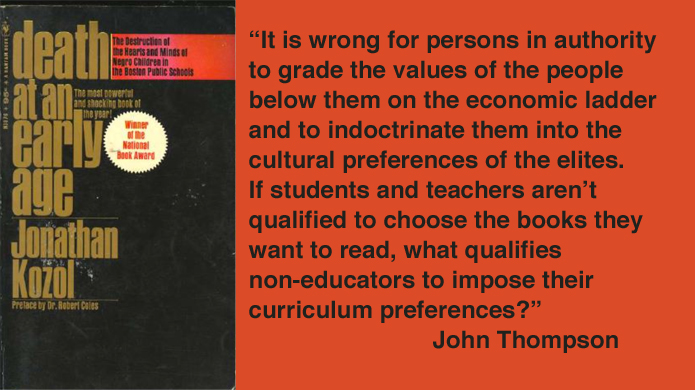
Jonathan Kozol's Death at an Early Age Is Still a Must-Read | John Thompson

Jonathan Kozol's Death at an Early Age Is Still a Must-Read | John Thompson:

Jonathan Kozol's Death at an Early Age Is Still a Must-Read


Rereading Jonathan Kozol's Death at an Early Age on the 50th anniversary of his firing from the Boston Public School System is to be forced to confront the unrelenting horror of school segregation. Its subtitle is The Destruction of the Hearts and Minds of Negro Children in the Boston Public Schools.
We first meet Kozol's 4th grade student, Stephen, who talks to himself and stares "with unusual concentration at a chosen spot on the floor." Stephen is beaten in his foster home, and ridiculed and subjected to corporal punishment at school.
Before long, we read about Frederick who is hospitalized after suffering an injury when he moved his hand as he was punished. The teachers who do the beatings might, in all other instances, seem to be decent persons, but the way they make a fetish out of inflicting pain on children seems inexplicable. When a mistake is made and a child is injured, the perpetrator forcefully protests that he "done the whipping right." But, as Kozol explains:
When you hear of a sixty pound mentally ill fourth grader being guarded by two men and whipped by a third for acts that are manifestly crazy, and when the teacher who prepares the punishment is not only gleaming with excitement but has, not ten days before, been speaking of the niggers Down South or the little bastards causing trouble up there in room four, then ... something has gone wrong.
Teachers didn't seem to notice when an emotionally disturbed child walked backwards up the stairs or made frog noises as he hopped like a frog. It was easier to dismiss such children as impossible to teach, and resort to physical punishment. Even the Reading Teacher, who appeared to be one of the better of the educators, reacted cruelly to a student who cried when he fell behind in reading. She told the struggling student, "'I'll not have it.'" When doing so, the Reading Teacher was "virtually seething with her decision-making power."
Neither did the teachers notice the "bright and attractive and impatient Negro girl who showed her hatred for school and teacher by sitting all day with a slow and smoldering look of cynical resentment." Only Kozol, it seemed, appreciated the creative insubordination of the boy who was asked the antonym of dry and replied "isn't there something called a dry martini?"
The faculty seemed united in its condemnation of Kozol's building of personal relationships with students, giving kids gifts and driving them home after school, as Jonathan Kozol's Death at an Early Age Is Still a Must-Read | John Thompson:

Washington Post writes the most embarrassing, awful profile of Arne Duncan ever, completely misses the point - Salon.com

Washington Post writes the most embarrassing, awful profile of Arne Duncan ever, completely misses the point - Salon.com:

Washington Post writes the most embarrassing, awful profile of Arne Duncan ever, completely misses the point

Arne Duncan has been a monumental flop as education secretary. Why is the Washington Post drinking his Kool-Aid?


For some years now, the term “The Village” has circulated throughout the Internet blogosphere as a shorthand description of the insular life of the Washington, D.C., policy makers and media mavens. As Heather “Digby” Parton explained in 2009, the term is a metaphor for how Beltway folks in policy circles and the press speak with great assurance about what is understood by “average Americans” without ever actually consulting anyone outside a tight circle of anointed “experts” or dipping their toes into the experiential waters of communities very different from their own.
Although thoughts attributed to The Village are most apt to be shared in discussions about economic policy, there is a form of Village narrowcasting in education policy discussions too.
That’s why, for instance, you almost always see news articles about education policy liberally salted with quotes by operatives from a very select few right-wing and politically centrist Beltway policy shops, such as the Thomas B. Fordham Institute, the American Enterprise Institute, the Education Trust, or Democrats for Education Reform.
When reporters want to “balance” that wonkery with another point of view, they might get a statement from a teachers’ union representative such as American Federation of Teachers president Randi Weingarten. But what’s extremely rare is to encounter arguments being made by people of color in communities such as New OrleansChicagoPhiladelphia, or New York City – you know, the people actually most affected by the kinds of policies being talked about.
Maybe journalists believe ordinary citizens with firsthand experiences can’t be regarded as “experts.” But even when they look for validated expertise, their gaze rarely goes beyond the banks of the Potomac.
This is not to say that those inhabiting the education wing of The Village are dishonest people, lack credibility, or have any bad intentions – or that it may be arguable that people who report about education generally have more journalistic integrity than reporters on other beats. It’s just that when conversations about something as important as public education seem extraordinarily closed off to but an elite few, there are bound to be some completely unsubstantiated claims and atrocious misperceptions being reported by what normally would be considered reliable sources.
That’s likely the dynamic that caused Lyndsey Layton, a normally super-competent education journalist for The Washington Post, to lay this brontosaurus egg in that outlet.
The subject of Layton’s reporting, U.S. Secretary of Education Arne Duncan, was thebipartisan stud when the Obama administration debuted but has now devolved into the bipartisan flop as new bills in Congress seek to do all they can to neuter the secretary and make sure future secretaries never do what he did ever again.

Geaux Teacher!: BESE Candidate Lee Barrios Endorsed by "Louisiana Educator"

Geaux Teacher!: BESE Candidate Lee Barrios Endorsed by "Louisiana Educator":

BESE Candidate Lee Barrios Endorsed by "Louisiana Educator"


Posted: 10 Jul 2015 07:28 AM PDT

Why the John White Controlled BESE is Wrong for Louisiana

All elected seats for BESE will be up for election in the October 24, 2015 primary election. There are 8 elected members on BESE that run in districts similar to the old Louisiana Congressional Districts. Five of the present elected members have been closely aligned with State Superintendent John White and have consistently voted for policies that have done great damage to our public education system and to the status and wellbeing of our professional educators. It is my hope that these individuals will be defeated and replaced by persons who believe in public education governed by local voters and our elected local school boards. We need candidates who respect professional educators and who value their professional opinion on education matters. 

There are three elected members of BESE that have stood for local control, and that have opposed policies that are harmful to public education who should be reelected. These very positive, pro-public education members of BESE are Dr Lottie Beebe representing the 3rdBESE district,  Mary Harris representing the 4th BESE district, and Carolyn Hillrepresenting the 8th BESE district. I am asking my readers who live and vote in these three districts to please vote for and assist these good BESE members in getting reelected.

The flawed policies of the John White majority on BESE

·      Privatization of public schools: The John White controlled faction of BESE has consistently supported the approval of privately managed charters schools that use MFP funding over the objection of our local school boards. These charter managers are not responsible to the voters in each local district and can pocket a large percentage of our tax dollars without voter approval and at the same time deliver a substandard education to Louisiana children. Some takeover school managers have been allowed to choose their own governing agency and are not being returned to the local school boards as the original law intended.  This is an abuse of public trust.
·      Substandard accountability for Charter and Voucher schools: The John White controlled faction of BESE allows some voucher and charter schools to operate without proper professional staff and facilities. This shortchanges the students attending these schools financed by our tax dollars. Some of these privately managed schools use mandatory entrance interviews to cull out hard to educate students and serve fewer handicapped students, (This fact has been documented by a lawsuit against the Recovery District and the LDOE) Many charter schools dump discipline problems and low performers back to the real public schools, and counsel out students that would lower their school performance scores.
·      Unfair VAM Evaluations of Teachers:The John White controlled faction on BESE has approved BESE polices that require 10% of all VAM rated teachers must be found to be ineffective each year even if overall student performance on state standards improves. This inherently unfair and error plagued process for teacher evaluation that is driving away good teachers will not be changed as long as White controls the majority on BESE.
·       Damage to the Teacher Retirement System: Present BESE policy allows charter schools and voucher schools to opt out of the teacher retirement system while still retaining the full MFP allocation for each student. This policy puts a growing burden on our local school boards and provides a windfall profit to the charter managers.
·      Refusal to consider legitimate criticisms of Common Core by parents and teachers: The John White faction of BESE has repeatedly ignored legitimate complaints that portions of the Common Core standards are not age appropriate and that some methods required by the standards are impractical and counter-productive. The only reason the standards are now being reviewed is because the legislature and the governor have demanded it in recent legislation.
·      Control by Out-of-State Interests: The biggest problem with our John White aligned majority on BESE is that they are basically controlled by out-of-state and privatizer interests. Big contributors such as Michael Bloomberg, Lane Grigsby, K-12 Virtual schools, USA Charter Schools,  and Teach for America supporters, all make huge contributors to BESE campaigns with the condition that their candidates will support John White in basically all his policies. This puts one person (who is not even qualified to serve as an assistant principal) with a flawed philosophy in charge of our educational system instead of the parents and taxpayers. These BESE members must be changed if we are to restore local control of our public school systems and to prevent misuse of our tax dollars.  Our public education system was set up to insure that all children have an opportunity to get properly educated. It was not set up so that profiteers could make money using our tax dollars. The issue of school choice has been perverted to serve the interests of a few wealthy contributors to BESE and legislative campaigns who are misusing our school taxes while shortchanging students. Only the defeat of the John White "yes" men and women on BESE will change this trend.

The following candidates have great credentials and platforms to serve on BESE and have made it clear that the John White privatization machine will not control them:

District 1; Candidate Lee Barrios, is a retired educator who has been very active in supporting parents and educator rights. This district includes St Tammany, Northern Jefferson and part of Orleans. Click here for her Facebook page.

District 2; No challenger has announced yet for the district, which includes much of Orleans, St Charles, St John and St James. 

District 3; Incumbent Dr Lottie Beebie represents southern St. Landry, southern Pointe Coupee, St. Martin, Iberville, Iberia, St Mary, Terrebonne, Lafourche, southern Jefferson, St. Bernard and Plaquemines. She is the local superintendent for St. Martin Parish Click here for her Facebook page. Email is lotteb@cox.net.

District 4; Incumbent Mary Harris is a school principal in Caddo Parish and has proven that she will be independent and support professional educators and parents. This district includes Caddo, Bossier, Webster, Bienville, Red River, Desoto, Sabine, Natchitoches, Winn, and Vernon. Click here for her Facebook page. Email is HarrisforBESE4@yahoo.com

District 5; Candidate Johnny Fatheree is an excellent well educated candidate who supports reading improvement in the place of endless testing and opposes Common Core. He believes in supporting professional educators. This district includes the parishes of: Claiborne, Union, Morehouse, E. Carroll, W. Carroll, Madison, Richland, Ouachita, Jackson, Caldwell, Franklin, Tensas, Concordia, Catahoula, LaSalle, Grant, Rapides, and Evangeline. Click here for his Facebook page. Email: fatheree1953@yahoo.com. Campaign contributions to: PO Box 976 Farmerville, LA 71241.

District 6; Candidate Jason France is a parent of public school children, is an expert in state education policies and opposes Common Core and state and federal interference in our schools. His blog, Crazy Crawfish has exposed some of the most serious improper conduct of John White and his administration. This district includes the southern portion and far North portion of East Baton Rouge Parish,  and all of Ascension, Livingston, Tangipahoa, and Washington Parish. Click here for his web site. It includes a contribution button and volunteer button. Email is jasonfrance@hotmail.com

District 7; Candidate Michael Kreamer is a school principal who has made his position clear in opposition to school privatization and interference in our schools by federal authorities. This district includes Beauregard, Allen, Calcasieu, Jeff Davis, Acadia, Lafayette, Vermilion and Cameron. Click here for his Facebook page. Email: kreamermt@cox.net. Contributions may be sent to MikeKreamerforBESE7, 2851 Johnston St., Lafayette, LA 70503.

District 8; Incumbent Carolyn Hill is a professional school social worker who has repeatedly taken firm stands against the John White machine. She has shown true compassion for our students and supports parent and educator rights. Click here for her Facebook page. 

Another important source of BESE election information is the Flip BESEFacebook Page.

Please visit the Facebook page of the candidate in your district and offer them the support they will need to go up against the big money supporting the John White faction of BESE. Small contributions from many people can make a big difference. Please "like" your candidates' Facebook page and send it to all your friends with your recommendation of support. Or you could help in the old fashioned way by just talking to your friends and relatives about supporting the good candidates that will help us to Flip BESE!Geaux Teacher!: BESE Candidate Lee Barrios Endorsed by "Louisiana Educator":

CURMUDGUCATION: Jeb: Beware Big Words

CURMUDGUCATION: Jeb: Beware Big Words:

Jeb: Beware Big Words


Well, here's another possible explanation for why Jeb Bush favors reformster policies for breaking down public education and selling off the parts.

Jeb sat down for an interview with the New Hampshire Union Leader, and as written up, it presents a fairly boilerplate Bush campaign talk. The Union Leader reported one section of the interview like this:

"We don't have to be the world's policeman, but we have to be the world's leader," Bush said. "If we're not leading, that creates chaos and a more dangerous world." 


ave to be the world's policeman, but we have to be the world’s leader," Bush said. "If we're not leading, that creates chaos and a more dangerous world."
- See more at: http://www.unionleader.com/article/20150709/NEWS0605/150709206/0/FRONTPAGE#sthash.8Yj14IrD.dpuf
"We don’t have to be the world's policeman, but we have to be the world’s leader," Bush said. "If we're not leading, that creates chaos and a more dangerous world."
- See more at: http://www.unionleader.com/article/20150709/NEWS0605/150709206/0/FRONTPAGE#sthash.8Yj14IrD.dpuf
But when C-Span took a look at the raw footage, they discovered that the Union Leader might have cleaned that quote up for Jeb a bit. The full quote sounds a little more like this:

You don’t have to be the world’s policemen, but you have to be the world’s leader and there’s a huge difference. This guy — this president and Secretary Clinton and Secretary Kerry – when someone disagrees with their nuanced approach where it’s all kind of so sophisticated it makes no sense. You know what I’m saying? Big syllable words and lots of fancy conferences and meetings and – We’re not leading. That creates chaos. It creates a more dangerous world. So restoring the alliances that have kept the world safer and our country safer – getting back to a position in the 
CURMUDGUCATION: Jeb: Beware Big Words:


WI: Cheering Public Ed Destruction


The Wisconsin Legislature passed a budget this week that dumps more funding into the already-robust voucherific choicetastic system in Wisconsin. All the budget needs is a signature from Governor Scott Walker, and the only way Walker wouldn't approve such move would be if he were disappointed that it didn't explicitly end public education and replace public school teachers with minimum-wage temps.

Also cheering for this are the boys at the Heartland Institute, a thinky tank devoted to free market causes and a better world where rich people are free to do as they wish and poor people live the crappy lives they deserve.

But these quotes certainly show what free market folks want. No surprises here, but it's nice to see them in their own words.

"This budget shows Wisconsin legislators are taking improving education seriously. They are doing so by recognizing that throwing more money at a broken public education system in need of systemic change is not the answer," says Heather Kays. She does not go on to say, "But they do recognize that 


WI: Cheering Public Ed Destruction


Florida Charter Scam (Part 23,174)


Can you read one more story about how a charter school was used to scam taxpayers and make one more amateur education expert rich?

This one comes from Florida, courtesy of Andrew Marra at the Palm Beach Post. I'll give you the highlights; you should follow the link for the full deal.The story is one more example of how a charter school can be used as a giant money funnel, even if it wears the noble "non-profit" badge.

Gregory James Blount was a 40-ish-year-old former model and events producer who was working his way out of bankruptcy by teaching modeling and acting classes when he decided that getting into the charter school biz seemed like a fine career move. He recruited Liz Knowles, a teacher and private school chief, to run the school and write his "Artademics" curriculum. But Knowles walked away from Blount soon after (final straw-- discovering he had created a Artademics company to cash in). Knowles recalled Blount's argument for her to stay. "Don't worry, :Liz. You'll be rich."

The Eagle Arts Academy opened up, and Blount was cashing in. What's repeatedly impressive about these scam schools is that even people with no education experience or even successful business 


Florida Charter Scam (Part 23,174)

State’s most vulnerable children get their day in court by Wendy Lecker - Wait What?

State’s most vulnerable children get their day in court by Wendy Lecker - Wait What?:

State’s most vulnerable children get their day in court by Wendy Lecker


Wendy Lecker is one of Connecticut’s most outspoken education advocates.  As senior attorney at the Education Law Center, she has helped lead critically important school finance lawsuits.  Wendy Lecker is also a column list for the Hearst Connecticut Media Group.  The week she reports on Connecticut’s vital CCJEF v. Rell School Funding Lawsuit.
Once supporters for ensuring Connecticut has a fair and equitable school funding formula, Governor Dannel Malloy and Attorney General George Jepson are now leading the effort to ensure that Connecticut’s public school students and Connecticut’s local property taxpayers don’t get the help they need and deserve.
Wendy Lecker explains,
Connecticut’s elected officials have steadfastly refused to fix our school finance system, which leaves schools underfunded and local property taxpayers overburdened. Public school students and local property taxpayers will finally have their day in court when Connecticut’s school funding case, CCJEF v. Rell, starts trial in October. It is now important to understand some of the basic tenets in school finance.
First, all children have the constitutional right to school resources sufficient for an education enabling them to participate in democratic institutions, attain productive employment, or progress to higher education.
Second, it costs more to educate some children than others. Children living in poverty often require more services than children who do not. The stresses associated with poverty affect brain development, often leaving children with behavioral and cognitive difficulties. As a result, schools serving poor children need specific resources, such as: social workers, behavioral therapists, psychologists, learning specialists, small classes.
Children learning English require more services than those already proficient. The services necessary to help a child learn English are different than those needed to support a child who lives in poverty. Similarly, children with disabilities require additional services.
Third, some municipalities cannot raise as much revenue as others, and therefore need more state school aid. Often, those municipalities serve the highest concentration of the neediest — and therefore most expensive to educate — children.
These cornerstones of school finance are universally accepted and understood. They form the bases of school funding systems across the nation. They undergird the CCJEF plaintiffs’ case. Essentially, the plaintiffs claim Connecticut has underfunded its public schools in large part because the state school finance system does not accurately account for the cost of education in general, the cost of educating students with additional needs or a 
State’s most vulnerable children get their day in court by Wendy Lecker - Wait What?:

Denied Special Education Services: Parents Push Back for Students

Denied Special Education Services: Parents Push Back for Students:

Young woman lifts hands in defense.

Denied Special Education Services: Parents Push Back for Students

The outrage concerning diminishing services in special education has recently surfaced in in three different places—Chicago, Fairfield, CT, and the State of Alabama. There are interesting similarities, and these places are certainly not alone when it comes to special education cuts.
NOTE: If you would like to share what is happening to special education where you live, let me know. Feel free to comment. Or, I will post it. You can also write about it if you would like. I won’t use your name unless you give me permission. Let’s put together all the scenarios and shenanigans surrounding harmful special education cuts and how they are hurting children and families. What are the similarities? How are parents pushing back?
Also, if you know of attorneys who deal with special education cases, let me know that too. I’ll add it to the website.
In Chicago, Mayor Rahm Emanuel, and his team, are cutting 1,058 school staff and will also refuse to fill 350 other vacancies. A big concern is that those bearing the biggest brunt of the cuts are involved with special education.
Jesse Ruiz, the interim Chicago Public School CEO said the cuts were “painful and intolerable” but blamed the state. I really hate the business-like term CEO when talking about schools. But I digress.
Ruiz further worried everyone by saying Chicago Public Schools would move special education students out of their special cluster programs into neighborhood schools. The concern is that they will be pulling students with disabilities out of special education and putting them into regular education classes.
Is this allowed on the Individual Educational Plan (IEP)? Are they breaking the law surrounding Individuals with Disabilities Education Act (IDEA)? Also, how many real educators, including those with preparation to work with students with disabilities, and Denied Special Education Services: Parents Push Back for Students:

NPE Statement on the Every Child Achieves Act – The Network For Public Education

NPE Statement on the Every Child Achieves Act – The Network For Public Education:

NPE Statement on the Every Child Achieves Act


There is much we applaud in the Every Child Achieves Act (ECAA). Although the bill is far from perfect, it is better than the status quo.  ECAA represents a critical step forward, placing an absolute ban on the federal government intervening in how states evaluate schools and teachers. It bars the US Department of Education from either requiring or incentivizing states to adopt any particular set of standards, as Arne Duncan did through Race to the Top grants and NCLB waivers.
The Every Child Achieves Act would prohibit the federal government from requiring that teachers be judged by student test scores and would prevent the federal government from withholding funds from states that allow parents to opt out of testing, which Duncan most recently threatened to do to the state of Oregon.
And it would take the federal “high-stakes” from annual testing—the consequences of which have a disparate negative impact on students of color and those of highest need.
ECAA does not “lock in” the Common Core, but rather allows the states to set their own standards without having to meet a litmus test set by the federal government.  States could thoughtfully design and revise standards and their teacher evaluation systems with stakeholders, without fear of losing a waiver that protects their schools from being labeled as failing.
Below is the relevant language that expressly prohibits the federal government from exerting influence on standards, curriculum and teacher evaluation, followed by the language that prohibits the federal government from interfering in parental decisions to opt out of state tests:
“(a) Prohibition Against Federal Mandates, Direction, Or Control.—Nothing in this title shall be construed to authorize the Secretary or any other officer or employee of the Federal Government to mandate, direct, or control a State, local educational agency, or school’s—
“(1) instructional content or materials, curriculum, program of instruction, academic standards, or academic assessments;
“(2) teacher, principal, or other school leader evaluation system;
“(3) specific definition of teacher, principal, or other school leader effectiveness; or
“(4) teacher, principal, or other school leader professional standards, certification, or licensing
“(K) RULE OF CONSTRUCTION ON PARENT AND GUARDIAN RIGHTS.—Nothing in this part shall be construed as preempting a State or local law regarding the decision of a parent or guardian to not have the parent or guardian’s child participate in the statewide academic assessments under this paragraph.
Even as we support the above, we disapprove that the bill does not go far enough to meet the justified concerns of those who support our public schools. The federal government should cease providing financial support for privately managed charter schools that drain much needed resources from the public schools that enroll the vast majority of our students–caring for all and turning none away.
We are also dismayed that the bill maintains an annual testing mandate–which enriches testing companies while distracting us from the needed work to be done to improve our public schools.
We will continue to fight to restore ESEA to its original purpose of providing equity for the most disadvantaged children. We support the concerns raised by the coalition of Civil Rights groups who do not see testing as the answer to improving our schools. We will also continue to NPE Statement on the Every Child Achieves Act – The Network For Public Education:

GOP senator: Let states fix No Child Left Behind | TheHill

GOP senator: Let states fix No Child Left Behind | TheHill:

GOP senator: Let states fix No Child Left Behind


Sen. Lamar Alexander (R-Tenn.) on Saturday said giving states power over their education systems could fix the No Child Left Behind bill.
“Not only is there consensus about the need to fix No Child Left Behind, but there’s also remarkable consensus about how to fix it,” Alexander said in the GOP’s weekly address.
“That consensus is this: Continue the law’s important measurements of academic progress of students but restore to states, school districts, classroom teachers and parents the responsibility for deciding what to do about improving student achievement,” he said.
Alexander argued No Child Left Behind’s complicated set of educational standards is causing “anxiety and confusion” in school systems nationwide.
He blamed his fellow lawmakers for repeatedly failing in attempts at reforming the legislation.
“No Child Left Behind expired in 2007 but Congress has been unable to agree on how to reauthorize it,” Alexander said. 
“As a result, the law’s original requirements have stayed in place and gradually become unworkable,” he said.
Alexander said the law’s Common Core academic standards, teacher evaluation rules and standardized testing are now flummoxing 50 million children across 100,000 public schools.
“How well our children are learning is much more important than any political game,” he said.
“If fixing no Child Left Behind were a standardized test, Congress would have earned a failing grade for each of the last seven years we couldn’t agree to fix it,” Alexander added.
Alexander touted his proposed Senate bill fixing the law’s flaws.
“Our bill will help states improve their early education programs, evaluate teachers if they would like, and expand high-quality charter schools – but it will not tell them how to do it,” he said.
“Our bill also prohibits the federal government from telling states what their standards must be, or mandating or coercing them to use a certain set of standards,” he added.
“In other words, whether your state adopts Common Core is entirely your state’s decision,” Alexander said.
The House narrowly voted 218-213 to reauthorize No Child Left Behind on Wednesday.
The Senate is working on a potential reform bill next week.GOP senator: Let states fix No Child Left Behind | TheHill:

Can the Zeldin Amendment End Common Core?

Can the Zeldin Amendment End Common Core?:

CAN THE ZELDIN AMENDMENT END COMMON CORE?


An amendment was successfully added to the Student Success Act that could possibly bring an end to Common Core. This week, the US House narrowly passed the reauthorization of HR 5 (the Student Success Act). HR 5 is the controversial proposed replacement for the No Child Left Behind Act (NCLB). The amendment, authored by conservative 
Rep. Lee Zeldin (R-NY)
67%
, would allow a state to opt-out of Common Core “or other specific standards” without reprisals from the feds. It passed with overwhelming bi-partisan support in a 373-57 vote.


The eponymous Zeldin Amendment is a two sentence piece of legislation that says a state can withdraw from Common Core or any other specific standards without penalty or punishment from a government agent. The intent is to remove the fear of losing federal funds and bring control of education decisions back to the state and local level.
The amendment reads:
SEC. 6532. STATE CONTROL OVER STANDARDS.
(a) IN GENERAL.—Nothing in this Act shall be construed to prohibit a State from withdrawing from the Common Core State Standards or any other specific standards.
(b) PROHIBITION.—No officer or employee of the Federal Government shall, directly or indirectly, through grants, contracts or other cooperative agreements, through waiver granted under section 6401 or through any other authority, take any action against a State that exercises its rights under subsection (a).
Can it end Common Core, though?
After the amendment passed, Zeldin told Breitbart Texas via email, “This is the single most important action Congress can take to make it crystal clear that states can withdraw from Common Core without fear of penalty from the federal government.”
As a New York state senator, Zeldin fought ferociously against Common Core. “The biggest complaint I received about why New York State couldn’t opt out of Common Core was because the state would lose federal funding,” he recently told Breitbart Texas in a phone conversation.
He blamed the “bureaucrats at the Department of Education in Washington threatening to financially penalize the state when I had introduced legislation that would have stopped Common Core in New York State.”
Zeldin said he introduced the amendment “to address the issue where states are not withdrawing from Common Core out of fear that they will be financially penalized from Can the Zeldin Amendment End Common Core?:

GOP Address: Sen. Lamar Alexander Calls For Long-Awaited Fix To No Child Left Behind - KMBZ

GOP Address: Sen. Lamar Alexander Calls For Long-Awaited Fix To No Child Left Behind - KMBZ:

GOP Address: Sen. Lamar Alexander Calls for Long-Awaited Fix to No Child Left Behind


(WASHINGTON) -- Senator Lamar Alexander, R-Tenn., presses for the passage of an education reform bill in the U.S. Senate that is designed to fix flaws in the 2001 No Child Left Behind Act.

"Not only is there consensus about the need to fix No Child Left Behind," Alexander explains, "but there's also remarkable consensus about how to fix it." The education law, which expired in 2007, has left Congress at a loss as to how to reauthorize it, leaving its original requirements in place to the point where Alexander calls them "unworkable."

The new bill, he explains, would "[prohibit] the federal government from telling states what their standards must be, or mandating or coercing states to use a certain set of standards." In other words, it would allow the state to decide on its own whether to adopt Common Core standards or not.

"Our bill will help states improve their early childhood education programs, evaluate teachers if they would like, and expand high-quality charter schools -- but it will not tell them how to do it," Alexander explains.
The Tennessee Republican concludes by saying that "if fixing No Child Left Behind were a standardized test, Congress would have earned a failing grade for each of the last seven years...I hope this time around, Congress will improve its grade and improve the future for 50 million children."
Read the full transcript of the Republican address:
“Hello, I’m Senator Lamar Alexander.

“This week and next, Congress is working on what a national news magazine called ‘the education law that everyone wants to fix.’

“That law, of course, is No Child Left Behind, enacted in 2001 and today causing confusion and anxiety in our country’s 100,000 public schools.

“Not only is there consensus about the need to fix No Child Left Behind, but there’s also remarkable consensus about how to fix it.  

“That consensus is this: Continue the law’s important measurements of academic progress of students but restore to states, school districts, classroom teachers and parents the responsibility for deciding what to do about improving student achievement. 

“This change should produce fewer tests for our students and more appropriate ways to measure their achievement. It is the most effective plan to advance higher state academic standards, better teaching, and real accountability. 

“How did our schools get in such a fix? There’s plenty of blame to go around.

“The problems with No Child Left Behind have been created by a combination of presidential action and congressional inaction.

“No Child Left Behind expired in 2007 but Congress has been unable to agree on how to reauthorize it. As a result, the law’s original requirements have stayed in place and gradually become unworkable. This has caused almost all of America’s public schools to be classified as failing under the terms of the law.

“So, to avoid this bizarre result, President Obama’s Education Secretary offered waivers from the terms of the law. But in return, the Secretary told each of the 42 states currently operating under waivers exactly what academic standards to use, exactly what steps to take to address failing schools, and exactly how to evaluate teachers.

“So much new federal control of local schools has produced a backlash against Common Core academic standards, against teacher evaluation, and against tests in general.

“Governors and chief state school officers complain about federal overreach. Infuriated teachers say that the U.S. Department of Education has become a ‘National Human Resources Department or,’ they say, ‘in effect, a national school board.’
  
“No issue has stirred as much controversy as testing. No Child Left Behind required students to take 17 standardized tests over the course of their Kindergarten through the 12th grade education, and it attached high stakes for schools, school districts, and states to the results.

“As we studied the problem, the issue seemed not to be so much the federal tests, but the stakes attached to them.

“A third grader, for example, is required to take only one test in math and one in reading.

“But the accountability system for what to do about the test results has contributed to the exploding number of state and local tests—they were given to prepare students for the high-stakes federal tests.

“So our proposal maintains the reading, math and science tests established in 2001. The test results would be reported publicly so parents know how their children are performing – and the results are ‘disaggregated,’ so parents know how students of a particular gender, ethnicity, or disability are doing.

“But it ends the high stakes system that caused the cascade of tests. Instead, we restore state and local responsibility for creating systems to hold schools and teachers accountable.

“Our bill also prohibits the federal government from telling states what their standards must be, or mandating or coercing states to use a certain set of standards.

“In other words, whether your state adopts Common Core is entirely your state’s decision. 

“Our bill will help states improve their early childhood education programs, evaluate teachers if they would like, and expand high-quality charter schools – but it will not tell them how to do it.

“This bill has the support of teachers’ organizations, school superintendents, school board members, chief state school officers and governors.

“The bill is just one more example that Congress is back to work and dealing with important issues that secure our country from overseas terrorism and make us stronger at home.

“In the last two Congresses, discussions fell apart because of partisan differences. This year, Senator Murray, the Senate education committee’s senior Democrat, suggested that she and I write a bipartisan bill. We had a full debate in committee and we are the middle of a full debate on the Senate floor.

“This is how the Senate is supposed to work.

“How well our children are learning is much more important than any political game.

“Our goal is to pass both houses of Congress, earn the president’s signature, and fix the law.

“If fixing No Child Left Behind were a standardized test, Congress would have earned a failing grade for each of the last seven years that it couldn’t agree how to fix it.

“I hope this time around, Congress will improve its grade and improve the future for 50 million children in 100,000 public schools.”