Latest News and Comment from Education

Monday, July 6, 2015

Growing Evidence that Charter Schools Are Failing | Common Dreams | Breaking News & Views for the Progressive Community

Growing Evidence that Charter Schools Are Failing | Common Dreams | Breaking News & Views for the Progressive Community:

Growing Evidence that Charter Schools Are Failing


In early 2015 Stanford University's updated CREDO Report concluded that "urban charter schools in the aggregate provide significantly higher levels of annual growth in both math and reading compared to their TPS peers." 

This single claim of success has a lot of people believing that charter schools really work. But there are good reasons to be skeptical. First of all, CREDO is funded and managed by reform advocates. It's part of the Hoover Institution, aconservative and pro-business think tank funded in part by the Walton Foundation, and in partnership with Pearson, a leading developer of standardized testing materials. CREDO director Margaret Raymond is pro-charter and a free-market advocate. 

The 2015 CREDO study received much of its input, according to a Louisiana source, from the New Orleans Recovery School District and charter promoter New Schools for New Orleans, who together had "embarked on a bold, five-year journey to standardize, validate and export the New Orleans charter restart model...addressing the problem of failing schools by restarting them with schools operated by charter operators." 

Regarding national findings, a review of the CREDO study by the National Education Policy Center questioned CREDO's statistical methods: for example, the study excluded public schools that do NOT send students to charters, thus "introducing a bias against the best urban public schools." 

Charters Are Underperforming 

The inadequacies of charter schools have been confirmed by other recent studies, one of them by CREDO itself, which found that in comparison to traditional public schools "students in Ohio charter schools perform worse in both reading and mathematics." Another recent CREDO study of California schools reached mixed results, with charters showing higher scores in reading but lower scores in math. 

In a study of Chicago's public schools, the University of Minnesota Law School determined that "Sadly the charter schools, which on average score lower that the Chicago public schools, have not improved the Chicago school system, but perhaps made it even weaker." 

In general, as concluded by the nonpartisan Spencer Foundation and Public Agenda, "There is very little evidence that charter and traditional public schools differ meaningfully in their average impact on students' standardized test performance." Another report from Data First, part of the Center for Public Education, stated that "the majority of charter schools do no better or worse than traditional public schools." 

But there's a lot of data that leans toward "worse" rather than "better." A Brookings report showed underperformance in Arizona's charter schools. An In the Public Interest group found that an analyst for the District of Columbia "could not provide a single instance in which its strategy of transferring a low-performing school to a charter management organization had resulted in academic gains for the students." The Minnesota Star Tribune reported that "Students in most Minnesota charter schools are failing to hit learning targets and are not achieving adequate academic growth." Over 85 percent of Ohio's charter students were in schools graded D or F in 2012–2013. In the much-heralded New Orleans charter experiment, the Investigative Fund found that "eight years after Hurricane Katrina...seventy-nine percent of RSD charters are still rated D or F by the Louisiana Department of Education." 

Charters Won't Tell Us What They're Doing 

Performance aside, charters have other serious issues. The Nation called them "stunningly Growing Evidence that Charter Schools Are Failing | Common Dreams | Breaking News & Views for the Progressive Community:



US Presidential Democratic Hopeful, Bernie Sanders, Is Rapidly Gaining Popularity | deutsch29

US Presidential Democratic Hopeful, Bernie Sanders, Is Rapidly Gaining Popularity | deutsch29:

US Presidential Democratic Hopeful, Bernie Sanders, Is Rapidly Gaining Popularity


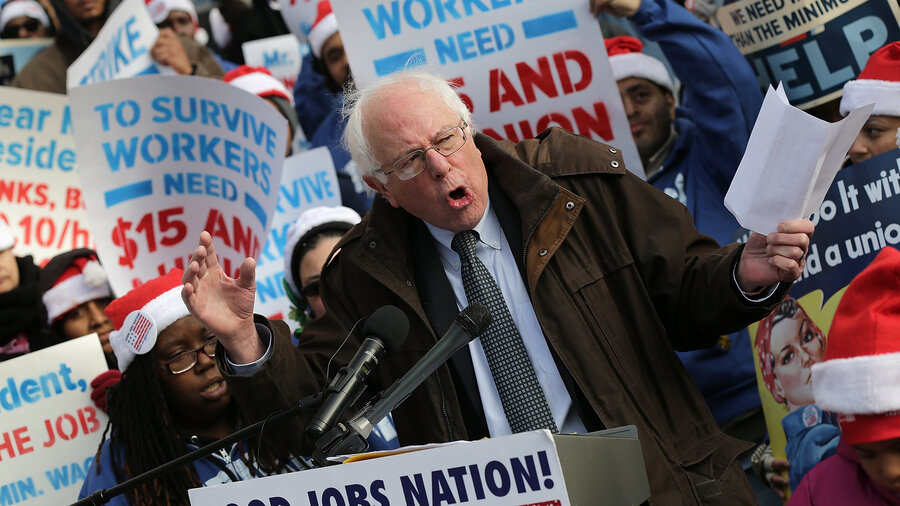
I just read on The Hill an article entitled, “Team Clinton ‘Worried’ about Bernie Sanders Campaign.” Sanders is quickly becoming serious competition for Clinton in the Democratic nomination:
Hillary Clinton’s campaign is “worried” about Bernie Sanders, whom a top Clinton aide described as a “serious force” in the 2016 battle.
“We are worried about him, sure. He will be a serious force for the campaign, and I don’t think that will diminish,” Clinton Communications Director Jennifer Palmieri said Monday in an interview with MSNBC’s “Morning Joe.”
“It’s to be expected that Sanders would do well in a Democratic primary, and he’s going to do well in Iowa in the Democratic caucus.”
Sanders, an independent senator from Vermont, has emerged as Clinton’s main foil in the Democratic primary.
While he’s still more than 40 percentage points behind Clinton in virtually all national polls, he’s greatly improved his stock in the early primary states. 
A new Quinnipiac University poll released last week found he doubled his share of Democratic supporters in Iowa in just seven weeks. Some polls in New Hampshire show Sanders less than 10 points behind Clinton.
Indeed, in the last several hours, Huffington Post columnist H.A. Goodman posted a piece entitled, “‘Bernie Sanders Can Become President’ Has Replaced ‘I Like Him, But He Can’t Win'”:
How many time have you heard the phrase, “I like Bernie Sanders, but he can’t win,” uttered by people who identify themselves as progressives? The facts, however, illustrate that “Bernie Sanders can win” and nobody in politics foreshadowed the Vermont Senator’s latest surge in both Iowa and New Hampshire. He recently raised $15 million in just two months, and his campaign reports that “Nearly 87 percent of the total amount raised during the quarter came from the donors who contributed $250 or less.” While Clinton’s team isn’t worried, they should be, primarily because Hillary Clinton already lost a presidential race (spending $229.4 million in the losing effort) and finished behind both Obama and John Edwards in the 2008 Iowa Caucus.
While Clinton is expected to amass $2.5 billion, Bernie Sanders has cut the former Secretary of State’s lead in New Hampshire from 38 percentage points down to just 8.
Goodman continues by noting that Sanders “snagged a key ally” in New Hampshire: Democratic activist Dudley Dudley. Why the rise in Sanders’ popularity? Well, a key reason seems to rest in the fact that the public can get a clear answer from him– on US Presidential Democratic Hopeful, Bernie Sanders, Is Rapidly Gaining Popularity | deutsch29:

Senator Bernie Sanders and K-12 Education: We’re Listening!

Senator Bernie Sanders and K-12 Education: We’re Listening!:

Man with hand on ear listening for quiet sound or paying attention
Senator Bernie Sanders and K-12 Education: We’re Listening!


Bernie fever is sweeping the Internet. I like Sen. Sanders. He says a lot of things that make me want to jump up and shout YES! You Go Bernie! But I, like many others, am still listening for the specifics when it comes to education and public schools.
On the issue of K-12 education he leaves me a bit high and dry. Something is missing. I think as parents and educators, we need to not be swept off our feet by Bernie Sanders, but we need to hold his feet to the fire. I think this is important because I am hopeful he is one candidate that might listen.
We should require more answers from him about his education agenda.
You might say, “Well who else is out there who will do any better for education and public schools?” Good question.
Still, while I am no fan of Jeb Bush, I can honestly say I know where he stands on education. This will make it simple for me not to vote or support him. The others, including Sen. Sanders, leave out a lot of issues.
The Pros
These are the positive reasons I like Sen. Sanders. Please let me know if I missed something and I will add it to the list.
  • He recognizes many children in this country live in poverty. Poverty has always been an overriding issue in the struggle to have decent public schools. What more will Sen. Sanders advocate concerning poverty and public schools?
  • Hr emphasizes good Pre-K programs. I’d like to hear more about what he means here since this is always one of the goals of politicians. But it should be addressed.
  • He supports affordable public higher education for all students who are capable and wish to attend college. He seems to be fighting for the middle class here and transcends the usual “all students must go to college” hype. He focuses instead on the troubling reality many hard-working students face–especially student debt.
  • He likes small class sizes! This is written in his educational platform and is one of those issues that makes me jump off my couch and cheer!
  • He is against vouchers. He has Senator Bernie Sanders and K-12 Education: We’re Listening!:


Outgoing national PTA president on privatization of schools, funding and future | Get Schooled

Outgoing national PTA president on privatization of schools, funding and future | Get Schooled:

Outgoing national PTA president on privatization of schools, funding and future


My AJC colleague Ty Tagami interviewed outgoing national PTA President and Georgia native Otha Thornton, a retired Army Lt. Colonel who won a Bronze Star Medal in Iraq.
Thornton has to be a brave man to answer Tagami’s questions so frankly, given the political climate in Georgia.
By Ty Tagami
For the past two years, Otha Thornton represented parents across the country as president of the U.S. PTA. The native Georgian — he was born in Elberton and graduated from Elberton County High School – completes his two-year term Sunday.
The retired Army Lt. Colonel was awarded the Bronze Star Medal for exceptional performance in combat operations during Operation Iraqi Freedom, worked as a communications officer in the White House under Presidents Bush and Obama and is back in Georgia as an analyst with General Dynamics in Fort Stewart. His two children graduated from high school in Maryland after attending elementary school in Richmond Hill near Fort Stewart.
Otha Thornton
Otha Thornton
Thornton is the first African-American man elected to lead the U.S. PTA in its 118-year history. He talks about the organization’s mission and about education in America — and Georgia.
Q: What do you see as the big challenges facing education?
A: We are almost infested with ALEC members — American Legislative Exchange Council. They’re for privatization of education. If you want to go to a private school, go to a private school. I have no issues with that. But 90 percent of our nation’s children go to public schools, so we need to make sure that our public schools are sound. Before I took this position, I was the Georgia PTA legislative chair, so I actually worked with some of those guys down there and some of the committee chairs at the time were ALEC members. [They wanted to give private school tuition vouchers to the children of military personnel.] If that military child goes to a private school — the government gives federal impact aid to public schools — so if … military kids get vouchers, the money will come out of the public school system. You’re going to lose federal impact funds that the government gives to states to compensate for those military kids going to public schools. In Columbus, Ga., alone, Fort Benning, Ga., they receive $1 million a year in impact aid funds, and [the lawmakers] didn’t know that.
Q: Next year, a constitutional amendment that allows the Georgia governor to take over “failing” schools will appear on the ballot. Will you tell people to vote for or against this Opportunity School District?
A: I’m speaking as a citizen of Georgia now: I would tell them to vote against it. It would impact most of your minority school systems, like Augusta, Atlanta, Columbus, and Athens. When you take a kid out, the school has to make up for the loss of students and the loss of state and federal funding for those students.
Q: What do you think is the biggest strength of our educational system?
A: Common Core is a great standard, but the Republican Party has politicized it. I remember back in 2009 when the National Governor’s Association, who were predominantly Republican and Sonny Perdue was the chair, brought Common Core forward. When President Obama came into office and he did Race to the Top [a federal grant program that encouraged adoption of the Common Core], people took that and they twisted it [into] ‘the federal government is trying to federalize education.’ That’s just not true. But if you continue to repeat something so much, people begin to believe it. In Georgia, the fact that we have implemented Common Core and it is still moving forward is a positive thing, and it’s going to help us move forward as a state.
Q: What do you think about the decision to create a local state test (the Georgia Milestones) rather than join other states in using the PARCC assessment to gauge mastery of the Common Core standards?
A: It doesn’t give a true reflection of how our kids stack up against other kids. I don’t know if xenophobic is the right word, or a parochial view of, ‘this is our state.’ It’s almost like we’re fighting the Civil War in some states again, and that’s unfortunate, particularly in the fast-moving world that we’re in, and competing with. I went to Outgoing national PTA president on privatization of schools, funding and future | Get Schooled:

Education Lessons From A Sparkly District: Newark Residents Should Select Their Next Superintendent

Education Lessons From A Sparkly District: Newark Residents Should Select Their Next Superintendent:

Newark Residents Should Select Their Next Superintendent


We believe that the people of Newark should be able to democratically govern their public schools.  

Fortunately, Mark Biedron, President of NJ’s State Board of Education, seems to agree.  Mr. Biedron recently told the Star Ledger that “the people of Newark having local control over the school district…is a good thing.”  

On Wednesday, Mr. Biedron will have an opportunity to act on this belief when the State Board votes on whether Chris Cerf should become Newark’s next Superintendent.  
If the State Board approves Mr. Cerf, it will be continuing a 20 year history of disenfranchisement for Newark’s nearly 300,000 residents, who have had no say in this decision.

If the Board rejects Mr. Cerf and instead approves a candidate selected by Newark’s popularly-elected Board of Education, it will be putting Mr. Biedron’s admirable philosophy into practice.

There is plenty of precedent for allowing Newark to select its own superintendent.
Newark, Jersey City, and Paterson are all state-controlled school districts.  Yet Jersey City’s popularly-elected Board of Education selected its Superintendent, Marcia Lyles.  Paterson’s Superintendent, Dr. Donnie Evans, was selected by a committee that included members of Paterson’s popularly-elected Board of Education, along with other community leaders.  In contrast, Newark’s popularly-elected Board of Education has had no voice in selecting Mr. Cerf, who was nominated for this position by Governor Christie.

Approving Mr. Cerf is also difficult to justify because Mr. Cerf lacks the qualifications necessary to run New Jersey’s largest school district.  Unlike Jersey City’s and Paterson’s leaders, Mr. Cerf has no prior experience as a superintendent.  

Nor is there a record of success in related public-education positions on which to base Mr. Cerf’s nomination.  In fact, Mr. Cerf’s tenure as New Jersey’s Commissioner of Education was marked by numerous poor decisions regarding Newark, including:


  • Appointing and continuing to support Newark’s prior Superintendent, Cami Anderson, whose policies and behaviors generated broad-based rejection and rebellion from Newark residents;
  • Improperly giving in to a demand from Ms. Anderson “to allow her to retain full control over 28 low-performing schools, which resulted in New Jersey failing to comply with federal requirements; and
  • Forcibly maintaining State control of Newark's schools by dramatically lowering the district’s scores on the State’s monitoring system (QSAC) from the scores that Mr. Cerf had given the district less than a year earlier. 
The people of Newark deserve the right to select their next Superintendent.  They also deserve Education Lessons From A Sparkly District: Newark Residents Should Select Their Next Superintendent:

We Can and Must Do Better: A Personal Reflection on Wealth Inequality – The Anarres Project

We Can and Must Do Better: A Personal Reflection on Wealth Inequality – The Anarres Project:

We Can and Must Do Better: A Personal Reflection on Wealth Inequality


By Mark Naison   (July 6, 2015)
The greatest sustained period of economic growth in the US took place between 1941 and 1970 when tax rates on the wealthy were much higher than they are now, when business regulation, especially of the financial sector, was much more rigorous, and when trade unions were much stronger. There are options within the US constitutional framework that could be invoked that will produce far better results that the current social contract, which has concentrated wealth at the top to a greater degree than at any time since the 19th century.
Having grown up in that era in a family of modest means, and having had far greater opportunities that young people in comparable conditions have today, I would hardly call myself a product of a failed experiment. I grew up in Crown Heights, attended PS 91 and Winthrop Junior High School, then went on to Wingate and Erasmus High Schools before going on to Columbia, where I ended up being captain of the tennis team even though I learned my tennis in Lincoln Terrace Park where my instructor was a mailman named Phil Rubell.  My cousin Steven, may his soul rest in peace, had the same experience, playing basketball at Columbia after learning the game in public school night centers
Could that happen today? Highly doubtful, since the parks and public school programs that my cousin and I benefited from have long since been de- funded. We can look to our own history for alternatives to a social order where upward We Can and Must Do Better: A Personal Reflection on Wealth Inequality – The Anarres Project:

PAA priority positions for ESEA (it’s finally time!) | Parents Across America

PAA priority positions for ESEA (it’s finally time!) | Parents Across America:

PAA priority positions for ESEA (it’s finally time!) 


On July 7, the Senate will begin to consider and move to a vote on a new Elementary and Secondary Education Act (ESEA) to replace the No Child Left Behind Act.
Over the past few months, PAA has been reviewing both the House and Senate proposals as they evolve. Our analysis of the House version, HR 5, the “Student Success Act,” is here; HR 5 passed out of the House education committee last February and is waiting for House action. The House seems to be waiting to see what the Senate does before finalizing their bill.
The Senate version of ESEA is S 1177, the “Every Child Achieves Act.” Here are PAA’s priority positions for S. 1177 (downloadable pdf version here).
True parent empowerment
  • PAA supports inclusion of parents in school policy decisions at the school, district, state, and national level.
  • We oppose forms of school privatization such as charter schools (Title V beginning p. 460  and S 316), vouchers, or “portability”  that take resources from the schools attended by most students and put them into private hands, with less oversight.
Limits on testing
  • PAA supports S. 1025 (the Tester amendment) which replaces federal annual testing mandates with grade span testing. This will help address the current misuse and overuse of tests which is due in large part to NCLB’s testing mandates.
  • We support Isakson Title 1 #1  amendment specifying parents’ right to opt their children out of any state standardized test.
  • We also support the SMART Act proposal (Baldwin Title 1 Amendment #1) to encourage states to control the number of state-mandated tests and provide better-quality assessment information to parents.
Teaching professionalism
  • PAA opposes any proposals that would fund programs that put unprepared teachers in classrooms, which happens most often in schools with the most challenges.
  • We also oppose increasing funds to expand adaptive technology and on-line learning, recognizing that the teacher/student relationship is paramount to supporting quality learning.
Funding
  • PAA supports an increase in Title 1 funding targeted to low-income children and more equitable school funding from the appropriate government sources (as in Baldwin Title 1 Amendment #5).
  • We support increased funding for systematic and effective class size reduction programs.
Student privacy
- See more at: http://parentsacrossamerica.org/paa-priority-positions-esea-are-yet/#sthash.pHr9LJ3E.dpuf

Koch Brothers’ Friends Funding Mike Pence | Hoosier School Heist Blog

Koch Brothers’ Friends Funding Mike Pence | Hoosier School Heist Blog:

KOCH BROTHERS’ FRIENDS FUNDING MIKE PENCE


By Doug Martin at Hoosier School Heist
(This is the first in a series of articles that will address the money behind Mike Pence’s quest to be reelected Governor of Indiana)
On June 25, just one day after the governor wrote a letter to president Obama saying Indiana would not comply with proposed Environmental Protection Agency rules against greenhouse omissions, Mike Pence’s campaign received a $10,000 gift from Marvin Gilliam of Bristol, Virginia.
Gilliam is the former VP of what was once one of the largest coal producers in America, Cumberland Resources, which was purchasedby Massey Energy in 2010.
In 2013, Gilliam and Koch Industries, along with other wealthy donors, financed the gubernatorial campaign of Virginia Attorney General Ken Cuccinelli II, a longtime Republican and anti-LGBT climate denier who “used his position to launch an inquisition against a former University of Virginia climate scientist.”
Owners of Koch Industries, a multinational oil and manufacturing corporation making money from toilet paper, fertilizer, and a long list of other things, the Koch Brothers are wealthy giants who have influenced everything from climate control to school board elections.
Marvin’s brother Richard, who founded Cumberland Resources and now directs the rare metals exploration company Endurance Gold Corp, gave Mike Pence’s campaign $25,000 in 2012.
Richard Gilliam is a major donor to Koch Brothers-supported groups and visited their secret retreat in June 2010 to discuss political strategy.
Richard and wife Leslie were listed as #33 in the top donors to Republican political campaigns, according to a study by the Center for Responsive Politics, spending over $520,000 in 2010 alone.
Richard Gilliam also handed money to Karl Rove’s American Crossroads super-PAC which spent over $104 million on the 2012 elections.
Another donor to Karl Rove’s PAC was Weaver Popcorn.  As I detail in Hoosier School Heist, Weaver Popcorn’s Mike Weaver was a chief Tony Bennet donor when the Republican ran for the Indiana supt. of public education slot in 2012.
BIO
Doug Martin is the author of Hoosier School Heist : How Corporations and Theocrats Stole Democracy From Public Education, a book being read in over 130 cities and towns and 78 Indiana counties, 23 states, and the District of Columbia.  A regular guest on national and Indiana radio talk shows such as Justin Oakley’s Just Let Me Teach and Amos Brown’s Afternoons with Amos, Dr. Martin’s research has been or will soon be featured in the Washington Post Answer Sheet , ABC’sNightline, and the Associated PressKoch Brothers’ Friends Funding Mike Pence | Hoosier School Heist Blog:

Nevada's New Voucher Law Will Worsen Educational Inequality - US News

Nevada's New Voucher Law Will Worsen Educational Inequality - US News:

The Wrong School Choice

Nevada's new school voucher law will make inequality worse.


I'm struggling to understand an intellectual disconnect of the first order.
Nearly everyone involved in education reform wrings their hands about the achievement gaps between poor and nonpoor, between white and minority students. And most Americans are increasingly disturbed about widening inequality of income and wealth.
Yet when Nevada enacted the nation's first law last month creating almost universal access to vouchers (technically, education savings accounts, or ESAs), few reformers pointed out that it would undermine equal opportunity. Dozens of bloggers weighed in; the Fordham Institute even invited 14 of them to comment. And not one of the 14 mentioned that the new bill would make access to quality education less equal than it is today.
Why do I say it will do that? Because it allows families to add to their education savings account to buy a more expensive education. Most parents want what's best for their children, so those who can afford it will do just that. Those who can't will not. And the education market will stratify by income, far more than it already does. In a decade, it will look like the markets for houses, cars and other private goods, with huge disparities based on wealth.

I just don't get it. We need bold reform of education, yes. But do we want to widen the achievement gap? Do we want to increase inequality in America? More than half of public students in America are poor (i.e., they qualify for a free or reduced price lunch). Do we want to leave them all behind in inferior schools?
A core value of public education – one of the reasons we treat it as a public rather than a private good – is equality of opportunity. That's hard to achieve in America, where incomes – hence neighborhoods – are vastly unequal. For 50 years the courts have forced states to take over more and more of the financing of public education from local governments, to create more equality of spending between communities. The results are disappointing in many states, but even in the worst, public school spending is not vastly unequal. And a few states have succeeded in creating fairly level playing fields, and in Washington, D.C., low-income kids actually get extra money.
What would happen if those states passed laws like Nevada's?
The new bill allows any parent whose child has been in public education for at least 100 days to take an education savings account worth $5,100 (or $5,700 for low-income kids and those with disabilities) and spend it as they please – on private schools, home-schooling, tutors, textbooks, online courses, computers, transportation, almost anything related to education. Participants will have to take a nationally norm-referenced test in math and English every year, but they get to choose which test, so there will be no universal measuring stick by which to compare performance.
In addition, low-income students can apply for a tax credit scholarship worth up to $7,775, though the legislature appropriated only $5 million a year, so it will serve less than 1,000 kids. But the accounts are available to all students, as long as they spend 100 days in a public school.
Putting all state, local and federal funds together, public schools in Nevada received $8,339 per student in 2013well below the national average. Tracey Weinstein, director of policy and innovation at StudentsFirst, says the average tuition at private schools in the state is $8,000-10,000.
So it's obvious that a $5,100 education – or even a $5,700 education – will be a cut-rate job. Every Nevada's New Voucher Law Will Worsen Educational Inequality - US News:

Conservative Groups Hope To Score This One Important Win In No Child Left Behind | ThinkProgress

Conservative Groups Hope To Score This One Important Win In No Child Left Behind | ThinkProgress:

Conservative Groups Hope To Score This One Important Win In No Child Left Behind


Bipartisan legislation that would make changes to No Child Left Behind will be up for debate in Congress this week.
The legislation was pulled in February after support for the bill waned following opposition from The Heritage Foundation, a conservative think tank and Club for Growth, a conservative advocacy group. The House Rules Committee is going to meet Tuesday at 5 p.m. to figure out which amendments will get votes.
Conservative groups want to include the A Plus Act amendment, a block grant that allows states to receive federal money without any strings attached. It’s likely to be considered next week, since it is seen as the premier amendment for those concerned with federal overreach. States would send proposals to the secretary of education to assure the U.S. Department of Education that they had certain safeguards in place. Those would include fiscal control procedures, include accountability to parents and other taxpayers and provide educational opportunities for disadvantaged students.
The debate on the ECAA has largely been one over how much more local control of schools the legislation should allow and whether or not testing requirements are still too punitive to schools that are already struggling. The reauthorization already allows states to carry the responsibility of setting their own improvement standards and the turnaround of low-performing schools would be controlled at the local level.
The Heritage Foundation supports the A Plus amendment. It did not support the Student Success Act, which gives states more control over education and promotes charter schools, because it didn’t provide an opt-out for federal programs and mandates. The Student Success Act, introduced in 2013 and sponsored by Rep. John Kline (R-MN), the chairman of the House Committee on Education and the Workforce, was supposed to be an improvement on the Obama administration’s waivers of NCLB requirements.
“High-stakes testing has led to ‘teaching to the test’ from DC, a practice which privileges exhaustive test preparation over learning,” Heritage Action for America’s fact sheet on NCLB reads.
However, by giving the Secretary of Education the ability to sign-off on the state plans, the federal government may have more control than they did under the waivers, some advocates of more state control argue. According to PoliticoPro, The Heritage Foundation expects Kline to whip Conservative Groups Hope To Score This One Important Win In No Child Left Behind | ThinkProgress: