Latest News and Comment from Education

Thursday, July 2, 2015

Largely run by for-profit corporations, Ohio’s charter schools misspend tax dollars—and lawmakers are letting it continue | The Progressive Pulse

Largely run by for-profit corporations, Ohio’s charter schools misspend tax dollars—and lawmakers are letting it continue | The Progressive Pulse:

Largely run by for-profit corporations, Ohio’s charter schools misspend tax dollars—and lawmakers are letting it continue


Ohio’s charter schools—many of which are run by for-profit education management corporations—are notorious for misspending tax dollars and producing poor academic results. Lawmakers there had a chance to do something about it this summer by passing legislation that would strengthen charter school oversight—but that legislation ultimately failed.
What happened? The bill — which, again, had the votes to pass — was tabled because, apparently, some lawmakers still want to make changes. The bill is supposed to come up again in September, but who really knows, given tepid efforts in the past to improve schools. Even if a bill passes later, implementation will be significantly delayed.
You’d think that the lousy state of Ohio’s charter system would have set a fire under everyone with even half a fingerprint on it. How bad is it? A June story in the Akron Beacon Journal started this way:
No sector — not local governments, school districts, court systems, public universities or hospitals — misspends tax dollars like charter schools in Ohio.
The newspaper had reviewed 4,263 audits released last year by the state and concluded that charter schools in the state appear to have misspent public money “nearly four times more often than any other type of taxpayer-funded agency.” It says that “since 2001, state auditors have uncovered $27.3 million improperly spent by charter schools, many run by for-profit companies, enrolling thousands of children and producing academic results that rival the worst in the nation.”
So what does the state of Ohio’s charter schools have to do with North Carolina?
It’s worth taking a closer look because, according to the Akron Beacon Journal, “only Michigan and Texas have a greater portion of charter schools [than Ohio] operated by private, for-profit companies, which are not compelled to disclose how they spend public money.
In North Carolina, lawmakers lifted the cap back in 2011 on the 100-charter school limit—and since then, more and more private, for-profit education management companies have been making their way into the state, some of which have sought to hide how they spend tax dollars.
This spring, the batch of 18 charter applications hoping to open up shop in 2016 faced an unusual amount of scrutiny and many of the applications were moved forward by reviewers with considerable reservations.
Notably, the majority of those charter school applications that made it to the final round of consideration this year were backed by national for-profit education management organizations (EMOs), rather than being run only by small, independent and locally-based nonprofit boards—unlike in years past when the opposite was the case.
Legislation moving through North Carolina’s General Assembly now that would make changes to how charter schools are regulated would make some improvements, such as forcing local charter boards to adopt anti-nepotism policies and be in financial compliance if they want to expand a grade level.
But the Senate bill (456) would also siphon tax dollars that are typically designated for traditional public
- See more at: http://pulse.ncpolicywatch.org/2015/07/02/largely-run-by-for-profit-corporations-ohios-charter-schools-misspend-tax-dollars-and-lawmakers-are-letting-it-continue/#sthash.Onp7E9mo.dpuf




Kevin Johnson Sues Sacramento, Hides Behind Group That Hates Him

Kevin Johnson Sues Sacramento, Hides Behind Group That Hates Him:

Kevin Johnson Sues Sacramento, Hides Behind Group That Hates Him


Sacramento Mayor Kevin Johnson is suing his own city and a local reporter to prevent the release of his emails. But officials of a mayoral group that the former NBA star and controversy magnet claims to be representing in his lawsuit say they’re not on his side.
“We want nothing to do with Kevin Johnson,” says Vanessa Williams, executive director of the National Conference of Black Mayors, an Atlanta-based organization that Johnson listed as a co-plaintiff in his suit. “He’s not even a member. He tried to ruin this organization. I dare Kevin Johnson to find one person with this organization who supports him. Just one! Everybody with this organization hates Kevin Johnson. Nobody gave him permission to sue for us.”
Johnson filed his odd suit after Cosmo Garvin, a reporter with the weekly Sacramento News & Review, filed a request for emails the mayor and his staff sent using private Gmail accounts while doing city business. The Sacramento Bee had made a similar records request earlier this year. Johnson has long faced accusations that he forces staffers on the public payroll to do work not related to their employment, and has them use private accounts while doing his personal bidding.
Among the communications the city attorney was prepared to release were emails between Johnson and lawyers from Ballard Spahr, a firm Johnson used during his brief and debacle-filled reign as NCBM president. Johnson’s suit, however, argues that an exemption in the public-records laws for communications between an attorney and client should prevent their release.
According to the complaint, the Sacramento Bee altered its request merely because Johnson’s attorneys asked the paper to, while Garvin “stubbornly refused” to acquiesce. So, the SacBeewasn’t sued, and Garvin was. An interview request to editor Joyce Terhaar was referred to managing editor Scott Lebar. Lebar declined to answer questions about the Johnson situation, but in an article posted last night the paper denied modifying its records request to appease Johnson. 
The News & Review’s Garvin, far and away the most aggressive reporter in town when it comes to covering the mayor, admits being surprised to find out that the major daily was not a fellow defendant.
“I figured I’d have some cover since I knew the Bee had made the same request,” says Garvin. “It was kind of scary to learn that they dropped out and I was on my own.”
Williams and other NCBM board members were also surprised the group was listed as a plaintiff in Johnson’s lawsuit, given how contentious the mayor’s relationship with them has been. Johnson was elected president of NCBM in 2013 under disputed circumstances. The group’s general counsel voided Johnson’s election just two weeks into his presidency, and Johnson sued to have his presidency restored. He and NCBM officials have been suing eachKevin Johnson Sues Sacramento, Hides Behind Group That Hates Him: 

Lawsuit Claims L.A. Unified Plans to Illegally Divert $2 Billion Intended to Serve High Need Students | Public Advocates Inc.

Lawsuit Claims L.A. Unified Plans to Illegally Divert $2 Billion Intended to Serve High Need Students | Public Advocates Inc.:


Lawsuit Claims L.A. Unified Plans to Illegally Divert $2 Billion
Intended to Serve High Need Students


(Los Angeles) –The Los Angeles Unified School District (LAUSD) is violating state law by refusing to use state education funds specifically targeted to help low-income students, English language learners and foster youth to increase or improve services for those students, according to a lawsuit filed on behalf of the Community Coalition of South Los Angeles and LAUSD parent Reyna Frias.
The suit, filed today in Los Angeles Superior Court, asserts that the district has used improper accounting practices that subvert both the letter and spirit of the 2013 education finance reform law known as Local Control Funding Formula (LCFF).  If the district proceeds with its current plan, high need students stand to lose more than $2 billion in funding over the next decade.
“LAUSD is breaking its promise to provide my children and millions of other students in the future, with the services they need and the law says they should receive,” said Ms. Frias, whose children qualify for the funds targeted by LCFF.
The plaintiffs are represented by Public Advocates Inc., the ACLU of California and Covington & Burling LLP.
“Community Coalition has spent decades working to transform the social and economic conditions in South Los Angeles,” said Alberto Retana, President and CEO of the Community Coalition of South Los Angeles, a plaintiff in the lawsuit.  “We want to ensure that our students aren’t short-changed by LAUSD’s budget process. We see too many students in our public schools struggling because they don’t receive the services they need to thrive academically.”
The law directs school districts to use state funds under LCFF to "increase or improve" services for the targeted students. Each district calculates what it will spend partly on what it has spent in the past on such services. The lawsuit alleges that by counting prior spending for "special education" — which the district is already required to provide — as spending on services for low-income students, English language learners and foster youth, LAUSD has in effect reduced its specific legal obligation to those very students by over $400 million in 2014-15 and 2015-16 combined. Over time, if allowed to continue the practice, LAUSD will short-change these students by over $2 billion by 2021, and $450 million additionally every year after that.
"If every district uses its new LCFF funds to pay for things it's already legally required to do like LAUSD, the promise of California's new funding law will evaporate overnight," said John Affeldt, managing attorney with Public Advocates. "LCFF requires that LAUSD use these hundreds of millions of dollars to deliver new and better services to targeted students.”
If the lawsuit prevails, special education students would still receive the same level of services they are now but LAUSD would be required to invest more money to develop new or improved services for high need students targeted under LCFF, who make up 84 percent of the district's student population.
“LCFF presents an historic opportunity to close opportunity gaps by directing additional resources to help California’s neediest students and aligning budget decisions more closely with student needs,” said Victor Leung, staff attorney with the ACLU Foundation of Southern California.
Public Advocates and the ACLU SoCal have spent the past year trying to resolve the issue with LAUSD and the L.A. County Office of Education, which is responsible for approving the LAUSD budget and spending plan, but with no success.
“We recognize that districts face financial pressures to prioritize their spending,” said Laura Muschamp of Covington & Burling. “Nevertheless, it’s not up to LAUSD to rewrite the law, but rather to follow it.”
The lawsuit was filed on behalf of Ms. Frias and the Community Coalition of South Los Angeles by John T. Affeldt and Angelica Jongco of Public Advocates  Inc., David B. Sapp and Victor Leung of ACLU Foundation of Southern California , and Laura E. Muschamp, Michael K. Plimack and Thomas Garten of Covington & Burling LLP.
For a copy of the complaint, Community Coalition of South Los Angeles and Reyna Frias v. LAUSD, et al, click here
Further Resources:
For a Primer on the LAUSD LCFF Spending Case, click here For a Local Control Funding Formula timeline, click hereFor a Graphic: Yearly Impact of LAUSD’s Error at Full Implementation click here

KJ and The Art of Deal Making in Sacramento


KJ and The Art of Deal Making in Sacramento
After his wife's successful book RHEE THE ART OF THE DEAL KJ has tried his hand at writing.


K.J. sues SN&R over controversial emails http://bit.ly/1JxLt4B

How Mayor Kevin Johnson continues using public resources for his private gain http://bit.ly/1CNWj1y

Kevin Johnson Truth? Who To Believe In Sacramento? SN&R or SacBee http://bit.ly/1AhQKNg

Sacramento Mayor Kevin Johnson Fights Email Release Amid Allegations Of Nepotism Benefiting His Wife http://bit.ly/1CNWp9s

Sacramento mayor Kevin Johnson seeks to block release of e-mails http://bit.ly/1CNWwBN

Mayor Kevin Johnson deleted text messages about arena deal http://bit.ly/1Nx8o1n

Scandal-Ridden Mayor Hosts Ben Carson in Sacramento http://bit.ly/1CNWFVQ

CORPORATE DREAM TEAM: PT Sac Mayor Kevin Johnson Praises...Ben Carson? http://bit.ly/1R6hm64

Kevin Johnson Promotes His Brand By Releasing Personal Logo http://bit.ly/1Mwrcww

How Mayor Kevin Johnson continues using public resources for his private gain http://bit.ly/1CNWj1y

Sacramento BEE MIA? Sacramento Mayor Kevin Johnson’s election as president of NCBM affirmed by judge http://bit.ly/1J63nho


How Kevin Johnson Destroyed A Black Mayors Group To Promote His Brand http://bit.ly/1HSy0qa


Michelle Rhee's Companion Book


Books by Other 1% 'ers


Choosing Democracy: The Next Effort to Break Teachers' Unions

Choosing Democracy: The Next Effort to Break Teachers' Unions:

The Next Effort to Break Teachers' Unions

Friedrichs v. California Teachers Association 

Randi Weingarten


The anti-worker forces that are trying to break our union just got a big break from the United States Supreme Court. This morning, the court agreed to hear the case Friedrichs v. California Teachers Association during its next term.

Make no mistake: This case is not about individual liberty or the First Amendment. It is an outright attack against unions to prevent us from representing our members and using our voices to fight for our families, our schools, our colleges, our healthcare facilities and our communities.

We’re preparing a national campaign to mobilize our members and communities across the country to fight for an America where everyone’s voice matters. Sign up to join when we launch later this summer.

This case would undermine our unions and challenge nearly 40 years of precedent—and the court agreed to hear it barely a year after it dealt a blow to workers with its decision in Harris v. Quinn. In fact, the conservative justices on the court used the Harris v.Quinn ruling to invite cases like this one, showing just how political they really are.

Friedrichs is being argued by the same law firm that tried to destroy the Affordable Care Act, and it is fueled by the same ideological forces whose lobbyists talk about driving a “fatal spear through the heart” of our unions.

In the end, this case comes down to a fundamental question: Do unions have a right to collect a fair share from the people we represent, to ensure that we’re able to speak for all workers?

The attack on labor by those who don’t want working families to have a voice has intensified. It has moved from the statehouse to the courthouse. But our affiliates understand that engaging our communities and our members, and organizing new members, are the key to repelling those attacks and growing a strong middle class.

I'm proud that, at times like these, the AFT is still growing. We passed the 1.6 million mark last summer, and that number continues to rise through the efforts of local affiliates like the Washington Teachers’ Union, which has worked to change the hearts and minds of 1,500 fair-share payers so they will become full members; efforts of workers like those in the Alaska Nurses Association, who voted to affiliate with us; and efforts of state affiliates like the Illinois Federation of Teachers, which added units from tenure-track faculty to court reporters to its ranks, and like AFT Michigan, which has held strong despite the so-called right-to-work law in place there. Educators at charter schools have voted to join our union this year, as have educators in states without collective bargaining, like Louisiana and Texas. This much is clear: Workers across the country want a collective voice on the job. 

While anti-union politicians like Wisconsin Gov. Scott Walker try to silence workers, we’re preparing a unionwide, nationwide conversation to engage all 1.6 million AFT members on the challenges they face at work, their aspirations, and how together we can fight the obstacles and reach those aspirations.

Commit to joining our campaign to take back our power and fight forward, when we launch later this summer. 

As these attacks keep coming, we’ll keep organizing—because workers’ organizing and collective bargaining rights are the way we can rebuild the middle class, create opportunity and bridge income inequality in this country.

I hope you’ll commit to take action with us.

In unity,
Randi Weingarten
AFT President
Choosing Democracy: The Next Effort to Break Teachers' Unions:

With A Brooklyn Accent: When New York City Was Greece- The Destruction of Youth Programs in the Name of Austerity in the late 70's

With A Brooklyn Accent: When New York City Was Greece- The Destruction of Youth Programs in the Name of Austerity in the late 70's:

When New York City Was Greece- The Destruction of Youth Programs in the Name of Austerity in the late 70's


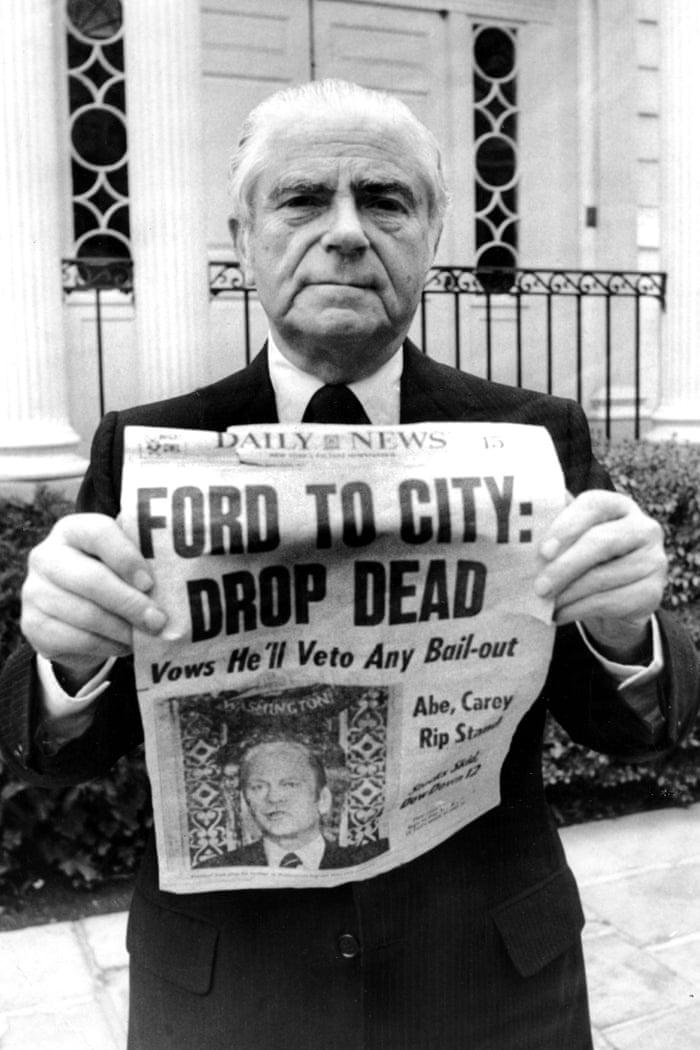
As the Greek crisis unfolds, it is instructive to turn to a moment in history when New York City went "bankrupt" and was put under the control of an Emergency Financial Control board who dictated what kind of budget cuts had to be made in order for the city to continue receiving financing from the nation's banks.

The year was 1976, Abraham Beame was the Mayor, and what transpired was an unalloyed tragedy for the young people of New York City, especially those growing up in the city's working class and middle class communities In fact, based on my own experience and scores of oral history interviews with people who attended or worked in Bronx public schools from the 1950's through the 1980's, many city neighborhoods, and the young people who lived in them, never recovered from what lost as a result of budget cuts made at that time.

Let us first look at the impact of budget cuts on New York City public schools, which had some of the best youth and cultural programs of any public school system in the world from the late 40's until the Emergency Financial Control Board took over.

  The after school programs in New York City public schools , which provided an enormous boon to working parents,were second to none. Every elementary school in the city was open 3-5 and 7-9 with supervised activity, run by New York City public school teachers paid with stipends that supplemented their regular salaries. The activities in these centers included arts and crafts, sports, music programs, talent shows, and occasionally school dances. I played basketball and nok hockey in the night center at PS 91 in Crown Heights, but some truly amazing things took place at schools in the Bronx, some of them serving predominantly Black and Latino neighborhoods. At PS 18 near the Patterson houses, the night center, run by former all American basketball player Floyd Lane and NY Knick player Ray Felix, scores of young people who played high school, college and even professional basektball learned the game, including the great Nate "Tiny Archibald." At PS 99 in Morrisania, in additional to sports activities, there were regular talents shows which featured young people who became some of the foremost "doo wop" singers in the nation, along with budding Latin musicians.  There amazing programs were all shut down for good in the late 70's thanks to EFB imposed budget cuts. Sportswriter and coach Howie Evans, who attended the center before working in them, said closing the afternoon and night centers was the worst single policy decision ever made affecting the youth of New York City

  Then there were the music programs in the public schools. During the same period- the late 40's through the late 70's- New York city public schools had the best music programs in the country. Ever junior high school, and many high schools had upwards of 300 musical instruments which could be taken home by any student who tried out for or made, school bands or orchestras. And the intruction was first rate. Many famous With A Brooklyn Accent: When New York City Was Greece- The Destruction of Youth Programs in the Name of Austerity in the late 70's:

Why the gov't let many trade schools become diploma mills - Yahoo Finance

Why the gov't let many trade schools become diploma mills - Yahoo Finance:

Why the gov't let many trade schools become diploma mills


WASHINGTON (AP) — How did trade schools go from being mom-and-pop shops that trained mechanics and hair stylists to making billions on Wall Street? And if the industry is as predatory as the Education Department and many lawmakers suggest, why didn't they stop it?
In 1990, there wasn't a single publicly traded college. Now, there are more than a dozen with most of them being investigated by state and federal regulators for fraud or deceptive business practices. Among the allegations is that many of these schools enrolled unqualified students, taught bogus coursework, and encouraged prospective students to lie on financial aid forms so they could access federal dollars.
Several consumer advocates interviewed by The Associated Press point to 2002 as the beginning of a dangerous rise of for-profit colleges. That's when an Education Department memo written under President George W. Bush suggested colleges wouldn't be severely penalized if they compensated college recruiters for getting students in the door. The memo became a tacit endorsement for the kinds of high-pressured sales tactics that emerged.
The next big change, they say, came in 2006, when Congress passed legislation backed by the Bush administration that erased a requirement that colleges deliver at least half their courses on a campus.
The top regulator on higher education at the Education Department during this time was Sally Stroup, now general counsel for the for-profit's chief lobbying arm, the Association of Private Sector Colleges and Universities.
"That's when these guys took off," said Tom Harkin, a former Democratic senator from Iowa who led a 2012 investigation into the for-profit industry. He said moving everything online made it easier for private investors to snap up failing schools and hide from regulators. Meanwhile, the schools invested heavily in lobbyists and making political connections that guaranteed access to federal Why the gov't let many trade schools become diploma mills - Yahoo Finance:

Ohio’s effort to reform its ridiculed charter schools is a big fail - The Washington Post

Ohio’s effort to reform its ridiculed charter schools is a big fail - The Washington Post:

Ohio’s effort to reform its ridiculed charter schools is a big fail


Ohio Gov. John Kasich is expected to officially announce this month that he is running for the 2016 Republican presidential nomination. Don’t expect to hear him tout his state’s charter schools.
Ohio lawmakers looked like they were actually going to do something about the state’s ridiculed $1 billion charter school system, the No. 1 sector in Ohio for misspending tax dollars. A two-year effort to write legislation that would strengthen oversight of these schools passed in the state Senate in June, and was believed to have majority support in the state House. But, alas, the bill never made it to a final vote.
What happened? The bill — which, again, had the votes to pass — was tabled because, apparently, some lawmakers still want to make changes. The bill is supposed to come up again in September, but who really knows, given tepid efforts in the past to improve schools. Even if a bill passes later, implementation will be significantly delayed.
You’d think that the lousy state of Ohio’s charter system would have set a fire under everyone with even half a fingerprint on it. How bad is it? A June story in the Akron Beacon Journal started this way:
No sector — not local governments, school districts, court systems, public universities or hospitals — misspends tax dollars like charter schools in Ohio.
The newspaper had reviewed 4,263 audits released last year by the state and concluded that charter schools in the state appear to have misspent public money “nearly four times more often than any other type of taxpayer-funded agency.” It says that “since 2001, state auditors have uncovered $27.3 million improperly spent by charter schools, many run by for-profit companies, enrolling thousands of children and producing academic results that rival the worst in the nation.”
To understand why there is skepticism about Ohio’s effort to provide better oversight to charters, one only has to look at what it has already been trying to do. Kasich and lawmakers came up with a plan a few years ago to pressure the organizations that grant permission for groups  to open charters to do a better oversight job. Those groups, called “agencies” in Ohio, include schools Ohio’s effort to reform its ridiculed charter schools is a big fail - The Washington Post:

Parents Fight Conservative Zealots and Charter School Advocates For Control of Their Kids' Education | Alternet

Parents Fight Conservative Zealots and Charter School Advocates For Control of Their Kids' Education | Alternet:

Parents Fight Conservative Zealots and Charter School Advocates For Control of Their Kids' Education

In Jefferson County, Colorado an acrimonious debate is taking place over the future of public school.


It's Tuesday evening, and people have come to church — but not for religion.
What's bringing people to Green Mountain United Methodist Church in the heart of Lakewood, Colorado, is a meeting modestly titled "Church and society: Stand up for students."
In a cramped, wood-paneled room on the second floor, two dozen attendees rise, one after another, to introduce themselves and say why they are here. "I'm concerned," say a few. "Scary," "outrageous," say others.
A neatly dressed elderly man speaks up: "When you've been given a lot for the education of your own children, it's important that the children after yours get that same level of education, or better. I don't believe we're doing that."
"I have two children in school," a younger woman says. "I hear things that are troubling. So I'm here to learn more."
The last woman to introduce herself, wearing a T-shirt declaring she is a "Jeffco Rebel," starts a stack of handouts circulating around the room. That's when a woman seated at the head of the room says, "We're here to arm you with information."
This is Jefferson County, Colorado.
Sprawling westward from the Denver skyline, where the front range of the Rockies sharpens its ascension to the peaks, Jeffco, as the locals call it, is experiencing an acrimonious debate about its public schools.
At scores of house parties like this one, parents and public school activists circulate flyers and repeat a well-rehearsed message of dissent. They complain of a new school board majority that is secretive, disrespectful to parents and teachers and irresponsible with tax dollars. They warn of the influence of right-wing groups, some with connections to evangelical Christianity. They complain of a powerful charter school industry, different from the "organic charters" Jeffco parents already send their kids to.
Behind every grassroots issue they identify lies a much "bigger thing," as more than one parent will tell you.
It's a complicated narrative that defies stereotypes and neat polarities. Although the fight is political, Republicans and Democrats are distributed on both sides of the debate. The argument is about education, but it's not an argument over pro-charter school versus anti-charter. Jeffco has had charters for years, many of which are highly popular with parents. Neither is this a narrative about choice versus anti-choice. Jeffco already allows parents toenroll their children in any school in the district (although there are cases of selective enrollment), and many families do opt for a school other than their neighborhood one.
Jeffco is a mostly white, middle-class and suburban school district that hardly resembles the "failing" school systems you're used to hearing about. According to the district's website, Jeffco students "outperform the state in all grade levels and content areas" on state mandated achievement tests. Six of the district's high schools rank in the top 40 of the 2014 Best High Schools in America according to U.S. News & World Report, and 11 elementary schools were listed as 5280 Magazine's top public elementary schools.
And Jeffco is not a community where teachers' unions are defending their turf from disgruntled parents. Parents, not union operatives, lead the numerous and frequent house parties like the one at Green Mountain Church.
What is also true about Jeffco is that the story unfolding here is one that isrecurring across the country, as community after community becomes mired in debates about who gets to call the shots in education systems strained by unending financial austerity and an unremitting "reform" agenda whose intent is unclear to the people in its way.
A Conflict About Curriculum
Jefferson County was first thrust into the media spotlight in 1999, when two armed students committed horrific killings at Columbine High School. More recently, this district of over 85,000 students, the second largest in the state, made headlines again when mass student walkouts occurred in high schools across the district to voice concerns over a proposed review of an AP U.S. history course.
As the Associated Press reported at the time, students were alarmed that the stated purpose of the review was "to make sure materials 'promote citizenship, patriotism, essentials and benefits of the free-market system, respect for authority and respect for individual rights' and don't 'encourage or condone civil disorder, social strife or disregard of the law.'"
The students took to the streets multiple days in a row to voice their right to learn about the history of protest and civil disobedience that helped create the country they live in today. Some teachers got involved as well, staging a "mass sick-out" in support of the students.
When MSNBC's Melissa Harris-Perry interviewed two student leaders of the protest, Ashlyn Maher and Kyle Ferris, Ferris explained, "We wanted to get the school board's attention. They're not really listening to the concerns of the Parents Fight Conservative Zealots and Charter School Advocates For Control of Their Kids' Education | Alternet:

Sacramento Mayor Kevin Johnson Fights Email Release Amid Allegations Of Nepotism Benefiting His Wife

Sacramento Mayor Kevin Johnson Fights Email Release Amid Allegations Of Nepotism Benefiting His Wife:

Sacramento Mayor Kevin Johnson Fights Email Release Amid Allegations Of Nepotism Benefiting His Wife


Sacramento Mayor Kevin Johnson doesn’t want the public to see private emails he sent to an attorney while he was involved with a national group of black city leaders. That’s according to local news outlets that requested the emails amid allegations that Johnson used his position as president of the National Conference of Black Mayors to promote a business run by his wife.
A California judge is expected to decide Thursday whether Sacramento can release the emails sent between Johnson and a black mayors' conference attorney. Johnson, who played professional basketball for 13 years before becoming the first African-American elected mayor of California’s capital, has sued the weekly city newspaper, the Sacramento News & Review, to stop certain emails from becoming public, according to a USA Today report.
Johnson’s personal attorney, Peter Haviland, said the lawsuit that his client filed in Sacramento Superior Court Wednesday is meant to prevent a violation of attorney-client privilege. "No responsible journalist nor attorney disputes that the attorney-client privilege is a bedrock of America's civil society,” Haviland said in an email to KXTV-TV.
“Public records requests are not intended to violate that privilege, and the law does not allow disclosure of attorney-client privileged materials pursuant to public records requests," the email continued.
Johnson, 49, was elected president of the National Conference of Black Mayors in 2012, one year after he married Michelle Rhee, a former chancellor of the Washington, D.C. public schools. Members of the mayors’ conference had challenged whether Johnson's election as their leader was valid as well as claims that he used the position to promote his wife’s education reform nonprofit, StudentsFirst.
Through the California Public Records Act, news outlets have asked for emails Johnson sent to the black mayors conference’s bankruptcy attorney. The emails were sent by Johnson from an unofficial email account. Sacramento Mayor Kevin Johnson Fights Email Release Amid Allegations Of Nepotism Benefiting His Wife:

It’s Official: The Feds Will Collect Psycho-Social Data On Your Child - California Political Review

It’s Official: The Feds Will Collect Psycho-Social Data On Your Child - California Political Review:

It’s Official: The Feds Will Collect Psycho-Social Data On Your Child


The Feds are mandating a “test” starting in 2017 for your kids. No it is not what they know about history, science or math. It is private, personal information taken from the kids for a national database—without telling us how it will be used. As we know the data collected by the Fed is totally secure—except for the NSA, the 32 million people that work or worked for the Feds—including the CIA.
“Almost any parent would read this and wonder why his child’s mindsets and personal goals are any of the government’s business. Indeed, there is serious doubt whether NAEP even has the statutory authority to delve into such matters. The federal statute authorizing NAEP requires that the assessment “objectively measure academic achievement, knowledge, and skills” and that the tests “do not evaluate or assess personal or family beliefs and attitudes . . . .” The statute further requires that NAEP “only collect information that is directly related to the appraisal of academic achievement . . . .”
This is the role of government. I urge parents to tell their children to refuse to answer any such questions. I urge the public to demand their school board not allow this invasion of privacy. When will we revolt against a totalitarian government controlling us by forcing our kids to give them information?
Kids
Government of the people and by the people should not plumb and manipulate the people’s psyches and emotions, especially when so many kids can still hardly read and cipher.
By Jane Robbins, The Federalist, 6/29/15
Every year, hundreds of thousands of U.S. students take the National Assessment of Educational Progress (the NAEP), the federally authorized test known as the “nation’s report card.” Education Week reportedrecently that, beginning in 2017, NAEP will ask “background questions” designed to gauge each student’s level of “motivation, mindset, and grit.” It’s not enough for the federal government to keep tabs on whether your child knows the material he’s been taught. Instead, it wants to peer inside his mind and critique his personality to see if he has the “noncognitive skills” government thinks he should.
As described by the Educational Testing Service at a conference of the Association for Psychological Science, two of the categories on the NAEP background survey will be labeled “grit” and “desire for learning.” Questions in these categories will be presented to all test-takers. Specific subject areas may include additional questions about other “noncognitive factors” such as “self-efficacy” and “personal achievement goals.”
Almost any parent would read this and wonder why his child’s mindsets and personal goals are any of the government’s business. Indeed, there is serious doubt whether NAEP even has the statutory authority to delve into such matters. The federal statute authorizing NAEP requires that the assessment “objectively measure academic achievement, knowledge, and skills” and that the tests “do not evaluate or assess personal or family beliefs and attitudes . . . .” The statute further requires that NAEP “only collect information that is directly related to the appraisal of academic achievement . . . .”
Presumably NAEP bureaucrats would argue that the background questions aren’t part of the assessment itself, so don’t violate the prohibition against assessing attitudes. Even so, is the non-cognitive information these questions collect “directly related to the appraisal of academic achievement”? Only in the sense that every aspect of one’s personality might theoretically affect one’s academic performance. If we take that broad a view, there is no limit to what NAEP can ask about.
Do you find yourself getting frustrated when you study? Does poor academic performance make your parents angry with you? Do you have problems at home that might affect your schoolwork? We’re here to help.
Now Schools Are Responsible for Kids’ Feelings
In any event, it’s no surprise that a federal education program is moving beyond assessing academic knowledge and into the realm of attitudes, mindsets, and dispositions. For years now, the federal government has openly advocated teaching and measuring the “appropriate” (that is, government-approved) mindsets for students. The concept is known as “social/emotional learning,” or SEL.
Do we really want the government determining what types of attitudes and mindsets are necessary to be a It’s Official: The Feds Will Collect Psycho-Social Data On Your Child - California Political Review:

Sacramento mayor Kevin Johnson seeks to block e-mails

Sacramento mayor Kevin Johnson seeks to block e-mails:

Sacramento mayor Kevin Johnson seeks to block release of e-mails


K.J. sues SN&R over controversial emails http://bit.ly/1JxLt4B


Sacramento mayor Kevin Johnson has filed a legal challenge against a local newspaper in an effort to block the release of e-mail records sought under California’s open records law.
In a petition filed in Sacramento Superior Court on Wednesday, private attorneys hired by Johnson are seeking to block the release of e-mails from one of Johnson’s personal accounts on the basis of attorney-client privilege.
The e-mails in question are at the center of a public records request filed by the Sacramento News & Review in which the newspaper reported the mayor and other city officials had been using private Google Mail accounts to conduct official city business.
Under the California Public Records Act, government officials at the state and local level are required to hand over records related to government matters, including correspondents sent from and received to official government e-mail accounts. However, certain records may be withheld under the CPRA, including documents that relate to attorney-client privilege.
The newspaper reported in March that Johnson and other city officials had been discussing and conducting official city business using third-party e-mail service providers instead of their government accounts. The paper identified Johnson’s Chief of Staff Daniel Conway and press spokesperson Ben Sosenko as using Google mail accounts; the paper said Johnson himself uses an account under the address kevinjohnson.com, which is paid for through a commercial service, according to records reviewed by The Desk.
Johnson has already handed over some of his e-mails to Michael Benner, the deputy city attorney for Sacramento, according to the News & Review. Benner said the e-mails were public records because they contained messages between Johnson and a private firm hired to handle an ongoing legal matter involving the mayor. Since the e-mails did not contain communications between Johnson and a city attorney, the e-mails were determined to be public records, Benner told the paper.
But sources close to the mayor told The Desk on Wednesday that an audit performed by the city attorney’s office turned up some e-mail records that “probably fit under the attorney-client privilege” exemption of the CPRA.
“Upon its review, it’s been discovered that approximately 100 emails contained in the responsive documents were communizations between the law firm…and the mayor and his staff,” the city attorney wrote in an email message sent to city officials. “It was deemed likely that these e-mails would be considered attorney-client privilege, but the city has no basis to claim this privilege between a third-party law firm involving non-city manners. The third-party law firm would have to assert the privilege through a court order.”
The e-mail written by the city attorney was provided verbally to The Desk by a source familiar with the ongoing dispute involving the records request. The Desk could not independently verify the authenticity of the e-mail message.
The e-mail would appear to contradict a claim reported by the News & Review in which the paper said Benner found the records from Johnson’s personal account were not exempt from disclosure under attorney-client privilege.
“As far as I’m concerned, these are public records,” Benner told the paper.
But Ballard Spahr, the private law firm hired by Johnson for the matter, disagrees.
“Public records requests are not intended to violate that privilege and the law does not allow disclosure of attorney-client privileged materials pursuant to public records requests,” Peter Haviland, an attorney for the firm, told The Desk by e-mail.
The petition filed in court on Wednesday notes that another newspaper, the Sacramento Bee, filed a Sacramento mayor Kevin Johnson seeks to block e-mails: