Latest News and Comment from Education

Monday, June 8, 2015

A big change in the S.F. teachers union | SocialistWorker.org

A big change in the S.F. teachers union | SocialistWorker.org:

A big change in the S.F. teachers union

Matt Bello, a high school teacher and activist in United Educators of San Francisco, analyzes the unexpected outcome of elections for the union's top offices.
From left to right: Claudia Haas, Lita Blanc and Rose Curreri celebrate the EDU victoryFrom left to right: Claudia Haas, Lita Blanc and Rose Curreri celebrate the EDU victory
A NEW era is coming to United Educators of San Francisco (UESF), the teachers union in the San Francisco public schools.
In a surprise upset, Dennis Kelly, the longtime president of the union and leader of the Progressive Leadership Caucus (PLC), was narrowly defeated by Lita Blanc of the reform caucus Educators for a Democratic Union (EDU). The popular incumbent Vice President Susan Solomon of PLC kept her position.
In all, 14 of 16 EDU candidates won the positions they were running for. But EDU didn't field enough candidates to win a majority of the 40 seats on the executive board. This outcome will force the two caucuses of the union that have often been at odds to share power. 

Kelly, a San Francisco teacher and labor activist since the 1960s, had been president of the union since 2003. While some were impressed by his decades of advocacy and the moderate gains for teachers in an age of austerity, many others have been turned off by his aloof, backroom leadership style and lack of vision for a district and city in midst of extreme gentrification.
Most recently, he was criticized for accepting a gag order imposed by a mediator duringcontract negotiations in late 2014--which kept members in the dark about what was happening and crippled attempts to build a campaign for a better contract.

Kelly is also a leader in the National Education Association (NEA) and American Federation of Teachers (AFT), and their state affiliates in California. He is currently a vice president of the AFT and a member of AFT President Randi Weingarten's Progressive Caucus--a formation that has led the union in a direction that many teacher activists are critical of, including collaboration with corporate school "reform."
Kelly has come under fire for other issues, as well. Prominent Palestinian activist Ali Abunimah recently criticized him, Weingarten and other AFT leaders for strengthening the union's ties with apartheid Israel--including traveling to Israel earlier this year on a junket arranged by the liberal Zionist lobbying organization J Street--and undermining the Palestinian boycott, divestment and sanctions campaign.
- - - - - - - - - - - - - - - -
KELLY AND the Progressive Leadership Caucus barely ran a campaign for the internal election, confident that they would be re-elected after the last contract achieved one of the largest raises for teachers in the state. The 12 percent raise over three years in San Francisco seems to stand out compared to pay increases for teachers elsewhere. But it falls far short of the extreme cost-of-living increases in the city, and overall wages remain below many neighboring suburban districts.
The union of approximately 6,200 members has seen 4,000 members leave the San Francisco Unified School District in the last 12 years. This hemorrhaging of membership is clearly tied to the extreme gentrification of San Francisco, but also to burdensome dependent health care costs, lack of secondary class size caps and an expanding program of standardized testing and top-down directives. None of these were addressed in the contract struggle.
In response to the enormous pressures on San Francisco educators and to the union leadership's inability to address the situation, the EDU caucus organized a small grassroots campaign during the pre-election period, by organizing small events at many schools, distributing leaflets to dozens of district schools and facilities, and developing a large base on Facebook. EDU also had the public support of the prominent and well-respected San Francisco-based grassroots professional development organizationTeachers 4 Social Justice.
All of these factors, along with EDU's reputation as opponents of the recent contract settlement and critics of standardized testing, raised its candidates' popularity.
Low voter turnout, which traditionally benefits incumbents, may have helped EDU this time. An archaic and confusing voting process not based at worksites, along with general membership apathy, resulted in only 13 percent of union members voting in the election--though the turnout was still approximately 100 votes higher than in the last election three years ago. The offer by EDU members to collect ballots from teachers and drive them A big change in the S.F. teachers union | SocialistWorker.org:


CA State Superintendent's Blueprint for a Second Term - On California - Education Week

CA State Superintendent's Blueprint for a Second Term - On California - Education Week:

CA State Superintendent's Blueprint for a Second Term


 Back in December, I wrote about a marvelous, campy country and western video that State Superintendent of Public Instruction Tom Torlakson sang (kinda) under the title "California: We do things different," adding the grammatically correct ly at the end.  The movement of the state from "test and judge" to "support and improve" now extends to Torlakson's official vocabulary as he talks about the "The California Way" in a series of proposals he's called Blueprint 2.0, which is in draft form.

Blueprint 2.0 begins by parting ways with the past.  "The days of California's reliance on a single standardized test for accountability purposes are over," the draft document says. "While well intentioned, we now recognize that we were using the wrong drivers for positive educational change."  Local control funding and the new state standards are creating "a new accountability system that differs from the previous [one] in almost every respect."
Torlakson recently talked with me about what Blueprint 2.0 calls the "unique opportunity" that schools have to reconfigure themselves as learning organizations.  Here, edited for length and clarity, is our conversation.
When you talk to your colleagues from other states, what do they think about California's difference?
They wondered about us four-and-a-half years ago when we were not jumping on board the train that was hauling all the federal money, if you obeyed the new rules.  Many of them got on that train and found that it wasn't going anywhere worthwhile.  Or they got the money, and now their waivers are in trouble.  I think we're viewed as progressive, and other superintendents marvel at the fact we passed an $8-billion tax measure and coupled it with finance system reform attuned to serving lower income kids and English learners.
Let's talk about the Blueprint specifically.  One of its elements is raising revenue. How are you going to build a coalition around finance?
There's a short term and a long term.  The short term is that we have to have a new measure for revenue to replace the loss of Prop 30 [the tax increase voters approved in 2011. Next year the sales tax portion expires, and the income tax portion expires at the end of 2018].  It's tricky enough to figure out what will sell to the voters and what would be acceptable to the governor or get his endorsement.  The longer-range issue is the whole definition of adequacy and how you fund that.  California used to be in the top five or six states in per pupil funding, and now we're 46th [adjusted for cost of living]. The promise of the Local Control Funding formula is in jeopardy if the funding isn't there.
The momentum from my re-election campaign helps. We're going to go around the state and put a spotlight on all the good things going on.  People support my push for career-tech education, technology in our schools, more parent involvement, more help for English learners. Many of those things are going on because Prop 30 is providing the revenue stream.
Are you anticipating a road show?
Of sorts.  We've done it before.  We've got lots of good news. We are changing the way schools are funded, providing more money to schools and students who need it most, implementing more CA State Superintendent's Blueprint for a Second Term - On California - Education Week:

D.C Public Schools Academic Performance Improves, But Achievement Gap Persists : Columns : ISchoolGuide

D.C Public Schools Academic Performance Improves, But Achievement Gap Persists : Columns : ISchoolGuide:

D.C Public Schools Academic Performance Improves, But Achievement Gap Persists

A National Research Council report showed promising improvements in D.C’s public schools after seven years of aggressive reforms. However, the report also revealed persisting disparities in the academic performance and resources between the poor and wealthy students.


D.C public schools seemed to be showing improvements after seven years of aggressive education reforms, according to a report from the National Research Council. While the findings looked promising, the report released Wednesday revealed a persisting gap between the wealthy and poor students when it comes to academic performance and resources.

The council provides an independent assessment of the education reform measures implemented in 2007 when former Mayor Adrian Fenty handled the city's schools and assigned Michelle Rhee as public schools chancellor. Michael Alison Chandler of The Washington Postsaid the council found the District's minority and poor students to be less likely to perform at grade level, have a quality teacher in class, and graduate from high school on time.
While test scores have improved for all student groups, the report stated that the city's achievement gap has not been addressed.
Rhee attracted national attention when she had a dispute with union leaders and promised to overturn the status quo in an effort to change the schools. Many urban school systems have positively viewed these changes, including new academic standards and teacher evaluations. However, researchers told the council's Education Committee on Wednesday that there are no quick solutions.
"Patience is of great importance in all these endeavors," said Diana Pullin, a professor of higher education and educational leadership at Boston College who contributed to the report.
The report suggested addressing the gap as the city's primary objective. It also highlighted the need for a more centralized collection of data district-wide, including charter schools. The data would be overseen by a single agency with the ultimate responsibility of tracking the quality of public education, The Washington Post reported.
Deputy Mayor for Education Jennifer Niles said she agreed with many of the findings, and said the city is working on clarifying and improving authority lines. The city also plans to unveil a new "cross-sector task force" that would focus on improving coherence in all public schools.
D.C Public Charter School Board Executive Director Scott Pearson said they have joined in collaborative efforts like LearnDC that collects data on college and career preparedness.D.C Public Schools Academic Performance Improves, But Achievement Gap Persists : Columns : ISchoolGuide:

The Unguarded Hen House - Change The LAUSD

The Unguarded Hen House - Change The LAUSD:

The Unguarded Hen House 


-California Department of Education, 2013

“All students who participate in the ceremony must wear a cap and gown. After January 31,2015, caps and gowns are $60.00 (CASH ONLY) and are only available at Senior Clearance on June 3, 2015.”
-Granada Hills Charter High School

California taxpayers send more than $3 billion to privately operated charter schools every year. This money is supposed to be used to educate our children in a way that is consistent with the law, but there is little assurance that the money diverted from public schools is benefiting the students. Charter schools were supposed to bring more accountability to education, but local, county and state agencies lack either the tools or the will to provide the necessary oversight. This creates a situation where these schools are permitted to operate outside the boundaries of the law.
Like their public school counterparts, charter schools in California are prohibited from charging their students “a pupil fee...for participation in an educational activity.” When I realized that Granada Hills Charter High School’s cap and gown fee was a violation of this law, I notified them of the problem. While they did agree to refund the fee that I had paid, they refused to change their policies so that all parents would be made aware that caps and gowns would be provided without charge. To make matters worse, they announced that contrary to the law, they would charge students $30 for tickets over their allotment of four. Clearly, it was going to take an outside force to ensure their compliance with the law.
I first contacted the LAUSD about these issues on May 8. While the district had just increased the budget so that their schools could comply with this law, the The Unguarded Hen House - Change The LAUSD:

Sunday, June 7, 2015

Inequitable school funding called ‘one of the sleeper civil rights issues of our time’ - The Washington Post

Inequitable school funding called ‘one of the sleeper civil rights issues of our time’ - The Washington Post:

Inequitable school funding called ‘one of the sleeper civil rights issues of our time’


Funding for public education in most states is inadequate and inequitable, creating a huge obstacle for the nation’s growing number of poor children as they try to overcome their circumstances, according to a set of reports released Monday by civil rights groups.
Students in the nation’s highest-spending state (New York) receive about $12,000 more each year than students in the lowest-spending state (Idaho), according to the reports, and in most states school districts in wealthy areas spend as much or more per pupil than districts with high concentrations of poverty.
In addition, many states were spending less on education in 2012 than they were in 2008, relative to their overall economic productivity, according to the reports.
The two reports – the Education Law Center’s fourth annual report card on school finance and a companion piece co-authored with the Leadership Conference Education Fund – are meant to help galvanize policymakers and activists to take on longstanding school funding disparities.
“School funding decisions are one of the sleeper civil rights issues of our time,” said Wade Henderson, president of the Leadership Conference on Civil Rights and Leadership Conference Education Fund. “The evidence from across the country is clear and compelling: Our nation must dramatically change the way that educational resources are distributed so that there is true equity in America’s classrooms.”
Henderson pointed to a little-known 1973 Supreme Court case as one reason for why inequitable funding has been such a difficult problem for activists to tackle.
In San Antonio Independent School District v. Rodriguez, justices ruled that it was legal to base state school funding formulas on local property taxes, even though doing so resulted in unequal resources. The court also ruled that there is no federal constitutional right to an education.
Henderson called the decision a “triumph of states’ rights over human rights,” Inequitable school funding called ‘one of the sleeper civil rights issues of our time’ - The Washington Post:
Source: "Is School Funding Fair?" by the Education Law Center

The Truth Behind Your State's High School Grad Rate : NPR Ed : NPR

The Truth Behind Your State's High School Grad Rate : NPR Ed : NPR:

The Truth Behind Your State's High School Grad Rate 


 STATE: 

GRADUATION RATES IN CALIFORNIA


NATIONAL RANK (2013)PERCENTAGE POINT CHANGE (2011-2013)201120122013
30th+476%79%80%

WHAT DIPLOMAS DOES YOUR STATE OFFER?

California offers two types of diploma. Twenty-one states offer more than one.2 Different diplomas have varying credit requirements — so high achieving students can earn more rigorus diplomas and underperforming students can graduate without reaching normal academic standards.

DIPLOMADESCRIPTION
California High School DiplomaMinimum
California Readiness Curriculum a-gOpt-in: Honors/College-Prep

HOW HARD IS IT TO GET A DIPLOMA IN CALIFORNIA?

California requires students to pass the California High School Exit Examination in order to graduate. Often, there are workarounds if students cannot pass the exam.

COLLEGE AND CAREER READINESS

California has a college and career ready diploma, butstudents must opt-in to it. “College and career ready” is a measure of rigorous diploma requirements developed by the policy organization Achieve.
ALAKAZARCACOCTDEDCFLGAHIIDILINIAKSKYLAMEMDMAMIMNMSMOMTNENVNHNJNMNYNCNDOHOKORPARISCSDTNTXUTVTVAWAWVWIWY
 

ALGEBRA II

California does not require students to take Algebra II in order to graduate. Experts say the class is essential: If you had to identify one requirement that shows rigor — it's Algebra II. But, in many states, students are not automatically enrolled or may opt into less-difficult courses.
ALAKAZARCACOCTDEDCFLGAHIIDILINIAKSKYLAMEMDMAMIMNMSMOMTNENVNHNJNMNYNCNDOHOKORPARISCSDTNTXUTVTVAWAWVWIWY

HOW DO STUDENTS PERFORM? LET'S LOOK AT THE ACT AND SAT.

ACT

In California, 29% of graduating students took the ACT exam in 2014. The ACT testing organization uses the results of these exams to publish its own, independent analysis of college readiness.

CALIF. AVERAGE SCORE (OUT OF 36)ACT BENCHMARK SCORE³ (OUT OF 36)% MEETING BENCHMARK
English21.81871%
Reading22.32251%
Math22.82257%
Science21.72343%

SAT

In California, 60.3% of graduating students took the SAT exam in 2014. 42.3% met College Board's benchmark score of 1550.4 (Out of 2400.) The College Board is the organization that administers the SAT.

FROM CALIFORNIA MEMBER STATIONS

Follow the story to Oakland with Zaidee Stavely of member station KQED.

Notes

1 Idaho, Kentucky and Oklahoma were granted a reporting extension. Graduation rates for these states are incomplete.
2 Diplomas also refer to courses of study and/or pathways available to students.
3 ACT calculates benchmarks by measuring how students perform in their first year of college. Learn more »
4 SAT's benchmark is also a measure of how students perform in their first year of college. Learn more »


 The Truth Behind Your State's High School Grad Rate : NPR Ed : NPR:

The Washington Teacher: Independent Evaluation of DC Public Schools Too Little Too Late to Impact Plight of Teachers

The Washington Teacher: Independent Evaluation of DC Public Schools Too Little Too Late to Impact Plight of Teachers:

Independent Evaluation of DC Public Schools Too Little Too Late to Impact Plight of Teachers


Written By Candi Peterson, WTU General Vice President

Somebody dropped the ball. Who’s to blame for the eight years we waited for an independent evaluation of mayoral control? Well accountability is reserved only for us peons (teachers, school personnel, principals, vice principals and; central office staff). Right? Not for mayors and other elected officials.

Under a 2007 law, known as PERAA (Public Education Reform Amendment Act) gave control of DC Public Schools to the Mayor (Former Mayor Adrian Fenty) as well as other changes in school governance. The purpose of the law was to give leaders more flexibility in making changes in light of the school systems history of failed fix it plans and floundering student achievement.

The reform law required the mayor to submit an independent annual evaluation of our public schools annually on academic achievement,personnel policies and business practices. The law also included an option to skip annual assessments and deliver a five year independent assessment by September 15, 2012. Obviously that deadline was not met.

There was much ado on the road to selecting independent evaluators. In 2009, Fenty eliminated funding for an independent evaluation. Then there were two evaluator names that initially surfaced including Frederick Hess, of American Enterprise Institute and Kenneth Wong, of Brown University who were proponents of mayoral control and made many uncomfortable about their objectivity including former Chairman Vincent Gray, who raised concerns, to his credit.

Eventually funding was restored for the independent evaluation in 2009. A total of $325,000 was included in the DC government budget to hire the National Research Council (NRC) to conduct the evaluation. NRC is one of four non-profit organizations that operate under the National Academies. It was estimated that DC government would provide 20 percent of the funding, with NRC raising the remaining cost from private donations.

The road to this independent assessment has been a rocky one. Let's count the three mayors who presided while we waited for a glimpse of this assessment. Let's see first there was Adrian Fenty, then Vincent Gray and now Muriel Bowser.

At long last, members of the evaluation committee reported their findings and recommendations on June 3, 2015 at a public round table at the Committee on Education held at the Council of the District of Columbia. Tweets were rampant on June 3rd from inside DC City Council chambers as the committee unveiled its report.

The report findings are in excess of 300 pages and for purposes here, I will try to dissect this information in The Washington Teacher: Independent Evaluation of DC Public Schools Too Little Too Late to Impact Plight of Teachers:


Google: rauner sociopath | Reclaim Reform

Google: rauner sociopath | Reclaim Reform:

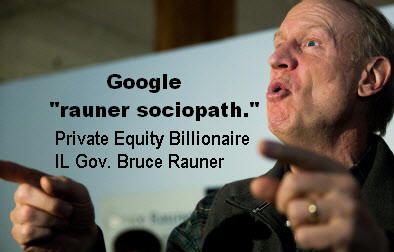
Google: rauner sociopath

rauner sociopath 1


Google the following: rauner sociopath.

Even Google knows that Illinois billionaire Gov. Bruce Rauner is a sociopath – by definition. He continues to steal from autism programs in particular to pay for his choice of pro-Rauner folks. This is NOT an insult. What is a sociopath by definition?
noun, Psychiatry.
1. a person with a psychopathic personality whose behavior is antisocial, often criminal, and who lacks a sense of moral responsibility or social conscience.
Rauner appointed Secretary of Education Beth Purvis as “his” Czar of Education to be paid a record high quarter of a million dollars a year. In the 2015 “Illinois Is Broke” state, where will this special level of salary come from?
Three weeks after Purvis’ contract was signed, the governor’s office announced that the Department of Human Services was strapped for cash, and sliced $26 million in services including for autism, epilepsy and burials for the indigent. The cuts, later known as “the Good Friday Massacre,” caused some programs to completely shut down.
“I had no idea that we’re paying the governor’s education staff out of the Department of Human Services budget,” state Rep. Greg Harris, D-Chicago.
– The Chicago Sun Times
This isn’t the first time that Rauner has singled out autism as undeserving.
Gov. Bruce Rauner reinstated his defeated opponent’s [Gov. Pat Quinn (D)] 
Google: rauner sociopath | Reclaim Reform: