Latest News and Comment from Education

Saturday, June 6, 2015

Rallies on Monday / DAMAGING changes in store for WI public schools in one list : blue cheddar

Rallies on Monday / DAMAGING changes in store for WI public schools in one list : blue cheddar:

Rallies on Monday / DAMAGING changes in store for WI public schools in one list


THE PROTESTS
Sun Prairie Monday June 8, 4-6 PM (they need volunteers)
Green Bay Monday June 8, 7:20 AM – 8:00 AM
Appleton Monday June 8 11:45 AM – 1 PM Press Conference to Support Our Schools
3:30 PM – 5:00 PM Honkin’ Good Rally for our Schools
THE LIST
This list is abbreviated* from a (PDF) letter that was recently sent to parents of children in the Rhinelander, WI public school. (doesn’t even list everything – already massive)
1. School District of Rhinelander public schools and schools across the state will have their state aid cut to allow for voucher expansion, i.e. public tax dollars used to pay for a student’s private education….
2. According to Michael Griffith, a senior policy analyst for the Education Commission of the States, this budget drives Wisconsin under the national average in per pupil spending…
3. The new law eliminates many standards for licensing teachers – no bachelor’s degree would be needed to teach our students in multiple subject areas. …
4. The tests that students are required to take will be different for the third consecutive year. … This change also makes it impossible to compare public, private, and charter schools.
5. The proposed law allows students in special education to use $12,000 in publicly funded annual vouchers to attend private and parochial schools. In these schools, students would not be guaranteed the legal rights and protections afforded to them by federal law. …
6. The new law would allow “learning portfolios” to replace up to one-half the credits needed to graduate from high school. The law would require that a diploma earned in this manner be the equivalent of a diploma earned through actual course completion. This proposal has the potential to change what high schools look and feel like across the state; including the likelihood that the rigor needed to earn a high school diploma would be significantly reduced, jeopardizing both in and out-of-state college acceptance.
7. The new law would allow home-schooled students and virtual school students to participate in any extra-curricular or athletic team that our school district offers. …
8. There is a new requirement in the law that mandates passing a civics assessment for high school graduation. This would be a 100 question test. This test is in addition to the multitude of other state mandated tests that students are already required to take. This proposal, set to become law, has had very little discussion and has no plan for implementation.
9. Our schools will be subject to a rating system based on stars. Can a star-rating system adequately portray the quality of our schools? The current school report cards indicate if schools are failing to meet, meeting, or exceeding expectations with specific feedback on areas of strength and recommendations for addressing concerns.
HOW TO CONTACT LEGISLATORS
You can visit the legis.wisconsin.gov site and enter your address on the right to find your legislators and contact them about these issues.
FIND legislators
IT LOOKS LIKE THIS
Add any other events related to public education in a comment please. Thanks.
* Sorry I’m not copying, pasting, and reformatting this whole letter today. My neighbor downstairs was having NOISY drama at 3:00 in the morning. I’m low on sleep.Rallies on Monday / DAMAGING changes in store for WI public schools in one list : blue cheddar:

Why a simple 30-year-old chart is an ingenious teaching tool today - The Washington Post

Why a simple 30-year-old chart is an ingenious teaching tool today - The Washington Post:

Why a simple 30-year-old chart is an ingenious teaching tool today


Almost three decades ago, a simple chart known as the K-W-L was born — and it has helped millions of teachers help kids think and learn ever since. What is it and why is it so powerful? Author Alfie Kohn explains, and even makes the case that this old chart should be viewed as radical in today’s learning environment.  Kohn is the author of  14 books, including “Schooling Beyond Measure….And Other Unorthdox Essays About Education,” just published by Heinemann.
By Alfie Kohn
I believe it was Dale Carnegie who first counseled public speakers to “tell the audience what you’re going to say . . . say it . . . then tell them what you’ve said.” This advice, which presumably appeared in his book “How to Lose Friends and Irritate People,” suggests a rather dim view of the audience’s capacity to comprehend or remember what they’ve heard – or, perhaps, the speaker’s capacity to come up with enough content to fill the allotted time.
Nevertheless, the general idea of sandwiching the main event between some sort of preparation and some sort of reflection actually makes a fair bit of sense when applied to learning — provided that the goal is more ambitious than mere repetition.
Consider the iconic K-W-L chart, first described by literacy expert Donna Ogle in an article published almost 30 years ago in “The Reading Teacher.”[1] Students are asked to brainstorm what they already know (K) about the subject matter of the text they’re going to read and also to anticipate the kinds of information it’s likely to contain. Then they discuss what they hope to learn (W). Finally, after reading, they consider what they actually did learn (L).
I’ll return in a moment to how this procedure illustrates what might be called sandwiching, but first let me say a word about K-W-L in its own right. Its status as one of those nifty practical ideas that teachers can pick up quickly and start using the following morning probably explains why it became so popular. But, like other teaching strategies that are deceptively radical in their implications, K-W-L is also easily corrupted – and often implemented so poorly as to undermine any meaningful benefit.
For example, rather than being given time to reflect on what, if anything, they genuinely want to know about a given subject, students may be asked to cough up questions on the spot — which results in responses that are perfunctory and inauthentic. Even when students come up with thoughtful questions, moreover, the teacher may write them down and then ignore them, teaching the unit exactly the way she had originally planned. Finally, the Why a simple 30-year-old chart is an ingenious teaching tool today - The Washington Post:

The Education of EduShyster (a Comedy) | EduShyster

The Education of EduShyster (a Comedy) | EduShyster:

The Education of EduShyster (a Comedy)


Can you believe I’ve been at this for three years???
three candlesNote: to mark the third anniversary of my blog, I’m sharing a chapter that I wrote for a book called Resisting Reform: Reclaiming Public Education Through Grassroots Activism. I recount my unlikely journey into the world of edu-blogging and reveal at long last what (or rather who) prompted me to come out as my self…
I can tell you exactly when Edushyster.com came into being. It was the summer of 2012 and I was deep in conversation with my husband. Well, maybe conversation isn’t quite the right word as it implies some sort of a back-and-forth. This was more of a one-way affair—a diatribe to be precise, and I was the one doing the dia-tribing. As he liked to point out, I’d been doing a lot of this lately. Our early morning newspaper reading sessions had become a launching pad for my many strong opinions.
diatribe
THE GENTLEMAN ON THE RECEIVING END OF MY DIATRIBES.
The cause of this particular harangue was yet another column in the Boston Globe giving unquestioning support to a proposed ballot measure that would essentially eliminate tenure for teachers in Massachusetts. Authored by a writer whose beat seemed to consist alternately of teacher bashing and charter school cheerleading, the column was a familiar mélange of talking points: change-obstructing teachers union (check), overpaid teachers with guarantees of life-time employment (check), obligatory reference to the achievement gap (check).
*You know that the Globe writers have strict seniority protections,* I pronounced in the direction of my husband, who wielded a copy of the Boston Herald like a shield. *You have to admit that’s kind of a double standard.* I paused, giving him an opportunity to respond to this obvious outrage. Nothing. *At one point they had a provision in their contract that guaranteed them jobs for life.* Still nothing. *Well, don’t you think that’s outrageous?* I abandoned the Globe in order to better make my case.
*You know what I think?* he said finally, peering at me over the top of his paper. *I The Education of EduShyster (a Comedy) | EduShyster:

Millions in costly real estate deals threaten Albany charter school foundation - Times Union

Millions in costly real estate deals threaten Albany charter school foundation - Times Union:

Millions in costly real estate deals threaten Albany charter school foundation


For 15 years, the Brighter Choice Foundationhas been the leading backer of charter schools in Albany, which is among the most concentrated and contentious charter proving grounds in the state.
Founded by ideological pioneers of New York's charter movement, Brighter Choice helped seed 11 of the 12 charter schools once operating within a 20-minute walk of the state Capitol. Seven will still be open next school year.
But the nonprofit has altered the city's landscape in a more material way inseparable from its mission to provide alternatives to struggling city schools: It has also been one of Albany's most prolific real estate developers.
The foundation has struck complex financing arrangements for tens of millions of dollars to build nine new schools — the equivalent of a second school district paid for with tax money city schools are legally bound to share with the charters to educate the children who choose to attend them.
There may be no better example than the Brighter Choice Middle School for Boys and Brighter Choice Middle School for Girls, which will saddle the foundation with a $15 million debt on the 4-year-old Elk Street building they share when they close next month.
The deals rest on a key assumption: That the schools, whose charters need to be renewed by the state every five years, will stay open long enough to pay the loans taken out to build them.
To critics, they represent big-money gambles on unproven schools. To boosters they are emblematic of a fundamental flaw in New York's 1998 charter school law that excluded charters from the huge pool of state aid — some $2.7 billion this year — to renovate or replace aging public school buildings.
"We started off with one hand tied behind our back," said Kyle Rosenkrans, CEO of the New York City-based Northeast Charter Schools Network.
The result, the network alleges in a lawsuit filed against the state last year, is that charters spend money on real estate rather than on educating students.
Brighter Choice may be ground zero for the long-term consequences of that.
Buffeted by a series of school closures, the foundation finds itself under significant financial pressure in part due to bets on several schools the state says have failed to meet their educational benchmarks, according to financial documents reviewed by the Times Union.
The closure of the Brighter Choice middle schools will eventually leave the foundation on the hook for a $15.1 million construction debt it guaranteed that Wall Street doubts it can pay for more than three years.
The 30-year bonds were issued in 2012 through the Industrial Development Authority of the City of Phoenix; in March, Fitch Ratings called the schools' default "inevitable."
The foundation has also guaranteed another $1.35 million in related loans for the schools.
A default by the schools would force the foundation to find a way to pay the bondholders — Chicago-based Nuveen Asset Management — without the $14,072 per-student revenue that is the core of the Brighter Choice business model, or face having the building sold out from under it.
This has happened before. After New Covenant Charter School on North Lark Street lost its charter in 2010 with nearly $16 million in principal still owed on bonds issued to build it, the city school district ultimately bought the building for $2.5 million, with bondholders recouping just a fraction of their investment.
New Covenant was the city's first charter school and the only one not backed by Brighter Choice.
Despite the acrimony between the two, the city school district may help provide Brighter Choice a short-term reprieve. Scrambling to find space to accommodate the roughly 440 students from the closing middle schools, the district is in talks to lease the middle school building through the end of next school year for up to $371,855 — a fraction of the annual debt payments, which are in excess of $1 million, according to financial statements.

Over 250 nation's mayors to gather in San Francisco this summer - eTurboNews.com

Over 250 nation's mayors to gather in San Francisco this summer - eTurboNews.com:

Over 250 nation's mayors to gather in San Francisco this summer


WASHINGTON, DC - Under the leadership of US Conference of Mayors (USCM) President Sacramento Mayor Kevin Johnson and host San Francisco (CA) Mayor Ed Lee, more than 250 of the nation's mayors will convene at the Hilton San Francisco Union Square this summer to discuss the economic health of the nation's cities and their metropolitan areas, and the factors that contribute to growth and/or decline. Mayors will also release their annual U.S. Metro Economies Report containing last year's Gross Metropolitan Product (GMP) numbers for each of the nation's 363 metro areas, along with 2015-2016 metro economic forecasts of GMP and employment.
Issues topping the Cities 3.0 agenda in San Francisco include: water conservation, transportation, municipal bonds and marketplace fairness, education, workforce development and apprenticeship programs for youth, technology and innovation, energy efficiency, community policing and more. Mayors will also give awards to cities showcasing stellar best-practices in the areas of climate protection, manufacturing innovation, neighborhood stabilization, college and career-readiness training, and programs that enhance the livability of America's cities.
On the final day of the meeting, the mayors will usher in new leadership and vote on policy resolutions to forward to Congress and the Administration in the hopes of shaping federal legislation.
All business sessions are OPEN to the press unless otherwise indicated (EVENING EVENTS ARE CLOSED TO PRESS). ONLY reporters with proper press credentials will be allowed access.
Meeting highlights include (at Hilton Union Square unless otherwise noted):
FRIDAY, JUNE 19 – Opening Press Conference at 11:15am; Site Visit to New Door Ventures; Water Council Mtg re Implementing CA Water Restrictions; Mayors and Police Chiefs Task Force Mtg; Climate Protection Awards for Winning Cities Announced; Walmart VP Gerard Dehrmann to launch Cycle 2 of Manufacturing Innovation Fund; Discussion on Music and Politics feat. MC Hammer and Carlos Santana; Workshop on WAZE (traffic app); Kaiser Permanente CEO Bernard Tyson; Salesforce Exec. VP Vivek Kundra; House Democratic Leader Nancy Pelosi; Committee Mtgs: Criminal and Social Justice; Energy; Jobs, Education and Workforce w/ U.S. Labor Sec Perez; Metropolitan Economics; Women Mayors
SATURDAY, JUNE 20 – USCM President Sacramento Mayor Kevin Johnson's Farewell Address; City Livability Awards for Winning Cities Announced; CA Senator Dianne Feinstein; U.S. Ambassador Andrew Young; MLB Commissioner Robert Manfred, Jr. re Play Ball Anncmnt.; Workshops: Increasing Diversity in Tech Industry; Building Out Broadband; Balancing Regulations and Economic Growth; Task Force Mtgs: Food Policy; Education Excellence; My Brother's Keeper; Commmitte Mtgs: Housing & Community Development; Health & Human Services; Environment; Transportation & Communications
SUNDAY, JUNE 21 – Chicago Mayor Rahm Emanuel; Los Angeles Mayor Eric Garcetti; CA Lt Gov Gavin Newsom; USCM/USA Funds Education Pathways with a Purpose Grant Awards & Forum; Small Business Clusters Forum; Special Plenary Session on Education Reform feat. Michelle Rhee, Antonio Villaraigosa; USCM/Wells Fargo CommunityWINS Grant Awards for Neighborhood Stabilization
MONDAY, JUNE 22 – Mayors' Amtrak Advisory Council; Ports and Exports Task Force Mtg; National Park Service Dir Jonathan Jarvis; Business Session to Debate/Vote on Policy Resolutions by Conference General Body; New USCM President Baltimore Mayor Stephanie Rawlings-Blake's Inaugural Address
WHO: Opening Press Conference of The U.S. Conference of Mayors 83rd Annual Meeting: USCM Leadership, Host San Francisco Mayor Ed Lee (New Economic Data To Be Released)
WHEN: Friday, June 19, 2015 at 11:15am
WHERE: Grand Ballroom -- Salon A | Hilton San Francisco Union Square | 333 O' Farrell Street | San Francisco, CA

“White Girl” Kati Haycock Takes On Marc Tucker and His Dissing Annual Testing | deutsch29

“White Girl” Kati Haycock Takes On Marc Tucker and His Dissing Annual Testing | deutsch29:

“White Girl” Kati Haycock Takes On Marc Tucker and His Dissing Annual Testing


On May 28, 2015, National Center on Education and the Economy (NCEE) president Marc Tucker wrote a piece for Ed Week in which he argued against the utility of annual testing. Below is an excerpt from his post:
…The data show that, although the performance of poor and minority students improved after passage of the No Child Left Behind Act, it was actually improving at a faster rate before the passage of the No Child Left Behind Act.  Over the 15-year history of the No Child Left Behind Act, there is no data to show that it contributed to improved student performance for poor and minority students at the high school level, which is where it counts.
Those who argue that annual accountability testing of every child is essential for the advancement of poor and minority children ought to be able to show that poor and minority children perform better in education systems that have such requirements and worse in systems that don’t have them.  But that is simply not the case.  Many nations that have no annual accountability testing requirements have higher average performance for poor and minority students and smaller gaps between their performance and the performance of majority students than we do here in the United States.  How can annual testing be a civil right if that is so?
In order to prove Tucker wrong, all one must do is refute the claims he makes based upon testing data available pre-NCLB and then during NCLB.
One could also attempt to show that some other nations without annual testing, their minority children demonstrate “achievement gaps” on international tests or based upon some other outcome, such as secondary school graduation.
But Education Trust president Kati Haycock chose another route in contesting Tucker’s claims:
The daytime television route.
In her June 4, 2015, Education Post rebuttal, Haycock jumps out of her daytime-TV chair, knocking it back as she rushes forward to get in Tucker’s face while declaring that she, “even a white girl,” can register what is Tucker’s obvious insult:  That the civil rights community could possibly be injuring children by insisting upon annual standardized testing.
No such drama was necessary.  All Haycock had to do was refute Tucker’s evidence.
She did not.
Instead, she goes on to write (in the $12 million, Walton-Broad-Bloomberg-funded, corporate-reform Education Post) that she– the white girl– is there to call Tucker out on behalf of a group of 12 civil rights organizations that she admittedly did not join with in their May 5, 2015, formal declaration against opting out.
In her Education Post entry, Haycock states she could refute Tucker’s evidence but that the real issue is his insult to those civil rights orgs that may or may not speak up for themselves:
If it mattered, I would refute Tucker’s assertions one by one. That would be easy, for the “evidence” he puts forth is weak. His suggestion, in particular, that these organizations are blind to the problems inherent in standardized testing should give pause to any knowledgeable reader, for these very organizations have fought against the misuse of tests for decades.
If test results are really what matters, why not present the evidence? Are the only “knowledgeable readers” the ones that already agree with Haycock– and therefore do not need to see any pesky evidence?
And actually, it is possible for an organization to “fight against the misuse of tests for decades” and not succeed in such a fight. But this concept, Haycock dismisses out of hand.
Continuing:
Instead of providing evidence of other nations that have successfully used annual 

CURMUDGUCATION: Hillary's Teacher PAC

CURMUDGUCATION: Hillary's Teacher PAC:

Hillary's Teacher PAC


With that first tweet, America's Teachers PAC made its twitter debut.

The PAC has a lovely website that launched just at the end of May and gives a clearer picture of what Hillary's-- well, no, of course this is the vision of the good folks at America's Teachers PAC who are I am sure following the rules that require them to be a separate entity from Clinton.

For one thing, they refer repeatedly to "our network of teachers-- reform and union." So right off the bat, we get their view of how the 'sides" of the education debates parse-- it's the reformers versus the unions. So there's one thing they don't get about current education issues-- that the reform side is a complicated web of entities including folks like the Center for American Progress, a reformster group with close ties to Hillary, and that "the union" doesn't even begin to describe the network of folks standing up for public education (that, in fact, the national unions are both late and lukewarm in their opposition to the reformster movement). But they repeatedly define these as the two "factions"-- reformers and unions.

The PAC lists talking points educational ideas to which it is committed.

1. Universal pre-school
2. Two free years of community college
3. Increased teacher pay and flex work options
4. Access to high quality schools for all communities
5. Full-service community schools

#4 opens with this familiar reformy dog whistle: "No child should be trapped in a failing school. Families should have alternatives if their neighborhood school is consistently underperforming." So, choice and charters. One more thing Hillary America's Teachers PAC gets wrong.

You find the same list on their LinkedIN page created on April 6 by Naveed Amalfard.

Amalfard is a math teacher in DC public schools, and he's been at that job for one whole year. He was previously at Emory in the economics department, held a summer job with McKinsey, was founder and CEO of Readers Beyond Borders for four years (You can watch him talk about it here). Can you guess how he ended up in a classroom? That's right-- Amalfard is a Teacher for America temp.

The America's Teacher blog used to open with a post from Amalfard:

I'm Naveed, an 11th grade statistics teacher in Washington, DC. I started America's Teachers as a grassroots Super PAC to bring together teachers, parents, and students to advocate for better public schools. Teaching in a high-poverty school has given me some insight into some of the web of challenges facing struggling students. I've developed a real appreciation for the depth and breadth of the educational crisis in our country.

Oh my goodness. One whole year and he gets the whole of the educational crisis. Once again, the Onion takes a back seat to reality.

You can't read that post on America's Teachers PAC website (where, actually, they neglect to call themselves a PAC); you have to find a cached copy. Now the website is pretty thoroughly scrubbed clean of any references to actual individuals, which seems like a bad choice since it gives the group the appearance of just one more shadowy collection of back room dark money deal makers.

We do know they've recruited the usual assortment of well-scrubbed college types. This recruiting post from the GW Democrats asks for fellows to join the America's Teachers PAC. The fellowship last twelve weeks-- the first half for training in "volunteer recruitment and management, event planning, and digital organizing." The second half will be putting these skills to work to make Hillary the next President. "Fellows will be integrated into the PAC and well-supported by its leadership. Each fellow will be responsible for specific workstreams." Operations will be base primarily in DC.

As to who that leadership might be...? Well, that's not entirely clear. A few of us asked the @AmericaTeachers twitter account who their backers are, but there was no answer (and given the nature of twitter, I don't find that particularly nefarious). I've emailed that question to the group 


How Kevin Johnson Used Public Money To His Own Personal Ends


How Kevin Johnson Used Public Money To His Own Personal Ends:

How Kevin Johnson Used Public Money To His Own Personal Ends


Kevin Johnson has ambitions of becoming something much more than just mayor of his hometown of Sacramento, Calif. So far, the former NBA star hasn’t found a way to realize them—but his desire to expand and promote his brand has meant that Sacramento city staffers have had lots of extra work to do that hasn’t had anything much to do with running the city.
Thus was Johnson’s taxpayer-subsidized mayoral team put to work on his behalf last year as he tried to play kingmaker when the National Basketball Players Association was searching for a new executive director.
In 2014, NBPA brass invited Johnson—at the time riding high on publicity from the assistance and counsel he offered NBA commissioner Adam Silver as he dealt with Los Angeles Clippers owner Donald Sterling’s racism scandal—to consult on its effort to replace deposed boss Billy Hunter.
Johnson, though, set up his own “advisory search committee” and personally approached candidates. The labor for this project came right off the Sacramento municipal payroll, with city workers using private email accounts, presumably to keep the operation off the books.
“All the emails included members of his [mayoral] staff,” says a source who witnessed Johnson’s approaches and requested anonymity, “and were him telling his staff to do this and him telling people they should get in touch with this staff person to get this done.
“It was always his staff.”

Public employees, public money, private work

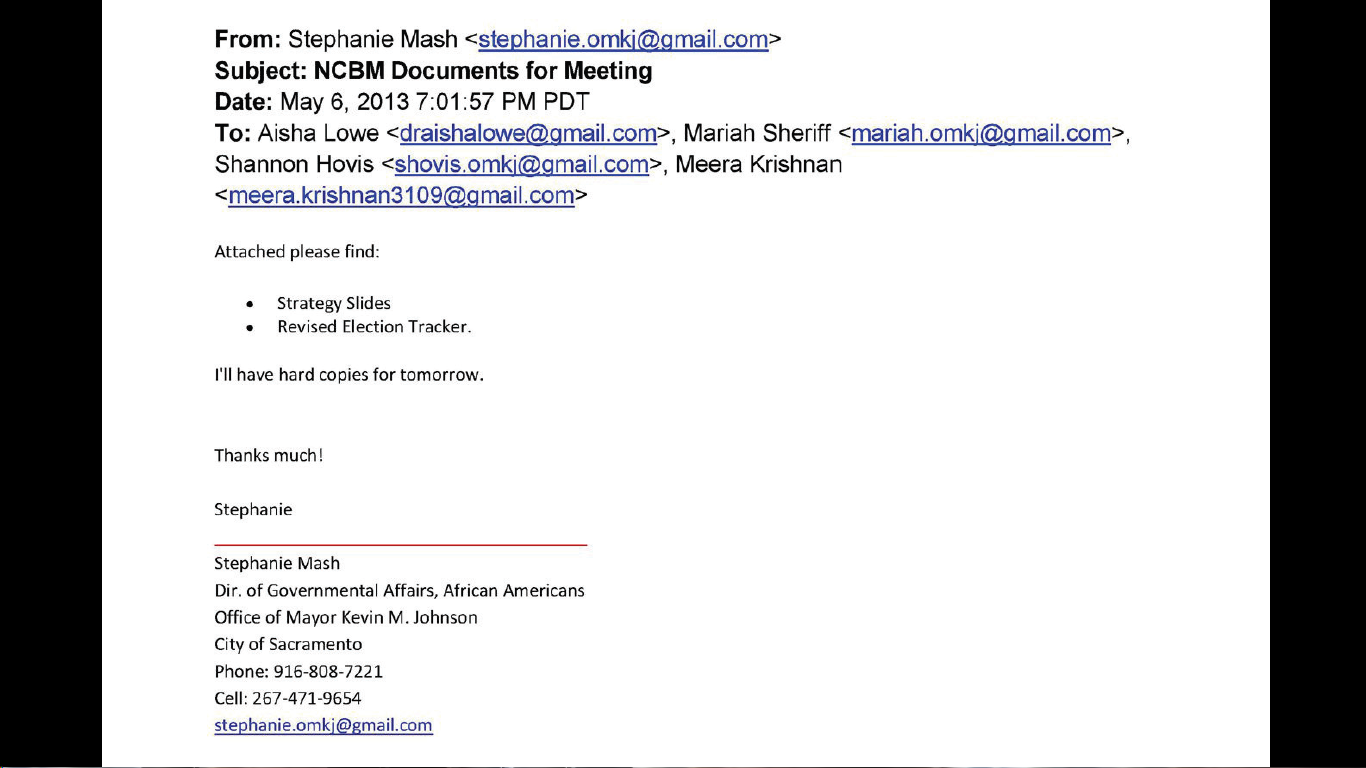
Among the mayoral staffers Johnson used during his NBPA excursion, according to a source, were Ben Sosenko, the press secretary; Daniel Conway, the chief of staff; Stephanie Mash, director of government affairs, African-Americans; Astrid Mirazo, administrative coordinator for the mayor’s office; and Aaron Anderson, whose online résumé says he’s in charge of “public-private partnerships” for the mayor’s office. This source says Johnson also exploited the labor of Andre Breaux, who earned a fellowship in Johnson’s office through his work at the University of Arkansas’ Clinton School of Public Policy, then signed on to the staff. Johnson clearly taught the young fellow that there’s nothing wrong with using public labor for private deeds: Breaux’s own résumé boasts that he “[m]anaged project tasks for the Mayor’s role as Chairman of the National Basketball Players Association (NBPA) Executive Director Search Committee.”
How Kevin Johnson Used Public Money To His Own Personal Ends
An email typical of those sent around by and to Johnson’s publicly-paid minions.

Alas, all the Sacramentans’ money and Johnson’s time and effort went for naught. The union’s executive committee grew tired of his cock-of-the-walk attitude, and when Johnson saw a lack of kowtowing on their part, he left the headhunting expedition in a huff while the search was still ongoing. 
“He wanted to run the thing with an iron fist,” says one observer, “and when he saw he couldn’t get everything his way, he took his ball and went home.”
Of course, the people of Sacramento had paid for the ball Johnson was playing with. And it turns out that Johnson’s use of city employees for the NBPA campaign wasn’t a one-off for him.
Deadspin wrote last week about all the time, effort, and bullying Johnson put into taking over and then demolishing a black mayor’s group. Court records now show that folks on the Sacramento payroll also did Johnson’s private bidding during every phase of that bizarre, megalomaniacal campaign, which flopped as badly as his foray into NBPA politics.
The discovery phase of civil lawsuits inspired by what Johnson called a “coup” carried out against the National Conference of Black Mayors has produced lots of evidence showing that he had members of his mayoral staff carrying out his clandestine operations. Among the civil servants doing Johnson’s dirty work: Mash and Sosenko, veterans of the NBPA excursion; Mariah Sheriff, director of governmental affairs in education; Aisha Lowe, whose emails identify her as interim director of African-American affairs for the mayor’s office; and Shannon Hovis, coordinator of governmental affairs in education. Meera Krishnan, a senior fellow on the mayor’s staff on loan from Harvard, was also knee-deep in Johnson’s NCBM muck.
In both the NBA and NCBM projects, the mayor and his staff used private email accounts. The staff typically just appended “OMKJ@gmail.com” (for “Office of Mayor Kevin Johnson) to their first names—press secretary Ben Sosenko, for example, used ben.omkj@gmail.com, when his normal work email address is bsosenko@cityofsacramento.org, while Johnson favoredmayorjohnson@kevinjohnson.com.
There is little purpose in using private email accounts, as has been pointed out by Hillary Clinton’s detractors, other than to make tracing a public servant’s deeds more difficult.

A history of dubious acts

Johnson’s history of using public money for his own purposes well predates his mayoralty. He was banned from accepting federal grants for any of his foundations in 2008, after an investigation by Gerald Walpin, inspector general for the Corporation for National Community Service. Walpin focused mostly on misdeeds at St. HOPE Academy, which Johnson founded to run charter schools. Walpin referred Johnson to the U.S. Attorney for criminal prosecution after How Kevin Johnson Used Public Money To His Own Personal Ends:

Thursday, June 4, 2015

Dumb Arguments About The Common Core Distract From What Matters Most

Dumb Arguments About The Common Core Distract From What Matters Most:

Dumb Arguments About The Common Core Distract From What Matters Most


While it’s refreshing to see K-12 education become a prominent issue in the very early stages of the 2016 election campaigns, it’s unfortunate to see support for the Common Core – the contentious new standards adopted by most states – become the focus of the debate.
What’s even worse is to see Democrats saying such bewildering, even misleading, things about the Common Core as they defend it against Republican criticism.
Specifically, when the subject turns to Common Core, there is a tendency among Democrats to immediately assert their support for the policy because of concerns for equity in the public school system.
For sure, inequity is a problem – if not the problem – in American schools. Inequities related to students’ race, ability levels, English language proficiency, and income characterize nearly every aspect of the outputs and inputs of the system. The achievement gap between white students and their black and brown peers has been at the center of education policy discussion for years. Students with learning disabilities experience a similar gap when compared with their mainstream peers. Racial discrimination also plagues school discipline policies resulting in black and brown students disproportionately being targeted for punishment, expulsion, and push-out into a school to prison pipeline. And many states discriminate against students on the basis of income by giving richer school districts more money than poorer ones.
But declaring that Common Core is somehow a solution to inequities is more than a stretch – it’s disingenuous. And if Democrats want to have some credibility in the debate on equity in the public school system, they should focus on policy proposals that really have something to do with equity.
Common Core Confusion
No doubt the Common Core has become a prominent issue in the presidential race, at least in the Republican primary.
As Politico reports, New Jersey Governor Chris Christie is the latest presidential aspirant in that party to make a big display of declaring opposition to standards he once championed. Now, the article explains, “Virtually every 2016 Republican presidential candidate has turned against the education standards, other than former Florida Gov. Jeb Bush.”
This is a strange turn of events for sure given that the idea of national standards was originally a popular conservative notion, dating back to the publication of “A Nation at Risk” during the Reagan administration. Even in Republican-led states where Common Core backlash has led to revising the standards, “the replacement standards have been near carbon copies of the Common Core,” The Hechinger Report explains.
But instead of pointing out the incoherency of this, Democrat operatives respond to Dumb Arguments About The Common Core Distract From What Matters Most:

The War of Attrition Over Public Schools - Living in Dialogue

The War of Attrition Over Public Schools - Living in Dialogue:

The War of Attrition Over Public Schools 


By Anthony Cody.
Public schools are in the midst of a war of attrition over their control – and even the very institution of public education is in danger. There is a sort of pincer assault under way, with billionaires on the far right pushing for complete de-regulation, and others, like the Gates Foundation, pursuing top-down systemic control of every public school in the nation.
On the “anti-government” side, billionaires like the Koch brothers and Walton family want to turn schools into a publicly-funded free market free-for-all, where virtually anybody who wants to can set up a school and teach whatever they want. This philosophy is resulting in voucher money going to schools that use the Bible as a source in teaching about the origins of life on Earth. The American Legislative Exchange Council has developed legislation sometimes called “Opportunity Scholarships” which give parents tax credits that can be applied to private or parochial school tuition. This week, the state of Nevada became the latest to adopt this model, so soon tax dollars will flow to whatever school the parent chooses, stripping funds from public schools. Deregulation is extending to the teaching profession as well. In Wisconsin, newly proposed rules would allow anyone to teach, regardless of their level of education, so long as they have “relevant experience.”
On the “pro-government” side, the Gates and Broad Foundations have been working closely with the Obama administration and teacher unions to advance the Common Core and aligned tests as the new accountability system that will re-wire our schools and turn our classrooms into uniform “sockets” for technologically-based learning systems. With the lure of Race to the Top grants, and by threatening the loss of Title One funds, the federal Department of Education has coerced a majority of states into adopting the Common Core. For similar reasons, many states now mandate the inclusion of test scores in teacher evaluations, though these systems are irrational and unfair. The Vergara case in California diabolically pitted the interests of students against those of teachers, asserting that teacher seniority protections interfered with students’ ability to get a good education.
The result of these attacks has been the unprecedented demoralization of the teaching profession. The number of applicants for teacher credentialing programs has plummeted in the state of California from around 77,000 around 2001 to fewer than 20,000 in 2012. According to the MetLife survey, teacher The War of Attrition Over Public Schools - Living in Dialogue:

Five things people say about standardized tests and the opt-out movement that aren’t true - The Washington Post

Five things people say about standardized tests and the opt-out movement that aren’t true - The Washington Post:

Five things people say about standardized tests and the opt-out movement that aren’t true


Denisha Jones is a visiting assistant professor of early childhood education at Howard University in Washington D.C., and over the last 10 years, she has taught kindergarten, preschool, and served as a campus-based preschool director. Her research interests include service-learning, dealing with challenging behaviors, the de-professionalization of teaching, and promoting diversity in education. She is also an administrator for United Opt Out National, a non-profit organization that works to eliminate high-stakes standardized testing in public education.
In this post, a version of one that appeared in emPower Magazine on Wednesday, June, 3,  Jones looks at common myths about standardized testing as well as about the growing opt-out movement, in which parents and students and teachers are refusing to take/administer high-stakes tests that they believe are being used for invalid purposes.
The introduction she wrote on her original post talks about the country’s testing obsession and about the push-back against the opt-out movement now under way by school reformers and even some civil rights organizations who have somehow equated annual standardized testing with civil rights.  Jones notes that President Obama has said that he would veto any rewrite of No Child Left Behind, the current version of the 1965 Elementary and Secondary Education Act, that does not include annual standardized testing for accountability purposes.
Jones wrote that “most of the arguments made by those who believe in standardized testing are filled with myths about what standardized testing can and should accomplish and misconceptions about the promise of opting out.” Here she addresses these myths head-on (and you can read her entire post here):

By Denisha Jones
Here are five popular myths about standardized testing and the opt-out movement — and the facts that tell what is really happening.
Myth #1. Standardized testing is needed to address the racial and socioeconomic achievement gaps.
This is the main point of 12 national civil rights group who issued a press release on May 5, 2015, denouncing “anti-testing efforts.” The group joint statement says: “For the civil rights community, data provide the power to advocate for greater equality under the law. It’s the reason we’ve fought to make sure that we’re counted equally in every aspect of American life, such as in employment, the criminal justice system, and consumer lending.” They acknowledge that high-stakes standardized testing (tests used to determine graduation or grade retention) can be misused and undermine the purpose of public education, but they counter that the today’s opt-out movement prohibits the collection of important data that will reveal the education disparities by race and class and our ability to fix what we measure. Additionally the statement takes issues with opt out activists using the Five things people say about standardized tests and the opt-out movement that aren’t true - The Washington Post: