Latest News and Comment from Education

Sunday, May 17, 2015

LAUSD: Fact-checking California Charter Schools Assocation Attack Ads Against Schmerelson

LAUSD: Fact-checking California Charter Schools Assocation Attack Ads Against Schmerelson:

Fact-Checking Attack Mailers on Schmerelson Sent By the California Charter School Association


Below in the Scribd window is yet another attack mailer sent to residents of Los Angeles by the California Charter Schools Association (CCSA), a lobbyist group that pushes for unfunded expansion of unregulated charter schools in the state. In the race for LAUSD District 3, the runoff is between incumbent Tamar Galatzan and the challenger Scott Schmerelson.
Tamar Galatzan and the discredited John Deasy
CCSA’s candidate is Galatzan, who was closely allied with failed superintendent John Deasy, currently being investigated for bid-rigging by the FBI and by the SEC for misuse of facilities bond funds. Galatzan favors charter schools and supported John Deasy’s iPad plan well past time it became clear that his signature initiative was poorly planned and implemented, had the air of being corrupt, and relied on improper sources of funding.
NOT TRUE: The misguided basis of CCSA’s allegations that Schmerelson is “executive director of an organization that lobbies in Sacramento for more funding and higher salaries for school bureaucrats” seems to be this memo dated August 2, 2014, where Schmerelson was elected executive director of region 16 of the Association of California School Administrators (ACSA). There are 19 regions in all representing school principals from all across California. He is NOT the President of ACSA, nor is he the Executive Director of ACSA as the mailer implies. Insofar as ACSA lobbies Sacramento, it does so to speak with one voice so lawmakers can know where education professionals stand on issues relating to the funding of public schools and school policy — from the perspective of people whose job it is to run public schools.
NOT TRUE: Scott Schmerelson is no more a “Sacramento lobbyist” than a parent who belongs to the California State PTA is a lobbyist — these are citizen-lobbyists who advocate for public schools due to their interests as stakeholders. The professional organization ACSA may retain paid lobbyists but that is not Scott Schmerelson. Ironically, the California Charter Schools Association is an organization much like ACSA, and the CCSA retains two lobbying firms in Sacramento to push for unfunded charter school expansion (spending $200,000 in 2013-2104 to influence legislators) and has made large dollar donations to Tamar Galatzan in the past and present school board races, so you could say they have a vested interest in influencing an LAUSD school board member who has the power to approve or deny new charter applications and renewals.
NOT TRUE: Salaries of school “bureaucrats” are ultimately determined by the locally-elected school board members who hire principals and decide salary and benefits packages, not Sacramento lawmakers.
Why the distortions aimed at Scott Schmerelson, a career educator and person who seems to have moderate views when it comes to school administration? Perhaps CCSA feels that their own candidate is tainted by association with Deasy, or perhaps they find Schmerelson’s decades serving students, parents, and career educators threatening. If anything, CCSA’s attack mailers make their candidate Galatzan look weak.
In any case, it’s surprising that these inaccuracies are allowed to stand by candidate Galatzan when previously she’s been called on to denounce CCSA attack mailers sent out on behalf of a slate of CCSA LAUSD school board candidates that also included her. With support from “friends” like mudslinging lobbyist group California Charter Schools Association, who needs enemies to drag you down into the mud?

Big Data and Little Kids: In Whose Best Interest? | ECE PolicyWorks

Big Data and Little Kids: In Whose Best Interest? | ECE PolicyWorks:

Big Data and Little Kids: In Whose Best Interest? 

Americans love data. We cannot get enough of it. Collectors on speed, we measure every indicator in sight. Children are the youngest, most fragile casualties of our obsessive compulsive disorder. How many words do they have in their emergent lexicons? Do they know their letters? Can they count up to 20? Are they ready for school? Are they reading The Sorcerer’s Stone ahead of the third-grade benchmarks? They’re on treadmills, each milestone anxiously awaited, and dutifully recorded.
Exams Only Put Youngest Learners under the Microscope
Nothing is off limits in our pursuit of cognitive development and predictors of academic achievement. And we start early. Several years ago, Susan Goldin-Meadow and Meredith Rowe, two researchers from the University of Chicago, published a study in Science that revealed a gap among infants’ gesturing across socioeconomic lines—a potential harbinger of stunted language acquisition. In 2014, amid vociferous debate about the Common Core standards, Susan Sirigatti, a former school principal, extrapolated from their findings in a posting to a blog called “A Smarter Beginning.” The headline read “Gesturing PredictsChildren’s Future School Success”—a symptom of our ever-growing anxiety.
Recently, Megan McClelland, an associate professor of health and child development at Oregon State University tracked the outcomes of 400 preschoolers who had played a tweaked version of the classic children’s game, “Head, Shoulders, Knees, and Toes.” In the original game, the directives match the body part; in McClelland’s experiment, she required the children to do the opposite, touching toes, for example, when she asks them to touch their heads.
Never mind that some of her undergraduates had trouble executing the task; she got her rich lode of data. Children who were able to finesse the exercise were more likely to pay attention in class or keep nose to the grindstone in specific activities—signs of a well-functioning prefrontal cortex, the locus of school readiness and academic success.
Kindergarten assessments are among the latest manifestation of our obsessive-compulsive tendencies. Their origins can be traced to a meeting of George H.W. Bush and the nation’s governors in 1995 at whichschool readiness floated to the top of the agenda, enshrined in the Goals 2000: Educate America Act of 1994. The first Bush, grandfather of No Child Left Behind, had officially welcomed early childhood to the beleaguered precincts of K-12 education reform.
I welcomed this development. I must have been crazy. The landscape of early learning was a mess: a patchwork of public and private programs plagued by uneven quality, an ill-educated, generally impoverished workforce, and anemic investment. How the field was going to get these young students with their variable backgrounds prepared for kindergarten was anyone’s guess. And then there’s that little problem of definition. What does school readiness mean? How do you know if a child is prepared—and for what?
A classic survey of parents and teachers, conducted on the cusp of the Goals 2000 legislation highlights the divergence of opinion. The surveyors divided their work into two clusters of behavioral and school-related items. Included in the first category were the ability to verbally communicate needs, wants, and thoughts; take turns and share; display enthusiasm and curiosity in approaching new activities; and sit still and pay attention. The second listed proficiency with pencils and paint brushes, counting ability (up to 20 or more), and knowledge of the letters of the alphabet.
Both groups converged on the need for well-honed communication skills and positive approaches to learning. But stark disagreement emerged on the question of the academic items: the percentage of parents who rated them very important or essential ranged from six to eight times greater than those of teachers.
Assessing readiness “a somewhat narrow and artificial construct of questionable merit,” as one early childhood expert put it, is daunting.  Kids develop on wildly different timelines, their progress difficult to capture in a snapshot. But that doesn’t stop us. Today, a growing number of states are adopting universal assessment of kindergarten students, grappling with the challenges of reliability and validity in the instruments they use.
As Jennifer Stedron and Alexander Berger noted in a technical report for the National Conference of State Legislatures, “ideally, evaluation of the complicated set of skills and behaviors that comprise ‘school readiness’ would use multiple assessment methods.” Nuance, needless to say, does not come cheap, and children suffer the consequences.
“Our protective urges are stymied,” Peter Mangione, co-director of WestEd’s Center for Child and Family Studies in Sausalito, California, told me. “Our tenderness is critical for their sense of well-being.” A child psychologist, he served as a technical advisor to Ohio when the state was crafting its standards for children from birth to age 5. He worries that we expect infants to act like third-graders: “We’re asking the child to do what they’re not ready to do, and we’re not supporting what they’re ready and meant to do.”
Last December, in the wake of a survey of kindergarten teachers, the Maryland State Education Association called for immediate suspension of the state’s readiness assessment. The teachers had delivered an hour-long test to five-year-olds whom they barely knew on skills that they had not yet taught. Nearly 30 percent of the students were unable to understand and use the technology required by the exam. Many teachers lamented the loss of critical time for bonding with their eager, young learners. And 63 percent of them reported that they had received no meaningful data to inform instruction from administration of the exam.
As the southern writer Walker Percy observed, authentic knowledge remains elusive. “The scientist, in practicing the scientific method, cannot utter a single word about an individual thing or creature insofar as it is an individual,” he wrote in “Diagnosing the Modern Malaise,” one of a collection of essays in Sign-Posts in a Strange Land. “This limitation holds true whether the individual is a molecule of NaCl or an amoeba or a human being.”
I am not arguing that we should bury our heads in the sand. Assessment is necessary, a critical tool for marking human progress, and for surfacing the deep inequalities that mark young children’s development and learning in the U.S. But America’s youngest students have had the grave misfortune to enter the academic arena in a period of measurement gone terribly awry. We need to come to a consensus on the kind of data that’s worth collecting, and we need to stop putting our smallest learners under the microscope, squashing their own insatiable quest for data and knowledge about the world.
An abridged version of this article appeared in the Albany Times Union on April 22, 2015.Big Data and Little Kids: In Whose Best Interest? | ECE PolicyWorks:


Attack ads plentiful as more than $5.5 million spent on LAUSD board races

Attack ads plentiful as more than $5.5 million spent on LAUSD board races:

Attack ads plentiful as more than $5.5 million spent on LAUSD board races


Three seats on the Los Angeles Unified School Board will cost more than $5.5 million by the time ballots are cast Tuesday.
Nearly $1 million of that money will have been spent on attack ads that attempt to misinform voters with revisionist histories and less than honest portrayals.
Board member Tamar Galatzan, who is running for re-election to the District 3 seat representing the western San Fernando Valley, said it’s a “different time” than her first campaign eight years ago.
In the 2007 elections, outside money was controlled by campaigns, she said. Now, Galatzan said, outside groups act without the oversight of candidates they support.
“The thing that’s difficult for me, as a candidate, is not having control over what’s said about me or my opponents,” Galatzan said.
Teachers union-supported groups have spent $82,630 opposing Galatzan’s bid for re-election. A recent flier gives the two-term incumbent an “F” for failing to support students and protect tax dollars — apparently blaming her for a recession that cut revenues prompting layoffs.
Charter school groups that support Galatzan, meanwhile, have spent $141,211 attacking her opponent, Scott Schmerelson.
According to the mailers, the retired LAUSD principal and teacher is actually a lobbyist, responsible for trying to convince legislators they should “increase the already bloated salaries and benefits for administrators, taking money out of the classroom.”
Schmerelson is not a lobbyist. He’s also backed by the teachers union. A political newcomer, Schmerelson said he’s shocked by all the money and lies used in a nonpartisan race for the school board.
“I just can’t believe people would say things that are absolutely not true,” Schmerelson said.
But the most vigorous attack ads were made in efforts to influence voters in areas of Eagle Rock, Echo Park and other neighborhoods inside District 5.
Charter school advocacy groups have spent $554,604 in an effort to oust board member Bennett Kayser and install Ref Rodriguez.
The onslaught started before the primary, when a mailer made the unfounded claim that Kayser tried to stop Latinos from attending “schools in white neighborhoods.” While the stir caused by the mailer prompted Rodriguez to disavow the group “Parent Teacher Alliance in Support of Rodriguez, Galatzan, Vladovic, and McKenna for School Board 2015,” the negative campaigning continues.
Recent attacks portray Kayser as being responsible for the district’s plan to buy $1.3 billion in iPads. Kayser never voted for the contract that sent money to Apple and Pearson — a deal now under federal investigation — because he owned a small amount of stock in Apple. He was also an outspoken critic of the program’s failings.
Meanwhile, groups funded by the teachers union have spent $167,582 attacking Rodriguez. Recent mailers have largely focused on an audit of a charter campus Rodriguez co-founded, Lakeview Charter Academy.
The audit concluded Lakeview Charter Academy, which is one of 16 schools operated by Rodriguez’s Partnership to Uplift Communities, operated in the red and had poor fiscal oversight. According to the attack ads, Rodriguez tried to hide the audit from the public.
The claim is apparently based on the request of a board member that the audit be discussed in closed session prior to its public release. LAUSD General Counsel Dave Holmquist has said such requests are not unusual.
In the South Bay, negative campaigning in the race for District 7 has been limited to $37,549 spent against challenger Lydia Gutierrez. In that district, both charter advocates and unions support Board President Richard Vladovic’s re-election bid.
According to a flier funded by Service Employees International Union Local 99, Gutierrez is a “Tea Party Extremist” who opposes teaching evolution in schools and promotes other beliefs that are commonly part of a conservative agenda.
Gutierrez called the claims made in the flier false and demanded an apology from Local 99.
“Every SEIU Local 99 member should be outraged that their union would attack an individual who is a union member on her personal beliefs and distort the truth,” Gutierrez said in a written statement.Attack ads plentiful as more than $5.5 million spent on LAUSD board races:

School is Out - Let Your Education Begin! - Living in Dialogue

School is Out - Let Your Education Begin! - Living in Dialogue:

School is Out - Let Your Education Begin! 


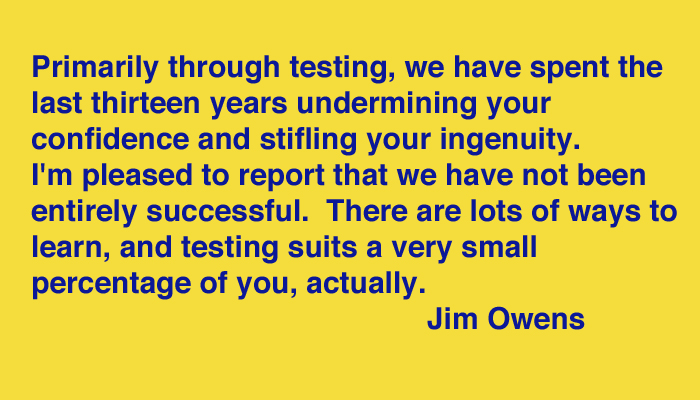
Teacher Jim Owens was chosen by the 435 graduating seniors at Gainesville High School to address them and their families, and delivered this speech to an audience of 5,000 on June 5, 2011. I originally shared this talk back then, and I think it is still relevant now. 
Testing. Testing 1,2. Just like school, no? Always testing. Can you hear me in the cheap seats? Look at you! You’re radiant. You look brighter than ever today. You look like you’ve learned something. It must be the cap. What do you think, should we make it and the gown the SCHOOL UNIFORM for next year? Think of the photo ops. That would show the rest of the world what education looks like in America.
owens.jpg
I am deeply, deeply honored to be speaking to you today, to have been invited BY YOU, the students, on this very special occasion. There is no honor that this humble profession of mine offers that I would ever, or could ever, value more …not even … Merit Pay!
My name is Owens. Not Mister Owens. Not Jim. Just PLAIN Owens. That’s what the kids call me and have for years. I must confess, it felt a little brisk at first, like an enthusiastic slap on the back. Until I realized it was a gesture of cordiality, whereupon I embraced it with affection. Should you too, in the future, feel inclined to call me Owens, by all means, do so.
I teach thinking skills. I do not teach to the test. I’m the guy who teaches your children to think outside-of-the-box. I do not teach your children how to think. Would that not be indocrination? Would that not be brainwashing? I provoke thought, at least I try to. I rather suspect that’s why your children invited me to speak today: to provoke you. I shall do my utmost not … to disappoint them.
Thinking skills. What’s that? Well, that depends on whom you ask. If you ask the people who WRITE the tests, thinking skills might look something like this: If Chinese workers can produce and ship a television for $50, what would it cost to import a million televisions from China. A. $50,000 B. $500,000 C. $5,000,000 D. $50,000,000 or E. Insufficient factors to compute. For instance: how many American jobs will be lost? How will those lost jobs affect the middle class? How will rising unemployment affect the sale of televisions? The ONLY thing I can guarantee you, for sure, is that option E will NOT be on the test.
A more interesting question, I think, might be: If we’ve been testing for the past decade or two and our children, in world competition, are supposedly falling further and further behind, could it be that testing School is Out - Let Your Education Begin! - Living in Dialogue:

Preying on the Promise of Higher Education | Randi Weingarten

Preying on the Promise of Higher Education | Randi Weingarten:

Preying on the Promise of Higher Education


There's a promise we make to the next generation: Graduate from college and you can get ahead. Indeed, recent studies show that college graduates earn $1 million more than high school graduates over their lifetimes.
Yet, as we make this promise, public higher education institutions nationwide are facing a troubling trend of disinvestment. Even with poorly treated adjuncts and other nontenure-track contingent faculty doing the lion's share of teaching at many colleges,tuition costs keep rising. Even with current federal and state student loans and grants,students have been saddled with crippling debt.
And then there's another side of higher education. For-profit colleges are defined by putting profit before the public good, earnings over education, shareholders above students. At these schools--such as Corinthian Colleges Inc., which filed for bankruptcy this month, and ITT Tech, which is being investigated by the Securities and Exchange Commission for alleged fraud--students are products, faculty are afraid to tell accreditors the truth about where they work, and taxpayers foot the bill foraggressive marketing that preys on first-generation college studentsveterans andstudents of color.
Funded largely by taxpayers, for-profit colleges get close to 90 percent of their funding from federal aid--that's more than $30 billion annually. The industry feeds off our noble national goal to ensure higher education is a ladder of opportunity for all who want to climb. However, instead of offering an affordable path to a better tomorrow, they leave students with an uncertain future. Seventy-two percent of these for-profit schools produce graduates who earn less, on average, than high school dropouts.
Currently, for-profit schools enroll just 9 percent of all postsecondary students but account for nearly half of all student loan defaults. They allocate about 23 percent of their revenue to recruiting and marketing and just 17 percent to academic instruction. Compare that with institutions where academics are the priority, such as community colleges, which spend 80 percent or more on instruction.
How did we get to this place where promises are broken, students are held back and for-profits are using our money to fund their schemes?
The simple answer is that the for-profit college industry, through its trade association, the Association of Private Sector Colleges and Universities, and other lobbyists, hasenormous sway in Washington. It's used massive public relations campaigns and campaign contributions to keep politicians on both sides of the aisle from policing its institutions.
Still, we are fighting back. In Congress, Sen. Tom Harkin (D-Iowa) led the charge with a groundbreaking investigation in 2012. Right now, Rep. Mark Takano (D-Calif.) is pushing the Protections and Regulations for Our Students (PRO Students) Act, which aims to protect students from the deceptive and fraudulent practices of for-profit colleges. And as the nation's largest union of higher education faculty and staff, theAmerican Federation of Teachers has joined with courageous students and community organizations to demand justice.
Unfortunately, the U.S. Department of Education has been sitting on the sidelines. For instance, even though Corinthian Colleges faces a $30 million fine for falsified job placement rates and "blatant disregard" for the federal student loan program, the federal government has done little to help the 16,000 students left high and dry. In fact, the corporation is asking for a taxpayer bailout of its $143.1 million in debts.
This month, we sent a letter to Education Secretary Arne Duncan demanding that he use his authority to discharge the loans of Corinthian's students and advocate for stricter regulations to prevent others from engaging in this abuse. And this week, 12 state attorneys general joined the call for "meaningful debt relief to all students who Preying on the Promise of Higher Education | Randi Weingarten:

Broken Windows and American Oligarchy - NYTimes.com

Broken Windows and American Oligarchy - NYTimes.com:

Broken Windows and American Oligarchy


Some years ago I gave a talk to a group of businesspeople — I don’t remember the occasion — and afterward, during the drink and mingle part of the event, had a conversation about executive pay. Quite a few of the businesspeople themselves thought that pay had grown excessive, but what has remained with me was the explanation one guy offered, more or less seriously: it’s all the fault of Monday Night Football.
His story went like this: when games started being televised, the financial rewards to winning teams shot up, and star players began being offered big salaries. And CEOs, who watch a lot of football, noticed — and started saying to themselves, “Why not me?” If salaries were set in any kind of competitive marketplace, that wouldn’t have mattered, but they aren’t — CEOs appoint the committees that decide how much they’re worth, and are restrained only by norms about what seems like too much. Football, so my conversation partner averred, started the breakdown of those norms, and we were off to the races.
By the way, the timing is about right.
Now, this sounds ridiculous — surely huge historical changes must have deeper roots. But I found myself thinking about this conversation when reading this interesting post by Vera te Velde on tests of the “broken windows” theory, which says that people are more likely to break social norms if they see other people violating norms, even if there’s no direct connection — you grab handbags if you see graffiti, you litter if you hear people ignoring noise ordinances, etc.. As she notes, there is now overwhelming experimental evidence for that theory. So it’s not crazy to think that CEOs might start violating pay norms because they see quarterbacks getting big checks.
OK, you don’t have to place sole emphasis, or any emphasis at all, on football. The real point here is that the eruption of top incomes that began around 40 years ago need not have solid causes — it could be a case of contagious norms-breaking. This might also explain why movements of top incomes are so different in different countries, with the most obvious determinant being whether you speak English; think of it as an epidemic of broken windows in the United States, which spreads to countries that are culturally close to America but not so much elsewhere.
Very loose speculation, the sort of thing that once upon a time a serious economist wouldn’t put out there in the public sphere. But I see all these people saying stuff, and figured that I might as well … OK, never mind.Broken Windows and American Oligarchy - NYTimes.com:

Steve Zimmer's Steadfast Endorsement of LAUSD's Bennett Kayser


Steve Zimmer's Steadfast Endorsement of LAUSD's Bennett Kayser


LAUSD Board Member Steve Zimmer explains why a vote for Board Member Bennett Kasyer is a vote for Los Angeles children.


Measuring student safety: Bullying rates at school - NCES Blog

NCES Blog | May 1. 2015:

Measuring student safety: Bullying rates at school


Bullying remains a serious issue for students and their families, and efforts to reduce bullying concern policy makers, administrators, and educators. Measuring the extent of the problem, as well as tracking any progress towards reducing the prevalence of bullying, is of utmost importance and why NCES is committed to providing reliable and timely data on important topics such as bullying. NCES provides additional context for understanding this issue in our schools by publishing comparative data on different student groups, as well as data on changes over time in students’ reports of being bulled at school.
The School Crime Supplement (SCS) to the National Crime Victimization Survey collects data on bullying by asking a nationally representative sample of students ages 12–18 if they had been bullied at school. In 2013, about 22 percent of students reported being bullied at school during the school year. This percentage was lower than the percentage reported inevery prior survey year in which these data were collected (28 percent each in 2005, 2009, and 2011 and 32 percent in 2007).
Similarly, lower percentages of students reporting being bullied in 2013 were observed across some student characteristics. For example, in 2013 about 24 percent of female students reported being bullied at school, compared with 29 to 33 percent in prior survey years. The pattern for males was similar. The percentage of students who reported being bullied in 2013 was also lower than the percentages in all prior survey years for White and Black students. For Hispanic and Asian students, the percentage of students who reported being bullied in 2013 was lower than the percentages in both 2007 and 2009.

Percentage of students ages 12–18 who reported being bullied at school during the school year, by gender: Selected years, 2005 through 2013

This graph shows three lines representing the total percentage of students bullied at school in 2005, 2007, 2009, 2011, and 2013, as well as the percentage of males and females who report being bullied at school. The percentage goes up between 2005 and 2007 for all groups, it goes down between 2007 and 2009 for all groups, it goes up between 2009 and 2011 for all groups and it goes down between 2011 and 2013 for all groups. The line for females is higher than the total line and the line for males for all points in time. The line for males is lower than the other lines at all points in time.
NOTE: "At school" includes the school building, on school property, on a school bus, or going to and from school.
SOURCE: U.S. Department of Justice, Bureau of Justice Statistics, School Crime Supplement (SCS) to the National Crime Victimization Survey, 2005 through 2013.

In 2013, a higher percentage of females than of males ages 12–18 reported being bullied at school during the school year (24 vs. 19 percent). A higher percentage of White students (24 percent) than of Hispanic students (19 percent) and Asian students (9 percent) reported being bullied at school. In addition, higher percentages of Black students (20 percent) and Hispanic students than of Asian students reported being bullied at school. Higher percentages of students in grades 6 through 11 than of students in grade 12 reported being bullied at school during the school year. In 2013, about 14 percent of 12th-graders reported being bullied at school, compared with 28 percent of 6th-graders, 26 percent of 7th-graders, 22 percent of 8th-graders, 23 percent of 9th-graders, 19 percent of 10th-graders, and 20 percent of 11th-graders.
Additional data from the 2013 School Crime Supplement are available in the Student Reports of Bullying and Cyberbullying: Results from the 2013 School Crime Supplement to the National Victimization Survey. Tables in this report contain further information on bullying-related topics such as frequency and types of bullying, cyber-bullying, and fear and avoidance behaviors at school.
Additional information on the definition of bullying, risk factors for bullying, and bullying prevention can be found on stopbullying.gov. The Department of Education, along with other federal agencies, sponsored stopbullying.gov to provide resources on bullying to school administrators, teachers, parents, and children. NCES Blog | May 1. 2015:

Opinion: Controversy, ambition continue to define Sacramento Mayor Kevin Johnson | The Sacramento Bee

Opinion: Controversy, ambition continue to define Sacramento Mayor Kevin Johnson | The Sacramento Bee:

Opinion: Controversy, ambition continue to define Sacramento Mayor Kevin Johnson


KJ pushes to increase staff amid another sexual harassment allegation Outside the city, mayor thrives as an ambassador for Sacramento At home, he struggles with statesmanship and communication


Read more here: http://www.sacbee.com/news/local/news-columns-blogs/marcos-breton/article21188448.html#storylink=cpy


It was déjà vu. The events of this past week transported Sacramento back to the summer of 2008, when a vast majority of city voters wanted Kevin Johnson as their mayor – but the political candidate with so much promise and charisma was dogged by allegations of sexual misconduct.
Sacramento elected him anyway. Voters seemed to decide that KJ’s past was his past. They wanted him for his dynamism, his youth, his connections and his promise to promote a more robust and positive image for Sacramento.
The mayor blossomed from a stilted speaker to a confident one. He went from being politically naive to politically powerful. A City Council of antagonists largely morphed into a council of friends and supporters.
Even the setback at the polls this past November – his ill-fated strong-mayor attempt – hardly seemed to matter. He continued to ride a wave of optimism as the new arena took shape, as he secured federal dollars for Sacramento, as he chased a Major League Soccer berth for the city and pledged to repopulate downtown.
When Ferguson, Mo., was erupting in racial violence, KJ was leading community events that helped keep the peace. Weeks ago in New York, he was the star of a premiere at the Tribeca Film Festival – the lead player in an ESPN film about Sacramento’s successful quest to keep the Kings. At another event at New York University, the mayor turned a ballroom of law school students into fans.
Then it was déjà vu. What seemed like the past was suddenly the present.
A city employee accused Johnson of sexual misconduct. Like past accusations, KJ denied it. We were told the issue had been settled. How? We don’t know. Is money going to change hands between accuser and accused? We don’t know. Is there going to be another shoe to drop? We don’t know.
The mayor’s representatives said the issue was over, settled, with the city formally rejecting the accuser’s claim last week. But City Attorney Jim Sanchez was acting and talking like it wasn’t over – ordering all city parties to keep quiet. Sanchez wants to protect Sacramento from a civil lawsuit or an employment complaint from the state.
THE NET EFFECT WAS THAT THE VALUE OF K.J. THE AMBASSADOR WAS OBSCURED BY THE SHORTCOMINGS OF K.J. THE POLITICIAN – WHOSE ACHILLES HEEL HAS BEEN ARTICULATING WHY HE SHOULD GET MORE AUTHORITY.
The implication that this could linger exposed a type of controversy that has been part of KJ’s story since he was an NBA superstar with the Phoenix Suns. In Arizona during the ’90s, he was accused of having an inappropriate relationship with an underage girl. That also was murky. The authorities didn’t prosecute, but a financial settlement was reached.
On social media, people wondered last week if this is a pattern of behavior or if KJ is just terribly unlucky with some relationships. Based on the information, it wouldn’t be right to render judgment on the latest accusation.
The question now is does this incident affect Johnson’s ambitions for the city and for himself?
It’s worth noting that just before the story of the accusation broke in The Sacramento Bee, Johnson was in Knoxville, Tenn., in his capacity as leader of the U.S. Conference of Mayors. He and other mayors attended a public event with U.S. Transportation Secretary Anthony Foxx. This type of visibility outside the city has netted Johnson access to federal officials and federal dollars for Sacramento.
Last month, Sacramento was one of eight communities nationwide designated a “Promise Zone”by the Obama administration, whereby certain high poverty neighborhoods are given greater priority when applying for federal grants to spur economic growth. With the elimination of state redevelopment dollars, “Promise Zone” could help give Sacramento a real shot at landing money to help improve the quality of life in Del Paso Heights, Oak Park, Lemon Hill and other struggling neighborhoods.
KJ also played a role in the $1.5 million federal transportation grant awarded to West Sacramento in 2014 – money to be used on the new Broadway bridge that will connect West Sacramento and Sacramento.
With these successes as a backdrop, Johnson is seeking to bolster his staff so that he will have greater capacity to trade on his relationships with federal officials. It’s a legitimate idea that deserves discussion.
But while KJ was standing behind Foxx as he addressed reporters in Tennessee, his staffing plans were getting pummeled back home. Instead of being the primary spokesman for why he should get more staffers at Tuesday’s City Council meeting, Johnson left it to his aides to speak for him unconvincingly. Meanwhile, even close allies on the council expressed frustration that he didn’t clue them in to what he was doing.
The net effect was that the value of KJ the ambassador was obscured by the shortcomings of KJ the politician – whose Achilles heel has been articulating why he should get more authority.

He can sell Sacramento to the world, but struggles at selling himself to his peers and constituents. By leaving the council to discuss his request for five additional staffers at a cost of nearly $700,000 while he went to Tennessee, the whole issue landed like a thud.
It would have been different if he said on the City Council dais what he said to me by phone Friday:
“Giving the mayor more capacity allows him to be more effective,” Johnson said. “It shouldn’t be controversial to go from seven staffers to 12. More staffers would help me get more done for the city.”
He said he decided to miss Tuesday’s meeting because the staffing increase – part of the proposed city budget for the 2015-16 fiscal year – wasn’t going to be voted on that night. “I would be back in plenty of time to discuss it, and if people didn’t agree, they would have the opportunity to do so.”
KJ has been a fascinating puzzle of achievement and enigma. He’s moved mountains with his guard up. He thrives outside City Hall in the service of Sacramento. It’s working inside City Hall – the site of the sexual misconduct allegation – that has been the problem.

Hear Our Teachers; A New Film by Laurie Gabriel - Living in Dialogue

Hear Our Teachers; A New Film by Laurie Gabriel - Living in Dialogue:

Hear Our Teachers; A New Film by Laurie Gabriel 


Why waste money on profiteers with no classroom experience when the experts are already on salary? Hear the dangers of corporate / government control. Hear the solutions from those in the know. HEAR OUR TEACHERS.

What Does It Mean To Be Well Educated? | WagTheDog

What Does It Mean To Be Well Educated? | WagTheDog:

What Does It Mean To Be Well Educated?


My mother said I must always be intolerant of ignorance but understanding of illiteracy. That some people, unable to go to school, were more educated and more intelligent than college professors. 

~ Maya Angelou

Image
Education should provide countless opportunities for students to discover their talents andpursue their passions, instead of being an obligation and competition to be “ready” for college and careers.
Schooling should be about students learning to love, being loved, and cultivating a love of learning, rather than students learning primarily for assessment.
It is far more important that students are free to learn in school and well educated, than subjecting them to continuous testing to determine if they have been educated well.
We always find time for what we truly love, one way or another.
Suppose further that love, being an inclusive spirit, refused to choose between Shakespeare and Toni Morrison (or Tony Bennett, for that matter), and we located our bliss in the unstable relationship between the two, rattling from book to book, looking for connections and grandly unconcerned about whether we’ve read “enough,” as long as we read what we read with love…
The whole world’s a classroom, and to really make it one, the first thing is to believe it is.
We need to take seriously the proposition that reflection and knowledge born out of contact with the real world, an education carpentered out of the best combination we can make of school, salon, reading, online exploration, walking the streets, hiking in the woods, museums, poetry classes at the Y, and friendship, may be the best education of all—not a makeshift substitute that must apologize for itself in the shadow of academe…
You get the idea. The American tradition, in learning as well as jazz and activism, is improvisatory.There are as many ways to become an 
What Does It Mean To Be Well Educated? | WagTheDog: