Latest News and Comment from Education

Friday, May 8, 2015

Los Angeles teachers face political fight to defend public education

Los Angeles teachers face political fight to defend public education - World Socialist Web Site:

Los Angeles teachers face political fight to defend public education


More than 35,000 teachers are currently voting on the agreement reached between the United Teachers of Los Angeles (UTLA) and the Los Angeles Unified School District (LAUSD), the second-largest public school system in the United States with 670,000 students.
The deal is a stab in the back to the district’s teachers and other school employees, which opens the door for an escalation of the attacks on the jobs, wages and conditions of educators in Los Angeles and around the country. The sellout further integrates the UTLA into the billionaire-led education “reform” movement and the anti-teacher attacks being spearheaded by the Obama administration and the Democrats and Republicans at every level of government.
The agreement is a veritable compendium of anti-teacher provisions that should be decisively rejected. These include:
  • The implementation of teacher evaluation schemes designed to accelerate the mass firings of well-qualified teachers. Far from ending punitive test-based “accountability” schemes, the contract establishes a new evaluation program in which the UTLA will have joint authority with the district to implement new teacher evaluation measures.
  • An agreement to end the so-called “teacher jail” system. Instead, teachers accused of alleged misconduct will have their cases reviewed in 90 days or less to accelerate the victimization and dismissal of teachers.
  • An insulting 10.6 percent pay increase, which the union agreed to after dropping its initial 17 percent proposal. The raise will not make up for unpaid furlough days and other sacrifices forced on teachers since the 2008 financial crash, nor the additional out-of-pocket health care expenses absorbed by UTLA members.
  • Guidelines related to class size restrictions that will do nothing to actually reduce class sizes or hire more teachers. Only $13 million—out of a budget of $7.2 billion—will be allocated to reduce class sizes. The union itself acknowledges class size reductions “may not be achieved due to circumstances such as state funding limitations.”
The World Socialist Web Site calls on teachers and school employees to reject this sellout deal with the contempt it deserves and form rank-and-file committees to prepare a citywide strike. At the same time teachers must reach out to the broadest sections of the working class—parents, students, city workers, dockworkers, immigrant workers and others—to support the fight to defend public education.
Above all teachers must understand that this is a political fight. Every section of the political establishment—from President Obama to Governor Brown to Mayor Eric Garcetti, the Democrats and the Republicans—are determined to destroy public education and further open up the $1.3 trillion “education market” to for-profit companies and hedge funds.
Teachers and the achievements won through decades of struggle have become such a target that university enrollment in teacher and education programs is experiencing record declines. In the state of California, teacher enrollment programs fell 53 percent between 2008 and 2012 while overall student enrollment in the university system actually increased.
While the financial elite claims that there is no money for smaller class sizes or decent pay for teachers, trillions are squandered on Wall Street bailouts, corporate tax cuts and the funding of current wars and the new ones being planned. As poverty increases and social programs are cut, 95 percent of all income gains have gone to the top one percent since the economic “recovery” began.
According to a 2014 study, the city of Los Angeles is the ninth most unequal major city in the country, with the top 5 percent of income earners earning as much as 12.3 times the lowest 20 percent of income earners. This actually understates the real level of inequality since it does not factor in capital gains and investment income.
Meanwhile more than 50 percent of Los Angeles children between one month and 17 years live in poverty. More than 1.3 million county residents are classified as food insecure.
To claim that teachers can overcome these wretched conditions without a vast infusion of resources to eradicate poverty and chronically underfunded schools is a lie. Instead the politicians from both parties scapegoat teachers for these problems in order to accelerate the destruction of public education.
In the eyes of the corporate and financial elite, an educated working class is dangerous. That is why the expansion of poverty wage jobs, cuts in essential services, an epidemic of police killings and threat of wider wars have gone hand in hand with the shutdown of schools and the layoff of hundreds of thousands of teachers since 2008.
The UTLA, like its counterparts across the country, seeks to conceal these political issues and prevent a mobilization of teachers and other workers against the Democratic Party, with which the unions are allied. At the same time the union promotes the absurd claim that the lack of funding is solely due to local district mismanagement.
In reality, successive state administrations, including Democratic Governor Jerry Brown’s, have cut billions from public education to provide more tax cuts to the corporations and the wealthy. To the extent that education funding has been restored under the “balanced” state budget of 2014, it has largely been funneled into the Local Control Funding Formula (LCFF), which pumps billions of dollars into private charter schools.
The UTLA has not raised any complaints about the LCFF and is also largely silent on the question of the governor’s soon-to-be-released May Budgetary Revise, which could reduce traditional public school funding even further.
The UTLA and its parent organization, the American Federation of Teachers, do not defend the interests of teachers, parents or students. On the contrary, the UTLA and AFT collaborate with the enemies of public education, including Bill Gates, President Obama and Arne Duncan, and are only looking to get their own share from the transformation of education into a profit-making business.
The UTLA already runs its own charter-style operations, so-called “Pilot Schools,” which give the union authority to hire and fire teachers while Los Angeles teachers face political fight to defend public education - World Socialist Web Site:

Stephen Colbert: SC Teachers' $800,000 man

Stephen Colbert: SC Teachers' $800,000 man:

Stephen Colbert: SC Teachers' $800,000 man


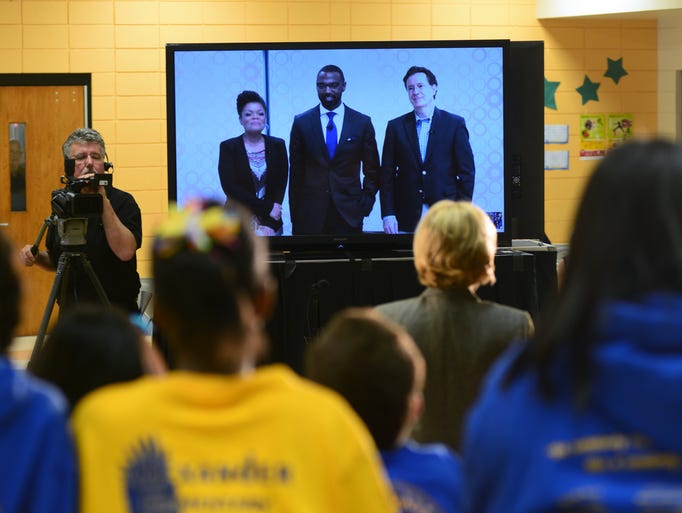
 Comedian Stephen Colbert announced Thursday that he would fund every existing grant request South Carolina public school teachers have made on the education crowdfunding websiteDonorsChoose.org.
Colbert made the announcement on a live video feed Thursday at a surprise event at Alexander Elementary School in Greenville.
Colbert partnered with The Morgridge Family Foundation 's Share Fair Nation andScanSource, which is headquartered in Greenville, to fund nearly 1,000 projects for more than 800 teachers at over 375 schools, totaling $800,000.
Colbert, a South Carolina native and product of South Carolina's public schools, announced the funding at a conference in New York hosted by DonorsChoose.org, a crowdfunding non-profit where teachers create projects requesting materials and experiences their students need to learn, and donors support the projects that inspire them.
"Using the proceeds of the sale of my old set on The Colbert Report which we auctioned off, and with the generous matching funds from The Morgridge Family Foundation and ScanSource, DonorsChoose is going to flash-fund all 1,000 projects in South Carolina," Colbert said. "Enjoy your learning, South Carolina."
Damon Qualls, a teacher at Alexander Elementary School in Greenville, joined Colbert for the surprise announcement in New York. Qualls has had 126 projects funded onDonorsChoose.org, including five projects from today's announcement.
The event was attended by local and state school officials, including state schools Superintendent Molly Spearman.
"There are going to be some happy, happy teachers across the state," Spearman said. "This is Teacher Appreciation Week, so what a great way to say 'thank you teachers for what you're doing every day.'"
Grants will fund everything from new books to classroom supplies, school-branded clothing or professional development for teachers.
"I think it's generally extra things, but to be honest with you, in some situations it could be basic-type things that the students need where the district just hasn't been able to fund it," Spearman said.
"There's a great need out there and thankfully Stephen Colbert is from South Carolina," she said.
Alexander Elementary has been central to the promotion of DonorsChoose.orgprojects in South Carolina. The small, Title 1 school on Greenville's Westside surpassed $100,000 in grants funded earlier this year and now has received more than $125,000 for supplies and experiences through DonorsChoose, said Principal Sonya Campbell.

teacher Damon Qualls receiving the news from Stephen Colbert in NYC
Hitting the $100,000 mark kicked off planning for Thursday's announcement, Campbell said.
Campbell asked each teacher at Alexander to write at least one grant request this year. Now every teacher has had a project funded, she said.
DonorsChoose and ScanSource surprised teachers and hand-delivered some gifts Thursday.
Beth Bailey, Alexander's school librarian, picked through a cardboard box filled with new books for a girls reading group she had hoped to start.
"These girls, they've been asking for this one for weeks," she said, holding up a paperback. "To have this in our library is huge and it's just promoting reading in so many ways. We're so grateful."
ScanSource helped bring then-fledgling DonorsChoose to South Carolina in 2005 and offered tech support, helped them set up their office and offered advice on how to structure the nonprofit as it grew, said Christy Thompson, vice president for worldwide Stephen Colbert: SC Teachers' $800,000 man:

Jersey Jazzman: Lifestyles Of The Rich and Reformy

Jersey Jazzman: Lifestyles Of The Rich and Reformy:

Lifestyles Of The Rich and Reformy


Back in 2013, I told the story of Joe Bruno, a former accounting and health care executive who is now heads a non-profit that is one of the biggest sources of capital for charter school construction.


This picture was taken at the 2013 National Charter School Conference; apparently, charter school advocates thought that the misogynist rapper Pitbull was a fine choice for a keynote speaker that year.


To Pitbull's right is Fernando "Ferny" Zulueta; the two are partners in the SLAM Charter School in Miami. According to a series of reports by the Miami Herald, Zulueta runs the "richest charter school management firm" in Florida, Academica, a for-profit company with annual revenues of $158 million at the time of the reports. Zulueta also controls, along with his brother, Ignacio, more than $115 million of South Florida real estate that is exempt from property taxes as "public" schools.

Bruno's firm, Building Hope, is a major source of capital for Zulueta and other charter school profiteers. Bruno works essentially as a mortgage broker: he gathers up both governmental and private, non-profit funds -- both of which are subsidized by taxpayers -- and disburses those funds to firms like Zulueta's to be used for charter school construction.


Considering taxpayers both provide the capital (either directly through the government or indirectly through the tax code) and pay for students to attend these charter schools, this is a sweet deal for all involved. As I said back in 2013:
Also: while we can debate the relative merits of charter schools, one thing is quite certain: any notion that the charter industry is "all about the kids" needs to be dismissed, because there are adults who are clearly making a lot of money off of charter expansion. And it's not just people like the Zuluetas: Bruno himself, according to Building Hope's 2011 tax return, earned $388,709 in compensation and another $56,865 in benefits for a year's work. In contrast, the average Florida teacher salary is $45,723.
Tax forms for 2013 from Guidestar show Bruno made $386,576 in salary $57,668 in benefits that year. To be fair, Bruno likely made much more when he was a partner at - See more at: http://jerseyjazzman.blogspot.com/2015/05/lifestyles-of-rich-and-reformy.html


A love letter to tireless teachers everywhere, who deserve a little appreciation

What teachers really want for Teacher Appreciation Week:

A love letter to tireless teachers everywhere, who deserve a little appreciation

What teachers really want for Teacher Appreciation Week


Our teachers are under siege. They're underfunded, over-scrutinized and exhausted. And we're all paying the price.
We're losing our best teachers. Nearly half. Four out of every 10 freshly minted teachers will leave the profession in the first five years of their career. Why? Because as the Association of Teachers and Lecturers General Secretary Mary Bousted says, teaching is a profession that has become "incompatible with normal life."
I happen to know one of these teachers. Just a few years into her career, Lauren (not her real name) is without question what you would call a rock star teacher. She has won all kinds of awards, and the thriving kids in her class are proof they're well deserved. But she's leaving teaching at the end of the school year to pursue a career in travel. Countless kids are losing a fantastic, spirited, smart teacher, and that sucks. When I asked her what she would like more than anything else for Teacher Appreciation Week, her response reflected her disillusion.
"Competent administrators, a supportive district and a living wage would be nice, I guess..."
That doesn't really sound like such a tall order, does it?
And so with Lauren and so many of her colleagues in mind, here are a few things that teacher in your life would sincerely appreciate during this Teacher Appreciation Week.

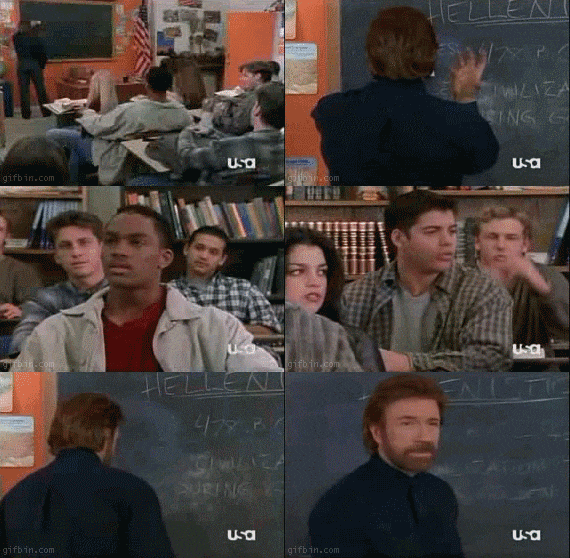
1. Professional respect

Chuck Norris teacher respect
Image: Giphy
Teachers are professionals with a specialized knowledge not just of the subject they teach, but they are actually certified experts in the way kids learn. Listen to them, and take their opinions seriously. They really do know what they're talking about.

2. The benefit of the doubt

teacher benefit of the doubt
Image: Giphy
Chalk it up to Tiger Mom or helicopter parents or the ultra-competitive nature of parenting in the new millennium, but parents by and large just don't have the teacher's back anymore. Let's try to remember that teachers are there because they want to help, and work on giving them a little more support when our smart-mouth kid needs to learn some self-control during math class.

3. Your support

Support teachers
Image: Giphy
After a long day, it's hard to come home and immediately launch into "enforcer" mode, especially when it comes to schoolwork. But teachers need to know you're making school a priority at home too. Your investment at home can make a huge difference in your kid's education. So support their discipline and boundaries. Make sure homework is getting done. And if you have the time, volunteering in the classroom is a great way to connect with your kid's school experience and lend a hand too.

4. School supplies

School supplies
Image: Giphy
Gutted school budgets across the country have forced the burden of adequate school supplies to fall directly — and shamefully — on the shoulders of the underpaid teachers themselves. One teacher just last month had already spent $800 over the school year on school supplies when her pencil sharpener broke. So she turned to crowdfunding for the $323 she needed for a replacement pencil sharpener for her classroom. If you'd like to give the teacher in your life a gift for any holiday, consider a gift card to your local office supply or big box store so they can stock up on what they need.

5. Kids with full bellies

Hungry Kids
Image: Giphy
Three out of four public schoolteachers say they have kids who come to school hungry on a regular basis. First, make sure your own students are going to school on a full stomach, and support programs that expand low-cost breakfasts and lunches for every single student every day. Teachers are spending an average of $35 per month to stock classrooms with food for hungry kids, so next time you're at the grocery store, pick up something for your favorite teacher. Or better yet, get a grocery store gift card so the teacher can get exactly what their students need.

6. Wine

Wine teachers
Image: Giphy
Because being a teacher is a hard job, and a nice bottle of wine makes almost anything better. Cheers!

7. Your vote

Vote teachers
Image: Giphy
You don't have to look very hard to see the damage the past decade of extremely underfunded schools has done to our country. The next time a budget override or increase comes on the ballot in your neighborhood, vote for it. Pay a little extra in taxes, and call it a smart investment in your community's future. Our education system is the foundation for tomorrow's America, and we need policies in place to strengthen our education system, not cut off all its funding and then scream about its lack of quality.

8. Communication

Thank you
Image: Giphy
Teachers value — and need — a steady stream of communication about what's going on with your kid. They want to know, and it helps them do a better job of meeting your kid's needs. You, however, aren't the important person in the relationship; the teacher and student are. Also, you don't need to "sell" you kid's abilities to the teacher. They'll figure that out on their own (remember, they are certified for this). Attend parent-teacher conferences, come prepared with questions, and actually be open to the feedback, which is easier said than done, admittedly.

9. Your teamwork

Teachers team
Image: Giphy
Another one of my favorite teachers, Susan (not her real name), when asked what she would want most for Teacher Appreciation Week, had this incredible response. "The gift I would most treasure is to have parents realize that we are all on the same side," she says. "We love their children and want them to have all the choices in life that a strong education can provide. We are a team."
Amen. Let's give our teachers a little more of that.

10. A nap

Nap
Image: Giphy
Not sure how to pull this one off, but I bet you know a teacher who could really use a nap. Maybe a fold-down classroom cot for lunchtime? If you figure this one out, call me.

11. A "thank you"

Thank you teachers
Image: Giphy
They give encouragement and teach kids to read. They love our kids like they are their own and are asked to care even though they're surrounded by apathy and criticism. During this Teacher Appreciation Week, sure, candy is a sweet gesture, and everyone loves a Starbucks card, but a simple "thank you for everything you do every day" would probably go a long way. If it becomes a habit, great. Our teachers could use a little love; they don't get too much of it these days. And you know you'll miss them over summer vacation.

More about teachers

It’s National Charter Schools Week. Are charters really worth celebrating? - The Washington Post

It’s National Charter Schools Week. Are charters really worth celebrating? - The Washington Post:

It’s National Charter Schools Week. Are charters really worth celebrating?


Celebrating National Charter Schools Week: Dark Money Part 4  #CharterSchoolsWeek

Celebrating National Charter Schools Week: Re-Segregating America’s Schools Part 3 #CharterSchoolsWeek


This week is National Charters School Week, a time intended to “raise awareness” about — and hold a “national celebration” for — charter schools,according to the National Alliance for Public Charter Schools. In the following post, Paul Thomas, an associate professor of education at Furman University in South Carolina, asks exactly what it is about charter schools that are worth celebrating. This post, which I am publishing with his permission, appearedon AlterNet.


By Paul Thomas
In his proclamation for National Charter Schools Week, President  Obama asks us to accept a truth as yet unproven. He writes: “Today, our nation’s very best charter schools are gateways to higher education and endless possibilities, lifting up students of all backgrounds and empowering them to achieve a brighter future.”
Obama is not the only one building the hype. Political praise for charter schools emanates from both sides of the aisle; nearly every conservative call for education reform extols charter schools, with said accolades usually accompanying calls for the holy grail of free-market thinking in the educational realm: more parental “choice.”
But no amount of proclaiming and rallying can upend the evidence, which is not good for the charter school camp. Considering that under Obama, the basic framework of education reform has hewn closely to the deeply flawedtemplate created by George W. Bush’s No Child Left Behind Act (and, arguably, raised the stakes even higher), perhaps we should use this week less for celebration and more to seriously consider the evidence. What, exactly, are we meant to celebrate about charter schools? What have they achieved?
Charter Advocacy Fails Against Evidence
For education reformers committed to market forces as a way to force public schools to improve, the initial focus was on vouchers that allowed parents to use public money to pay for private schools. During the Bush administration, however, researchers found that when controlling for student characteristics, private and public schools were mostly alike—both demonstrating a range of quality, the greatest factors being student characteristics.
Since the public has often resisted private-school vouchers, charter schoolshave become the next great hope that school choice will motivate public schools to reform. Yet in an analysis of charters conducted for the Shanker Institute, researcher Matthew Di Carlo has concluded that “there is nothing about ‘charterness’ that leads to strong results.” In other words, there is nothing about a school being identified as a charter school that excludes other types of schools (regular public, private) from adopting the same policies or practices; there is also nothing about a school operating as a charter school that specifically leads to success. (Take that as your first indication that charter advocacy is more about ideology than evidence-based reform.)
But if there’s nothing about the structure of charters that separates them from the pack, are we celebrating charter schools because of superior student achievement?
In my home state of South Carolina, the picture on student achievement in charters is much like it is in the rest of the U.S. Over a two-year analysis, I have compared S.C. charter schools with public schools with similar populations of students. Approximately 95 percent of those charter schools reflect student achievement about the same or worse than comparable public schools.
In other words, charter, public and private schools have about the same range of student outcomes. As Di Carlo stressed in his report, what we know to be true is that the type of school structure matters far less than what schools do and who the students are.
So if it’s not about school structure and it’s not about student achievement, are we celebrating charter schools for reversing the trend of re-segregation in U.S. public schools?
Sixty years after Brown v. Board, public schools across the country have become increasingly segregated by race and class. Few who seek education reform would argue against seeking policies that would counter that trend. Charter schools have demonstrably not met that need because they are significantly segregated—and charter schools also cause serious concern about selectivity, pushing out and under-serving marginalized student populations (highest-poverty, English language learners, special needs students).
Since many charter schools serve black, Latino and impoverished students, are we celebrating charter schools for offering those students the types of educations wealthy, white students experience?
If political and public support for charter schools was built on all children having the sort of school experience Obama’s daughters enjoy, I imagine virtually no one would be challenging charter schools. Minority and high-poverty students in charter schools, however, experience nothing like that. They are instead treated like “other people’s children” and subjected to reduced curricula, extensive test-prep and harsh “no excuses” discipline policies. And when a high-profile media examination of “no excuses” exposes horrors like students wetting their pants during testing, charter advocates remain committed to their standard (though misleading) “miracle” playbook, suggesting that the ends justify the means.
Finally, are we celebrating charter schools for those “miracles” that can serve as models for reforming all public schools?
There are two problems with miracle schools. The first is a point of logic: elite outliers are not models for any norm. If miracle schools existed, they would be no more useful as a yardstick for all schools than Michael Jordan is the template for evaluating all NBA players—since the typical NBA player (already an elite athlete) is rendered a failure against Jordan.
But the greater problem is that miracle schools have overwhelmingly been discredited. They are not miracles at all, we discover, once the data are It’s National Charter Schools Week. Are charters really worth celebrating? - The Washington Post:

Los Angeles School District Builds Apartments for Teachers | L.A. Weekly

Los Angeles School District Builds Apartments for Teachers | L.A. Weekly:

L.A. RENTS ARE SO HIGH THE SCHOOL DISTRICT IS BUILDING APARTMENTS FOR TEACHERS

L.A. Rents Are So High the School District Is Building Apartments for Teachers


Teachers in Los Angeles aren't exactly poor. But consider the cost of living here: A report last year said it takes you nearly $100,000 a year in household income just to make a median rental home in L.A. affordable.
Furthermore, a UCLA study concluded that the gap between local incomes and rents have made Los Angeles the least affordable rental market in America.
The Los Angeles Unified School District is one of the few bureaucracies in town that is doing anything significant about the problem.
Its 66-unit, four-story Selma Community Workforce Housing Project is under construction at North Cherokee and Selma avenues in Hollywood and is scheduled to open in fall of 2016, the district says. It's ...
 ... intended for L.A. Unified employees who fall into a designated economic category. The complex is part of the District’s ambitious effort to attract and retain staff who want to live near work but can’t afford to pay for housing costs. 
The LAUSD notes that annual median rents in California have increased 21 percent since 2000, while average renters have experienced a real-world loss in income of eight percent:
Increasingly, the high rents place more people into poverty. A new report from the California Housing Partnership said statewide the lowest-income households spend two out of three dollars of income on housing. That leaves little money for food, utilities and other expenses.
This traps many people. In fact, the study found 1.5 million low-income households across the Southland cannot find housing they can afford. The problem has worsened as rents rise and incomes stall.
L.A. Rents Are So High the School District Is Building Apartments for Teachers
Selma under construction via LAUSD
Teachers are not immune. Interestingly, the district last month agreed to a contract that will give its educators a 10 percent salary boost over two years, the kind of raise not seen among average L.A. workers.
The LAUSD has planned three such apartment complexes for its teachers. The Sage Park Apartments next to Gardena Senior High School opened last month and features 90 units.
The 29-unit Norwood Learning Village near USC is expected to open late next year.
The district notes that its projects are among "few affordable housing projects under construction in the Southland."
That's a problem. We're looking at you, City Hall.
Send feedback and tips to the author. Follow Dennis Romero on Twitter at @dennisjromero. Follow L.A. Weekly News on Twitter at @laweeklynews.