Latest News and Comment from Education

Saturday, April 11, 2015

Speak to federal legislators about ESEA and get a signed copy of Reign of Error! – The Network For Public Education

Speak to federal legislators about ESEA and get a signed copy of Reign of Error! – The Network For Public Education:

Speak to federal legislators about ESEA and get a signed copy of Reign of Error!


The advent of the 114th Congress has been marked by renewed energy to reauthorize the Elementary and Secondary Education Act (ESEA), better known as No Child Left Behind (NCLB). NCLB, the 2001 reauthorization of ESEA, changed ESEA from a law devoted to equity to a law devoted to testing and accountability.
As NPE President Diane Ravitch recently wrote, “The switch from ESEA to NCLB was a substitution of punishment and sanctions for direct federal aid to the neediest districts. ESEA and the federal aid it supplied were supposed to help poor children, not convert their schools into test-prep factories or close them or privatize them.”
Last month a Republican effort to pass a House reauthorization bill -- the Student Success Act (H.R. 5) -- failed to gain sufficient support among Democrats and conservative Republicans for passage. H.R. 5 also elicited the promise of a presidential veto from Barack Obama. To date, Senate efforts at reauthorization appear to be more promising. Health, Education, Labor and Pension (HELP) Committee Chairman (Senator Lamar Alexander, R-TN) and Ranking Democratic Member (Senator Patty Murray, D-WA) are currently working on a bipartisan rewrite, which is expected to be ready for markup the week of April 13th.
Between now and April 13th Congress will be in recess and Senators and House Representatives will be in their home districts. Now is the perfect time to reach out and tell them what YOU want (and don’t want) to see in an ESEA rewrite.We’re asking our friends and allies to call, write, or email your Senators and Representatives and if possible, set up meetings to discuss your thoughts on ESEA. Movement on a Senate bill seems most likely after the break, so focus on your Senators if possible.
Here are some helpful talking points, based on Diane Ravitch’s recent article, How to Fix No Child Left Behind, as well as NPE’s letter writing campaigns to the House of Representatives and the Senate HELP Committee.
Restore the original purpose of the ESEA
  • equity for poor children and the schools they attend
  • schools need more money for smaller classes, social workers, nurses, and librarians, not more testing.
Designate federal aid for reducing class size, for intensive tutoring by certified teachers and for other interventions that are known to be effective
  • Do not allow portability of Title I funds
  • Do not allow a reduction in the use of Title II funds for class size reduction
Keep highly trained well-prepared teachers in the classroom
  • Elevate the status of the teaching profession
  • Do not use student test scores to reward or punish teachers
Eliminate the testing and accountability portions of the law and leave decisions about when and how often to test to states and districts
  • Testing every child every year in grades 3-8 and 11 is an enormous waste of money and instructional time
  • No high performing nation tests every child every year
  • Teachers should write their own tests; they know what they taught and what their students should have learned
  • Use normed standardized tests only for diagnostic purposes, to help students
Rely on the federal testing program – the National Assessment of Educational Progress (NAEP) – to provide an audit of every state’s progress.
  • NAEP data are disaggregated by race, gender, ethnicity, language and disability status
  • NAEP tracks achievement gaps between blacks and whites and Hispanics and whites
  • NAEP Tests samples of students, and tells us whatever we need to know
You can find contact information for your House Representative here and your Senators here
Please fill out our form below and let us know if you speak with your Senator(s) and/or Representative or their staff and let us know what have to say about ESEA. 
The first five allies to respond will get a signed copy of Reign of Error! Be the first person to get a meeting and send us a photo of you with your Senator or Representative to info@networkforpubliceducation.org and you'll get a signed copy of Anthony Cody's The Educator And The Oligarch: A Teacher Challenges The Gates Foundation.Speak to federal legislators about ESEA and get a signed copy of Reign of Error! – The Network For Public Education:
“Opt out now”: The Seattle NAACP revives the legacy W.E.B Du Bois, demands an end to Common Core testing | I AM AN EDUCATOR

“Opt out now”: The Seattle NAACP revives the legacy W.E.B Du Bois, demands an end to Common Core testing | I AM AN EDUCATOR:

“Opt out now”: The Seattle NAACP revives the legacy W.E.B Du Bois, demands an end to Common Core testing


“…the Opt Out movement is a vital component of the Black Lives Matter movement and other struggles for social justice in our region. Using standardized tests to label Black people and immigrants ‘lesser,’ while systematically under-funding their schools, has a long and ugly history in this country.” -Gerald Hankerson, current President of the Seattle/King County NAACP “It was not until I was long out of school and indeed after the [first] World War that there came the hurried use of the new technique of psychological tests, which were quickly adjusted so as to put black folk absolutely beyond the possibility of civilization.” –W.E.B Du Bois, Co-founder of the NAACP

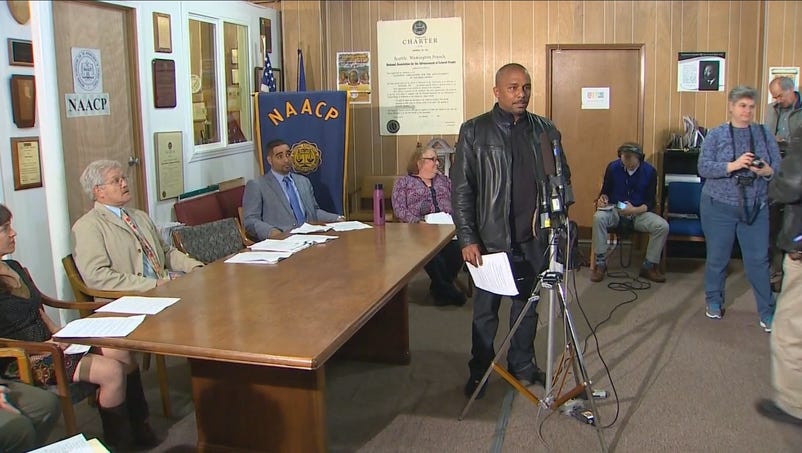
Seattle NAACP President Gerald Hankerson addresses the SBAC press conference.
On Tuesday, April 7, 2015 Gerald Hankerson, the President of the Seattle/King County NAACP and Rita Green, the Education Chair of the Seattle/King County NAACP, began our press conference with a powerful idea and a call for action that holds the potential to help produce a tremendous social transformation. Together their opening remarks at the press conference—a gathering of parents, teachers, and community leaders that I helped to organize in opposition to the Common Core “Smarter Balanced Assessment Consortium” (SBAC) tests—represent a clarion call to both education advocates and social justice activists across the country. Their simple, yet mighty, proposition is that the movement to oppose high-stakes standardized testing and the Black Lives Matter movement (and other struggles against oppression) should and can unite in a great uprising in service of transforming our schools into an environment designed to nurture our children, in body and intellect, rather than to rank, sort, and reproduce institutional racism.


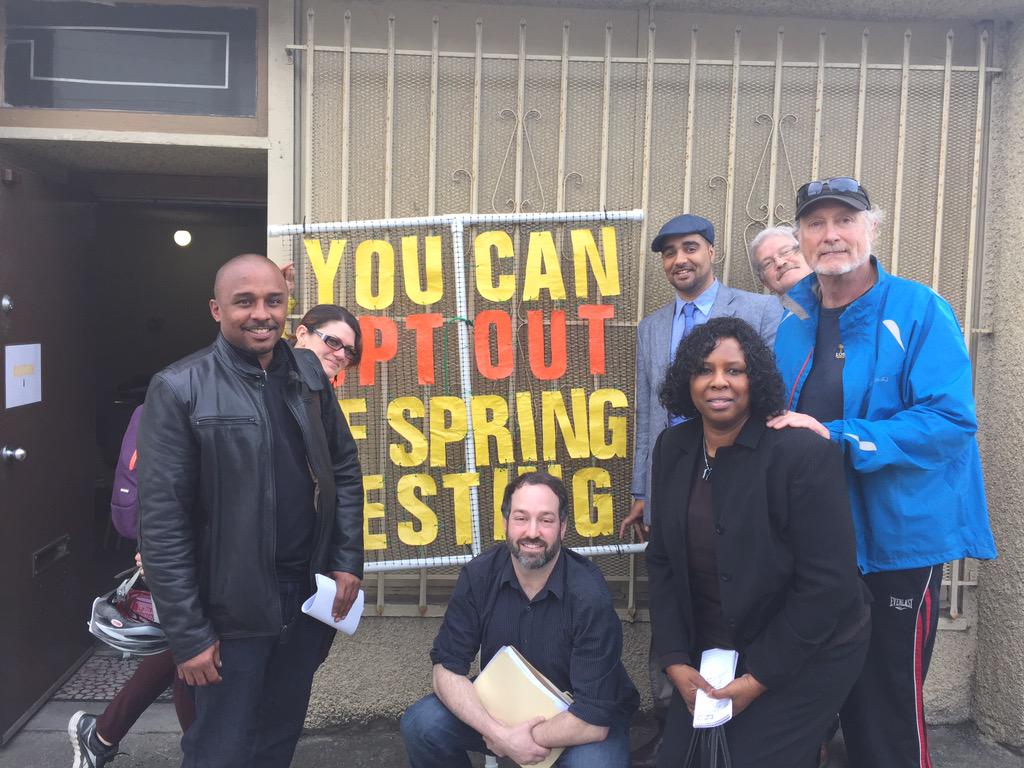
Seattle NAACP President Hankerson (font left) and Education Chair Rita Green (front right) with supporters outside of the press conference.
Hankerson, kicking off the event, referenced the “long and ugly history” of using standardized tests in an effort to establish white supremacy. This is a history that the corporate “testocracy” is desperate to insure remains hidden from the public, as the uncovering of this history would bury their attempts to claim that standardizing testing is the key to closing the “achievement gap.” As the social justice education periodical Rethinking Schools recentlyeditorialized,
“Standardized tests first entered the public schools in the 1920s, pushed by eugenicists whose pseudoscience promoted the “natural superiority” of wealthy, white, U.S.-born males. High-stakes standardized tests have disguised class and race privilege as merit ever since. The consistent use of test scores to demonstrate first a “mental ability” gap and now an “achievement” gap exposes the intrinsic nature of these tests: They are built to maintain inequality, not to serve as an antidote to educational disparities.”
One of these early eugenicists was Carl Brigham, a professor at Princeton University and author of the white supremacist manifesto, A Study of American Intelligence. Brigham left Princeton during WWI to develop and administer IQ tests used to sort the grunt soldiers, who would be used as cannon fodder, from the officers who would oversee the war. Upon the conclusion of the war, Brigham returned to Princeton and developed the Scholastic Aptitude Test, known as the SAT, that came to be used as a gatekeeper to Princeton. Soon standardized tests became commonplace in the public schools. As Alan Stoskepf wrote, “by the early 1920s, more than 2 “Opt out now”: The Seattle NAACP revives the legacy W.E.B Du Bois, demands an end to Common Core testing | I AM AN EDUCATOR:

Arthur Goldstein: The teacher rating system is a farce - NY Daily News

Arthur Goldstein: The teacher rating system is a farce - NY Daily News:

The teacher rating system is a farce: A high-school ESL teacher says he won't change his teaching methods no matter what the governor says


 Starting in the fall, for the third year in a row, New York City teachers will be judged by a new evaluation system. Gov. Cuomo suggests we don’t want to be evaluated like professionals, but that’s wrong. What we want is to be evaluated using a reasonable system that will help us improve.

There is no evidence that evaluating teachers based on gains in student test scores will improve teacher quality. The American Statistical Association estimates teachers affect test scores by a factor of 1% to 14% , and that evaluating teachers by scores may actually reduce quality.
Another problem is the way New York’s tests are scored. When John King announced 70% of students would fail new Common Core-based tests before they were given, the state Education Department took the graded tests and set the cut scores so they did.
These tests are rigged to produce whatever results the pols want — and right now they want public schools and teachers to look bad. It is absurd that the governor finds these tests unsuitable to rate children but acceptable to rate teachers.
I teach English as a Second Language, and at every level, these kids need to be taught grammar and usage. Colleges ask for writing samples, and students who make non-native errors are bounced to costly non-credit remedial classes. Mastery of usage, unlike the arbitrarily-set standards used by the state, is a concrete measure of college readiness.
The new NYSESLAT test (that mouthful stands for New York State English as a Second Language Achievement Test), the one by which I and thousands of my fellow ESL teachers will be rated, is largely a mystery. We know it is supposed to be aligned with the Common Core standards and measure things like close reading. The value of this is questionable at best. Anyone who studies language acquisition will tell you that reading skills transfer from one language to another.
But learning a second language takes time, and that time varies wildly with individual learners. Students who love being here acquire language rapidly. The opposite is the case for kids dragged kicking and screaming.
The state Education Department can rate me poorly if they like. I certainly can’t promise my approach will result in stellar scores on a new test I’ve never seen, and in which neither I nor anyone I know had input.
If my kids don’t do well enough on these tests, I can’t be rated higher than “developing,” though I haven’t gotten a negative observation since I was a beginning teacher, and I’ve never received a negative end-of-year rating.
As for outside observers — another supposed advance in the new system — will they know that I’m not calling on Jenny in the back because she just arrived from El Salvador in the last week, has missed six months of instruction and I don’t wish to humiliate her? How will they know that, though I’m incredibly busy, I’ve offered to teach an additional class to help newcomers catch up?
They won’t. They will take everything out of context, which is the worst possible Arthur Goldstein: The teacher rating system is a farce - NY Daily News:

Why is Common Core so controversial? Chris Hayes sits down with Arne Duncan

All In with Chris Hayes on msnbc:
Why is Common Core so controversial?


If video not working check this link: http://on.msnbc.com/1I0KBny

Why is Common Core so controversial?

Chris Hayes sits down with U.S. Secretary of Education Arne Duncan and asks him about everything from Common Core to college student debt forgiveness.
Duration: 6:52

All In with Chris Hayes on msnbc:


DFER-IL Endorses Chicago's Champions of Education - Democrats for Education Reform

DFER-IL Endorses Chicago's Champions of Education - Democrats for Education Reform:


dfer-il-logo

Democrats for Education Reform – Illinois (DFER-IL) has made several endorsements for the 2015 municipal elections. The candidates were evaluated on their responses to a questionnaire, as well as their public statements and city council votes.


The endorsed candidates are:


Alderman JoAnn Thompson (16th)
Alderman Thompson has been fighting for Englewood in the city council since 2007. She has been a strong supporter of the longer school day in Chicago, more quality options for kids and expanding access to pre-k. She will continue to put her constituents first when it comes to improving education, eradicating gun violence and creating jobs. Her main opponent, Alderman Toni Foulkes, calls herself a progressive but voted against a plan to give thousands of children access to early childhood education. The 16th ward will be well served keeping Thompson in charge.
Alderman Emma Mitts (37th)
Alderman Mitts has been a tireless advocate for her community.  She believes that all students deserve a high-quality education, which is why she championed increasing diversity in Chicago’s best schools and expanding early education options for low-income children. Voters of the 37th ward need her continued leadership in increasing educational opportunities for families on the west side
Michael Diaz, candidate 45th ward
Michael Diaz is a champion for Chicago’s school children and if elected, will bring much needed progressive values to the city council. He supports the full school day and year and believes in promoting high-quality education options for our kids – regardless of background or zip code. Diaz also will fight for increased accountability across the board to ensure that every school is held to a higher standard. His opponent, Alderman John Arena, has given new meaning to the term “political pandering” in his first term in office. The self-proclaimed “progressive” voted against expanding early childhood education and was more interested in standing on a soapbox than he was helping low-income children succeed. Diaz is the new leader that the 45th ward deserves.
Alderman Will Burns (4th)
Will Burns is a true progressive who believes that regardless of life circumstances, nothing should stand in the way of every child’s right to a good education. Like President Obama, he believes in boosting classroom standards and expanding access to early education. He has fought for better jobs, safer streets and led the fight for a higher minimum wage. He is a leader in the Democratic Party in Chicago, and is strongly endorsed for re-election.
Alderman Michelle Harris (8th)
Alderman Harris believes in increasing high-quality education options for the kids in her ward – more seats at selective enrollment schools for African-Americans, more IB or STEM schools, or even more high-performing public charters. She knows that education at an early age is the key to success. That’s why she voted to increase access to pre-k services for thousands of low-income students in Chicago. If re-elected, Alderman Harris will continue to advocate on behalf of every child.

Alderman Patrick O’Connor (40th)
Alderman O’Connor has a proven track record of leadership on education in the City Council. For many years, he served as chair of the Committee on Education, directly working to improve Chicago’s schools by supporting early childhood education and quality options for children and their families. He also worked in Springfield to create Local School Councils, which give Chicago parents and community members more say in how our schools are run. Very few have the variety of experience in education policy that Alderman O’Connor has and he is strongly endorsed by Democrats for Education Reform. His opponent, Dianne Daleiden does not offer any meaningful policies to improve education, and will not hold schools accountable for ensuring that our kids succeed.
Alderman Howard Brookins (21st)
Alderman Brookins has provided a critical voice in the City Council as an outspoken advocate for the residents of the 21st ward. While serving as the head of the Black Caucus, he has been one of the most prominent leaders in fighting for jobs and economic development on the South side of Chicago. Ald. Brookins is committed to making quality investments in education like expanding school options in his community. The 21st ward will be well served with another four years of his leadership.
Alderman Walter Burnett (27th)
Alderman Burnett has advocated for the West Side of Chicago exceptionally well in the City Council. While he’s known for his sense of humor, there is nothing he takes more seriously than the education of Chicago’s children and will continue to fight for more selective enrollment schools, charter schools, IB schools and STEM schools in his ward. Furthermore, he has been a leader in pushing for increased diversity in Chicago’s highest performing schools, a problem we will be tackling in the coming months. His opponent, Gabe Beukinga, lacks the leadership qualities that the residents of the 27th ward need.
Elise Doody-Jones, candidate 32nd ward
Elise Doody-Jones will be a passionate representative of the hard-working families of the 32nd ward, while avoiding the impotent criticism often touted as productive by her opponent, current Alderman Scott Waguespack. She knows the community, brick-by-brick, and understands the urgent need to improve the quality of education our students are receiving – from cradle to career. Her opponent often prefers the bright spotlight of the television camera then the crucible of tough decisions. The Alderman’s opposition to the city’s plan to give more than 2,600 preschoolers education opportunities otherwise denied to them highlights his preference for media attention and political opposition rather than results. The 32nd ward deserves a progressive, independent voice, and Doody-Jones will do more to affect change for her community, while focusing less on her media profile than the incumbent.

 James Dukes, candidate 17th ward
James Dukes knows that a high quality education is the most important thing we can give Chicago’s kids and he will make sure that this a top priority if elected to City Council. His vision for the 17th Ward includes expanding access to great schools and boosting graduation rates. Bishop Dukes is a passionate advocate for his community and has consistently shown great leadership when it comes to keeping our neighborhoods safe from violent crime. He is the best candidate to represent the people of Chicago’s 17th Ward. While we appreciate Glenda Franklin’s viewpoints on education based on her questionnaire responses, Duke’s active in role in advocating for more quality public school options over the years makes him the clear choice.
Alderman John Pope (10th)
Alderman Pope has stood up for the children of Chicago time and again by championing initiatives that ensure a quality education for all. He knows that early childhood education is critical to future academic success, which is why he voted to expand pre-K to 2,600 low-income Chicago kids by issuing social impact bonds. Pope also has been a key supporter of the Chicago STAR Scholarship program, which provides scholarships in the form of tuition to qualifying high school graduates, making sure they can earn their associate degree without the burden of out of pocket costs. His commitment to improving Chicago’s schools makes him the best candidate to represent the people of the 10th ward.
Since 2012, DFER-IL has been working with elected officials, community groups, parents and students to build support for an education reform agenda in the city of Chicago. DFER also established an Independent Expenditure Committee to support elected officials and candidates who support their goals, and hold accountable those officials and candidates who oppose necessary reforms to CPS.

Colorado Teacher—Peggy Robertson—who will REFUSE to give Common Core tests this Spring. | BustED Pencils

Episode 3 - 4/10/15 | BustED Pencils:


Colorado Teacher—Peggy Robertson—who will REFUSE to give Common Core tests this Spring.  


Episode 3 is here. Trending News exposes the most important issues of the day.  Jed and Tim talk to Colorado Teacher—Peggy Robertson—who will REFUSE to give Common Core tests this Spring.  Poverty rears its ugly head and Matt Damon’s mom dismantles the “poverty can’t be an excuse” rhetoric.  And in our Moment of Zinn we turn to Howard himself to give us a refresher on the meaning of the Declaration of Independence.
Audio Player
Filed under: Uncategorized

Mixing profits and performance at alternative schools | Catalyst Chicago

Mixing profits and performance at alternative schools | Catalyst Chicago:

Mixing profits and performance at alternative schools


 At a conference held by School Board member Deborah Quazzo’s education investment firm Global Silicon Valley Advisors, fellow board member Mahalia Hines introduced Magic Johnson and highlighted Johnson’s visit to a Chicago alternative school that bears his name.

Hines said the former basketball superstar was moved to tears as he listened to a young man’s story of hardship. “The Magic I know was not afraid to cry,” Hines said. “Not only did he shed tears, he offered him a full [college] scholarship and beyond.”
When Hines handed Johnson the microphone at the conference last spring, his entire speech focused on how he has made money starting businesses in urban areas, returning bigger profits than expected in each case. He didn’t mention the schools for dropouts at all until he was asked a question about his education investments.
“I am an aggressive businessman,” he said, adding later that he cared about doing good while making money. “That is who I am.”
Like Johnson, the executives who run the companies that have opened a string of new alternative schools in Chicago cast their involvement as an altruistic mission to improve the lives of low-income teens.  At a community breakfast this winter at the South Side location of Ombudsman, one of the schools, CEO Mark Claypool told the crowd that the school was about giving the students hope.
“It gives students hope and dignity that life can be better,” Claypool said. “It tells them, I can transcend.”
But as Chicago quickly and dramatically expands these schools—most of which rely heavily on online curricula and appeal to students’ desire to get a diploma quickly—it’s clear that altruism is heavily mixed with profit-making savvy. CPS has invested nearly $60 million in these companies in the past two years, leading to significant profits—including profit based on buying services and materials from the schools’ own affiliated enterprises.
Making money isn’t problematic in and of itself, as one Harvard University expert points out. But the schools raise another concern, he adds: There is no way to know whether the companies will deliver results given the complex goal of educating students and ensuring their diploma has value.
This last of three stories from a Catalyst Chicago/WBEZ investigation reports on a review of financial information for the four companies that have opened 15 schools in the past two years: Camelot Schools ; Ombudsman; EdisonLearning, which owns Magic Johnson Bridgescape Academy; and Pathways in Education-Illinois, the sole non-profit operator, although its executives own for-profit companies that do business with the non- profit.
The financial information is from audits and budgets obtained from CPS by Catalyst Chicago/WBEZ through a Freedom of Information Act request.
Part 1 reported on questions regarding the quality of the new schools. Part 2 reported on the impact of alternative school expansion on the district’s graduation rate.
While the companies were willing to talk generally about their finances, several of the executives refused to talk about their profits.
Public policy, private profit
Chicago’s expansion is part of a national trend of widespread growth in private, for-profit alternative schools. The four companies that have opened schools here operate more than 100 schools in at least 30 states. Other companies are also part of the mix: More than 15 responded to the request-for-proposals issued by CPS to carry out its expansion goals.
When Camelot Schools was acquired in 2011 by Riverside Company, a private equity firm, Riverside’s managing partner noted in a press release: “Alternative and special education has significant growth.”
In the past two years, the companies have received more than $10 million to launch in Chicago, plus about $50 million in per-pupil general funding.
According to Catalyst/WBEZ’s investigation:
  • Company budgets include substantial money for overhead costs and buying services or materials from affiliated companies. As a result, half or less of their funding from CPS pays for teachers and other personnel.
  • As mostly online ventures, the schools operate two or even three sessions a day and can enroll more students without having to pay additional teachers. The exception is Camelot, which has an eight-hour day and less online work.
  • Since the companies are privately owned, the public has little or no way to know who is investing in them—and most importantly, whether or not the companies have any connections to district or city officials.
Issues like these worry critics. “It is very problematic to hand important public policy matters to Mixing profits and performance at alternative schools | Catalyst Chicago:

Education Isn’t the Solution to Income Inequality

Education Isn’t the Solution to Income Inequality:

Education Isn’t the Solution to Income Inequality

 Source: iStock
 0 Your Reaction?
Source: iStock
“[H]igher education may be the surest path to the middle class,” President Obama declared in a 2013 speech on economic mobility. That belief in the power of education lies behind the current administration’s recent efforts to make community college free for students, increase Pell Grants for the neediest students, and keep student loan interest rates low.
Yet those attempts to get more people enrolled in college, while laudable, aren’t going to be enough to eliminate income inequality, say an increasing number of economists. While no one is arguing that people who finish high school and go on to college generally reap big financial rewards, simply making it easier for more Americans to pursue higher education likely won’t do much to close the huge gap between the richest and poorest people in the United States.
“[E]ducation is an immensely worthwhile investment,” said economist Larry Summers in an interview with The Washington Post in March 2015. “That said, the main way in which strengthening education is desirable is that it will raise productivity and raise overall incomes in our society. It is not likely, in my view, that any feasible program of improving education will have a large impact on inequality in any relevant horizon.”
Other experts on inequality agree. “Even if increasing educational attainment reduced inequality of opportunity between the disadvantaged and the middle class — and reduced wage differentials within the middle class — this does not imply an acceleration of the rate of average income growth of the bottom 99%,” wrote economist Lars Osberg on Inequality.org.
Source: Thinkstock
 0 Your Reaction?
Source: Thinkstock
The real solution to income equality in the U.S., Summers suggests, is a system of more progressive taxation so that the rich benefit less from generous tax loopholes and the poor pay fewer taxes.
Summers, along with fellow economists Brad Hershbein and Melissa Kearney, conducted an experiment to see what might happen if 10% of men between the ages of 25 and 64 who hadn’t been to college suddenly had a degree. They concluded that having a degree meant greater earnings potential and higher incomes for individuals. Median earnings would jump by more than $3,000 per year, according to their calculations, which were published on the Brookings Institution blog.
Giving more people a college education would also reduce inequality among the bottom 50% of earners. But it would have little impact at the top. “Increasing educational attainment will not significantly change overall earnings inequality,” Summers and his colleagues wrote.
In the past, many people have assumed that better-educated workers would be able to command higher wages, because there were more jobs requiring an education than workers to fill them. The theory was that “increasing the supply of educated workers should reduce inequality as it would increase wages among a broader supply of more educated workers,” wrote Nick Bunker, a policy analyst with the Washington Center for Equitable Growth, on the think tank’s blog. “But that assumes the demand for educated workers will continue to rise. Problem is, recent research finds that the demand for skilled labor appears to be on the decline.”
Source: Thinkstock
 0 Your Reaction?
Source: Thinkstock
If it’s true that demand for educated workers is actually falling (Bunker points to research from the National Bureau of Economic Research to support his point), then educating more workers means that the “wage premium” that comes with having an education will shrink.
Nobel-Prize-winning economist Paul Krugman made a similar point in a New York Times op-ed. “The notion that highly skilled workers are generally in demand is just false,” he wrote. “Rising inequality isn’t about who has the knowledge; it’s about who has the power.”
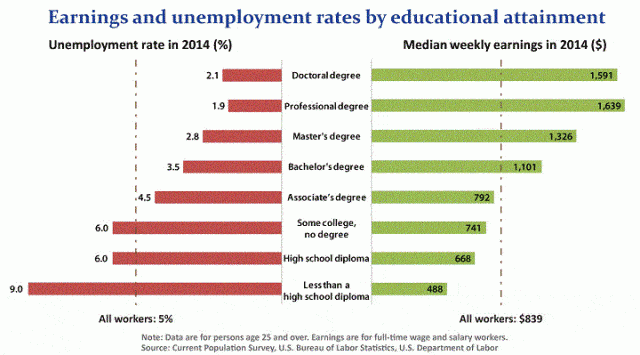
Education is still vital to improving the day-to-day lives of lower-income workers. Better-educated workers enjoy lower unemployment rates and higher overall earnings on average when compared to those with less education. In 2014, the unemployment rate among workers with a bachelor’s degree was 3.5%, according to the Bureau of Labor Statistics, while 6% of those with just a high school diploma were not working. People with four-year degrees also took home an average of $433 more per week than those who did not have education beyond the 12th grade.
Source: Bureau of Labor Statistics
 0 Your Reaction?
Source: Bureau of Labor Statistics
Those figures mask a troubling truth, however. While college-educated workers tend to do better economically than those without a degree, their wages have not been growing in recent years. Real wages among young college graduates are actually lower today than they were in 2000, according to the Economic Policy Institute (EPI). For the bottom 90% of workers, real wages have increased just 15% since 1980, compared to a 138% increase for those in the top 1%.
Source: Thinkstock
 0 Your Reaction?
Source: Thinkstock
Huge increases in CEO compensation without equivalent increases in pay for those at the bottom are behind this income gap, say EPI economists. The average annual income for a middle-class household would be
Read more: http://www.cheatsheet.com/personal-finance/education-isnt-the-solution-to-income-inequality.html/?a=viewall#ixzz3X16UsLdS