Latest News and Comment from Education

Friday, April 3, 2015

NYC Public School Parents: Flawed state budget bill gives parents more reasons to opt out

NYC Public School Parents: Flawed state budget bill gives parents more reasons to opt out:


Flawed state budget bill gives parents more reasons to opt out


On Tuesday night, a state budget bill was approved that doubles down on high-stakes testing and removes any local input– with student "growth scores" on the state exams linked to teacher ratings in a uniform evaluation system. Teachers must do well in terms of student scores to achieve an effective rating. If not, they cannot get tenure, and they risk losing their jobs if found to be ineffective two years in a row. Teacher and student surveys cannot be used in any local evaluation system and the State Education Dept. will be tasked with creating new "student learning objectives" or assessments in all the subjects and grades that do not currently have a state exam. Schools must hire "independent" evaluators to observe and assess the teachers in addition to principals and/or school staff. If districts don't adopt this system by mid-November they will lose any increase in state funding. A good summary of the new teacher evaluation system is described here – as well as other aspects of the bill, including an aggressive receivership program, in which struggling schools can be converted into charter schools without any vote of the parents (which is what the existing state law requires.)
The entire bill is posted here, Assembly vote here, and the Senate vote here. The bill was approved despite the opposition of the NY State United Teachers, the NYC Principals Union, and the NYS PTA, (but not apparently the UFT). The Council of State Superintendents and NY State School Boards Association pointed out this is the fourth deeply- flawed teacher evaluation system to be adopted in five years: "The well-known definition of insanity is doing the same thing over and over and expecting a different result." Here is some of the angry reaction from educators after the bill passed.
Now parents are faced with a limited set of choices. The ELA exams are scheduled for April 14-16. Class Size Matters and NYS Allies for Public Education, our statewide coalition, urge all parents of students in grades 3-8 to opt their children out of these faulty, unreliable and excessive exams. Some of the reasons offered by NYSAPE as well as sample opt out letters you can use are here. NYC-based Change the Stakes offers additional reasons and opt out letters here. Lisa Nielsen, also known as Innovative Educator, lists more reasons here. Last year over 60,000 students did refuse the state exams, according to the State Education Department, and in a statewide survey of NY districts, more than 35 percent of superintendents said at least 5 percent of their eligible students opted out. Twenty-three percent of superintendents reported opt outs at 10 percent or more. Not a single school or district experienced any penalty or any loss of funding.
I would add another reason to opt out relates to serious privacy concerns, with Pearson collecting much personal student information via the exams, NYC Public School Parents: Flawed state budget bill gives parents more reasons to opt out:


What the ‘thoughtless’ N.Y. government just did to teachers - The Washington Post

What the ‘thoughtless’ N.Y. government just did to teachers - The Washington Post:

What the ‘thoughtless’ N.Y. government just did to teachers


 The New York legislature this week approved a budget along with some education reforms proposed by Gov. Andrew Cuomo that have been strongly opposed by teachers in part because they make the state’s awful teacher evaluation system even worse. In this post, award-winning principal Carol Burris explains exactly why what the legislature did is so harmful to public schools.

Burris of South Side High School, who has been exposing the botched school reform program in New York on this blog,  was named New York’s 2013 High School Principal of the Year by the School Administrators Association of New York and the National Association of Secondary School Principals. In 2010, she was selected as the 2010 New York State Outstanding Educator by the School Administrators Association of New York State.

By Carol Burris
The New York State legislature celebrated the Eve of April Fools by making a bad teacher evaluation system even worse.   With the exception of a few principled members, the rest of the Senate and Assembly fell in line, without care or concern for the consequences their “reform” would bring. More remarkably, by the time debate was done, it was obvious that many legislators had no understanding of what they were voting into law.
The bill was bundled with the budget. There was no opportunity for the profession, including those who actually evaluate teachers or principals, to weigh in. In the end, the legislature caved to Cuomo’s demand that student test scores be 50 percent of a teacher and principal’s evaluation.
This is the plan they approved: Teachers will receive two, component scores–one based on “student performance” and a second based on observations. State standardized tests must be used for the first score, if such tests are part of the course or grade level taught by the teacher. Schools may add an additional test, but it must be created by the New York State Education Department (NYSED), or be on a NYSED approved list. In both cases, NYSED must create the means to generate a standardized “growth score” for that test. Clearly, when the legislature politely called this measure “student performance,” they were talking about tests, not talent shows.
Using a matrix, the two scores (performance and observation) will be blended to produce the final evaluation score, according to the line by line instructions in the bill, which you can find here.
The outcomes of the various combinations of the two subcomponent scores are given in the chart below.

There is one exception. If a district decides to use an optional second test in the test component and the teacher is ineffective, the teacher must be rated What the ‘thoughtless’ N.Y. government just did to teachers - The Washington Post:

'Don't Become a Teacher': A History - Teaching Now

'Don't Become a Teacher': A History - Teaching Now - Education Week Teacher:

"'Don't Become a Teacher': A History"


teacher-1954.jpg


Pop quiz. Name the source of this quote:
"I most certainly would not advise anyone to go into teaching. Teachers are definitely not respected as they should be by parents or students."
You might be tempted to think it's from one of the many responses to Nancie Atwell's recent comments about entering the teaching profession. In fact, it's a quote from a teacher association president in a New York Times article titled "Teacher Morale Ebbing in Nation"from 1947.
It turns out that teachers advising students to either avoid the profession, or at least to carefully consider what they're getting into, is nothing new. In 1933, a Columbia professor was quoted in The Washington Post as telling newly minted graduates of Wilson Teachers College that they should only move forward if they truly loved the job: "If you don't like teaching, if you don't like children—then get out of teaching. ... Don't wait until you get married, because for some teachers that's a long time." (This, of course, was back in the days when primary education was a field reserved for unmarried women.)
Then there's the 1947 piece mentioned above, which reported that more than half of U.S. superintendents said that teacher morale was worse than before World War II, and 36 percent of "classroom leaders" said that they would discourage young people from becoming teachers.
Teachers quoted in the Times piece cited many grievances that today's teachers would recognize, particularly a low wage ($37 a week!) and a lack of respect from the public. They also struggled with outdated equipment, overcrowding, and substandard facilities: "If we had electric lights we could do much more work here," said one rural teacher. Not to mention era-specific troubles, like accusations of communist sympathies. All of this added up to difficulties with teacher recruitment and retention and a teacher shortage in many states.
Sound familiar?
Fast-forward to the '80s and the situation looked similar. Another New York Times article, from 1985, shows the results of a poll of over 1,300 teachers: "The survey found that only one-fourth of the teachers would wholeheartedly recommend teaching to a young person making a decision about a career. Slightly more than half said they would make the recommendation with major reservations and 22 percent said they would flatly advise against becoming a teacher." Once again, teachers' financial woes played a central role, with teachers saying the average salary ($23,345 per year) was more than $6,000 too low.
1999 Education Week commentary suggested something more like what Atwell has said: That teaching can be great, in the right school. James Nehring, a teacher and former principal at a Massachusetts charter, wrote how his school created a student-teacher ratio "unrivaled" by other public schools:
"Consider the number of students a high school teacher must teach: 120? 150? If the essential joy of teaching comes from touching a child's soul, then we are miles from satisfaction, stretched as we are to simply learn all their names by December."
And of course, the Internet era has brought with it countless blog posts and articles in the past few years about why teaching just isn't worth it anymore. Take, for example, a Tampa Bay Times piece called "Why I Stopped Encouraging Students to Become Teachers," which calls out a "toxic environment" for public school teachers. Or "A Warning to Young People: Don't Become a Teacher," in the Huffington Post. Or ... well, you get the point.
For just as long, though, negative voices have been accompanied by positive ones. Over onTeacher in a Strange Land, Nancy Flanagan wrote that despite what it may seem, most veteran teachers aren't really discouraging new teachers, but simply being honest. "In fact, we want you to 'Don't Become a Teacher': A History - Teaching Now - Education Week Teacher


Atlanta teacher convictions: Do standardized testing pressures foster cheating? - Yahoo News

Atlanta teacher convictions: Do standardized testing pressures foster cheating? - Yahoo News:

Atlanta teacher convictions: Do standardized testing pressures foster cheating?

An Atlanta jury convicted 11 out of 12 teachers charged with conspiring to manipulate student test scores, but experts say 'Atlanta is the tip of the test-cheating iceberg.'


 A jury convicted 11 educators of racketeering Wednesday for their role in the Atlanta cheating scandal. But nationally, there’s a strong split between those who see their actions as an aberration and those who would convict right alongside them the accountability systems that have attached increasingly high stakes to standardized tests in recent decades.

The teachers and administrators face potentially harsh sentences for a conspiracy to manipulate test scores – which investigators said involved more than 44 schools and about 180 educators. Eleven out of 12 who went to trial were convicted, and they were sent immediately to jail to await sentencing (with the exception of one who is pregnant).
For opponents of such high-stakes testing, there’s likely to be more sympathy for the educatorsbecause of undue pressures being placed on teachers by an overemphasis on test scores. But for proponents of accountability, it’s just as easy to hold up these educators as an example of why strong objective systems are needed to oversee and measure educators’ performance.
The pressured atmosphere doesn’t justify cheating, but it’s one indication of a much larger problem, say critics of how testing has been used.
Especially as the federal government has pushed states to tie teacher evaluation policies to standardized-test gains, the testing regimen “creates a climate in school where you have to boost scores by hook or by crook,” says Robert Schaeffer, a spokesman for the National Center for Fair & Open Testing (FairTest).
Atlanta offered up extreme examples such as test-cheating “parties.” But “Atlanta is the tip of the test-cheating iceberg,” Mr. Schaeffer says, with other cases surfacing in about 39 states, including a dozen or more that showed widespread cheating.
The El Paso, Texas, superintendent went to prison in 2012 for fraud for manipulating federal accountability measures, and nearly a dozen others were held accountable for their role by the state education department.
An Arizona State University study surveyed Arizona educators in 2010 and found that 39 percent knew of situations in which colleagues encouraged students to redo test problems, while 10 percent knew of colleagues who did something they considered more outright cheating.
“We have a system in which people are told all the time that all that really matters is raising test scores,” says Daniel Koretz, a professor at the Harvard Graduate School of Education. 
Some examples of the “shortcuts” teachers are encouraged to take? Teachers are often shown “power standards” – the types of items most commonly tested – by administrators, and sometimes are taught to skip chapters of textbooks that don’t fall in that category, Professor Koretz says. And states now routinely offer teachers old test items to use for test prep, a practice frowned upon in the 1980s.
“Clearly cheating is unethical, but at what point does this other stuff become unethical?” he saysAtlanta teacher convictions: Do standardized testing pressures foster cheating? - Yahoo News:

Parents Can Opt Out - United Opt Out National

Click Here to go to United Opt Out National: 


Click Here to go to the WebsiteUnited Opt Out Team
Home
Click Here to go to the Website FairTest

Revealed: Why Funders Can’t Change K-12 Educational Practices - Inside Philanthropy

Revealed: Why Funders Can’t Change K-12 Educational Practices - Inside Philanthropy: Fundraising Intelligence - Inside Philanthropy:


Revealed: Why Funders Can’t Change K-12 Educational Practices

We’re all familiar with the most common criticisms leveled at funders such as Gates, Broad, and Walton, and their efforts to reform public education. Critics charge that these and other foundations are on a crusade to privatize public schooling, that they stifle the voices of educators and the public, and that they have no accountability when their experiments go badly.
In a paper presented at a recent American Enterprise Institute conference on education philanthropy, education Professor Larry Cuban of Stanford University examines these criticisms. He finds the claims of a privatization agenda to be largely hyperbole that ignores the broader societal embrace of market-driven reforms. On the second criticism, Cuban finds that by pushing reforms that have the effect of greater centralization of education policy, reduced participation by educators and citizens has been an unintended consequence.
He further agrees that there is no accountability for funders when their initiatives are unsuccessful. Such concerns are legitimate, especially when applied to public education, traditionally seen as one of our most democratic institutions. Cuban points out that concerns about the accountability and influence of foundations are not new and extend as far back as 1915, when then-U.S. Senator Frank Smith branded foundations a “menace to the welfare of society.”
But amid these criticisms of education philanthropy, Cuban contends that a larger, more important, question is not being asked: namely, why are Gates, Broad, and other funders continuing to spend such large sums to improve academic performance despite such minimal results in changing classroom teaching practices and student learning?
The answer, according to Cuban, can be found in the assumptions that drive most funder-driven educational reforms, as well as the large gap that separates the perspectives of policymakers and funders who think up grand policy reforms from the perspectives of the educators who are tasked with carrying them out.
In the funder worldview, low student achievement is the result of schools with no competition, low standards, teachers unions that fight change, and administrators wedded to the status quo. So funders helped create new schools by putting millions into charter schools, developed the Common Core, and created new pipelines for educators and principals through such organizations as Teach For America and the Broad Superintendents Academy. However, these and other systemic reforms have yet to translate into broad improvements in student achievement.
Among other things, more competition doesn't work magic, as many funders have hoped. Meanwhile, the total number of students in alternative schools is small. Less than five percent of all K-12 students are enrolled in public charter schools. 
This leads to Cuban’s next criticism; namely, funders’ overreliance on public policy as a means to improve education. It is understandable that foundations would choose this route. Most funders seek systemic reforms, Revealed: Why Funders Can’t Change K-12 Educational Practices - Inside Philanthropy: Fundraising Intelligence - Inside Philanthropy:

ABC Refuses To Air Anti-Rahm Commercial | The Daily ‪#‎Chuy2015‬ ‪#‎imwithchuy‬

ABC Refuses To Air Anti-Rahm Commercial | The Daily Caller:

ABC Refuses To Air Anti-Rahm Commercial


The ABC network refuses to air a commercial criticizing Chicago mayor Rahm Emanuel even though other networks are running the spot, The Daily Caller has learned.
As Emanuel seeks re-election in the Chicago mayoral run-off next week, the Republican-leaning Real Chicago PAC produced an ad highlighting reported instances of Emanuel’s corruption and crony capitalism, including his promotion of the transportation company Uber, in which his brother Ari is a major investor.
“We sent the commercial to the local Fox affiliate. They vetted it, they checked every single quote and every single headline to make sure it was accurate and they ran it on the night of the [mayoral] debate,” Real Chicago PAC chairman Bill Kelly told TheDC. Kelly noted that NBC also approved the ad. But the ad will not appear on ABC 7, Chicago’s highest-rated local network. And that decision came down from ABC’s national corporate infrastructure.


When Real Chicago PAC representative Laura Grock sent the commercial to ABC, Philadelphia-based Dee Parker of the network’s national sales office sent the video to its legal department, based in New York City. Parker then emailed Grock on Wednesday and demanded that the ad be changed.
ABC took issue with the ad’s claim that Emanuel made $18 million in three years as an investment banker between 1999 and 2002 for almost no work and that he used the mayoralty to turn brother Ari Emanuel’s Uber investment into a billion dollars. The ad’s makers cited multiple press articles to provide what they claim is factual basis for their assertions.

“Two of the track lines need to be revised, or this ad cannot air:” ABC’s Parker wrote in her email to Grock.
“1. There is no support for the phrase: for almost no work,” Parker wrote.
“2. There is no support for the claim, as phrased, that: He used his position to turn his brother’s investment in Uber into a billion dollars,” Parker added.
“If they took out the phrase ‘for almost no work,’ and rewrote the Uber allegation to take out the causation and the amount claims [to something like: 'He used his position to favor his brother’s investment in Uber'],” Parker continued, without elaborating further.
Grock refused to change the commercial.
“No, we won’t change the ad — especially not at this date. The Chicago Magazine article substantiates our claim as to the ‘almost no work’ and the valuation on the Uber stock has been discussed in the media,” Grock replied.
In response to ABC’s first problem with the ad, Grock cited a Chicago Magazine article detailing Emanuel’s leisurely relationship with private equity mogul Bruce Rauner and a Chicago Reader article that reported, “In that period [1999-2002] Emanuel made about $18 million, putting together deals by tapping connections he made in the White House.”

As for ABC’s objection to the bit about Uber and Emanuel’s investor brother? Grock cited a Chicago Sun-Times piece revealing Emanuel’s brother’s stake in Uber and detailing the company’s massive expansion in Chicago after Emanuel was elected mayor in 2011.
Reached by TheDC, ABC’s Parker confirmed the email exchange but declined to speak on the record.
“That commercial should be running on ABC today,” Real Chicago PAC chairman Kelly told TheDC. “I want them to run that commercial all day until the polls close on Tuesday. They’re refusing. I think they’re being incredibly unfair and duplicitous.”
Emanuel voted early, presumably for himself, Thursday morning. When he showed up to the polling place, he referred to the crowd of reporters surrounding him as “my family.”
Emanuel leads opponent Jesus “Chuy” Garcia in Tuesday’s run-off.ABC Refuses To Air Anti-Rahm Commercial | The Daily Caller:


empathyeducates – My Son Has Been Suspended Five Times. He’s 3.

empathyeducates – My Son Has Been Suspended Five Times. He’s 3.:

My Son Has Been Suspended Five Times. He’s 3.


I received a call from my sons’ school in March telling me that my oldest needed to be picked up early. He had been given a one-day suspension because he had thrown a chair. He did not hit anyone, but he could have, the school officials told me.

JJ was 4 at the time.
I agreed his behavior was inappropriate, but I was shocked that it resulted in a suspension.
For weeks, it seemed as if JJ was on the chopping block. He was suspended two more times, once for throwing another chair and then for spitting on a student who was bothering him at breakfast. Again, these are behaviors I found inappropriate, but I did not agree with suspension.
Still, I kept quiet. I knew my history. I was the bad preschooler.
I was expelled from preschool and went on to serve more suspensions than I can remember. But I do remember my teachers’ disparaging words. I remember being told I was bad and believing it. I remember just how long it took me to believe anything else about myself.
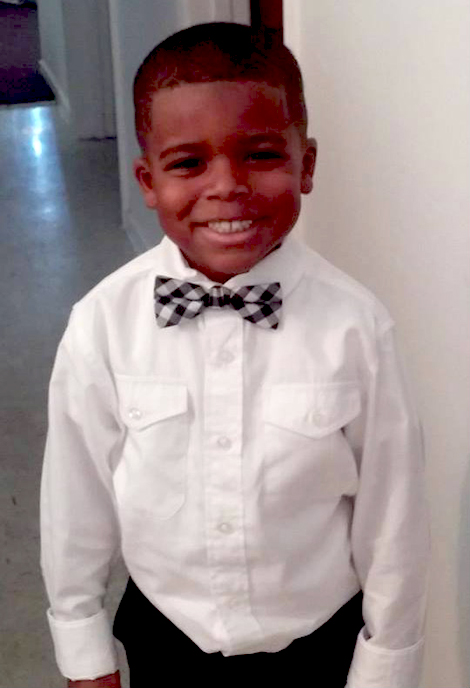
Tunette Powell’s oldest son, JJ
Tunette Powell’s oldest son, JJ, was 4 years old when he was suspended from preschool. (Tunette Powell)
And even still, when my children were born, I promised myself that I would not let my negative school experiences affect them. I believed my experience was isolated. I searched for excuses. Maybe I was just a bad kid. Maybe it had something to do with my father’s incarceration, which forced my mother to raise me and my brothers alone.
So I punished JJ at home and ignored my concerns. Then, two months later, I was called to pick up my 3-year-old son, Joah. Joah had hit a staff member on the arm. After that incident, they deemed him a “danger to the staff.” Joah was suspended a total of five times. In 2014, my children have received eight suspensions.
Just like before, I tried to find excuses. I looked at myself. What was I doing wrong? My children are living a comfortable life. My husband is an amazing father to JJ and Joah. At home, they have given us very few problems; the same goes for time with babysitters.
I blamed myself, my past. And I would have continued to blame myself had I not taken the boys to a birthday party for one of JJ’s classmates. At the party, the mothers congregated to talk about everyday parenting things, including preschool. As we talked, I admitted that JJ had been suspended three times. All of the mothers were shocked at the news.
“JJ?” one mother asked.
“My son threw something at a kid on purpose and the kid had to be rushed to the hospital,” another parent said. “All I got was a phone call.”
One after another, white mothers confessed the trouble their children had gotten into. Some of the behavior was similar to JJ’s; some was much worse.
Most startling: None of their children had been suspended.
After that party, I read a study reflecting everything I was living.
Black children represent 18 percent of preschool enrollment but make up 48 percent of preschool children receiving more than one out-of-school suspension, according to the study released by the Education Department’s Office for Civil Rights in March.
I immediately thought back to my own childhood. I thought back to the humiliating labels that greeted me before I could read. I thought back to the number of black friends and family members who also were suspended and expelled. I thought about my family and friends who had not overcome the detrimental effects of being suspended in preschool. I did not want that for JJ and Joah. I did not want it for any child.
But the next step was the hardest. At news of all of this, friends and relatives suggested that I pull my children out of the preschool program and move them into another. At first, I considered that. That move may have changed my kids’ circumstances, but it would not have solved the problem. All across this country, black children are being suspended in preschool.
We can no longer put a Band-Aid on our nation’s preschool-to-prison pipeline, which pushes children out of the education system and criminalizes relatively minor offenses. Moving my boys to another school would have provided a stopgap solution. It may have solved my problem, but it would not have solved the problem.
lightbox title
Tunette Powell’s 3-year-old son, Joah, has been suspended from school five times. (Tunette Powell)
The problem is not that we have a bunch of racist teachers and administrators. I believe most educators want to help all children. But many aren’t aware of the biases and prejudices that they, like all of us, harbor, and our current system offers very little diversity training to preschool staff.


Former DC Whistleblower Principal, Adell Cothorne, on the Atlanta Cheating Verdict | deutsch29

Former DC Whistleblower Principal, Adell Cothorne, on the Atlanta Cheating Verdict | deutsch29:

Former DC Whistleblower Principal, Adell Cothorne, on the Atlanta Cheating Verdict


adell cothorne


It may have happened in April Fools Day, but it was certainly no joke.
On April 1, 2015, 11 Atlanta educators were convicted of racketeering related to their roles in what has come to be widely known as “the Atlanta cheating scandal.” I first read of the verdict in the New York Times:
…A jury here (in Atlanta) on Wednesday convicted 11 educators for their roles in a standardized test cheating scandal that tarnished a major school district’s reputation and raised broader questions about the role of high-stakes testing in American schools.
On their eighth day of deliberations, the jurors convicted 11 of the 12 defendants of racketeering, a felony that carries up to 20 years in prison. Many of the defendants — a mixture of Atlanta public school teachers, testing coordinators and administrators — were also convicted of other charges, such as making false statements, that could add years to their sentences.
The New York Times article linked above also refers to the Atlanta cheating scandal as, “what has been described as the largest cheating scandal in the nation’s history.”
I’m not so sure about that.
I think the under-investigated, test score “erasure” situation during former DC chancellor Michelle Rhee could top the Atlanta cheating scandal– if the situation is ever properly investigated.
In my book, A Chronicle of Echoes, I offer a detailed discussion of the events surrounding Rhee’s questionable test score gains, including the shallow “investigation” into erasures and the test score plummet that occurred once Rhee was no longer DC chancellor.
I also discuss the involvement of former DC principal, Adell Cothorne, who refused to keep silent when she encountered DC teachers altering student test documents and who demanded heightened security for her school’s tests.
On April 2, 2015, I asked Cothorne if she would weigh in on the Atlanta verdict.
She agreed.
The remainder of this post is Cothorne’s initial reaction to the Atlanta verdict. I have invited her to expand upon her initial reaction once she has had some more time to ponder the situation, so stay tuned.

On April 1, 2015, 11 Atlanta educators were indicted in a cheating scandal that has captured public attention for the last three years. One of the defendants called the judge’s decision to have the educators immediately sent to jail “unnecessary and vindictive”. Many argue – via social media – that the judge was too harsh and only handed down such a stern decision because the defendants were African-American.
There will be many people who weigh in during the next few days, weeks, and even years about what this verdict means. Some pundits will have had zeroexperience in education but feel they can wax poetic about the virtues of merit pay, testing, and the “plight” of educating urban children.
Let me take a moment to deliver a brief synopsis of my credentials:


NY BATs Outraged: Children Lose to an On Time Budget & Flimsy Ethics Reform

Badass Teachers Association:

NEW YORK STATE BADASS TEACHERS ASSOCIATION - PRESS RELEASE
FOR IMMEDIATE RELEASE: April 1, 2015

More Information Contact:
Marla Kilfoyle, General Manager, BATs
Melissa Tomlinson, Asst General Manager, BATs
contact.batmanager@gmail.com
Badass Teachers Association - http://www.badassteacher.org/
BAT
NY BATs Outraged: Children Lose to an On Time Budget & Flimsy Ethics Reform

The New York Badass Teachers Association, is a diverse pro-public education organization of 2820 members, affiliated with the Badass Teachers Association, currently 54,913 strong nationwide.

NY BATs voices its strong disgust with the passing of Governor Cuomo’s education reforms last night. The YES votes in the Legislature have thrown New York State Education into years of chaos, re-empowering the same entities that created the current statewide APPR crisis, costing NY districts millions. This will be the fifth consecutive proposal to “fix” education in as many years without acknowledging the most obvious obstacles to learning in our communities such as underfunding of schools in impoverished areas.

At it’s most basic this is about abdicating local control - whether NYSED's professional accountability measures (bubble test scores) should trump the autonomy of democratically elected school officials, certified professionals, and locally negotiated contracts. Clearly, the purveyors of this budget are forging ahead without consideration of polls, petitions or protests returning us to question of whether Albany is serving the people or the hedge fund managers.

Governor Cuomo, in his quest to punish unions that did not endorse these unsound education policies, has put the children of New York State into the center of another storm. We are sad to see some members of the Assembly and the Senate plowing headlong into unchartered territory, invoking “emergency”procedures to prevent exactly the reading of the bills that is supposed to address contentious legal and scientific questions. Clearly, Albany worked overtime last night to avoid debate.

As significant percentages of NY families abandon mandated annual state tests, there can be no doubt, even for Common Core advocates that New York’s implementation was ill-conceived and shoddily carried out, failing to communicate any policy that earned the trust or confidence of stakeholders (don’t forget how school parents were haughtily called "special interest groups”).

APPR left principals and administrators to design and redesign APPR evaluation plans that forced math and English scores on teachers regardless of subject taught or license area. Then, they put scores through two different manipulations after-the-fact. Not only do they “adjust” the proficiency thresholds, they can at any time discard “test items” to make as many grades as NYSED wishes jump in “proficiency”, statewide, by the stroke of a pen.

“I am a mother, teacher, and taxpayer in New York and the Governor has used our children as a pawn in his political game”, said NY BAT Marla Kilfoyle.  “When we examine the things they will NOT allow to be used in a teacher evaluation we see evidence of student development and performance derived from lesson plans, artifacts of teacher practice, and student portfolios; all things that show growth throughout the entire year and make up good pedagogical practice they want OUT of evaluation.  This is MADNESS.”

Jamy Brice Hyde, a NY BAT proclaimed, “Teachers, Parents, and Administrators watched together as one by one politicians elected to serve our children instead chose to serve a vindictive bully serving his revenge upon the most critical profession to our democracy! New York State lost its way yesterday putting vengeance before our children! We have witnessed firsthand the destruction of New York State public education by ballots cast! Educators will protect the children of our state from this harmful legislation. We will fight every step of the way for our right to teach, to be treated with dignity and respect, to protect parents right to refuse toxic tests  designed to punish teachers and harm our children.  We will fight to the bitter end to save our schools and our children from this abuse and we will fight to restore our profession!”

“The budget was forced through just so it would be on time. Instead of working for the betterment of our schools, our students, and our communities the majority of our politicians proved they were only interested in playing politics”, said NY BAT Beth Glazer Schettino.

"Using math and ELA scores to evaluate teachers of gym, foreign language or the arts now for a second year is a ridiculous use of tax dollars. We need solutions in the inner city, not unproven metrics that tell us the obvious. But test scores can’t show us the work of a  math or ELA teacher either - especially when the state is changing the cut scores to throw off any claim of impartial statistical accuracy. Schools are already in hiring crisis, the last thing we need is to worsen working conditions in high needs schools," claims NY BAT Jake Jacobs

These proposals by Cuomo, which were approved by the Senate and the Assembly so that they could have an ON TIME BUDGET, are demoralizing to children, teachers, and public education.  Cuomo and members of the Legislature who voted YES to this proposal continue to ignore the voices of parents, teachers, students, and administrators.   The Assembly and the Senate members who voted for this, rest assured, you will be voted out of office next election cycle.  We look forward to the day when Albany once again serves the people and not hedge fund managers.


Badass Teachers Association: