Latest News and Comment from Education

Friday, April 3, 2015

Atlanta teacher convictions: Do standardized testing pressures foster cheating? - Yahoo News

Atlanta teacher convictions: Do standardized testing pressures foster cheating? - Yahoo News:

Atlanta teacher convictions: Do standardized testing pressures foster cheating?

An Atlanta jury convicted 11 out of 12 teachers charged with conspiring to manipulate student test scores, but experts say 'Atlanta is the tip of the test-cheating iceberg.'


 A jury convicted 11 educators of racketeering Wednesday for their role in the Atlanta cheating scandal. But nationally, there’s a strong split between those who see their actions as an aberration and those who would convict right alongside them the accountability systems that have attached increasingly high stakes to standardized tests in recent decades.

The teachers and administrators face potentially harsh sentences for a conspiracy to manipulate test scores – which investigators said involved more than 44 schools and about 180 educators. Eleven out of 12 who went to trial were convicted, and they were sent immediately to jail to await sentencing (with the exception of one who is pregnant).
For opponents of such high-stakes testing, there’s likely to be more sympathy for the educatorsbecause of undue pressures being placed on teachers by an overemphasis on test scores. But for proponents of accountability, it’s just as easy to hold up these educators as an example of why strong objective systems are needed to oversee and measure educators’ performance.
The pressured atmosphere doesn’t justify cheating, but it’s one indication of a much larger problem, say critics of how testing has been used.
Especially as the federal government has pushed states to tie teacher evaluation policies to standardized-test gains, the testing regimen “creates a climate in school where you have to boost scores by hook or by crook,” says Robert Schaeffer, a spokesman for the National Center for Fair & Open Testing (FairTest).
Atlanta offered up extreme examples such as test-cheating “parties.” But “Atlanta is the tip of the test-cheating iceberg,” Mr. Schaeffer says, with other cases surfacing in about 39 states, including a dozen or more that showed widespread cheating.
The El Paso, Texas, superintendent went to prison in 2012 for fraud for manipulating federal accountability measures, and nearly a dozen others were held accountable for their role by the state education department.
An Arizona State University study surveyed Arizona educators in 2010 and found that 39 percent knew of situations in which colleagues encouraged students to redo test problems, while 10 percent knew of colleagues who did something they considered more outright cheating.
“We have a system in which people are told all the time that all that really matters is raising test scores,” says Daniel Koretz, a professor at the Harvard Graduate School of Education. 
Some examples of the “shortcuts” teachers are encouraged to take? Teachers are often shown “power standards” – the types of items most commonly tested – by administrators, and sometimes are taught to skip chapters of textbooks that don’t fall in that category, Professor Koretz says. And states now routinely offer teachers old test items to use for test prep, a practice frowned upon in the 1980s.
“Clearly cheating is unethical, but at what point does this other stuff become unethical?” he saysAtlanta teacher convictions: Do standardized testing pressures foster cheating? - Yahoo News:


Parents Can Opt Out - United Opt Out National

Click Here to go to United Opt Out National: 


Click Here to go to the WebsiteUnited Opt Out Team
Home
Click Here to go to the Website FairTest

Revealed: Why Funders Can’t Change K-12 Educational Practices - Inside Philanthropy

Revealed: Why Funders Can’t Change K-12 Educational Practices - Inside Philanthropy: Fundraising Intelligence - Inside Philanthropy:


Revealed: Why Funders Can’t Change K-12 Educational Practices

We’re all familiar with the most common criticisms leveled at funders such as Gates, Broad, and Walton, and their efforts to reform public education. Critics charge that these and other foundations are on a crusade to privatize public schooling, that they stifle the voices of educators and the public, and that they have no accountability when their experiments go badly.
In a paper presented at a recent American Enterprise Institute conference on education philanthropy, education Professor Larry Cuban of Stanford University examines these criticisms. He finds the claims of a privatization agenda to be largely hyperbole that ignores the broader societal embrace of market-driven reforms. On the second criticism, Cuban finds that by pushing reforms that have the effect of greater centralization of education policy, reduced participation by educators and citizens has been an unintended consequence.
He further agrees that there is no accountability for funders when their initiatives are unsuccessful. Such concerns are legitimate, especially when applied to public education, traditionally seen as one of our most democratic institutions. Cuban points out that concerns about the accountability and influence of foundations are not new and extend as far back as 1915, when then-U.S. Senator Frank Smith branded foundations a “menace to the welfare of society.”
But amid these criticisms of education philanthropy, Cuban contends that a larger, more important, question is not being asked: namely, why are Gates, Broad, and other funders continuing to spend such large sums to improve academic performance despite such minimal results in changing classroom teaching practices and student learning?
The answer, according to Cuban, can be found in the assumptions that drive most funder-driven educational reforms, as well as the large gap that separates the perspectives of policymakers and funders who think up grand policy reforms from the perspectives of the educators who are tasked with carrying them out.
In the funder worldview, low student achievement is the result of schools with no competition, low standards, teachers unions that fight change, and administrators wedded to the status quo. So funders helped create new schools by putting millions into charter schools, developed the Common Core, and created new pipelines for educators and principals through such organizations as Teach For America and the Broad Superintendents Academy. However, these and other systemic reforms have yet to translate into broad improvements in student achievement.
Among other things, more competition doesn't work magic, as many funders have hoped. Meanwhile, the total number of students in alternative schools is small. Less than five percent of all K-12 students are enrolled in public charter schools. 
This leads to Cuban’s next criticism; namely, funders’ overreliance on public policy as a means to improve education. It is understandable that foundations would choose this route. Most funders seek systemic reforms, Revealed: Why Funders Can’t Change K-12 Educational Practices - Inside Philanthropy: Fundraising Intelligence - Inside Philanthropy:

ABC Refuses To Air Anti-Rahm Commercial | The Daily ‪#‎Chuy2015‬ ‪#‎imwithchuy‬

ABC Refuses To Air Anti-Rahm Commercial | The Daily Caller:

ABC Refuses To Air Anti-Rahm Commercial


The ABC network refuses to air a commercial criticizing Chicago mayor Rahm Emanuel even though other networks are running the spot, The Daily Caller has learned.
As Emanuel seeks re-election in the Chicago mayoral run-off next week, the Republican-leaning Real Chicago PAC produced an ad highlighting reported instances of Emanuel’s corruption and crony capitalism, including his promotion of the transportation company Uber, in which his brother Ari is a major investor.
“We sent the commercial to the local Fox affiliate. They vetted it, they checked every single quote and every single headline to make sure it was accurate and they ran it on the night of the [mayoral] debate,” Real Chicago PAC chairman Bill Kelly told TheDC. Kelly noted that NBC also approved the ad. But the ad will not appear on ABC 7, Chicago’s highest-rated local network. And that decision came down from ABC’s national corporate infrastructure.


When Real Chicago PAC representative Laura Grock sent the commercial to ABC, Philadelphia-based Dee Parker of the network’s national sales office sent the video to its legal department, based in New York City. Parker then emailed Grock on Wednesday and demanded that the ad be changed.
ABC took issue with the ad’s claim that Emanuel made $18 million in three years as an investment banker between 1999 and 2002 for almost no work and that he used the mayoralty to turn brother Ari Emanuel’s Uber investment into a billion dollars. The ad’s makers cited multiple press articles to provide what they claim is factual basis for their assertions.

“Two of the track lines need to be revised, or this ad cannot air:” ABC’s Parker wrote in her email to Grock.
“1. There is no support for the phrase: for almost no work,” Parker wrote.
“2. There is no support for the claim, as phrased, that: He used his position to turn his brother’s investment in Uber into a billion dollars,” Parker added.
“If they took out the phrase ‘for almost no work,’ and rewrote the Uber allegation to take out the causation and the amount claims [to something like: 'He used his position to favor his brother’s investment in Uber'],” Parker continued, without elaborating further.
Grock refused to change the commercial.
“No, we won’t change the ad — especially not at this date. The Chicago Magazine article substantiates our claim as to the ‘almost no work’ and the valuation on the Uber stock has been discussed in the media,” Grock replied.
In response to ABC’s first problem with the ad, Grock cited a Chicago Magazine article detailing Emanuel’s leisurely relationship with private equity mogul Bruce Rauner and a Chicago Reader article that reported, “In that period [1999-2002] Emanuel made about $18 million, putting together deals by tapping connections he made in the White House.”

As for ABC’s objection to the bit about Uber and Emanuel’s investor brother? Grock cited a Chicago Sun-Times piece revealing Emanuel’s brother’s stake in Uber and detailing the company’s massive expansion in Chicago after Emanuel was elected mayor in 2011.
Reached by TheDC, ABC’s Parker confirmed the email exchange but declined to speak on the record.
“That commercial should be running on ABC today,” Real Chicago PAC chairman Kelly told TheDC. “I want them to run that commercial all day until the polls close on Tuesday. They’re refusing. I think they’re being incredibly unfair and duplicitous.”
Emanuel voted early, presumably for himself, Thursday morning. When he showed up to the polling place, he referred to the crowd of reporters surrounding him as “my family.”
Emanuel leads opponent Jesus “Chuy” Garcia in Tuesday’s run-off.ABC Refuses To Air Anti-Rahm Commercial | The Daily Caller:


empathyeducates – My Son Has Been Suspended Five Times. He’s 3.

empathyeducates – My Son Has Been Suspended Five Times. He’s 3.:

My Son Has Been Suspended Five Times. He’s 3.


I received a call from my sons’ school in March telling me that my oldest needed to be picked up early. He had been given a one-day suspension because he had thrown a chair. He did not hit anyone, but he could have, the school officials told me.

JJ was 4 at the time.
I agreed his behavior was inappropriate, but I was shocked that it resulted in a suspension.
For weeks, it seemed as if JJ was on the chopping block. He was suspended two more times, once for throwing another chair and then for spitting on a student who was bothering him at breakfast. Again, these are behaviors I found inappropriate, but I did not agree with suspension.
Still, I kept quiet. I knew my history. I was the bad preschooler.
I was expelled from preschool and went on to serve more suspensions than I can remember. But I do remember my teachers’ disparaging words. I remember being told I was bad and believing it. I remember just how long it took me to believe anything else about myself.
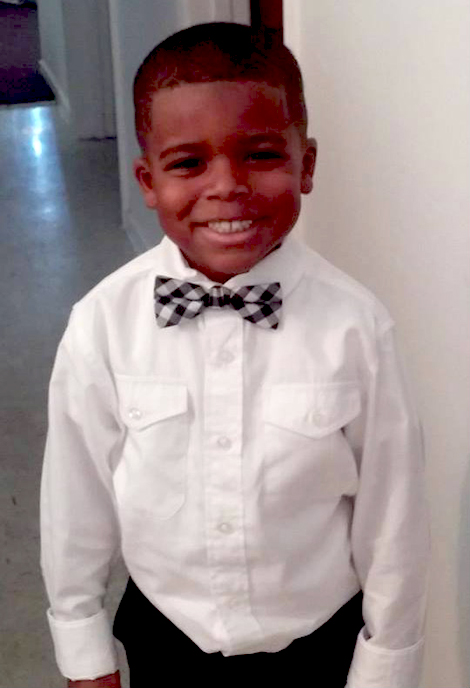
Tunette Powell’s oldest son, JJ
Tunette Powell’s oldest son, JJ, was 4 years old when he was suspended from preschool. (Tunette Powell)
And even still, when my children were born, I promised myself that I would not let my negative school experiences affect them. I believed my experience was isolated. I searched for excuses. Maybe I was just a bad kid. Maybe it had something to do with my father’s incarceration, which forced my mother to raise me and my brothers alone.
So I punished JJ at home and ignored my concerns. Then, two months later, I was called to pick up my 3-year-old son, Joah. Joah had hit a staff member on the arm. After that incident, they deemed him a “danger to the staff.” Joah was suspended a total of five times. In 2014, my children have received eight suspensions.
Just like before, I tried to find excuses. I looked at myself. What was I doing wrong? My children are living a comfortable life. My husband is an amazing father to JJ and Joah. At home, they have given us very few problems; the same goes for time with babysitters.
I blamed myself, my past. And I would have continued to blame myself had I not taken the boys to a birthday party for one of JJ’s classmates. At the party, the mothers congregated to talk about everyday parenting things, including preschool. As we talked, I admitted that JJ had been suspended three times. All of the mothers were shocked at the news.
“JJ?” one mother asked.
“My son threw something at a kid on purpose and the kid had to be rushed to the hospital,” another parent said. “All I got was a phone call.”
One after another, white mothers confessed the trouble their children had gotten into. Some of the behavior was similar to JJ’s; some was much worse.
Most startling: None of their children had been suspended.
After that party, I read a study reflecting everything I was living.
Black children represent 18 percent of preschool enrollment but make up 48 percent of preschool children receiving more than one out-of-school suspension, according to the study released by the Education Department’s Office for Civil Rights in March.
I immediately thought back to my own childhood. I thought back to the humiliating labels that greeted me before I could read. I thought back to the number of black friends and family members who also were suspended and expelled. I thought about my family and friends who had not overcome the detrimental effects of being suspended in preschool. I did not want that for JJ and Joah. I did not want it for any child.
But the next step was the hardest. At news of all of this, friends and relatives suggested that I pull my children out of the preschool program and move them into another. At first, I considered that. That move may have changed my kids’ circumstances, but it would not have solved the problem. All across this country, black children are being suspended in preschool.
We can no longer put a Band-Aid on our nation’s preschool-to-prison pipeline, which pushes children out of the education system and criminalizes relatively minor offenses. Moving my boys to another school would have provided a stopgap solution. It may have solved my problem, but it would not have solved the problem.
lightbox title
Tunette Powell’s 3-year-old son, Joah, has been suspended from school five times. (Tunette Powell)
The problem is not that we have a bunch of racist teachers and administrators. I believe most educators want to help all children. But many aren’t aware of the biases and prejudices that they, like all of us, harbor, and our current system offers very little diversity training to preschool staff.


Former DC Whistleblower Principal, Adell Cothorne, on the Atlanta Cheating Verdict | deutsch29

Former DC Whistleblower Principal, Adell Cothorne, on the Atlanta Cheating Verdict | deutsch29:

Former DC Whistleblower Principal, Adell Cothorne, on the Atlanta Cheating Verdict


adell cothorne


It may have happened in April Fools Day, but it was certainly no joke.
On April 1, 2015, 11 Atlanta educators were convicted of racketeering related to their roles in what has come to be widely known as “the Atlanta cheating scandal.” I first read of the verdict in the New York Times:
…A jury here (in Atlanta) on Wednesday convicted 11 educators for their roles in a standardized test cheating scandal that tarnished a major school district’s reputation and raised broader questions about the role of high-stakes testing in American schools.
On their eighth day of deliberations, the jurors convicted 11 of the 12 defendants of racketeering, a felony that carries up to 20 years in prison. Many of the defendants — a mixture of Atlanta public school teachers, testing coordinators and administrators — were also convicted of other charges, such as making false statements, that could add years to their sentences.
The New York Times article linked above also refers to the Atlanta cheating scandal as, “what has been described as the largest cheating scandal in the nation’s history.”
I’m not so sure about that.
I think the under-investigated, test score “erasure” situation during former DC chancellor Michelle Rhee could top the Atlanta cheating scandal– if the situation is ever properly investigated.
In my book, A Chronicle of Echoes, I offer a detailed discussion of the events surrounding Rhee’s questionable test score gains, including the shallow “investigation” into erasures and the test score plummet that occurred once Rhee was no longer DC chancellor.
I also discuss the involvement of former DC principal, Adell Cothorne, who refused to keep silent when she encountered DC teachers altering student test documents and who demanded heightened security for her school’s tests.
On April 2, 2015, I asked Cothorne if she would weigh in on the Atlanta verdict.
She agreed.
The remainder of this post is Cothorne’s initial reaction to the Atlanta verdict. I have invited her to expand upon her initial reaction once she has had some more time to ponder the situation, so stay tuned.

On April 1, 2015, 11 Atlanta educators were indicted in a cheating scandal that has captured public attention for the last three years. One of the defendants called the judge’s decision to have the educators immediately sent to jail “unnecessary and vindictive”. Many argue – via social media – that the judge was too harsh and only handed down such a stern decision because the defendants were African-American.
There will be many people who weigh in during the next few days, weeks, and even years about what this verdict means. Some pundits will have had zeroexperience in education but feel they can wax poetic about the virtues of merit pay, testing, and the “plight” of educating urban children.
Let me take a moment to deliver a brief synopsis of my credentials:


NY BATs Outraged: Children Lose to an On Time Budget & Flimsy Ethics Reform

Badass Teachers Association:

NEW YORK STATE BADASS TEACHERS ASSOCIATION - PRESS RELEASE
FOR IMMEDIATE RELEASE: April 1, 2015

More Information Contact:
Marla Kilfoyle, General Manager, BATs
Melissa Tomlinson, Asst General Manager, BATs
contact.batmanager@gmail.com
Badass Teachers Association - http://www.badassteacher.org/
BAT
NY BATs Outraged: Children Lose to an On Time Budget & Flimsy Ethics Reform

The New York Badass Teachers Association, is a diverse pro-public education organization of 2820 members, affiliated with the Badass Teachers Association, currently 54,913 strong nationwide.

NY BATs voices its strong disgust with the passing of Governor Cuomo’s education reforms last night. The YES votes in the Legislature have thrown New York State Education into years of chaos, re-empowering the same entities that created the current statewide APPR crisis, costing NY districts millions. This will be the fifth consecutive proposal to “fix” education in as many years without acknowledging the most obvious obstacles to learning in our communities such as underfunding of schools in impoverished areas.

At it’s most basic this is about abdicating local control - whether NYSED's professional accountability measures (bubble test scores) should trump the autonomy of democratically elected school officials, certified professionals, and locally negotiated contracts. Clearly, the purveyors of this budget are forging ahead without consideration of polls, petitions or protests returning us to question of whether Albany is serving the people or the hedge fund managers.

Governor Cuomo, in his quest to punish unions that did not endorse these unsound education policies, has put the children of New York State into the center of another storm. We are sad to see some members of the Assembly and the Senate plowing headlong into unchartered territory, invoking “emergency”procedures to prevent exactly the reading of the bills that is supposed to address contentious legal and scientific questions. Clearly, Albany worked overtime last night to avoid debate.

As significant percentages of NY families abandon mandated annual state tests, there can be no doubt, even for Common Core advocates that New York’s implementation was ill-conceived and shoddily carried out, failing to communicate any policy that earned the trust or confidence of stakeholders (don’t forget how school parents were haughtily called "special interest groups”).

APPR left principals and administrators to design and redesign APPR evaluation plans that forced math and English scores on teachers regardless of subject taught or license area. Then, they put scores through two different manipulations after-the-fact. Not only do they “adjust” the proficiency thresholds, they can at any time discard “test items” to make as many grades as NYSED wishes jump in “proficiency”, statewide, by the stroke of a pen.

“I am a mother, teacher, and taxpayer in New York and the Governor has used our children as a pawn in his political game”, said NY BAT Marla Kilfoyle.  “When we examine the things they will NOT allow to be used in a teacher evaluation we see evidence of student development and performance derived from lesson plans, artifacts of teacher practice, and student portfolios; all things that show growth throughout the entire year and make up good pedagogical practice they want OUT of evaluation.  This is MADNESS.”

Jamy Brice Hyde, a NY BAT proclaimed, “Teachers, Parents, and Administrators watched together as one by one politicians elected to serve our children instead chose to serve a vindictive bully serving his revenge upon the most critical profession to our democracy! New York State lost its way yesterday putting vengeance before our children! We have witnessed firsthand the destruction of New York State public education by ballots cast! Educators will protect the children of our state from this harmful legislation. We will fight every step of the way for our right to teach, to be treated with dignity and respect, to protect parents right to refuse toxic tests  designed to punish teachers and harm our children.  We will fight to the bitter end to save our schools and our children from this abuse and we will fight to restore our profession!”

“The budget was forced through just so it would be on time. Instead of working for the betterment of our schools, our students, and our communities the majority of our politicians proved they were only interested in playing politics”, said NY BAT Beth Glazer Schettino.

"Using math and ELA scores to evaluate teachers of gym, foreign language or the arts now for a second year is a ridiculous use of tax dollars. We need solutions in the inner city, not unproven metrics that tell us the obvious. But test scores can’t show us the work of a  math or ELA teacher either - especially when the state is changing the cut scores to throw off any claim of impartial statistical accuracy. Schools are already in hiring crisis, the last thing we need is to worsen working conditions in high needs schools," claims NY BAT Jake Jacobs

These proposals by Cuomo, which were approved by the Senate and the Assembly so that they could have an ON TIME BUDGET, are demoralizing to children, teachers, and public education.  Cuomo and members of the Legislature who voted YES to this proposal continue to ignore the voices of parents, teachers, students, and administrators.   The Assembly and the Senate members who voted for this, rest assured, you will be voted out of office next election cycle.  We look forward to the day when Albany once again serves the people and not hedge fund managers.


Badass Teachers Association:

Thursday, April 2, 2015

CPS students won't come by free City Colleges scholarships so easily | Chicago

CPS students won't come by free City Colleges scholarships so easily | Chicago:

CPS students won't come by free City Colleges scholarships so easily


Well it was kinda not a lie!
 Mayor Rahm Emanuel announces the Chicago Star Scholarship program on Oct. 1, 2014. | Brian Jackson/Sun-Times
Mayor Rahm Emanuel’s plan to give “B” students free scholarships to attend City Colleges of Chicago is a campaign promise he repeatedly cites in re-election talking points.
While it’s widely viewed as a free tuition program for those students, a look at the fine print shows it won’t be a cakewalk for graduating Chicago public school seniors.
An additional testing score required to win the Star Scholarship would rule out more than half of the pool of Chicago Public Schools students who graduated last year with a B average, a Chicago Sun-Times review of the numbers shows.
That’s because B students must also score at least a 21 on both the math and English sections of the ACT. This extra qualification alone cuts out more than half of the pool of more than 5,264 students who graduated from CPS in 2014 with B averages.
In 2014, 2,503 students in CPS fulfilled that requirement, according to numbers provided to the Chicago Sun-Times by CPS.
That same year, CPS students scored an average 18 on the ACT, 17.4 on English section and 18.2 on mathematics, according to Illinois State Board of Education statistics.
Typically, about 90 percent of City Colleges students need to take remedial courses in English and math to elevate to college-level classes.
CPS officials have estimated that between 500 and 1,000 students graduate with a B average and do not go on to college, many because of financial need.
But CPS did not have estimates on how many students typically don’t go on to college and meet the full requirements for the scholarship.
Students who apply for the scholarship must first apply for federal grants and financial aid. But if students are denied the federal aid, they still qualify for the scholarship, a City Colleges spokeswoman said.
“Star is a unique scholarship program for us in that it allows any student who meets the qualifications to automatically receive a full ride (after application of financial grant aid) and, unlike any other scholarships, is open to any and all students who qualify,” said Katheryn Hayes, City Colleges of Chicago spokeswoman.


Hayes said the colleges have received 1,220 applications and is working through the evaluation process, which cannot be completed until the end of the school year.
Emanuel has touted the scholarship to the two-year colleges as a way for deserving students who otherwise can’t afford college to eventually move on to earn a bachelor’s degrees.
But there are skeptics, including those who say the qualifications CPS students won't come by free City Colleges scholarships so easily | Chicago:

Ingraham High School staff object to the SBAC | Seattle Education

Ingraham High School staff object to the SBAC | Seattle Education:


Ingraham High School staff object to the SBAC

IngrahamHSLogo
By a vote of 48 to 1, Ingraham staff passed the following resolution:
A RESOLUTION OF DISAPPROVAL OF THE Ingraham High School
WHEREAS Ingraham High School strives to provide an excellent education

to every student;
WHEREAS the Smarter Balanced Assessment is not required for graduation;
WHEREAS this computer-based assessment will take approximately eight

hours for each 11th grader to complete and its confusing format is

unlike anything students will experience outside the testing

environment;
WHEREAS there are not enough computers to test the students in a

reasonable amount of time and it is unacceptable for computers to be

unavailable to non-testing students for such a long period of time;
WHEREAS the failure rate of the assessment is going to be

extraordinarily high (possibly 60%) for the general population and

even higher for students of color, ELL students, and students on

individualized education plans;
WHEREAS student performance on this test will in no way be indicative

of their learning and instead this test must be given to meet

arbitrary, antiquated and poorly considered state and federal

mandates;
WHEREAS graduation and standardized testing requirements in Washington

State are confusing and poorly communicated;
WHEREAS the sheer number of state-mandated standardized tests is unacceptable;
WHEREAS in addition to other assessments during the last seven weeks

of school, we must administer one month of International Baccalaureate

exams, several weeks of AP testing, many weeks of 11th grade SBAIngraham High School staff object to the SBAC | Seattle Education:

Eva Moskowitz: Turning Schools Into Fight Clubs - WSJ

Eva Moskowitz: Turning Schools Into Fight Clubs - WSJ:

Turning Schools Into Fight Clubs

If student A’s fist ‘impacts’ student B, they don’t need ‘to dialogue.’ Student A needs to be disciplined.


Eighth-graders in a Queens, N.Y., public elementary school recently organized a “fight club” for first-graders, beating up those who wouldn’t participate. This disgraceful episode comes at a time when many across the country are engaging in a misguided campaign to diminish the school discipline needed to ensure a nurturing and productive learning environment.
Leading the pack is New York City, where Mayor Bill de Blasio has proposed a disciplinary code due to take effect this month in the city’s district schools. The code is full of edu-babble. For example, the code promotes “restorative circles.” What is that? It’s a “community process for supporting those in conflict [that] brings together the three parties to a conflict—those who have acted, those directly impacted and the wider community—within an intentional systemic context, to dialogue as equals.”
This is nonsense. If student A “impacts” student B with a fist, they shouldn’t “dialogue as equals.” Student A should be disciplined.
“Collaborative problem solving” is another strategy. Teachers “articulate the adults’ concerns about the behavior and engage the student in a collaborative process,” the code explains, to “decide upon a plan of action” that is “mutually acceptable to both.”
New York City Mayor Bill de BlasioENLARGE
New York City Mayor Bill de Blasio PHOTO:BRENDAN MCDERMID/REUTERS
You read that correctly. Teachers’ views on proper conduct are mere “concerns” that must be explained, and students get to decide what resolution is “acceptable” to them.
The new disciplinary code also undermines principals. Under the old code, they could give out-of-school suspensions of up to five days; only a superintendent could impose longer suspensions. Under the new code, a principal can only impose a pretend suspension in which the student receives “alternative instruction” at school. Previously such instruction would be provided at an alternative location, which is preferable.
Suspensions convey the critical message to students and parents that certain behavior is inconsistent with being a member of the school community. Pretend suspensions, in which a student is allowed to remain in the school community, do not convey that message. Many students actually feed off the attention they get for misbehaving. Keeping these students in school encourages that misbehavior.
Proponents of lax discipline claim it would benefit minority students, who are suspended at higher rates than their white peers. But minority students are also the most likely to suffer the adverse consequences of lax discipline—that is, their education is disrupted by a chaotic school environment or by violence.
This is a real concern. According to the New York City Department of Health and Mental Hygiene, 4% of New York City high-school students carry a weapon to school; 2% carry a gun. Thus, in a high school of 3,000 students, 60 may carry weapons, posing an enormous risk to their classmates.
Last year at Success Academy Charter Schools, which I founded in New York City in 2006, we suspended 11% of the 7,000 students in our 22 schools, a rate higher than the 4% average for the city’s district schools. Yet strict discipline has not dissuaded parents. This year there were more than 20,000 student applications for 2,688 spots. Most of the Eva Moskowitz: Turning Schools Into Fight Clubs - WSJ:


Big Education Ape: Success Academy parent's secret tapes reveal attempt to push out special needs student - NY Dail... http://bit.ly/1gVSu2n