Sunday, March 15, 2015

The Brave New World of testing expands | Bob Braun's Ledger

The Brave New World of testing expands | Bob Braun's Ledger:


The Brave New World of testing expands

Share on FacebookTweet about this on TwitterEmail this to someoneShare on LinkedInShare on Google+Share on StumbleUpon
BLOGHANOVERAnother New Jersey school district–Hanover Park Regional in East Hanover–was notified by state officials that “monitoring”–spying?– by the British test publisher Pearson revealed at least one student had used a social media account to post a forbidden message regarding the  PARCC tests.  No surprise, really–it’s happening everywhere, including Maryland where a state official said he gets daily reports from Pearson on what students are saying about testing on their social media accounts.
“PARCC has a very sophisticated system that closely monitors social media for pretty much everything (comments like the one you shared, test item questions that students use cell phones cameras and take),” said Henry Johnson, the state assistant education commissioner in Maryland. The state, like New Jersey, has a contract with Pearson.
Henry R. Johnson, Jr.
“We get those reports daily.”
Let’s run that one by you again:
“PARCC has a very sophisticated system that closely monitors social media for pretty much everything….”
The phrase “pretty much everything” aptly describes the broad reach of how this brave new world of testing and cooperation with government works. Pearson will say–as it told the Washington Post–that it is doing it for “security” reasons.
But security is itself a broad term. Here is what the State of New Jersey and Pearson agreed encompassed the idea of security and its possible breach–it’s codified in the testing manual developed by the state and sent out to all the districts:
“Revealing or discussing passages or test items with anyone, including students The Brave New World of testing expands | Bob Braun's Ledger:
Bob Braun's Ledger
Bob Braun 

The show will feature Bob Braun of Bob Braun's Ledger who published the NJ Spy Gate story on Friday and had his website attacked and disabled.

The show will also honor Lucianna M. Sanson and her excellent work for public education here on The War Report on Public Education

Click on the website below to listen live and join the discussion:
Sunday Starts:  2:00 pm PT   Ends: 2:55 pm PT
http://bbsradio.com/thewarreport

A direct listen-in line only
Station 1 - 716-748-0150

To call-in and interact live
Station 1 - 888-627-6008

Host
Talking to Bob Braun about Pearson spying on children.by Busted Pencils
Special BustED Pencils at 6pm EST

Talking to Bob Braun about Pearson spying on children. 03/15 by Busted Pencils | Education Podcasts

Talking to Bob Braun about Pearson spying on children. 03/15 by Busted Pencils | Education Podcasts:


Talking to Bob Braun about Pearson spying on children.


Host


Talking to Bob Braun about Pearson spying on children.

Special BustED Pencils at 6pm EST


BustED Pencils talks to verteran journalist Bob Braun about Pearson and the fact that they use social media to spy on students.


Bob Braun's Ledger
Bob Braun

The show will feature Bob Braun of Bob Braun's Ledger who published the NJ Spy Gate story on Friday and had his website attacked and disabled

Big Education Ape: UPDATE: Pearson, NJ, spying on social media of students taking PARCC tests | Bob Braun's Ledger http://bit.ly/1BCz9Ol

Why Tech Companies Need to Better Protect Student Data

Why Tech Companies Need to Better Protect Student Data:

Why Tech Companies Need to Better Protect Student Data


 A wide array of education technology startups are marketing their digital learning tools to teachers, who are increasingly willing to experiment with adaptive learning products that analyze students’ online activities to personalize their lessons. Writing for The New York Times, Natasha Singer reports that school district technology directors, who are responsible for safeguarding student data, are scrambling to keep track of which companies are collecting their students’ data and how they are using it.

The market for educational software designed for pre-kindergarten through twelfth grade students reached nearly $8.4 billion, up from $7.5 billion in 2010. Yet each of the 14,000 school districts in the United States is confronting issues of privacy and student data security alone. A teacher can sign up for any app or service, without the knowledge or approval of anyone else at the school district.
Some school districts have already experienced data breaches with software that they purchased from vendors, where, in a few cases, student records have been publicly leaked online. Many legal experts posit that companies’ policy of signing up teachers directly, instead of going through the school district, skirts federal privacy laws.

What protections for student privacy are in place?

A federal law called the Family Educational Rights and Privacy Act requires that school districts maintain the confidentiality of student records and retain control of those records even if some school functions are outsourced to vendors. Another federal law, the Children’s Online Privacy Protection Act, enables schools to allow online providers to collect certain personal details from children, but the Federal Trade Commission has recommended that schools do not delegate that responsibility to individual teachers.
The Department of Education recently issued best practice recommendations for school administrators evaluating educational services, and the Consortium for School Networking, an association for district technology professionals, offers a tool kit with data security questions (PDF) that schools should ask service providers. Most recently, a coalition of educational groups published a set of security principles for the use of student data.
All of these are meant to safeguard against security issues like data breaches, identity theft, and student profiling. But unfortunately, student data has fallen prey to all of these thanks to companies who are often more focused on gaining market share than taking steps to truly handle data securely and ethically. Some sites are unencrypted, store passwords in plain text, and in other ways offer inadequate protection against hackers who could potentially seek to gain access to student data.Why Tech Companies Need to Better Protect Student Data:

Big Brother [The Smarter Balanced Assessment Consortium SBAC] is spying on our children! - Wait What?

Big Brother [The Smarter Balanced Assessment Consortium SBAC] is spying on our children! - Wait What?:


Big Brother [The Smarter Balanced Assessment Consortium SBAC] is spying on our children!


WARNING!
Public school students in grades 3-8 will begin taking the unfair, inappropriate and discriminatory Common Core Smarter Balanced Assessment Consortium (SBAC) Tests this week.  Children in PARCC States, the alternative Common Core Testing Program begin taking their tests last week.
The Common Core SBAC Testing period runs March 17 – June 15, 2015
The following is just one of the many reasons parents should opt their children out of the destructive Common Core SBAC Tests.
Read the following statement that was provided to all states administering the Smarter Balanced Assessment Consortium (SBAC) Tests;
Please note that the social media Web sites are being monitored by Smarter Balanced Communications staff members.
In fact, the SBAC consortium has enlisted the help of state governments, school districts, schools and test administrators to participate in their spying operation.
The SBAC Spying Memo is entitled, “GUIDANCE FOR SOCIAL MEDIA MONITORING DURING THE FIELD TEST,” and it states:
The Consortium is closely monitoring social media networks for security breaches and escalating to states when appropriate.
Test Administration Procedures
To get ahead of the problem and reduce the number of security breaches on social media, we encourage you to refer to the Smarter Balanced Test Administration Manual (Appendix B) for detailed information on the impact and definition of incidences as well as the timeline for reporting these activities.
Sites to Monitor
Twitter (https://twitter.com/.)  If your school has a Twitter account, you can take advantage of following your students by requesting their @username and/or encouraging them to the follow the school Twitter account.
Join Host Dr. James Avington Miller Jr. on the War Report radio show on Sunday as he exposes Pearson as the Orwellian Big Brother in American public education ---- be afraid, be very afraid!

The War Report on Public Education with Dr James Avington Miller Jr


The show will feature Bob Braun of Bob Braun's Ledger who published the NJ Spy Gate story on Friday and had his website attacked and disabled.

The show will also honor Lucianna M. Sanson and her excellent work for public education here on The War Report on Public Education

Click on the website below to listen live and join the discussion:

http://bbsradio.com/thewarreport

A direct listen-in line only
Station 1 - 716-748-0150

To call-in and interact live
Station 1 - 888-627-6008

Principal: How Common Core testing hurts disadvantaged students - The Washington Post

Principal: How Common Core testing hurts disadvantaged students - The Washington Post:


Principal: How Common Core testing hurts disadvantaged students


 March 15 at 10:30 AM  
This is the third in a continuing series of letters between two award-winning school principals, one who likes the Common Core State Standards and the other who doesn’t. The debate over the Common Core State Standards has become so polarized that it is hard to get people who disagree to have reasonable conversations about it. The Hechinger Report, a nonprofit, independent news Web site focused on inequality and innovation in education, is hosting a conversation between Carol Burris of New York and Jayne Ellspermann of Florida (in a format that Education Week once used with Diane Ravitch and Deborah Meier as the authors).  The Report’s editors as well as both principals have given me permission to republish each letter.
Burris has served as principal of South Side High School in the Rockville Centre School District in New York since 2000. In 2010, she was recognized by the School Administrators Association of New York State as their Outstanding Educator of the Year, and in 2013, she was recognized as the New York State High School Principal of the Year. Ellspermann is principal of West Port High School in Ocala, Florida.  She has served as a principal in elementary, middle, and high schools for the past 24 years and is the 2015 Principal of the Year for the National Association of Secondary School Principals.
The first letter was written by Burris, a Core opponent, to Ellspermann, a Core supporter. Burris explains why she once liked the Core but changed her mind after New York State schools began to implement them several years ago. You can read her letter to Ellspermann here. Ellspermann’s replay letter, which you can read here, explains why she thinks the schools in her district benefit from the Common Core.
Here is the third in the series, from Burris back to Ellspermann:

Dear Jayne,
I am grateful to have the opportunity to respond to your letter. In it, you attribute my disappointment with the Common Core to poor implementation in New York State, which you contrast with Florida’s. Although New York’s experience has indeed been rocky, the problems I see go beyond the mechanical issues of implementation. I blame the standards themselves, and I am not sure from your response whether my concerns were heard.
For example, you justify the early childhood standards because your grandsons are comfortable with them. I have no worries that my four-year old granddaughter will also be fine. She attends an outstanding pre-school, and her college-educated parents have jobs that allow them to spend ample time with her. My granddaughter can describe a tide pool because she saw one in Scotland, and she can explain the differences between bison and buffalo from having visited Grand Teton National Park.
If only every child in America grew up in a financially secure home and had Principal: How Common Core testing hurts disadvantaged students - The Washington Post:

Duncan on Standards, ESEA, and Why He Avoided PARCC Protesters - Curriculum Matters - Education Week

Duncan on Standards, ESEA, and Why He Avoided PARCC Protesters - Curriculum Matters - Education Week:


Duncan on Standards, ESEA, and Why He Avoided PARCC Protesters


Chicago
At the National Science Teachers Association's annual conference this week, U.S. Secretary of Education Arne Duncan spoke about the need for higher standards, reductions in "overtesting," and fostering innovation in students. He also expressed some skepticism that reauthorization of the Elementary and Secondary Education Act, currently known as No Child Left Behind, would happen anytime soon.
Just as notable is what the secretary did not do: He did not mention the Common Core State Standards or the Next Generation Science Standards at all by name—even when directly asked about them—nor did he touch on an initiative to prepare 100,000 STEM teachers that the Obama administration has been touting over the last few years.
The secretary gave a short speech to the semi-full ballroom before joining a panel discussion with four science educators. In the speech, he praised science teachers for being "at the forefront of innovation."
"It's pretty clear what top CEOs are looking for. They want employees to be able work as a team, to solve problems, to communicate, to prioritize, to obtain and process information," he said. "I think about all those skills and what better way to teach them than in science classes?"
He went on to make several allusions to the common-core standards without naming them. "Ultimately, all students must graduate from high school truly college and career ready—the simple definition there is not having to take remedial classes," he said. "Teachers are leading this profound change, which focuses on rigor and relevance.
During the teacher panel, the discussion turned to professional development. "Who should own that PD [professional development]—the teacher, school, district, state?" he asked the group. "Who do you empower? That's something we struggle with."
Steven Long, a 40-year veteran chemistry teacher from Arkansas who was on the panel answered: "I think schools have part of that, but a teacher needs to own his or her professional development. What PD schools do is often done to us, not for us." (Mild clapping and snapping ensued.)
Several teachers also voiced the need for performance-based assessments in science. "As there's more inquiry-based [instruction], more problem-solving, I think students should be assessed on performing something, on doing something," said Valia Thompson, who teaches at a STEM elementary school in Chicago. Multiple-choice is no longer going to cut it, she said.
Ignoring Protesters?
In a media-only session before his speech, the secretary also faced questions about an encounter Thursday morning with a group of about 50 parents protesting the PARCC tests. As the Chicago Sun-Times reports, Duncan's SUV took a wrong turn on the way to Ariel Community Academy in Chicago, and he was forced to get out and walk through the protesters, who were there to express their opposition to the new common-core-aligned exams. Duncan did not stop to speak to them.
When Sun-Times reporter Lauren FitzPatrick asked about this, he said, "I've been clear that there are some places that overtest. ... It's important to assess students annually, ... but there's too much Duncan on Standards, ESEA, and Why He Avoided PARCC Protesters - Curriculum Matters - Education Week:


Pope Francis says society today needs good, well paid teachers Vatican Radio

Pope Francis says society today needs good, well paid teachers Vatican Radio:


Pope Francis says society today needs good, well paid teachers


(Vatican Radio) Pope Francis has denounced poor wages for teachers, saying computers can teach content but  it takes a good teacher to instill values and hope in young people today and create harmony in society.
Receiving the Unione Cattolica Italiana Insegnati, Dirigenti, Educatori, Formatori (UCIIM) on their 70th anniversary, the Pope addressed them as colleagues, saying he had fond memories of his own days in the classroom, when he too was a teacher.
He then said: “teaching is a beautiful profession, … it’s a pity teachers are badly paid…because it is not just about the time they spend in school, but the time they spend in preparation, the time they spend on each individual student”. 
The Pope referred to his own country, where many teachers have to work double shifts “just to be able to  earn a decent wage”.
Instead the teaching profession is a great responsibility, he said, likening it to being spiritual parents for students, particularly the most difficult students who can often try a teachers patience.
In a society that struggles to find points of reference, the Pope continued young people need a positive reference point in their school.
But, the school can become this only “if it has teachers capable of giving meaning to the school, to study and culture, without reducing everything to the mere transmission of technical knowledge”. 
“You must not teach just content, but the values and customs of life. A computer can teach content.  Instead there are three things that you must transmit: how to love, how to understand which values and customs create harmony in society.  For that we need good teachers!!”
Teachers, he concluded “must aim to build an educational relationship with each student, who must feel welcomed and loved for what he or she is, with all of their limitations and potential. In this direction, your task is now more necessary than ever”.
Below a Vatican Radio translation of the Holy Father’s prepared text:
Dear colleagues,
allow me to address you as such, given that I too have been a teacher like you and I have fond memories of my days spent in the classroom with students.  I cordially greet you all and thank the President for his kind words.
Teaching is a beautiful profession, … it’s a pity teachers are badly paid…because it is not just about the time they spend in school, but the time they spend in preparation, the time they spend on each individual student.  I think of my own country, where many teachers have to work double shiofts just to be able to get a decent wage. But what state will a teacher be in after a double Pope Francis says society today needs good, well paid teachers Vatican Radio:

A Tale of Two States | Randi Weingarten

A Tale of Two States | Randi Weingarten:


A Tale of Two States

It's a tale of two states.
They sit side by side, each taking in the views of Lake Superior. Their economies both grew from foundations in manufacturing, farming and mining, and they each boast a strong history of organized labor. And in 2010, still reeling from the recession, they elected new governors.
Those two governors took these two states -- Minnesota and Wisconsin -- down two very different paths. Today, Minnesota's unemployment rate is 3.6 percent -- far below the nationwide rate of 5.7 percent - while Wisconsin's job growth has been among the worst in the region and its income growth has been among the worst in the nation.
Since his election, Minnesota Governor Mark Dayton turned his state's budget deficit into a projected surplus of nearly $2 billion. Wisconsin Governor Scott Walker has swollen his state's budget deficit to a projected $2 billion. Meanwhile, Dayton has boosted the minimum wage, invested in public education and supported workers' rights. (And Minnesota has the most union members of any state in the Midwest.)
Trickle-down economics doesn't work and frankly, it never has. If we want to restore a healthy middle class, we need a different approach.
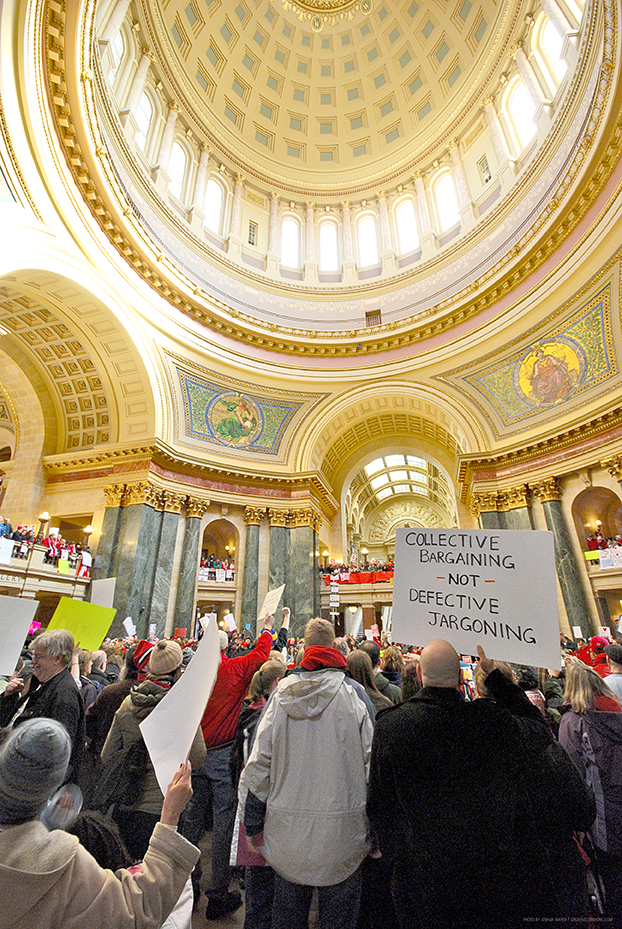
And Walker? He has slashed funding to public schools, and is dismantling the state's public university system. On March 9, he signed a bill that makes Wisconsin the 25th so-called right to work state, which, research shows, contrary to the hype, drives down wages and destroys good jobs. Why? All in an effort to eviscerate Wisconsin's labor unions.
2015-03-14-1426360750-6996733-NYT_201503_graph.png
There's a moral to this story. As my high school students taught me, "You've got to walk the walk, not just talk the talk." If you want a strong middle class, then you can't take out the unions that built it. If you want good jobs with higher wages, then workers need a voice.
Trickle-down economics doesn't work, and frankly, it never has. If we want to restore a healthy middle class, we need a different approach, a virtuous cycle that begins with a high-quality public education that gives students the skills they need to get good jobs with fair wages, helping each generation climb the ladder of opportunity. Another crucial step is to enable more workers to form and join unions.
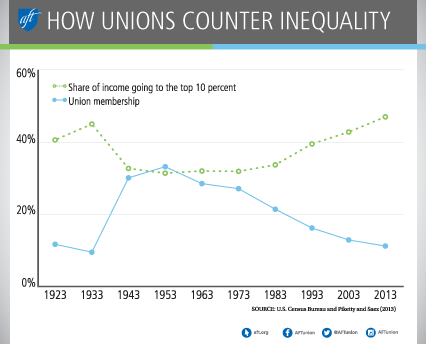
As Hillary Clinton recently noted, "The American middle class was built, in part, by the right for people to organize and bargain." She's right. When unions were at their peak, more workers -- upwards of 50 percent -- were in the middle class. Conversely, a decline in union membership - spurred on by trickle-down economics, ideological attacks and globalization -- is directly linked to the rise in income inequality.
At a time when only the wealthiest 10 percent have reaped the benefits of any gains in productivity, workers once again need a voice on the job. Collective bargaining can lift all boats, even those boats that aren't carrying a union card.
Look at wages. In the heyday of the American labor movement, non-managerial workers' wages went up 75 percent. As unions have been on the decline, these workers have only seen a four percent bump. Still, even today, union workers earn 28 percent more than nonunion workers. When two-thirds of our economic activity is driven by consumer spending, it's critical that working families have more money in their pockets to spend. Broadly shared prosperity will remain elusive as long as workers' buying power is limited.
And then there is retirement security. Eighty-six percent of Americans believe our nation faces a retirement security crisis. Unions bargain a secure retirement on behalf of workers, often in the form of pensions. Pensions both ensure that workers can retire with financial dignity and are important investors in our economy. For every dollar paid in pension benefits, there's $2.37 in economic output. Plus, long-term capital funds create hundreds of thousands of jobs in asset classes like infrastructure, venture capital and real estate.
Collective bargaining has a multiplier effect. So do laws meant to take collective bargaining away.
2015-03-14-1426361356-5132125-NYT_201503_PHOTO.jpeg
Workers in so-called right-to-work states make about $1,500 less per year. When wages are lower, workers leave the state, depressing job creation, and there's a sizable economic loss to the state. Marquette University economist Abdur Chowdhury estimates the impact of right-to-work on Wisconsin will be "a net loss of direct and indirect income of at least $5.8 billion annually."
Governors and state policymakers have a clear choice. They can push ideological A Tale of Two States | Randi Weingarten: