Latest News and Comment from Education

Friday, March 13, 2015

How We End The War Over Standardized Testing

How We End The War Over Standardized Testing:


How We End The War Over Standardized Testing


 Anyone who grew up in the 1960s, during the time of the Cold War, remembers our nation’s response to the threat of nuclear war by enforcing “duck and cover” drills in our schools.

The drill would start with the shrill whistle blast over the PA speaker at the front of the classroom – once, twice, then again.
“Class! Class!” the teacher would shout, “Stop what you’re doing and duck and cover.”
Duck and cover entailed dropping to the floor, on your knees, under your desk, being sure to rest your forehead on one arm, while covering your head with the other. The purpose of this perverted yoga pose was to protect your head from getting hit by the shattering windows and falling chunks of concrete caused by a nuclear bomb explosion.
While you’re in squat mode, the teacher paced through the aisles to inspect which students were doing it right and which needed correcting. With only the tap-tap of the teacher’s shoes breaking the thick silence, your knees would grow hot with pain, and your head would gradually turn into a sweaty meatball under the pressure of the self-imposed headlock.
Your only hope was that some kid would fart, and the whole class bust out in laughter. But eventually, the principal would come back on the speaker and whistle an “all clear.”
A generation removed from that time, you have to agree it’s preposterous we ever went through such a ritual.
Of course, a silly drill wasn’t going to save us from nuclear holocaust. But we did it anyway, because… Because it made the adults feel better? Because we didn’t know what else to do?
Today there’s a similar sort of charade carried out in schools across the nation. It’s called standardized testing.
Only this time, we’re imposing the schoolhouse drill, not to protect our children from nuclear annihilation, but to protect them from supposed widespread education malpractice being carried out by classroom teachers and school administrators. And the drill isn’t over in fifteen minutes.
If you feel that analogy is over the top, consider the rationale for testing. Too many schools, we’re told, are “failure factories” that doom poor kidsand imperil the middle class. Public schools have been branded a national security threat.
The tests, we’ve been told, are the only way we know “as parents, as teachers, for students themselves to know how they’re doing.” They are“key to student success.” They are as essential for our children as “a trip to the doctor.” People even go so far as to compare standardized testing to the need to vaccinate children against deadly infectious diseases. Ending the tests would “endanger students” and would “endanger schools.” The tests ensure “every student matters,” especially the low-performing ones.
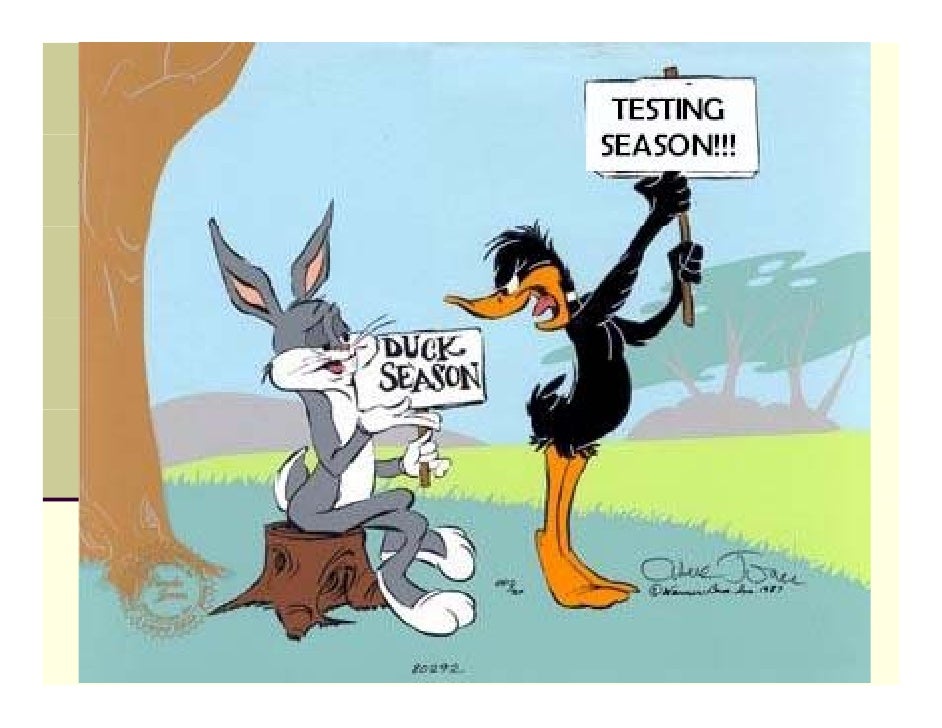
Yet, as testing season rolls out this school year, loud protests are breaking out in school districts across the country. While politicians and policy leaders insist the tests must go on, educators and parents are painstakingly pointing to evidence the tests do more harm than good, and we’re sliding into a Cold War of a different sort, where earnest proponents of “school accountability” square off against ardent activists who demand freedom from “government regulation.”
At a time such as this, when anger is setting in and ideological positions are hardening, it’s good to remember what really did help protect us from the threat of nuclear extinction. It wasn’t duck and cover. It was a dialogue.
A Nationwide Rebellion To Standardized Testing
As Valerie Strauss reports from her blog at The Washington Post, as testing season started to roll out in New Mexico, hundreds of students in different cities took to the streets in protest. “In New Jersey and other states, thousands of students refused to take the tests,” Strauss writes.
In a recent issue of US News & World Report, education correspondent Allie Bidwell writes, “Tens of thousands of parents and students nationwide are engaging in civil disobedience by refusing to participate in federally mandated standardized tests.”
PBS education correspondent John Merrow went to the scenes of protests and demonstrations in New Jersey to find thousands of students How We End The War Over Standardized Testing:

Parents Can Opt Out - United Opt Out National

Click Here to go to United Opt Out National: 


Click Here to go to the WebsiteUnited Opt Out Team
Home
Click Here to go to the Website FairTest

Enforcing Compliance: Parental Rights - Change The LAUSD

Enforcing Compliance - Change The LAUSD:


Enforcing Compliance

“Pupils, school personnel, classroom, special programs or other activities, regardless of their funding source, are not subject to visitation observation or any other external attention without the school administrator’s endorsement.”
- Derek Horowitz, Principal, Nobel Charter Middle School

The problems that I had been hearing about Nobel Middle School were confirmed when I wrote The Administrator Who Stole Christmas. Shortly after I published this piece,the head of their charter boardcomplained about the general accuracy of the piece - but despite being asked, he never offered a specific correction; he would only say that most parents were happy with the school. Instead, he seemed more interested in knowing which parent had provided me with the information. I was taken aback when his response to my refusal to name my source was to start listing parents who he thought were responsible. He referred to them as his few “disgruntled parents.” Interestingly, his list did not include the actual person.
Knowing that this behavior was unprofessional, I immediately notified the one person the administrator had named whom I knew. This person was angry but not surprised. It fit the pattern of how dissent was handled within the school. Those who interfered with the ability to achieve consensus were routinely subject to intimidation; this was no exception.
This weekend I was provided with a copy of a letter that brought this bullying to a whole new level. I am trying to confirm the details about the worst part of this letter which included innuendo of “inappropriate” behavior without stating what this behavior was. However, one does not have to read too far between the lines to find the intention of the letter.
Charter schools are publicly funded and, therefore, must be held accountable to the communities that they serve. As a neighborhood school, all children have a right to attend, even if their parents agitate for change.  These parents should not be told to find new schools if they are not happy with the administration. They should certainly not be told that if they “have issues with the way the Enforcing Compliance - Change The LAUSD:

It's Just the Start of the Winter/Spring Testing Season and Already ... | John Thompson

It's Just the Start of the Winter/Spring Testing Season and Already ... | John Thompson:


It's Just the Start of the Winter/Spring Testing Season and Already ...


 Since the beginning of bubble-in mania known as corporate reform, learning typically stagnates during the Winter Test Prep Season and halts for the school year with the April Testing Season. With Common Core, however, children have already taken their seats in front of computer screens and started their seemingly endless high-stakes assessments.

The rushed start to the Test, Sort, and Punish Season(s) raises the question of how early can the Test Prep Season begin. If the accountability-driven school reform movement has taught us anything, we must now acknowledge the extremes that under-the-gun schools will go to make their metrics look better, so who knows how much time for learning is being lost? And, this year the Technical Fix Season and the anti-Opt Out Student Intimidation Season are also in full bloom.
Systems are predictably frightened that their computers won't be up to the demands of Common Core testing, but it would have been hard to anticipate the birth of the Student Sit and Stare Season. The Washington Post's Emma Brown reports that a New Mexico father said of his daughter, "he was flabbergasted when she came home from school recently saying that she and her classmates had spent an hour sitting in front of computers to make sure that the technology was ready for the new online exams." The dad complained, "'They're using up classroom time to test the test.'"

New Mexico is just one state where the parents' and students' Opt Out is undermining the March Madness. Some embattled districts have retaliated and extended the Sit and Stare Season into the testing season, punishing students who Opt Out of tests to hours of doing nothing as they vegetate in front of the test banks. This story has gone viral with the conservative as well as the mainstream press, and social media.
True-believers in bubble-in accountability are fuming as the Opt Outs spread to tens of thousands of students, especially in places like New Jersey, New York, and other states where the anti-"reform" backlash is at its peak. These non-educators flip-flop between their new, more humane-sounding soundbites (coined by their high-dollar public relations teams,) and seeking vengeance against the educators who they blame for defeating their beautiful hypotheses about "disruptive innovation" blowing up the "status quo." But, if they believe that today's anti-testing movement is peaking, reformers will get a real eye-opener when the Pound of Flesh Season opens.

For the next few months, the focus will be on the foul-ups that accompany the peak Spring Testing Season. We'll read about children breaking down in tears, begging their parents to let them stay home from school. We'll get a peek at the most absurd test questions. Blame will be repeatedly cast regarding the inevitable testing glitches, and disputes over holding students accountable for tests given in the middle of those fiascoes. But, the reason why these stories will merit headlines is that these flawed tests carry heavy consequences - punitive measures that are just now being phased in. When their Punishment Season takes off, the outcries will multiply.
The Pound of Flesh Season will get in full swing as the Non-Graduation Season begins. As more and more students are denied high school diplomas because they could not pass college readiness tests, the parents' revolt will take off in families of all socio-economic classes in all parts of the nation. Then, it will be the teaching profession's time to render its pound of flesh, as educators are fired due to the guestimates produced by unreliable value-added models that crunch test data that is invalid for the purposes that it is used for.
Hopefully, the Pound of Flesh Season will be abbreviated by a successful Litigation Season. Currently, judges can (and do) rule that value-added teacher evaluations are unfair, but they are not illegal because they are not irrational. At present, the best candidates for legal victories overturning data-driven evaluations are plaintiffs facing It's Just the Start of the Winter/Spring Testing Season and Already ... | John Thompson:

Thursday, March 12, 2015

Why Las Vegas Is Desperate To Hire Thousands Of Teachers

Why Las Vegas Is Desperate To Hire Thousands Of Teachers:


Why Las Vegas Is Desperate To Hire Thousands Of Teachers


Technology specialist Sara Boucher teaches about 1,000 students in classes as large as 45 at Steven G. Schorr Elementary School in Clark County, Nevada, making it hard to tailor instruction and impossible to learn everyone's name.
She does her best, but the teacher shortage in the county, which includes Las Vegas, is about to get worse. Next school year, Clark County expects to have 2,600 teachers fewer than it needs. The shortage, the result of an awakening economy, attrition and growing population has created teeming schools, a heavy reliance on substitute teachers and oversubscribed special education programs.
"We're at capacity," said Erick Capetillo, a teacher and coach at Las Vegas High School. "We can't accept someone who moves into the zone and needs our [special-needs] program."
The teacher shortage in Clark County, the nation's fifth-largest school district, comes as the hiring of teachers in the U.S. has been rebounding after several years of layoffs. There's "no good national estimate" of a teacher shortage -- or whether there is one, said Robert Floden, a professor at Michigan State University's College of Education who leads its Institute for Research on Teaching and Learning.
States like Nevada, Floden said, may not have a big enough population to produce sufficient teachers."The students in Nevada might not all want to be teachers," he said. "They might want to be doctors or lawyers or lumberjacks."
Nevada is only expected to produce 1,300 new teachers from its education schools this year, Clark County superintendent Pat Skorkowsky said. So even if the district hires every single one, it would still be 1,300 short. At the same time, the district is set on improving teacher quality. "We had a different mindset in the past: It was about warm bodies," Skorkowsky said. "Now we're about quality."
No matter how dedicated, it's difficult to provide the building blocks of a quality education when teachers are in such short supply. Research on the effect of class size on student learning is inconclusive.
Clark County is so desperate to fill classrooms with good teachers that in late January, Skorkowsky zip-lined down Fremont Street, cheered by teachers wearing red capes. The stunt kicked off a campaign called "Calling All Heroes" to attract national teaching talent.
The school district set up a special superhero-themed recruiting website, and enlisted family members of administrators who live in Boston to spell out the district's website URL in the city's mountains of snow. (The website immediately saw a bump in East Coast traffic). "Calling All Heroes" advertisements are running in various locations such as Southwest Airline's in-flight magazine. Successful referrals can net a $110 "hero finders fee."
Clark County faces significant recruiting challenges. The graduation rate was 29th out of 39 major urban districts in 2012, according to a recent study. Nevada's came in last.
Nevada also ranked last for public education and 48th for overall childhood well-being in 2014, according to the Annie E. Casey Foundation's Kids Count report. Almost one-fifth of Clark County students lack proficiency in English and 59.6 percent are eligible for free or reduced-price lunch.
Then there's the problem of Las Vegas' image of glitzy casinos and ersatz monuments. "We're selling a state as a great place to live and raise your family," chief human resources officer Staci Vesneske said of the recruiting campaign. "It's an education for what Las Vegas really is."
And starting salary for a starting teacher in Clark County is $34,684 compared to thenational average of $36,141. (Average rent for Las Vegas one-bedroom apartmentruns about $775 a month.)
If the district gets enough applicants, Vesneske said she'd ideally like to hire only the top 10 percent to 15 percent. But that's probably unrealistic, she said. In previous Why Las Vegas Is Desperate To Hire Thousands Of Teachers:

Harold 2.0? | Articles | News | AustinWeeklyNews ‪#‎Chuy2015‬ ‪#‎imwithchuy‬

Harold 2.0? | Articles | News | AustinWeeklyNews.com:

Harold 2.0?

Can Jesus "Chuy" Garcia put together a rainbow coalition of the 21st Century?


 By Michael Romain

Editor

A lot has changed for Cook County Commissioner Jesus "Chuy" Garcia in the few weeks since forcing Mayor Rahm Emanuel into an April 7 runoff election. 
A poll conducted by the firm Ogden & Fry in early March showed the two candidates in a "dead heat," with Emanuel drawing about 43 percent, and Garcia drawing about 39 percent, support among roughly 1,000 likely voters. An unscientific poll conducted by the African American publication N'DIGO magazine showed Garcia with about 64 percent support and Emanuel with about 36 percent support among roughly 440 respondents.
Garcia's name recognition has increased both in Chicago and throughout the country. He's been profiled by publications such as the New York Times, the Nation, the International Business Times and USA Today. The Daily Beast dubbed him the "Rahm Slayer." He's appeared on left-leaning cable shows, such as MSNBC's the "Ed Show" and "Democracy Now!"
Garcia has also experienced a significant bump in campaign revenue. He's raised more than $365,000 between Feb. 24 and March 7—that's about a quarter of the money he raised throughout his entire campaign leading up to election night. Much of that money has come in the form of $1,000 contributions from donors whose listed occupations include doctor, homemaker, company president, software engineer, truck driver and professor. But most of it is owing to two donations—$250,000 from Service Employees International Union (SEIU) and $25,000 from Yusef D. Jackson, the beer distributor and son of the Rev. Jesse Jackson, Sr., who officially endorsed Garcia last week. 
A race that was once mostly about Mayor Rahm Emanuel's first term has now turned into a contest of two wills and one dark horse.
As much as Rahm Emanuel's team has mounted attacks against Garcia's political resume, they've been much less inclined to touch his deep connections to historical populist figures such as Cesar Chavez, Jesse Jackson, Sr. (a la 1984 and 1988) and Harold Washington. That's because if Emanuel's team focuses too much attention on this aspect of Garcia's history, they only risk playing into what could be the political equivalent of an uncontrollable brush fire.
"People haven't recovered from the Emanuel administration's 50 school closures," said Jackson during an interview last year with In These Times. "That was one of the most devastating blows. Banks were charged with targeting and clustering black and brown families and found guilty of pushing subprime mortgage loans on minority communities, but not a single person was charged with a crime. That compounded the sense of alienation. And it is this alienation that amounts to dry chips, ready to ignite."
Garcia's brand of populism may have the potential to ignite a genuinely populist, multiracial, movement-based campaign in the mold of Jackson's two presidential bids in 1984 and 1988, or Washington's successful run for mayor in 1983. And Garcia himself—who served as one of Jackson's delegates during his '88 run and was a key figure in Washington's reformist administration—is the only candidate in the race who can claim ownership of such a movement with any kind of sincerity.
If that were to happen, Mayor Emanuel wouldn't be able to co-opt it by changing his pitch or making last-minute policy adjustments. The key to victory for Garcia is how effectively he can mobilize that sort of movement-based coalition. The key to victory for the mayor is how effectively he can stop this Harold 2.0? | Articles | News | AustinWeeklyNews.com:


Karen Lewis: Chuy Garcia should be next mayor of Chicago - #‎Chuy2015‬ ‪#‎imwithchuy‬

Karen Lewis: Chuy Garcia should be next mayor of Chicago - Opinion - Crain's Chicago Business:

Karen Lewis: Chuy Garcia should be next mayor of Chicago

Karen Lewis, president of the Chicago Teachers Union, considered running for mayor of Chicago.
The day of reckoning for Chicago's pension problem is coming. Let's be clear, however—it was years of the city's nonpayment to the Chicago Teachers' Pension Fund and structured underpayment to police and fire departments that created the current crisis. The city did not make any efforts during more flush times to address the issue, even though it was crystal clear that future challenges would result. In the case of the CTPF, it was the Illinois Legislature and Mayor Richard M. Daley that eliminated the fund's dedicated property tax line in 1995.
While Republican Sen. Mark Kirk is stumping for Chicago Mayor Rahm Emanuel by imprudently comparing our city to Detroit, Chicago can take a different route to stability by closing corporate loopholes, taking legal action against banks engaged in predatory financial deals and raising taxes on the wealthy. The only solution is a sufficient, dedicated funding stream that can't be diverted to operations.
Unfortunately, Emanuel has sided with his Republican brethren and big banks in virtually every instance during his four years in office and now is working overtime to limit the liability of banks. Our city is ready for a leader who will defend us against the rapacious interests of the banks. Jesus “Chuy” Garcia is that leader.
Emanuel has continued the policies of his predecessor: privatization of public assets like parking meters, the attempt to privatize Midway Airport, scoop-and-toss bonding and intensification of regressive fines and fees.
Garcia has proposed major tax increment financing changes and supports a graduated state income tax. If Garcia takes on the banks, we're already much further ahead. The key is to move toward straightforward decisions that can't be gamed by financial institutions.
Take on the banks. By taking legal action against banks that have engaged in toxic swaps and taken advantage of an economic crisis of their own creation, Chicago could recover all of the money paid to these banks, as well as any future payments or termination penalties. This would be worth up to $800 million, which includes estimated net payments of $534 million from the city and $237 million from CPS on the swap deals through last August.
The city has engaged in these complex financing deals with hidden costs and hidden risks Karen Lewis: Chuy Garcia should be next mayor of Chicago - Opinion - Crain's Chicago Business:


Capitol Confidential » Cuomo: ‘I have nothing to do with the education system’

Capitol Confidential » Cuomo: ‘I have nothing to do with the education system’:


Cuomo: ‘I have nothing to do with the education system’


 Talking to reporters on Wednesday in Rochester after speaking about his upstate economic development plans, Gov. Andrew Cuomo insisted repeatedly that he has no control over the education system — except his ability to control, y’know, its funding.

Asked to respond to criticism from Assembly Speaker Carl Heastie and others that his insertion of non-fiscal matters into his budget proposal exceeds his powers, Cuomo pushed back.
“We have something called the constitution, and in the constitution … the predominance of the power to make a budget is with a governor,” Cuomo said. “The Assembly has powers that the Senate doesn’t have, and that I don’t have. The Assembly appoints the Board of Regents — the Assembly basically runs education in this state. I have nothing to do with the education system; the Senate has nothing to do with the education system. … If the Speaker doesn’t like the constitution of the state of New York, he could try to change the constitution.”
Cuomo reiterated his lack of power over the education system in answer to another question a few minutes later, just before laying out his proposal to overhaul teacher evaluations.
“If you want more funding, then you have to fix these problems,” he said.
The governor repeated his lack of power a third time before noting his action to reduce the impact of Common Core-related testing for teachers and students. (For a guy with no power, he was starting to sound rather influential.)
Another response from the 10-minute gaggle required some backpedaling by the press office.
“In a recent article in the New York Times, a former prison commissioner said that due to the recent events and the Capitol Confidential » Cuomo: ‘I have nothing to do with the education system’:

Big Education Ape: New York Hedge Funds Pour Millions of Dollars into Cuomo-Led Bid to Expand Charter Schools | Dem... http://bit.ly/1GK9ZjW


Big Education Ape: Left-wing protesters target hedge funds - The Insider Blog | Crain's New York Business http://bit.ly/1BATAtv


Big Education Ape: Hedge fund execs' money for charter schools may pay off - NY Daily News http://bit.ly/1BATEti


A Month of Opting Out of Standardized Tests | EduSanity

A Month of Opting Out of Standardized Tests | EduSanity:


A MONTH OF OPTING OUT OF STANDARDIZED TESTS


 I get a lot of questions about education from friends, family, friends of family, family of friends and random people on the interwebs.  One of the most difficult questions I get is “Why did you choose to opt your kids out of standardized tests?”.  This question isn’t difficult because I don’t know the answer.  It’s difficult because they are

1425915980_featured.jpeglooking for the short version of a very complex decision.  Last year I wrote about our decision to opt out of the state test in Arkansas.  This year is a bit different.  Partly because our reasons have evolved and partly because standardized testing will take an entire MONTH in 2015.  So I decided that I would tackle one reason per day during the month-long testing window of March 9 – April 10.  Including spring break, that’s 20 school days of testing.  I’ll post each reason separately and use this post as the master list.  So here you have it, the Endacott Family Top 20 Reasons we are opting out of PARCC in 2015:
Reason 1:  We trust teachers
Standardized tests have become the most important measure of educational quality in recent years.  As some of my later posts will explain, this is ridiculous.  You might have heard of Value Added Measurement (VAM)which is how test scores are used to determine teacher quality.  VAM requires a complicated statistical model that can be horribly erroneous when calculated by those without the right expertise.  Not only is VAM ripe for error, but the American Statistical Association has highlighted research that shows teachers account for only 1%-14% of the variance in student test scores. Very recent research has also demonstrated that there is no association between VAM test score data and other composite measures of effective teaching.  In other words VAM is a problematic way to measure teacher quality that is also inconsistent with what we already know about good teaching.  Talk about throwing the baby out with the bathwater.
According to the most recent Phi Delta Kappa survey on public education, 72% of Americans have trust and confidence in their kids’ teachers.  You can count us among their numbers.  Nobody knows what our children are capable of more than the teachers that see them every day.  58% of Americans also oppose the use of standardized tests to evaluate teachers.  We are definitely among them as well, and as long as test scores are being used in this fashion, I hope they join us in opting out.
Reason 2: False Premises
If you listen to politicians and pundits (bad idea) then you’d think A Month of Opting Out of Standardized Tests | EduSanity:

Parents Can Opt Out - United Opt Out National

Click Here to go to United Opt Out National: 


Click Here to go to the WebsiteUnited Opt Out Team
Home
Click Here to go to the Website FairTest

Why Do American Students Have So Little Power? — The Atlantic

Why Do American Students Have So Little Power? — The Atlantic:

Why Do American Students Have So Little Power?

A group of Kentucky teens is struggling to get a modest bill passed, revealing just how difficult it is to convince adults that kids' opinions matter.


or the past four months, a group of Kentucky teenagers has been working to make a one-sentence change to a state law. In the history of student activism, this is not a big ask. They want local school boards to have the option—just the option—of including a student on the committees that screen candidates for superintendent jobs.
That’s it. They aren’t asking to choose the superintendent; the elected school board does that. They just want to have one student sit among the half-dozen adults (including two teachers, a parent, and a principal) who help vet candidates and make recommendations to the board.
"I thought everyone would view it as a no-brainer," said Nicole Fielder, 18. She said this on Tuesday from Frankfort, the state’s capital, where she was missing classes in order to advocate—for the sixth time—for this bill.
Policymakers should be begging students to serve on committees and school boards, not the other way around. That’s because students are their secret weapons: Kids can translate abstract policy into real life with a speed and fluency that no adult can match.

To date, Fielder and her fellow students have testified before lawmakers, written op-eds, consulted attorneys, and collected piles of research. When a snowstorm threatened to keep them from traveling to appear in front of a committee last week, they asked if they could sleep on the floor of the Capitol rotunda. (The answer was no; they stayed in a nearby hotel.) As of today, the bill appeared in danger of dying a sudden death.
In the eight years I’ve been writing about education, my best sources have been students. An 11th grader in Washington, D.C., named Allante Rhodes told me that, while it was nice his high school offered a Microsoft Word class, only six of the campus’ 14 computers worked; he often spent his computer class reading a handout given to him by the teacher. That was good for me to know.
Meanwhile, Andrew Brennen, a 12th-grader who had moved five times as a teenager, told me that his grades depended on his zip code. In Georgia, he was at the top of his class; in Maryland, the very next year, his grades plummeted and he had to retake Spanish altogether. In Kentucky, he did fine in science but struggled with math. And that’s why he thought adopting the Common Core State Standards made sense. "Honestly," he told me, "you spend 35 hours a week in a classroom, you know what kind of things work and don’t work."
Students are the most valuable and least consulted education-policy experts in America. Before they graduate, they spend roughly 2,300 days contemplating their situation, considering how their schools and neighborhoods could be better—or worse. And unlike many journalists, teachers, principals, and school-board members, most couldn’t care less about politics.
Jack Jacobson, the president of Washington, D.C.’s Board of Education, serves alongside two student representatives. "They are honest brokers. They have no hidden agenda," he said. "Time after time, our student representatives ask the most intelligent questions, and they frankly have a better sense of what is Why Do American Students Have So Little Power? — The Atlantic:

What’s Love Got To Do With Education Reform? - Living in Dialogue

What’s Love Got To Do With Education Reform? - Living in Dialogue:


What’s Love Got To Do With Education Reform? 


 by M. Shannon Hernandez.

Call me radical, or just call me plain crazy, or even an idealist, but I believe the missing ingredient in public education reform is love. And compassion. And gratitude.
Please, let me explain.
Love has many definitions. As a noun, it can mean “deep affection, warmth, adoration” or “enjoyment, appreciation, passion”, or “compassion, caring, kindness”. As a verb, love can be defined with words like “adore, delight in, and hold very dear.”
Look over that list above again. Is there one word up there—just one—that if applied to the everyday world of public education, wouldn’t make our schools a better place for our students and teachers?
As a 15-year veteran teacher, professor, and education activist, I’ve been doing a lot of thinking since releasing my book: Breaking the Silence: My Final Forty Days as a Public School Teacher, in August 2014.The very incident that inspired me to start speaking about the flaws in public schools was a sexual misconduct charge brought forth by my principal.
The crime? Embracing the students in a group hug, much like a team huddle, after a high-stakes ELA test. Thankfully, the charge was dismissed, but that incident opened my eyes, even more, to the lack of love, compassion, and gratitude many teachers, students, and parents face day-in and day-out in our public schools.
When a teacher can’t hug a student, or a group of students, we have a problem in this country.
When a principal could potentially ruin a career and life, of a teacher who wants nothing more than the very best for her students, we have a problem in this country.
When a school board can investigate a teacher for over a year, traveling around New York City, trying to gather statements from students and teachers (with tax payer dollars!), and the teacher has no idea that this investigation is even happening, we have a problem in this country.
And this, my fellow teachers, parents, and administrators, is only the beginning…
My student teachers at Brooklyn College spent weeks preparing for their first round of parent-teacher conferences. As teachers, we know how important it is to make contact with families, have quality discussions about students’ successes and progress, and create an environment on parent-teacher night where students and families feel welcome and at ease.
As the student teachers filed into class on a Thursday, following conference night, we held a discussion about their first conferencing experience. I learned that many of my teachers didn’t leave the building until well after 10 p.m. The reason? They are grades 7-12 science teachers who have been given class loads of well over 160 students each. The administration failed to recognize that conferencing for this many students would take so long. But even worse than this, were the student teachers who shared with the class that they were allotted 5 minutes per parent. Yes, you read that correctly, 5 minutes.
I listened to their stories with heartache and anger, wondering a few things:What’s Love Got To Do With Education Reform? - Living in Dialogue: