Latest News and Comment from Education

Sunday, March 1, 2015

Marie Corfield: Chris Christie: Governor Wack-A-Mole

Marie Corfield: Chris Christie: Governor Wack-A-Mole:


Chris Christie: Governor Wack-A-Mole


Gov. Christie wants America to believe he tells it like it is. He wants us to believe he's not afraid to stand up for his beliefs, and he says his record proves it. Last week at CPAC Christie sat down with conservative commentator, Laura Ingrahm for a Q&A on a range of topics, and let America know that:
"I care about fighting the fights that are worth fighting"

Except that based on his record, the only fights he deems worthy of fighting are againsthis constituents, not for them. While other states in the region have recovered from the Great Recession, NJ is still in a post-recession shambles, with little to show for it but 7 credit downgrades and a second-to-last rank for job growth. Yea, I'm lovin' that 'Jersey Comeback'!

But boy-oh-boy, are his town hall meetings taxpayer-funded campaign stops a huge success! In case you couldn't get to one (because they're held during the day when most folks are at work) he's even got a You Tube channel with 7 pages of these things. (Full disclosure: I make an appearance in one of them).

Whether it's having no regrets about calling a Navy Seal an idiot, ("He's an idiot. I don't have any regret about it at all"), or telling a Sandy volunteer to "sit down and shut up", no other elected official has spoken to and about constituents with such bullying disrespect, and still managed to get re-elected. At first, many found his style refreshing. After four years of Gov. Jon Corzine, who was long on cash and short on warmth and political savvy, Republicans voted the party line and Democrats voted the party machine in 2009 to elect their very own Tony Soprano—telling it like it is and taking no prisoners! And despite his horrendous job at restoring NJ's economy after the Great Recession, they would do so again in 2013.

But that act is all Christie has to run on, and it's getting old. Personally, I like my 'Rude Jersey' on TV, not in the statehouse. Tony, Snookie and the rest represent the very best of the worst Jersey stereotypes. And they have about as much chance of getting elected to public office as any musician has of beating Bruce Springsteen in a Garden State 
Marie Corfield: Chris Christie: Governor Wack-A-Mole:


Lily Eskelsen Garcia: Congress to take on rewrite of No Child Left Behind | MSNBC

Congress to take on rewrite of No Child Left Behind | MSNBC:


Congress to take on rewrite of No Child Left Behind | MSNBC


Congress is gearing up for yet another battle over No Child Left Behind, but what are they planning to do and will testing remain at the law's core? Lily Eskelsen Garcia, President of the National Education Association, joins to discuss. Duration: 7:37

Rahm's Accomplishments - #Chuy2015

Rahm's Accomplishments - Home:


RAHM'S ACCOMPLISHMENTS

Four years of Rahm's Achievements.


 Chicago likes a tough mayor that gets things done.  Let's take a look at what Mayor Rahm Emanuel has done in his short tenure.  From finance and crime, to education and jobs, Rahm has touched every aspect of our city in less than four years.


Finance & Ethics
  • Of Emanuel’s top 106 contributors, 60 of them received favors from the city. 
  • Evaded his own, much-trumpeted executive order banning campaign contributions from city contractors by shoveling $38 million in city resources to his donors via “direct voucher payments,” a sketchy loophole that lets businesses get city money without bids or contracts — without, in fact, any way of documenting what the money is used for.
  • Disregarded ethics and laws and accepted more than $600,000 worth of donations from executives at firms managing Chicago pension money.
  • Doesn’t attempt to recoup more than $100 million from issuance of $1 billion in risky auction-rate debt paired with interest-rate swaps…despite a federal rule that requires banks to "deal fairly" with governments when they underwrite government bonds. 
  • Established regulations favorable to Uber, a company Rahm’s brother stands to make a billions dollars from.
  • Pays for preschool using dubious scheme in which investors could double their money and cost the city dearly.
  • Missed the only opportunity to fight the parking meter deal, and instead locked the contract in place for the next 75 years.
  • Chicago’s bond rating dropped to near junk-bond levels.
  • Appointed board member Deborah Quazzo, who invests in companies that privatize school functions tripled their business with the Chicago Public Schools while she was on the board.
  • Cut pensions of middle-class workers and diverted funds to enrich some of his biggest campaign contributors.
  • Fails to reform disability programs, costing taxpayers millions.
  • Facing budget crisis, spends $2.7 million on armor for horses for a NATO summit.
  • Outsourced CTA fare card, despite having one that worked fine, to a company for $454 million, which then added new fees that bilk the poor on a grand scale.
  • Top donor bought stock in Marriott immediately before City awarded company huge contract.

Education

Crime & Safety

Employment & Poverty


Does Rahm deserve another four years?
Picture

Big Education Ape: Chicago Inc. Rahm Emanuel Dances for Corporate Money - Vote for Chuy!!! http://bit.ly/1AaLZT1

Contentious teacher-related policies moving from legislatures to the courts - The Washington Post

Contentious teacher-related policies moving from legislatures to the courts - The Washington Post:


Contentious teacher-related policies moving from legislatures to the courts


American Federation of Teachers President Randi Weingarten expects to see more challenges to “value-added” teacher evaluations. (Damian Dovarganes/Associated Press)


 Opponents of the nation’s teacher unions won a landmark victory last year in a California lawsuit that challenged tenure protections, a case that became the beginning of a national effort to roll back teacher tenure laws in state courts.

Now the largest unions in the country are using a similar tactic, as teachers turn to the courts to fight for one of their most pressing interests: An end to test-based evaluations they say are arbitrary and unfair.
The lawsuits show that two of the nation’s most contentious battles over the teaching profession are shifting from legislative arenas to the courts, giving judges the chance to make decisions that could shape the way teachers are hired, fired and paid. Union critics and wealthy advocates have hired lawyers to take on the teachers; the teachers, through their unions, have gone before the bench to go after state officials and their policies.
The latest foray into the courtroom began Feb. 13, when New Mexico teachers sued state officials over an evaluation system that relies heavily on student test scores. Tennessee teachers also sued their state officials this month, arguing that most teachers’ evaluations are based on the test scores of students they don’t actually teach. Florida teachers brought a similar lawsuit last year; it is now in federal appeals court, while other complaints are pending in Texas and New York.
Union officials say they expect to see more lawsuits in the future, especially over evaluations that use complex and controversial algorithms — called “value-added models” — to figure out how much of a student’s learning can be attributed to their teacher.
“There will be more challenges because things are not being seen as credible and fair,” said Randi Weingarten, president of the American Federation of Teachers, which joined the New Mexico lawsuit. “What we’ve gotten to is this routinized, mechanized displacement of human judgment, and that’s what I think you’re seeing — that is the underlying issue that is the root of this agita about evaluations.”
“It’s ridiculous that we have to go to the courts,” Weingarten said. But she said that New Mexico education officials and other supporters of test-based evaluation are deaf to evidence that the evaluations aren’t working.
Critics say that the unions are exaggerating both the problems associated with value-added scores and the weight that they carry in evaluations. Value-added scores account for up to 50 percent of evaluations in some states, and a smaller portion in many others, with the remainder of teachers’ ratings comprised of classroom observations and other measures.
“Essentially teacher unions don’t want any evaluation,” said Eric Hanushek, an economist at Stanford University’s conservative Hoover Institute and a supporter of value-added measures. “That’s what they’re angling for.”
Until recently, teachers’ evaluations in many jurisdictions were based almost exclusively on principals’ observations, and the vast majority of teachers were rated satisfactory. But the Obama administration made test-based evaluations a requirement for any state that wanted to compete forRace to the Top grant money or win relief from the federal No Child Left Behind law.
Now 35 states require student achievement to be a significant factor in teacher evaluations, and many school districts are using those evaluations to make decisions about teacher bonuses and as a basis for firings.
Most states are using the value-added models to determine how much Contentious teacher-related policies moving from legislatures to the courts - The Washington Post:

Teacher Labor Supply - Forbes

Teacher Labor Supply - Forbes:


Teacher Labor Supply


ednext_20084_36_open14


I spent this morning arguing with my internet friend Freddie DeBoer about education reform, and I thought it would be useful to elevate some parts of our disagreement to a blog post. His argument is: education reformers want to make teaching a worse job, so then how are we going to get more teachers? He argues we already face teacher shortages, and also don’t we care at all about teacher quality? Let me start by giving Freddie some credit where I can. He’s right that the labor supply impacts of education reform aren’t thought about enough by many education reformers. This is something I’ve written about before. However, he’s wrong to think that the status quo provides anywhere close to the best system that balances benefits of reforms against labor supply issues.

There are several ways to improve the labor supply of teachers while making reforms that many teachers would nevertheless oppose. First, is pension reform. Right now pensions are skewed so that teachers receive very few benefits until later in their careers, and then they receive massive benefits for a few years, and then they are strongly incentivized to retire early. A recent paper by Costrell and Podgursky reviews teacher pension rules in several states and provides some useful examples of how this works. For example, a teacher in Ohio who retires at age 55 receives a pension that is worth 55% of their total compensation over her career. In contrast, a teacher who retires at age 30 receives a pension worth 7% of their total compensation, which is less than they have paid into the system. The authors argue that the accrual spikes for teachers dwarf those seen in private sector pensions by an order of magnitude. Freddie sees reforms as increasing risks for teachers, but this system creates a huge amount of risk, “because an entering teacher often does not know in advance whether she will be a short timer, leaving the system with little pension wealth, or a career teacher receiving benefits that far outweigh the contributions”, as Costrell and Podgursky point it.

This suggests changing retirement benefits to accrue more smoothly over their career could improve labor supply. Indeed, since teachers receive such a large share of their compensation in retirement benefits, it’s likey that labor supply could be increased by reducing benefits and increasing salary.  A recent paper on Illinois pensions found that teachers valued each $1 in marginal pension benefits at $0.20 suggesting that this could easily be done in a revenue neutral way that significantly increased the value of compensation to teachers. 

However, it’s not just pension benefits that give the short end of the stick to young teachers. Jacob Vigdor has shown that teacher pay schedules heavily reward old teachers relative to young teachers. A flatter salary schedule would reward younger teachers sooner, which makes sense given that research has shown the benefits to experience peak at around five years, and given that this is standard in other professional occupations.

Another way to make teaching more desirable is to get rid of the pay bumps for graduate degrees. There is little evidence these advanced degrees make teachers more effective. A recent review of the literature from Sass and Harris argued that, with the exception of masters degrees for elementary math teachers, “recent research indicates either insignificant or in some cases even negative associations between possession of graduate degrees by a teacher and their students’ achievement in either math or reading”. Yet despite the lack of evidence here, the Center for American Progressestimates that in the 2007-2008 school year, we spent $14.8 billion on pay bumps for masters degrees. While defenders argue these work as important teacher retention tools, I suggest using these billions of dollars to raise pay across the board would be a more effective retention tool. This would also save teachers the cost of spending so much of their time and money getting advanced degrees, many of whom do so on weekends, evenings, and over the summers while employed full-time as teachers. This should be coupled with lowering other credentialing as well, which will also help increase the labor supply by allowing people who didn’t attend education schools to become teachers.

In addition, there is some evidence that more charter schools increase teacher pay. Those who defend teachers’ unions often cite the monopsony power of local school districts, so they should not be surprised by this finding. Kirabo Jackson found teacher pay went up from charter competition in North Carolina. Another study from Lori Taylor found that charter competition lead to higher wages for most teachers in Texas. While this isn’t a lot of research, it is suggestive and the theory is relatively plausible. If public schools are wasting money on excessive administration or other costs, this could incentivize them to cut costs and spend more on teacher salaries.

A couple more quick points before I finish. Freddie also complained that teachers aren’t respected and their jobs are miserable, but as I’ve already shown him respect for Teacher Labor Supply - Forbes:

Keep this in mind in quest to reform Detroit's schools

Keep this in mind in quest to reform Detroit's schools:


Data is key in quest to transform Detroit's schools


The formation of the Coalition for the Future of Detroit Schoolchildren — a broad spectrum of community stakeholders, including leaders from the education, business, philanthropic and faith-based sectors — is an unprecedented opportunity for genuine reform in Detroit's public schools and a chance to improve the lives of thousands of young people.
As representatives of so many perspectives, coalition members will have varied ideas about what needs to be done, but we want to urge the coalition to follow the evidence.
The good news is that we have more data today than ever before to tell us what works in transforming education in high-poverty schools and neighborhoods.
The data show, for example, that the schools facing the greatest educational challenges require an infusion of human resources and capacity-building efforts so that evidence-based innovations addressing both academic and non-academic needs of students can be implemented. These are schools in which nearly all students need not only engaging instruction from skilled teachers, but also additional support to help them attend school regularly, stay focused in class and complete assignments.
Reform must address the needs and structures of the whole school and the whole child; a piecemeal or either/or approach will not work.
Research also tells us that many high-poverty schools have been struggling and unsuccessfully reforming for years. In good part, this is because both students and adults have to function under high stress and conditions of scarcity — a situation, which, recent findings have shown, clouds judgment. It also leads to a loss of hope. Thus the human, as well as the technical, aspects of school reform need to be attended to.
The students, families, teachers and adults at the center of it have to feel listened to and be shown a clear and supported path to improvement that is attainable. At the same time, in some cases, a fresh team of adults in the school will be required, not because they will necessarily be more skilled, but because they bring a can-do spirit instead of being bound by years of despair.
The data also tell us that by the end of sixth grade, it is possible to identify about half of the students who are falling off the path to graduation, and as many as 75% can be identified by the end of ninth grade. The good news here is that early-warning indicator systems — already in place in several Detroit schools and hundreds of others across the country — allow educators to intervene effectively and provide these students with the support they need to get back on the path to graduation. This approach especially works when a high percentage of students live in poverty and when schools are struggling to generate higher levels of student achievement and academic growth.
Finally, data and experience indicate that comprehensive school reform, including improved classroom instruction, enhanced student support, and effective early-warning indicator and intervention systems, works best when supported by a broad spectrum of community and educational leaders. They not only help sustain the reforms over time, track progress and make mid-course adjustments, but also provide students with tangible pathways from high school graduation to adult success via internships, job training and post-secondary schooling linked to the local labor market. This has been the case in school districts around the country.
The Coalition for the Future of Detroit Schoolchildren has a real chance to break the Keep this in mind in quest to reform Detroit's schools:

How Jeb Bush’s school reforms really played out in Florida - The Washington Post

How Jeb Bush’s school reforms really played out in Florida - The Washington Post:


How Jeb Bush’s school reforms really played out in Florida


Jeb Bush talks a great deal about his record on education when he was governor of Florida from 1999-2007 and later as a private citizen through his Foundation for Excellence in Education. As governor, he introduced school reforms that have become common across the country — including high-stakes standardized testing for “accountability” purposes and school “choice” — and since then has been a leading voice in spreading his education gospel nationwide. His critics call him not a “reformer” but a “privatizer” of public education in part because of his attitude abouttraditional public schools — calling them “politicized, unionized monopolies” or “government-run monopolies run by unions” — while advocating for charter schools as well as voucher and voucher-like programs, which use public money to pay private school tuition for students.
How successful were Bush’s reforms in Florida? He, of course, says they were enormously successful. Others don’t. To understand what really happened, I had an e-mail conversation with professor Sherman Dorn of the University of South Florida, who has spent years researching and writing about public education in the Sunshine State. He maintains a blog about public education at www.shermandorn.com.
Here’s our conversation:
Q) Let’s start with the basics. When Jeb Bush became governor of Florida in 1999, how did he proceed in terms of school reform?
A) In his first term, most of Jeb Bush’s efforts in education came in three areas: test-based accountability, private-school vouchers, and support for improved reading instruction. In 1999, Bush signed legislation that required annual testing of all children in grades 3-10, tied test scores to annual “A” through “F” labels assigned to local public and charter schools, and required retention of children in third grade if they did not meet critical scores in the state reading test or provide other evidence of reading skill. In the same year, the Florida legislature created two voucher programs, one tied to the state labeling of local public schools and the other available to children with disabilities. Bush also created the Florida Center for Reading Research in 1999, which used both state and federal funding to support classroom teachers and reading coaches.
The real-estate boom in Florida at the time made it relatively easy for the state legislature to add funding in the form of bonuses for teachers in schools labeled A (or in schools with improved labels), and to support the hiring of hundreds of reading coaches in Florida’s elementary schools. Bush left office at the peak of the boom years and never had to face budget crises that are a regular part of state politics now.
Q) Bush frequently talks about how his test-based policies led to higher test scores. I’m not sure if he was referring to NAEP or to FCAT. What happened with the test scores and the achievement gap?
A) Most of the time that Bush or his policy advocates talk about Florida children’s achievement, they refer to NAEP. Attached are some relevant materials taken from the NAEP website, comparing reading and math scores between Florida’s students and the rest of the country for grades 4, 8, and 12 for the years where Florida scores can be separated out and where NAEP 
How Jeb Bush’s school reforms really played out in Florida - The Washington Post:

The important things standardized tests don’t measure - The Washington Post

The important things standardized tests don’t measure - The Washington Post:


The important things standardized tests don’t measure

In this photo taken Feb. 12, 2015, sixth-grade students  work through an exercise on their laptops during a practice session to prepare for the the Common Core State Standards Test at a school in Stockport, Ohio. (AP Photo/Ty Wright)

Marion Brady is a veteran educator who has long argued that public education needs a paradigm shift, though not the same one pushed by school reformers who champion the Common Core State Standards, school choice and vouchers. Brady says schools need a complete transformationl in what and how students learn. He has also been highly critical of standardized testing. Here’s his latest piece. You can see some of his earlier pieces here (Why Common Core isn’t the answer)here (One way to solve America’s major curriculum problem) and here  (‘The Procedure’ and how it is harming public education).

By Marion Brady
As my students were taking their seats, Myrna, sitting near my desk, said she’d just read a magazine article about secret societies in high school. What, she asked, did I know about them?
I knew nothing—had never even heard of them—but the matter was interesting enough to quickly engage my eleventh-grade English class, so I let the conversation continue. Someone suggested making it a research project and I told them to have at it.
The school library wasn’t much help, but somebody figured out how to contact the student editor of the school newspaper in a town mentioned in the article and wrote her a letter. She answered, other contacts were made, and kid-to-kid communication began. How did the societies get started? Who joined them? Why? How? Did they create problems? If so, what kind? Were the societies more than just temporary cliques? How were teachers and administrators reacting?
Answers generated more questions. My students thought, wrote, took sides, argued, learned. I mostly watched.
That happened in a class in a semi-rural high school in northeastern Ohio many decades ago. I’d be willing to bet that if any of the participants remember anything about the class, that research project would be it.
I wasn’t smart enough to realize it at the time, but I was seeing a demonstration of something extremely important, that real learning is natural and inherently satisfying. Myrna’s question kicked off genuine learning—self-propelled and successful not because the work was rigorous and the kids had grit, but because it was driven by curiosity, because The important things standardized tests don’t measure - The Washington Post:

With ESEA Reauthorization Underway, Coalition of Education Advocates Unveil Proposal to Expand High-Quality Early Education

RELEASE: With ESEA Reauthorization Underway, Coalition of Education Advocates Unveil Proposal to Expand High-Quality Early Education in Rewrite of Historic Education Law | Center for American Progress:


 With ESEA Reauthorization Underway, Coalition of Education Advocates Unveil Proposal to Expand High-Quality Early Education in Rewrite of Historic Education Law


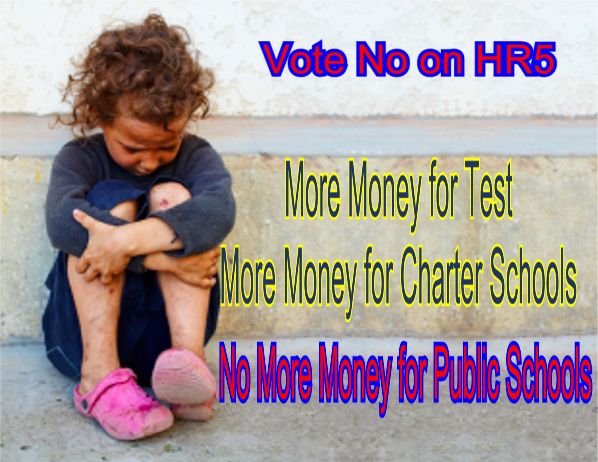
Call and Tweet your House Rep and ask him/her to vote ‪#‎NOonHR5‬ http://bit.ly/17s6O1b

Embedded image permalink


 Center for American Progress, American Federation of Teachers, Children’s Defense Fund, National Association of Elementary School Principals, National Education Association, and National Center on Learning Disabilities unveil proposal to include new title for high-quality early education in ESEA

Washington, D.C. — As Congress moves forward with rewriting the Elementary and Secondary Education Act, or ESEA, a coalition of education advocates—including the Center for American Progress, the American Federation of Teachers, the Children’s Defense Fund, the National Association of Elementary School Principals, the National Education Association, and the National Center on Learning Disabilities—today unveiled a proposal for adding a new title to the law to expand preschool, invest in high-quality early childhood education, and make full-day kindergarten more widely available for families.
“Enacted as part of President Lyndon B. Johnson’s War on Poverty, the Elementary and Secondary Education Act has brought tremendous change to our schools and helped level the playing field for all students—no matter their parents’ income or ZIP code,” said Neera Tanden, President of the Center for American Progress. “Decades of research have shown how important high-quality early education is for narrowing the school readiness gap and putting children on a pathway to a lifetime of learning and career success. The reauthorization of ESEA presents a rare opportunity for Congress to help our nation meet the goal of a high-quality education for all students.”
“Fifty years ago, the Elementary and Secondary Education Act improved opportunities for public school children in the United States—in particular, Title I leveled the playing field for poor students. Today, we have the chance to make ESEA better again by adding a new title that makes a significant commitment to early childhood education,” said American Federation of Teachers, or AFT, President Randi Weingarten. “The value of early childhood education is undeniable. It helps ensure kids, especially poor kids, have a strong start. And it yields a strong return on the investment: Every dollar we invest in early childhood programs saves us up to $8 in the future. This new title would ensure fewer poor children fall through the cracks by providing access to high-quality early childhood education, and it’s an investment our nation can’t afford not to make.”
“Principals who lead our nation’s elementary schools that serve more than 35 million children support an expansion of high-quality early childhood education to ensure that every child will have access to impactful learning opportunities as early as possible,” said National Association of Elementary School Principals, or NAESP, Executive Director Gail Connelly. “This vision is necessary to address all students’ developmental or social and emotional well-being, which goes hand-in-hand with academic success, especially during the foundational years of a child’s life from prekindergarten to the third grade. The proposal sets forth an appropriate and necessary plan for congressional leaders as part of a reauthorized Elementary and Secondary Education Act.”
“Expanding access to early childhood education is paramount to ensuring equal opportunity for all children regardless of the ZIP code in which they live,” said National Education Association, or NEA, President Lily Eskelsen García. “In fact, we fundamentally believe access to high-quality early education programs is an indicator of student and school success, which is why we are urging Congress to include as part of its ESEA reauthorization process high-quality learning opportunities for children from birth to age five. This would go a long way toward fulfilling America’s promise of equal opportunity for each student.”
“The National Center for Learning Disabilities, or NCLD, is pleased to support expanding preschool programs to include early screening for learning and attention issues, which affect one in five children across the nation. Yet, because these learning issues are not immediately visible, they often go unnoticed for years, making early screening an essential component of any early education program. By providing professionals with the tools and information they need to identify children who are struggling with early math and reading skills, we can set children on a path to success,” stated James H. Wendorf, Executive Director of the National Center for Learning Disabilities.
The coalition’s proposed new title of ESEA would expand access to preschool for the nation’s poorest children, using a federal-state cost-sharing partnership as states ramp up their programs. The proposal would provide for coordination and collaboration between early childhood providers and schools, ensuring that providers and districts work with school RELEASE: With ESEA Reauthorization Underway, Coalition of Education Advocates Unveil Proposal to Expand High-Quality Early Education in Rewrite of Historic Education Law | Center for American Progress: