Latest News and Comment from Education

Friday, February 6, 2015

The Buffalo School District and its Shiny New Police State | The Public

The BPS and its Shiny New Police State | The Public:


The BPS and its Shiny New Police State

by  / Feb. 6, 2015 7am EST
The underlying goal isn’t unique to the Buffalo School District. Throughout New York State, tea party reactionaries have aligned themselves with the state government to bring about a simple equation. 
1. De-fund the schools; 
2. Cut electives and programs; fire teachers;
3. Break the teachers’ union;
4. Label schools as “low performing”;
5. Create “charter” schools;
6. Segregate better students into charters; exclude troubled, poor, and special education students; 
7. Ensure that charters rent space from private landlords; 
8. Profit. 
That’s more or less what’s being attempted in Buffalo. It’s a district that has more than its share of socioeconomic crises, but instead of helping the most troubled and disadvantaged kids, powerful, monied interests now controlling the district seems to be writing them off. Instead, it’s moving forward with publicly funded private, exclusive charter schools, not all of which are all that high performing, either, thank you very much. 
It’s not just Buffalo, by the way. In tony, conservative Clarence, a small but well-funded band of tea party activists have succeeded in de-funding the schools, which in turn led to cutting teachers, programs, electives, and every social worker in the district. Kids suffer so that some of western New York’s wealthiest residents can save pennies on their tax bill. No district, teacher, board, or student is safe from this new American movement to destroy public education. 
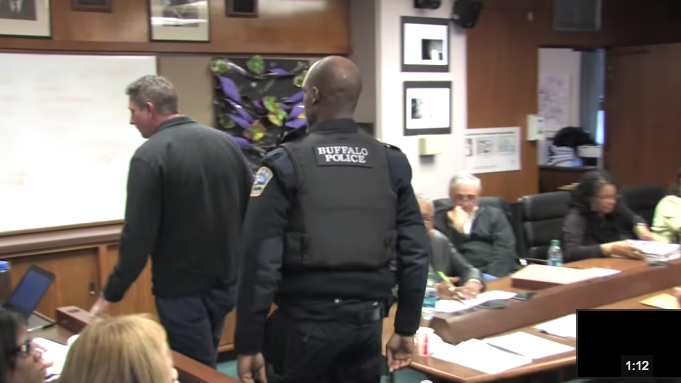
But what apparently happened Thursday at a hastily organized public Buffalo Board of Education meeting is something new and chilling. Kevin Gibson is the Secretary of the Buffalo Teacher’s Federation, and has every right to be present at a Buffalo school board meeting, and to speak. He began his remarks with, “My name is Kevin Gibson, and I’m a teacher in Buffalo”. Just a few weeks ago, he gave this powerful presentation, blasting one local charter as being just as “low performing” as any other school. 
But this Thursday, Gibson never got a chance to speak. It was a public meeting, and a public comment period. But when Gibson got up, this happened. Keep an eye on Larry Quinn, who seemingly has no patience for this job that he ran for The BPS and its Shiny New Police State | The Public:

A history of Pearson’s testing problems worldwide - The Washington Post

A history of Pearson’s testing problems worldwide - The Washington Post:


A history of Pearson’s testing problems worldwide


 Now that Pearson, the worldwide education company, has won a huge contract with PARCC,  one of the two multi-state consortia designing new Common Core-aligned tests with federal funds, it seems like a good time to review problems Pearson has had with previous projects.

I’ve run one of these before but this is an updated list compiled by Bob Schaeffer, public education director of FairTest, the National Center for Fair & Open Testing, which is dedicated to ending the misuse of standardized tests. Take a look at not just the number of problems but the variety in 14 states — Virginia, Florida, Texas, California, South Carolina, Oklahoma, Minnesota, Arizona, Mississippi, Wyoming, New York, Arkansas, Illinois, Iowa, — as well as in Guam and elsewhere around the world.

1998
California – Test score delivery is delayed.
1999-2000
Arizona – 12,000 tests misgraded due to flawed answer key.
 2000
Florida – Test score delivery is delayed, resulting in $4 million fine.
Minnesota – 45,739  graduation tests misgraded, leading to lawsuit with $11 million settlement; judge finds “years of quality control problems” and a “culture emphasizing profitability and cost-cutting.”  (FairTest consulted with plaintiffs’ attorneys)
Washington – 204,000 writing Washington Assessment of Student Learning exams have to be rescored.
2002
Florida — Dozens of school districts received no state grades for their 2002 scores because of a “programming error” at the state Department of Education. One Montessori school never received scores because NCS Pearson claimed not to have received the tests.
2005
Michigan — Scores are delayed and fines levied per contract.
Virginia   –  Five students get $5,000 scholarships based on misgraded computerized test.
2005-2006
SAT college admissions test – 4400 tests wrongly scored; $3 million settlement after lawsuit (note FairTest was an expert witness for plaintiffs)
2007-2011
Mississippi – Subcontractor programs correct answer as incorrect, A history of Pearson’s testing problems worldwide - The Washington Post:

Fewer Top Graduates Want to Join Teach for America - NYTimes.com

Fewer Top Graduates Want to Join Teach for America - NYTimes.com:


Fewer Top Graduates Want to Join Teach for America


Teach for America, the education powerhouse that has sent thousands of handpicked college graduates to teach in some of the nation’s most troubled schools, is suddenly having recruitment problems.
For the second year in a row, applicants for the elite program have dropped, breaking a 15-year growth trend. Applications are down by about 10 percent from a year earlier on college campuses around the country as of the end of last month.
The group, which has sought to transform education in close alignment with the charter school movement, has advised schools that the size of its teacher corps this fall could be down by as much as a quarter and has closed two of its eight national summer training sites, in New York City and Los Angeles.
“I want the numbers to be higher, because the demand from districts is extremely high and we’re not going to meet it this year,” said Matt Kramer, a co-chief executive of Teach for America. But, he added, “it is not existentially concerning.”
Last year, the highly selective program accepted about 15 percent of its applicants. Mr. Kramer said there were no plans to lower standards for the current year simply to yield a larger corps of teachers.
Photo


Some say the decline in applicants could point to a loss of luster for the program, which rose to prominence through the idea that teaching the nation’s poorest, most needy students could be a crusade, like the Peace Corps. Teach for America has sent hundreds of graduates to Capitol Hill, school superintendents’ offices and education reform groups, seeding a movement that has supported testing and standards, teacher evaluations tethered to student test scores, and a weakening of teacher tenure.
“We are sort of at 2.0 of education reform, and its future direction seems a little bit uncertain at this point,” said David M. Steiner, the dean of the Hunter College School of Education in New York.
Leaders of the organization say their biggest problem is that the rebounding economy has given high-achieving college graduates more job choices.
“It’s so different from three years ago, where suddenly you have candidates that may have an offer from Facebook and Wells Fargo and an offer to join the T.F.A. corps, and clearly, the money is going to be radically different,” said Lida Jennings, executive director of the Los Angeles office of Teach for America.
Mr. Kramer dismissed the idea that the group’s philosophy was driving candidates away. “As I talk to people on campuses, it is not like the central thing I hear,” he said. “I don’t hear people say, ‘Oh, I hear this criticism and therefore I don’t want to do Teach for America.’ ”
Teaching in general has been losing favor. From 2010 to 2013, the number of student candidates enrolled in teacher training programs fell 12.5 percent, according to federal data.
But Teach for America’s belief that new college graduates can jump into teaching without much training, as well as its ties through prominent alumni to the testing and standards movement, may also be taking a toll, driving away the kind of students the program once attracted.
When Haleigh Duncan, a junior at Macalester College in St. Paul, first came across Teach for America recruiters on campus during her freshman year in 2012, she was captivated by the group’s mission to address educational inequality.
Ms. Duncan, an English major, went back to her dormitory room and pinned the group’s pamphlet on a bulletin board. She was also attracted by the fact that it would be a fast route into teaching. “I felt like I didn’t want to waste time and wanted to jump into the field,” she said.
But as she learned more about the organization, Ms. Duncan lost faith in its short training and grew skeptical of its ties to certain donors, including the Walton Family Foundation, a philanthropic group governed by the family that founded Walmart. She decided she needed to go to a teachers’ college after graduation. “I had a little too much confidence in my ability to override my lack of experience through sheer good will,” she said.
Founded in 1990 by Wendy Kopp, a Princeton University student who proposed the idea in her senior thesis, Teach for America started as a kind of civil rights crusade, with 500 novice teachers in six regions across the country.
The nonprofit organization faced financial and management challenges during its first decade, but since 2000 had been growing its teaching corps by close to 20 percent every year. Ms. Kopp, who now runs Teach for All, a global spinoff initiative she founded, declined to be interviewed for this article.
With corporate sponsors like Wells Fargo and Comcast NBCUniversal,charitable contributions from the Walton family, and foundations overseen by the families of the billionaires John D. Arnold and Eli Broad, Teach for America now has 10,500 teachers in classrooms in 35 states and employs 2,400 people across its regional offices. Last year, it had revenue of $196.2 Fewer Top Graduates Want to Join Teach for America - NYTimes.com:

Thursday, February 5, 2015

Constitutional Protection? Yes, but not for teachers. | Reclaim Reform

Constitutional Protection? Yes, but not for teachers. | Reclaim Reform:


Constitutional Protection? Yes, but not for teachers.

The human corruption known as elected legislators is out of control.
Some legislators carry little copies of the U.S. Constitution, with itty-bitty font, in the suit pockets over their hearts since it is sacred. Sacred? The written word of the one true God? They “quote” anything they want and claim that it’s all there as they raise aloft the tiny tome in sacred consecration.
Other legislators think of the U.S. Constitution as something written on an Etch-a-Sketch that can be turned upside down, shaken and changed at will. Hey, doo-doo happens!
Since both extremes are self-serving forms of legalized corruption, the least these legislators can do is apply it to everyone with no exceptions. Teachers, money and teachers’ money are the exceptions in many states.
In Illinois all legislators take a short oath of office. The oath simply states that they, as lawmakers not judicial experts, will uphold the state constitution and the U.S. Constitution. Not doing so is a violation of their elected office; they can and should be removed from office.
Nekritz cut pensions
State Rep. Elaine Nekritz (D) of Northbrook stated for the Chicago Tribune, “”There are no absolutes in the state constitution or the U.S. Constitution.”
Nekritz wants to steal even more from active and retired teachers.
(Blogger Glen Brownsearches deeper into the intricacies.)
The Illinois Constitution states, “Membership in any pension or retirement system of the State, any unit of local government, or school district, or any agency or instrumentality thereof, shall be an enforceable contractual relationship, the benefits of which shall not be diminished or impaired.”
What does Nekritz want to do as she and members of both political parties hand over hundreds of millions of tax dollars per corporation per year to her political campaign Constitutional Protection? Yes, but not for teachers. | Reclaim Reform:

Madeloni to Warren: Educators want to "end the testing madness"

Madeloni to Warren: Educators want to "end the testing madness":

Madeloni to Warren: Educators want to "end the testing madness"

Warren and Madeloni


At a meeting on January 29 with U.S. Senator Elizabeth Warren, MTA President Barbara Madeloni conveyed the message that educators want to “end the testing madness.” She also asked Warren to help ensure that state and federal education policymakers are held accountable for providing the schools our children deserve.
Warren is a member of the Senate Committee on Health, Education, Labor and Pensions, which is currently holding hearings on the reauthorization of the Elementary and Secondary Education Act, better known as No Child Left Behind. Click here to read Senator Warren's comments about the importance of providing funding to help educators do their jobs.
Related Resources

The First Question This Teacher Asks Her Students Every Day

The First Question This Teacher Asks Her Students Every Day:


The First Question This Teacher Asks Her Kindergarteners Every Morning Is Heartbreaking

poverty
About a decade ago, I stood in a high school English classroom, trying my best to give an exciting speech about my experiences as a young reporter. I worked for the local newspaper at the time and the school had invited me and a photographer to give the students a sense of the career opportunities available to them.

The teens all sat politely, if not quite rapt … except for one. He was a short, scrawny kid in an oversized hoodie. I could see him fidget and, worse, heard him mutter the occasional complaint about my presentation. Finally, he seemed to surrender to the fact that yes, I would be there for at least a few more minutes but instead of perking his ears up to listen, he lay his head down on his desk.
His teacher approached him and I expected some form of discipline would ensue. Instead, she gently put her arm around him and said something in a soft voice. I couldn’t make out exactly what it was, but it was clear she wasn’t scolding him — just showing some TLC. I felt mildly annoyed, to say the least. A child was acting rudely during my talk and there’d be no consequence for it?
It only hit me later that the student’s behavior likely had little to do with me. The school served mostly poor students, more than half of whom qualified for free or reduced-cost lunches. The odds were good that this kid faced dire straits outside school hours. Maybe he was cranky because he had skipped a meal or two. Maybe he was tired because he didn’t have a comfortable place to sleep. Maybe he didn’t have a home at all. Whatever his problems were, his teacher saw fit to offer him compassion instead of punishment.
I thought about them both as I read a recent story in The Washington Post reporting that more than half of U.S. public school students live in poverty. The statistic itself is shocking, but what moved me even more was an anecdote about a kindergarten teacher in Albuquerque. Sonya Romero-Smith shows her young students some TLC, too, in part by stocking a drawer full of clean kids’ socks, underwear, and pants for the children.
“When they first come in my door in the morning, the first thing I do is an inventory of immediate needs: Did you eat? Are you clean?” she told The Post.
My older son is nearly kindergarten age and he’s never short on food or clean clothing. No one The First Question This Teacher Asks Her Students Every Day:

GLSEN Adds Chapters in Arkansas, Georgia and Missouri, Bringing Total Number of Chapters to 40 in 28 States | GLSEN

Find Chapters | GLSEN:


GLSEN Adds Chapters in Arkansas, Georgia and Missouri, Bringing Total Number of Chapters to 40 in 28 States

Home

NEW YORK (Feb. 5, 2015) – GLSEN today announced expansion of its chapter network to 40 in 28 states with the addition of three new chapters in Arkansas, Georgia and Missouri. GLSEN Atlanta and GLSEN Southeast Arkansas are the only chapters in Georgia and Arkansas, respectively. With the addition of GLSEN Springfield to GLSEN Kansas City, Missouri now has two chapters.

GLSEN chapters, led by volunteers, play an important role in bringing GLSEN's programs to ensure safe and affirming schools for all students to local communities. The chapters work closely with the national office to implement programs, such as student leadership, educator training and public policy.

“We are excited to have these new chapters spearheaded by local leaders who are committed to ensuring that all students have safe and affirming school environments that foster robust learning environments,” said Dr. Eliza Byard, Executive Director of GLSEN. “The reality is that the majority of LGBT students continue to face hostile school climates. These new chapters will work with students and educators to help turn that reality around. I look forward to seeing the impact they will have in their communities.”

The most recent National School Climate Survey, which first began in 1999 and remains one of the few studies to examine the middle and high school experiences of lesbian, gay, bisexual and transgender (LGBT) youth nationally, found that while school climate for LGBT students has improved somewhat over the years, schools nationwide remain hostile environments for a distressing number of LGBT students. Specifically in Georgia and Missouri, more than 90 percent of LGBT students regularly heard homophobic remarks and most did not have access to vital in-school supports, like Gay-Straight Alliances (GSAs).

“GLSEN Atlanta has come together through the leadership of students, teachers, faculty members and community activists to improve the environment that LGBT students face in K-12 schools in Atlanta and the surrounding area,” said Patrick Faerber, chair of GLSEN Atlanta. “Even in a city considered by many to be the LGBT capital of the south, our students are not protected from discrimination based on their sexual orientation or gender identity. Our objective is to provide Atlanta’s K-12 students, teachers, parents and school staff with all the necessary tools and knowledge to create schools where every student is part of an environment in which they can succeed regardless of their sexual orientation or gender identity.”

“In Southeast Arkansas, diverse educators, activists, administrators and community members have collaborated to ensure that all students, regardless of their sexual orientation or gender identity, have access to a safe, equal and inclusive education,” said Alen Amini, chair of GLSEN Southeast Arkansas. “The narrative in our communities typically revolves around perceived deficits - high poverty and unemployment rates, rampant obesity, lack of basic necessities - but our chapter seeks to empower students and educators to work together to improve outcomes. We will focus on influencing state policy, as well as training educators across the region, to make certain that our students will have enhanced opportunities in and out of the classroom, and that they feel respected and valued in school, at home and in their communities.”

“Springfield is nestled in the heart of the Ozarks, a predominately rural, conservative, religious region. Historically, Missouri, and the Springfield region in particular, have not been places supportive of LGBT individuals, and our schools are certainly no exception,” said Amanda Derham, chair of GLSEN Springfield. “We plan to work tirelessly to address the LGBT bias, bullying and harassment that exist in the hallways of our schools and government buildings where legislators have passed laws that prohibit schools from creating safer places for students. We plan to do so by focusing our first year on the development and growth of GSAs, advocating for policies at local and state levels that address bias and bullying in schools, and creating networks of LGBT and allied support to join us in promoting GLSEN’s mission.”

For a full list of GLSEN chapters, including contact information, visit www.glsen.org/chapters.

About GLSEN
GLSEN, the Gay, Lesbian & Straight Education Network, is the leading national education organization focused on ensuring safe and affirming schools for all students. Celebrating its 25th year, GLSEN envisions a world in which every child learns to respect and accept all people, regardless of sexual orientation or gender identity/expression. GLSEN seeks to develop school climates where difference is valued for the positive contribution it makes to creating a more vibrant and diverse community. For information on GLSEN's research, educational resources, public policy advocacy, student organizing programs and educator training initiatives, visit www.glsen.org.
###

Is this School Heaven? No, it’s Finland - Lily's Blackboard

Is this School Heaven? No, it’s Finland - Lily's Blackboard:


Is this School Heaven? No, it’s Finland

Metaphor Alert: I have been to the mountaintop. I have trod sacred ground. I have seen the light. I have been to Finland. It’s the place where teachers go after they die if they’ve been good and taught the Whole Blessed Child; if they’ve rejected the hell of Obsessive Standardized Testing.
It says something about the upside-down world we live in where we are called on to keep believing in the false and failed prophets of absurd school proposals they like to call “reform” – privatize for profit, have children compete with each other for the winner’s crown or the loser label. Here in the United States, we’re told this will hold back the demon – our “Global Competition”.IMG_3646
Well, let’s end the metaphor here or I’ll run out of air-quotes. Let’s talk science. Because our Global Competition is basically every country doing the opposite of what school privateers and test profiteers tell us to have faith in.
Singapore doesn’t use test scores to shame teachersCanada doesn’t have charter franchises. Korea doesn’t have short-cut preparation for teachers. This is an embarrassment to the Global Education Reform Movement (the GERM) that rolls out economic development plans to entire countries suggesting they will become richer countries if they privatize, standardize and de-professionalize education.
None of the top performing countries got there with this stuff. And these guys have no idea what to do with smart, little Finland.
Finland is no mystery and it is no miracle. They simply have a very good system’s approach to school improvement. They decided 40 years ago that in a country with few natural resources, they would do well to develop the human beings in their society. The believed that healthy, well-educated, compassionate human beings should form the foundation, not only of a good economy, but of good families, neighbors, and even a good democracy.
They did their homework. They saw that private competition in school systems tended to shake out with wealthFullSizeRender[8]y families getting more for their kids than middle class and poor families. As they had no brains to waste, they decided to invest in one, good public system where all kids would get what they needed whether their parents were rich or not.
They decided to invest heavily in teacher recruitment and teacher preparation. By design, they made the colleges of education a highly elite program where only the top university students were accepted with all expenses paid.
There is a one-year residency under a top teacher for graduates. All teachers have master’s degrees related to their teaching assignments. They make it impossible to hire a bad teacher.
There are no fast-track, short-cut, temporary teachers. There is no Teach for Finland. Trust is the key word that comes from politicians, parents, academicians, and unions – after a top notch teacher training for top ranked students; trust rules.
And they put in the hands of these skilled, career educators the tools, technology and time to collaborate, design, intervene and assess instruction, teaching and learning on the school building level. (There are no state Is this School Heaven? No, it’s Finland - Lily's Blackboard:

2/5/2015 – An End To Education Austerity?

2/5/2015 – An End To Education Austerity?:


Education Opportunity Network -


2/5/2015 – An End To Education Austerity?

THIS WEEK: Pre-K Save On Special Ed … School Spending Drops, Again … The Activity Gap … More Churches In Schools … Lani Guinier On Meritocracy Lie

TOP STORY

Is This The End Of Education Austerity?

By Jeff Bryant

“Don’t get too excited yet, but there are signs we may have finally turned a corner for the better in the war for public school financing. Recently, government officials and politicians – from the Beltway to the heartland – have declared allegiance to do what has been, up until now, the unmentionable: Spend more money on public education.”
Read more …

NEWS AND VIEWS

Study: Early Childhood Programs In NC Reduce Special Education

Raleigh News & Observer

“Children enrolled in North Carolina’s state-supported early education programs have a reduced chance of being placed in special education by third grade, Duke University researchers say. The findings suggest that state investment in quality early childhood programs can prevent costly special education later … Access to the state’s prekindergarten program for 4-year-olds (at the 2009 funding of $1,110 per child) reduced the likelihood of third-grade special education placements by 32% … The study confirmed … there are conditions in young children that could be improved by high-quality early childhood education … Even children who were not funded for an NC Pre-K slot benefited.”
Read more …

School Spending Per Student Drops For The Second Year In A Row

The Hechinger Report

“The most recent data, from the 2011-12 school year … show that average per-pupil spending fell 2.8%, to $10,667, from the previous school year. That’s the second year in a row that per-student spending fell … the steepest drops were in Arizona, Florida, Texas, Wisconsin and Washington, D.C. … One major reason is that federal funding to schools fell by more than 20% … The U.S. has a higher percentage of children in poverty than other top performing countries, and many experts say that poor children need more resources … It is troubling to see the rise in poverty and a decline in education spending happen at the same time.”
Read more …

The Activity Gap

The Atlantic

“Income-based differences in extracurricular participation are on the rise, and these differences greatly affect later outcomes. This disparity exacerbates the already-growing income achievement gap that has kept poor children behind in school and later in life. While upper- and middle-class students have become more active in school clubs and sports teams over the past four decades, their working-class peers ‘have become increasingly disengaged and disconnected,’ particularly since their participation rates started plummeting in the ’90s … While there’s always been a gap in access to extracurriculars, participation numbers for the two groups increased at about the same rate until they started to diverge precipitously – in the early 1980s for non-athletic activities and in the early 1990s for sports teams … outside experiences have just as much impact on a child’s life as the classroom ones.”
Read more …

The Movement To Put A Church In Every School Is Growing

The Nation

“The fusion of church and school … is an increasingly common phenomenon in the U.S. Indeed, a number of national and international franchise networks are dedicated to planting churches in public schools across the country, sometimes providing services that fill in the vacuum left by the government underfunding of public education. The mingling of church and school has also been encouraged by some poorly understood but profound changes originating in recent Supreme Court decisions about the relationship between religion and public education … Evangelical networks that have planted churches in public schools across the U.S. … The religious right has invested in legal-advocacy organizations that promote a certain version of Christianity in public life and seek to destroy the separation of church and state.”
Read more …

Lani Guinier On Our Ivy League Meritocracy Lie

Salon

In a Salon interview with Lani Guinier, Jeff Bryant writes, “You remember Lani Guinier. In the early days of the Bill Clinton presidential administration, she became a lightning rod for wingnut conservatives when news broke that Clinton would nominate her to be the first black woman to head the Civil Rights … In her new book, ‘The Tyranny of the Meritocracy,’ she once again takes on a component of right-wing authoritarianism … Guinier argues for a radically different view of how merit is awarded in American society starting with the college admission process. Guinier does not confine her argument to higher education, but merely uses the college admission process as a launching pad to critical examinations of K-12 education policy and the greater public arena. ‘We need a culture shift,’ she writes, “about how we reevaluate the meaning of merit by measuring its democratic values rather than its testocratic machinery.’”
Read more …

What a Senator’s confusion about charter schools illuminates - The Washington Post

What a Senator’s confusion about charter schools illuminates - The Washington Post:


What a Senator’s confusion about charter schools illuminates


It would be entirely understandable for some people to be confused about the nature of charter schools.
Funded by the public but privately operated — sometimes by for-profit companies — and allowed to operate outside rules that demand transparency from traditional public schools — some people make the mistake of thinking that charter schools, or at least some of them, are indeed private schools.
And the confusion can grow when judges and government regulators themselves are asked to decide whether charters are public or private — and sometimes come down on the side of less than public. (For example, the 9th Circuit Court of Appeals in an employment case in 2010 decided that in regard to federal U.S. civil rights law, a charter school in Arizona was not a “state actor.”)
And confusion can grow when charters go to court to fight state audits (as happened in New York) or to fight efforts by their teachers to unionize (as happened in Chicago and Philadelphia). Or when charter schools counsel out students who are problems, or limit enrollment, or refuse to accept students mid-year. Or when nonprofits who win charters to operate these schools funnel public funding through their own for-profit real estate companies that charge big rates for a school building. Or when scandals are exposed in which a great deal of public money is mismanaged or stolen by charter operators.
But it’s another thing when an elected official with education policy-making power — and who happens to support charter schools — is confused.
Sen. Lamar Alexander, the Republican from Tennessee who was once U.S. secretary of education and is now the chairman of the Senate education committee in charge of spearheading the Senate’s rewrite of No Child Left Behind, revealed his own confusion about the nature of charter schools at a Washington event about school choice hosted on Wednesday by the nonprofit Brookings Institution. During a discussion, my colleague Emma Brown reported in this post, that the conversation went like this:
“Well they’re all — charter schools are public schools,” said Grover J. “Russ” Whitehurst, director of the Brown Center on Education Policy at Brookings.
“There are some private charter schools, are there not?” asked Alexander.
“Charter schools, I guess as we define it, are public schools that operate What a Senator’s confusion about charter schools illuminates - The Washington Post:


Are charter schools public or private?