Story Highlights
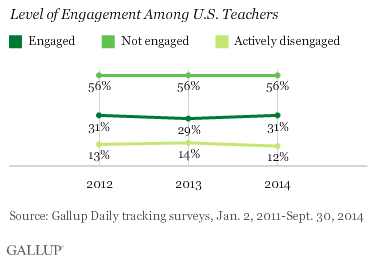
- Since 2012, teacher engagement has remained relatively stable
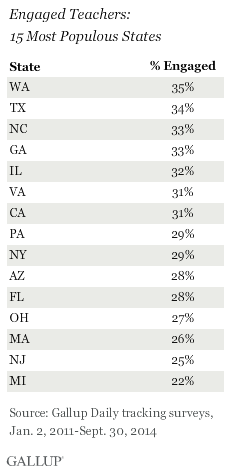
- Among top 15 states, Washington has highest percentage of "engaged" teachers
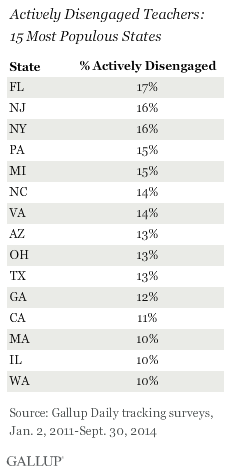
- Florida has highest percentage of "actively disengaged" teachers
This article is the second in a series exploring employee engagement among U.S. teachers as measured by Gallup Daily tracking.
WASHINGTON, D.C. -- Of the 15 most populous U.S. states, Washington leads in the percentage of teachers engaged in their jobs (35%) followed by Texas, North Carolina, Georgia and Illinois. Florida reports the highest percentage of actively disengaged teachers (17%) followed by New Jersey, New York, Pennsylvania and Michigan.
Gallup categorizes survey participants as "engaged," "not engaged" or "actively disengaged" based on their responses to questions about workplace elements having proven links to performance outcomes. Gallup defines engaged teachers as involved with, enthusiastic about and committed to their work. They know the scope of their jobs and constantly look for new and better ways to achieve outcomes. Not engaged teachers may be satisfied with their jobs, but they are not emotionally connected to their workplaces and are unlikely to devote much discretionary effort to their work. Actively disengagedteachers are not only unhappy, but also act out their unhappiness in ways that undermine what their coworkers accomplish.
These results are based on interviews with 16,529 full-time K-12 schoolteachers conducted Jan. 2, 2011-Sept. 30, 2014, as part of Gallup Daily tracking.
Interestingly, Washington state reported the largest percentage of engaged teachers while also boasting the smallest percentage of actively disengaged teachers. At just 10%, it stands tied with Massachusetts and Illinois for the lowest percentage of actively disengaged teachers.
While no state is completely free of actively disengaged teachers, most states included in the analysis registered percentages of actively disengaged teachers at or less than the national average of 13% for the survey period. Seven states exceeded that figure, meaning they have a larger than average percentage of actively disengaged teachers.
Among them, at 17%, Florida leads large states in the percentage of actively disengaged teachers. New Jersey, New York, Pennsylvania and Michigan round out the top five states with the largest percentage of actively disengaged teachers. Michigan has the lowest percentage of engaged teachers, at 22%.
Although states with the highest percentage of actively disengaged teachers typically have the lowest percentage of engaged teachers, Massachusetts is an exception. Massachusetts has a relatively low percentage of actively disengaged teachers, but also ranks among the lowest for engaged teachers, at 26%. As a result, of the states included in this analysis, it has the highest percentage of teachers in the middle, "not engaged," category.
Teacher Engagement Nationwide Relatively Stable Since 2012
As measured in 2014, 31% of all U.S. teachers were identified as being engaged in their jobs, while 12% reported being actively disengaged. The majority of U.S. teachers, 56%, were not engaged in their work. Employee engagement among U.S. teachers has remained relatively stable since 2012. Moreover, teachers exhibit levels of engagement comparable to estimates for the
total U.S. workforce.
Implications
Among the most populous states included in this analysis, the range in estimates of engaged teachers is wide -- a 13-percentage-point difference between the top- and bottom-ranking states. This may suggest that some states are more successfully capitalizing on the talent of their teachers than others. However, even for states like Washington, with the highest percentage of engaged teachers coupled with the lowest percentage of actively disengaged teachers, there remains room for improvement. Those looking to improve teacher engagement might be well-served by studying the best practices of states with high levels of teacher engagement.
Survey Methods
Results are based on telephone interviews conducted Jan. 2, 2011-Sept. 30, 2014, as part of the Gallup Daily tracking survey, for a subgroup of 16,259 full-time K-12 school teachers, from a random sample of adults, aged 18 and older, living in all 50 U.S. states and the District of Columbia. All reported margins of sampling error include computed design effects for weighting.
For results based on the total sample of U.S. teachers, the margin of sampling error is ±1 percentage point at the 95% confidence level. For state level estimates, the margin of sampling error for most states is ±4 but is as low as ±2 for larger states and as high as ±7 percentage points for states with smaller populations.
Each sample of national adults includes a minimum quota of 50% cellphone respondents and 50% landline respondents, with additional minimum quotas by time zone within region. Landline and cellular telephone numbers are selected using random-digit-dial methods.