Latest News and Comment from Education

Wednesday, January 28, 2015

Georgia school chief to feds: Stop the ”measure, pressure, and punish” approach

Get Schooled | A blog about education in Atlanta, Georgia and the nation. Discuss, learn and share news and opinion with Maureen Downey:


Georgia school chief to feds: Stop the ”measure, pressure, and punish” approach

 January 27, 2015


 State School Superintendent Richard Woods today sent a letter to U.S. Secretary of Education Arne Duncan, members of Georgia’s congressional delegation and members of the U.S. Senate and House Education Committees about the reauthorization of the Elementary and Secondary Education Act.

Georgia Superintendent Richard Woods. (DOE Photo)
Here is his letter:
Dear Secretary Duncan,
With the reauthorization of the Elementary and Secondary Education Act (ESEA) comes an opportunity to address the valid concerns of students, parents, teachers, and communities regarding the quantity and quality of federally mandated standardized tests.
As Georgia’s School Superintendent, I have a constitutional duty to convey those concerns and provide ideas on how to move my state and our nation forward. Georgia recently entered into a $108 million contract to deliver federally mandated standardized tests to our students. That figure does not include the millions of dollars spent to develop and validate test questions and inform the public about the new tests.
This adds to the need for an audit to provide information on the number of tests and loss of instructional time our children endure, as well as a cost/benefit analysis on our current national testing model. As a nation, we have surrendered time, talent, and resources to an emphasis on autopsy-styled assessments, rather than physical-styled assessments. With the reauthorization of ESEA comes an opportunity for a real paradigm shift in the area of assessment.
Instead of a “measure, pressure, and punish” model that sets our students, teachers, and schools up for failure, we need a diagnostic, remediate/accelerate model that personalizes instruction, empowers students, involves parents, and provides real feedback to our teachers.
We need greater emphasis for a federally supported but state-driven formative assessment model that identifies the strengths and weakness of students, coupled with a less intrusive, student-sampled or grade-staggered summative assessment model for the purposes of state-tostate comparisons and world rankings.
Our broken model of assessment is too focused on labeling our schools and teachers, and not focused enough on supporting our students. Our current status quo model is forcing our teachers to teach to the test. We need an innovative approach that uses tests to guide instruction, just as scans and tests guide medical professionals. Oftentimes, we hear teachers called professionals because they have the knowledge and skill set to reach the needs of their individual students, yet in our accountability measures we have not supported or given value to diagnostic tools and tests that teachers need to fully utilize that knowledge or those skills. We must find a balance between accountability and responsibility.
We must give our teachers the tools and trust to be successful or our current path to hyper-accountability will continue to set our students and teachers up for failure. Teachers should not view tests as tools that tie their hands as professionals, but as tools that help them grow in their profession. Students should not view tests as Get Schooled | A blog about education in Atlanta, Georgia and the nation. Discuss, learn and share news and opinion with Maureen Downey:

Students from two-parent families achieve a grade level higher than children of single parents

4:39 am Jan. 27, 2015
Ludger Woessmann,  a professor of economics at the University of Munich and director of the Ifo Center for the Economics of Education, looked at data from the Programme for International Student Assessment to determine how 

World Premier of Short Film: @TeachforAmerica – Passion vs. Preparedness | Cloaking Inequity

World Premier of Short Film: @TeachforAmerica – Passion vs. Preparedness | Cloaking Inequity:


World Premier of Short Film: @TeachforAmerica – Passion vs. Preparedness

World Premier sign
Today Cloaking Inequity is hosting the world premier of a new short film about Teach For America entitled Teach for America – Passion vs. Preparedness. This film was made by Texas filmmaker Julia Duke. She presents a balanced perspective with two critiques and two supporters. The film begins with a critique of Teach For America. It then integrates the perspectives of an Austin Teach For America recruiter and a former TFA corps member who now teachers at a KIPP charter school in Austin. The story then integrates Elle Chernosky’s perspective about her recent Teach For America experience teaching in KIPP San Antonio. You can read more about Elle’s experience in Teach For America in the post Tell-All From A TFA and KIPP Teacher: Unprepared, Isolation, Shame, and Burnout. She needed to be anonymous until she had left KIPP schools. You have most likely seen the Teach For America promotional and marketing materials over the years with corps member extolling the virtues of a short term teaching stint… But have you ever seen a film with the experiences and critiques from a TFA corps member? I think this may be the first time that a film has included a critical perspective about Teach For America. Let me know what you think about the film. Tweet at @ProfessorJVH.


For all of Cloaking Inequity’s posts on Teach For America click here.
Please Facebook Like, Tweet, etc below and/or reblog to share this discussion with others.
Want to know about Cloaking Inequity’s freshly pressed conversations about educational policy? Click the “Follow blog by email” button in the upper left hand corner of this page.
Twitter: @ProfessorJVH
Click here for Vitae.
Please blame Teach For America for any typos.
Interested in joining us in the sunny capitol of California and obtaining your Doctorate in Educational Leadership from California State University Sacramento? Apply by March 1. Go here.

How school reform has failed the test - The Washington Post

How school reform has failed the test - The Washington Post:


How school reform has failed the test

Few education policies are built from a deep knowledge of schools, the teachers who work in them, or the students who attend them. In an article in The American Scholar’s Winter, 2015 edition, scholar Mike Rose takes us into life in the classroom, and from that vantage point examines the pitfalls of contemporary school reform. I am running parts of the article — titled “School Reform Fails the Test: How can our schools get better when we have made teachers the problem and not the solution?” — with the permission of Rose and the journal.
Rose is on the faculty of the UCLA Graduate School of Education and Information Studies and author of  books that include Back to School: Why Everyone Deserves a Second Chance at Education, Possible Lives: The Promise of Public Education in America,  and Why School? Reclaiming Education for All of Us.”

He begins:
 During the first wave of what would become the 30-year school reform movement that shapes education policy to this day, I visited good public school classrooms across the United States, wanting to compare the rhetoric of reform, which tended to be abstract and focused on crisis, with the daily efforts of teachers and students who were making public education work.
I identified teachers, principals, and superintendents who knew about local schools; college professors who taught teachers; parents and community activists who were involved in education. What’s going on in your area that seems promising? I asked. What are teachers talking about? Who do parents hold in esteem? In all, I interviewed and often observed in action more than 60 teachers and 25 administrators in 30-some schools. I also met many students and parents from the communities I visited. What soon became evident–and is still true today–was an intellectual and social richness that was rarely discussed in the public sphere or in the media. I tried to capture this travelogue of educational achievement in a book published in 1995 called Possible Lives: The Promise of 
How school reform has failed the test - The Washington Post:


California School Library Association 2015 Centennial Celebration Conference : KQED Education | KQED Public Media for Northern CA

California School Library Association 2015 Centennial Celebration Conference : KQED Education | KQED Public Media for Northern CA:


California School Library Association 2015 Centennial Celebration Conference

 | January 28, 2015 0 Comments
Portrait of a woman in a library
KQED is proud to sponsor the California School Library Association 2015 Centennial Celebration Conference taking place in Burlingame from February 5- 8, 2015. Through its professional development activities, CSLA has helped school librarians learn from one another and serve the students of California in a unique and powerful setting, the school library. Visit PBS LearningMedia CA in the Exhibit Hall, stop by for a quick overview of PBS LearningMedia at the Exhibitor Learning Session on Friday, February 6th from 1:30 -2pm and check out our session: Public Media Digital Library: 87,000 Resources Sunday, February 8th 9- 9:50am.

Exhibit Hall

Exhibitor Learning Session 
Friday, February 6th – 1:30pm-2pm
Room: Sandpebble
Discover how new productivity tools from PBS can engage students in strengthening media and information literacy skills while also addressing CCSS. Walk away with tools for implementing digital story boarding and interactive assessment tools for teaching and learning.
PBS LearningMedia Resources

Concurrent Session

Public Media Digital Library: 87,000 Resources 
Sunday, February 8th, – 9am- 9:50am
Room: Harbor A
PBS LearningMedia, a free digital library, is a media platform for
PreK -16 classrooms to help re-imagine classroom learning, transform teaching, and more creatively engage students. PBS LearningMedia has over 87,000 digitized resources, including video, audio, images, interactives, documents, lesson plans and websites. Participants will experience PBS LearningMedia and discuss how to apply this resource to instruction for teaching and learning. Participants will also explore tools for creating personalized learning adventures for students.
PBS LearningMedia Productivity Tools
Presentation Slides
Explore

Does School Choice Mean that You Choose the School?

Does School Choice Mean that You Choose the School?:


DOES SCHOOL CHOICE MEAN THAT YOU CHOOSE THE SCHOOL?


Got Choice? Ubetcha! - Celebrating National School Choice Week


National Association of Charter School Authorizers (NACSA) Group: 1 in 5 charter schools not doing well enough to stay open

A group that oversees more than half of the nation's 5,600 charter schools said as many as one in five U.S. charter schools should be shut down because of poor academic performance. 
http://seattletimes.com/html/nationworld/2019784379_charterschools29.html
Big Education Ape: Got Choice? Ubetcha! - ALL The RIGHT People Celebrate National School Choice Week http://bit.ly/1z2lai7


 This is “school choice” week for those who propose that all parents just take a certain amount of tax money and choose whatever school they want their child to be in. But it doesn’t always work that way.

School makes the choice

In many cases, the “choice” is by the school as to whether your child will be accepted or not. As I pointed out in my last post, much of selling “school choice” is a bait-and-switch game. Tell the voters that it will do one thing, with plans to do something else once it passes.

What we now know is that especially for poor children, more often the school is the one making the choice, not the parents.

Track record is there

How do we know? In some states like Oklahoma “school choice” is still somewhat theoretical, but not in all states. In fact, the U.S. as a whole has about a decade of experience from a number of states and stories from implementing “school choice”.

And what we are seeing isn’t pretty.

If your child is black, brown, on an individualized education plan (IEP), or has a history of discipline issues good luck trying to get them into the school of your choice.

Even if you are from a lower economic class than the majority of the students in the school, you just may not get in. Never mind the reasons that they state, it’s because the parents with real money don’t want their children mixing with yours.

Even if your children get in

Suppose there is room at a school that you want to put your child into. Suppose they think that your child is a good fit. Suppose that the school accepts children of color, but only children of color assuming that those kids (your kids) can only accomplish being  compliant low-level servants of a corporation.

Supposing all of those things work the way that you want and your child gets into the school of your choice. That means that…

They choose your child for acceptance as the last word.
They can choose, without your input, to “exit” (kick out) your child any time the administrators or even other more influential Does School Choice Mean that You Choose the School?:

Reducing Our Obscene Level of Child Poverty - NYTimes.com

Reducing Our Obscene Level of Child Poverty - NYTimes.com:


Reducing Our Obscene Level of Child Poverty


I’m not someone who believes that poverty can ever truly be ended — I’m one of those “the poor will always be with you” types — but I do believe that the ranks of the poor can and must be shrunk and that the effects of poverty can and must be ameliorated.
And there is one area above all others where we should feel a moral obligation to reduce poverty as much as possible and to soften its bite: poverty among children.
People may disagree about the choices parents make — including premarital sex and out-of-wedlock births. People may disagree about access to methods of family planning — including contraception and abortion. People may disagree about the size and role of government — including the role of safety-net programs.
But surely we can all agree that no child, once born, should suffer through poverty. Surely we can all agree that working to end child poverty — or at least severely reduce it — is a moral obligation of a civilized society.
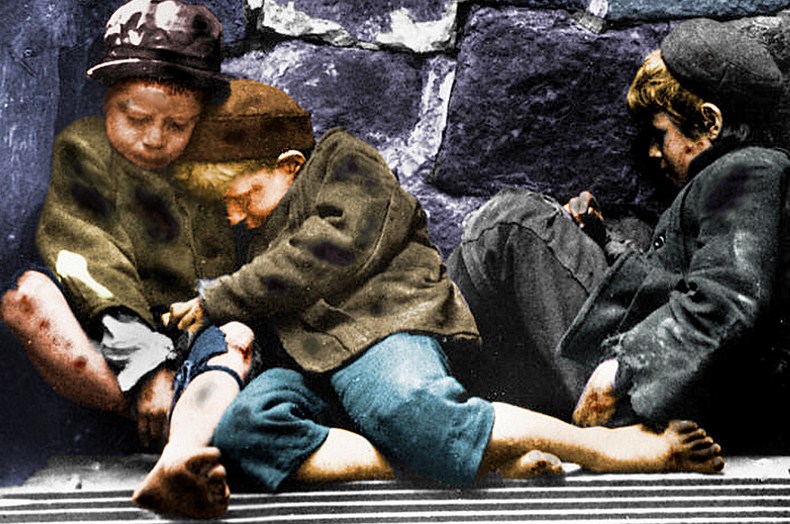
And yet, 14.7 million children in this country are poor, and 6.5 million of them are extremely poor (living below half the poverty line).
Today, the Children’s Defense Fund is releasing a report entitled “Ending Child Poverty Now” that calls this country’s rate of child poverty “a moral disgrace.”
As the report points out:
“America’s poor children did not ask to be born; did not choose their parents, country, state, neighborhood, race, color, or faith. In fact if they had been born in 33 other Organization for Economic Cooperation and Development (OECD) countries they would be less likely to be poor. Among these 35 countries, America ranks 34th in relative child poverty — ahead only of Romania, whose economy is 99 percent smaller than ours.”
It points out many of the corrosive cruelties of childhood poverty: worse health and educational outcomes, impaired cognitive development and the effects of “toxic stress” on brain functions. It also points out the “intergenerational transmission” properties of poverty:
“In one study, people who experienced poverty at any point during childhood were more than three times as likely to be poor at age 30 as those who were never poor as children. The longer a child was poor, the greater the risk of adult poverty.”
But the report is more than just an excoriation of the hollowness of our professed American values and our ethical quandary. It also serves as an economic manifesto, making the point that allowing child poverty to remain at these unconscionable levels costs “far more than eliminating it would,” calculating that an immediate 60 percent reduction in child poverty would cost $77.2 billion a year, or just 2 percent of our national budget.
For context, the report puts it this way:
“Every year we keep 14.7 million children in poverty costs our nation $500 billion — six times more than the $77 billion investment we propose to Reducing Our Obscene Level of Child Poverty - NYTimes.com:

Rick Hess’s Startling Analysis of Common Core | Diane Ravitch's blog

Rick Hess’s Startling Analysis of Common Core | Diane Ravitch's blog:


Rick Hess’s Startling Analysis of Common Core


Click on picture to Listen to Diane Ravitch


 Many of us had been under the impression that the goal of the Common Core standards was to improve the quality of teaching and learning in the nation’s schools.

As someone who spent years advocating for national standards–but has been agnostic about the new Common Core standards–it was always my hope that improving education would be, should be the goal. At least that was my hope when I worked in the US Department of Education in 1991-93 and expended a few million dollars so that teachers’ groups could write voluntary national standards in the arts, history, civics, science, foreign language, physical education, and economics (the math teachers had already written their own standards).
Rick Hess of the American Enterprise Institute has a completely different understanding of the Common Core. As he explains it, “reformers” expect that the Common Core standards will reveal to suburban parents just how awful their public schools are. This will set off the “reformers'” long-hoped for stampede for privatization among the smug and satisfied denizens of the nation’s suburbs.
Imagine the possibilities as everyone discovers their local school is failing and runs to the exits, demanding charters and vouchers.
Farewell, public education. Hello, free market.
Even Rick Hess has his doubts about this scenario.Rick Hess’s Startling Analysis of Common Core | Diane Ravitch's blog:

How do charter schools affect education in Pennsylvania? | PennLive.com

How do charter schools affect education in Pennsylvania? | PennLive.com:


How do charter schools affect education in Pennsylvania?


 York may become one of the few cities in America to privatize an entire school district.

Facing a $20 million budget deficit from 2014, York City School District failed to implement a recovery plan designed by chief recovery officer David Meckley. The state Department of Education then pursued receivership, which would transfer almost all functions of a school board to one person: Meckley.
In response to this news, Pennsylvania State Education Association President Michael Crossey said, "York's citizens don't want this, the elected school board doesn't want this, and parents and educators don't want this."
Per York County President Judge Stephen P. Linebaugh's decision to allow York City School District to appeal the receivership, the school board is still in control. Gov. Tom Wolf, who has authority over the Pennsylvania Department of Education, is already looking into the situation.
State Rep. Kevin Schreiber, D-York City said, "All-charter is not the right option, but we have to come to a resolution to strengthen and reform the district."
What is your perspective? Is going all-charter the way to reform a financially unstable school district? Does it trade one set of problems for another? What does this mean for public education in central Pennsylvania?
We want to hear about your experiences with charter schools. Starting Thursday, Jan. 29, PennLive will run a series of stories the decade-long, multi-million dollar campaign by for-profit schools to to alter laws and education in Pennsylvania.
Cast your vote in our poll, defend your position in the comments and let us know how charter schools in Pennsylvania affect you.
Thank you for voting!


Total Votes: 136

Diane Ravitch: Andrew Cuomo’s attack on public schools - NY Daily News

Diane Ravitch: Andrew Cuomo’s attack on public schools - NY Daily News:


Andrew Cuomo’s attack on public schools 

His teacher-evaluation reforms would scare away good educators and further distort classroom education


Gov. Cuomo’s reform agenda for the schools is dangerously wrong. It will harm students, teachers and public education. It will waste taxpayer dollars on failed policies.

The governor says that our public schools are in crisis. In fact, they rank the same on national tests as 20 years ago — in the middle of the pack. Only 30% of our students passed the new Common Core tests, but 80% passed the state tests they replaced.

Scores fell not because students or teachers got worse, but because the new tests were designed to fail 70% of students. Then-Education Commissioner John King predicted the failure rate before the tests were given.

Cuomo said in his State of the State speech that “everyone will tell you nationwide, the key to education reform is a teacher evaluation system.”

New York’s new teacher evaluation system rated 98.7% of teachers “effective.” The governor says this must be inaccurate because so many students failed.

He wants a system that will base 50% of every teacher’s evaluation on state tests (which currently count for only 20%). The other 50% will be based on observations, one by the principal (counting for 15 points) and the other by independent observers (counting for 35 points).

The governor is wrong about what “everyone will tell you.” Experts would tell the governor that basing teachers’ evaluations on test scores doesn’t work. Many superb teachers are teaching children who learn slowly — such as students with severe disabilities and English-language learners. These students received the lowest scores on the state tests (more than 90% “failed”).

Experts would also tell the governor that excellent teachers will be rated ineffective because they teach slow learners, and mediocre teachers may get high ratings because they teach in wealthy districts. Many teachers who are rated ineffective one year may be rated effective the next.

The American Statistical Association warned last year that the kind of evaluation system proposed by the governor should not be used to rate individual teachers. There are many factors that affect student test scores, including the home, poverty and students’ motivation. The teacher’s influence, said the association, accounts for only 1% to 14% of the variation in scores.

The National Academy of Education and the American Educational Research Association issued a joint statement pointing out the flaws of the measures the governor wants.

Cuomo’s plan will also change tenure rules — so that a teacher can qualify for job protections only if he or she gets five consecutive years of effective ratings.

The consequences of these plans are predictable. Teachers will devote even more time to test preparation. Schools will narrow their curriculum, taking away time from the arts, physical education, science and whatever is not tested. This will harm students.

New York State will lose many good teachers who teach students who are learning English, students with disabilities, students struggling with poverty — Diane Ravitch: Andrew Cuomo’s attack on public schools - NY Daily News:

Why Won't Arne Duncan and other True-Believers in High Stakes Testing Face Reality? | John Thompson

Why Won't Arne Duncan and other True-Believers in High Stakes Testing Face Reality? | John Thompson:


Why Won't Arne Duncan and other True-Believers in High Stakes Testing Face Reality?


Democrats who support test-driven reform are showcasing a kinder, gentler soundbite to defend the indefensible. No longer do they take the "Sister Soldja" position, showing how macho they are by beating up on two of their most loyal constituencies - teachers and unions. Now, the rationale for attaching stakes to standardized tests isn't teachers being so all-fired awful; now, the voters supposedly demand it.
The current argument is that high-stakes testing may have caused severe damage to students - especially poor children of color - but we can't spend federal dollars without attaching test-driven accountability. Parents are thus being told that their kids are subject to the educational malpractice of test, sort, and punish because school reformers believe that they wouldn't invest in schools unless somebody has to give up a pound of flesh.
If this spin works, Secretary of Education Arne Duncan will soon hold his nose as he promotes the worst of No Child Left Behind, explaining to teachers, students, and parents that imposing his agenda hurts him more than it hurts us.
As high-stakes testing becomes even more unpopular, we can also anticipate more of his efforts to pretend that it isn't punitive. But, the use of test scores to punish is, by definition, the use of tests to punish.
Let's engage in a "thought experiment" about what Arne Duncan would have proposed for renewing NCLB if he was focused on improving schools, not defeating adult opponents. Surely he knows that NCLB-type testing failed dramatically. Curriculum was narrowed and poor children of color were disproportionately subjected to drill and kill. Student performance growth on the reliable NAEP tests slowed as the punitive portions of NCLB tests took effect and it declined further after Duncan put bubble-in accountability on steroids.
So, what would Duncan have proposed for accountability purposes if he was willing to grapple with the sad lessons of the last 15 years?
Let's start by facing the real world significance of the seemingly miraculous increase in NCLB test scores at a time when NAEP test score growth mostly decreased or remained pretty stable. The "bubble" was not a victimless scam. At minimum, it meant that the energies of educators were diverted from school improvement to "juking the stats." Whether we refer to the process that jacked up primitive standardized test outcomes as massaging the data or flat-out fabricating it, the integrity of our public education system was compromised. Neither should we ignore the hard work of students and educators that was largely wasted in order to jack up test scores.
If Duncan and company were focused on honest data to highlight and rectify inequities, would they be doubling down on discredited bubble-in testing, or would they pattern their metrics on the highly-respected NAEP methodology? If Duncan really believed testing is a civil rights issue, would he still be stressing the quantity of Why Won't Arne Duncan and other True-Believers in High Stakes Testing Face Reality? | John Thompson: