Latest News and Comment from Education

Sunday, January 25, 2015

Teachers Were Never The Problem - In These Times

Teachers Were Never The Problem - In These Times:


Study finds that in one third of U.S. states majority of public school students come from low-income households. (Southern Education Foundation)

Teachers Were Never The Problem

Poverty still lies at the root of the U.S. ‘education crisis.’
BY DAVID SIROTA

Social science research over the last few decades has shown that two thirds of student achievement is a product of out-of-school factors - and among the most powerful of those is economic status.
Google the phrase “education crisis” and you'll be hit with a glut of articles, blog posts and think tank reports claiming the entire American school system is facing an emergency. Much of this agitprop additionally asserts that teachers unions are the primary cause of the alleged problem. Not surprisingly, the fabulists pushing these narratives are often backed by anti-public school conservatives and anti-union plutocrats. But a little-noticed study released last week provides yet more confirmation that neither the “education crisis” meme or the “evil teachers' union” narrative is accurate.  
Before looking at that study, consider some of the ways we already know that the dominant storyline about education is, indeed, baseless propaganda. 
As I've reported before, we know that American public school students from wealthy districts generate some of the best test scores in the world. This proves that the education system's problems are not universal–the crisis is isolated primarily in the parts of the system that operate in high poverty areas. It also proves that while the structure of the traditional public school system is hardly perfect, it is not the big problem in America’s K-12 education system. If it was the problem, then traditional public schools in rich neighborhoods would not perform as well as they do. 
Similarly, we know that many of the high-performing public schools in America's wealthy locales are unionized. We also know that one of the best school systems in the world—Finland's—is fully unionized. These facts prove that teachers' unions are not the root cause of the education problem, either. After all, if unions were the problem, then unionized public schools in wealthy areas and Finland would be failing.
So what is the problem? That brings us to the new study from the Southern Education Foundation. Cross-referencing and education data, researchers found that that a majority of all public school students in one third of America's states now come from low-income families.  
How much does this have to do with educational outcomes? A lot. Social science research over the last few decades has shown that two thirds of student achievement is a product of out-of-school factors–and among the most powerful of those is economic status. That's hardly shocking: kids who experience destitution and all the problems that come with it have enough trouble just surviving, much less succeeding in school. 
All of this leads to an obvious conclusion: If America was serious about fixing the troubled parts of its education system, then we would be having a fundamentally different conversation.  
We wouldn't be talking about budget austerity—we would be talking about raising public revenues to fund special tutoring, child care, basic health programs and other so-called wrap-around services at low-income schools.  
We wouldn't only be looking to make sure that schools in high-poverty districts finally receive the same amount of public Teachers Were Never The Problem - In These Times:

How to Get Your State Democratic Party to Oppose Common Core - Living in Dialogue

How to Get Your State Democratic Party to Oppose Common Core - Living in Dialogue:


How to Get Your State Democratic Party to Oppose Common Core


 By David Spring M. Ed. and Elizabeth Hanson M. Ed.

01b
Yesterday afternoon, a miracle happened in Washington State. The Washington State Democratic Party became the first Democratic State Party in the nation to pass a resolution opposing Common Core! This is huge because Washington State is not only the home state of Bill Gates. It is also the home state for the SBAC Common Core test. If Washington state pulls out of Common Core, it could bring the entire project crashing to the ground.
01
We realize that several Republican controlled states have already rejected Common Core. But it is much easier for a Republican controlled state to reject Common Core than for a Democratic controlled State to reject Common Core. All Republicans have to do is call it “ObamaCore” and blame the entire thing on those “Damn Democrats” and Republicans will jump at the chance to get rid of Common Core. For example, the Washington State Republican Party passed a resolution opposing Common Core over a year ago.
But not all states are Republican states. Nor do children come with D’s or R’s stamped on their foreheads. For a Democratic state to pass a Resolution opposing Common Core requires going against a sitting Democratic President and also going against nearly your entire Democratic Party political leadership – who are all aligned with Obama and Arne Duncan just as Common Core tests and Common Core books are (supposed to be) aligned with Common Core standards.
A Brief Lesson in Political Organizing
For parents and teachers living in Democratic controlled states and wanting to escape from the death grip of Common Core, we would like to explain how this miracle happened – so that you can use this process as a template to pass a similar resolution in your (Democratic) state.
First, we have been working on this issue for nearly a year. So it will take a lot of patience and determination to overcome the wealthy billionaire controlled wing of the Democratic Party. Do not expect overnight success. You should write a well organized resolution that takes no more than one page. Our successful resolution is at the end of this article if you would like to read it. Feel free to copy it. Unlike Common Core, it is not Copyrighted!
02
Second, it is helpful if at least some members of your group are already members of your state’s Democratic Party. One of us, David, has been a Precinct Committee Officer (PCO) in the Democratic Party for more than 14 years in East King County, near Seattle Washington. The other of us, Elizabeth, is a new PCO for a different legislative district in North Seattle, Washington. Even if you do not like your local Democratic Party, and you think they are evil, you should join it and start attending monthly party meetings in your legislative district. You will find that Democrats are not as evil as you may have been led to believe. Many of them are parents and teachers just like you. They care about our kids and about the future of our country just like you.
Third, it is helpful if you have passed other resolutions at various levels of the Democratic Party in the past and have at least some idea of how the process works. We have previously passed SIX resolutions in the State Democratic Party before the Common Core Resolution. These include resolutions in favor of a State Public Bank, restoration of Glass Steagall Banking Regulations, Getting the Money out of Politics, and Restoring a Fairer GED test. So this was our seventh successful resolution. But it was also by far the hardest to pass.
Fourth, it is essential to start at the legislative district level. Start with your own legislative district. Attend several monthly meetings. Get to know the other folks attending the monthly meetings. Find out who are parents and teachers and whether their kids are struggling with Common Core. Most kids are having a terrible time. Ask these parents and teachers to help you pass a resolution in your legislative district. After How to Get Your State Democratic Party to Oppose Common Core - Living in Dialogue:

Data Mining Students Through Common Core

Data Mining Students Through Common Core:


Data Mining Students Through Common Core


Written by  


Data Mining Students Through Common Core
Awareness is growing rapidly about the recent initiative to bring Common Core Standards to schools across America. Although the standards were supposedly proposed by the National Governors Association (NGA) and the Council of Chief State School Officers (CCSSO) — giving the illusion that the agenda is “state-led,” it was the federal government that endorsed the plan by offering $4 billion in grant money through Obama’s Race to the Top program to cooperating states. Representative Blaine Luetkemeyer(R-Mo.) recently decided to take action and write a letter to U.S. Department of Education Secretary Arne Duncan and is currently seeking co-signers from congressional colleagues. Congressman Luetkemeyer addressed several issues of concern with Common Core — and in the last half of his letter he emphasized the crux of the problem: data mining.
“We understand that as a condition of applying for [Race to the Top] grant funding, states obligated themselves to implement a State Longitudinal Database System (SLDS) used to track students by obtaining personally identifiable information,” Luetkemeyer said. “We formally request a detailed description of each change to student privacy policy that has been made under your leadership, including the need and intended purpose for such changes.”
Parents might reasonably assume that the “personally identifiable information” collected for the database will include students' test scores and perhaps other measures of academic proficiency. But they would be much less likely to imagine that the federal government envisions something far more extensive and invasive than merely tracking academic performance. According to the Department of Education’s February 2013 report Promoting Grit, Tenacity, and Perseverance: Critical Factors for Success in the 21st Century, “Researchers are exploring how to gather complex affective data and generate meaningful and usable information to feed back to learners, teachers, researchers, and the technology itself. Connections to neuroscience are also beginning to emerge.” (Emphasis added.)
So far, nine states across the country have already agreed to adopt the data mining process, with parents having no say in this decision. Schools in New York, Delaware, Colorado, Massachusetts, Kentucky, Illinois, Louisiana, Georgia, and North Carolina have committed to “pilot testing” and information dissemination via sending students’ personal information to a database managed by inBloom, Inc., a private organization funded largely by the Bill and Melinda Gates Foundation.
This digital warehouse boasts on its website that it "partners with education technology companies, content providers and developers to support the creation of products compatible with this infrastructure." Presumably this means information sharing. On the "faq" page of the website, one of the questions is: "Will inBloom give away or sell confidential student and teacher data to Data Mining Students Through Common Core:

The Washington State Democratic Party’s Central Committee passed a resolution opposing Common Core State Standards | Seattle Education

The Washington State Democratic Party’s Central Committee passed a resolution opposing Common Core State Standards | Seattle Education:


The Washington State Democratic Party’s Central Committee passed a resolution opposing Common Core State Standards

common core2
This is the first time a statewide Democratic Party committee has taken a public position against the Common Core and it happened in our great state.
David Spring, a Parents Across America member and active in the Democratic Party in East King County and who was one of the education advocates who organized this effort, said:
This was a huge victory for the children, parents, and teachers of Washington State to have the Washington State Democratic Party – the first Democratic Party in the nation to vote against Common Core. It is our hope that this is the beginning of the end for Bill Gates in the Common Core scam. This was the grassroots – the rank and file of the Democratic Party – who said NO to Common Core. They deserve all the credit, along with you teacher activists.
The resolution as it was passed.
Resolution Opposing Common Core State Standards
WHEREAS the copyrighted (and therefore unchangeable) Common Core State Standards (CCSS) are a set of controversial top-down K-12 academic standards that were promulgated by wealthy private interests without research-based evidence of validity and are developmentally inappropriate in the lowest grades; and
WHEREAS, as a means of avoiding the U.S. Constitution’s 10th Amendment prohibition against federal meddling in state education policy, two unaccountable private trade associations–the National Governors Association (NGA) and the Council of Chief State School Officers (CCSSO)–have received millions of dollars in funding from the Gates Foundation and others to create the CCSS; and
WHEREAS the U.S. Department of Education improperly pressured state legislatures into adopting the Common Core State Standards and high-stakes standardized testing based on them as a condition of competing for federal Race to the Top (RTTT) stimulus funds that should have been based on need; and
WHEREAS as a result of Washington State Senate Bill 6669, which passed the State legislature on March 11, 2010, the Office of the Superintendent of Instruction (OSPI) adopted Common Core State Standards (CCSS) on July 20, 2011; and

Saturday, January 24, 2015

Is Standardized Testing a Pediatric Disease? -e-Literate

Is Standardized Testing a Pediatric Disease? -e-Literate:


Is Standardized Testing a Pediatric Disease?

In my last post, I wrote about the tension between learning, with the emphasis on the needs and progress of individual human learners, and education, which is the system by which we try to guarantee learning to all but which we often subvert in our well-meaning but misguided attempts to measure whether we are delivering that learning. I spent a lot of time in that post exploring research by Gallup regarding the workplace performance of adults, various dimensions of personal wellbeing, and the links of both to each other and to college experiences. One of Gallup’s findings were that workers who are disengaged with their work are less healthy. They are more likely to get clinically depressed, more likely to get heart conditions, and more likely to die young. I then made a connection between disengaged adults and disengaged students. What I left implicit was that if being disengaged as an adult is bad for one’s health, it stands to reason that being disengaged as a child is also bad for one’s health. We could be literally making our children sick with schooling.
I am in the midst of reading Anya Kamenetz’s new book The Test. It has convinced me that I need to take some time making the connection explicit.
In that previous post, I wrote,
Also, people who love their jobs are more likely to both stay working longer and live longer. In a study George Gallup conducted in the 1950s,
…men who lived to see 95 did not retire until they were 80 years old on average. Even more remarkable, 93% of these men reported getting a great deal of satisfaction out of the work they did, and 86% reported having fun doing their job.
Conversely, a 2008 study the company found a link between employee disengagement and depression:
We measured their engagement levels and asked them if they had ever been diagnosed with depression. We excluded those who reported that they had been diagnosed with depression from our analysis. When we contacted the remaining panel members in 2009, we again asked them if they had been diagnosed with depression in the last year. It turned out that 5% of our panel members (who had no diagnosis of depression in 2008) had been newly diagnosed with depression. Further, those who were actively disengaged in their careers in 2008 were nearly twice as likely to be diagnosed with depression over the next year. While there are many factors that contribute to depression, being disengaged at work appears to be a leading indicator of a subsequent clinical diagnosis of depression.
Which is obviously bad for employer and employee alike.
In some cases, Gallup went all in with physiological studies. For example, they “recruited 168 employees and studied their engagement, heart rate, 
Is Standardized Testing a Pediatric Disease? -e-Literate:

Bait and Switch with "Parent Choice"?

Bait and Switch with "Parent Choice"?:


BAIT AND SWITCH WITH “PARENT CHOICE”?

JANUARY 24, 2015 BRETT DICKERSON


A sweeping charter school bill was defeated last year in the Oklahoma Legislature. If passed, they would have allowed investor-owned charters to spring up in direct competition to public schools everywhere, even in the smallest of towns.

The “reform” argument was the same as it has always been when selling “education reform”: (Said with big, sincere eyes) We cannot allow poor children to continue to be trapped in under-performing schools. So, we have to have competition to help these kids break out.

But the actual concern is not for the poor. It’s about the poor and the liberty of more powerful people to remove their children from the presence of poor children.

A mechanism for letting this happen is “parent choice” or “school choice”. And since bills that would just muscle in charters state-wide were defeated last year in the Oklahoma Legislature, the “choice” attack on public schools is back.

“Choice” bills already being filed in Oklahoma Legislature

From the looks of bills already being filed in the Oklahoma legislature, there will be a reset of strategies. A big push for “parent choice” through vouchers will be the approach this year.

In other states where “choice” was sold and passed, the introduction of for-profit investor-owned charters soon followed.

It’s proven to be a winning strategy for getting investor charters into states that have been resistant to direct attempts to charterize the state.

Scholarship opens the door for “choice”

The first opening for “choice” in Oklahoma was to allow parents of children who were on an IEP (Individualized Education Plan) to receive scholarships from the state to transfer their child to a private school if they believe that she/he will receive a better education. (IEPs are developed to make accommodation for particular measured learning or physical disabilities that a student may have.)

It is important to note two things about the application process for the scholarship, called the Lindsey Nicole Henry Scholarship for Children with Disabilities:

The public school is where the effort and expense of testing and developing the IEP takes place.

There is no provision for determining the income of the parents.

So, once the large effort is made in the public school to do the assessments and then write a quite lengthy IEP that meets all federal requirements, the student is then paid state funds to transfer to a private school that may or may not even have a teacher who is trained to deal with a child with that particular disability.

In addition, the parents can be wealthy and plenty able to pay for a private education.

One problem with allowing this is to set the precedent that parents can just individually take their tax money with them to whatever school they want. And we know that isn’t the way that schools are paid for. Any per student figure set for portability is arbitrary since the whole of education expense flows at different levels from year to year even for the same student.

But, the biggest problem with allowing the wealthy to take advantage of this is that the measure was sold, as are all “choice” bills, as a way to keep the poor and people with little means from being “stuck in a low-performing school.”

It turns out that the poor are not the primary beneficiaries of this Bait and Switch with "Parent Choice"?:

Washington State Democratic Party Committee Votes to Reject Common Core - Living in Dialogue

Washington State Democratic Party Committee Votes to Reject Common Core - Living in Dialogue:


Washington State Democratic Party Committee Votes to Reject Common Core


 By Anthony Cody.

The Central Committee of the Washington State Democratic Party has passed a resolution that roundly condemns the Common Core standards. This is the first time a statewide Democratic Party committee has taken a public position against the Common Core, and it happened in the back yard of the Gates Foundation, which has provided the funding that made the national standards project possible. This could signal a sea-change for the beleaguered standards, because up until now, political opposition has been strongest in the Republican party.
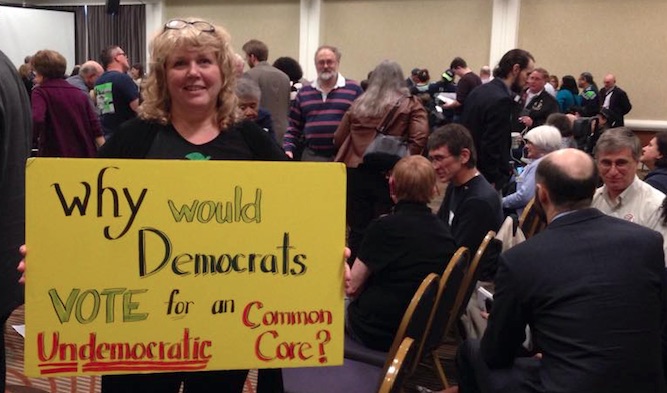
About 150 delegates representing 49 legislative districts, from 29 counties, gathered at the Red Lion Inn in the state capital, Olympia on Saturday, Jan. 24, where there was a showdown between “new Democrats” and a scrappy coalition of education and labor activists. Activists mixed in with the delegates, and carried homemade signs expressing their opposition to the Common Core. They also arrived early and made sure there were flyers on each chair carrying their message.
David Spring is a leader of the Democratic Party for East King County near Seattle. He helped organize for the vote, and says,
This was a huge victory for the children, parents, and teachers of Washington State to have the Washington State Democratic Party – the first Democratic Party in the nation to vote against Common Core. It is our hope is that this is the beginning of the end for Bill Gates in the Common Core scam. This was the grassroots – the rank and file of the Democratic Party – who said NO to Common Core. They deserve all the credit, along with you teacher activists.
Senator Marilyn Chase, reached at her home during the legislative session in Olympia, said she supports the resolution. She explained, “I love kids. I don’t like high stakes testing and I don’t like Common Core.” David Spring said her support was of great value. “Marilyn Chase is a leader of the Washington Democratic Party and she represents North Seattle in the Washington State Senate and this was huge to have Marilyn supporting a resolution.”
Seattle area teacher Susan DuFresne describes how teachers organized for the vote:
We got to speak to the members before the meeting adjourned. We carried our signs around and spoke to members who were on the fence. We also handed out copies of Common Core: Ten Colossal Errors, with “what to do” on the other side. This tipped the scales in our favor.
Three delegates spoke in favor of the resolution, and three against. Brian Gunn, state committee man from 31st legislative district and chair of the Progressive Caucus, speaking to the assembly, said,
We have to take into account corporations are looking at our children as commodities. This is a moral issue. We’re allowing corporations that produce these materials and sponsor these tests to treat our children as sources of income. So I think it is very important that we look at that aspect of this, because everything that is part of the commons — things that everyone needs — is looked at to a large extent as a source of profit. And that source of profit is our own children. What is at stake is their education and their opportunity to have a good life — to make a decent standard of living in their future lives.  We have to see that as a moral issue, and not cede that responsibility away from the place where it belongs, which is hopefully our state schools and our state teachers — and allow THEM to make the choices about what the standards should be (applause).
When the vote was taken, roughly three fourths of the delegates voted in favor of Resolution 707. Below is the text of the resolution that was passed, in its entirety.

Resolution Opposing Common Core State Standards

WHEREAS the copyrighted (and therefore unchangeable) Common Core State Standards (CCSS) are a set of Washington State Democratic Party Committee Votes to Reject Common Core - Living in Dialogue:

“Response to Intervention”—An Excuse to Deny Services to Students with Learning Disabilities? - Living in Dialogue

“Response to Intervention”—An Excuse to Deny Services to Students with Learning Disabilities? - Living in Dialogue:


“Response to Intervention”—An Excuse to Deny Services to Students with Learning Disabilities?


 By Nancy E. Bailey.

Response to Intervention (RTI), the program to identify children with learning disabilities early, was recently described by the Chalkbeat in Tennessee as having problems with implementation. In many places, like Tennessee, RTI has replaced —a model which has been used for years to identify students with learning disabilities, the “discrepancy” model.
The discrepancy model compares a student’s IQ test score (e.g. the WISC-IV) with achievement scores (e.g.,Woodcock-Johnson Achievement Test). A learning disability is thought to exist if the student’s IQ scores are at least two standard deviations (30 points) higher than scores on the achievement test. This indicates a significant discrepancy between the two tests. Consideration of the student’s work in the classroom is also given. All of this usually comes about when the teacher, and/or parent, observes a student experiencing difficulty in school and requests school psychological testing.
RTI uses what’s called a multi-tiered approach to identify students. All students are screened in a serious effort to keep students from special education classes. School districts might use different kinds of formats with RTI, and parents are supposed to be able to request a formal evaluation at any point in the program. Students remain in each tier for a specified amount of time.
Tier 1: Involves regular classroom instruction, repeated screening, and group interventions. Students who do well here go back to doing all regular classwork.
Tier 2: Students, who do not do well in Tier 1, get interventions and repeated screening with small group instruction. This is mostly in reading and math for younger children. Students still get regular class work along with the interventions.
Tier 3: Students get this instruction if they don’t do well in Tier 2. It is more individualized and if they don’t do well at this level they are referred to special education using the information gathered in Tiers 1, 2, 3.
RTI raises many concerns. Some parents worry that RTI winds up denying children with learning disabilities services. One fear is that some parents don’t think they can request an evaluation, or they are led to believe it isn’t necessary.
Two quotes the Chalkbeat provides, by Douglas Fuchs, a respected researcher from Vanderbilt, sum up the controversy surrounding RTI, as I see it.
RTI was introduced to the educational mainstream in 2004, when the Individuals with Disabilities Education Act IDEA—a law meant to protect students with disabilities— was reauthorized. For the first time, RTI could be used to identify learning disabilities. Before that, students were often identified as having a learning disability if there was a large discrepancy between a child’s academic performance and his or her’s (sic) IQ, or “potential.”
First, was IDEA devised to protect students with disabilities? Or, were IDEA re-authorizations more about cutting costs to special education and creating one-size-fits-all schooling? Much of IDEA surrounds concerns that there is an “over-identification” of students for special education. Students in special education are said to cost twice as much as those not in special ed. By putting all students with special needs into the regular classroom (largely what IDEA is all about) special education services for children cost less.
Second, many would say the discrepancy model served students well. So, before foisting RTI on school districts, why weren’t these two methods compared more in serious randomized studies, with small groups in select schools? Such studies take time, but a review of the literature shows few studies before RTI was implemented. Like Common Core, it seems RTI was pushed into school districts before it was proven to be better than the discrepancy model.
Another quote the Chalkbeat uses, also by Fuchs, demonstrates quite clearly the effects of school reform on special education.
This [old] method [he is talking about the discrepancy model] of identifying learning disabilities has always had many critics, and one of the main concerns has “Response to Intervention”—An Excuse to Deny Services to Students with Learning Disabilities? - Living in Dialogue:

Five key questions to ask now about charter schools - The Washington Post

Five key questions to ask now about charter schools - The Washington Post:


Five key questions to ask now about charter schools


You can tell that National School Choice Week is nearly upon us — it runs from Jan. 25- 31 — by the number of announcements coming forth hailing the greatness of school choice.
Jeb Bush’s Florida-based Foundation for Excellence in Education put out an announcement that it would participate in a march next week in Texas to support school choice (with one of the speakers being Texas Land Commissioner George P. Bush, Jeb’s son). There’s a new poll by the pro-choice American Federation for Children showing (I bet you can guess) that most Americans support school choice.  Etc., etc.
There is other school choice news too, but you won’t hear it from the pro-choice folks. This comes from 10th Period blog, by Steven Dyer, a lawyer who is the education policy fellow at Innovation Ohio and who once served as a state representative and was the chief legislative architect for Ohio’s Evidence Based Model of school funding:
In a disturbing new report from State Auditor David Yost, officials found that at one Ohio charter school, the state was paying the school to educate about 160 students, yet none, that’s right, zero, were actually at the school. And that’s just the worst of a really chilling report, which, if the results are extrapolated across the life of the Ohio charter school program, means taxpayers have paid more than $2 billion for kids to be educated in charter schools who weren’t even there.  Here are the takeaways:
  • Seven of 30 schools had headcounts more than two standard deviations below the amount the school told the state it had.
  • Nine of 30 schools that had headcounts at least 10% below what the charter told the state it had, though it was less than two standard deviations.
  • The remaining 14 had headcounts that weren’t off by as much.
  • However, 27 of 30 schools had fewer students at the school Five key questions to ask now about charter schools - The Washington Post:


Join NPE’s letter writing campaign to Sen. Alexander and the HELP Committee The Network For Public Education |

The Network For Public Education | Join NPE’s letter writing campaign to Sen. Alexander and the HELP Committee:


Join NPE’s letter writing campaign to Sen. Alexander and the HELP Committee

Join NPE’s letter writing campaign to Sen. Alexander and the HELP Committee

Urge Sen. Lamar Alexander and the Health, Education, Labor and Pensions (HELP) Committee to put an end to annual standardized testing