Latest News and Comment from Education

Tuesday, September 30, 2014

9-30-14 Hemlock on the Rocks

Hemlock on the Rocks:


Successful Student Remediation Requires Educational Regression
(Mensaje se repite en Español)While some kids will succeed despite the purposeful, generational, and what remains the unaccountable incompetence of LAUSD, the vast majority will predictably never recover. Vacuous rhetoric unsupported by substantive pragmatic programs designed to address the subjective levels of the predominantly minority students are nowhere to be found in LAUSD or inner city dist
Why Teachers' Unions & Due Process Matter - Bridging Differences - Education Week
http://blogs.edweek.org/edweek/Bridging-Differences/2014/09/today_leo_casey_of_the.html?cmp=ENL-EU-NEWS3 Why Teachers' Unions & Due Process Matter Today, Leo Casey of the Albert Shanker Institute joins Deborah Meier on the Bridging Differences blog. Deb: So we begin our conversation with the idea of democracy. It is the pivotal idea in the political heritage we share, as a strong conception


Big Education Ape: Homeless students increase by 58 percent in past six years | Education By The Numbers
http://bigeducationape.blogspot.com/2014/09/homeless-students-increase-by-58.html Homeless students increase by 58 percent in past six years | Education By The NumbersDespite signs of a national economic recovery, homelessness in U.S. public schools steadily increased 8 percent, to 1.26 million students, in the 2012-13 school year from the previous year. That may not sound terrible, but consider
Los Angeles, a city of poverty and unemployment - World Socialist Web Site
http://www.wsws.org/en/articles/2014/04/15/losa-a15.html Los Angeles, a city of poverty and unemployment   By Gabriel Black 15 April 2014 On Wednesday, the second part of the Los Angeles 2020 Commission report was published. The report, taken together with its December 2013 predecessor, lifts the lid on the brutal, crushing conditions facing workers in the second largest city in the US. In its

YESTERDAY

Los Angeles and the Endless Saga of Dr. John Deasy | Diane Ravitch's blog
http://dianeravitch.net/2014/09/29/los-angeles-and-the-endless-saga-of-dr-john-deasy/Whose the boss?  Los Angeles and the Endless Saga of Dr. John Deasy Los Angeles' school politics is beginning to sound like a soap opera. Tune in next week to see if long-suffering Superintendent John Deasy, much admired by billionaire Eli Broad, survives yet oanother unjust attack at the hands of the brutes who
LAUSD keeps no written records of Deasy performance reviews
http://laschoolreport.com/lausd-keeps-no-written-records-of-deasy-performance-reviews/ LAUSD keeps no written records of Deasy performance reviews Superintendent John Deasy As the LA Unified school board prepares to meet privately tomorrow to discuss how to evaluate Superintendent John Deasy in his performance review next month, it might be instructive to have a look at the board's previous evalu
Attorney Alleges Possible Tampering By LAUSD In Miramonte Civil Suit
DEASY and NEWTON'S TWISTED FACTS
Deasy and Newton’sTwisted FactsAgain, the LA Times shows it’s bias in downplaying Superintendent John Deasy’s many failures and mismanagement which has cost taxpayers multi millions of wasted money. Newton sloughs over the iPad potential collusion, now visible with reports of two year old emails between Apple and Pearson, and Deasy and Aquino. But he also avoids the huge failure of the doomed MiSi


9-29-14 Hemlock on the Rocks
Hemlock on the Rocks: Big Education Ape: LAUSD spends like Billionaires while being a Tyrant about Teacher’s Salaries - Lydia Gutierrezhttp://bigeducationape.blogspot.com/2014/09/lausd-spends-like-billionaires-while.html LAUSD spends like Billionaires while being a Tyrant about Teacher's Salaries - Lydia Gutierrez Lydia Gutierrez: LAUSD spends like Billionaires while being a Tyrant about Teacher's


9-30-14 Perdido Street School

Perdido Street School:


Note To George Pataki: No One Cares If You Run For President
This is too funny:Former NY Governor George Pataki is privately gearing up for a 2016 presidential run, according to sources, and was spotted meeting GOP kingmaker David Koch last week. New York Republican Pataki has been publicly noncommittal about if he was leaving the door open for a run, telling Newsmax TV’s Steve Malzberg in August, “It’s still summer,” while bashing the current administratio


Could There Be Anything Crazier Than Expecting Rich People Like Bill Gates To Save Us?
Bill Gates does a lot of destruction in education by throwing around a ton of money to push through changes he thinks will make a difference in schools - teacher evaluatinos tied to test scores and Common Core are two examples.But the destruction Gates wreaks is not limited to education - he's doing it to the environment too:Billionaire philanthropist Bill Gates has been supporting a wide array of

Oprah Loves "Warriors"
Associated Press today: SYRACUSE, N.Y. (AP) -- Oprah Winfrey is donating $100,000 to a youth center on the south side of Syracuse.Winfrey made a surprise stop Monday at the Mary Nelson Youth Center and said she was writing out the check on the spot. She called Mary Nelson a "community warrior" for doing the work she does on the city's crime-ridden south side, part of which borders Syracu

9-29-14 Perdido Street School
Perdido Street School: Bill Gates Has Some Lessons Leadership For YouGreat start to week breakfast with @BillGates in DC #LessonsFromLeaders ... the ultimate thought-leader— Nick Owens (@MSPLLC) September 29, 2014Lesson #1:Only listen to yourself. No one else knows anything but you.Lesson # 2:Have more money than God so you don't have to listen to anybody else.Lesson #3:Be as ruthless in business


How college ed programs try, fail to recruit teachers of color | The Hechinger Report

How college ed programs try, fail to recruit teachers of color | The Hechinger Report:


How college ed programs try, fail to recruit teachers of color

Only radical new engagement strategies can end racial disparity

By
Nationally, black males account for 2 percent of the teacher population. Blacks in total represent 8 percent of all teachers; Latinos, 7 percent; and Asians, 2 percent. My 3-year-old son could have approximately 50 different teachers by the time he graduates from high school. How many times should he expect to see an African American male teacher before graduation? This is a “Common Core” question I struggle with.
In a seminar titled, “How Do We Get More Black Male Teachers in America’s Classrooms?” At the Congressional Black Caucus Foundation’s 44th Annual Legislative Conference in Washington, D.C., an audience member asked, “Are colleges even recruiting black male teachers?” As someone who is charged with building a teacher prep program, I can say most universities aren’t built to recruit from black communities.
Black and brown people represent 30 percent of the population. But they represent 15 percent of teachers, and that figure is in decline. Woodrow Wilson reports that if current trends hold, the percentage of teachers of color will fall to an all-time low of 5 percent by 2020. But today for the first time in American history, the majority of public school students are of color.
Diversity matters when it comes to learning. Ethnic minorities benefit from seeing teachers who share similar backgrounds. This reality motivated the Center for American Progress to create their DiversityIndex, which “ranks states on the percentage-point difference between teachers of color and students of color.” But everyone benefits from seeing authentic teaching and learning come from all walks of life. Even though we should all have diverse teachers in our lives, most of us don’t.
The days of recruiters waiting for aspiring teachers to willingly hand over their tuition in exchange for a certificate are over. If we want teachers of color, colleges are going to have to recruit outside their social networks. Meaning, we really have to recruit.”
Before explaining the lack of infrastructure to recruit black teachers, I must assert an extraneous but important claim. Students are more likely to become teachers if they’re treated with respect while in school. If racial disparities in suspension and expulsion provide indications of preferential treatment, then our teacher recruitment strategy should include “discipline” reform. Unfortunately, schools are a negative flashpoint in many black children’s lives. In addition, a lack of school quality makes it more difficult for aspiring teachers to meet the ever-increasing academic requirements to enroll in programs. Students’ educational experiences will influence future career decisions.
Click to read more columns.
The Council for the Accreditation of Teacher Preparation (CAEP) and organizations like Teach for America have certainly raised the bar for entry into the profession. A college 3.0 GPA has become standard. Again, if students aren’t prepared at the secondary and postsecondary levels, then they won’t be able to pass required tests for How college ed programs try, fail to recruit teachers of color | The Hechinger Report:

A #Commoncore Twitter Play | Missouri Education Watchdog

A #Commoncore Twitter Play | Missouri Education Watchdog:


A #Commoncore Twitter Play

twitter play
Pass the popcorn.

CAST:
Common Core Proponents (Supported by Tax Dollars and Special Interest Groups):
  • Missouri Department of Elementary and Secondary Education, State Education Agency,Jefferson City, MO dese.mo.gov
  • Robert Pondiscio, Senior Fellow @ Fordham Institute; senior adviser @democracyprep. K-12 education, literacy, civics and citizenship
  • EdProgress, Center For American Progress Education Policy Team
    Washington D.C.
Common Core Opponents (Unpaid writers/researchers and taxpayers concerned about private non governmental organizations developing/directing public education with no accountability):
Scene: Critique of pro Common Core kindergarten math video published on twitter.
Location: Twitter
Act I:
Missouri DESE retweets Robert Pondiscio’s  modified tweet from EdProgress containing a video produced by Center for American Progress on ‘what Common Core means for students’.  EdProgress asks for questions.

missouri dese center for american progress
 The video link is here.
Act II:
Questions are asked for, so I ask one.  Simple, right?  I ask Susan and AP if they know if Pondiscio and EdProgress are connected financially with special interest groups funding the standards that just ‘might’ taint their support.  They do know the answer:

pondiscio twitter convo
Scene III:


Crickets from Mr. Pondiscio, Missouri DESE and EdProgress regarding  question about the financial support and/or grants these organizations have received from special interest groups. Maybe Mr. Pondiscio’s previous tweet explains and represents the silence from the well funded A #Commoncore Twitter Play | Missouri Education Watchdog:

Ohio’s Plunderbund Examines Correlation of School District Ratings with Family Income | janresseger

Ohio’s Plunderbund Examines Correlation of School District Ratings with Family Income | janresseger:


Ohio’s Plunderbund Examines Correlation of School District Ratings with Family Income

For many years Ohio has used a Performance Index to judge its school districts.  The Performance Index is a formula based primarily on standardized test scores.  Not too long ago at a meeting, when someone pointed out that the Performance Index seems to reflect family wealth and may not, in fact, represent school quality, an expert responded that we pretty much have to use the Performance Index as an indicator of school quality in Ohio because it is really the only long standing, reliable indicator we have.  I wondered about this at the time.  A rating system that is wrong and that unfairly assigns blame, however handy, doesn’t seem to me to be a good tool to use.
(Of course there is also the question about why we are creating a competition in the first place—ranking and rating school districts when they serve different children and they are located in different kinds of communities.)
Finally this year people are paying more attention to how Ohio’s school district performance ratings are calculated, because Ohio is in the process of moving from a ranking of “Excellent, Effective, Continuous Improvement, Academic Watch and Academic Emergency” to a more damning system for many school districts—A, B, C, D, and F.  Many of the school districts caught in the “Continuous Improvement” range have been able to benefit from the quaisi-positive frame of that term.  Now some of those supposedly “C” school districts will fall to the D or F category.  And the stakes are high.  Last week this blog (here) quoted a statement from a 2005 National Council of Churches document that clarifies one of the serious consequences in actual practice of evaluating schools and school districts by students’ test scores, a practice codified in 2002 in the federal testing law No Child Left Behind: “The No Child Left Behind Act exacerbates racial and economic segregation in metropolitan areas by rating homogeneous, wealthier school districts as excellent, while labeling urban districts with far more subgroups and more complex demands made by the law as ‘in need of improvement.’ Such labeling of schools and districts encourages families with means to move to wealthy, homogeneous school districts.”
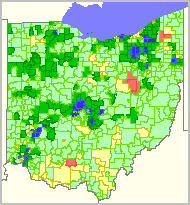
Over the weekend the Columbus, Ohio blog Plunderbund published an investigation of the meaning and impact of Ohio’s Performance Index.  Plunderbund concludes: “If you live in the vast majority of Ohio’s communities (92.7%) where the median income is less than $45,000, your school district has less than 1% of a chance at receiving an A on John Kasich’s report card… Nine years’ worth of data appear to reveal that the best way to improve student test scores is to increase the community’s income.  So we must ask ourselves—What are Ohio’s Ohio’s Plunderbund Examines Correlation of School District Ratings with Family Income | janresseger:

Mike Klonsky's SmallTalk Blog: Philly's cancerous approach to school funding

Mike Klonsky's SmallTalk Blog: Philly's cancerous approach to school funding:


Philly's cancerous approach to school funding


As if making schools dependent on property taxes wasn't bad enough, now Philadelphia Public Schools will have to rely on cigarette sales just to make it through the year. Without the regressive $2-a-pack cigarette tax increase passed by the legislature and signed by Gov. Corbett last week, the city schools and schools throughout the state are facing more draconian cuts in October. Much of the revenue generated by the new tax will be used to expand the already swelling ranks of privately-run charter schools in the city.

This from The Philadelphia Public School Notebook:


 Something is seriously wrong with this picture. Pennsylvania is not a poor state and is situated in one of the richest countries in the world. But many districts can’t provide our children with school personnel we once took for granted. Not to mention books, technology – and in some cases, soap and toilet paper.
That’s not just a Pennsylvania problem. The United States is unusual among industrialized countries in having it backward: We spend the fewest education dollars on the neediest students. If we want to spend tax dollars wisely and get results, we need to flip that script.
Three years of Rahm is enough... Andy Shaw, President & CEO of the BGA, tries to give a balanced assessment of the mayor's first three years. But he can't help conclude that Rahm's positives are mostly "low-hanging fruit" with "limited progress on the more daunting Mike Klonsky's SmallTalk Blog: Philly's cancerous approach to school funding:

Teachers' Unions, Democracy, & Risk-Taking - Bridging Differences - Education Week

Teachers' Unions, Democracy, & Risk-Taking - Bridging Differences - Education Week:


Teachers' Unions, Democracy, & Risk-Taking

Deborah Meier continues her conversation with Leo Casey today. 
Dear Leo (and Readers),
Yes, indeed, democracy is nonnegotiable, except ...  democracy is a constant negotiation, a balancing act, which never gets it quite right. 
The role of labor unions is a fundamental part of that balancing act. Nothing can replace it—as you rightly take note. It is a fundamental foundation of democracy, as long as there is labor to be done.
But  democracy is not a recipe that can be followed whether we are talking about schools, governments, or unions. And at times there are difficult choices—trade-offs—to decide between. For example, how do we create schools that represent democratically the views and votes of all their essential constituents, the parents who send their kids to them, the citizens who fund them and who are affected by their work, the staff of the school—professionals and nonprofessionals—and, of course, students of varying age, expertise, and wisdom. Who should decide who serves as principal?  They each have a strong case to make on their important and essential role. Yet ...  
How do we respond if the citizens supporting the school want to teach ideas and engage in practices that we think undermine democracy—not to mention just plain good sense? (Re. climate change, evolution, religious dogmas, historical "truth," etc.) What about when professional teachers decide to use the school to promote their own ideological message—even one you and I might agree with, Leo?
We struggled with each and every one of these points in creating the governing rules of Mission Hill School, the only school I was part of that had the official/legal freedom to carry out some pretty far-out ideas. We did it more informally at Central Park East, and somewhere in between informal and formal at Central Park East Secondary School where, like Mission Hill, we wrote out our agreements as faculty and signed them (or revised them) annually, and distributed them to all parents and other interested parties.
At Mission Hill we also created a semi-powerful board of directors that gave substantial power to each constituency. The latter with both the union's blessing and management's. In fact, all these schools (and the many others they spawned in New York and around the nation) had the support of their teachers' unions and some level of support from the city government—to truly break old molds. Yet  each chose somewhat different trade-offs, and all did so in the name of democracy. Is that OK?
The unions I've belonged to and supported faced the same dilemma, and the teachers' unions have hardly been the worst examples when it comes to trade-offs.  We know that many unions, like Teachers' Unions, Democracy, & Risk-Taking - Bridging Differences - Education Week:

Teaching U.S. History in a Failing School (Part 2) | Larry Cuban on School Reform and Classroom Practice

Teaching U.S. History in a Failing School (Part 2) | Larry Cuban on School Reform and Classroom Practice:


Teaching U.S. History in a Failing School (Part 2)

How to interpret the three history lessons I watched Mark Allison, a veteran teacher, teach?
Allison had prepared an interactive lesson with a series of slides on the Civil Rights movement. He asked his students to inspect each slide carefully and tell what they saw and speculate, alright hypothesize, about what the facts they see may add up to. He completed the lesson within the 40 minutes allotted to him in the bell schedule.
The lesson reflected his passion for the subject (a glass case filled with civil rights photos along one wall of the room) and for his students (one wall of student photos in  his classes). Before during and after the lesson, students responded to his requests and questions.  Students did engage in the activities he designed for them. At no time in any of the three lessons I observed were students defiant, unresponsive, or dulled into inactivity. The rapport between teacher and students as he went through the lesson prodding them to apply their present experiences to the past was evident to me.
Were there someone else in the room besides me, say, the principal, a district official, or another teacher there to judge his performance, surely that evaluator could find items to praise and holes in how and what Allison taught in these three lessons.
Perhaps, that observer might have assessed Allison’s performance in the way that Becky Reed, a Delaware social studies teacher did in a comment for this post:
I think this represents exactly how I would have taught a lesson 25 years ago (okay, maybe 15). I would have been very proud of the activity that took me an entire evening to create, time that I could have spent with my family. In reflection (then) I would have thought the lesson was a success; students were engaged, discussion in small groups was apparent, primary sources were used, and students “got” that the Civil Rights Era was about freedom and equality.Sadly, I think that many administrators would have rated this lesson as an Teaching U.S. History in a Failing School (Part 2) | Larry Cuban on School Reform and Classroom Practice:

NYC Educator: What Does UFT Leadership Stand For?

NYC Educator: What Does UFT Leadership Stand For?:


What Does UFT Leadership Stand For?


We know that President Michael Mulgrew loves Common Core, because he clearly stated he'd punch anyone who tried to take it away from him. He then ridiculed those who said Gates had anything to do with it, though Gates clearly pumped hundreds of millions into it, several in the direction of teacher unions. While ridiculing Gates' involvement was juvenile and absurd, and while the overwhelming majority of New Yorkers disagree with Mulgrew, at least we know it's something he stands for.

Does leadership stand for parity with other city unions? Apparently not, since they all got raises in 2010, and it's OK for UFT members to wait until 2020. Perhaps leadership feels money is worth the same in 2020 that it is in 2010. Although a dispirited membership swallowed this contract, not everyone concurs. In fact, I just bought a car, and when I asked the dealer if I could put off payment interest-free until 2020, he didn't see it as a viable option. I won't publish his precise remark here, as this is a family blog.

Does leadership stand for unity, as in union? I'm gonna have to say no, since very worst aspect of the new contract is limited due process for ATR teachers. While Mulgrew stood up and said some teachers complained 3020a took too long, no one I know who's gone through it has complained he or she was given too much time to present a defense. ATR teachers will get one day, and according to Mulgrew, they can face dismissal if two principals complain they were shouting in the hall.

Does leadership stand for rational argument? I'm gonna have to say no, since the contract was sold largely via logical fallacies. One of the questioners at the DA (one who Mulgrew did not shout down), after telling Mulgrew what a swell guy he was, asked what would happen if the contract were not approved. Mulgrew launched right into an oft-repeated appeal to fear, that we'd have to get in line behind 150 other unions. He neglected to point out that would not be the case if he had not negotiated such a substandard contract.

A popular argument to those of us who opposed the contract was that we opposed teacher empowerment. That's a classic strawman and it's ridiculous. We opposed precisely what I said we opposed, and no matter how many committees there are to negotiate how junk science and teacher detention are conducted, those were the more pressing issues.

Does leadership stand for placing ATRs back in the classroom? A ten year contract suggests otherwise. Does leadership stand for ATRs having a NYC Educator: What Does UFT Leadership Stand For?:

Brown wraps up ed bills, leaves some heads shaking :: SI&A Cabinet Report

Brown wraps up ed bills, leaves some heads shaking :: SI&A Cabinet Report :: The Essential Resource for Superintendents and the Cabinet:


Brown wraps up ed bills, leaves some heads shaking


Brown wraps up ed bills, leaves some heads shaking


(Calif.) Gov. Jerry Brown has vetoed a bill that would have made kindergarten mandatory while at the same time signing one intended to show the overwhelming boost that optional year gives kids headed to first grade.
It has been a busy few days for the governor, reviewing hundreds of pieces of legislation – including a stack of education bills – requiring his approval by the end of today.
Those he signed into law over the weekend and Monday include one that removes “willful defiance” as a reason to suspend or expel a student, and another that adds sex trafficking prevention education to the K-12 health curriculum.
Brown also vetoed a plan to allow districts to include sports participation data in their accountability plans as evidence of good school climate. But it is his rejection of Democratic Assemblywoman Joan Buchanan’s AB 1444 – the mandatory kindergarten bill – that is likely to generate more disappointment given the overwhelming sentiment behind it.
“Most children already attend kindergarten, and those that don’t may be enrolled in other educational or developmental programs that are deemed more appropriate for them by their families,” Brown wrote in his veto message. “I would prefer to let parents determine what is best for their children, rather than mandate an entirely new grade level.”
The call to make kindergarten compulsory for all California students before they can enter first grade is part of a broader push to beef up all early learning programs, both here and across the nation.
Buoyed by reams of evidence that the education a child receives in the first five years of life is critical to his or her future success, leaders from President Barack Obama to governors and state legislators have launched initiatives aimed at providing high-quality early learning opportunities to every child from birth to age five.
Current law requires that everyone between the ages of six and 18 attend school full-time. AB 1444 would have maintained the age-eligibility condition, meaning a parent could wait until their child turned six to enroll him or her in school, but that six-year-old would have to start in kindergarten – something opponents of the bill argued would be detrimental to children.
The bill would have affected a relatively small number of students. The California Department of Education estimates that only 28,000 students enrolled in first grade in the 2011-12 school year – 5.7 percent of all first graders – didn’t attended kindergarten the prior year.
Brown did sign, however, AB 1719, by Assemblymember Shirley Weber, D-San Diego, which requires public school agencies, beginning next school year, to “provide an annual report to the State Brown wraps up ed bills, leaves some heads shaking :: SI&A Cabinet Report :: The Essential Resource for Superintendents and the Cabinet:


Yoga benefits the whole student
(Calif.) What many children’s yoga instructors call the “frog pose” tones young legs, increases hamstring flexibility and improves heart health. It’s also just one of a number of poses a student may learn during yoga sessions springing up in classrooms across the country.

Evaluating Gates via His Microsoft Failure | deutsch29

Evaluating Gates via His Microsoft Failure | deutsch29:


Evaluating Gates via His Microsoft Failure

September 30, 2014


Billionaire Bill Gates has been buying his version of American public education for years now. His first major *reform* effort began in 2000 and involved chopping large urban high schools into smaller schools. It was his solution of choice for several years.  He abandoned the idea in 2006 after it had been found “less successful than hoped” according to the Seattle Times. (Documented in chapter 23 of A Chronicle of Echoes and also discussed in this post.)
For Gates, the small schools failure was an inconvenience and a disappointment. (He wanted to “scale” the results.) For the school districts left holding the bag, it was incredibly disruptive.
Gates actively advances a spectrum of so-called reforms that interest him, including grading teachers using student test scores (in order to dump the “ineffective” teachers), merit pay, increased class sizes, longer school day and year, data systems to “track progress,” charter school fondness, and, of course, “fewer, clearer, higher standards”–an idea Gates publicly advanced in November 2008, in the months following his decision to bankroll the Common Core State Standards (CCSS) because Council of Chief State School Officers (CCSSO) President Gene Wilhoit and CCSS “lead architect” David Coleman asked Gates to pay for it.
Interestingly, Gates notes the “need” for CCSS as a “standard” for grading teachers:
The first step in identifying effective teaching has to be setting fewer, clearer, higher standards that are aligned with the goal of graduating students from high school college-ready. You can’t compare teachers if they’re not pursuing a common standard.[Emphasis added.]
Must I write how stupid this idea is?
Teachers do pursue “common standards” in teaching students. It’s just that such “common standards” are often of a higher order that tends to defy quantification. Included among them are teaching and learning for the sheer joy of it and equipping students to make choices that might lead to a self-fulfillment that leads, in turn, to students becoming productive, engaged members of society.
Profit-grabbers like Pearson cannot test such lofty goals.
Nevertheless, billionaire boy Bill is only interested in that which might be quantified– but only as such lends support for his own preferences. Consider this statement from the same November 2008 speech linked above:
A good education means completing a postsecondary degree.
Gates did not complete a postsecondary degree. However, he has determined that this narrow view of “a good education” must apply to all others.
Gates continues in his speech by stating, “we are determined to follow the evidence.” Evaluating Gates via His Microsoft Failure | deutsch29: