Latest News and Comment from Education

Thursday, September 18, 2014

The Feds Bypass the State and Come Directly to Districts Asking Them To Commit To Federal Goals | Missouri Education Watchdog

The Feds Bypass the State and Come Directly to Districts Asking Them To Commit To Federal Goals | Missouri Education Watchdog:


The Feds Bypass the State and Come Directly to Districts Asking Them To Commit To Federal Goals

Flock of sheep, New Zealand, Pacific
Someone please sign everyone at the USDoEd up for a refresher course on the constitution. They are really struggling with the concept of the 10th amendment.
The latest from Arne Duncan et al continues the tradition of the federal government inserting its nose into local school district decisions which the constitution does not allow for and ESEA expressly forbids. They are now going directly to local school districts and asking 16,000 Superintendent across the country to sign THEIR Future Ready technology pledge.
From the letter sent to Superintendents,
The U.S. Department of Education seeks to encourage and support superintendents who commit to taking a leadership role in this transition with recognition and resources to help facilitate this transition to digital learning.
The main goal of this initiative is to get districts, charters and private schools to commit to maximizing their use of digital learning and broadband access to the internet. They want schools to fund the resources necessary to “leverage their maximum impact on student learning… to develop the human capacity, digital materials, and device access to use the new bandwidth wisely and effectively.” In other words, buy more devices so you can meet our Race To The Top goal of 1:1 student:device ratio so you can purchase more digital learning services and supplies. They have a lot of high powered (well funded) friends of Washington who produce educational supplies and services who need to be repaid for helping get the right people in office so the bureaucrats could get an appointment.
They want districts to “transition to effective digital learning,” to “achieve tangible outcomes for the students they serve.” So here we all still are on the outcomes based education bandwagon.
It’s a nice little system. Millions of students with no other education option, will be pushed into using a private company’s product which will in turn continuously collect data on their use to improve said product. And who benefits from this? The private company. How many of our Superintendents will gladly be team players and sign this little pledge without any careful consideration of the costs of such an action? If history is any example, it unfortunately will be many (see photo above.)


Among other things, the pledge commits districts to helping support home internet access. Since when is this the job of a school district? If it is, then shouldn’t they also support efforts to get every child a nice desk and chair at which to study? Shouldn’t they also be in the business of making sure every child has a nice bed since sleep is critical to learning readiness? Where does the school district’s responsibility end when it comes to a child’s education? And since when is it the job of the education department of the federal government to make sure that internet is available in the The Feds Bypass the State and Come Directly to Districts Asking Them To Commit To Federal Goals | Missouri Education Watchdog:

Washington State Supreme Court Holds Legislature In Contempt Over School Funding | janresseger

Washington State Supreme Court Holds Legislature In Contempt Over School Funding | janresseger:


Washington State Supreme Court Holds Legislature In Contempt Over School Funding

Too frequently, even after a state supreme court finds the state’s school funding system unconstitutional, nothing much happens.  My state Ohio is the extreme example.  Three times the supreme court found Ohio’s school finance unconstitutional.  Then a fourth time the court spoke, reiterating that the system is unconstitutional but releasing jurisdiction in the case.  This meant the legislature no longer had an obligation to design a remedy.  Although the court found for the plaintiffs, nothing happened and nothing ever will.
Washington  state’s supreme court is taking a very different path.  In January of 2012 in what is known as the McCleary case, the state’s supreme court ruled in favor of the parent plaintiffs, and in the words of Joseph O’Sullivan of the Seattle Times, “ordered the state to increase education spending enough to fulfill the Washington state Legislature’s own definition of what it would take to meet the state constitution’s requirement of providing a basic education to all Washington children.”
Last week, on September 11, 2014, Washington’s supreme court spoke again to scold the legislature for dragging its feet.  In the original 2012 McCleary decision, the court gave Washington’s legislature what seemed like plenty of time to phase in a remedy—until the 2017-2018 school year, but the supreme court retained jurisdiction in the interim.  Last week the supreme court held the state legislature in contempt for failing to institute a time line that will ensure schools are fully funded by 2018.  The court has now given the legislature an ultimatum: get a remedy well underway by next year.  The Associated Press reports, “The court promised to reconvene and impose sanctions and other remedial measures if lawmakers do not make plans to solve the problem,” by the end of the legislative session in 2015.
Here is how—in the 2012 McCleary decision itself— the state’s supreme court justicesinterpreted the language of the education clause of Washington’s constitution.  Education spending must be “ample.”  “The word ‘ample’ in article IX, section 1 provides a broad constitutional guideline meaning fully sufficient, and considerably more than just adequate.  Ample funding for basic education must be accomplished by means of dependable and regular tax sources.  The State has not complied with its article IX, section 1 duty to make ample provision for the education of all children in Washington.”
The Associated Press reports that the legislature added $1 billion to the school fund in the recent budget, but cost studies that were the basis of the original McCleary decision indicated that the budget needs to be roughly $4 billion annually above the 2012 expenditure level.According to the Education Law Center, “Underfunded educational resources that the Washington State Supreme Court Holds Legislature In Contempt Over School Funding | janresseger:

Tom Hayden, counterculture icon, invites public to dig into his archives | Al Jazeera America

Tom Hayden, counterculture icon, invites public to dig into his archives | Al Jazeera America:


Tom Hayden, counterculture icon, invites public to dig into his archives

Cache includes 22,000 pages of FBI files showing government surveillance of him and Jane Fonda
ANN ARBOR, Mich. – The man regarded as the intellectual father of the 1960s is opening up his archives in what historians of modern America regard as one of the most important document dumps in recent times, and one that breaks a tradition in which monumental public figures wait until they are dead to show the world the personal papers, diaries and mementos of their most tumultuous times.
This week, the University of Michigan has been hosting alumnus Tom Hayden, now 74, for a series of events that culminate in a celebration on Thursday to mark the delivery of more than 120 boxes of material that historians and journalists will likely spend generations exploring for insights into the making of that all-important epoch of social and cultural upheaval.
Among the key caches in the bequest are more than 22,000 pages of FBI files showing the government’s exhaustive 15-year surveillance of him and his then-wife Jane Fonda as well as the bureau’s often ham-handed attempts to create rifts between Hayden’s circle and other prominent civil rights groups such as the Black Panthers. Hayden obtained the files in the mid-1970s after successfully suing the government on grounds that they had been illegally monitoring his actions.
Tom Hayden, Cesar Chavez (United Farmworkers Union), and Ken Msemaji (Nia Cultural Organization) leading the march of the 10th annual Malcolm X Kuzaliwa (birthday) celebration, May 1977
Tom Hayden (from left), Cesar Chavez and Ken Msemaji lead the march of the 10th annual Malcolm X Kuzaliwa celebration in May 1977.
 Tom Hayden Papers / University of Michigan
“Tom is one of the great figures of the 20th century,” said Maurice Isserman, a history professor at Hamilton College in New York and author of several books on the era including “America Divided: The Civil War of the 1960s.” “He was absolutely formative in the early 1960s. I will be fascinated to see the archives, and it is wonderful to have them while he’s still alive.”
Hayden burst onto the national stage in the early 1960s as the primary drafter of the Port Huron Statement, a 25,000-word manifesto published in 1962 that laid out the goals of the then-budding student protest movement. He went on to become a leading voice opposing the Vietnam War, making several controversial visits to North Vietnam during the conflict. As a key organizer of student protests in Chicago outside the 1968 Democratic National Convention, Hayden was convicted of inciting violence, but the conviction was later overturned.
He also is the author of 20 books on social issues, and served 18 years in the California Legislature where he championed immigration rights, climate change and animal welfare. He ran unsuccessfully as the Democratic nominee for Los Angeles mayor and lost a close primary battle to unseat a sitting Democratic U.S. senator. As recently as last week, Hayden weighed in on current events in an essay for the San Francisco Chronicle in which he criticized President Barack Obama for not offering an exit strategy in his speech on the U.S. counterattack on ISIL.
“I can’t wait till after I’m dead [to make the archives public],” Hayden said in a phone interview from California last week in advance of his appearances in Ann Arbor. “A lot of this stuff was molding or on the verge of molding. It occurred to me it would be important to turn it over to some responsible researchers and archivists while I am alive and alert because it would help me go through it and share what is there with others, with professors, graduate students, with interested undergraduates.”
a cartoon the FBI created and planned to distribute to incite dissension between the New Left and the Black Panthers. There's a letter there from Hayden's FBI files that's an FBI memo explaining why they didn't go through with it.
Hayden's archives include a cartoon the FBI created and planned to distribute to incite dissension between the New Left and the Black Panthers, and an FBI memo explaining why they didn't go through with it.
 Taoli Zhang
University of Michigan special collections curator Julie Herrada, who is overseeing the organization and management of the Hayden material, said Hayden’s availability to explain his own archives is unusual. “He’s also young enough to still come and actively engage and work with students regarding the papers,” she said, “[to] have them see the historical artifacts and talk to the person who created them.”
Indeed, Hayden insisted on it.
As part of his arrangement with UM, he will receive $200,000 over the coming four years to visit the campus and work with both archivists and students. Hayden said he also insisted that the UM collection, which primarily focuses on social movements, also accept his papers from his time as a California legislator so that his Tom Hayden, counterculture icon, invites public to dig into his archives | Al Jazeera America:

Shanker Blog » Regular Public And Charter Schools: Is A Different Conversation Possible?

Shanker Blog » Regular Public And Charter Schools: Is A Different Conversation Possible?:


Regular Public And Charter Schools: Is A Different Conversation Possible?

Posted by  on September 18, 2014


Uplifting Leadership, Andrew Hargreaves’ new book with coauthors Alan Boyle and Alma Harris, is based on a seven-year international study, and illustrates how leaders from diverse organizations were able to lift up their teams by harnessing and balancing qualities that we often view as opposites, such as dreaming and action, creativity and discipline, measurement and meaningfulness, and so on.
Chapter three, Collaboration With Competition, was particularly interesting to me and to our series, “The Social Side of Reform.” In that series, we’ve been emphasizing the value of collaboration and have considered extreme competition to be counterproductive. But, is that always the case? Can collaboration and competition live under the same roof and, in combination, promote systemic improvement? Could, for example, different types of schools serving (or competing for) the same students work in cooperative ways for the greater good of their communities?
Hargreaves and colleagues believe that establishing this environment is difficult but possible, and that it has already happened in some places. In fact, Al Shanker was one of the first proponents of a model that bears some similarity. In this post, I highlight some ideas and illustrations from Uplifting Leadership and tie them to Shanker’s own vision of how charter schools, conceived as idea incubators and, eventually, as innovations within the public school system, could potentially lift all students and the entire system, from the bottom up, one group of teachers at a time.
The London borough of Hackney is one of the most deprived communities in the United Kingdom but, according to Hargreaves and colleagues, it may have a thing or two to teach us about “how to create collaborative relations among schools that compete” (Page 79). In 1999, the district was declared the worst in the country and in 2002 its administration was transferred to a private nonprofit called The Learning Trust. Over the following ten years, Hackney seemed to get better; what did the Trust do that might have facilitated such improvement?
One of the Trust’s more controversial moves was to build five new secondary school academies — similar to US charter schools. Organizing public education on the principles of competitive markets between individual schools, without local control, in a bid for parent customers, has often created cultures that focus on “my child,” “my class” and “my school” with not thought for anyone else’s child, class, or school. So the Hackney Learning Trust insisted that the academies protect and strengthen Hackney’s educational community — not undermine it.

(…) The schools had to be non-selective and a member of the family of Hackney schools. The point was to ensure that people should have an allegiance to Hackney’s community and its children — to a purpose that was bigger than their own self-interest. (…)”
To operationalize the notion of shared responsibility, educators established school-to-school networks or federations. This structure facilitated productive behavior, such as drawing on shared resources to help struggling schools. For example, two principals from high performing schools assumed joint leadership of a third low performing school, Holy Trinity. This meant they could switch teachers to coach their peers at Holy Trinity and that they could bring teachers from Holy Trinity to the other two schools so that they could see examples of good teaching.
But, as Hargreaves notes, examples like this are rare in the United States:
Neighboring public and charter schools are usually in competitions with each other for students and sheer survival. (…) On the benefits of school-to-school

Shanker Blog » Regular Public And Charter Schools: Is A Different Conversation Possible?:

Wednesday, September 17, 2014

Majority of Newark board promises legal action against Cami | Bob Braun's Ledger

Majority of Newark board promises legal action against Cami | Bob Braun's Ledger:


Majority of Newark board promises legal action against Cami

Share on FacebookTweet about this on TwitterEmail this to someoneShare on LinkedInShare on Google+Share on StumbleUpon
Newark school board members Marquis Lewis-Aquil, Donald Jackson, Antoinette Baskerville-Richardson and Ariagna Perello at Wednesday night's press conference.
Newark school board members Marquis Lewis-Aquil, Donald Jackson, Antoinette Baskerville-Richardson and Ariagna Perello at Wednesday night’s press conference. Deborah Gregory Smith, head of the Newark NAACP, looks on.

Seven of the nine members of Newark’s elected school board said they would go to court to seek the end of the city’s school reorganization plan known as “One Newark,” the dismissal of state-imposed school superintendent Cami Anderson, and the return of local control of a district seized by the state in 1995.  The board members contend Anderson has violated both school board policy and fire safety codes.
“We will not wait until they destroy Newark’s public schools, ” declared Ariagna Perello, the vice chair of the school board in a new conference on the steps of City Hall.
Four other board members–Antoinette Baskerville-Richardson, Philip Seelinger, Donald Jackson, and Marquis-Aquil Lewis–joined in the news conference. Statements in support of the board action by members DeNiqua Matias and Kahlil Rashidi were read by Perello.
Board president Rashon Hasan, viewed as an Anderson ally, and  member Rashied McCreary did not join their colleagues in condemning the superintendent and the man who appointed her,  Gov. Chris Christie. McCreary is a teacher at the KIPP charter school chain; charter schools have been major beneficiaries of the public school closing and  student dispersal plan Anderson called “One Newark.”
The board members, led by Perello, expressed increased frustration with the chaos that attended the opening of school under the “One Newark” plan earlier this month. She cited the problems at Barringer  High School where many Majority of Newark board promises legal action against Cami | Bob Braun's Ledger:

#optout #refusethetest without Fear of Federal Penalty to Your School - UNITED OPT OUT: The Movement to End Corporate Education Reform

#optout #refusethetest without Fear of Federal Penalty to Your School - UNITED OPT OUT: The Movement to End Corporate Education Reform:


#optout #refusethetest without Fear of Federal Penalty to Your School

fairtest logo

The following document is courtesy of Fairtest.  A big thank you to Monty Neill, Lisa Guisbond and Bob Schaeffer for their collaboration as we work together to take down corporate education reform.

Rubber Room is Death Row southbronxschool

http://www.southbronxschool.com:


Rubber Room is Death Row

There was a parole, or maybe a commutation, today at the Zerega Ave Rubber Room.

As mentioned the other day, Rudy Baylor as reported here on Monday, received a new suit, a bus ticket and a ride to the deep end of the ATR pool courtesy of our friends at the DOE. We all bade him a fond farewell, wished him the best and went back to waiting. And waiting, and waiting for whatever fate awaits us.

Now there are 11 of us left. Coincidentally, we are all, we the exception of one (Who happens to be on the cusp of 40), over the age of 40. The vast majority are male and/or of color. But all of us share a few similarities. We are independent of mind and counting the days.

Two weeks ago I wrote about Tito Landrum and how OSI came for him. The poor guy has his meeting just a few days ago and he has been a wreck. He is walking around the last few days in a fog, just in shock. Almost 20 years in the system and it can all go down the toilet because anything a child says is gospel and teachers are deemed guilty unless they have the fight in them to prove themselves innocent after being kicked in the face for months.

Last year I wrote about my lack of human contact where I was assigned. In some ways that was better than I have it now. In a surreal way the Rubber Room at Zerega Ave resembles, rather is, Death Row. Death and doom are all around me. At least at 4360 Broadway I could create my own fantastical world.

That's what it's like. We sit around day after day, week after week and so on and wonder when our doom is coming or if will we get a last minute call to save us. Worse, we sit there wondering if this is all some kind of dream that we can't yet wake ourselves out of. 

We are in a large lunchroom with is akin to the day room in the pod on Death Row. A dozen people http://www.southbronxschool.com:

New report on L.A. Unified's iPads reflects problems with curriculum - LA Times

New report on L.A. Unified's iPads reflects problems with curriculum - LA Times:


New report on L.A. Unified's iPads reflects problems with curriculum


 An  evaluation of the iPads-for-all project in Los Angeles schools found that only 1 of 245 classrooms surveyed even used the costly curriculum. 


The analysis, conducted by an outside firm, also highlighted other problems, including the pace of the rollout last year at 47 schools in the Los Angeles Unified School District. It found that district staff was so focused on distributing devices that little attention could be paid to using iPads effectively in the classroom.


The early goal "was to just get the devices out, that was basically it, just get the devices out, use them as quick as possible ... there were other goals … they were talked about but they really didn’t get implemented,” the report quoted one technical specialist as saying.


A “district leader” commented: “We didn’t have enough people so everyone was working on deployment ... that really, really impacted our professional development rollout, in fact we barely had one because of that.”


The review, conducted by a nine-member team from Washington firm American Institutes for Research, offers a sharp contrast to early pronouncements from the school district on the $1.3-billion effort. In particular, L.A. schools Supt. John Deasy labeled the project “an astonishing success” and officials faulted media reports for suggesting otherwise.


Last month, Deasy suspended new purchases under the iPad contract and relaunched bidding. His close ties to Apple, the device maker, and Pearson, which provided the curriculum on the iPad, are under scrutiny by the school system’s inspector general. Deasy has denied any impropriety, emphasizing that he recused himself from the bidding because he owned Apple stock.


All told, the nation’s second-largest school system has purchased 109,000 iPads so far; 62,000 contain the Pearson curriculum. It was left off devices purchased late last year for use in state standardized testing. To date, the district has spent $61 million on the iPads, New report on L.A. Unified's iPads reflects problems with curriculum - LA Times:


lRelatedSupt. Deasy's early and avid support of iPads under intense scrutiny

EDUCATION
Supt. Deasy's early and avid support of iPads under intense scrutiny
SEE ALL RELATED


Disgraced, recalled, homophobic former Education Comm. Chair Paul Scott now a lobbyist for anti-teacher group StudentsFirst | Eclectablog

Disgraced, recalled, homophobic former Education Comm. Chair Paul Scott now a lobbyist for anti-teacher group StudentsFirst | Eclectablog:


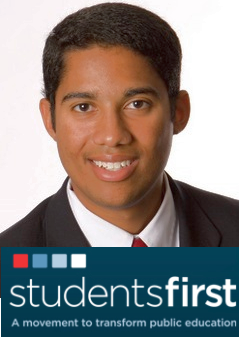
Disgraced, recalled, homophobic former Education Comm. Chair Paul Scott now a lobbyist for anti-teacher group StudentsFirst

Former state House Representative Paul Scott earned a reputation during his time in office as one of the most anti-teacher legislators in Michigan. In his position as the Chair of the House Education Committee, he oversaw some of the most egregious attacks on teachers since Republicans swept into power following the 2010 election. It was bad enough that, eventually, Scott was recalled by voters in his district. The recall had a long and convoluted history with Scott attempting – unsuccessfully – to have the courts throw it out three times. In one of his attempts, he used the ludicrous rationale that he himself had created too much confusion for the recall to continue.
During the recall effort, Governor Rick Snyder and Attorney General Bill Schuette came to Scott’s defense in what the Detroit Free Press called a “clumsy and nakedly partisan” move, intervening on behalf of Scott with the State Supreme Court. Snyder even campaigned for him in Genesee County to help him fight the recall.
Scott has a notorious history as detailed by our pals at Progress Michigan. For example, while in office, he got one of his staffers pregnant and then moved her to a position on his campaign for Secretary of State.
Scott is also a notorious homophobe. He once accused an opponent of receiving support from “far left and radical homosexual groups”, his term for LGBT advocacy groups like Equality Michigan. An observer described Scott’s behavior during one debate this way:
At several points during the debate, Scott sneered at “the liberals,” whom he said have ruined this state, the family and our economy. Twice during the debate, he balled his fists and raised his voice in anger about the threat that gay people pose to our civilization. Scott’s angriest moment came when he expressed his utter “disgust” that middle school students in Goodrich are taught about condom use in a voluntary sex education class.
We now learn that, despite his homophobic, extreme views, Paul Scott has been hired as a lobbyist for the anti-teacher group StudentsFirst or “Regional Legislative Manager”, as they call him.
Scott has a long history with StudentsFirst. As the Chair of the House Education Committee, he shepherded multiple pieces of legislation written by them through his committee, legislation which did things like making illegal teacher strikes more illegal. In a leaked internal document from 2011, StudentsFirst thanks Scott for “overseeing the entire process” and gives credit to House Policy advisor Jason Mancini for Disgraced, recalled, homophobic former Education Comm. Chair Paul Scott now a lobbyist for anti-teacher group StudentsFirst | Eclectablog:

Bill to Improve After School and Expanded Learning - Year 2014 (CA Dept of Education)

Bill to Improve After School and Expanded Learning - Year 2014 (CA Dept of Education):


State Schools Chief Tom Torlakson Applauds Approval of Bill to
Improve After School and Expanded Learning Programs 


SACRAMENTO—State Superintendent of Public Instruction Tom Torlakson today praised Governor Edmund G. Brown, Jr. for signing Senate Bill 1221, sponsored by State Senator Loni Hancock, D-Berkeley, which will improve the quality of after school and expanded learning programs and encourage more programs to operate year-round.

"Strengthening and increasing access to after school and expanded learning programs is a top priority," Torlakson said. "High-quality programs help students succeed inside and outside the classroom by improving school attendance and academic success, while reducing high school dropout rates and juvenile crime."

The legislation is just one part of Torlakson's effort to upgrade expanded learning programs, which include before and after school, summer and intersession programs focused on developing the academic, social, emotional, and physical needs of students.

Torlakson' s After School Division issued a report last week that provides a road map to help all programs strive for excellence. The report, Quality Standards for Expanded Learning in California: Creating and Implementing a Shared Vision of Quality External link opens in new window or tab.offers a set of guidelines for implementing innovative and engaging programs.

In June Torlakson announced that $51 million in new grants from three separate funds were awarded to 333 local after school and expanded learning programs. In California, the Department of Education funds more than 4,400 programs, more than all the other 49 states combined.

For more information about expanded learning, visit the CDE's Before and After School Web page. For more information on SB 1221 External link opens in new window or tab. visit the California Legislative Information Web page.
# # # #
Tom Torlakson — State Superintendent of Public Instruction
Communications Division, Room 5206, 916-319-0818, Fax 916-319-0100

solidaridad: Unpacking Charter Schools' Heavy Baggage this week on Politics Or Pedagogy? with John Cromshow

solidaridad: Unpacking Charter Schools' Heavy Baggage this week on Politics Or Pedagogy? with John Cromshow:


Unpacking Charter Schools' Heavy Baggage this week on Politics Or Pedagogy? with John Cromshow

Politics Or Pedagogy? with John Cromshow

Featuring an analysis of education, policy and practice affecting our public schools.


KPFK 90.7 FM
Politics or Pedagogy? with John Cromshow

Friday, September 19, 2014
7:00 - 8:00 PM
Call in: (818) 985-5735

TOPIC:
Unpacking Charter Schools Heavy Baggage

GUESTS:
Kurt Bier, Esq.
Scott Folsom
Cynthia Liu, Ph.D.
(Dr. Paul Payne)
Meredith Ryley
Robert D. Skeels

INTERVIEWS:
Jackie Goldberg
Lisa Karahalios