Latest News and Comment from Education

Wednesday, September 17, 2014

9-17-14 Perdido Street School

Perdido Street School:


Cuomo Wants To "Bridge The Broadband Divide" At Same Time He Can't Pay For The Tappan Zee Bridge Project
It is becoming increasingly clear that Governor Andrew M. Cuomo is building a $3.9 billion dollar replacement for the Tappan Zee Bridge that has no funding source.Cuomo tried to get half a billion in loans from the EPA clean water fund for the bridge, but that attempt was rejected yesterday.Now people are worried that Cuomo will have to raise tolls on the Thruway and pull money from other sources
Cuomo Has To Hike NY State Thruway Tolls To Pay For His Bridge Mess
Oy:ALBANY – The federal government Tuesday rejected most of the Cuomo administration’s bid to use $511 million from a clean water fund for the Tappan Zee Bridge replacement project, a decision that has implications for Thruway tolls across the entire state.The Environmental Protection Agency’s rejection of all but $30 million in funding from the Clean Water State Revolving Fund highlighted critici
9-16-14 Perdido Street School
Perdido Street School: Charter School Advocates Sue New York State For More MoneyWhat Governor Cuomo did for NYC charter schools by forcing the city to either find space for charters or pony up rent for private space?Charter advocates want that same advantage state-wide:A lawsuit filed by a group of charter-school supporters alleges that a chronic funding gap between charter schools and traditiona


MEW Editors Join Lawsuit Challenging Missouri Payments to Support Common Core | Missouri Education Watchdog

MEW Editors Join Lawsuit Challenging Missouri Payments to Support Common Core | Missouri Education Watchdog:


Missouri Education Watchdog


MEW Editors Join Lawsuit Challenging Missouri Payments to Support Common Core


Gretchen Logue  and Anne Gassel  of the Missouri Coalition Against Common Core have joined Fred N. Sauer in filing a taxpayer lawsuit against Governor Nixon, Commissioner Nicastro, and other state officials.  The lawsuit challenges Missouri’s payment of taxpayer money to the Smarter Balanced Assessment Consortium, a consortium of states that is implementing tests aligned to the Common Core State Standards (“Common Core”).
Logue and Gassel’s lawsuit alleges that the Smarter Balanced Assessment Consortium is an unconstitutional interstate compact that was not approved by Congress, in violation of the Compact Clause of the U.S. Constitution, Article I, Section 3, Clause 10.  The suit also alleges that Governor Nixon and Commissioner Nicastro’s course of conduct in committing Missouri to Common Core was in violation of numerous federal and state statutes.
By passing HB 1490 by an overwhelming majority, the Missouri state legislature effectively repudiated Common Core, requiring it to be replaced by 2016.  But Missouri has not withdrawn from the consortium of states implementing Common Core aligned tests.  According to public records, the Department of Elementary and Secondary Education plans to send millions of dollars of taxpayer funds to the Smarter Balanced consortium in 2015, which will be used to support the implementation of Common Core in numerous other states.  These payments are illegal under the federal constitution, federal statutes, and Missouri state law.
Governor Nixon and Commissioner Nicastro engaged in a long course of conduct, in cooperation with the federal Department of Education, to commit Missouri’s public schools to Common Core without legislative approval.  The “consortium” of States implementing tests aligned with Common Core constitutes an illegal end-run around federal statutes forbidding the federal Department from implementing a national test or curriculum.  Even though Missouri is committed to exiting Common Core, DESE nevertheless continues to participate in SBAC and to administer the SBAC common core aligned tests in this state.
“The Missouri Legislature and Missouri voters have rejected Common Core.  Yet DESE continues to plan to send millions of dollars of payments to the Smarter Balanced Assessment Consortium to support the implementation of Common Core in other states.  The consortium is an unconstitutional entity, and these payments are illegal.  We will continue to fight to protect Missouri taxes from being spent for this illegal purpose,” said Gassel and Logue.MEW Editors Join Lawsuit Challenging Missouri Payments to Support Common Core | Missouri Education Watchdog:


PDK/Gallup Poll Says Americans Value Teachers and Want Teachers Supported, Not Punished | janresseger

PDK/Gallup Poll Says Americans Value Teachers and Want Teachers Supported, Not Punished | janresseger:


PDK/Gallup Poll Says Americans Value Teachers and Want Teachers Supported, Not Punished

Too often lately when I read about teachers and teaching, I am bothered because I suspect the writer has never taught in any kind of school.  Even though I know that data from tests and classroom work has always informed teachers’ strategies for working with particular students, I am puzzled by people who assume that teachers keep in mind a compartmentalized mental file of each child’s standardized test scores as the key to strengths and weaknesses and a finite list of steps to be taken to erase the weaknesses. And I am troubled by statisticians calculating econometric formulas to measure the amount of knowledge particular teachers add to a child’s education.
To my mind teaching is an art, though teachers certainly need to inform their practice with what science tells us about psychology and sociology and child development. Teaching is relational.  It is not the mere imparting of bits and bites of information.  Teachers must come to know their students deeply and respect what each student brings to the relationship.  Teaching is about awakening interest, inspiring hard work, stimulating curiosity, listening, considering, supporting, encouraging and making students feel safe enough to learn from criticism.  Teachers need to be able to encourage students to analyze, be critical, and challenge authority while at the same time creating a safe and orderly classroom.  So much of today’s talk about teachers fails to consider what teachers really do.  When learning happens, there is a spark of connection.  Gloria Ladson-Billings titled her classic book about teaching, The Dreamkeepers; Sonia Nieto called hers, The Light in Their Eyes.
Even if I try, I find it meaningless to apply the “Value Added Measure” (VAM) concept to my experience with my favorite teachers. A lot of these measures would try to connect “value added” to the salaries I have been able to earn over the years—the economic value of my education.  While I certainly don’t want to scoff at the importance of my capacity to work, I don’t really value my own education at all from an economic point of view.  The teachers who took the trouble to connect with me, help form my habits of thought, encourage me to be and feel competent—these are the teachers I value, but I can’t measure the worth of my connection to my teachers or assign a numerical value to the experience.
Mike Rose, one of my favorite writers about teachers and education, describes what is rarely considered in much of today’s talk about schooling:  “I’m interested here in the experience of education when it’s done well with the student’s well-being in mind.  The unfortunate thing is that there is nothing in the standard talk about schooling—and this has been true for decades—that leads us to consider how school is perceived by those who attend it.  Yet it is our PDK/Gallup Poll Says Americans Value Teachers and Want Teachers Supported, Not Punished | janresseger:

NEA - Annenberg study calls for new charter school standards to be implemented in policy

NEA - Annenberg study calls for new charter school standards to be implemented in policy:


Annenberg study calls for new charter school standards to be implemented in policy

NEA President Eskelsen García: ‘Standards and vigorous oversight are key to protecting charter school students and the public’s investment in public education”


WASHINGTON - September 16, 2014 -
new report just released by the Annenberg Institute at Brown University  calls for increased accountability, transparency and equity in the taxpayer-funded charter school sector. The Institute is proposing standards to be implemented into state and charter authorizer policies that would better serve all students and protect the public’s investment in public education. Approximately 2.57 million students are enrolled in over 6,000 charter schools nationwide.
“Charters began as a way to free teams of educators to devise innovative ways to engage students and learn from effective practices to improve all of public education,” said National Education Association President Lily Eskelsen García. “Unfortunately, the lack of vigorous oversight and a superficial regulatory structure in the charter sector has enabled too many of these schools to fall short of delivering on what they promise students and families. Charter sector standards are key to making sure that more of our charter schools serve their students well and do not make the job of our traditional public education sector even more challenging.”
As charter schools have expanded rapidly across the country, this frequently lax oversight has harmed taxpayers and communities as well. A May 2014 report by the Center for Popular Democracy documented over $100 million in waste, fraud and abuse in 17 areas alone. Closing loopholes, stronger regulation and vigorous oversight is essential to prevent further bilking of taxpayers and undermining the strength of public school systems in our communities, while allowing the best qualities of chartering to flourish.
“Children deserve choices, but not just for the sake of offering choices,” said National Education President Lily Eskelsen García. “If charters are to continue receiving public funds, they should be accountable to the public — the very communities they exist in.  But more and more we see the voices of educators, parents and community members bypassed in favor of doing what’s best for corporate profits—and students end up truly paying the cost.”
The Annenberg report found some common concerns: uneven academic performance; practices that pushed or kept students out of charter schools; overly harsh discipline policies; funding patterns that destabilized traditional schools; and a lack of representative governance, transparency, and adequate oversight.
Eskelsen García said it’s time for the charter industry to be just as transparent in enrollment, discipline and oversight as traditional public schools. “The public deserves to know that all taxpayer-funded schools, charter as well as traditional and magnet, are working to provide the best education they can for students. Good standards are about protecting their investment and protecting our students. It’s time to shine a light on charters and make sure they are serving students and communities first.”
NEA believes that the Annenberg standards and report are a major contribution to identifying and offering constructive suggestions on key concerns in the charter sector. “We urge policymakers, parents, educators in all sectors and communities to read it, discuss it and draw from it to develop measures that work for students,” said Eskelsen García.
Follow NEA at twitter.com/neamedia. Join the conversation using #CharterStnds.

While schools and teachers have a tremendous influence over student learning, there is nothing the teachers can do to make it happen. It is completely out of the control of teachers to make students learn; the students have to do it by themselves, according to author and educator Ben Johnson. “So where should a school invest effort, time, and resources to help students? Invest in either finding th

Mike Klonsky's SmallTalk Blog: Rahm Love and the Mess at CPS

Mike Klonsky's SmallTalk Blog: Rahm Love and the Mess at CPS:


Rahm Love and the Mess at CPS

GOOD READ...And at home I found a separate culture of intellectual achievement. This is the tradition of Carter G. Woodson, Frederick Douglass, and Malcolm X. It argues for education not simply as credentialism or certification, but as a profound act of auto-liberation. This was the culture of my childhood and it gave me some of the greatest thrills of my youth. -- Ta-Nehisi Coates"Acting French"


RAHMLOVE...If you're an alderman looking to win Rahm's love, the Reader's Ben Joravskyshows you the way. All you have to do is kiss his ass and answer all the questions right on (former CPS liar-in-chief) Becky Carroll's Chicago Forward questionnaire.

Chicago Forward is run by my old pal Becky Carroll, who used to be the mayor's chief spokeswoman at the Chicago Public Schools. In the last few months, it's raised more than $1 million from some of the mayor's closest and richest chums, including Michael Sacks, Kenneth Griffin, and other gazillionaires.
THE MESS AT CPS..."Aramark’s top priority is to make sure that CPS students, faculty and staff have clean, comfortable learning environments." -- Company spokesperson Karen Cutler


One way to win RahmLove is to shut up about the whole filthy mess at CPS caused by the mayor's privatization of custodial services, including the firing of hundreds of janitors. Principals and parents are outraged by the conditions schools are in. After hiding under his desk for a week and leaving the hemming and hawing over Mike Klonsky's SmallTalk Blog: Rahm Love and the Mess at CPS:

Lying with numbers in Newark | Bob Braun's Ledger

Lying with numbers in Newark | Bob Braun's Ledger:


Lying with numbers in Newark

Share on FacebookTweet about this on TwitterEmail this to someoneShare on LinkedInShare on Google+Share on StumbleUpon
The only audience that matters to Cami
Here’s the core of the problem in Newark schools: Cami Anderson, Gov. Chris Christie’s agent in Newark, has the numbers that reveal how well or how poorly she is doing. No one else, including the city’s elected school board, has them. So she can make outrageous statements–like the first day of school had 90 percent attendance, as she said Tuesday night, and all the school buses ran on time–and, while everyone else believes she’s either lying or demented, or both, they have no way of disproving her.
The school board–or a majority of it because the panel is divided–is trying to force her to reveal the numbers, but there really isn’t much they can do. She is the “decider’s”– Christie’s–woman on the ground in Newark and she can tell the board members to shove it, which is what she does, but nicely. Most of the time, nicely.
A number of exchanges at Tuesday’s night’s board meeting between Anderson and board members illustrate the problem. For example, after her outrageously positive description of how well the first days of school went, Philip Seelinger, a board member from Newark’s Ironbound, described how, when he toured schools the first days of school, he saw overcrowded classrooms with 35 or more students jammed into one learning space, in violation of the city’s policy.
Anderson, who fancies herself light on her feet intellectually, immediately saw an opening. The reason, she said, was that “there always has ben overcrowding in the Ironbound” because the schools in  predominantly white and relatively prosperous neighborhood are attractive to parents. So she works very hard to shoe-horn kids into the schools and, after all, parents want siblings in the same Lying with numbers in Newark | Bob Braun's Ledger:

Common Core As Child Abuse | PopularResistance.Org

Common Core As Child Abuse | PopularResistance.Org:


Common Core As Child Abuse

Print Friendly
“It is easier to build strong children than to repair broken men.”
Government and business leaders profess that today’s education policies will provide students with “21st-century skills.” If only these leaders had the 19th-century wisdom ofFrederick Douglass, they would see that the education “reform” they are imposing has created a school environment that is devastating to our children’s development and mental health.
Our most vulnerable children often suffer “toxic stress:” prolonged activation of the body’s stress response system brought on by chronic traumatic experiences. Toxic stress disrupts the development of the areas of the brain associated with learning and can have lifelong consequences.
The effects of toxic stress must be mitigated, according to the American Association of Pediatrics. To do so, adults must reduce children’s exposure to continuously stressful situations.
It is imperative, therefore, that we make school a supportive environment free of the extreme stress that can harm healthy development. Some stress is productive and promotes growth. However, especially for children living in poverty, creating an unnecessarily stressful environment has long-term damaging effects.
Unfortunately, many public schools are generating, rather than reducing, anxiety. The explosion of almost continuous high-stakes standardized testing is a major factor.
This year, Pittsburgh students will take 270 tests; 33 just for fourth graders. Bridgeport’s testing schedule calls for six weeks of standardized district tests, a week of CMT science tests; then the final 12 weeks of school are set aside for the new Common Core standardized tests.
For children under 8, standardized testing is unreliable. Moreover, requiring young children to meet specific reading and mathematics goals ignores the fact that there is an acceptable range of ages for developing these skills. Child-development experts have decried the age-inappropriateness of the Common Core. In 2010, more than 500 people signed a statement stating that the “standards conflict with compelling new research in cognitive science, neuroscience, child development, and early childhood education about how young children learn, what they need to learn, and how best to teach them in kindergarten and the early grades.”
Dr. Samuel Meisels, director of the University of Nebraska‘s Buffett Early Childhood Institute, agrees that a school culture focused on high-stakes tests is exactly the type of environment that we should avoid for children who experience toxic stress. Dr. Marcy Guddemi, head of the Gesell Institute of Child Development maintains that for children under 8, current policies combining an age-inappropriate curriculum with standardized testing are nothing short of child abuse.
For older children, the overuse of high-stakes testing is just as useless and damaging. Common Core As Child Abuse | PopularResistance.Org:

NYC Educator: Teacher Torture

NYC Educator: Teacher Torture:


Teacher Torture

That's what a Queens chapter leader called the 80 minutes of PD most city teachers are subject to every Monday for the foreseeable future. Of course UFT leadership deems it a great victory, since there is now a committee that will sit around and figure out how to inflict plan this. The idea, of course, is that with teacher input everything will be much better. Of course, I've been to teacher-planned PD sessions for years, and I can't see a whole lot revolutionary about it.

Mulgrew asked the city chapter leaders last week whether it was PD or faculty meetings, and there was a moan that very much selected the latter. After sitting through decades of meetings planned by administrators, almost all of which I'd have done just as well without, it's kind of tough for me to understand just why Carmen Fariña determined it would all be different this year. Did she think that because her PD was perfect in every way that it would be magically replicated citywide? Did she think that administrators everywhere would finally discover the secret sauce and motivate all the teachers who'd reluctantly sat through years of tedious and unnecessary meetings? Did she think that teachers, who supposedly never had any voice in PD before, would all wake up experts in administering it?

Of course this innovation was a great victory for the UFT, just as the small group instruction was a great victory for the UFT. Of course, when this great victory was over, it was just as great a victory to get rid of it. It must be fabulous to run the UFT, go to gala luncheons, and declare victory all NYC Educator: Teacher Torture:

Op-Ed: School District Consolidation Should Be Welcomed in New Jersey - NJ Spotlight

Op-Ed: School District Consolidation Should Be Welcomed in New Jersey - NJ Spotlight:


OP-ED: SCHOOL DISTRICT CONSOLIDATION SHOULD BE WELCOMED IN NEW JERSEY

When it comes to local school districts, small isn’t beautiful -- it’s usually inefficient and expensive


christine todd whitman
Former Gov. Christine Todd Whitman
It was nearly 20 years ago that I called for a nonbinding referendum that would allow the state to force some of its smaller school districts to merge. That vote never took place, and the state is still home to more than 600 school districts. I am pleased to see, however, that recently there has been some movement toward consolidation in a few pockets throughout New Jersey.
The state did ultimately direct county school superintendents to develop a plan to eliminate smaller school districts that do not offer grades pre-K or K-12; recommendations were due by March 2010. More than 85 percent of voters in West Amwell, Stockton, and Lambertville cast ballots to disband their small school districts and create a unified South Hunterdon school district, which occurred July 1 of this year. And in Hunterdon County, where per-pupil costs average $17,651, the county freeholders are offering to match the cost for school consolidation studies.
Despite these positive steps, a lot of work remains to be done to improve the small, inefficient school districts in the state. State auditors released a report this summer recommending the state Department of Education push for consolidation. The report notes there are 278 school districts in New Jersey servicing students in only grades K-6 or K-8, yet with total administrative costs of $270 million. Of that number, 144 are school districts with just one school, costing taxpayers $63.5 million. Auditors discovered even more potentially wasteful spending, including the fact that 90 of these single-school districts employed a schools superintendent and/or a full-time principal with combined salaries of $13.4 million, while 70 of these mini-districts also spent $5.3 million combined for school business administrations. Moreover, it was noted that 18 school districts with just a single K-6 or K-8 school had both a full-time superintendent and full-time principal, each earning an average of $121,000 in fiscal Op-Ed: School District Consolidation Should Be Welcomed in New Jersey - NJ Spotlight:


Talks Sought on Easing Much-Debated Caps on Superintendent Salaries
Legislative and legal actions have failed to sway Christie administration, so lawmakers may try joint nonbinding resolution
Health Advocates Examine Lifelong Health Effects of Childhood Trauma
NJTV program premiering tonight explores impact of adverse experiences on kids in urban areas

October 11th, be there: The Network for Public Education will hold an historic event | Seattle Education

October 11th, be there: The Network for Public Education will hold an historic event | Seattle Education:


October 11th, be there: The Network for Public Education will hold an historic event

NPE

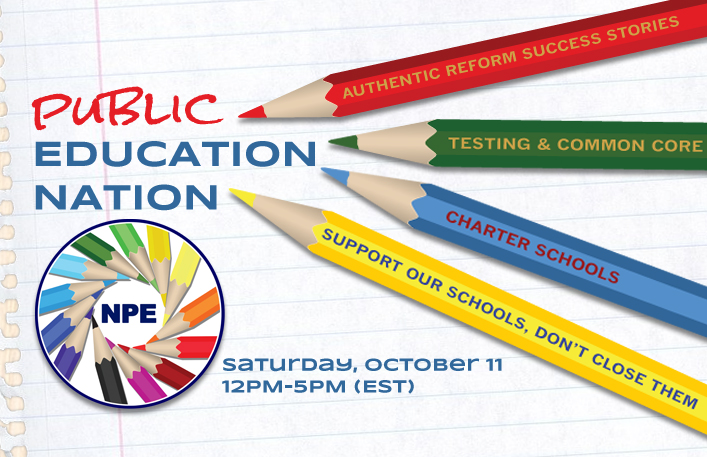
PUBLIC Education Nation will deliver the conversation the country has been waiting for. Rather than featuring billionaires and pop singers, this event will be built around intense conversations featuring leading educators, parents, students and community activists. We have waited too long for that seat at someone else’s table. This time, the tables are turned, and we are the ones setting the agenda.
This event will be livestreamed on the web on the afternoon of Saturday, October 11, from the auditorium of Brooklyn New School, a public school. There will be four panels focusing on the most critical issues we face in our schools. The event will conclude with a conversation between Diane Ravitch and Jitu Brown.
Testing and the Common Core: New York Principal of the Year Carol Burris will lead a discussion  with educators Takeima Bunche-Smith, Rosa Rivera-McCutchen and Alan Aja.
Support Our Schools, Don’t Close Them: Chicago teacher Xian Barrett will moderate a panel featuring education professor Yohuru Williams, Hiram Rivera of the Philadelphia Student Union, and a representative of the Newark Student Union.
Charter Schools: North Carolina writer and activist Jeff Bryant will host a discussion that will include New Orleans parent activist Karran Harper Royal, New York teacher and blogger Gary Rubinstein, and Connecticut writer and activist Wendy Lecker.
Authentic Reform Success Stories: The fourth panel will be led by Network for Public Education executive director Robin Hiller and will include New York teacher and activist Brian Jones, and author of Beyond the Education Wars: Evidence That Collaboration Builds Effective Schools, Greg Anrig.
Diane Ravitch and Jitu Brown, In Conversation: The event will finish off with a conversation between leading community activist Jitu Brown and Diane Ravitch, who will talk about where we are in building a movement for real improvement in our schools.
This event will be broadcast live on the web, and can be viewed from anywhere in the world, at no cost. No registration is required. If you happen to be in the New York area, you can join the studio audience at the Brooklyn New School, at 610 Henry St. Brooklyn, for the live event.
The Network for Public Education is hosting this event. It is NOT sponsored by the Gates, Walton or Bloomberg foundations. It is sponsored by YOU, each and every one of the people who care about our children’s future.  
Can you make a small donation to help us cover the expense of this event? We are determined to create the space not ordinarily given to voices like these. But we need your participation. Please donate by visiting the NPE website and clicking on the PayPal link.
A live-stream of the event will be available on Saturday, Oct. 11, starting at Noon Eastern time, (9 am Pacific time) at  http://www.schoolhouselive.org.