Latest News and Comment from Education

Thursday, May 8, 2014

5-8-14 Scathing Purple Musings | Color me purple in Florida ALL Week

Scathing Purple Musings | Color me purple in Florida, red in Washington, dark sky-blue in Israel and public school in Education:


Stagnant Grade 12 Scores Show “Failure of Test-Driven Public Education”
From FairTest: Results from the National Assessment of Educational Progress (NAEP) for twelfth graders “underscore the failure of federal and state test-driven school policies,” according to the National Center for Fair & Open Testing (FairTest). Today’s report shows no NAEP score improvement for high school seniors in reading or math since 2009 and little progress over the past decade. Over t
Michelle Rhee’s – and Jeb Bush’s – Disasterous Day on FOX News
Michelle Rhee wants no part of Michelle Malkin in ANY debate, yet alone one on Common Core. This weeks appearance on FOX News didn’t go as well for Michelle Rhee as she had hoped as she didn’t get the puff ball questions she assumed she would. Writing in the  popular conservative web site, American Thinker, Ann Kane noticed: In response to Rhee’s praise of the Common Core Standards on Fox News’ Sp
5-6-14 Scathing Purple Musings | Color me purple in Florida ALL Week
Scathing Purple Musings | Color me purple in Florida, red in Washington, dark sky-blue in Israel and public school in Education: The Florida PTA? Not THOSE Parents!Washington Post writer, Valerie Strauss pointed out the indefensible double-standard which Florida republican legislators operate when it comes to education policy. One statement in particular stood out to Strauss: The Associated Press


5-8-14 Perdido Street School

Perdido Street School:


Mulgrew Gets Definitive At The DA: No Paying For Health Care
There was a leaked memo going around that said city workers will pay a percentage of their salaries toward health care as per a "savings" agreement made between the city and the Municipal Labor Committee.Here's how the payments will work according to the memo:Salary<$30,000Contribution Percentage of Salary0.0%$30,000 - $40,0000.5%$40,000 - $50,0001.0%$50,000 - $60,0001.5%$60,000+2.

Student Suspended For Opting Out Of Assessment Test
More negative news for the testing regime: An Alabama teen says she was suspended from school after she refused to take a local assessment test, contrary to an earlier report from WAAY-TV that the test was aligned with the state's Common Core curriculum. Alyssa McKinney, an eighth-grade student at Whitesburg Middle School in Huntsville, Ala., told the station she was given two in-school suspension
5-7-14 Perdido Street School
Perdido Street School: Is The Tentative UFT Contract Changing How The System Deals With Teachers Rated "Ineffective" On Testing Components?The tentative contract language is finally available to peruse - you can find it here.I noticed this:Measures of Student Learning Options1. For the 2014 - 15 school year and thereafter the DOE shall create new measures (referred to as “Linked Measures


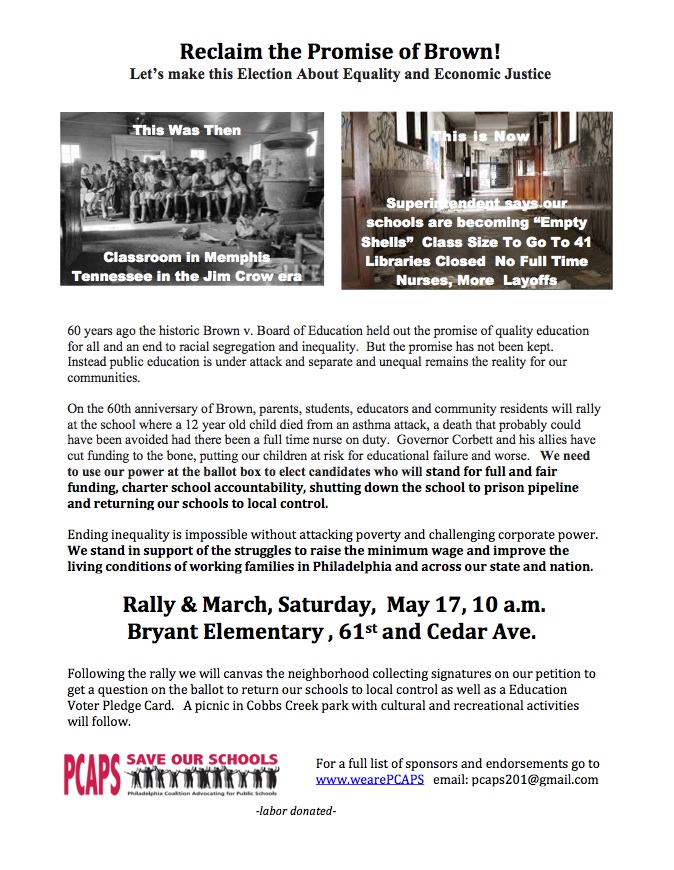
Reclaim the Promise of Brown on May 17th | WeArePCAPS

Reclaim the Promise of Brown on May 17th | WeArePCAPS:


Reclaim the Promise of Brown on May 17th

Untitled 3

solidaridad: SLASD Community rally for an authentic voice in the LAUSD LCFF/LCAP process!

solidaridad: SLASD Community rally for an authentic voice in the LAUSD LCFF/LCAP process!:


SLASD Community rally for an authentic voice in the LAUSD LCFF/LCAP process!


 How do YOU want LAUSD to spend YOUR $$$?
standardized tests? iPads? consultants?

or 

full-time nurses, psychologists, counselors???
psychiatric social workers?
librarians, art , music, P.E teachers????
adult education, pre-K??
other services?


March and Rally TOMORROW!!!

 May 8th, 4:30 p.m.
RFK Community School
701 S. Catalina St.
Los Angeles, 90005

Meet at 4:30
Parking available at RFK Community
(Entrance to parking lot on Catalina or parking garage on 8th St.)
March to corner of Wilshire and Vermont

If you can't make it at 4:30, 
meet at corner of Wilshire and Vermont at 5:00 p.m.
right outside Metro Station (Red/Purple Line)

If you can't make it at all, find someone who can, and 
Spread the Word!

We can quietly agonize 
or ACTIVELY ORGANIZE!

You Choose!

¡ATENCIÓN PADRES DE FAMILIA!


¿Como quiere que el LAUSD gaste nuestro $$$?
¿en exámenes inútiles? ¿en iPads? ¿en consultantes inútiles?

o

¿enfermeras, psicólogos, consejeros por tiempo completo?
¿trabajadores sociales psiquiátricos?
¿bibliotecarios, maestros de arte, música y gimnasia?
¿más clases para adultos?
¿más maestros de pre-kinder?
¿otros servicios?

¡VENGAN A UNA MARCHA Y MANIFESTACIÓN EN 5 DÍAS!

El día jueves, 8 de mayo a las 4:30
RFK Community School
701 S. Catalina St.
Los Ángeles 90010
(en la esquina de la Calle 7 y la Catalina)

Nos reunimos a las 4:30 en la RFK Community School
Hay estacionamiento en la RFK Community School en la entrada de la Calle 8
Al reunirnos, vamos a hacer la marcha hasta la esquina de Wilshire y Vermont (solo a 4 cuadras)

Si no puede llegar a las 4:30 en la RFK Community School
Unase con nosotros a las 5:00 en la esquina de Wilshire y Vermont
en frente de la estación del Metro (Línea Roja/Morada)

Si no puede participar, encuentre una persona que si puede 
y animarle a presentarse y 
¡PASAR LA VOZ!

Podemos sufrir en silencio 
u ¡ORGANIZARNOS CON GANAS!

La opción es nuestra

Louisiana Educator: Relentless Drive to Mislead Citizens About Common Core

Louisiana Educator: Relentless Drive to Mislead Citizens About Common Core:


Relentless Drive to Mislead Citizens About Common Core


Superintendent White, the Baton Rouge Advocate, LABI and CABL are pulling out all the stops to sell the Common Core to Louisiana, yet there is not one in the bunch that really knows what it is like to teach to those standards or to get kids ready to pass the PARCC test. These folks are on a crusade to sell us a product they really know little about.

Breaking news: HB 953 passed the House floor Wednesday May 7. This bill would delay the effects of the Common Core testing on school letter grades and teacher evaluations through the 2015-16 school year. White and his allies will surely try to kill this bill in the Senate Education Committee where proponents of Common Core seem to dominate.

The Advocate just printed two more slanted stories, here andhere, suggesting that Republicans and K-12 students think the standards are great. But close inspection of the two surveys reported on does not show any real support for the Common Core. In the first story, only a  minority of the Republicans surveyed say they think the Common Core standards are a good idea, and 40% did not know enough to give an opinion. One of the questions asked found that a significant minority support the standards, but that is only after they are told in the introduction that 75% of teachers believe the Common Core will improve student achievement. 

Our survey on this blog had 71% of our respondents opposed to CCSS and PARCC. I am well aware that a voluntary survey such as we conducted is not considered a scientific survey, but at least the majority of the respondents were educators who were  well versed on the standards because they are actually in the middle of implementing the standards.

The Advocate article reporting on the survey of students taking the sample PARCC test this Spring had the headline: "Students Give High Marks to Common Core Test" yet the press release about the survey results does not indicate whether the students think the test is good or bad. The main issue the students 
Louisiana Educator: Relentless Drive to Mislead Citizens About Common Core:

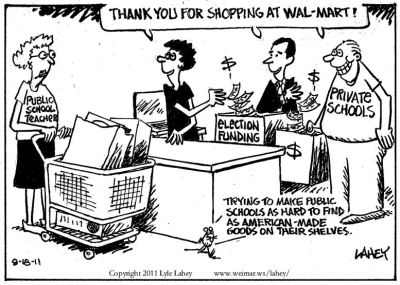
Pity the Poor, Underfunded Charters | Live Long and Prosper

Pity the Poor, Underfunded Charters | Live Long and Prosper:


Pity the Poor, Underfunded Charters


WALTONS CLAIM CHARTERS UNDERFUNDED
Last month the University of Walmart Arkansas released a report — from theirDepartment of Education Reform — that showed charter schools are underfunded.
Max Brantley at the Arkansas Blog, no friend of the Waltons, reported the following.
The Walton-subsidized University of Arkansas has issued a news release today about a report from a Walton-financed arm of the UA, the Department of Education Reform, that more money is spent on conventional public school districts than on charter schools, which the Walton heirs are spending hundreds of millions to promote in the United States, often to the detriment of existing public school districts.
He also suggested a few reasons that charter schools are not getting as much asreal public schools.
I believe there are some understandable factors that lessen the the drama about the gap, ranging from less-experienced teachers who are paid less, differences in facilities and extra money given to public school districts for such considerations as desegregation plans (money to be phased out in Little Rock, for example) and federal money for poor students.
The biggest gap is a lack of local property tax revenue for charters and state construction funding. Walton lobbyists have managed to open the door in 
Pity the Poor, Underfunded Charters | Live Long and Prosper:

Report Decries Unregulated Charters: Arne Duncan Should Crack Down | janresseger

Report Decries Unregulated Charters: Arne Duncan Should Crack Down | janresseger:


Report Decries Unregulated Charters: Arne Duncan Should Crack Down

Earlier this week Charter School Vulnerabilities to Waste, Fraud, and Abuse was released jointly by the Center for Popular Democracy and Integrity in Education.  In an age when charter schools are regulated in state law, we are likely to read stories in our local papers about fraud or academic malpractice at a charter school nearby.  This is the first report I’ve read that details widespread abuse of the public interest by charter schools in 15 states: Arizona, California, Colorado, Washington, D.C., Florida, Hawaii, Illinois, Louisiana, Minnesota, New Jersey, New York, Ohio, Pennsylvania, Texas and Wisconsin.
The report’s authors explain, “Charter enrollment has doubled three times since 2000; it doubled from 2000 to 2004, and again from 2004 to 2008, and again from 2008 to 2014.” The report highlights a memorandum from the U.S. Department of Education’s Office of Inspector General that warned the Department itself, “of our concern about vulnerabilities in the oversight of charter schools.”  The Department’s Office of Inspector General “specifically highlights the problem of ‘fraud perpetrated by charter school officials, and internal control weaknesses in the Department’s oversight processes.’”
This week’s report identifies six categories of fraud and mismanagement the authors documented through news reports and criminal complaints: charter operators using public funds illegally for personal gain; charter operators using school revenue illegally to support other businesses owned by the charter operators; schools putting children in actual or potential danger (by failing to screen staff or providing dangerous building conditions); charter schools billing states for services they claim to be providing but are not in fact providing; charters inflating enrollment and billing states for children who are not attending the school; and charter operators mismanaging public funds.  (This blog recently reported two examples of charter school operators or board members profiting when charter school dollars were spent at their privately held, for-profit companies that provide services for the charter schools they operate in Milwaukee and in Ohio.)
The report concludes with two pages of excellent recommendations for fiscal and academic safeguards that states should implement:  establish a charter regulatory agency; ensure Report Decries Unregulated Charters: Arne Duncan Should Crack Down | janresseger:

Whose Help Don't We Need? - Bridging Differences - Education Week

Whose Help Don't We Need? - Bridging Differences - Education Week:


Whose Help Don't We Need?

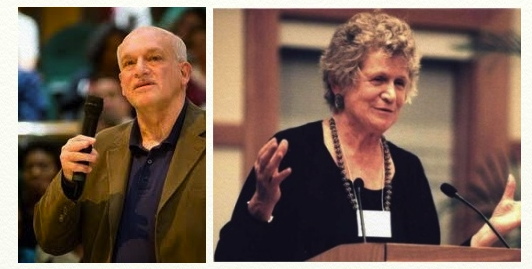
Deborah Meier continues her conversation with Mike Klonsky today.
Dear Mike,
Count on me to continue to corrupt you. Or at least try.
So, here's my dilemma. If we are to prevail (on almost any of the many equally dangerous roads we are traveling down), we'll need to win over people we very much disagree with. So that means one has to ignore some of their unsavory views in order to move them to better understand their own self-interest ... or something like that.  (Not to mention their interest in fairness, equality, decency, anti-racism, and a good education.)
Yes, there are racists who ought to be on my side and whose prejudices blind them to their best interests. Do we want to cement their racism or make them a little more uneasy about it?  Do I want to push them further into the arms of their real enemies? It's why I thought it a mistake to call the cops bad names in the '60s, since even cops ought to be on my side. Not to mention some other unwise tactics some of my current allies and friends once engaged in.  
I know people who still think that the Hitler-Stalin pact was a necessary temporary alliance, that dictatorship is sometimes necessary for the greater good and who justify the murder of many innocent people in the name of "any enemy of my enemy is my friend," BUT who are today on my side on most issues.  I'm sometimes uneasy about that. Less uneasy about those who have gradually dropped such views, although not as adamantly as I'd like. In fact, some of my best friends are former enemies. I could go on and on about how under different circumstances we have forgiven former enemies, or at the very least agreed to a common front.
The rampant paranoia on the extreme right is not entirely unjustified. I, too, am afraid of a government with too much power, even one I "like." In fact, I'm in an alliance these days with some pretty unpalatable "allies" in the Democratic Party on some issues.  Sometimes I support the lesser evil—which requires a temporary alliance with evil!
The other day I met a couple of religious right-wingers. As they described the state of the nation most of what they said was realistic and pretty much as I would describe it.  They knew my politics and I knew theirs, and they are friends of friends so we avoided certain themes.  One could, if listening in, have found it a productive discourse between allies.  I didn't push, but I suspect that there is a place and time when I could see them making a leap in our direction. I may be fooling myself.
Still, if my house were on fire, I'd not reject the help of a neighbor whose views I otherwise despise.  I think our nation is on fire.  The real power on the "other side" is prepared to sell out not merelyWhose Help Don't We Need? - Bridging Differences - Education Week: 

Repeating Policy Behaviors Over and Over Again Despite the Evidence |

Repeating Policy Behaviors Over and Over Again Despite the Evidence |:


Repeating Policy Behaviors Over and Over Again Despite the Evidence


 According to Albert Einstein, the definition of insanity is to repeat the same behaviors over and over again in the hope that different results will materialize “the next time,” perhaps after this is fiddled with or that is fine-tuned. In the case of VAMs, it seems, educational policymaker are stuck in such a pattern of insanity, propagating and regenerating policies based on the use of students’ test scores to evaluate teachers, despite the fact that this has been a policy initiative of now almost 25 years past. Yes, we have research from now almost 25 years ago re: why this is a bad idea!

Gene V Glass published a study about just this in 1990. Click here to check it out. While this study was conducted pre-VAM (as we currently know it, particularly in terms of policy not form), the research-based reason why this is wrong remains the same. Regardless of the machine or statistical technique to be used, “the machine that is meant to do the world’s work must be observed in the actual world where [the VAM-based research] designs meet reality.”
The issues then, continue to be the issues today: “[t]he issue of ‘pupil performance in teacher evaluation’ needs to be discussed in a way that has not been separated from the many other pressures that shape a personnel system of assessment and rewards. The issue cannot be judged apart from how it exists in real places. The validity of such a process of evaluating teachers, its economy, its power to engender belief and win acceptance, depend on how it fits with many other realities of the teaching profession. What now must be addressed is how this notion gets applied in a context as complicated as education. How is the idea transformed as it moves from the statistician’s mind to the real world? How does it fare when the tradeoffs and balances are struck? Is the concept of Repeating Policy Behaviors Over and Over Again Despite the Evidence |:

‘Participatory budgeting’ goes to Washington - Bites - Sacramento News & Review -

Sacramento News & Review - ‘Participatory budgeting’ goes to Washington - Bites - Opinions - May 8, 2014:


‘Participatory budgeting’ goes to Washington

Will a south Sacramento’s visit to D.C. mean more open government in Sacramento?

By  
cosmog@newsreview.com


This article was published on .

Last December, the Obama administration issued its second Open Government National Action Plan, promoting its best ideas for encouraging citizen participation and transparency in government.

These include modernizing federal open records laws, increasing access to government data and a commitment to promote greater fiscal transparency at all levels of government.

The White House also endorsed something called “participatory budgeting,” which Bites has mentioned from time to time. Next week, the White House will convene participatory-budgeting advocates from around the country to figure out how to encourage more local governments to adopt the practice.

The basic idea is simple: Citizens set spending priorities and vote directly on spending decisions. PB is gaining ground in American cities as a way to engage citizens and spread power to groups who feel shut out of fiscal decision-making.

In New York and Chicago, citizens decided on small discretionary budgets within city council districts. Nearby Vallejowas the first place in the United States to use participatory budgeting city-wide.

There, citizen assemblies—which included residents as young as 16 years old—forwarded their ideas to the ballot and last year approved $3 million worth of funding for pothole repairs, street lights, parks, school libraries, school counselors, spaying-and-neutering programs and street cameras. Work has begun on those projects, and residents have submitted hundreds more to be voted on in the fall.

Other California cities are following Vallejo’s lead. In March, a Long Beach city council member piloted a PB project, inviting district residents to vote on allocations. Sidewalk repair, tree trimming and library repairs won out. And in San Diego, a coalition of labor and community groups is proposing a PB project that would give residents a direct say in funding about $3 million worth of projects in low-income areas of the city.

Former Vallejo city council member Marti Brown was the first one who really explained PB to Bites. She was its champion in that city. She’s since moved to Sacramento, where she works as executive director of the North Franklin District Business Association. And she’s headed to the White House next week to help spread the PB gospel.

“The whole idea is that you’re trying to engage people who have felt disconnected and disregarded from the process,” Brown told Bites.

Disconnected and disregarded? In Sacramento?

And elsewhere in California. In 2012, California was 48th in the nation in voter participation. “People are understandably cynical. I think we need to find ways to make our civic processes more engaging,” says Anne Stuhldreher with The California Endowment. The Endowment has allocated $100,000 to help promote PB projects in the 14 cities targeted in its Building Healthy Communities program. Sacramento is one of those cities, as are San Diego and Long Beach.

Stuhldreher says building healthy communities includes building a community’s capacity to make its own decisions. “A sense of agency and control over your life is a big predictor of health. The more people can participate in the decisions that affect the quality of their life, the healthier they will be.”

Speaking of ailing democratic institutions, participatory budgeting could be a help to the Sacramento City Unified School District.

“It would give the community an opportunity to talk about what they want, instead of just responding to what district staff proposes,” says Carl Pinkston with the Sacramento Black Parallel School Board. Pinkston is trying to build support for PB to be part of the school district’s 2015-16 budget. A good starting point would be the supplemental funds provided under the state’s new Local Control Funding Formula. The new law includes requirements for greater public input in district spending.

School funding can be frustratingly complex for average people. And unfortunately the Sacramento News & Review - ‘Participatory budgeting’ goes to Washington - Bites - Opinions - May 8, 2014:


Teaching to the tech: On Sacramento schools, Common Core and the digital divide - Sacramento News & Review
Teaching to the tech: On Sacramento schools, Common Core and the digital divideSacramento News & ReviewThe kids look like they're focused on a test. But maybe they're just mesmerized by the devices that the exam is on: shiny new MacBook Airs. The Sacramento City Unified School District recently deployed more than 6,000 of these laptops to its schools in ...

Shanker Blog » Invisible Labor Redux

Shanker Blog » Invisible Labor Redux:


Invisible Labor Redux

Posted by  on May 8, 2014


Recently, I learned that the Connecticut legislature is considering a bill that would mandate coverage of labor history in high school curricula. I was surprised. And interested. At a time when there are immense pressures to align curriculum –  ever more narrowly –  to standardized tests, these Connecticut politicians were advocating for material that is unlikely ever to appear on a high-stakes test.
What makes it even more interesting is that the legislation is urging the study of labor history. Let’s face it, unions are in drastic decline in this country and the political climate is as hostile to labor as it has ever been — so much so that the U.S. is cited by international democracy and human rights organizations as a country where basic worker rights are routinely violated, in law and in practice.
There has been little public outcry over the years as unions have weakened, although some commentators (here,here) have recently noted that the decline of unions has tracked the decline of real wages and the rise of wealth inequality.  In this context, the economic benefits that unions bring to individual workers (through good wages and benefits) have long been recognized by the World Bank and others, see here, and here for example.   In cross-national studies, the Bank has also noted the ‘negative correlation’ between high rates of union density and collective bargaining coverage, and wage inequality and variance.
Although most observers would agree that there are lots of reasons for union weakness, the Albert Shanker Institute, together with the American Labor Studies Center (ALSC), recently highlighted one that is often overlooked – labor history doesn’t get much attention in standard high school history textbooks, and when it does, it is marked by omissions, distortions and a focus on violent conflict. The continuing, positive impact of workers – men and womenShanker Blog » Invisible Labor Redux:

NYC Educator: Why Do We Have a Union?

NYC Educator: Why Do We Have a Union?:


Why Do We Have a Union?

A young UFT delegate asked me that question while she was watching UFT President Michael Mulgrew shut down Jamaica High School's James Eterno, for my money the most knowledgeable and resourceful chapter leader anywhere. Eterno, after listening for over an hour about the marvels and wonders of the new contract, attempted to give the other side.

We have a union so that demagogues like Michael  Bloomberg cannot do to you what Michael Mulgrew did to Eterno. Without a union, you wouldn't be reading this right now, as anyone who spoke counter to the great and mysterious Bloomberg would be sacked without a second thought. This was what Bloomberg was aiming for when he pushed a bill to end LIFO for NYC teachers only. Fortunately, our esteemed governor decided he could fire teachers effectively enough via junk science VAM.

We have a union so your supervisor can't push you to do nonsensical petty nonsense, even if she's from the Leadership Academy. If you don't feel like sleeping with her, that ought not to jeopardize your position. If you don't feel like washing her car or getting her dry cleaning, that too ought not to be problematic.

We have a union so that callow and untrained supervisors can't just walk all over you. In your school, you ought to have a chapter leader who knows the rules, or who can at least find out what the rules are, and make sure school leadership follows them. You ought not to get a letter in your file about bulletin boards, or about something that happened 22 years ago, for example.

We have a union so that reformy leaders face not only you, but tens of thousands of your brother and sister UFT members when they wish to enact pointless reforms. When they introduce their unproven and/ or failed nonsense, they at least have to get us to agree to it. They don't like steps like that, which is why NYC Educator: Why Do We Have a Union?:

UPDATE: Mike Klonsky's SmallTalk Blog: This is not a test...

Mike Klonsky's SmallTalk Blog: This is not a test...:


This is not a test...

A SMALLTALK SALUTE goes out to teacher/author/activist Jose Vilson, whose book, This Is Not a Test: A New Narrative on Race, Class, and Education, was released yesterday. A definite must-read for educators in need of a little inspiration in these difficult times, Jose's memoir traces his experiences growing up in New York City, his education in the city (and later, in New York State – at Syracuse University), and his return to the classroom as a NYC math teacher. It also stands as a powerful critique of Common Core testing madness.

You can also keep up with Jose's JLV Blog here which includes his take on the recent N.Y. contract agreement.

OBAMA'S TEST PREP MESSAGE is mixed, writes Ross Brenneman in Edweek Teacher.Every once in a while the President will take a poke at teachers who teach to the test.
But while the president may have a view of teaching that involves more than test results, his administration's policies have arguably failed to focus attention beyond that aspect.
Case in point, the punishing of Washington State, where the role of standardized testing in teacher evaluation has been de-emphasized. Arne Duncan reacted last month by revoking the state's NCLB waiver which leaves it schools open to the DOE's failed system of test-based rewards and punishments.

Isn't it time for Duncan's departure?

CHICAGO TEACHERS SAY NO TO COMMON CORE... There's no mixed messages coming Mike Klonsky's SmallTalk Blog: This is not a test...:


Taking Back Our Schools
My guest blogger today is David Greene, Chair Taking Back Our Schools Rally Committee, Save Our Schools Treasurer, and Author of DOING THE RIGHT THING: A Teacher Speaks60 Years AgoMay 17, 2014 will mark the 60th anniversary of the Brown Decision to integrate American public schools. What better day is there for a Rally to TAKE BACK OUR SCHOOLS from the corporate reformers who seem to defy that lan


In the mailbox: Support Luis Muñoz Marín Elementary school in North Philadephia.
Hello Mike, My Name is Maria Cruz, and I am the President of the School Advisory Council at Luis Muñoz Marín Elementary school in North Philadephia.  As you may already know, our neighborhood school was targeted by Philadelphia Superintendent William Hite and the School reform Commission last month as a "turnaround" school, subject to a takeover by the private charter operator, ASPIRA of