Latest News and Comment from Education

Thursday, April 17, 2014

4-17-13 Curmudgucation Week

CURMUDGUCATION:


Paul Bruno's Advice for CCSS Supporters
Paul Bruno is a science teacher who writes a blog of his own while occasionally contributing to This Week in Education over at Scholastic. He calls himself a CCSS agnostic and generally writes about the standards with a fairly even hand.After spanking CCSS supporters for abandoning an affirmative case for the standards, Bruno was asked by Morgan Polikoff to provide a positive suggestion, and so to

CT Makes New Strides in Grittology
Sandwiched in the midst of a puff piece about Connecticut's new elite cadre of Common Core teacher shills is this important paragraph:Getting on the list was competitive. According to a news release from the Department of Education, teachers "were chosen through a competitive statewide application on the basis of their content knowledge, grit, and understanding of the Common Core State Standa
4-16-13 Curmudgucation Week
CURMUDGUCATION: Bill McCallum, CCSS Author & Sad ScientistWhen movies present us with science-related disasters, we generally involve one of two sciency types-- the mad scientists and the sad scientist. The mad scientist is the one genetically engineering giant gerbils to take over the world (cue maniacal laugh). The sad scientist is the one who believes that he is Doing Great Things, like cre


4-17-14 Perdido Street School Week

Perdido Street School:


More Details On TWU 100 Contract
More from Dana Rubenstein at Capital NY on the TWU 100 contract:After two long years of stop-and-go negotiations, Governor Andrew Cuomo today announced that the Metropolitan Transportation Authority and the Transport Workers Union had struck a tentative labor contract deal.The announcement, which was light on details, includes five years of annual wage increases, including 1 percent in the first t

Cuomo Announces Contract Deal Between MTA And TWU 100 - Raises In Each Year + Full Retro
Here's TWU 100 update:President Samuelsen, Gov. Cuomo announce tentative contract agreement giving raises in each year and fully retro. pic.twitter.com/zTC6OYDrmq— TWU Local 100 (@TWULocal100) April 17, 2014 Cuomo was asked at the press conference if this new TWU 100 contract sets the pattern for city contracts.Remember that he said a few months ago that the state pattern set the pattern for the c

Cuomo Appoints Geoffrey Canada To Smart School Initiative Commission That Looks To Upgrade Classrooms For Online Testing
Another day, another Cuomo commission - this one a commission to make recommendations for what to do with $2 billion in "Smart School Initiative" bond money Cuomo hopes to get the public to pass in order to provide "smart classrooms" (i.e., classrooms wired for online testing) in schools:Though voters are yet to consider a $2 billion bond act for education infrastructure and te

Daily News: Cuomo Stepping In To Broker MTA/TWU 100 Deal
As surmised in this morning's NY Times piece, Governor Cuomo is indeed stepping in to broker a deal between the MTA and TWU 100 over deadlocked contract negotiations that has brought about the possibility of a summer transit strike hitting just months before Cuomo hopes to get re-elected:Gov. Cuomo is stepping into the heated contract talks between the MTA and the union representing 34,000 transit

MTA Pulls What Amounted To Taxpayer-Funded Cuomo Campaign Ad
Colby Hamilton at DNAinfo:CIVIC CENTER —  The MTA will pull a subway advertisement that thanked Gov. Andrew Cuomo for helping to secure $4 billion in federal funding for Hurricane Sandy-related transit repairs, an MTA spokesman said on Wednesday, after DNAinfo New York contacted the agency earlier in the week....The ad, which began appearing inside subway cars last month, begin with the line, &quo


Cuomo May Break CSEA Contract Pattern For MTA, Has Implications For City Contract Negotiations
James Eterno at ICEUFT posted this morning that in its municipal contract negotiations the city is offering the pattern first set by Governor Cuomo and CSEA back in 2010 - a five year contract with 0% for the first three years, 2% in the fourth year and 2% in the fifth year.Cuomo said publicly that the CSEA pattern set the pattern for municipal contracts as well as state contracts, although in the


4-16-14 Perdido Street School Week
Perdido Street School: Wall Street Journal Covers ATR'sThe Wall Street Journal reports that the ATR issue is a major part of the contract discussion:As negotiations drag on over a new contract for the city's teachers, one sticky issue involves how to handle teachers who lost permanent jobs during cutbacks but keep getting full paychecks as they bounce around schools for brief stints, filling in fo

Charles M. Blow:"Minimum Wage, Maximum Outrage"

Charles M. Blow:"Minimum Wage, Maximum Outrage":


No one should ever endure the kind of economic humiliation that comes with working a full-time job and making a less-than-living wage.
There is dignity in all work, but that dignity grows dim when the checks are cashed and the coins are counted and still the bills rise higher than the wages.
That is the beginning of this powerful New York Times column by Charles M. Blow which I urge people to read.
He places the political debate about raising the minimum wage in the context of hopes and aspirations most Americans have for a better life, and then writes
But it is easy to see how people can have that hope thrashed out of them, by having to wrestle with the most wrenching of questions: how to make do when you work for less than you can live on?
This is powerful writing.
It is clear writing.
It is direct writing.
Blow places things in a larger political context, pointing out how some of the people affected by the minimum wage are the same people who must ride public transportation then wait online for hours in order to vote.  He notes:
But it is easy to see how people can have that hope thrashed out of them, by having to 

Schooling in the Ownership Society: Rauner makes big profits off the jailing of children

Schooling in the Ownership Society: Rauner makes big profits off the jailing of children:


Rauner makes big profits off the jailing of children

Thanks to a lucrative state contract given him by none other than Gov. Quinn, Republican billionaire Bruce Rauner is making millions in the prison/industrial complex. Quinn says he didn't know Rauner was still associated with GTCR. 
Rauner formerly headed GTCR LLC, a Chicago private equity firm in which he still holds a stake as an investor. Since December 2012, GTCR has owned Correctional Healthcare Cos., which got a five-year contract with a five-year renewal option from the Illinois Department of Juvenile Justice in February 2013 to provide medical, dental and mental health evaluations and treatment for the approximately 900 inmates, ages 13 to 20, of six state-run youth detention centers in the Chicago area and downstate. The state deal  Schooling in the Ownership Society: Rauner makes big profits off the jailing of children:

Shanker Blog » What Is Implicit Bias, And How Might It Affect Teachers And Students? (Part II - Solutions)

Shanker Blog » What Is Implicit Bias, And How Might It Affect Teachers And Students? (Part II - Solutions):


What Is Implicit Bias, And How Might It Affect Teachers And Students? (Part II – Solutions)

Posted by  on April 17, 2014


In my first post on this topic, I argued that teachers are better positioned than, say, doctors or judges, to learn specifics about the individuals they serve. This strategy – called “individuating” – has proven to be effective in reducing implicit biases (related to race, gender, ethnicity, etc.). This post offers additional thoughts on how we might support teachers’ orientation to get to know their students. Second, I discuss additional strategies that have been proven to be effective in mitigating the effects of implicit biases.
A couple of weeks ago, a colleague asked a great question during the Shanker Institute’s Good Schools Seminar on “Creating Safe and Supportive Schools.” His question was motivated by a presentation on implicit bias by Kirwan Institute director Sharon Davies. The question was: Wouldn’t you expect more conscious, systematic decision-making (and fewer automatic, snap judgments) from teachers who, after all, see their students everyday and get to know them well? (See here, minute 50:55.)
As I related in the previous post, individuating (or learning about the particulars of a person, his/her interests, skills, family, etc.) can be a very effective “de-biasing” tool.* So, how might we leverage and support teachers’ natural inclination to get to know students well? How might a potential de-biasing intervention build on this feature of teachers’ work?
The reason I ask this question is that cognitive biases come in all sizes and shapes – stereotypes are just onesource. For example, we tend to remember and pay more attention to information that confirms our preexisting beliefs – a.k.a. “confirmation bias.” We also tend to give more weigh to information that is presented to us earlier rather than later – a.k.a. “primacy effect.” Very important too is the “fundamental attribution error”: the belief that, while our own actions can be explained by circumstances (i.e., I yelled at a colleague because I had a stressful day), others’ behaviors are explained by their personalities and dispositions (i.e., he yelled at a colleague because he is a bully). The list goes on and on – for an overview of heuristics and biases see Thinking and Deciding and Thinking, Fast and Slow). My point is that tools and strategies that can guide and scaffold the way we gather and weigh Shanker Blog » What Is Implicit Bias, And How Might It Affect Teachers And Students? (Part II - Solutions):

empathyeducates – Civil Rights Complaint Targets New Orleans Charter Group Collegiate Academies

empathyeducates – Civil Rights Complaint Targets New Orleans Charter Group Collegiate Academies:


  1. 1
  2. 2
  3. 3
  4. 4
  5. 5

Civil Rights Complaint Targets New Orleans Charter Group Collegiate Academies

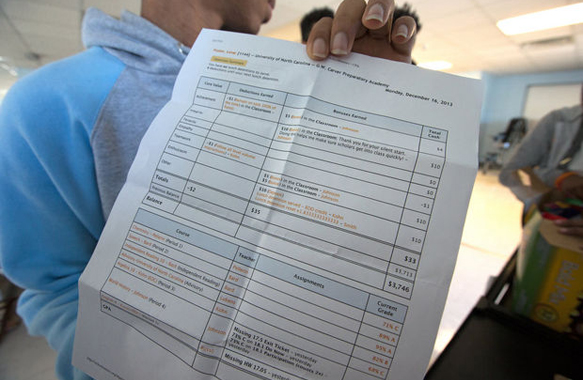
All Photographs represent aspects within the civil rights complaint. Tuesday, December 17, 2013. (Photo by Ted Jackson, Nola.com | The Times-Picayune)
What do we do when an ugly reality comes face-to-face with the pretty picture fame and fortune flaunted? Do we run? Do we hide? Do we conveniently forget or perhaps, we seek more information. We might ask for a comment or accept what is given. There is reason to believe that those who we thought could be trusted, inadvertently or not, led us astray. That is the quandary New Orleans residents find themselves in.
Most remember the day in 2010 when Oprah Winfrey drove into the city with a bundle of money. She donated and hand-delivered one million dollars to New Orleans Sci Academy. A year later, claims of systematic discrimination against disabled students appeared in the courts. The Oprah-Backed Charter Schoolwas among them. It is now 2014, years have passed since the revelation. And while Oprah remains silent New Orleans parents do not.

Civil Rights Complaint Targets New Orleans Charter Group Collegiate Academies

By Danielle Dreilinger | The Times-Picayune. April 15, 2014 at 10:02 AM, updated April 15, 2014 at 5:19 PM
A civil rights complaint filed Tuesday against New Orleans charter school managers Collegiate Academies alleges discipline so harsh that it violates federal laws and verges on abuse. A group calling itself the Better Education Support Team, plus more than 30 students and relatives, asked the U.S. Education and Justice departments’ civil rights divisions to investigate.
Their complaint details “out-of-control suspension practices for trivial matters” and “intimidation of students exercising First Amendment rights.” It also alleges a host of violations concerning students with disabilities.empathyeducates – Civil Rights Complaint Targets New Orleans Charter Group Collegiate Academies:

Some Advice for Common Core Supporters | Paul Bruno

Some Advice for Common Core Supporters | Paul Bruno:


Some Advice for Common Core Supporters

659315_5ba9794c89Yesterday at TWIE I gave CCSS supportersa hard time for seeming to give up the affirmative case for the new standards:
These days supporters seem to dedicate most of their time to assuring us that the CCSS are not to blame for “fuzzy” math curriculua or “whole language” or questionable history assignments. We are even told that it’s just as well if states opt out of the Common Core altogether because they’re unlikely to gain much from implementation anyway.
On Twitter Morgan Polikoff asked what I would prefer for CCSS supporters to do instead of making these half-hearted defenses. Fair enough, though I don’t really think of myself as part of the team so take all of this with a grain of salt. I’d recommend the following, which are arguably all variations on one or two themes:
1. CCSS supporters need to acknowledge that they overestimated the potential for standards per se to improve curriculum and instruction.Reformers are rarely comfortable wading into the minefields that are debates over C&I, but one of the lessons here should be that you can’t just lean on standards to do that work for you. Frankly, the science of teaching is just not sufficiently advanced and accepted that educators and families will all fall into line if you just give them the right goals to shoot for. Teachers already think their pedagogy is about right for whatever learning objectives you want to establish; if you want them to think differently you need to convince them directly. It is also increasingly apparent that you can’t avoid nasty battles over curriculum by saying “standards are not a curriculum”.  You may as well wage that war directly.
2. CCSS supporters should acknowledge that the new standards are not really as unambiguous as they had thought. By convincing themselves that opponents just don’t understand what the standards “really” say, supporters end up repeatedly missing the point. That tactic may work in a few cases, but Some Advice for Common Core Supporters | Paul Bruno:

Economic and Racial Inequality Obliterate Opportunity in America: Do We Care? | janresseger

Economic and Racial Inequality Obliterate Opportunity in America: Do We Care? | janresseger:


Economic and Racial Inequality Obliterate Opportunity in America: Do We Care?

The 50th anniversary this month of the passage of the Civil Rights Act has produced some soul-searching journalism.  How is it our society has made so little progress?
In an early April interview at Salon.com, Stanford University professor and education writer Linda Darling-Hammond describes the injustices in public education in the United States: “First of all, we have a dramatically unequal allocation of wealth in the society, which is getting worse…. Then we need schools that are equitably funded, with more money going to the students who have the greatest needs…And then beyond that, I think we have to be sure that the state builds a high-quality teaching force, well-prepared for all candidates… It’s a fundamental problem of the red-lining… around those schools that allowed them to become such poor places for teaching and learning.  That is the real problem that has to be addressed.”
During the same week, Valerie Strauss printed in the Washington Post a column by Economic Policy Institute advocate Elaine Weiss and New York University sociologist Patrick Sharkey in which they declared: “Stuck in place. That seems the most accurate description for the circumstances in which many African-American children and their families find themselves today… When it comes to neighborhood and school inequality, the federal government has always had a short attention span.  Small-scale, short-term initiatives to address urban disadvantage have come and gone, but our nation has never made a commitment to durable policies with the capacity to transform communities, schools, and the lives of families within them.  As a result, neighborhood inequality has been passed down to the current generation.  About two out of three African Americans who were raised in poor neighborhoods grow up and raise their own children in similarly poor neighborhoods compared to just two out of five whites… These disturbing statistics indicate that racial inequality is multi-generational.  The challenges facing black children today are a continuation of the disadvantages experienced by generations of their family members. And the cumulative experience of life in the nation’s most disadvantaged neighborhoods is most severe.”
Then  last Saturday’s NY Times published a disturbing and moving reflection on racial segregation by columnist Charles M. Blow:  “The landmark act brought an end to legal racial segregation in public places.  But now we are facing another, worsening kind of segregation Economic and Racial Inequality Obliterate Opportunity in America: Do We Care? | janresseger:

Polling Center: Leaving Tests Behind | The Texas Tribune

Polling Center: Leaving Tests Behind | The Texas Tribune:


Polling Center: Leaving Tests Behind

Bayless Elementary teacher Holly Guillmen identifies and explains the use of the contents of the Waterwise home water conservation kit provided to students by the High Plains Underground Water District in Lubbock, Texas, Oct. 17, 2012.
Amid the monumental advancements celebrated during last week’s Civil Rights Summit at the LBJ Presidential Library,George W. Bush’s little noticed reminder of “the tyranny of low expectations” highlighted a shift in attitudes toward accountability in public education.
Texans have largely abandoned one of the weapons championed by Bush in the fight against that tyranny — frequent, high-stakes testing — marking yet another way in which the Bush era in Texas seems a distant memory. That once-popular standardized testing has become anathema to much of the public — so much so that it has become a political weapon in the current gubernatorial campaign.
The breadth of current public opposition to K-12 testing in the public schools is a marked change from the mythic era of good feeling in Texas politics presided over by then-Gov. Bush, Lt. Gov. Bob Bullock and Speaker of the House Pete Laney. Those good feelings included warm fuzzies for Bush’s education policies and certainly helped in getting him elected president. But attitudes captured in the University of Texas/Texas Tribune Poll suggest that the good feelings toward accountability through testing have gone the way of those friendly weekly breakfasts shared by the Big Three way back when.
In the 2013 session, in a rebuke to Bush’s reforms, the Legislature voted overwhelmingly to reduce the number of standardized tests required to graduate from Texas public high schools to five from 15. In the June 2013 UT/TT Poll, as the session came to a close, we asked Texas voters whether they approved of this change. Overall, 60 percent of Texans expressed Polling Center: Leaving Tests Behind | The Texas Tribune:

At Shanker: Are Americans (and Texans) as Stupid as the Media Tells Us We Are? | Cloaking Inequity

At Shanker: Are Americans (and Texans) as Stupid as the Media Tells Us We Are? | Cloaking Inequity:


At Shanker: Are Americans (and Texans) as Stupid as the Media Tells Us We Are?

Screen Shot 2014-04-17 at 7.07.29 AM
The media onslaught letting Americans know that they are dunces has gone on for decades. How stupid are we? You might be surprised that the news about our public education system in the United States is not actually as bad as you have been led to believe… Last week I travelled to Washington D.C. to participate in the Reclaiming the Promise of Public Education conversation series at the Albert Shanker Institute. The topic of conversation was theAmerican Education in Global Perspective. The Shanker Institute writes:
Since the 1995 introduction of the TIMSS studies (Trends in International Mathematics and Science Study) and the 2000 start of the PISA assessments (Program for International Student Assessment), much ink has been spilled on the subject of where American schools and American students stand vis-Ć -vis their international counterparts. While the TIMSS and PISA rankings themselves are straightforward, there is considerable disagreement, often contentious, over what those international comparisons tell us about the state of American education. Both market critics of American public education and critics of the market-based reforms of the last decade and a half point to American education’s international standing as evidence that supports their respective policy agendas, while others dispute the very suggestion that meaningful causal links can be drawn between the international rankings and broad policy agendas. Other flash points revolve around how educational performance is shaped by the rate of childhood poverty, by the professional status of teachers, and by the existence of a national curriculum and national standards. The panel discussed these and other facets of America’s education from a global perspective.
This post is video heavy rather than text. I have also included the web links to the powerpoint, prezi and report after At Shanker: Are Americans (and Texans) as Stupid as the Media Tells Us We Are? | Cloaking Inequity:

NYC Educator: Rhee's Two Takes on her Taping Incident

NYC Educator: Rhee's Two Takes on her Taping Incident:


Rhee's Two Takes on her Taping Incident

 by guest blogger Arwen E.

Michelle Rhee popped up in The Washington Post this month glorifying the same standardized tests from which so many parents seek to shelter their children.  It is so strange to me, in this day and age, that one who started her career with a glaring example of child abuse could come so far and exercise so much influence upon our public-school system.  I would like to briefly revisit that incident, including her more recent attempts to rewrite her own history.  

In an online Financial Times article entitled, "Lunch with the FT:  Controversial Schools Reformer Michelle Rhee," October 4, 2013, Edward Luce quotes Rhee, "I think when I took the job in DC, I was not particularly savvy about the media.  People asked me for interviews, I answered the questions and because I was so honest about my thoughts, it gave them the material. I can’t blame anyone other than myself for that. I was stupid.”


Luce asked her, among other things, about her incident taping students' lips at Harlem Park in Baltimore.  Rhee explained that she had asked her rowdy class to put their fingers to their lips as they passed other classrooms on the way to lunch:  "One of the boys asked for a strip of Scotch tape instead and suddenly everyone wanted the same thing,” she says. “And when I removed the strips, one of the boy’s dry lips bled a little. That’s all that happened. Now it’s turned into, ‘Michelle Rhee duct tapes children!’  But the only reason anyone knows the story in the first NYC Educator: Rhee's Two Takes on her Taping Incident:

Mike Klonsky's SmallTalk Blog: SAVING GRESHAM

Mike Klonsky's SmallTalk Blog: SAVING GRESHAM:


SAVING GRESHAM

Tuesday's protest to save Gresham        (Sun-Times)
DIEDRUS BROWN...the principal of embattled Gresham Elementary on Chicago's south side, continued her very vocal fight Tuesday to save her school from undergoing a so-called “turnaround” — but this time with about 40 teachers, parents and students marching with her.

SUSPENSIONS...Dozens of students marched from Chicago Public Schools headquarters to the Thompson Center Wednesday in support of state legislation that would set new limits on suspensions and expulsions. The march, organized by Voices of Youth in Chicago Education, protested alleged bias in school disciplinary practices and backed state Senate Bill 3004 setting stricter standards for offenses that can result in suspension or expulsion.
"We're not asking for no discipline," said Mariama Bangura, a junior at Roosevelt High School and a youth leader for VOYCE and the Albany Park Neighborhood Council. "We're asking for common-sense discipline." -- DNAinfo
KAREN LEWIS is on the case. The CTU prez has an op-ed in yesterday's S-T, making no bones Mike Klonsky's SmallTalk Blog: SAVING GRESHAM: