Latest News and Comment from Education

Friday, January 27, 2012

Today's Big Education Ape - PostRank Top Early Afternoon Posts 1-27 #ows #edreform


Where did she go? Emily Alpert Former Voice of San Diego Reporter Joins the LA Times - FishbowlLA

Former Voice of San Diego Reporter Joins the LA Times - FishbowlLA:Former Voice of San Diego Reporter Joins the LA TimesBy Matthew Fleischer on January 17, 2012 10:00 AMLooks like former Voice of San Diego reporter Emily Alpert has landed on her feet. Alpert was one of three VoSD journos laid off shortly before the new year due to fundraising shortages at the journalistic nonprofit. According to her Twitter account, Alpert has since moved north to join the LA Times ... more »

All Education Matters: Why America Is Losing the War On Poverty

All Education Matters: Why America Is Losing the War On Poverty:Why America Is Losing the War On Povertyby Cryn JohannsenHere's a snippet from my latest article, "Why America Is Losing the War on Poverty," at The Loop21.com:Recent figures about poverty in America paint a grim picture about the living conditions of a large majority of Americans. Not only is poverty spreading rapidly, but the chances of escaping it are becoming more difficult, if not impossible. For instance, Timothy Smeeding wrote ... more »

Major Bill Actions in Education - U.S. Congress - OpenCongress

Education - U.S. Congress - OpenCongress:Bill Sent To President: H.R.3237 SOAR Technical Corrections ActOpen Congress : Major Bill Actions in Education - 12 minutes agoTo amend the SOAR Act by clarifying the scope of coverage of the Act. January 25, 2012: Presented to President.Bill Introduced: H.R.3826 To amend the Higher Education Act of 1965 to extend the reduced interest rate for Federal Direct Stafford Loans.Open Congress : Major Bill Actions in Education - 12 minutes agoTo amend the Higher Education ... more »

Weekly Update, January 27, 2012: In Tucson racism is alive and well, Rahm bus(ted) in Chicago and other stories in education | Seattle Education

Weekly Update, January 27, 2012: In Tucson racism is alive and well, Rahm bus(ted) in Chicago and other stories in education | Seattle Education:Weekly Update, January 27, 2012: In Tucson racism is alive and well, Rahm bus(ted) in Chicago and other stories in educationby seattleducation2011This has not been a slow news week so I’ll get started with all the news that fits.First up, the teachers and students in Tucson. If you haven’t been following this story, I would recommend that ... more »

5 Biggest Lies About the Right-Wing Corporate-Backed War on Our Schools | | AlterNet

5 Biggest Lies About the Right-Wing Corporate-Backed War on Our Schools | | AlterNet:5 Biggest Lies About the Right-Wing Corporate-Backed War on Our SchoolsThough National School Choice Week has some liberal support, its primary backers are deeply conservative activists whose goal is to dissolve public education in the US.January 23, 2012 | LIKE THIS ARTICLE ?Join our mailing list:Sign up to stay up to date on the latest headlines via email. National School Choice Week, a pet project of big ... more »

Can Codecademy Teach Poor Black & Brown Kids to Code?

Can Codecademy Teach Poor Black Brown Kids to Code?:Can Codecademy Teach Poor Black Brown Kids to Code?By Marshall Kirkpatrick / January 18, 2012 8:02 PM / 19 CommentsinShare76Share on TumblrUnemployment among youth of color is widespread complex; can a tech education startup change things?The White House announced new participation in a jobs initiative yesterday from fast-growing technical education website Codecademy, as well as some venerable social justice oriented organizations Level Playing Field Institute and College Bound Brotherhood, a group dedicated ... more »

Schools Matter: GUEST BLOG: IDOE–Shrinking State Power to Expose Your Tender Underbelly (UPDATE)

Schools Matter: GUEST BLOG: IDOE–Shrinking State Power to Expose Your Tender Underbelly (UPDATE):GUEST BLOG: IDOE–Shrinking State Power to Expose Your Tender Underbelly (UPDATE)by P. L. ThomasIDOE–Shrinking State Power to Expose Your Tender Underbelly (UPDATE)by Douglas Storm[UPDATE in the body of the text]Indiana is at the forefront of a concerted and aggressive drive to weaken state power. That sounds good to so many of us, especially those who believe there is a libertarian with a good heart out there. But here’s ... more »

VIDEO: Dallas ISD board meeting turns chaotic before vote to close schools | Dallas ISD Blog | dallasnews.com

VIDEO: Dallas ISD board meeting turns chaotic before vote to close schools | Dallas ISD Blog | dallasnews.com:VIDEO: Dallas ISD board meeting turns chaotic before vote to close schoolsby Matthew Haag/ReporterThe Dallas school board voted Thursday night to close 11 schools -- but not before the audience taunted and yelled at trustees, police escorted community activist Joyce Foreman from the auditorium and board members moved to another room. It was a chaotic scene, and Tawnell Hobbs captured it all:

4LAKids - some of the news that doesn't fit

4LAKids - some of the news that doesn't fit:TWO L.A. UNIFIED SCHOOLS WIN $100,000 GRANTS FROM TARGETsmf at 4LAKids - some of the news that doesn't fit - 6 hours ago-- Rick Rojas | la tIMES/la nOW | http://lat.ms/yDWdEK January 25, 2012 | 7:42 pm :: Two Los Angeles Unif-ed schools, nominated by viewers of Ellen DeGeneres' daytime talk show, have received $100,000 grants from Target, the district announced Wednesday. Crenshaw High School and Enadia Way Elementary School were two ... more »

Modern School: Data Driven Nonsense--Few Credible Studies of Charter Schools

Modern School: Data Driven Nonsense--Few Credible Studies of Charter Schools:Data Driven Nonsense--Few Credible Studies of Charter Schoolsby Michael DunnTeachers in the trenches have long suspected that the “data-driven” reforms being shoved down their throats by Gates, Broad, Walton, Obama, Duncan, Rhee, et al, had little credible data to back them up and little hope of improving educational outcomes for their students. An article in the latest issue of Science (reposted on EurekAlert) lends credibility to these suspicions.According to UC San ... more »

Letter From Reynoso Indicates UCD Police Not Cooperating With Investigation #ows

Letter From Reynoso Indicates UCD Police Not Cooperating With Investigation:Letter From Reynoso Indicates UCD Police Not Cooperating With InvestigationWritten by David GreenwaldWednesday, 25 January 2012 04:20A letter from former Supreme Court Justice Cruz Reynoso sent to UC President Mark Yudof indicates there will be delays in the original timeline. The delay means that Justice Reynoso is now "targeting February 21, 2012 for the release of the report of the Task Force."Mr. Reynoso indicates the changes result "primarily from our negotiations ... more »

Comprehensive, Continuous, and Coherent Assessment « The Whole Child Blog « Whole Child Education

Comprehensive, Continuous, and Coherent Assessment « The Whole Child Blog « Whole Child Education:Comprehensive, Continuous, and Coherent Assessmentby Klea ScharbergOur goal is to educate students who are healthy, safe, engaged, supported, and challenged and who are ready for the demands of college, career, and citizenship. Through a combination of assessments of and for learning, such as growth models; portfolios; criterion-referenced tests; norm-referenced tests; computer adaptive assessments; diagnostic evaluations; and formative, interim, and summative assessments; we get a more... more »

NYC Public School Parents: The decline of science education in NYC high schools as shown by the falling number of Intel submissions and semi-finalists

NYC Public School Parents: The decline of science education in NYC high schools as shown by the falling number of Intel submissions and semi-finalists:The decline of science education in NYC high schools as shown by the falling number of Intel submissions and semi-finalistsby Leonie HaimsonThese posts about the decline of independent science research at NYC high schools – especially at the less selective non-specialized high schools – were written and researched by NYC parents Steve Koss and Melvin Meer. For ... more »

Jersey Jazzman: NOLA: Charter Nirvana

Jersey Jazzman: NOLA: Charter Nirvana:NOLA: Charter Nirvanaby DukeRick Hess took the week off and left the keys to his blog with Neerav Kingsland, the chief strategy officer for New Schools for New Orleans. His posts this week - here, here, here, and here - are both astonishing and infuriating.Astonishing because they call for a radical upending of public education through the entire country. Infuriating because Kingsland simply ignores the primary issue with charter school expansion:In the following letter I aim ... more »

Today's Big Education Ape - PostRank Top 1-26 Early Evening Posts #ows #edreform

Life in Rahm’s Chicago. Thursday edition. « Fred KlonskyBig Education Ape - PostRank (PostRank: All)-58 minutes agoLife in Rahm’s Chicago. Thursday edition. « Fred Klonsky:Life in Rahm’s Chicago. Thursday edition.by Fred KlonskyRahm doesn’t think pay-for-protesters is a problem.And his hand-picked board of education seems to have skipped a step. They’re budgeting for turnarounds before all the public hearings and actually taking a vote.The Sun-Times:The mayor was not concerned.“The ministers have a right — who have been long involved in school ... more »

SACRAMENTO PROGRESSIVE ALLIANCE: Demonstrators Protest Rhee and Corporate Agenda for Schools

SACRAMENTO PROGRESSIVE ALLIANCE: Demonstrators Protest Rhee and Corporate Agenda for Schools:Demonstrators Protest Rhee and Corporate Agenda for Schoolsby Duane Campbell“Silent” protestors with their mouths tapedshut confronted Sacramento MayorKevin Johnson and corporate education proponent Michelle Rhee as they entereda carefully promoted andcontrolled discussion abouteducation issues at the Tsakopoulos Library Galleria, 828 I St, in Sacramentoon Wednesday, January 25.Demonstrators held a news briefing with local mediaoutlets. The Sacramento Bee didnot

NYC Public School Parents: Concerns with the MRDC study on small schools released today

NYC Public School Parents: Concerns with the MRDC study on small schools released today:Concerns with the MRDC study on small schools released todayfrom NYC Public School Parents by Leonie HaimsonMDRC released a study today, which the NY Times writes “appeared to validate the Bloomberg administration’s decade-long push to create small schools to replace larger, failing high schools.” The report mentions the current controversy over the massive number of school closings, here in NYC and across the country, and thus there ... more »

No-Day Lobby Day. « Fred Klonsky

No-Day Lobby Day. « Fred Klonsky:No-Day Lobby Day.by Fred KlonskyI don’t know why the leaders of the IEA decided not to mobilize teachers for Lobby Day in Springfield this year.I know that their stated reason, that the Capitol building is under renovation, doesn’t make any sense. We have met with Park Ridge State Senator Dan Kotowski in his Capitol building office, in his office when it was in some

Life in Rahm’s Chicago. Thursday edition. « Fred Klonsky

Life in Rahm’s Chicago. Thursday edition. « Fred Klonsky:Life in Rahm’s Chicago. Thursday edition.by Fred KlonskyRahm doesn’t think pay-for-protesters is a problem.And his hand-picked board of education seems to have skipped a step. They’re budgeting for turnarounds before all the public hearings and actually taking a vote.The Sun-Times:The mayor was not concerned.“The ministers have a right — who have been long involved in school reform, longer school day, turnaround schools, who don’t accept the status quo — to speak up,” ... more »

RheeFirst! » Protesters stage duct-taped “silent protests” on Rhee’s home turf

RheeFirst! » Protesters stage duct-taped “silent protests” on Rhee’s home turf:Protesters stage duct-taped “silent protests” on Rhee’s home turfby adminA spirited “silent protest” was held in Rhee’s home turf last night. Rhee’s “Town Hall” had advertised itself as open to all Sacramento residents but a member of the public shown here was turned away because she did not belong to StudentsFirst or Stand for Children.Eventually, Rhee and her employees noted the growing number of protesters standing outside with their mouths

New Brief Detailing Failure of Mayor’s School Closings Policy « EdVox

New Brief Detailing Failure of Mayor’s School Closings Policy « EdVox:

New Brief Detailing Failure of Mayor’s School Closings Policy

“School Closures: A Shell Game with Students” shows that lower percentages of high-needs students at Bloomberg’s new schools inflated performance. Click here to read the policy brief!

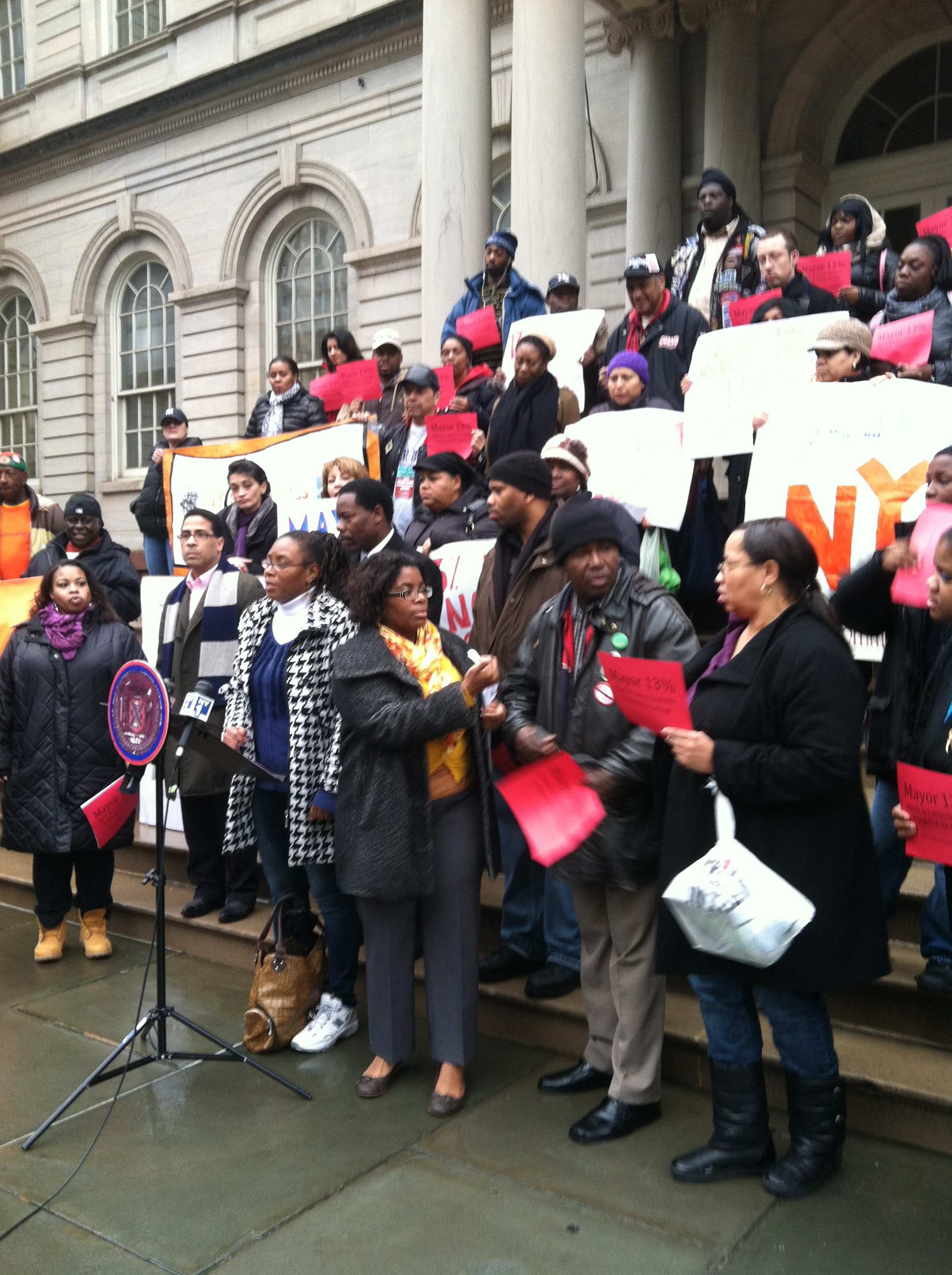
Parents, elected officials and advocates gathered on the City Hall steps

(January 27, 2012 – New York, NY) About a dozen elected officials joined the City’s largest public school and parent-led organizations today on the steps of City Hall to release a report with new statistics detailing the failure of Mayor Bloomberg’s education reforms—particularly his school closings policy. The group demanded immediate action to suspend and reverse failed policies.

The report provides evidence that key Bloomberg “reforms” such as school closings have not produced the gains that the Mayor has claimed over the past decade. Elected officials and advocates today called the closings

NYC Public School Parents: Deadline Mon. Jan. 30 on the state's awful NCLB waiver proposal; please make your voice heard

NYC Public School Parents: Deadline Mon. Jan. 30 on the state's awful NCLB waiver proposal; please make your voice heard:

Deadline Mon. Jan. 30 on the state's awful NCLB waiver proposal; please make your voice heard

The NY State Education Department is proposing to submit a NCLB waiver request to the US Dept. of Education that is posted here. The deadline for public comment is 5 PM, this Monday, Jan. 30.

While purporting to create more district “flexibility,” it will actually lead to even more standardized testing, more test prep, more teachers unfairly fired and schools closed, and hundreds of millions of dollars wasted, while our kids suffer from budget cuts and even larger classes.
Please send a message today! A sample email, adapted and expanded from a letter signed onto by 1/3 of all NYS principals, is below. The comments should be sent to eseathnktank@mail.nysed.gov, with a copy to the Regents who appoint the Commissioner, and Speaker Silver, who is responsible for the appointment of the

Jersey Jazzman: Merit Pay Fails Outside of Schools

Jersey Jazzman: Merit Pay Fails Outside of Schools:

Merit Pay Fails Outside of Schools

Merit pay is a disaster wherever it goes:
We’ve talked about this since the financial meltdown. Now it’s time to do it: Unlink pay from performance. The evidence keeps growing that pay for performance is ineffective. It also may induce executives to take company-killing risks. There are other ways to motivate employees that yield better results at lower cost.
Thanks mainly to provisions linked to performance, CEO compensation has skyrocketed in recent decades, while its correlation with actual corporate performance has remained as weak as ever. This has been most true in the U.S., where among the S&P 500 the ratio of average CEO pay to

Blue Jersey:: Liars For Yahweh! How The Tikun Olam Charter School Got A $600,000 Federal Grant

Blue Jersey:: Liars For Yahweh! How The Tikun Olam Charter School Got A $600,000 Federal Grant:

Liars For Yahweh! How The Tikun Olam Charter School Got A $600,000 Federal Grant

An infuriating and amazing story. Superb reporting by Chris Rodda, Senior Research Director for the Military Religious Freedom Foundation (MRFF), and author of Liars For Jesus: The Religious Right's Alternate Version of American History.
Promoted by Rosi, with thanks to Chris.

Cross-posted from The Public Record.

Question: How does a charter school whose multiple applications have been riddled with lies and misrepresentations and has been rejected three times by a state education department get approved for a $600,000 grant from the federal government?
Answer: The federal government admittedly does not routinely fact-check grant applications for charter schools, and does not allow the private consultants it hires to look at the grant applications to look at any information other than what's in the grant application.

That's right, an applicant for a federal grant for a charter school can say whatever they want to in their application, true or false, and nothing they say will be questioned, even if their application has already been

SB 161 Antiseizure Medication Law FAQs - Health Services & School Nursing (CA Dept of Education)

Antiseizure Medication Law FAQs - Health Services & School Nursing (CA Dept of Education):

Antiseizure Medication Law FAQs

Frequently asked questions pertaining to SB 161 antiseizure medication law.

Q: Does SB 161 apply only to diazepam, or also to other medications approved by the federal Food and Drug Administration (FDA) for this purpose?

A: The "emergency antiseizure medication" in SB 161 means diazepam rectal gel and emergency medications approved by the federal FDA for patients with epilepsy for the management of seizures by persons other than (1) a physician and surgeon; (2) a physician assistant; (3) a credentialed school nurse; (4) a registered nurse; (5) a certificated public health nurse.

Q: Will school nurses train personnel to administer diastat?

A: If a school district, county office of education, or charter school chooses to participate in a program to provide nonmedical school employees with voluntary emergency medical training to provide, in the absence of a credentialed school nurse or other licensed nurse onsite at the school or charter school, emergency medical assistance, including the administration of emergency antiseizure medication to pupils with epilepsy suffering from seizures, any training of volunteers must be done by one or more of the following: (1) a physician and surgeon; (2) a physician assistant; (3) a credentialed school nurse; (4) a registered nurse; (5) a certificated public health nurse.

Q: Should school nurses be assigned to students to administer diastat?

A: The law does not reference "assignment" of personnel to individual students. SB 161 states that, whenever possible, an emergency antiseizure medication should be administered by a school nurse or licensed vocational nurse who has been trained in its administration. A school district, county office of education, or charter school may choose to participate in a program to provide nonmedical school employees with voluntary emergency medical training to provide, in the absence of a credentialed school nurse or other licensed nurse onsite at the school or charter school, emergency medical assistance, including the administration of emergency antiseizure medication to pupils with epilepsy suffering from seizures.

Q: Should schools start training as of January 1?

A: SB 161 went into effect January 1, 2012. Guidelines on training and supervision are due to be posted by no later than July 1, 2012. The voluntary emergency medical training provided under this program must be consistent with the guidelines that are to be posted by July 1. Any emergency medical assistance provided by trained volunteers under this program must be provided using the guidelines that are to be posted by July 1, 2012.

Q: Who does the training?

A: Any training of volunteers must be done by one or more of the following: (1) a physician and surgeon; (2) a physician assistant; (3) a credentialed school nurse; (4) a registered nurse; (5) a certificated public health nurse.

Local educational agencies are encouraged to consult their respective legal counsel as needed if they have any questions relating to SB 161.

RheeFirst! » Selling Schools Out

RheeFirst! » Selling Schools Out:

Selling Schools Out

Written by Lee Fang for The Nation. Read the entire article here.
If the national movement to “reform” public education through vouchers, charters and privatization has a laboratory, it is Florida. It was one of the first states to undertake a program of “virtual schools” — charters operated online, with teachers instructing students over the Internet — as well as one of the first to use vouchers to channel taxpayer money to charter schools run by for-profits.

According to author Steven Brill, ex–DC school chancellor Michelle Rhee’s new group, StudentsFirst, [actively lobbying in Florida] raised $100 million… Rhee’s donors include Rupert Murdoch, philanthropist Eli Broad and Home Depot founder Ken Langone. Rhee’s group has pledged to spend more than $1 billion to bring for-profit

Parents 4 Teachers says, “Call Brizard.” « Fred Klonsky

Parents 4 Teachers says, “Call Brizard.” « Fred Klonsky:

Parents 4 Teachers says, “Call Brizard.”

Hi Fred,
My name is Erica–I’m a CPS parent (going on 14 years in the system!), an avid reader of your blog, and really ticked off at what passes for education debate in the country, state, city these days.
For the last year, I’ve been complaining (to anyone who would listen) that parents need to get organized and stand up to the teacher bashing that is so fashionable these days. The way I see it, as long as the 99 percent and their mouthpieces can blame teachers for what ails education, we’re never going make the real changes we need to improve our schools.
So I and a few friends decided to stop complaining and get to work. We’ve formed a new (very new) and still

“Shorting” New York City’s Schools? | Edwize

“Shorting” New York City’s Schools? | Edwize:

Shorting” New York City’s Schools?

Hedge fund manager David Einhorn was in the news this week after he and his firm were hit with an $11.2 million fine for insider trading. Based on an investigation by authorities in the UK, Einhorn was cited for selling millions of shares of a troubled business just minutes after an executive there quietly revealed to him that the company was in financial trouble:

“Einhorn is an experienced professional with a high profile in the industry,” said Tracey McDermott, the FSA’s acting enforcement chief. “We expect someone in his position to be able to identify inside information when he receives it and to act appropriately. His failure to do so is a serious breach.”

If the name sounds familiar to many New Yorkers, it may be because of his recent flirtation with becoming the white knight of the beleaguered Mets franchise; others may remember him for his fame as the financial analyst whose decision to bet on the collapse of Lehman Brothers made

Remarks by the President on College Affordability, Ann Arbor, Michigan | The White House

Remarks by the President on College Affordability, Ann Arbor, Michigan | The White House:

Remarks by the President on College Affordability, Ann Arbor, Michigan

Release Time:
For Immediate Release

University of Michigan
Ann Arbor, Michigan

10:00 A.M. EST

THE PRESIDENT: Hello, Michigan! (Applause.) Oh, it is good to be back in Ann Arbor. (Applause.)

Thank you, Christina, for that introduction. I also want to thank your president, Mary Sue Coleman. (Applause.) The mayor of Ann Arbor, John Hieftje, is here. (Applause.) My outstanding Secretary of Education, Arne Duncan, is in the house. (Applause.) We have some outstanding members of Congress who are here as well, who are representing you each and every day. Give them a round of applause -- come on. (Applause.)

AUDIENCE MEMBER: I love you, President Obama!

THE PRESIDENT: I love you back. (Applause.)

So in terms of -- boy, we've got all kinds of members of Congress here, so -- (laughter.)

Where's Denard? (Applause.) Denard Robinson is in the house. (Applause.) I hear you're coming back, man. (Applause.) That is a good deal for Michigan. (Applause.)

AUDIENCE MEMBER: Denard Robinson in 2012! (Laughter.)

THE PRESIDENT: Oh, oh, come on. They're trying to draft you for President. (Laughter.) He's got to graduate before he runs for President. (Laughter.) There's an age limit. (Laughter.)

Well, it is wonderful to be here. I want to thank all of you for coming out this morning. I know for folks in college, this is still really early. I remember those days. It is good home -- good to be in the home of the Sugar Bowl champion Wolverines. (Applause.) And with Denard Robinson coming back, this will be a team to be reckoned with. I understand your basketball team is pretty good this year, too. (Applause.) All right -- go, Blue! (Applause.) It's always good to start with a easy applause line. (Laughter.)

But the reason I'm here today -- in addition to meeting Denard Robinson -- (laughter) -- is to talk with all of you about what most of you do here every day -- and that is to think about how you can gain the skills and the training you need to succeed in this 21st century economy. And this is going to be one of the most important issues that not just you face, but this entire country faces: How can we make sure that everybody is getting the kind of education they need to personally succeed but also to build up this nation -- because in this economy, there is no greater predictor of individual success than a good education.

Today, the unemployment rate for Americans with a college degree or more is about half the national average. Their incomes are twice as high as those who don’t have a high school diploma. College is the single most important investment you can make in your future. And I'm proud that all of you are making that investment. (Applause.)

And the degree you earn from Michigan will be the best tool you have to achieve that basic American promise -- the idea that if you work hard, if you are applying yourself, if you are doing the right thing, you can do well enough to raise a family and own a home and send your own kids to college, put away a little for retirement, create products or services -- be part of something that is adding value to this country and maybe changing the world. That's what you're striving for. That's what the American Dream is all about.

And how we keep that promise alive is the defining issue of our time. I don’t want to be in a country where we only are looking at success for a small group of people. We want a country where everybody has a chance. (Applause.) Where everybody has a chance. We don't want to become a country where a shrinking number of Americans do really well while a growing number barely get by. That’s not the future we want. Not the future I want for you, it's not the future I want for my daughters. I want this to be a big, bold, generous country where everybody gets a fair shot, everybody is doing their fair share, everybody is playing by the same set of rules. That’s the America I know. That’s the American I want to keep. That's the future within our reach. (Applause.)

Now, in the State of the Union on Tuesday, I laid out a blueprint that gets us there. Blueprint -- it's blue. (Laughter and applause.) That's no coincidence. I planned it that way, Michigan. (Laughter.) A blueprint for an economy that’s built to last.

It’s an economy built on new American manufacturing -- because Michigan is all about making stuff. (Applause.) If there's anybody in America who can teach us how to bring back manufacturing, it is the great state of Michigan. (Applause.)

On the day I took office, with the help of folks like Debbie Stabenow, your senator, and Carl Levin and -- (applause) -- John Conyers -- the American auto industry was on the verge of collapse. And some politicians were willing to let it just die. We said no. We believe in the workers of this state. (Applause.) I believe in American ingenuity. We placed our bets on the American auto industry, and today, the American auto industry is back. Jobs are coming back -- (applause) -- 160,000 jobs.

And to bring back even more jobs, I want this Congress to stop rewarding companies that are shipping jobs and profits overseas, start rewarding companies who are hiring here and investing here and creating good jobs here in Michigan and here in the United States of America. (Applause.)

So our first step is rebuilding American manufacturing. And by the way, not all the jobs that have gone overseas are going to come back. We have to be realistic. And technology means that a larger and larger portion of you will work in the service sector as engineers and computer scientists. (Applause.) There you go. We got the engineering school -- there you go. (Applause.) And entrepreneurs. So there’s going to be a lot of activity in the service sector. But part of my argument, part of the argument of Michigan’s congressional delegation is that when manufacturing does well, then the entire economy does well.

The service sector does well if manufacturing is doing well, so we’ve got to make sure that America isn’t just buying stuff, but we’re also selling stuff -- all around the world, products stamped with those three proud words: Made In America. (Applause.)

An economy built to last is also one where we control our energy needs. We don't let foreign countries control our energy supplies. Right now, America is producing more of our own oil than we were eight years ago. That's good news. (Applause.) As a percentage, we’re actually importing less than any time in the last 16 years.

But -- I think young people especially understand this -- no matter how much oil we produce, we’ve only got 2 percent of the world’s oil reserves. And that means we’ve got to focus on clean, renewable energy. (Applause.) We’ve got to have a strategy that, yes, is producing our own oil and natural gas. But we’ve also got to develop wind and solar and biofuels. (Applause.)

And that is good for our economy. It creates jobs. But it’s also good for our environment. (Applause.) It also makes sure that this planet is sustainable. That’s part of the future that you deserve.

We've subsidized oil companies for a century. That’s long enough. Congress needs to stop giving taxpayer dollars to an oil industry that’s never been more profitable, and double down on a clean energy future that’s never been more promising. (Applause.)

I don’t want to cede the wind or the solar or the battery industry to China or Germany because we were too timid, we didn’t have the imagination to make the same commitment here. And I want those jobs created here in the United States of America. And I also want us to think about energy efficiency, making sure -- we’ve already doubled fuel efficiency standards on cars. Part of Detroit coming back is creating more fuel-efficient cars here in Michigan -- (applause) -- and more fuel-efficient trucks. And we’ve got to revamp our buildings to make them more fuel-efficient.

And we -- if we are focused on this, we can control our energy future. That’s part of creating an America that’s built to last.

And we’ve got to have an economy in which every American has access to a world-class higher education, the kind you are getting right here at the University of Michigan. (Applause.)

My grandfather got the chance to go to college because this country decided that every returning veteran of World War II should be able to afford it. My mother was able to raise two kids by herself because she was able to get grants and work her way through school. I am only standing here today because scholarships and student loans gave me a shot at a decent education. Michelle and I can still remember how long it took us to pay back our student loans. (Laughter.)

AUDIENCE MEMBER: Tell the First Lady we wish her happy birthday!

THE PRESIDENT: I will tell Michelle you said happy birthday. (Applause.)

But I just want all of you to understand, your President and your First Lady were in your shoes not that long ago. (Laughter.) We didn’t come from wealthy families. The only reason that we were able to achieve what we were able to achieve was because we got a great education. That’s the only reason. (Applause.) And we could not have done that unless we lived in a country that made a commitment to opening up opportunity to all people. (Applause.)

The point is, this country has always made a commitment to put a good education within the reach of all who are willing to work for it, and that’s part of what helped to create this economic miracle and build the largest middle class in history.
And this precedes even college. I mean, we were -- we helped to begin the movement in industrialized countries to create public schools, public high schools, understanding that as people are moving from an agricultural sector to an industrial sector, they were going to need training.

Now we've moved to an information age, a digitalized age, a global economy. We've got to make that same commitment today. (Applause.)

Now, we still have, by far, the best network of colleges and universities in the world. Nobody else comes close. Nobody else comes close. (Applause.) But the challenge is it's getting tougher and tougher to afford it. Since most of you were born, tuition and fees have more than doubled. That forces students like you to take out more loans and rack up more debt.

In 2010, graduates who took out loans left college owing an average of $24,000. That's an average. Are you waving because you owe $24,000 or -- (laughter.)

Student loan debt has now surpassed credit card debt for the first time ever. Think about that. That’s inexcusable. In the coming decade, 60 percent of new jobs will require more than a high school diploma. Higher education is not a luxury. It's an economic imperative that every family in America should be able to afford. And when I say higher education, I don't just mean four-year colleges and universities; I also mean our community colleges and providing lifelong learning for workers who may need to retrain for jobs when the economy shifts. All those things cost money, and it's harder and harder to afford. (Applause.)

So we've got to do something to help families be able to afford -- and students to be able to afford -- this higher education. We've all got a responsibility here.

Thanks to the hard work of Secretary Duncan, my administration is increasing federal student aid so more students can afford college. (Applause.) And one of the things I'm proudest of, with the help of all these members of Congress, we won a tough fight to stop handing out tens of billions of dollars in taxpayer subsidies to banks that issue student loans and shift that money to where it should go, directly to the students and to the families who need it. (Applause.)

Tens of billions of dollars that were going to subsidies for banks are now going to students in the form of more grants and lower rates on loans. We’ve capped student loan payments so that nearly 1.6 million students -- including a bunch of you -- are only going to have to pay 10 percent of your monthly income towards your loans once you graduate -- 10 percent of your monthly income. (Applause.)

So that’s what we’ve been doing. Now Congress has to do more. Congress needs to do more. They need to stop the interest rates on student loans from doubling this July. That's what’s scheduled to happen if Congress doesn't act. That would not be good for you. (Laughter.) So you should let your members of Congress know: Don't do that. Don't do it. Don't do it.

They need to extend the tuition tax credit that we’ve put in place that’s saving some of you and millions of folks all across the country thousands of dollars. And Congress needs to give more young people the chance to earn their way through college by doubling the number of work-study jobs in the next five years. (Applause.)

So the administration has a job to do. Congress has a job to do. But it’s not just enough to increase student aid, and you can imagine why. Look, we can’t just keep on subsidizing skyrocketing tuition. If tuition is going up faster than inflation, faster than even health care is going up, no matter how much we subsidize it, sooner or later, we’re going to run out of money. And that means that others have to do their part. Colleges and universities need to do their part to keep costs down as well. (Applause.)

Recently, I spoke with a group of college presidents who’ve done just that. Here at Michigan, you’ve done a lot to find savings in your budget. We know this is possible. So from now on, I’m telling Congress we should steer federal campus-based aid to those colleges that keep tuition affordable, provide good value, serve their students well. (Applause.) We are putting colleges on notice -- you can’t keep -- you can't assume that you’ll just jack up tuition every single year. If you can’t stop tuition from going up, then the funding you get from taxpayers each year will go down. We should push colleges to do better. We should hold them accountable if they don’t. (Applause.)

Now, states also have to do their part. I was talking to your president -- and this is true all across the country -- states have to do their part by making higher education a higher priority in their budgets. (Applause.) Last year, over 40 states cut their higher education spending -- 40 states cut their higher education budget. And we know that these state budget cuts have been the largest factor in tuition increases at public colleges over the past decade.

So we’re challenging states: Take responsibility as well on this issue. (Applause.) What we’re doing is, today we’re going to launch a Race to the Top for college affordability. We’re telling the states, if you can find new ways to bring down the cost of college and make it easier for more students to graduate, we’ll help you do it. We will give you additional federal support if you are doing a good job of making sure that all of you aren’t loaded up with debt when you graduate from college. (Applause.)
And, finally, today I’m also calling for a new report card for colleges. Parents like getting report cards. I know you guys may not always look forward to it. (Laughter.) But we parents, we like to know what you’re doing. From now on, parents and students deserve to know how a college is doing -- how affordable is it, how well are its students doing? We want you to know how well a car stacks up before you buy it. You should know how well a college stacks up.

We call this -- one of the things that we’re doing at the Consumer Finance Protection Board that I just set up with Richard Cordray -- (applause) -- is to make sure that young people understand the financing of colleges. He calls it, “Know Before You Owe.” (Laughter.) Know before you owe. So we want to push more information out so consumers can make good choices, so you as consumers of higher education understand what it is that you’re getting.

The bottom line is that an economy built to last demands we keep doing everything we can to bring down the cost of college. That goes along with strengthening American manufacturing. It means we keep on investing in American energy. It means we double down on the clean energy that’s creating jobs across this state and guaranteeing your generation a better future. (Applause.)

And you know what else it means? It means that we renew the American values of fair play and shared responsibility. (Applause.) Shared responsibility.

I talked about this at the State of the Union. We’ve got to make sure that as we’re paying for the investments of the future that everybody is doing their part, that we’re looking out for middle-class families and not just those at the top. The first thing that means is making sure taxes don’t go up on 160 million working Americans at the end of next month. (Applause.) People can’t afford to lose $40 out of every paycheck. Not right now. Students who are working certainly can’t afford it.

Your voices encouraged and ultimately convinced Congress to extend the payroll tax cut for two months. Now we’ve got to extend it for the whole year. I need your help to get it done again. Tell them to pass this tax cut, without drama, without delay. (Applause.) Get it done. It’s good for the economy. (Applause.)

AUDIENCE MEMBER: Four more years!

THE PRESIDENT: Okay. (Laughter and applause.)

Now, in the longer run, we’re also going to have to reduce our deficit. We’ve got to invest in our future and we’ve got to reduce our deficit. And to do both, we’ve got to make some choices. Let me give you some examples.

Right now, we’re scheduled to spend nearly $1 trillion more on what was intended to be a temporary tax cut for the wealthiest 2 percent of Americans.

AUDIENCE MEMBER: That's not fair.

THE PRESIDENT: That's not fair. A quarter of all millionaires pay lower tax rates than millions of middle-class households.

AUDIENCE: Booo --

THE PRESIDENT: Not fair. Warren Buffett pays a lower tax rate than his secretary. I know because she was at the State of the Union. She told me. (Laughter.) Is that fair?

AUDIENCE: No!

THE PRESIDENT: Does it make sense to you?

AUDIENCE: No!

THE PRESIDENT: Do we want to keep these tax cuts for folks like me who don’t need them? Or do we want to invest in the things that will help us in the long term -- like student loans and grants -- (applause) -- and a strong military -- (applause) -- and care for our veterans -- (applause) -- and basic research? (Applause.)

Those are the choices we've got to make. We can't do everything. We can't reduce our deficit and make the investments we need at the same time, and keep tax breaks for folks who don't need them and weren't even asking for them -- well, some of them were asking for them. I wasn't asking for them. (Laughter.) We've got to choose.

When it comes to paying our fair share, I believe we should follow the Buffett Rule: If you make more than $1 million a year -- and I hope a lot of you do after you graduate -- (laughter) -- then you should pay a tax rate of at least 30 percent. (Applause.) On the other hand, if you decide to go into a less lucrative profession, if you decide to become a teacher -- and we need teachers -- (applause) -- if you decide to go into public service, if you decide to go into a helping profession -- (applause) -- if you make less than $250,000 a year -- which 98 percent of Americans do -- then your taxes shouldn’t go up. (Applause.)

This is part of the idea of shared responsibility. I know a lot of folks have been running around calling this class warfare. I think asking a billionaire to pay at least as much as his secretary in taxes is just common sense. (Applause.) Yesterday, Bill Gates said he doesn't think people like him are paying enough in taxes. I promise you, Warren Buffett is doing fine, Bill Gates is doing fine, I’m doing fine.

AUDIENCE MEMBER: Koch Brothers.

THE PRESIDENT: They're definitely doing fine. (Laughter.)

We don't need more tax breaks. There are a lot of families out there who are struggling, who’ve seen their wages stall, and the cost of everything from a college education to groceries and food have gone up. You’re the ones who need that. You’re the ones who need help. And we can't do both.

There have been some who have been saying, well, the only reason you’re saying that is because you're trying to stir people up, make them envious of the rich. People don't envy the rich. When people talk about me paying my fair share of taxes, or Bill Gates or Warren Buffett paying their fair share, the reason that they're talking about it is because they understand that when I get a tax break that I don't need, that the country can't afford, then one of two things are going to happen: Either the deficit will go up and ultimately you guys are going to have to pay for it, or alternatively, somebody else is going to foot the bill -- some senior who suddenly has to pay more for their Medicare, or some veteran who's not getting the help that they need readjusting after they have defended this country, or some student who’s suddenly having to pay higher interest rates on their student loans.

We do not begrudge wealth in this country. I want everybody here to do well. We aspire to financial success. But we also understand that we’re not successful just by ourselves. We’re successful because somebody started the University of Michigan. (Applause.) We’re successful because somebody made an investment in all the federal research labs that created the Internet. We’re successful because we have an outstanding military -- that costs money. We’re successful because somebody built roads and bridges and laid broadband lines. And these things didn’t just happen on their own.

And if we all understand that we’ve got to pay for this stuff, it makes sense for those of us who've done best to do our fair share. And to try to pass off that bill onto somebody else, that’s not right. That’s not who we are. (Applause.) That’s not what my grandparents' generation worked hard to pass down. That’s not what your grandparents and your great-grandparents worked hard to pass down. We’ve got a different idea of America, a more generous America. (Applause.)

Everybody here is only here because somebody somewhere down the road decided we’re going to think not just about ourselves, but about the future. We’ve got responsibilities, yes, to ourselves but also to each other. And now it’s our turn to be responsible. Now it’s our turn to leave an America that’s built to last. And I know we can do it. We’ve done it before and I know we can do it again because of you.

When I meet young people all across this country, with energy and drive and vision, despite the fact that you’ve come of age during a difficult, tumultuous time in this world, it gives me hope. You inspire me. You’re here at Michigan because you believe in your future. You’re working hard. You’re putting in long hours -- hopefully some at the library. (Laughter.) Some of you are balancing a job at the same time. You know that doing big things isn’t always easy, but you’re not giving up.

You’ve got the whole world before you. And you embody that sense of possibility that is quintessentially American. We do not shrink from challenges. We stand up to them. And we don’t leave people behind; we make sure everybody comes along with us on this journey that we’re on. (Applause.)

That’s the spirit right now that we need, Michigan. (Applause.) Here in America, we don’t give up. We look out for each other. We make sure everybody has a chance to get ahead. And if we work in common purpose, with common resolve, we can build an economy that gives everybody a fair shot. And we will remind the world just why it is that the United States of America is the greatest nation on Earth. (Applause.)

Thank you, everybody. God bless you. God bless the United States of America. Thank you. (Applause.)

END 10:33 A.M. EST

Missouri Education Watchdog: Senator Chappelle Nadal Struggles with the Right to an Education

Missouri Education Watchdog: Senator Chappelle Nadal Struggles with the Right to an Education:

Senator Chappelle Nadal Struggles with the Right to an Education

Last night, the Washington University Brown School Policy Forum and Teach For America held a public forum to discuss St Louis Public Education. On the panel were: Senator Chappelle-Nadal (District 14), Senator Cunningham (District 7), Representative Dieckhaus (District 109), Representative Jones (District 63), Dr. Nicastro (Commissioner of Ed), and Dr. Senti (Cooperating School Districts of Greater St. Louis.) The discussion focused on the Turner Decision, the previous legislative stalemate on a solution, and the current legislative "fix"

IEA leadership wants a stay-at-home Lobby Day? Here’s a New Business Item. « Fred Klonsky

IEA leadership wants a stay-at-home Lobby Day? Here’s a New Business Item. « Fred Klonsky:

IEA leadership wants a stay-at-home Lobby Day? Here’s a New Business Item.

Tim Furman at School Tech Connect also wonders why we’re not heading for Springfield in May for Lobby Day.

But he has a suggestion:

It all seems like a golden opportunity to move forward with the suggestion I keep making about “back-home lobbying.” If it’s such a good strategy, then it should be supported.

My colleagues in the IFT and the IEA will soon be electing delegates to their respective annual meetings. I would humbly suggest that someone in these organization organize a new business item that calls for the creation of a state-wide, opt-in database that lets members see who else lives in their legislative

Friday Thoughts: In my own words (recent media commentary) « School Finance 101

Friday Thoughts: In my own words (recent media commentary) « School Finance 101:

Friday Thoughts: In my own words (recent media commentary)

Interview for In These Times:

[I]t’s much easier to point blame at those working within the system–like teachers–than to actually raise the revenues to provide the resources necessary to really improve the system–to pay sufficient wages to attract and retain top college graduates and to provide the working conditions that would make teaching more appealing–including smaller total student loads… and higher quality infrastructure, materials, supplies, equipment and other supports.

http://www.inthesetimes.com/working/entry/12618/teachers_and_communities_overshadowed_by_corporate_fixes_for_schools/

In my interview with Geoff Mulvihill of AP:

Chicago town hall meeting on a longer school day. « Fred Klonsky

Chicago town hall meeting on a longer school day. « Fred Klonsky:

Chicago town hall meeting on a longer school day.

Townhall Meeting on CPS Proposed Longer Day

Thursday, Feb. 2 from 6:00 to 7:30 pm

Mt. Greenwood Library

110th & Kedzie

You are invited to a townhall meeting on the controversial plan to lengthen the CPS school day.

Jesse Sharkey from the CTU will answer your questions on the proposed longer day and longer year, and how it compares with the current school day.

CPS will not confirm this, but there is talk that the school year will begin mid-August, and there is talk that Chicago Park District programs will be rescheduled to start later as a result of the longer day.

Petitions will be available to sign.

Share this:

Diane Ravitch stokes the teacher revolt in Sacramento - SNOG - January 24, 2012 - Blogs - Sacramento News & Review

Diane Ravitch stokes the teacher revolt in Sacramento - SNOG - January 24, 2012 - Blogs - Sacramento News & Review:

Diane Ravitch stokes the teacher revolt in Sacramento

Education historian Diane Ravitch brought her anti-corporate education reform, pro-teacher message to an enthusiastic crowd at the Sacramento Convention Center last Friday.
The Sacramento Bee downplayed the crowd as “hundreds of teachers.” Event organizers put it at closer 3600 people, not bad at all considering the lousy weather and traffic.
Ravitch was preceded by a long line of speakers, including California Superintendent of Public Instruction Tom Torlakson, who said he carried a copy of Ravitch’s Death and Life of the Great American School System with him during his election campaign. He warned, “There’s too much at stake to let the fad reformers and the bubble testers take control of our schools and classrooms.”
After Torlakson was Stanford professor of education Linda Darling-Hammond, who was an education advisor to Barack Obama, but has disagreed with the president’s Race to the Top program. Darling-Hammond noted that Finland, whose students are top of the world in academic achievement, approaches

Democurmudgeon: Bad Grades for Education Managemnet Organizations. Who are they? Part of the Privatization of Education.

Democurmudgeon: Bad Grades for Education Managemnet Organizations. Who are they? Part of the Privatization of Education.:

Bad Grades for Education Managemnet Organizations. Who are they? Part of the Privatization of Education.


While Republicans demand teacher evaluations and schoolrankings be based on test scores, the privatization movement and managers broughtin to oversee many charter schools think it’s unfair to use those same standards.Huh?

It’s all part of the upside down world of conservatism,where platitudes about freedom and liberty are thrown in to fill the space leftby the lack of research and substance. “It’s what the founding fathersenvisioned…blah, blah, blah.”

The public is getting suckered into believing the privatesector is somehow better, like the following profit and non-