Latest News and Comment from Education

Friday, September 23, 2011

Irvine 11: Jury reaches verdict in free-speech case - latimes.com

Irvine 11: Jury reaches verdict in free-speech case - latimes.com:

Irvine 11: Jury reaches verdict in free-speech case

Jury reaches verdict in Irvine 11 case
An Orange County jury has reached a verdict in the Irvine 11 case of Muslim students accused of conspiring and disrupting a February 2010 speech by the Israeli ambassador to the United States.

The case garnered national attention over free-speech rights and centered on conflicting views of who was being censored. Prosecutors argued that Ambassador Michael Oren was "shut down" when his speech was interrupted by students who took turns shouting preplanned phrases in a crowded UC

Fox in the Schoolhouse: Rupert Murdoch Wants to Teach Your Kids! | Mother Jones

Fox in the Schoolhouse: Rupert Murdoch Wants to Teach Your Kids! | Mother Jones:

Fox in the Schoolhouse: Rupert Murdoch Wants to Teach Your Kids!

Rupert Murdoch

News Corp.'s major move into the education business.

Fri Sep. 23, 2011 3:00 AM PDT

Rupert Murdoch's reputation precedes him—but one thing he's not well known for is his education reform advocacy. But that could soon change. Next month, Murdoch will make an unusual public appearance in San Francisco, delivering the keynote address at an education summit hosted by former Florida Gov. Jeb Bush, who has lately been crisscrossing the country promoting his own version of education reform.

The high-profile speech to a collection of conservative ed reformers, state legislators, and educators is just the latest step in Murdoch's quiet march into the business of education, which has been somewhat eclipsed by the phone-hacking scandal besieging his media empire. (On Tuesday, word of Murdoch's appearance at Bush's conference came just hours after

Guidelines for HIV/AIDS Prevention Instruction - Comprehensive Sexual Health & HIV/AIDS Instruction (CA Dept of Education)

Guidelines for HIV/AIDS Prevention Instruction - Comprehensive Sexual Health & HIV/AIDS Instruction (CA Dept of Education):

Guidelines for HIV/AIDS Prevention Instruction

Putting It All Together: Program Guidelines for State-Mandated HIV/AIDS Prevention Education in California Middle and High Schools.

These guidelines were written primarily to give school administrators, board members, policymakers, and decision-makers support and direction in meeting the mandates for providing HIV/AIDS prevention instruction in middle and high schools. Parents and community members may find the guidelines helpful in understanding the legislative requirements for HIV/AIDS prevention and the community essential to an effective program. Teachers and health educators may use the guidelines to identify resources and materials to improve the quality of instruction.

Putting It All Together: Program Guidelines for State-Mandated HIV/AIDS Prevention Education in California Middle and High Schools (PDF; 416KB; 82pp.)

Related Content
  • Comprehensive Sexual Health & HIV/AIDS Education - Information on comprehensive sexual health education and HIV/AIDS/STD prevention; includes legal requirements for education in these areas and additional resources for quality instructional programs.
Questions: Coordinated School Health & Safety Office | schoolhealth@cde.ca.gov | 916-319-0914

Public Policy Blogger: Public Education in America: Looking into the crystal ball

Public Policy Blogger: Public Education in America: Looking into the crystal ball:

Public Education in America: Looking into the crystal ball

The wish we all have. To find a crystal ball. To see if what we're doing now will pay off tomorrow. Where we go to college. Whom we marry. Where we buy a house. How we raise our kids. We think about it in the big picture, too. In our economy. Our politics. So it is with our public schools. They always seem like a playground for experimentation. Some proved to be bad ideas, like open-classroom school buildings. Most have been replaced. Or the brilliant idea when I was in high school. English and history taught as electives. Let the students choose what interests them. I'm still paying the price for that scattershot experience. And the "new math" roller coaster. We all paid the price for that one. But, they were bumps in the road compared to what is playing out now. The experimentation is on such a grand scale and so many are convinced it is the "right and only" way to go, there may be no path to recovery if it all turns out to be misguided.

I've been glimpsing a crystal ball. And what I see in it frightens me.

In a nutshell, it's the current experiment with our public schools: Standards, testing, performance pay and charter schools. President Obama (and former President George W. Bush), the U.S. Department of Education,

Remarks by the President on No Child Left Behind Flexibility | The White House

Remarks by the President on No Child Left Behind Flexibility | The White House:

Remarks by the President on No Child Left Behind Flexibility

Release Time:
For Immediate Release

East Room

10:24 A.M. EDT

THE PRESIDENT: Thank you so much. Everybody, please have a seat. Well, welcome to the White House, everybody. I see a whole bunch of people who are interested in education, and we are grateful for all the work that you do each and every day.

I want to recognize the person to my right, somebody who I think will end up being considered one of the finest Secretaries of Education we’ve ever had -- Arne Duncan. (Applause.) In addition to his passion, probably the finest basketball player ever in the Cabinet. (Laughter.)

I also want to thank Governor Bill Haslam of Tennessee for taking the time to be here today, and the great work that he’s doing in Tennessee. I’m especially appreciative because I found that his daughter is getting married, and he is doing the ceremony tomorrow, so we’ve got to get him back on time. (Laughter and applause.) But we really appreciate his presence. Thank you.

And a good friend, somebody who I had the pleasure of serving with during the time that I was in the United States Senate, he is now the Governor of Rhode Island -- Lincoln Chafee. It’s wonderful to see Lincoln. (Applause.)

Thank you all for coming. And I do want to acknowledge two guys who’ve just worked tirelessly on behalf of education issues who happen to be in the front row here -- from the House, outstanding Congressman, George Miller. (Applause.) And from the Senate, the pride of Iowa, Tom Harkin. (Applause.)

Now, it is an undeniable fact that countries who out-educate us today are going to out-compete us tomorrow. But today, our students are sliding against their peers around the globe. Today, our kids trail too many other countries in math, in science, in reading. And that's true, by the way, not just in inner-city schools, not just among poor kids; even among what are considered our better-off suburban schools we’re lagging behind where we need to be. Today, as many as a quarter of our students aren’t finishing high school. We have fallen to 16th in the proportion of young people with a college degree, even though we know that 60 percent of new jobs in the coming decade will require more than a high school diploma.

And what this means is if we’re serious about building an economy that lasts –- an economy in which hard work pays off with the opportunity for solid middle-class jobs -– we’ve got to get serious about education. We are going to have to pick up our games and raise our standards.

We’re in the midst of an ongoing enormous economic challenge. And I spend a lot of my time thinking immediately about how we can put folks back to work and how we can stabilize the world financial markets. And those things are all important. But the economic challenges we face now are economic challenges that have been building for decades now, and the most important thing we can do is to make sure that our kids are prepared for this new economy. That’s the single-most important thing we can do. (Applause.) So even as we focus on the near term and what we’ve got to do to put folks back to work, we’ve got to be thinking a little bit ahead and start making the tough decisions now to make sure that our schools are working the way they need to work.

Now, we all now that schools can’t do it alone. As parents, the task begins at home. It begins by turning off the TV and helping with homework, and encouraging a love of learning from the very start of our children’s lives. And I’m speaking from experience now. (Laughter.) Malia and Sasha would often rather be watching American Idol or Sponge Bob, but Michelle and I know that our first job, our first responsibility, is instilling a sense of learning, a sense of a love of learning in our kids. And so there are no shortcuts there; we have to do that job. And we can’t just blame teachers and schools if we’re not instilling that commitment, that dedication to learning, in our kids.

But as a nation, we also have an obligation to make sure that all of our children have the resources they need to learn, because they’re spending a lot of time outside of the household. They’re spending the bulk of their waking hours in school. And that means that we’ve got to make sure we’ve got quality schools, good teachers, the latest textbooks, the right technology. And that, by the way, is something we can do something about right away. That’s why I sent the jobs bill to Congress that would put thousands of teachers back to work all across the country and modernize at least 35,000 schools. (Applause.)

Congress should pass that bill right now. We've got too many schools that are under-resourced, too many teachers who want to be in the classroom who aren’t because of budget constraints, not because they can’t do the job.

So parents have a role and schools need more resources. But money alone won’t solve our education problems. I’ve said this before, I will repeat it: Money alone is not enough. We also need reform. We’ve got to make sure that every classroom is a place of high expectations and high performance. And that’s been our vision since taking office. That’s why instead of just pouring money into the system that’s not working, we launched a competition called Race to the Top. And to all 50 states -- to governors, to schools districts -- we said, show us the most innovative plans to improve teacher quality and student achievement; we’ll show you the money. We want to provide you more resources, but there’s also got to be a commitment on your part to make the changes that are necessary so that we can see actual results.

And for less than 1 percent of what we spend on education each year, Race to the Top, under Arne’s leadership, has led states across the country to raise their standards for teaching and learning. And, by the way, these standards that we’re talking about -- these high standards that we’re talking about were not developed here in Washington. They were developed by Republican and Democratic governors throughout the country -- essentially as a peer group, a peer review system where everybody traded best practices and said, here’s what seems to work, and let’s hold all of our schools to these high standards. And since that Race to the Top has been launched, we’ve seen what’s possible when reform isn’t just a top-down mandate but the work of local teachers and principals and school boards and communities working together to develop better standards.

This is why, in my State of the Union address this year, I said that Congress should reform the No Child Left Behind law based on the principles that have guided Race to the Top.

And I want to say the goals behind No Child Left Behind were admirable, and President Bush deserves credit for that. Higher standards are the right goal. Accountability is the right goal. Closing the achievement gap is the right goal. And we’ve got to stay focused on those goals. But experience has taught us that, in it’s implementation, No Child Left Behind had some serious flaws that are hurting our children instead of helping them. Teachers too often are being forced to teach to the test. Subjects like history and science have been squeezed out. And in order to avoid having their schools labeled as failures, some states, perversely, have actually had to lower their standards in a race to the bottom instead of a Race to the Top. They don't want to get penalized? Let’s make sure that the standards are so low that we’re not going to be seen failing to meet them. That makes no sense.

And these problems have been obvious to parents and educators all over the country for years now. Despite the good intentions of some -- two of them are sitting right here, Tom and George -- Congress has not been able to fix these flaws so far. I’ve urged Congress for a while now, let’s get a bipartisan effort, let’s fix this. Congress hasn’t been able to do it. So I will. Our kids only get one shot at a decent education. They cannot afford to wait any longer. So, given that Congress cannot act, I am acting. (Applause.)

So starting today, we’ll be giving states more flexibility to meet high standards. Keep in mind, the change we’re making is not lowering standards; we’re saying we’re going to give you more flexibility to meet high standards. We’re going to let states, schools and teachers come up with innovative ways to give our children the skills they need to compete for the jobs of the future. Because what works in Rhode Island may not be the same thing that works in Tennessee -– but every student should have the same opportunity to learn and grow, no matter what state they live in.

Let me repeat: This does not mean that states will be able to lower their standards or escape accountability. In fact, the way we’ve structured this, if states want more flexibility, they’re going to have to set higher standards, more honest standards, that prove they’re serious about meeting them.

And already, 44 states –- led by some of the people on this stage –- have set higher standards and proposed new ways to get there -- because that’s what’s critical. They know what’s at stake here.

Ricky Hall is the principal of a charter school in Worcester, Massachusetts. Where’s Ricky? Oh, Ricky’s not here. (Laughter.) He was -- there he is. Ricky -- I wasn’t sure if he was behind me. Good. Thank you. (Applause.) Every single student who graduated from Ricky’s school in the last three years went on to college. Every single one. (Applause.) His school ranks in the top quarter of all schools in Massachusetts -- and as you know, Massachusetts’ schools rank very high among the 50 states. But because Ricky’s school did not meet all the technical standards of No Child Left Behind, his school was labeled a failure last year. That’s not right. That needs to change. What we’re doing today will encourage the progress at schools like Ricky’s.

Is John Becker here? He is? All right, here’s John. (Laughter.) I didn't think you were John. (Laughter.) John teaches at one of the highest-performing middle schools in D.C., and now with these changes we’re making he’s going to be able to focus on teaching his 4th-graders math in a way that improves their performance instead of just teaching to a test. (Applause.)

We have superintendents like David Estrop from Springfield, Ohio -- right here. (Applause.) Dave will be able to focus on improving teaching and learning in his district instead of spending all his time on bureaucratic mandates from Washington that don’t actually produce results.

So this isn’t just the right thing to do for our kids -– it’s the right thing to do for our country. We can’t afford to wait for an education system that is not doing everything it needs to do for our kids. We can’t let another generation of young people fall behind because we didn’t have the courage to recognize what doesn’t work, admit it, and replace it with something that does. We’ve got to act now. (Applause.) We’ve got to act now and harness all the good ideas coming out of our states, out of our schools. We can't be tied up with ideology. We can't be worrying about partisanship. We just have to make sure that we figure out what works, and we hold ourselves to those high standards. Because now is the time to give our children the skills that they need to compete in this global economy.

We’ve got a couple of students up on stage who are doing outstanding work because somebody in their schools is dedicated and committed every single day to making sure that they’ve got a chance to succeed. But I don't want them to be the exception. I want them to be the rule. Now is the time to make our education system the best in the world, the envy of the world. (Applause.) It used to be. It is going to be again, thanks to the people in this room.

God bless you. God bless the United States of America.

Thank you. (Applause.)

Through Your Child’s Eyes: American Sign Language - Letters (CA Dept of Education)

Through Your Child’s Eyes: American Sign Language - Letters (CA Dept of Education):


September 22, 2011
Dear County and District Superintendents and Charter School Administrators:
Through Your Child’s Eyes: American Sign Language DVD
The California Department of Education (CDE) is pleased to announce a new DVD called Through Your Child’s Eyes: American Sign Language. The DVD, funded by a generous grant from the Annenberg Foundation and in-kind contributions from California State University, Northridge (CSUN), celebrates the ability of children who are Deaf or hard of hearing to acquire a natural, visual language–American Sign Language (ASL).
With the advent of Universal Newborn Hearing Screening and advances in cochlear implants and hearing-aid technology, children who are born Deaf or hard of hearing have improved opportunities for acquiring listening skills and spoken language. At the same time, the CDE recognizes research evidence that sign language supports and enhances the development of both spoken language and cognitive skills for all children. Research done by Drs. Linda Acredolo and Susan Goodwyn showed that babies who learn to sign before they are able to speak, talk earlier and score higher on Intelligence Quotient (IQ) tests than their non-signing peers. Another researcher, Dr. Marilyn Daniels, showed that babies who learn sign language score higher on the Peabody Vocabulary Test than non-signing children. Dr. Christine Yoshinaga-Itano’s research has dispelled a long-held notion that teaching children who are Deaf to sign will delay their spoken language development.
The CDE encourages educators to foster every student’s linguistic development. Students who are Deaf or hard of hearing, can derive significant benefits when using ASL, even when those students are enrolled in programs that focus on developing speaking and listening skills. ASL provides a linguistic foundation that supports language development in English.
The DVD, Through Your Child’s Eyes: American Sign Language, available in both Spanish and English, can be viewed on the CDE Deaf & Hard of Hearing Web page at http://www.cde.ca.gov/sp/ss/dh/. The DVD can also be obtained on the CSUN Through Your Child’s Eyes: American Sign Language Web page at http://www.csun.edu/~tyce/about.html (Outside Source).
I hope you will share this information with all the families that you work with.
To obtain additional information regarding programs and opportunities for children who are Deaf or hard of hearing, or regarding the research referenced in this letter, please contact Nancy Grosz Sager, Deaf and Hard of Hearing Programs Consultant, State Special Schools and Services Division, by phone at 916-327-3868, by videophone at 916-993-3023 or 8660371-6722, or by e-mail at nsager@cde.ca.gov.
If you have any questions regarding the DVD, please contact Andrew Laufer, Education Administrator, Special Services and Support Branch, by phone at 916-319-0559 or by e-mail at alaufer@cde.ca.gov.
Sincerely,
Tom Torlakson
TT:ngs

How to Destroy Public Education — Lesson One | AMPS

How to Destroy Public Education — Lesson One | AMPS:

How to Destroy Public Education — Lesson One

The Soft Boys – “I Wanna Destroy You” (click to listen or download)

One of the tactics employed by the enemies of public education is to undermine confidence in our schools in order to weaken financial and other support and induce parents to look for non public options. Some do this by pointing to real failures — like the achievement gaps between minority/non minority and poor/non poor students – and offering simplistic free market solutions (more on this approach in relation to the Madison Prep proposal very soon in a couple of posts I’m working on).

The Bradley, Gates, Walton….funded Fordham Institute puts a new twist on this strategy. In a new report and the accompanying press materials they attempt to create a panic around research showing that our schools are doing exactly

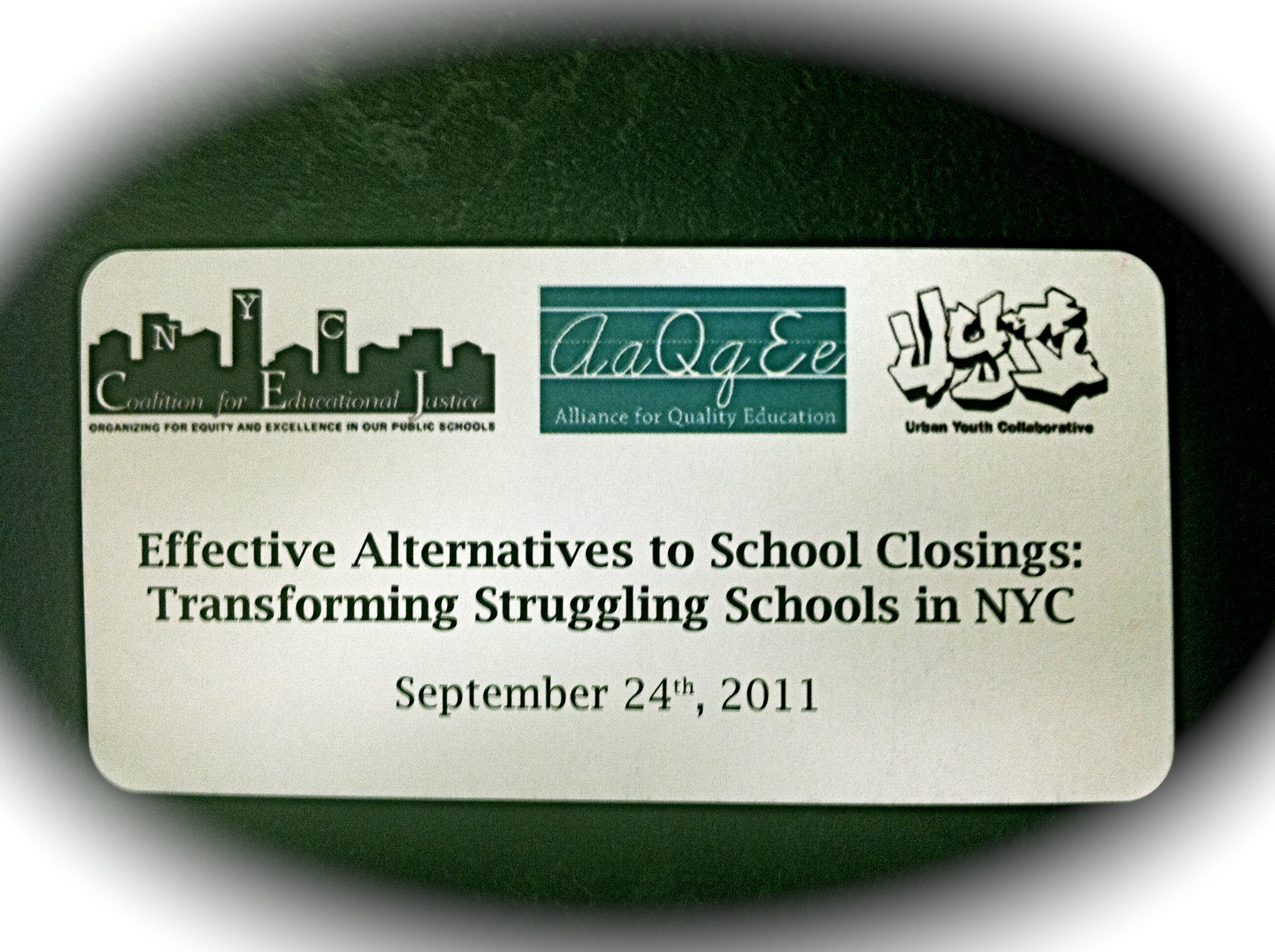
Conference on Alternatives to School Closings « EdVox

Conference on Alternatives to School Closings « EdVox:

Conference on Alternatives to School Closings

NY’s Largest Education Advocacy Organizations to Host Conference on Alternatives to School Closings as Polls Show Popular Demand for New City Policies

State and City government education chairs, Chancellor Tisch, UFT President Mulgrew, local and national policy leaders and educators discuss strategies for transforming struggling schools

Parents and students organize first-of-its-kind event with eye toward new reforms

As polls show popular discontentment with the state of New York City schools and the current administration’s education policies, the City’s largest parent- and student-run organizations will join together tomorrow to organize a one-day conference at the Bank Street College of Education. The conference will feature panels of

What's Going on With No Child Left Behind? - Dana Goldstein

What's Going on With No Child Left Behind? - Dana Goldstein:

What's Going on With No Child Left Behind?

Over at The Nation, I assess the Obama administration's new "waiver process:"

A more progressive rethinking of NCLB might have allowed students to transfer out of their home school districts to integrated, higher-performing suburban schools: We know from the experiences of Milwaukee, Seattle, and Hartford that when such programs are available, they are extremely popular among low-income families and lead to improved academic outcomes.

On curriculum, it would have been worthwhile to encourage states to scale-up programs that introduce teenagers--in an academecially rigorous way--to potential occupations, since we know one of the best ways

The unilateral repeal of NCLB and the 2012 election

The unilateral repeal of NCLB and the 2012 election:

The unilateral repeal of NCLB and the 2012 election

Chester E. Finn, Jr. Posted by Chester E. Finn, Jr. on September 23, 2011 at 11:23 am

The Obama administration’s new waiver plan (officially here, and covered extensively here, here, and here—and elsewhere, I’m sure) doesn’t officially repeal the No Child Left Behind Act, but it is tantamount to making large-scale amendments to it. Which it does unilaterally, without even a thumbs-up from Congress.

Though the specific conditions that the White House and Secretary Duncan are attaching to statewide “flexibility waivers” are consistent with the Administration’s long-standing “blueprint” for reauthorizing NCLB, and also happen to be conditions that I think generally have merit, they amount to changing the law, not just waiving it. This raises Constitutional as well as statutory issues—though the administration’s response, not surprisingly or implausibly, is that “if a do-nothing Congress won’t act to solve problems, we’ll solve them ourselves as best we can.”

Yet the changes themselves—at least their timing and high-profile release—are motivated at least as much by election-year political considerations as by policy. This is not the first

Mike Klonsky's SmallTalk Blog: Defender gets it right on Rahm's longer school day scam

Mike Klonsky's SmallTalk Blog: Defender gets it right on Rahm's longer school day scam:

Defender gets it right on Rahm's longer school day scam

An editorial in the Chicago Defender, "Breaking the Teachers Union" blasts the mayor's longer-school-day campaign.
Though the district is trying to close a $200 million budget deficit, and has reneged on a negotiated 4 percent raise for the teachers, that is not the rallying cry for the district. Instead, CPS sends out notices trumpeting the fact that teachers at individual schools are voting for longer school hours, succumbing to the siren call of 2 percent bonuses offered by the district. If all of the schools voted that way, it would cost $100 million ... which would pay for the

Manhattan Trade School for Girls: Report cards from the 1920s and the stories they tell. (1) - By Paul Lukas - Slate Magazine

Manhattan Trade School for Girls: Report cards from the 1920s and the stories they tell. (1) - By Paul Lukas - Slate Magazine:

Permanent Record

How I Found the Report Cards, and How They Changed My Life

Posted Sunday, Sept. 18, 2011, at 10:12 PM ET

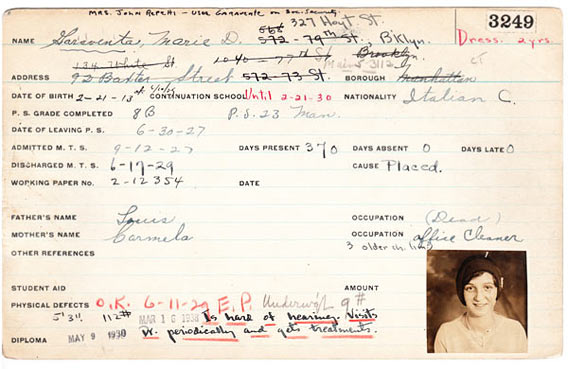
Meet Marie Garaventa.

What you see above is the front of her report card from the Manhattan Trade School for Girls, a vocational school she attended in the late 1920s, after she had finished the eighth grade. As you can see, she had a perfect attendance record—this despite moving several times, having a deceased father, and being hard of hearing.

If you click through the rest of Marie's student record, you'll see that the school's staff initially described her as "slow" and "irritable" (perhaps due to her hearing problems) but that she eventually gained confidence and made the honor roll. You'll also see that the school helped to place her in more than a dozen sewing and dress-finishing jobs after she graduated, and that at one point she was scolded for not returning to a job after her lunch break.

It all reads like the storyboard for a movie or a play—the rough outline of a young