Latest News and Comment from Education

Monday, June 13, 2011

The Upside and Downside of Urban School Reform | Larry Cuban on School Reform and Classroom Practice

The Upside and Downside of Urban School Reform | Larry Cuban on School Reform and Classroom Practice

The Upside and Downside of Urban School Reform

Based on my school and district experiences and research into urban reform strategies over the past quarter-century to improve schools, I have concluded the following:

*Most urban districts, either with or without mayoral control, have centralized control of schools through state standards and testing, offered parents a portfolio of choices in elementary and secondary schools, and intensified traditional ways of schooling children.

*While some national leaders call for overhauling the existing system reform most reformers have sought incremental changes in existing school structures. In fact, acclaimed entrepreneurial ventures such as Teach For America, New Leaders for New Schools, and Knowledge Is Power Program (KIPP) use the rhetoric of fundamental reform but choose to work within district structures while pressing for small, important policy changes. [i]

The good news is that some top-down strategies have worked in some districts for a while. Many urban districts,

This Week In Education: Update: Unsolved Mysteries Of Locke High School & Green Dot

This Week In Education: Update: Unsolved Mysteries Of Locke High School & Green Dot

Update: Unsolved Mysteries Of Locke High School & Green Dot

image from images.huffingtonpost.comEven having written a book there are many things I still don't know about Green Dot and Locke High School -- an ignorance often exposed by curious interviewers as during my talk with Stephen Smith at American RadioWorks (here), which just came online Friday. Here are some examples: Why's it called Green Dot? What really happened to Emily the counselor? Did they really have to include the note in the 99o tax form that ended up exposing Barr's mis-spending? Could they have cut a deal with UTLA to allow more Locke veterans to stay without

Pentagon Papers - Truth after 40 years

Pentagon Papers

Pentagon Papers

The Pentagon Papers, officially titled "Report of the Office of the Secretary of Defense Vietnam Task Force", was commissioned by Secretary of Defense Robert McNamara in 1967. In June of 1971, small portions of the report were leaked to the press and widely distributed. However, the publications of the report that resulted from these leaks were incomplete and suffered from many quality issues.

On the 40th anniversary of the leak to the press, the National Archives, along with the Kennedy, Johnson, and Nixon Presidential Libraries, has released the complete report. There are 48 boxes and approximately 7,000 declassified pages. Approximately 34% of the report is available for the first time.

What is unique about this, compared to other versions, is that:

  • The complete Report is now available with no redactions compared to previous releases
  • The Report is presented as Leslie Gelb presented it to then Secretary of Defense Clark Clifford on January 15, 1969
  • All the supplemental back-documentation is included. In the Gravel Edition, 80% of the documents in Part V.B. were not included
  • This release includes the complete account of peace negotiations, significant portions of which were not previously available either in the House Armed Services Committee redacted copy of the Report or in the Gravel Edition

Files

(All files in the "Title" column are in PDF format)
TitleFile SizeARC ID
Index(3.84 MB)5890484
[Part I] Vietnam and the U.S., 1940-1950(121 MB)5890485
[Part II] U.S. Involvement in the Franco-Viet Minh War, 1950-1954(46.1 MB)5890486
[Part III] The Geneva Accords(66 MB)5890487
[Part IV. A. 1.] Evolution of the War. NATO and SEATO: A Comparison(26.3 MB)5890488
[Part IV. A. 2.] Evolution of the War. Aid for France in Indochina, 1950-54(17.7 MB)5890489
[Part IV. A. 3.] Evolution of the War. U.S. and France's Withdrawal from Vietnam, 1954-56(35.2 MB)5890490
[Part IV. A. 4.] Evolution of the War. U.S. Training of Vietnamese National Army, 1954-59(53.3 MB)5890491
[Part IV. A. 5.] Evolution of the War. Origins of the Insurgency(185.8 MB)5890492
[Part IV. B. 1.] Evolution of the War. Counterinsurgency: The Kennedy Commitments and Programs, 1961(90.9 MB)5890493
[Part IV. B. 2.] Evolution of the War. Counterinsurgency: Strategic Hamlet Program, 1961-63(27 MB)5890494
[Part IV. B. 3.] Evolution of the War. Counterinsurgency: The Advisory Build-up, 1961-67(74 MB)5890495
[Part IV. B. 4.] Evolution of the War. Counterinsurgency: Phased Withdrawal of U.S. Forces in Vietnam, 1962-64(29.3 MB)5890496
[Part IV. B. 5.] Evolution of the War. Counterinsurgency: The Overthrow of Ngo Dinh Diem, May-Nov. 1963(55.6 MB)5890497
[Part IV. C. 1.] Evolution of the War. U.S. Programs in South Vietnam, November 1963-April 1965: NASM 273 -- NSAM 288 -- Honolulu(73 MB)5890498
[Part IV. C. 2. a.] Evolution of the War. Military Pressures Against NVN. February - June 1964(38.7 MB)5890499
[Part IV. C. 2. b.] Evolution of the War. Military Pressures Against NVN. July - October 1964(48 MB)5890500
[Part IV. C. 2. c.] Evolution of the War. Military Pressures Against NVN. November - December 1964(57.1 MB)5890501
[Part IV. C. 3.] Evolution of the War. ROLLING THUNDER Program Begins: January - June 1965(92.9 MB)5890502
[Part IV. C. 4.] Evolution of the War. Marine Combat Units Go to DaNang, March 1965(22.4 MB)5890503
[Part IV. C. 5.] Evolution of the War. Phase I in the Build-up of U.S. Forces: March - July 1965(68.7 MB)5890504
[Part IV. C. 6. a.] Evolution of the War. U.S. Ground Strategy and Force Deployments: 1965 - 1967. Volume I: Phase II, Program 3, Program 4(72.3 MB)5890505
[Part IV. C. 6. b.] Evolution of the War. U.S. Ground Strategy and Force Deployments: 1965 - 1967. Volume II: Program 5(116.4 MB)5890506
[Part IV. C. 6. c.] Evolution of the War. U.S. Ground Strategy and Force Deployments: 1965 - 1967. Volume III: Program 6(47 MB)5890507
[Part IV. C. 7. a.] Evolution of the War. Air War in the North: 1965 - 1968. Volume I(106.5 MB)5890508
[Part IV. C. 7. b.] Evolution of the War. Air War in the North: 1965 - 1968. Volume II(101.4 MB)5890509
[Part IV. C. 8.] Evolution of the War. Re-emphasis on Pacification: 1965-1967(534 MB)5890510
[Part IV. C. 9. a.] Evolution of the War. U.S.-GVN Relations. Volume 1: December 1963 - June 1965(325.1 MB)5890511
[Part IV. C. 9. b.] Evolution of the War. U.S.-GVN Relations. Volume 2: July 1965 - December 1967(309.5 MB)5890512
[Part IV. C. 10.] Evolution of the War. Statistical Survey of the War, North and South: 1965 - 1967(103.4 MB)5890513
[Part V. A.] Justification of the War. Public Statements. Volume I: A--The Truman Administration(386.8 MB)5890514
[Part V. A.] Justification of the War. Public Statements. Volume I: B--The Eisenhower Administration(190.6 MB)5890515
[Part V. A.] Justification of the War. Public Statements. Volume I: C--The Kennedy Administration(164.7 MB)5890516
[Part V. A.] Justification of the War. Public Statements. Volume II: D--The Johnson Administration(496.1 MB)5890517
[Part V. B. 1.] Justification of the War. Internal Documents. The Roosevelt Administration(309.4 MB)5890518
[Part V. B. 2. a.] Justification of the War. Internal Documents. The Truman Administration. Volume I: 1945 - 1949(121.5 MB)5890519
[Part V. B. 2. b.] Justification of the War. Internal Documents. The Truman Administration. Volume II: 1950 -1952(138.5 MB)5890520
[Part V. B. 3. a.] Justification of the War. Internal Documents. The Eisenhower Administration. Volume I: 1953(134.4 MB)5890521
[Part V. B. 3. b.] Justification of the War. Internal Documents. The Eisenhower Administration. Volume II: 1954 - Geneva(223 MB)5890522
[Part V. B. 3. c.] Justification of the War. Internal Documents. The Eisenhower Administration. Volume III: Geneva Accords - 15 March 1956(190.8 MB)5890523
[Part V. B. 3. d.] Justification of the War. Internal Documents. The Eisenhower Administration. Volume IV: 1956 French Withdrawal - 1960(156.2 MB)5890524
[Part V. B. 4.] Justification of the War. Internal Documents. The Kennedy Administration. Book I(196.3 MB)5890525
[Part V. B. 4.] Justification of the War. Internal Documents. The Kennedy Administration. Book II(103.1 MB)5890526
[Part VI. A.] Settlement of the Conflict. Negotiations, 1965-67: The Public Record(42 MB)5890527
[Part VI. B.] Settlement of the Conflict. Negotiations, 1965-67: Announced Position Statements(140.7 MB)5890528
[Part VI. C. 1.] Settlement of the Conflict. Histories of Contacts. 1965-1966(90.9 MB)5890529
[Part VI. C. 2.] Settlement of the Conflict. Histories of Contacts. Polish Track(71.4 MB)5890530
[Part VI. C. 3.] Settlement of the Conflict. Histories of Contacts. Moscow-London Track(74 MB)5890531
[Part VI. C. 4.] Settlement of the Conflict. Histories of Contacts. 1967-1968

This Week In Education: NCLB: Duncan Parachutes Into Hostile Territory

This Week In Education: NCLB: Duncan Parachutes Into Hostile Territory

NCLB: Duncan Parachutes Into Hostile Territory

image from www.freewebs.comIt's an attack from above -- an all-out aerial bombardment! Here's audio of the secret Friday conference call Team Duncan held with an elite group of education reporters (invitation only!). Here's the remarkable little slew of news stories that the call produced: Duncan Threatens to Alter No Child Left Behind WSJ, Arne Duncan's 'Plan B' May Leave 'No Child' Behind NPR, Duncan vows some easing of landmark education law AP, Education Secretary May Agree to Waivers on ‘No Child’ Law Requirements NYT. Here's the commentary Duncan got published in Politico (Revamp No Child Left Behind - now) to go along with the one Spellings wrote in the same publication. And they're not done. There's ANOTHER press call this afternoon, just in case anyone hasn't heard the word. But is it a good idea, what they're doing, and is Duncan right? Read on for a few thoughts on the matter.

You have to give Team Duncan credit for keeping at it with this whole reauthorization thing, whether you agree with them or not on the substance (NCLB is having a dire negative effect on public education) or the tactices

USFlag.org: A website dedicated to the Flag of the United States of America - The History Of Flag Day

USFlag.org: A website dedicated to the Flag of the United States of America - The History Of Flag Day

The History Of Flag Day

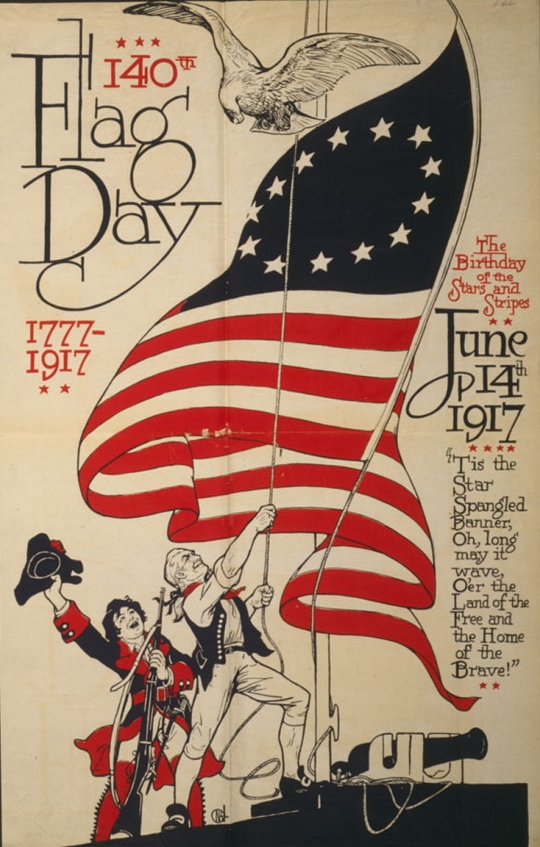
The Fourth of July was traditionally celebrated as America's birthday, but the idea of an annual day specifically celebrating the Flag is believed to have first originated in 1885. BJ Cigrand, a schoolteacher, arranged for the pupils in the Fredonia, Wisconsin Public School, District 6, to observe June 14 (the 108th anniversary of the official adoption of The Stars and Stripes) as 'Flag Birthday'. In numerous magazines and newspaper articles and public addresses over the following years, Cigrand continued to enthusiastically advocate the observance of June 14 as 'Flag Birthday', or 'Flag Day'.
On June 14, 1889, George Balch, a kindergarten teacher in New York City, planned appropriate ceremonies for the children of his school, and his idea of observing Flag Day was later adopted by the State Board of Education of New York. On June 14, 1891, the Betsy Ross House in Philadelphia held a Flag Day celebration, and on June 14 of the following year, the New York Society of the Sons of the Revolution, celebrated Flag Day.
Following the suggestion of Colonel J Granville Leach (at the time historian of the Pennsylvania Society of the Sons of the Revolution), the Pennsylvania Society of Colonial Dames of America on April 25, 1893 adopted a resolution requesting the mayor of Philadelphia and all others in authority and all private citizens to display the Flag on June 14th. Leach went on to recommend that thereafter the day be known as 'Flag Day', and on that day, school children be assembled for appropriate exercises, with each child being given a small Flag.
Two weeks later on May 8th, the Board of Managers of the Pennsylvania Society of Sons of the Revolution unanimously endorsed the action of the Pennsylvania Society of Colonial Dames. As a result of the resolution, Dr. Edward Brooks, then Superintendent of Public Schools of Philadelphia, directed that Flag Day exercises be held on June 14, 1893 in Independence Square. School children were assembled, each carrying a small Flag, and patriotic songs were sung and addresses delivered.
In 1894, the governor of New York directed that on June 14 the Flag be displayed on all public buildings. With BJ Cigrand and Leroy Van Horn as the moving spirits, the Illinois organization, known as the American Flag Day Association, was organized for the purpose of promoting the holding of Flag Day exercises. On June 14th, 1894, under the auspices of this association, the first general public school children's celebration of Flag Day in Chicago was held in Douglas, Garfield, Humboldt, Lincoln, and Washington Parks, with more than 300,000 children participating.
Adults, too, participated in patriotic programs. Franklin K. Lane, Secretary of the Interior, delivered a 1914 Flag Day address in which he repeated words he said the flag had spoken to him that morning: "I am what you make me; nothing more. I swing before your eyes as a bright gleam of color, a symbol of yourself."
Inspired by these three decades of state and local celebrations, Flag Day - the anniversary of the Flag Resolution of 1777 - was officially established by the Proclamation of President Woodrow Wilson on May 30th, 1916. While Flag Day was celebrated in various communities for years after Wilson's proclamation, it was not until August 3rd, 1949, that President Truman signed an Act of Congress designating June 14th of each year asNational Flag Day.

Shanker Blog » Middle Class Overvalues

Shanker Blog » Middle Class Overvalues

Middle Class Overvalues

Posted June 13, 2011

It is a staple of American politics that elected officials routinely frame their appeals to the “middle class.” The idea is simple: Since the vast majority of Americans consider themselves members of the middle class, it makes sense to use this label as shorthand for “people like you.” The practice of people locating themselves within a class structure – rather than being “assigned” to classes based on particular characteristics, such as income or occupation – is often called “subjective class identification.”

Now, I don’t know whether the daily use of the “middle class” appeal is smart politics (I assume it has been poll-tested and focus-grouped ad nauseum). But I can say that the underlying assumption – that virtually all Americans identify subjectively as middle class – is not correct. Or, more accurately, it depends on how you ask the question.

If you give people a three-category class structure (upper, middle, lower) in which they must place themselves, a huge plurality opts for the middle. On the other hand, in the simple tabulation below, I demonstrate what happens when you add a fourth category to the menu of options – “working class.” The data come from the General Social Survey (GSS) for 2010, and it’s a representative, unrestricted sample of all Americans over age 18. One of the survey questions is: “If you were asked to use one of four names for your social class, would you say you belong in: the lower class, the working class, the middle class, or the upper class?”

Fact-Challenged Policy

Fact-Challenged Policy

Fact-Challenged Policy
Richard Rothstein
March 8, 2011

EPI Research Associate Richard Rothstein posted this response on the National Journal Experts blog, on the topic of school reform efforts being promoted by Bill Gates and other prominent education policy advocates.

Read the PDF Version

Last week, Microsoft Chairman Bill Gates published an op-ed in the Washington Post, “How Teacher Development could Revolutionize our Schools,” proposing that American public schools should do a better job of evaluating the effectiveness of teachers, a goal with which none can disagree. But his specific prescriptions, and the urgency he attaches to them, are based on the misrepresentation of one fact, the misinterpretation of another and the demagogic presentation of a third. It is remarkable that someone associated with technology and progress should have such a careless disregard for accuracy when it comes to the education policy in which he is now so deeply involved.

Gates’ most important factual claim is that “over the past four decades, the per-student cost of running our K-12 schools has more than doubled, while our student achievement has remained virtually flat.” And, he adds, “spending has climbed, but our percentage of college graduates has dropped compared with other countries.” Let’s examine these factual claims:

Seattle’s Education Reform Hypocrisy | Seattle Education

Seattle’s Education Reform Hypocrisy | Seattle Education

Seattle’s Education Reform Hypocrisy

The doublespeak of ed reformers who repeatedly declare that the key to a successful education is to put an “excellent” teacher in every classroom, and then turn around and promote young, Teach for America recruits — with only five weeks’ training, no in-class experience, and only a two-year commitment to the profession — as the answer, has come into sharp focus at the University of Washington in Seattle these past two weeks.

On May 11, the University of Washington’s College of Education announced it would sponsor Teach for America at its teaching college, providing the missing component to the deal that TFA, Inc. struck with the Seattle School District last fall.

Last November, Seattle’s school board approved a (troubling and one-sided) contract to allow TFA, a short-term alternative teacher credentialing program, into Seattle’s hiring pool for the first time. TFA, Inc. also demands a

Food Revolution News, Recipes & Live Videos! « MomsRising Blog

Food Revolution News, Recipes & Live Videos! « MomsRising Blog

Food Revolution News, Recipes & Live Videos!

This week see’s another exciting one for the Food Revolution, with results coming through on our Milk Day of Action, along with our usual Food Revolution fun!

This week’s twitter competwition is tomorrow night, Tuesday 14th, at 6pm PDT/9pm EDT so join@FoodRevTeam for the chance to win a signed Jamie book! The winner will be announced the following night,Wednesday 15th at our weekly twitter party, this time at 4pm PDT/7pm EDT.

Our Food Revolution recipe this week is Pizza! To join our cook off, download and try this recipe at home and then upload all your photos on to our Food Revolution Community page. You can check out the Food Revolution team’s photos here.

Keep an eye out as we will be launching a