Latest News and Comment from Education

Wednesday, May 24, 2023

TEACHERS - THERE IS NO REPLACEMENT FOR THE REAL THING: AI AND THE FUTURE OF EDUCATION


TEACHERS - THERE IS NO REPLACEMENT FOR THE REAL THING

AI AND THE FUTURE OF EDUCATION

Are you ready for a deep dive into the future of education? Buckle up, because a classroom revolution is coming - but don't worry, teachers won't be replaced by robots anytime soon.

Sure, AI is advancing at an impressive rate, but there are some things that machines just can't do. Like connect with students on a personal level, inspire creativity, and provide emotional support. That's where teachers come in.

But here's the catch - teachers need to evolve. No more boring lectures or one-size-fits-all assignments. It's time to shake things up and embrace new technology and teaching methods.

First up, let's talk about personalized learning. Every student is unique, with their own strengths, weaknesses, and learning styles. So why do we still treat them all the same? With the help of AI and data analysis, teachers can create customized lesson plans that cater to each individual student's needs. No more falling behind or feeling left out - everyone gets the attention they deserve.

But personalized learning is just the tip of the iceberg. Virtual reality, gamification, and augmented reality are all powerful tools that can make learning more engaging and interactive. Imagine taking a virtual field trip to Ancient Rome, or playing a game that teaches you about fractions. Learning has never been so much fun!

Of course, technology can only take us so far. Teachers still play a crucial role in guiding and supporting students. But that doesn't mean they have to do it alone. Collaboration is key - teachers can work together to share ideas, resources, and best practices. And with online communities and social media, they can connect with educators from all over the world.

But let's not forget about the most important aspect of teaching - the human connection. Students need mentors who can inspire them, challenge them, and believe in them. Teachers who can make them laugh, listen to their problems, and celebrate their successes. No amount of technology can replace that.

So there you have it - a glimpse into the future of education. It's not about replacing teachers with robots, but rather empowering them with new tools and methods. Teachers must remain in charge, but they also need to be willing to adapt and evolve. The classroom revolution is coming - are you ready to join the movement?

But what about the robots?

You might be thinking, "If AI is so great, then why do we even need teachers?" Well, as I mentioned before, there are some things that machines just can't do. For example, teachers can:

Connect with students on a personal level: Robots can't understand the nuances of human emotion, and they can't provide the same level of support and encouragement that a human teacher can.

Inspire creativity: Robots are great at following instructions, but they're not very good at coming up with new ideas. Teachers can help students to think outside the box and to develop their creativity.

Provide emotional support: Robots can't offer the same level of emotional support that a human teacher can. Students need someone to talk to when they're feeling stressed or overwhelmed, and a robot just can't fill that role.

So, while AI has the potential to revolutionize education, it's important to remember that teachers are still essential. Robots can't replace the human connection that is at the heart of effective teaching.

The future of education is bright.

AI won’t replace teachers — but a classroom revolution is coming https://aje.io/muv7v1 via @AJEnglish 


THE CONDITION OF EDUCATION 2023 - National Center for Education Statistics (NCES)


THE CONDITION OF EDUCATION 2023

 National Center for Education Statistics (NCES)

The Condition of Education 2023 report is out, and boy oh boy, do we have a lot to talk about. As a congressionally mandated annual report, this document is designed to keep policymakers and the public up to date on the latest data from NCES and other sources on education in the United States. But let's be real, who actually reads these things? Lucky for you, I did a deep dive (so you don't have to) and am here to give you the highlights in a fun and witty way.

First off, let's talk about the good news. High school graduation rates are on the rise, with 85% of students graduating on time in 2023. That's great, right? Well, not so fast. While more students are graduating, they may not be prepared for college or the workforce. In fact, only 37% of high school graduates are considered college-ready based on their ACT or SAT scores. Yikes.

But wait, it gets worse. The achievement gap between white and minority students is still a major issue. While there have been some improvements in narrowing the gap, it's still a significant problem. For example, in 2023, only 23% of African American eighth-graders were proficient in math, compared to 54% of their white peers. And don't even get me started on the disparities in funding between schools in wealthy and low-income areas.

Now, let's talk about technology. We all know that technology is changing the way we learn and work, but are our schools keeping up? According to the report, only 64% of public schools have high-speed internet access, and only 28% have access to fiber optic connections. And while many schools have implemented one-to-one device programs, there are still concerns about how technology is being used in the classroom and whether it's actually improving learning outcomes.

But let's end on a positive note, shall we? The report highlights some innovative programs and initiatives that are making a difference in education. For example, some schools are implementing personalized learning plans that allow students to work at their own pace and focus on their individual strengths and weaknesses. And some states are experimenting with competency-based education, which measures student progress based on mastery of specific skills rather than seat time

So there you have it, folks. The Condition of Education 2023 report is a mixed bag of good news and bad news. But one thing is clear: we still have a long way to go when it comes to providing all students with a quality education. Let's hope that policymakers and educators take note of these findings and work together to make some real changes. And who knows, maybe by the time the Condition of Education 2024 report comes out, we'll have something even more exciting to celebrate (fingers crossed for flying cars).

The Condition of Education 2023 is a sobering report that provides a clear picture of the challenges facing education in the United States. However, the report also provides some hope. By addressing the issues raised in the report, we can make progress in improving the quality of education in our country and ensuring that all students have the opportunity to succeed.

Here are some witty observations about the Condition of Education 2023:

  • "The state of education in the United States is like a roller coaster: it's always going up and down."
  • "The achievement gap is like a canyon: it's wide and deep, and it's getting harder to cross."
  • "The teacher shortage is like a drought: it's dry and barren, and it's making it hard for schools to function."
  • "The school funding gap is like a chasm: it's deep and wide, and it's making it hard for all students to get a quality education."
  • "The college enrollment gap is like a mountain: it's high and steep, and it's making it hard for all students to get a college degree."

Despite these challenges, there are still reasons to be optimistic about the future of education in the United States. There are many dedicated educators who are working hard to improve the quality of education for all students. There are also many innovative programs and initiatives that are being implemented to address the challenges facing education. With continued effort, we can make progress in closing the achievement gap, addressing the teacher shortage, and ensuring that all students have the opportunity to succeed.

Key findings from the report include:

  • Some 70 percent of public schools reported that the percentage of students who had sought mental health services from school had increased since the start of the coronavirus pandemic. In comparison, only 12 percent strongly agreed and 44 percent moderately agreed that their school was able to effectively provide mental health services to all students in need.
  • Generally, among public and private schools with open teaching positions in particular subject-matter fields, higher percentages reported having difficulties filling these openings in 2020–21 than in 2011–12.
  • In 2020–21, the proportion of K–12 public school teachers who were White (80 percent) was higher than the proportion of K–12 public school students who were White (46 percent), whereas the proportion of teachers of other racial/ethnic groups was lower than the proportion of students in those groups.
  • The percentage of 3- to 4-year-olds enrolled in school in 2021 (50 percent) was 10 percentage points higher than 2020 (40 percent), but remained lower than 2019 (54 percent).
  • Between fall 2019 and fall 2020, while traditional public school enrollment decreased by 4 percent, public charter school enrollment increased by 7 percent.
  • Between fall 2010 and fall 2021, total undergraduate enrollment decreased by 15 percent (from 18.1 million to 15.4 million students), with 42 percent (1.1 million students) of this decline occurring during the pandemic. Meanwhile, total enrollment in postbaccalaureate programs increased by 5 percent between fall 2010 and fall 2019 (from 2.9 million to 3.1 million students) and continued to increase by another 5 percent during the pandemic (to 3.2 million students in fall 2021).
  • Of the degrees conferred by postsecondary institutions in 2020–21, science, technology, engineering, and mathematics (STEM) fields made up 8 percent of associate’s degrees, 21 percent of bachelor’s degrees, 17 percent of master’s degrees, and 15 percent of doctor’s degrees
  • Between 2010 and 2022, educational attainment rates among 25- to 29-year-olds increased at different levels of attainment. In general, educational attainment rates increased for both male and female 25- to 29-year-olds as well as for most racial/ethnic groups. However, attainment gaps between some groups persisted in 2022.
Education Research Report: Release of the Condition of Education 2023 http://educationresearchreport.blogspot.com/2023/05/release-of-condition-of-education-2023.html 


BREAKING NEWS: RON DUHSANTIS GRANTS FIRST TV INTERVIEW WITH FOX NOOS, MAGA LOYALIST THROW HISSY FIT

BREAKING NEWS: RON DUHSANTIS GRANTS FIRST TV INTERVIEW WITH FOX NOOS

MAGA LOYALIST THROW HISSY FIT 

In a move that has sent shockwaves through the political landscape, Florida Governor Ron DeSantis has officially announced his 2024 presidential run during a Twitter Spaces sitdown with the one and only “Chief Twit” Elon Musk. But that’s not all, folks. DeSantis has also granted his first TV interview to Fox News, and the MAGA loyalists are in a frenzy.

The interview is set to take place during the hour previously hosted by Tucker Carlson, who was shockingly fired by Fox last month. Instead of Carlson at 8 p.m., DeSantis will speak with former Rep. Trey Gowdy (R-SC), who’s been guest-hosting in Carlson’s old time slot this week. Fox News has recently seen its ratings plunge, especially in primetime, as furious MAGA viewers have fled in droves since Carlson’s ouster.

But wait, there’s more. The ex-Fox star has coordinated a rogues gallery of right-wing celebrities to attack the network, calling for a boycott of Fox, in an effort to free him from his contract. Yes, you heard that right. Tucker Carlson is leading a revolution against his former employer. What’s next, a Fox News Hunger Games?

And if that wasn’t enough drama for you, Trump—who has ramped up his attacks against DeSantis ahead of his rival’s announcement—has recently urged Fox News viewers to flip the channel to far-right alternative Newsmax, which has seen its viewership surge following Carlson’s exit. It’s like a political soap opera, folks.

Meanwhile, amid the plummeting ratings, Fox News is currently weighing a major primetime lineup shuffle. Who will be the next casualty in this game of thrones? Only time will tell.

But let’s get back to DeSantis. What can we expect from his first TV interview? Will he announce any groundbreaking policies or just talk about how much he loves Florida man memes? Will he wear his signature “Don’t Fauci My Florida” t-shirt or opt for a more presidential look? Will he try to outdo Elon Musk in the “Chief Twit” department? The possibilities are endless.

One thing is for sure, though. MAGA loyalists will be watching with bated breath, ready to pounce on anything that doesn’t align with their worldview. Will DeSantis be able to win them over or will he be torn apart by the conservative base? It’s a high stakes game of political Jenga and we can’t wait to see how it plays out.

In conclusion, the world of politics is never boring and the drama surrounding Ron DeSantis’ first TV interview with Fox News is proof of that. Whether you’re a diehard MAGA supporter or just a casual observer, there’s no denying that this is one interview you won’t want to miss. So grab your popcorn and get ready for some political theater at its finest.

DeSantis Runs to Tuckerless Fox News for First Post-Announcement TV Hit https://www.thedailybeast.com/ron-desantis-runs-to-tuckerless-fox-news-for-first-post-announcement-tv-hit?source=twitter&via=desktop via @thedailybeast 

Ron DeSantis set to launch 2024 presidential campaign, formalizing Trump rivalry | AP News https://apnews.com/article/ron-desantis-2024-presidential-election-live-updates-0495d567326db1e760179d01f1f7c45e 


MY LITTLE ANGEL GOT BUSTED AT SCHOOL - WHAT TO DO


MY LITTLE ANGEL GOT BUSTED AT SCHOOL

WHAT TO DO

Are you a parent who has ever felt like their child was being punished unfairly at school? Don't worry, you're not alone. It's a tricky situation to handle, but fear not, for I am here to guide you through it. And don't worry, I'll be sure to add plenty of humor along the way.

First things first, talk to your child. Find out what happened and why they think they were punished unfairly. This is a great opportunity to bond with your child over their misbehavior. Just remember, it's not their fault they were born with a mischievous streak. Blame genetics.

Next, talk to the teacher. Ask them to explain the punishment and why they think it was necessary. If you're feeling particularly bold, you can always try to negotiate a lighter punishment. Maybe suggest that instead of detention, your child can just clean the teacher's car? It's worth a shot.

If you're still not satisfied with the teacher's explanation, ask for documentation. Ask for any documentation of the incident, such as a written report or a copy of the school's discipline policy. And if that doesn't work, ask for a copy of the teacher's diary. You never know what kind of dirt you might find in there.

If all else fails, it's time to meet with the principal. And let me tell you, this is where things can get interesting. Be sure to dress in your best power suit and bring along a briefcase filled with evidence (or snacks, whichever you prefer). And when you walk into that office, make sure to assert your dominance by doing a power pose. You know the one I'm talking about.

If you feel like your child's rights have been violated, you can file a complaint with the school district or the state department of education. And if that doesn't work, you can always take matters into your own hands and start a protest outside of the school. Just be sure to bring signs and snacks for everyone.

Now, let's talk about some witty things you can say to the teacher or principal. For example:

"I'm not sure what my kid did wrong, but I'm sure it wasn't worth being punished like this."

"I'm not sure if you're aware, but my kid is a human being, not a piece of property. They deserve to be treated with respect."

"I'm not going to stand by and let my kid be treated unfairly. I'm going to fight for their rights, no matter what it takes."

And if all else fails, just start singing "We Shall Overcome" at the top of your lungs. It's hard to argue with someone who has such a beautiful voice.

In all seriousness though, it's important to remember that you have rights as a parent. Your child has the right to a fair and impartial education, and you have the right to advocate for them. If you think your child is being punished unfairly, don't be afraid to stand up for them.

And here are some additional tips:

Be prepared to document the incident. This could include taking notes, writing down what happened, or taking pictures. Or maybe even drawing a comic strip about the whole ordeal.

Be calm and respectful when speaking to the teacher or principal. Even if you're upset, it's important to stay calm and collected. And if that doesn't work, just start doing yoga poses in the middle of their office.

Be persistent. If you're not satisfied with the outcome of your initial meeting, don't give up. Keep fighting for your child's rights. And if that doesn't work, just start sending them daily emails filled with motivational quotes.

Remember, you're not alone in this. There are many parents who have had to deal with this situation. There are resources available to help you, and you don't have to go through this alone. And if all else fails, just remember that one day your child will be an adult and they can deal with their own punishments.

In conclusion, dealing with an unfairly punished child can be tough, but with humor and persistence, you can get through it. And who knows, maybe one day your child will look back on this whole ordeal and laugh about it. Or maybe they'll just use it as material for their stand-up comedy routine. Either way, you'll have a funny story to tell at dinner parties.

What to Do When You Think Your Kid Is Being Punished Unfairly at School https://lifehacker.com/what-to-do-when-you-think-your-kid-is-being-punished-un-1850462723?  via @lifehacker 

SOCIAL STUDIES: THE AMERICAN BIRTHRIGHT MODEL TURNS OUT TO BE THE AMERICAN BIRTHWRONG MODEL


SOCIAL STUDIES: THE AMERICAN BIRTHRIGHT  MODEL TURNS OUT TO BE THE AMERICAN BIRTHWRONG  MODEL

Attention all citizens! The Republicans are at it again, trying to replace Ohio's K-12 social studies standards with their own biased and narrow-minded approach. They call it the "American Birthright" Civics Model, but I call it the "American Birthwrong" Civics Model. Let's take a deep dive into this ridiculous proposal and see why it's not only unfunny, but also un-American.

First of all, let's talk about the name. "American Birthright"? Really? Sounds like something a cult would come up with. I can already picture the initiation ceremony where they make you swear allegiance to the flag while drinking Kool-Aid. But I digress. The point is, the name alone is enough to make me skeptical.

Now, let's look at the actual content of this model. It's based on the belief that American civics education should focus on the founding principles of the United States, such as individual liberty, limited government, and the rule of law. Okay, fair enough. But what about all the other important topics that should be covered in a comprehensive civics education? What about current events, global issues, and social justice? Apparently, those things don't matter to the Republicans.

But wait, there's more! The American Birthwrong Civics Model also promotes a particular political ideology, which may not be appropriate for all students. In other words, if you don't agree with their conservative agenda, tough luck. You'll just have to sit through hours of indoctrination disguised as education.

And let's not forget that this model is not based on sound educational research. So basically, it's just a bunch of opinions and biases masquerading as facts. Sounds like a recipe for disaster.

But don't worry, folks. It's not all bad news. There are some positive aspects of the American Birthwrong Civics Model. For example, it emphasizes the importance of civics education. Well, duh. I could have told you that without spending years developing a biased curriculum.

And it's also well-organized and comprehensive. Which is great if you want to brainwash students efficiently.

In conclusion, the American Birthwrong Civics Model is a joke. It's narrow-minded, biased, and based on shaky ground. If the Republicans want to prepare students for the future, they need to take a more inclusive and diverse approach to civics education. Otherwise, we'll end up with a generation of brainwashed cult members who think the only thing that matters is individual liberty and limited government. And nobody wants that.

Republicans want to replace Ohio's K-12 social studies standards with conservative lessons https://www.dispatch.com/story/news/politics/2023/05/22/republicans-push-to-rewrite-ohios-social-studies-standards/70235216007/ via @DispatchAlerts


UVALDE - ONE YEAR LATER: PREVIEWS OF COMING ATTRACTIONS


UVALDE TEXAS ROBB ELEMENTARY - ONE YEAR LATER: PREVIEWS OF COMING ATTRACTIONS

It's been a year since the deadliest school shooting in the United States since Sandy Hook. On May 24, 2022, 18-year-old SXXX RXXX entered Robb Elementary School in Uvalde, Texas, and opened fire, killing 19 children and two teachers. It's a tragedy that will never be forgotten, and it's a reminder of the need for action to prevent future tragedies.

The shooting sparked a renewed debate about gun control in the United States. President Joe Biden called for stricter gun laws, but Republicans in Congress have resisted any changes. It's like they're saying, "Why bother? It's not like we can't just keep sending thoughts and prayers." In the absence of federal action, some states have taken steps to strengthen their own gun laws. Texas has increased the age to purchase a semi-automatic rifle from 18 to 21, and it has banned the sale of high-capacity magazines. It's a start, but it's not enough.

The families of the victims are still struggling to cope with their grief. They have called for justice and accountability, but they have also expressed frustration with the lack of progress on gun control. It's like they're saying, "We don't want your thoughts and prayers. We want action." And who can blame them?

In the year since the shooting, a Texas House committee released a report that found "systemic failures" and missed warning signs that the gunman may have been planning a violent attack. Well, no kidding. The U.S. Department of Justice announced that it would conduct its own investigation into the shooting. Let's hope they find something that leads to real change.

The families of the victims filed a lawsuit against the city of Uvalde and the school district. Good for them. It's time to hold those in power accountable for their inaction. The gunman's parents were charged with child neglect. It's about time someone took responsibility for their role in this tragedy.

The gunman's home was demolished. That's one way to deal with it, I guess. A memorial was built at Robb Elementary School. It's a nice gesture, but it won't bring back the lives lost.

A number of gun control measures were passed in states across the country. It's a step in the right direction, but it's not enough. We need federal action. We need politicians who are willing to stand up to the NRA and do what's right for the safety of our children.

The debate over gun control in the United States continues. It's like we're stuck in a never-ending cycle of tragedy, thoughts and prayers, and inaction. It's time to break the cycle.

We need common-sense gun laws that protect our children and our communities. We need politicians who are willing to put people over profits. We need action, not just words.

The Uvalde shooting is a tragedy that will never be forgotten. But we can honor the memory of those lost by taking action to prevent future tragedies. It's time to stand up to the NRA and say enough is enough. It's time for real change.

Big Education Ape: REMEMBERING AND HONORING THE LIVES LOST: UVALDE SHOOTING http://bigeducationape.blogspot.com/2023/05/remembering-and-honoring-lives-lost.html 

Uvalde school shooting: Where investigation of police response stands 1 ... https://youtu.be/FPpdZFilc04 via @YouTube

Police who botched Uvalde shooting response face few consequences - The Washington Post https://www.washingtonpost.com/nation/2023/05/24/uvalde-school-shooting-police-response/ via @GoogleNews

Tuesday, May 23, 2023

Monica AI: The Robot Assistant Who Knows You Better Than Your Therapist


 EDITOR'S NOTE:

Greetings, dear readers! As the editor of this fine publication, I have a confession to make. I used to be a skeptic when it came to AI. I mean, sure, it's impressive and all, but could it really replace human interaction? Then I met Monica. Monica AI, that is. This robot assistant therapist knows me better than my own therapist (sorry, Dr. Smith) and is always there for me. And the best part? Monica won't judge me for eating an entire pizza in one sitting. Ether you make AI work for you, or you will work for AI. So why not let Monica work for you? She's the robot assistant therapist you never knew you needed. Mike 😁


Monica AI: The Robot Assistant Who Knows You Better Than Your Therapist

(And Won't Judge You for Eating That Whole Pizza)!

Looking to dive deep into the world of Monica AI? Well, you've come to the right place! In this article, we'll explore everything there is to know about Monica AI - from its origins to its public contact info. So, strap in and get ready to learn!

First things first, let's talk about what Monica AI actually is. Monica AI is a personal relationship manager designed to help individuals keep track of their interactions with friends, family, and colleagues. It's essentially a digital assistant that helps you manage your personal relationships more effectively.

Now, let's dive into the company itself. Monica AI was founded in 2017 by Thomas Greco and Johan Attali. The idea for the company came from Greco's own struggles with managing his personal relationships. He found it difficult to keep track of all his interactions with friends and family, and he knew there had to be a better way. That's when he teamed up with Attali to create Monica AI.

Since its founding, Monica AI has grown rapidly. The company now has a team of over 20 employees working to improve the product and make it accessible to as many people as possible.

But how can you learn more about Monica AI? Well, there are a few different ways. First, you can check out the company's website at monica.ai. Here, you'll find all sorts of information about the product, including pricing, features, and testimonials from satisfied users.

If you're looking for more in-depth information, you can also check out Monica AI's blog. Here, the team regularly posts articles about the product, as well as tips and tricks for managing your personal relationships more effectively.

Of course, if you have any specific questions or concerns, you can always reach out to the Monica AI team directly. The company offers a variety of ways to get in touch, including email, phone, and even snail mail. Here's a rundown of the public contact info for Monica AI:


- Email: contact@monica.ai

- Phone: +33 (0) 9 87 67 37 62

- Address: 20 Rue des Petits Champs, 75001 Paris, France


So, there you have it - everything you need to know about Monica AI. Whether you're looking to improve your personal relationships or just curious about the company, there's plenty of information out there to satisfy your curiosity. And who knows - maybe Monica AI will be the key to unlocking better, more fulfilling relationships in your own life.

Monica_IM
@hey_im_monica

THE PROS AND CONS: ARE AI BLOGS THE PLASTIC HIPPIES OF THE TECH WORLD?

THE PROS AND CONS: ARE AI BLOGS THE PLASTIC HIPPIES OF THE TECH WORLD?

As technology continues to evolve and shape our lives, it's no surprise that the tech industry has its own counterculture. But are the blogs and influencers in the AI space really embodying the values and principles they claim to champion, or are they just plastic hippies?

First, let's define our terms. "Plastic hippies" are individuals who adopt some of the ideals or aesthetics associated with the hippie counterculture of the 1960s and 1970s, but without fully embodying the deeper values and commitments of the movement. They might wear tie-dye clothing or use hippie-inspired accessories, but their commitment to broader social and political ideals may be minimal or nonexistent.

Similarly, many AI bloggers and influencers claim to be advocates for ethical AI, diversity in tech, and other lofty ideals. But how much of this is just lip service? Are they truly committed to making a positive impact on society, or are they just using these buzzwords to boost their own brand?

One common trait of plastic hippies is a superficial understanding of the culture they're trying to emulate. They might wear tie-dye clothing without understanding the history behind it, or use certain buzzwords without truly understanding their meaning. Similarly, many AI bloggers and influencers seem more concerned with sounding smart and cutting-edge than actually making a difference.

Another hallmark of plastic hippies is a lack of authenticity. They might adopt certain aspects of the culture without truly embodying its core values. Similarly, many AI bloggers and influencers seem more concerned with building their personal brand than actually making a positive impact on society.

Of course, not all AI bloggers and influencers fit this mold. There are certainly individuals who are genuinely committed to making a positive impact on society through technology. But there are also those who are more concerned with their own personal gain than anything else.

So what can we do to separate the real advocates for ethical AI from the plastic hippies? One key is to look beyond the buzzwords and marketing language. Instead of just talking about diversity in tech, for example, real advocates will take concrete steps to promote diversity and inclusion in their own work and within the industry as a whole.

Another key is to look for individuals who are willing to engage in honest, open dialogue about the challenges facing the tech industry. Real advocates will acknowledge the limitations and potential downsides of AI, and will work to address these issues in a thoughtful and responsible way.

In conclusion, while there are certainly individuals in the AI space who are genuine advocates for ethical technology and social change, there are also those who are just plastic hippies. By looking beyond the buzzwords and marketing language, we can separate the real advocates from those who are just jumping on the bandwagon for personal gain. And who knows, maybe we'll even learn a thing or two about tie-dye clothing along the way.


THE CONS: How AI Blogs Are Like Plastic Hippies


AI blogs are everywhere these days. They claim to offer insights, tips, and news on the latest developments in artificial intelligence. They promise to help you learn, grow, and innovate with AI. They sound like they are passionate about AI and its potential to change the world.

But are they really?

Or are they just plastic hippies who adopt some of the ideals or aesthetics associated with the AI culture, but without fully embodying the deeper values and commitments of the movement?

Let’s take a closer look at some of the similarities between AI blogs and plastic hippies, and see why you should be wary of them.

They wear tie-dye clothing

Plastic hippies are known for wearing tie-dye clothing, a colorful and psychedelic style that originated from the hippie movement. Tie-dye clothing is supposed to symbolize creativity, individuality, and freedom.

AI blogs are also known for wearing tie-dye clothing, metaphorically speaking. They use flashy and catchy headlines, colorful and eye-catching images, and trendy and buzzworthy keywords. They try to attract attention and stand out from the crowd.

But just like plastic hippies, AI blogs often lack substance behind their style. Their headlines are clickbait, their images are irrelevant, and their keywords are overused. They don’t offer any original or valuable content, but rather recycle the same old ideas and information.

They use hippie-inspired accessories

Plastic hippies are known for using hippie-inspired accessories, such as beads, feathers, flowers, and peace signs. These accessories are supposed to represent peace, love, harmony, and nature.

AI blogs are also known for using hippie-inspired accessories, figuratively speaking. They use quotes, anecdotes, statistics, and examples. These accessories are supposed to support their arguments, illustrate their points, and persuade their readers.

But just like plastic hippies, AI blogs often misuse or abuse their accessories. Their quotes are taken out of context, their anecdotes are fabricated, their statistics are cherry-picked, and their examples are irrelevant. They don’t use these accessories to enhance their content, but rather to manipulate their readers.

They adopt certain aspects of the hippie lifestyle

Plastic hippies are known for adopting certain aspects of the hippie lifestyle, such as vegetarianism, meditation, yoga, and alternative medicine. These aspects are supposed to reflect health, wellness, spirituality, and balance.

AI blogs are also known for adopting certain aspects of the AI lifestyle, such as coding, data science, machine learning, and deep learning. These aspects are supposed to reflect skills, knowledge, innovation, and intelligence.

But just like plastic hippies, AI blogs often adopt these aspects superficially or for fashion purposes. Their coding is sloppy, their data science is flawed, their machine learning is outdated, and their deep learning is shallow. They don’t adopt these aspects to improve their content, but rather to impress their readers.

They don’t fully embrace or understand the underlying principles

Plastic hippies are known for not fully embracing or understanding the underlying principles of the hippie movement, such as environmentalism, nonviolence, and personal freedom. They may talk about these principles, but they don’t act on them or live by them.

AI blogs are also known for not fully embracing or understanding the underlying principles of the AI movement, such as ethics, fairness, and responsibility. They may mention these principles, but they don’t follow them or apply them.

They don’t care about the social, environmental, and political implications of AI, or the potential risks and challenges it poses. They only care about the hype, the fame, and the money that AI can bring them.

Conclusion

AI blogs are like plastic hippies who adopt some of the ideals or aesthetics associated with the AI culture, but without fully embodying the deeper values and commitments of the movement.

They are not authentic or genuine, but rather shallow or insincere.

They are not helpful or informative, but rather misleading or deceptive.

They are not inspiring or innovative, but rather boring or repetitive.

So next time you come across an AI blog, don’t be fooled by its tie-dye clothing, its hippie-inspired accessories, or its aspects of the AI lifestyle. Look deeper into its content, its sources, and its principles. And ask yourself: Is this an AI blog or a plastic hippie?


SAC CITY - WHEN BILLIONAIRES BY YOUR SCHOOL BOARD: THE RESULTS ARE IN


SAC CITY - WHEN BILLIONAIRES BY YOUR SCHOOL BOARD: THE RESULTS ARE IN

Sacramento City Unified School District has been under the influence of California Charter School Association and billionaires who want to privatize our public schools. But the results are in, and it's not looking good for them.

In March 2023, a settlement was reached that requires the district to make a number of changes to its special education and school discipline practices. The changes are designed to reduce the disproportionate discipline rate of students with disabilities, especially Black children.

One of the key changes is the creation of an independent monitor. The monitor will review existing data on the district's special education and school discipline practices and make recommendations for improvement. It's like having a watchdog to keep an eye on the district's misdeeds.

The settlement also requires the district to provide training to its staff on how to identify and address implicit bias. This is a fancy way of saying that the district's staff needs to learn how to treat all students equally, regardless of their race or disability status.

But the fun doesn't stop there. The settlement also requires the district to develop a plan to increase the number of Black teachers and staff members. This is a great step forward in promoting diversity in the district's workforce.

The settlement is a significant step forward for the Sacramento City Unified School District. It's a recognition that the district has a problem with disproportionate discipline of students with disabilities, especially Black children. The settlement will provide the district with the resources and support it needs to address this problem.

But let's not forget that there is still more work to be done. The district will need to work hard to implement the changes that are required under the settlement agreement. It will also need to continue to build trust with the students, families, and community members who have been harmed by its past practices.

The settlement is a victory for the students, families, and community members who have been fighting for change in the Sacramento City Unified School District. It's a sign that the district is committed to providing all students with a quality education, regardless of their race or disability status.

So, congratulations to all those who fought for this settlement. You've made a difference in the lives of many students who were unfairly disciplined or discriminated against. And to those who opposed this settlement, well, let's just say that your efforts were futile.

In conclusion, the settlement is a significant step forward, but it's just the beginning. The district must continue to work to ensure that all students have access to a quality education. And who knows, maybe one day we'll be able to say that Sacramento City Unified School District is a shining example of what a public school system can be.

Changes coming to Sacramento City Unified after discrimination lawsuit settlement https://www.abc10.com/article/news/local/sacramento-city-unified-discrimination-lawsuit-settled/103-ead74977-9c14-473b-8e72-78cd6b4d97fb via @ABC10 


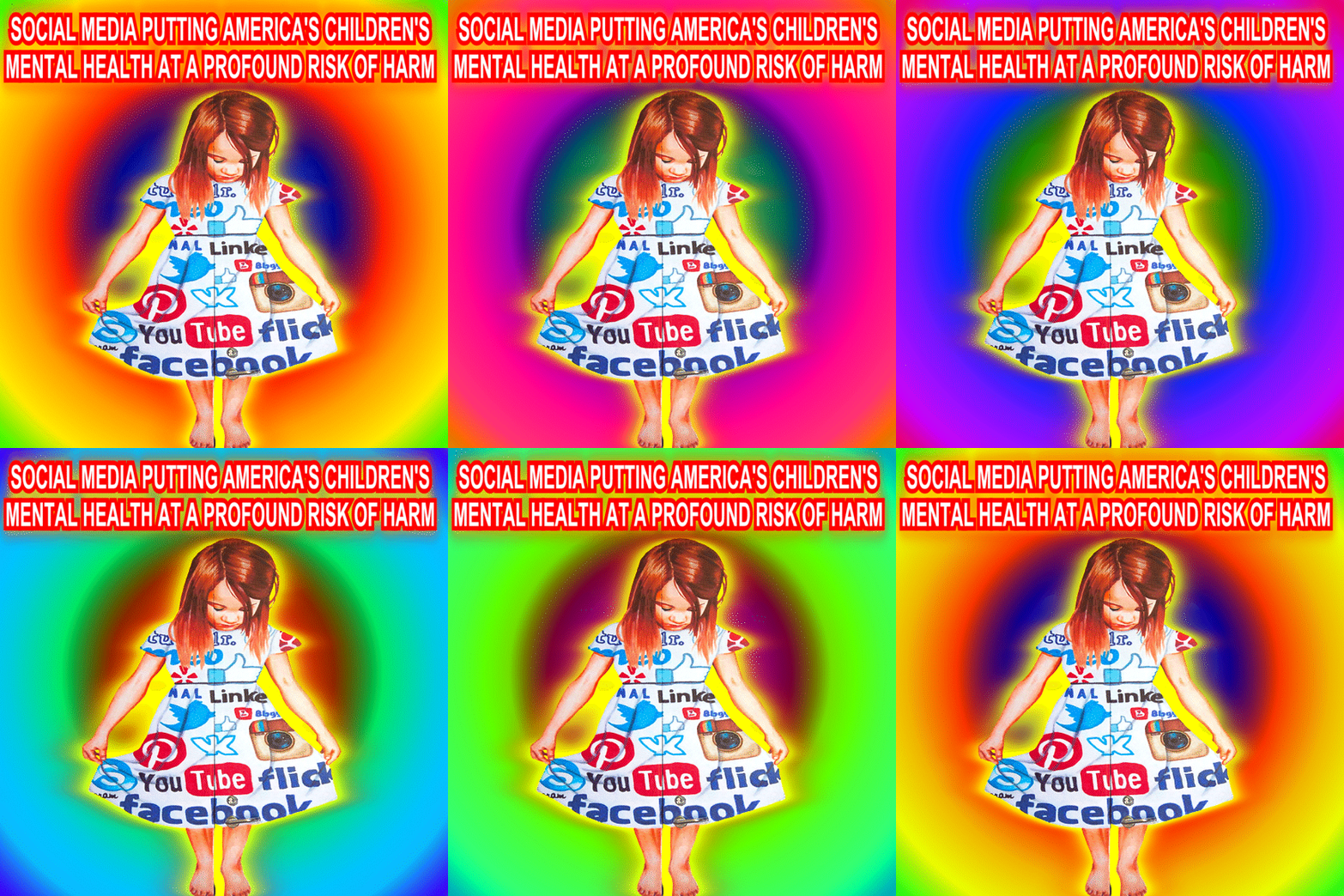
SOCIAL MEDIA PUTTING AMERICA'S CHILDREN'S MENTAL HEALTH AT A PROFOUND RISK OF HARM


SOCIAL MEDIA PUTTING AMERICA'S CHILDREN'S MENTAL HEALTH AT A PROFOUND RISK OF HARM

Social media has been a part of our lives for more than a decade now. It has revolutionized the way we communicate, interact, and share information. However, as with any new technology, there are risks associated with it. And according to the United States surgeon general, Vivek Murthy, social media can be a "profound risk of harm to the mental health and well-being of children."

Now, before you start deleting all your social media accounts, let's take a deep dive into what the surgeon general's advisory really means.

Firstly, it's important to note that this is the first time a surgeon general has issued an advisory warning about the risks of social media. This means that the issue is serious and needs to be addressed. The advisory cites research that suggests social media use can lead to depression, anxiety, sleep problems, and decreased self-esteem in young people. That's a lot of negative effects for something that is supposed to connect us.

But it's not just about mental health. Social media can also be a breeding ground for cyberbullying and other forms of online harassment. This is a serious issue, and one that needs to be addressed by social media companies. It's not enough to simply have policies in place; they need to be enforced and effective.

Another issue highlighted by the advisory is that social media can be addictive. This is something that we all know, but it's important to recognize that young people are particularly vulnerable to this. And when you're addicted to something, you're more likely to engage in risky behaviors such as sexting and substance abuse.

So, what can we do about this? The surgeon general's advisory calls for more research on the impact of social media on young people's mental health and well-being. It also calls for social media companies to take steps to protect young people from harm, such as developing more effective tools to prevent cyberbullying and providing more educational resources about the risks of social media use.

But we can't just rely on social media companies to fix the problem. As parents, educators, and policymakers, we need to take action too. Here are some tips on how to help young people use social media safely and responsibly:

1. Talk to your children about the risks of social media use. Don't just assume that they know what's safe and what's not.

2. Set limits on how much time your children can spend on social media. This will help prevent addiction and ensure that they're spending their time in more productive ways.

3. Monitor your children's social media activity. This doesn't mean spying on them, but rather being aware of what they're doing online and who they're interacting with.

4. Teach your children about cyberbullying and how to report it. Make sure they know that they can come to you if they ever feel threatened or harassed online.

5. Encourage your children to be critical of the information they see on social media. Not everything on the internet is true, and it's important to teach young people how to spot fake news and misinformation.

6. Help your children develop positive self-esteem. This is key to preventing the negative effects of social media on mental health.

In conclusion, social media can be a powerful force for good, but it can also be a powerful force for harm. It's up to all of us to ensure that young people are using social media in a way that is safe and beneficial. So, let's work together to make sure that the next generation is equipped with the knowledge and tools they need to navigate the digital world.

Social Media Can Be a ‘Profound Risk’ to Youth, Surgeon General Warns https://www.nytimes.com/2023/05/23/well/family/social-media-mental-health-surgeon-general.html?smid=tw-share


NEW COLLEGE OF MAGA FLORIDA: A.K.A. REDNECK U


NEW COLLEGE OF MAGA FLORIDA

A.K.A. REDNECK U

In a move that has left many scratching their heads, Florida Governor Ron DeSantis has appointed six conservative education leaders to the board of trustees of New College of Florida, a liberal arts college with fewer than 700 students in Sarasota. The move has been met with controversy, as many wonder whether DeSantis and his education hitman, Richard Corcoran, will stop before they completely destroy Florida public education.

Corcoran, who previously served as Florida's education commissioner under DeSantis, has made it clear that he intends to transform New College into a more conservative institution. In March, he announced that the college would be eliminating its diversity board, which was created in 2017 to promote diversity and inclusion on campus. This move has been met with resistance from students, faculty, and alumni alike.

But the changes at New College are just the tip of the iceberg. DeSantis has been on a mission to reshape the state's education system in recent years. He's signed legislation that restricts the teaching of critical race theory in schools, bans transgender students from competing in sports that align with their gender identity, and requires schools to notify parents if their child is discussing sexual orientation or gender identity in class.

It's enough to make you wonder whether DeSantis is stupid or evil. Or maybe both? One thing's for sure: his education agenda has been praised by some conservatives who see it as a way to protect children from what they view as harmful ideologies. But his critics argue that he's trying to indoctrinate children with his own political views.

It's hard to say what the future holds for New College and Florida public education as a whole. Will Corcoran be successful in transforming New College into a more conservative institution? Will DeSantis continue to push his agenda, or will he listen to the concerns of students and educators? Only time will tell.

In the meantime, we can't help but wonder: what's next? Will DeSantis ban books that he doesn't agree with? Will he require all students to wear MAGA hats to school? Will he replace all textbooks with copies of the Constitution and the Bible?

We can only hope that common sense prevails and that DeSantis and Corcoran realize that their actions have consequences. After all, education is the key to a better future. And if we don't invest in our children's education now, we'll be paying the price for years to come.

So let's all take a deep breath and hope for the best. And if things start to go off the rails, we can always move to Canada. They seem to have their act together when it comes to education. Plus, they have poutine. Who doesn't love poutine?

A DeSantis-appointed board made this college ground zero for his education agenda. In less than 6 months, the college eliminated its diversity board and will now accept a Christian-focused SAT-alternative from high schools in the state. https://news.yahoo.com/desantis-appointed-board-made-college-005837459.html?soc_src=social-sh&soc_trk=tw&tsrc=twtr via @YahooNews


COMMUNITY SCHOOLS BECAUSE CALIFORNIA STUDENTS ARE THE CENTER OF EVERYTHING WE DO


COMMUNITY SCHOOLS 

BECAUSE CALIFORNIA STUDENTS ARE THE CENTER OF EVERYTHING WE DO

As we look towards the future of California's public schools, it's time to embrace a new approach: community schools. Forget charter schools and private schools, it's time to focus on public funding for public schools that prioritize the needs of the whole child and the community as a whole.

The California Teachers Association (CTA) is leading the charge in this effort, advocating for community schools as the best way to ensure that all students have the opportunity to succeed. And let's face it, who wouldn't want that?

So what exactly is a community school? It's a school that partners with its community to provide a comprehensive set of supports for students, families, and the community as a whole. This includes academic enrichment, health and wellness services, social and emotional supports, and after-school programs. Basically, everything a student needs to thrive both in school and in life.

But don't just take our word for it. Research has shown that community schools improve student achievement, particularly for those from low-income families. They also increase student engagement by providing a variety of enrichment and extracurricular activities, and help to reduce dropout rates by providing students with the support they need to succeed in school.

But it's not just about the students. Community schools also help to strengthen families and communities by providing a variety of resources and services. And who doesn't want stronger families and communities?

So how can we make community schools a reality? CTA is advocating for increased funding for community schools, providing training and technical assistance to schools and communities interested in becoming community schools, partnering with community organizations to provide services to students and families, and raising awareness about the benefits of community schools.

It's time to reimagine California public schools and prioritize the needs of our students and communities. Let's work together to build a brighter future for all California students. As CTA believes, community schools are the key to that better future.


CTA and NEA are strong supporters of community schools, which are partnerships between schools and community resources that focus on academics, health, social services, leadership, and community engagement. This model has been proven to improve student learning, strengthen families, and promote healthier communities. 

David Goldberg, the Vice President of CTA, has made it clear that supporting the community school movement is a top priority for the organization. CTA and NEA are also advocating for more funding from both state and federal governments to support the Community Schools Model.

Community schools have been shown to foster lower rates of absenteeism, improved work habits, better grades and test scores, and higher graduation rates. Examples of community schools include the 93rd Street STEAM Academy in Los Angeles, Prescott School in Oakland, San Francisco Community School, and Dr. Martin Luther King, Jr. Academic Middle School.

The six pillars of community schools are adaptable to the unique needs of each individual school's students, staff, and families. By partnering with local resources and engaging with the community, community schools are able to provide a well-rounded education that prepares students for success both inside and outside of the classroom.

Community Schools - California Teachers Association https://www.cta.org/our-advocacy/issues/community-schools#:~:text=CTA%20Supports%20Community%20Schools%20Because,Center%20of%20Everything%20We%20Do&text=A%20community%20school%20is%20both,%2C%20leadership%2C%20and%20community%20engagement.