Latest News and Comment from Education

Saturday, May 25, 2019

Who Shows Up For Teachers? Coalition-Building In The Era Of Educator Activism | PopularResistance.Org

Who Shows Up For Teachers? Coalition-Building In The Era Of Educator Activism | PopularResistance.Org

WHO SHOWS UP FOR TEACHERS? COALITION-BUILDING IN THE ERA OF EDUCATOR ACTIVISM
The Enemies Of Public Education Are Organizing. It’s Time To Fight Back

This is a story of how I lost my glasses.
It’s OK—they were rose-colored anyway. Three years ago, I was a high school social studies teacher, content in my world. But that world was changing. Ten years of budget cuts were stressing Oklahoma education to the point of no return. I decided to run for office to try to do something about it.
I was amazed by the people who came out to support me, an ordinary teacher, and gratified when I won election to the statehouse. Friends and strangers came out to help me knock doors, hold events, and raise the dollars that are critical to competitive campaigns. I am humbled when I think of those volunteers and supporters.
But I was also puzzled by the absence of some I expected to see in the fight. In my head I had romantic notions about the coalition that would come out to support our schools: the legions of teachers, students, and parents who would fight for better education policies.
“Teachers have work to do—I have work to do—in gathering the kind of broad-based support we need to restore public education.”
The truth was much more mixed. Yes, teachers and their supporters came to the state capitol in the tens of thousands to protest for more education funding. Yes, I had the support I needed to win. But election 2018 actually strengthened the stranglehold of the GOP, under whose leadership education spending had declined 28 percent since 2008. In the statehouse, Democrats declined from 28 to 24 of 101 House seats.
Some of my seniors were angry that the walkout extended their school year by two weeks. I had given my seniors assignments over that period, to keep them ready for end-of-year exams. When I checked on their progress, one student replied: “I figured if you teachers weren’t going to work, I wasn’t going to work.” His contempt was palpable. Was that what he thought the walkout was about?
It seems the very people for whom we marched and campaigned were not always on board for our fight. In recent years we have seen students take CONTINUE READING: Who Shows Up For Teachers? Coalition-Building In The Era Of Educator Activism | PopularResistance.Org

In Defense of the SAT Adversity Score - The Atlantic

In Defense of the SAT Adversity Score - The Atlantic
An Imperfect SAT Adversity Score Is Better Than Just Ignoring Adversity
The College Board’s simple, straightforward indicator will make schools pay attention to the tough odds some applicants face.

Last week, the College Board announced a long-overdue innovation: It will try to put students’ SAT scores in context by providing colleges with an adversity measure that summarizes—on a scale of one to 100—the disadvantages that students suffer when they grow up in troubled neighborhoods and attend high-poverty schools.
But many in the chattering classes immediately pounced on the idea—some because the score does not explicitly take account of an applicant’s race and the particular challenges that may come with it, and others because they see it as a sneaky way of enshrining racial quotas. The adversity score’s wonkier critics faulted it for trying to reduce the complexities of a student’s circumstances—which could include a parent’s alcoholism or the premature death of a sibling—to a single number. A score based on school-wide or neighborhood-wide data, skeptics argued, could never accurately capture the gist of any one student’s life.
I have studied aspects of college admissions for decades. While the adversity measure was in development, I myself attended four meetings at the College Board to discuss the concept. I recommended, based on extensive research, that socioeconomic disadvantage be included at the family, neighborhood, and school levels. The College Board ended up using only the last two of the three.

Nevertheless, even an imperfect adversity score is better than failing to account for the difficulty so many students overcome. Research from Anthony Carnevale of Georgetown University has found that the most disadvantaged students, on average, score a whopping 784 points lower on the SAT (out of a CONTINUE READING: In Defense of the SAT Adversity Score - The Atlantic


State legislative wins bring fresh hope for students and educators + #RedForEd Rallies Step Up Pressure on Lawmakers to Take Action on Funding - Education Votes

State legislative wins bring fresh hope for students and educators - Education Votes

State legislative wins bring fresh hope for students and educators


By Amanda Menas and Amanda Litvinov
The conversation about public education is changing in statehouses across the country. The assumption that schools must operate in austerity—and that struggling schools should be punished—no longer prevails.
After more than a decade of deep education cuts and lagging teacher salaries, a renewed commitment to public schools is emerging. What’s changed? Some states elected more pro-public education legislators in 2018. The #RedForEd movement, and a series of polls showing public support for increased investment in public schools and teacher pay, made new and veteran legislators alike take notice.
As always, these state legislative wins also required the ongoing work of dedicated NEA leaders and members asking state lawmakers to stand up for public education, and do away with systems that label and threaten public schools.
Here are a few of those victories:

New Mexico

Educators and parents fighting to strengthen public education in New Mexico set the stage for progress by electing Gov. Michelle Lujan Grisham and more pro-public education members to the state legislature.  Only then could the failed policies of past administrations be changed during the 2019 legislative session. There were several enormous wins for public schools.
First, the legislature increased education funding by 16 percent, which will support an CONTINUE READING: State legislative wins bring fresh hope for students and educators - Education Votes

By Tim Walker
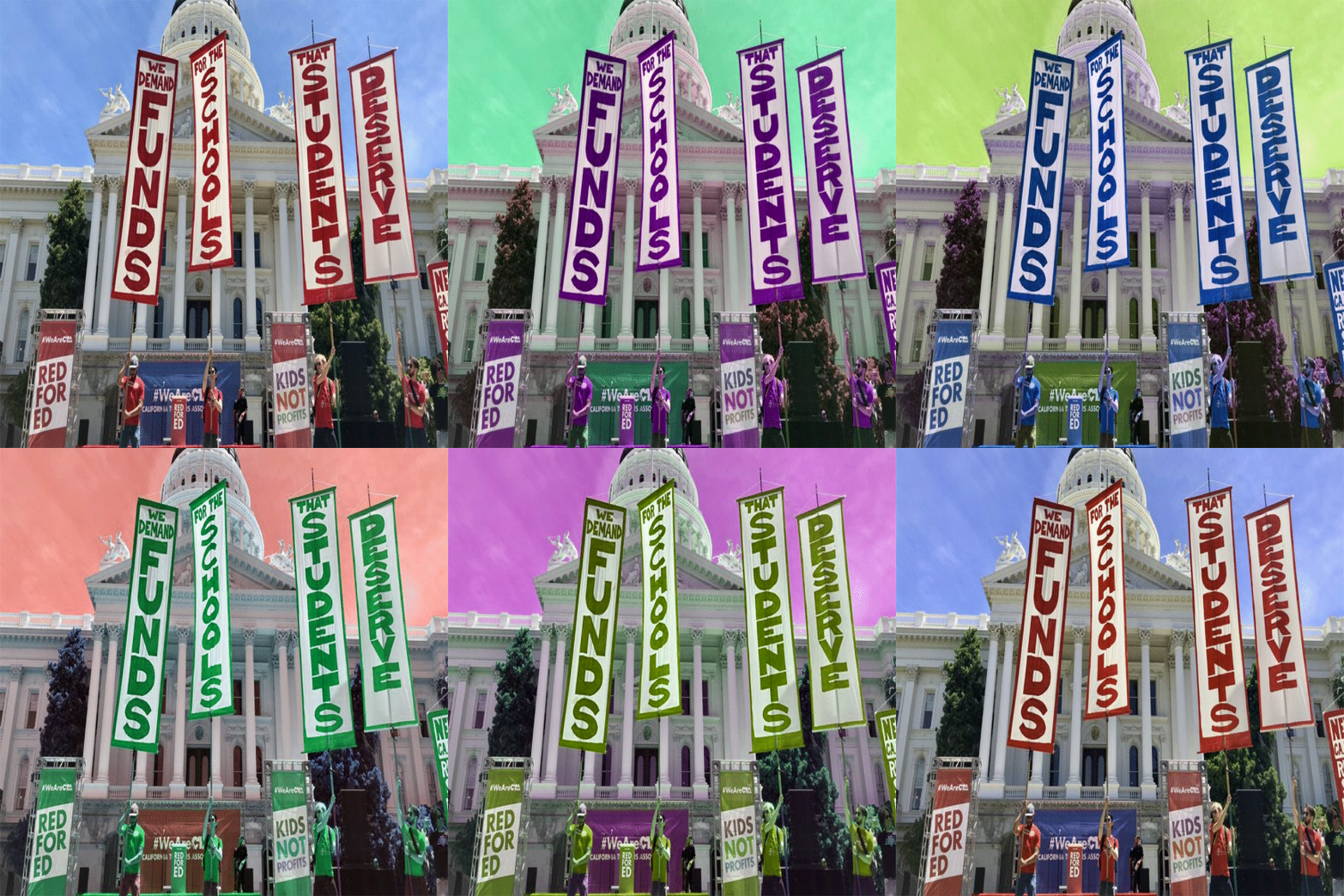
The #RedforEd movement played a huge role in motivating voters to go to the polls and support pro-public education candidates in the 2018 mid-terms. With hundreds of new lawmakers ensconced in statehouses across the country,  educators and their allies in 2019 transferred their energies from helping candidates get elected to making sure they supported legislation to dramatically increase education funding. In four states this week – California, Massachusetts, Minnesota, and Nevada –  as legislative sessions are winding down, activists ramped up the pressure on lawmakers to put an end to the era of austerity.

Minnesota

In a Day of Action organized by Education Minnesota, more than 400 educators from around the state converged on the Capitol Rotunda in St. Paul on May 17 to call for increased funding for their students. The legislature was in the last days of an end-of-session budget negotiation.
On this day at least, said Education Minnesota President Denise Specht, the halls of the Capitol were filled with individuals who knew better than anyone what their classrooms and schools needed.
“These people actually know the needs of students. They know their names. They know their families. They know the communities they go back to at the end of the day,” said Specht,. “It is educators like these who need to be heard in a building like this.”


School Funding in Mass: What Does Every Parent Need to Know? + Investing in Safe, Supportive and Police-Free Schools| Schott Foundation for Public Education

School Funding in Mass: What Does Every Parent Need to Know? | Schott Foundation for Public Education

School Funding in Mass: What Does Every Parent Need to Know?

Do your schools provide enough resources to students in your community? Do you ever wonder why some schools have more resources than others? How does funding in your school district work?
According to a 2015 bipartisan Foundation Budget Review Commission Report, Massachusetts schools are underfunded by $1 billion and $2 billion! So what is being done to solve this education crisis?
Join us as we talk to two state experts to understand the answers to these questions.
  • Colin Jones, Senior Policy Analyst, Massachusetts Budget and Policy Center
  • Tracy O'Connell Novick, Field Director, Massachusetts Association of School Committees
  • Marianna Islam (moderator), Director of Programs & Advocacy, Schott Foundation for Public Education

Investing in Safe, Supportive and Police-Free Schools


Black and Brown students are demanding that their school districts end the school-to-prison pipeline and invest in solutions that create a true sense of safety, dignity and opportunity for learning. They are advocating for schools that are sufficiently resourced, affirming of their identities, provide culturally responsive social and emotional learning, and offer mental health supports to students who need them. Students are also calling on school officials to decriminalize their learning environments from racially unjust policies and practices — including the removal of police from our schools.
Our speakers include:
  • Brittany Brathwaite, Organizing and Innovation Manager, Girls for Gender Equity
  • Tyler Whittenberg, Deputy Director, Advancement Project’s Ending the Schoolhouse-to-Jailhouse Track
  • Marianna Islam (moderator), Director of Programs & Advocacy, Schott Foundation for Public Education

Thousands of Charter Schools Perform Poorly | Dissident Voice

Thousands of Charter Schools Perform Poorly | Dissident Voice

Thousands of Charter Schools Perform Poorly


“Performance-based accountability” is a hackneyed, Skinnerian, neoliberal buzz-phrase often repeated dogmatically by charter school promoters in order to falsely claim that privately-operated nonprofit and for-profit charter schools are more accountable and higher-performing than public schools.
But it is becoming clearer to everyone with each passing day that charter school promoters have long vastly over-promised and under-delivered, while rapidly enriching themselves at the expense of students, parents, the public, the economy, and the national interest.
Extensive research, including research funded by billionaire charter school supporters, has consistently demonstrated that poor performance remains widespread in the scandal-ridden low-transparency charter school sector that intensifies segregation.
Year after year, thousands of privately-operated nonprofit and for-profit charter schools, which have been around nearly 30 years, deliver unimpressive results.
Not surprisingly, several thousand charter schools have failed and closed since 1991. At this time, about 150-200 charter schools close each year, leaving thousands of families—mostly African Americans and Latinx—betrayed and angry.
Below, in chronological order, is a tiny sample of the many studies exposing poor charter school performance in many states:
Many other studies could be cited. In addition, serious, reliable, and seasoned CONTINUE READING: Thousands of Charter Schools Perform Poorly | Dissident Voice

The 3% teacher salary cap. Can the IEA deliver on its main legislative agenda item? – Fred Klonsky

The 3% teacher salary cap. Can the IEA deliver on its main legislative agenda item? – Fred Klonsky

THE 3% TEACHER SALARY CAP. CAN THE IEA DELIVER ON ITS MAIN LEGISLATIVE AGENDA ITEM?
ep-141118612-1
Andy Manar’s bill dropped the repeal of the 3% salary cap.

The Illinois Education Association, which claims 130,000 members, has made the repeal of last year’s cap of 3% on pensionable raises its main legislative item. The General Assembly adjourns in a week with no repeal as of yet.
Last week the IEA delivered what they said was 55,000 signatures to the legislature supporting the repeal.
The back story is that Democratic Party legislative leaders (Madigan and Cullerton) slipped the salary cap into last years budget bill at the last moment. Years ago Madigan pushed and got a 6% cap, claiming teachers were getting a spike in salaries to increase our pensions. Capping salaries – which included extra compensation for non-teaching duties – was supposed to solve Madigan’s concern with teachers getting good pensions.
But at a time when there is justifiable concern for teacher shortages, Madigan and Cullerton reduced pensionable raises again last year to 3%.
No district in the state could agree to a raise for veteran teachers above 3% without paying an enormous penalty.
The concern for teacher shortages led this session of the Democratic Party controlled General Assembly to consider a bill with three components: Eliminate the state teaching licensure test. Allow pay for student teaching. Repeal the 3% salary cap.
The bill passed the Senate.
Last week it passed the House but without the repeal of the 3% salary cap.
The House version now goes back to the Senate for concurrence. That means House CONTINUE READING: The 3% teacher salary cap. Can the IEA deliver on its main legislative agenda item? – Fred Klonsky

As results of grade-fixing probe loom, five Kennedy High School administrators are “no longer employees,” board president says | The Lens

As results of grade-fixing probe loom, five Kennedy High School administrators are “no longer employees,” board president says | The Lens

As results of grade-fixing probe loom, five Kennedy High School administrators are “no longer employees,” board president says


Weeks after the resignation of New Beginnings Schools Foundation’s CEO amid a grade-inflation investigation, five administrators at John F. Kennedy High School are no longer employees of the network, according to the charter group’s board president.
In a letter to parents Friday afternoon, board President Raphael Gang wrote that an  investigation by the Adams and Reese law firm will be presented next week. Having promised transparency, he wrote, he wanted to inform families that the Gentilly high school’s principal and four other leadership team members were no longer employees.
“We were presented with strong evidence of improper conduct by members of our staff and we took decisive action,” Gang wrote. “As of today, the principal and four members of the JFK Leadership Team are no longer employees of NBSF.”
Released one week after Kennedy seniors wore blue and gold graduation regalia at Xavier’s Convocation Center, the letter alludes to potential ramifications for students.
“We are still going through the records of each of our students in detail,” Gang wrote. “We will CONTINUE READING: As results of grade-fixing probe loom, five Kennedy High School administrators are “no longer employees,” board president says | The Lens
Behind The Lens episode 33: ‘Sort of an elusive character’ | The Lens - https://thelensnola.org/?p=221217 on @thelensnola

Seattle Schools Community Forum: Looks Like Amplify May Be the Provider of Choice in SPS

Seattle Schools Community Forum: Looks Like Amplify May Be the Provider of Choice in SPS

Looks Like Amplify May Be the Provider of Choice in SPS


Sometimes you just can't make this stuff up.

I received a new group of public disclosure emails today.  They were not in any way related to Amplify and yet, there were two items about Amplify.  This was from the Assessment Development Program Manager, Shawn Cook.

In September 2015, principals were sent a notice to look for a "Beacon email" from Amplify.

"Please forward this and advise all teachers to look for this email. This is for ALL buildings, not just Amplify schools."

What was this about?


This year, the district is making Quick Checks within the Amplify Beacon assessment platform available to ALL schools in the district for grades 2-9. Quick Checks are short (5-7 questions) formative assessments aligned with standards. These Quick Checks are available for both reading and math and can be given at any time throughout the school year. 

Within the next week, all teachers who have rostered classes in PowerSchool for ELA and Math should receive an email directly from Amplify Beacon with their user name and temporary password. Please advise your teachers to look out for t his email (it will come from "mClasshome") and create their password as soon as possible. If they do not receive an email by Sept. 11, please have them email Amplify@seattleschools.org. and someone will promptly respond.

We will be sending out more information specific to Quick Checks (how to administer, how to score,etc.) directly via email within the next two weeks.
Anyone have their child take these assessments?  Any thoughts?

So Amplify is already well-established in SPS and if they have their Science CONTINUE READING: 
Seattle Schools Community Forum: Looks Like Amplify May Be the Provider of Choice in SPS

CURMUDGUCATION: PA: Free To Teach? Who Are These Guys?

CURMUDGUCATION: PA: Free To Teach? Who Are These Guys?

PA: Free To Teach? Who Are These Guys?


Once again, it's time for teachers in Pennsylvania to get a nice mass mailed postcard from our friends at Free To Teach, a group dedicated to reminding teachers that they don't have to belong to that stinky union. 

I took a look at these guys back in 2015, but as I look at the two postcards they sent to my home, I think it's time to revisit them. If you're a PA teacher wondering who these guys are, I can answer at least part of that question.

Free To Teach's front man used to be Matt Eason, a phys ed teacher down in the Philly area at Avon Grove schools (he also runs a first aid and CPR training company). His pitch was to call for "paycheck protection" and the death of fair share because he objected to being forced to join a union. He also pushed the usual misleading talking point that dues go to political purposes that he didn't support, an argument that depends on two notions; one, that dues pay for things like political support of candidates (they don't-- that's already illegal) and two, that everything a union does is political. 

I'm just going to liberate a couple of these guys before lunch
This time, the name on the postcard is Keith Williams. Like Eason, Williams was a real life teacher (English, Conewango Valley School District) for twenty-one years before he left in 2018 to become the director of Free To Teach. He's a graduate of Geneva College, and he also ran his own business consulting firm. And like Eason, he was upset that the union wanted them to give them his hard earned money. He even made the trip to Harrisburg in 2014 to argue against fair share and for paycheck protection . The argument here is that it costs the taxpayers big bucks to process deductions of union dues from teacher paychecks. This is a silly argument. Williams' CONTINUE READING: CURMUDGUCATION: PA: Free To Teach? Who Are These Guys?
No photo description available.

Pennsylvania: Those Disgraceful, Failing CyberCharters | Diane Ravitch's blog

Pennsylvania: Those Disgraceful, Failing CyberCharters | Diane Ravitch's blog

Pennsylvania: Those Disgraceful, Failing CyberCharters


I recommend that you get on the email list of the Keystone State Education Coalition if you want to know what is happening in Pennsylvania. Lawrence Feinberg posts informative articles about the schools of that state. You can contact him at lawrenceafeinberg@gmail.com.
One ongoing scandal in Pennsylvania is the story of cyber charters. Pennsylvania has 14 cyber charter schools, and 13 of them are on the state’s list of the lowest performing schools in the state. Cyber charters have low graduation rates, high attrition, and low scores. While Pennsylvania has many underfunded districts, the state is very generous with its failing cyber charters. From the years 2013-2016–four years–the state paid $1.6 Billion to these “schools.” In 2016 alone, the state handed out $454.7 million to cyber charters. All of that money is extracted from the budgets of public schools because the money follows the student, from good public schools to low-performing cyber charters. Most cyber charters are operated for profit. And they are very profitable! But not for their students.
Understand that the cyber charters receive full tuition for every student they enroll, even though they have none of the expenses of brick-and-mortar schools. No maintenance of grounds, no heating or cooling, no nurses, no library, no gym, no lunch room, no meals, etc. Yet they collect the same tuition as real schools. Their CONTINUE READING: Pennsylvania: Those Disgraceful, Failing CyberCharters | Diane Ravitch's blog


Why Streaming Kids According to Ability Is a Terrible Idea (Oscar Hedstrom) | Larry Cuban on School Reform and Classroom Practice

Why Streaming Kids According to Ability Is a Terrible Idea (Oscar Hedstrom) | Larry Cuban on School Reform and Classroom Practice

Why Streaming Kids According to Ability Is a Terrible Idea (Oscar Hedstrom)


Oscar Hedstrom is a secondary school teacher in Melbourne, [Australia]. He is interested in creative and critical thinking in education. This appeared in Aeon(no date).
Mixed-ability classes bore students, frustrate parents, and burn out teachers. The brightest will never summit Everest, and the laggers won’t enjoy the lovely stroll in the park they are perhaps more suited to. Individuals suffer at the demands of the collective, mediocrity prevails. In 2014, the UK Education Secretary called for streaming to be made compulsory. And as the former British prime minister David Cameron said in 2006: ‘I want to see it in every single school. Parents know it works. Teachers know it works.’ According to the Organisation for Economic Cooperation and Development, 98 per cent of Australian schools use some form of streaming.
Despite all this, there is limited empirical evidence to suggest that streaming results in better outcomes for students. Professor John Hattie, director of the Melbourne Education Research Institute, notes that ‘tracking has minimal effects on learning outcomes and profound negative equity effects’. Streaming significantly – and negatively – affects those students placed in the bottom sets. These students tend to have much higher representation of low socioeconomic backgrounds. Less significant is the small benefit for those lucky clever students in the higher sets. The overall result is relative inequality. The smart stay smart, and the dumb get dumber, further entrenching social disadvantage.
In the latest update of Hattie’s influential meta-analysis of factors influencing student achievement, one of the most significant factors – far more than reducing class size (effect: 0.21) or even providing feedback on student work (0.7) – is the teachers’ estimate of achievement (1.57). Streaming students by Why Streaming Kids According to Ability Is a Terrible Idea (Oscar Hedstrom) | Larry Cuban on School Reform and Classroom Practice

This Week With Larry Ferlazzo's Websites of the Day... | The latest news and resources in education since 2007

Larry Ferlazzo's Websites of the Day... | The latest news and resources in education since 2007


This Week With Larry Ferlazzo's Websites of the Day... 

 The latest news and resources in education since 2007


June 12th Would Be Anne Frank’s 90th Birthday – Here Are Related Teaching & Learning Resources
bernswaelz / Pixabay June 12th would be Anne Frank’s 90th birthday. You might be interested in The Best Sites To Learn About Anne Frank .
New Resources On Young People Organizing Around Climate Change
geralt / Pixabay Here are new additions to THE BEST RESOURCES ON TEENS DEMANDING AN EFFECTIVE RESPONSE TO CLIMATE CHANGE : School strike for climate: Protests staged around the world is from The BBC.
Guest Post: Working with adult English learners
Editor’s Note: I recently invited readers to contribute short posts about their experiences teaching adult English Language Learners. Many have responded – and there’s room for more! The first post was by Antoinette Perez. The second one was by Leighton Suen . Today’s post is by Coral Russell. Coral Russell has a Master’s in TESOL and has been teaching ELLs in the US, Korea, China, and Venezuela

YESTERDAY

Just Sent-Out Free Monthly Email Newsletter
geralt / Pixabay I’ve just mailed out the June issue of my very simple free monthly email newsletter . It has over 3,000 subscribers, and you can subscribe here . Of course, you can also join the eighteen thousand others who subscribe to this blog daily. Here Are 8 Ways You Can Subscribe For Free…
May’s “Best” Lists – There Are Now 2,040 Of Them!
Here’s my regular round-up of new “The Best…” lists I posted this month (you can see all 2,040 of them categorized here ): THE BEST IDEAS ON PEER REVIEW OF STUDENT WRITING UPDATED & REVISED: THE BEST ESL/EFL BLOGS – SHARE YOUR FAVORITES!
My Favorite Posts That Appeared In May
I regularly highlight my picks for the most useful posts for each month — not including “The Best…” lists. I also use some of them in a more extensive monthly newsletter I send-out. You can see older Best Posts of the Month at Websites Of The Month (more recent lists can be found here ). You can also see my all-time favorites here . I’ve also been doing “A Look Back” series reviewing old favorite
It’s World Oceans Day On June 8th – Here Are Teaching & Learning Resources
Claudia14 / Pixabay The United Nations has declared June 8th to be World Oceans Day . You might be interested in The Best Sites For Learning About The World’s Oceans .

MAY 23

May’s Most Popular Posts From This Blog
As regular readers know, at the end of each week I share the five most popular posts from the previous seven days. I thought people might find it interesting to see a list of the ten most popular posts from the previous thirty days. You might also be interested in IT’S THE TWELFTH ANNIVERSARY OF THIS BLOG – HERE ARE THE FORTY ALL-TIME MOST POPULAR POSTS. Not to mention THE TWENTY MOST POPULAR POS
World Refugee Day Is On June 20th – Here Are A Ton Of Teaching & Learning Resources
GDJ / Pixabay The United Nations has declared June 20th to be World Refugee Day . You might be interested in The Best Sites For Learning About World Refugee Day .
Intriguing Video: “1838-2019: Street Photography – A Photo For Every Year”
PublicDomainPictures / Pixabay This is an intriguing video that shows a streetscape image taken every year since the beginning of photography. It’s long, but I’m thinking that even just showing a portion of it could be a useful exercise with English Language Learners to have them identify common and unique characteristics….
New Study Finds That Thinking We Might Know Something, But Then Discovering We Don’t, Is Most Motivating Type Of Curiosity
There’s been a lot of interest in the role curiosity plays in learning (see The Best Posts On Curiosity ). A new study has come out suggesting that a particular type of curiosity is the most motivating for learning. The research (see What we think we know — but might not — pushes us to learn more ) suggests that the key is creating situations where students think they know something and then disc
Here Are Covers For The Three Books We’re Editing: Math, Science & Social Studies
The most recent book that Katie Hull and I wrote, The ELL Teacher’s Toolbox (click on its book cover at the bottom of this post for more info), has become very popular. In fact, it became so popular and useful to teachers immediately after its publication last year that we proposed to Jossey-Bass that it be used as a template for a series of books in each academic subject area to help teachers of
See What Animals See With This New Tool
AmnaS / Pixabay How animals view the world is a new tool from LensBest that lets you see how various animals see the world, and explains why that’s the case. You can choose the experience of a dog, cat, snail or bee. I’m adding it to The Best Sites For Walking In Someone Else’s Shoes .

MAY 22

New Video From TIME: “Here Are The Best Commencement Speeches Of 2019:
mmi9 / Pixabay I’m adding this new video from TIME to The Best Commencement Speeches:
Hot Off The Press! The Most Up-To-Date Statistics On English Language Learners In The U.S.
Every year I share the annual Condition of Education report from The National Center For Education Statistics. They’re always about two-and-a-half years behind the present-day, but it also always presents the most accurate date about ed that you’re going to find anyway. They have just released The Condition of Education 2019. Here are some charts and graphs related to English Language Learners th
New NPR Video: “Telepathy Is Already Possible With a Brain-Computer Interface”
ElisaRiva / Pixabay Here’s a new video from NPR that’s pretty mind-blowing. I’m adding it to The Best “Mind-Blowing” Videos About Technology That I’ve Seen — Help Me Find More .
“What Are the Best Ways to Handle Group Work in Class?”
What Are the Best Ways to Handle Group Work in Class? is the new question-of-the-week at my Education Week Teacher column. Feel free to leave responses in the comments sections there or here….
This Week Is The 100th Anniversary Of The House Passing The 19th Amendment – Here Are Related Resources
Wokandapix / Pixabay Though the 19th Amendment, guaranteeing a woman’s right to vote, was actually added to the Constitution until 1920, this week marks the 100th anniversary of the House of Representatives passing it . You might be interested in The Best Resources For Learning About Women’s Suffrage . On this day in 1919, the US House approved the 19th amendment – giving women the right to vote.
It’s Time For Commencement Speeches – Here Are The Best Ones
greymatters / Pixabay It’s graduation time, which means it’s also time for commencement speeches. Obviously, this year the one that is getting the most attention is Robert F. Smith’s one at Morehouse . You might be interested in checking out The Best Commencement Speeches .

MAY 21

Most Popular Posts Of The Week
I’m making a change in the content of the regular feature. In addition to sharing the top five posts that have received the most “hits” in the preceding seven days (though they may have originally been published on an earlier date), I will also include the top five posts that have actually appeared in the past week. Often, these are different posts. You might also be interested in IT’S THE TWELFT
New TED-Ed Video: “Can you spot the problem with these headlines?”
PublicDomainPictures / Pixabay The new TED-Ed video is an intriguing one. It’s designed to show how the media can incorrectly report the findings of medical research. It explains three scientific studies – one at a time – and then shows a headline from a news story about it. You’re supposed to then pause the video and figure out why the headline is incorrect based on your understanding of the res
Today Is “World Day for Cultural Diversity” – Here Are Related Teaching & Learning Resources
truthseeker08 / Pixabay The United Nations has declared today to be the World Day for Cultural Diversity for Dialogue and Development . You might be interested in: The Best Sites For Learning About The World’s Different Cultures The Best Resources About “Culturally Responsive Teaching” & “Culturally Sustaining Pedagogy” – Please Share More! The Best Posts On The Value Of Ethnic Studies Classes –
“A ‘Trauma-Informed Classroom Is a Safe and Secure Place'”
A ‘Trauma-Informed Classroom Is a Safe and Secure Place’ is the headline of my latest Education Week Teacher column. In it, Rita Platt, guest-host for this series on trauma-informed teaching, continues the conversation with her own response, along with contibutions from Beth Parson Stauner, Robert Ward, Amber Chandler and Kelly Knoche. Here are some excerpts: I’m adding it to The Best Ways For Re
Around The Web In ESL/EFL/ELL
BiljaST / Pixabay Five years ago I began this regular feature where I share a few posts and resources from around the Web related to ESL/EFL or to language in general that have caught my attention. You might also be interested in The Best Resources, Articles & Blog Posts For Teachers Of ELLs In 2018 – So Far and THE BEST RESOURCES, ARTICLES & BLOG POSTS FOR TEACHERS OF ELLS IN 2018 – PART TWO . A

MAY 20

SEL Weekly Update
I’ve recently begun this weekly post where I’ll be sharing resources I’m adding to The Best Social Emotional Learning (SEL) Resources or other related “Best” lists. You might also be interested in The Best Social Emotional Learning Resources Of 2018 – So Far. Finally, check out “Best” Lists Of The Week: Social Emotional Learning Resources . Here are this week’s picks: Nurturing a Culture of Growt
May 31st Is World No Tobacco Day – Here Are Related Teaching & Learning Resources
The United Nations has declared May 31st to be World No Tobacco Day . You might be interested in The Best Sites For ELL’s To Learn About The Dangers Of Smoking .
The Dangers – & Positive Possibilities – Of History Simulations
I’ve previously shared many resources related to simulations (see The Best Places To Read & Write “Choose Your Own Adventure” Stories and The Best Online Learning Simulation Games & Interactives — Help Me Find More) , as well as critiques of some (see THE DANGERS OF “CHOOSE YOUR OWN ADVENTURE” GENRE FOR REAL & PAINFUL STORIES , A Marine’s Reaction to a Children’s Book Prompts an Apology From the
“Strategies for ‘Trauma-Informed Teaching'”
Strategies for ‘Trauma-Informed Teaching’ is the headline of my latest Education Week Teacher column. Rita Platt guest-hosts this post on trauma-informed teaching with contributions from Dr. Christy Wolfe,Jason Harelson, Chris Weber, and Jenny Grant Rankin, Ph.D. Here are some excerpts:

MAY 19

Classroom Instruction Resources Of The Week
Each week, I publish a post or two containing three or four particularly useful resources on classroom instruction, and you can see them all here. You might also be interested in THE BEST RESOURCES ON CLASS INSTRUCTION IN 2018 – PART TWO. Here are this week’s picks: Fighting Words: Poetry in Response to Current Events [Contest and Workshop] is an intriguing use of poetry from The Pulitzer Center.
Does Anyone Using “Interleaving” When Teaching ELLs? If So, I’d Love To Hear What You DO
OpenClipart-Vectors / Pixabay A simple definition of interleaving is strategically alternating studying/teaching different skills, as opposed to “blocking,” which is focusing on one skill at a time. Scientific American has an accessible article about it titled The Interleaving Effect: Mixing It Up Boosts Learning . A new study just came out claiming HUGE benefits to using it in math class, and I’
Malcolm X Would Have Been 94 Today – Here Are Related Teaching Resources
WikiImages / Pixabay Malcolm X would have been 94 years-old today. You might be interested in The Best Resources For Learning & Teaching About Malcolm X . Brother Malcolm would have been 94 years-old today. We remember him, his legacy and his family. #MalcolmX pic.twitter.com/MILW8GNEsM — The King Center (@TheKingCenter) May 19, 2019 Happy Birthday to el-Hajj Malik el-Shabazz, better known as Mal
Guest Post: Representation In Media Matters, But What Kind Of Representation?
Editor’s Note: I recently invited readers to contribute short posts about their experiences teaching adult English Language Learners. Many have responded – and there’s room for more! The first post was by Antoinette Perez. Today’s post is by Leighton Suen. Leighton Suen is finishing his 3rd year as a dual-licensed ENL/ELA teacher at Franklin D. Roosevelt High School in Brooklyn, NY. He has taught
Sing About Injustice With “No Te Calles” (“Don’t Shut Up”)
OpenClipart-Vectors / Pixabay “No Te Calles” is a new song from the group Making Movies and Ruben Blades encouraging people, particularly Latinos, to fight against injustice. In addition, they’ve created a website where anyone can sing a verse about an injustice and post it on the site in video/audio or just audio form. Yes, I know this could potentially be tricky politically for some teachers, b
“Author Interview: Enhancing the ‘Mental Bandwidth’ of Students”
Author Interview: Enhancing the ‘Mental Bandwidth’ of Students is the headline of my latest Education Week Teacher column. It’s Part Two of an interview with Cia Verschelden about her book, “Bandwidth Recovery: Helping Students Reclaim Cognitive Resources Lost to Poverty, Racism and Social Marginalization.” Here are some excerpts: I’m adding it to The Best Resources Showing Social Emotional Learn

MAY 17

Around The Web In ESL/EFL/ELL
BiljaST / Pixabay Five years ago I began this regular feature where I share a few posts and resources from around the Web related to ESL/EFL or to language in general that have caught my attention. You might also be interested in The Best Resources, Articles & Blog Posts For Teachers Of ELLs In 2018 – So Far and THE BEST RESOURCES, ARTICLES & BLOG POSTS FOR TEACHERS OF ELLS IN 2018 – PART TWO . A
“Author Interview: ‘Helping Students Reclaim Cognitive Resources’ Lost to Poverty and Racism”
Author Interview: ‘Helping Students Reclaim Cognitive Resources’ Lost to Poverty and Racism is the headline of my latest column in Education Week Teacher. In it, Cia Verschelden agreed to answer a few questions about her 


Larry Ferlazzo's Websites of the Day... | The latest news and resources in education since 2007